Kirsten Hassenfeld

Dans La Lune 2007 photo by Nash Baker

Dans La Lune 2007 photo by Nash Baker

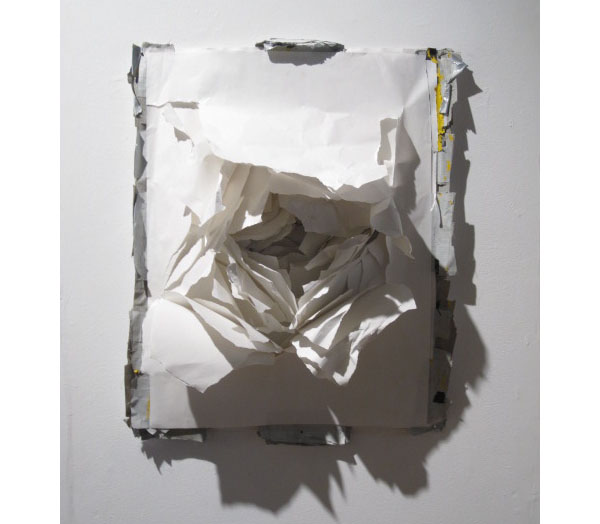
Kirsten Hassenfeld‘s ambitious paper sculptures far exceed what most would imagine could be created with the material at hand. A legion of delicate intricacies store like gems in the chest of treasure that is each piece she produces. The results of presumably painstaking hours spent folding, snipping, coiling and chaining, Hassenfeld’s sculptures are as elaborate as they are elegant. Recently, two of her bodies of work–Blueware and Dans la Lune–were on view at Brown University‘s David Winton Bell Gallery. The new series, Blueware, focuses on embodiments of nature, and both the Eastern and Western traditions of decorative arts. Meanwhile, Dans la Lune, which was a highly celebrated installation first exhibited at the Rice Art Gallery in Houston, Texas in 2007, thrills the senses with its ornate ceiling hung sculptures. The work glows with light from within and bathes in its own projection of baroque shadows.

Dans La Lune (detail) 2007 photo by Nash Baker

Dans La Lune (detail) 2007 photo by Nash Baker

Kirsten Hassenfeld lives and works in Brooklyn, New York. She received her MFA from the University of Arizona, Tuscon and her BFA from the Rhode Island School of Design, Providence. Her work has been exhibited extensively, including at: Bellwether, New York, NY; The Hudson River Museum, Yonkers, NY; Massachusetts College of Art, Boston, MA; P.S.1 Contemporary Art Center, Long Island City, NY; Phillips de Pury, New York, NY; The Brooklyn Museum of Art, Brooklyn, NY and White Columns, New York, NY. She is a 2006 recipient of the Pollock-Krasner Foundation Grant.

Share

Faris McReynolds

Faris-McReynolds_It'sNoJour

Courtesy of Roberts & Tilton, Culver City, CA

The Primitive Electric, Faris McReynolds’s fourth exhibition at Roberts & Tilton in Los Angeles, CA, spurs a compelling conversation between divergent painting styles and assorted perspectives. While he explores social commentaries, McReynolds’s paint application varies in thickness and sensitivity.  Overall, the exhibit attests to the difficulty involved in reconciling society’s ever expanding attitudes and perspectives on popular culture.

In paintings like Speedway, McReynolds uses broad, gestural strokes to describe figures in various throws of action.  He works with a sense of immediacy; his style reminiscent of artists Willem De Kooning and Richard Diebenkorn of the Abstract Expressionist and Bay Area Figurative movements.  Colors resonate, contrasting both in tonality and hue, aiding the flagrant figures’ substantial mass. In these paintings, McReynolds composes panoptic scenes–particularly crude stills from popular culture.  In The Leaving Party, a crowd is crammed onto the platform of a military type vehicle that flees a chaotic, burning backdrop.  One of the main subjects joyously waives a pink and purple striped necktie like a flag while another is victoriously thrusting up a human head.

Courtesy of Roberts & Tilton, Culver City, CA

Courtesy of Roberts & Tilton, Culver City, CA

Conversely, McReynolds’s mixed media pieces, such as It’s No Journey and A World of Reflections are more subtle and softened, lending to a contemplative mood.  The subjects of these cinematic portraits portray emotions that range from disappointment and depression to sheer psychosis.  One can imagine the characters are undergoing a complex set of reactions, perhaps shocked and dismayed by the vulgarities represented in his more expressionistic works.  In other portraits, such as Water Mirror, McReynolds slices up facial features, aggressively distorting the face with impasto, palette knife marks.  Viewers could deduct that the multiple portions of flesh, eyes, nose, and mouth are a metaphor for the complexities involved in seeing various viewpoints at once.

McReynolds was born in Dallas, Texas in 1977 and received his BFA from Otis College of Art and Design in 2000.  He now lives in Los Angeles, showing his work both nationally and internationally at Goff & Rosenthal in Berlin, Gallery Min Min in Tokyo, and the Tim Van Laere Gallery in Antwerp.   The Primitive Electric is on display at Roberts & Tilton until November 14th, 2009.

Share

Bessma Khalaf

Khalaf

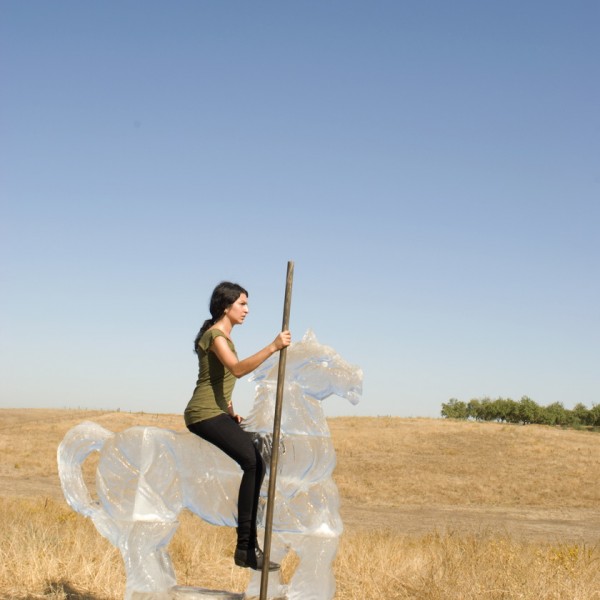
Now showing at Steven Wolf Fine Arts Gallery in San Francisco is Bessma Khalaf’s exhibition, You’re Not There. The show is comprised of five pieces: three individual video installations and two works that reference them. In Projection (2009), the viewer is lured into a lackadaisical daze by warm and fuzzy landscape imagery, only to be immediately jolted back out of it as a fist punches through the screen from the other side. In Monument (2009), the artist films herself sitting atop an ice sculpture in the shape of a horse, maintaining a hero pose as it melts under the California sun. Monument serves as the main illustration of Khalaf’s oeuvre and her negotiation of the space between the culture from which she originates from and her adopted one. Within this undefined region, Khalaf explores a variety of themes and issues along the way such as military exaltation, American consumerism, global warming, industrial pollution, identity politics and the spirit world. Nothing is taken for granted as she searches for understanding using her dual heritage as her lens.

Khalaf-2

Bessma Khalaf was born in 1978 in Baghdad, Iraq and moved to San Diego, California just before the first Gulf War. She received her MFA in Photography from the California College of Art in 2007 and has exhibited in multiple galleries around the Bay Area including Ping Pong Gallery and Arts Benicia Gallery. This is her first one-person exhibition at Steven Wolf Fine Arts. Khalaf currently lives and works in the San Francisco Bay Area.

Share

Jeff Carter

Jeff Carter
Since the mid-90s, artist Jeff Carter has traveled extensively throughout India, Sri Lanka, Indonesia and China. These travels have caused the artist to focus much of his attention on the idea of contemporary tourism and the implications of meaning that time and distance have on objects of travel, such as souvenirs and snapshots. Often, the artist will work directly from memory, recreating objects to investigate how experience is determined by the memory of the act. Carter’s work negotiates space as a first-time viewer and as an intimately connected local. A sense of nostalgia and longing from the absence of a particular place is found in the artist’s work, underscoring the physical and emotional effects of traveling. For his previous series of work, the artist has used Modified IKEA objects to create sculptures and small installations.

Carter received his MFA from the School of the Art Institute of Chicago (1998) and his BFA from the University of Colorado at Boulder. The artist has received many awards, including a fellowship award for visual arts from the Illinois Arts Council in Chicago and an ArtCouncil Grant in San Francisco. Previous exhibitions include System at Kavi Gupta Gallery in Leipzig, Germany and a self-titled exhibition at the Spencer Brownstone Gallery in New York.

Share

Heartland

Scott Hocking

Scott Hocking

Throughout the vast interior of the United States, contemporary artists are responding to the world around them and reshaping it in unexpected ways. Organized by the Smart Museum of Art and the Van Abbemuseum, one of Europe’s premier contemporary art institutions, Heartland offers an idiosyncratic look at the innovative forms of artistic creation taking place in the American Heartland.

Heartland features site-specific installations and performances as well as drawing, photography, and video by artists and artist groups who are working in—and in response to—Detroit, Kansas City, and other cities and rural communities across the region. The exhibition premieres new commissions and presents recent works by Carnal Torpor, Compass Group, Cody Critcheloe, Jeremiah Day, Detroit Tree of Heaven Woodshop, Design 99, Scott Hocking, Kerry James Marshall, Greely Myatt, Marjetica Potrč, Julika Rudelius, Artur Silva, Deb Sokolow, and Whoop Dee Doo.

Deb Sokolw

Deb Sokolow

In 2007 and 2008, the Heartland curators, eschewing traditional research methods, set out on a series of old-fashioned road trips through the vast center of the United States. These research trips informed two distinct exhibitions. The first presentation, which opened in October 2008 at the Van Abbemuseum in the Netherlands, sought to uncover new ways of thinking about the American interior during the U.S. presidential election and gave European audiences access to a broad survey of the Heartland’s culture, art, and music. The second, reconceived presentation at the Smart Museum, offers U.S. audiences a more focused look at the ideals of resourcefulness and invention that permeate the Heartland. Together, the two presentations offer a richly layered reading of a region that has too often been overlooked.

Share

Bill Viola: Bodies of Light

bill viola

Internationally acclaimed American artist Bill Viola has worked with video for over 35 years, creating immersive installations that surround the viewer with image and sound.  Driven by interests in sense perception, collective memory, subjective thought, and the universality of the human experience, Viola has produced videotapes, architectural video installations, and flat panel video pieces, as well as works for television broadcast.  His practice, stunning in its scope and technological sophistication, has greatly expanded the breadth of the medium and has helped to solidify video as a viable form of contemporary art.  His current exhibition at James Cohan Gallery in New York, Bodies of Light, which opened on October 23rd, includes a large video/sound installation as well as several flat screen pieces from the Transfigurations series, his most recent body of work.

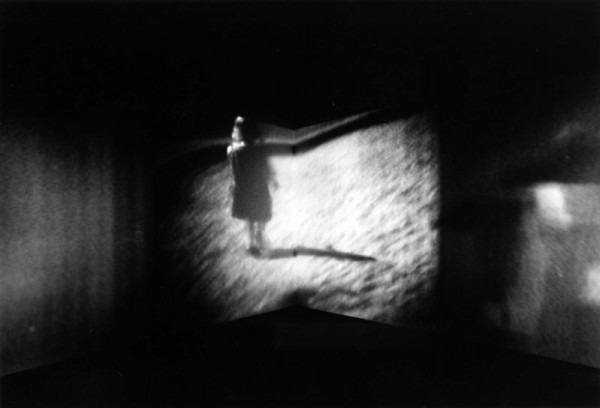
Pneuma, one of Viola’s signature full room installations, is situated in the main gallery space at James Cohan.  Bodies of Light marks the New York premiere of the piece, which was originally created in 1994 and updated in 2009.  Pneuma consists of three channels of black and white High-Definition video projected into three corners of a square space, accompanied by three channels of amplified sound, resulting in a constantly shifting sound field.  In the darkened room, viewers encounter monochromatic images that alternately emerge and disappear from the projection space.  These images do not refer to any particular place or event, but function like memory and only allude to recognizable forms, triggering emotional response within the viewer.  The title of the work, pneuma, is an ancient Greek term that has no modern linguistic equivalent.  It refers to a vital force that animates the human and natural world.

bill viola
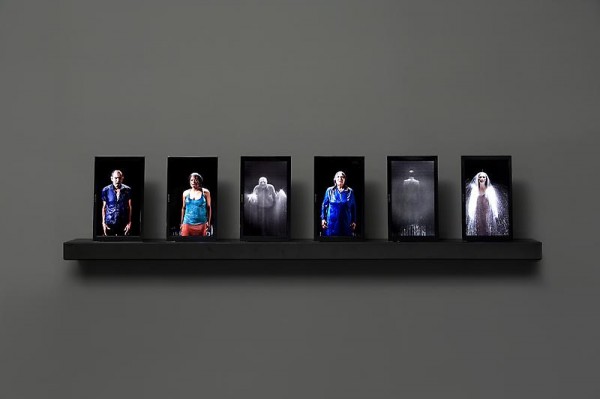
The Transfigurations series originated with Ocean Without a Shore, a piece created for the 2007 Venice Biennale where it was shown in the 15th century Church of San Gallo.  The works in the series depict mysterious black-and-white figures, recorded in grainy analog video, emerging from complete darkness to walk through a thin veil of water into a realm of clarity, color, and light.  Images recorded with an old surveillance camera slowly blend into those shot in High-Definition as the figures pass through the water screen.  The works being shown from this series are Acceptance (2008), Incarnation (2008), The Innocents (2008), and Small Saints (2008).

Viola’s works have been exhibited worldwide and are included in the collections of several international museums and important private collectors.  In 1997, the Whitney Museum of American Art organized Bill Viola: A 25-Year Survey that included over 35 installations and videotapes and traveled for two years in the United States and Europe.

Bodies of Light will remain at James Cohan in New York until December 19, 2009.

Share

The Pop of Colors

Clark Goolsby

Clark Goolsby

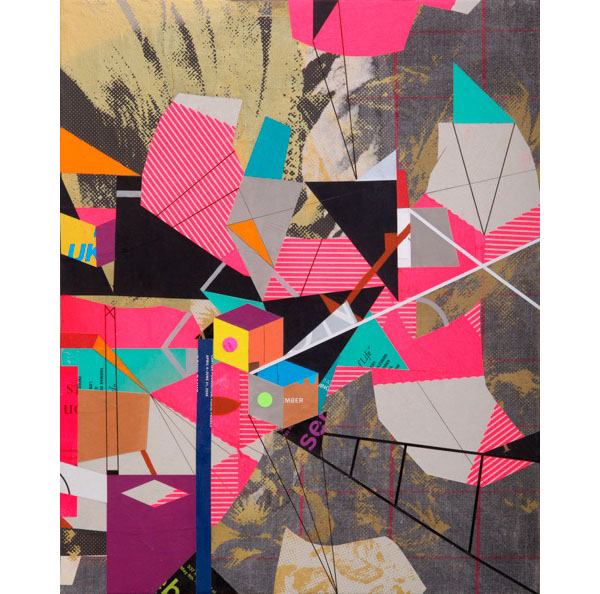
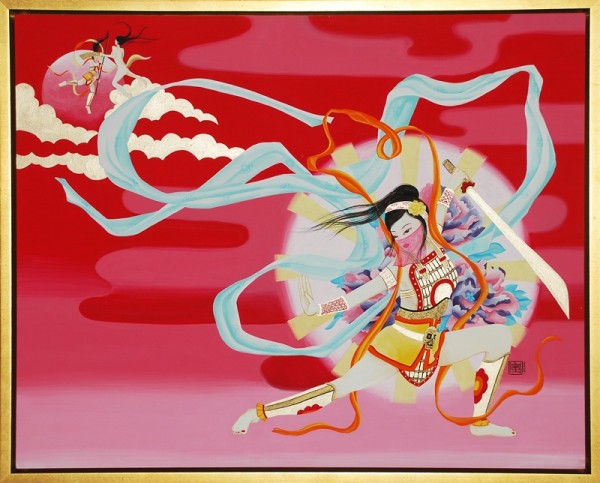
Currently on view at POV Evolving Gallery in Chinatown, Los Angeles is the group exhibition, The Pop of Colors. Curated by Yasmine Mohseni, the show features original pieces by artists whose work historically samples from the “Pop Art” color wheel, whether the vivid hues play central or supporting roles in the overall aesthetic. The artists exhibited include: former Daily Serving interviewees Amir H. Fallah and Stella Lai, DailyServing featured artists Mark Schoening and Mike Swaney, as well as Clark Goolsby, Jessalyn Haggenjos, Jason Redwood.

Stella Lai

Stella Lai

When Los Angeles-based Stella Lai talked to me about the process of creating original work for the exhibition, she noted, “Yasmine came up with the show title and when she first told me I thought it was a great idea to use color to connect all of the artists. My works fits right in without having to change my approach” and her work on view reflects this sentiment, as the bold color use organically intertwines with depictions of fantastical, ivory skinned and dark haired women.

Amir Fallah

Amir Fallah

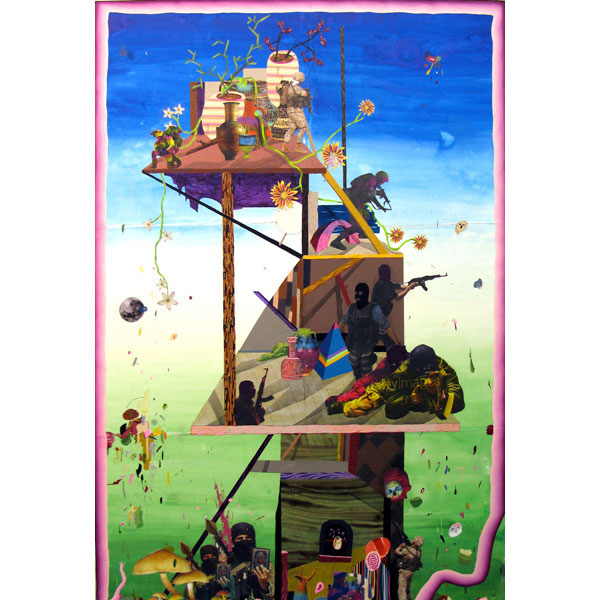
Amir H. Fallah presents another of his bright, fort-like structures, evoking whimsy in the same way previous site-specific incarnations have elsewhere. Meanwhile his collaged paintings on view, such as Terror Terror Terror, rouse a more heavy-hearted response, confronting viewers with the themes of global ethnic relations and fear, and proving that the use of hot pink and neon green in art does not have to necessarily correspond with blithe subject matter.

Share