for the time being

BenjaminBellas

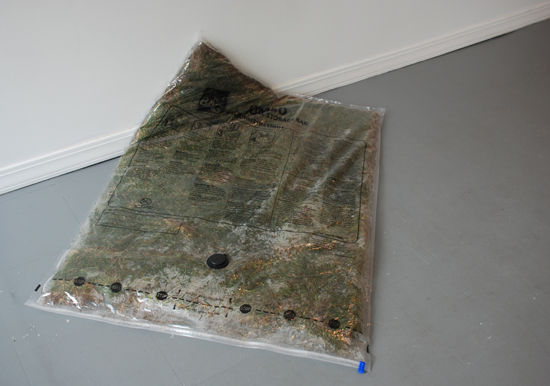
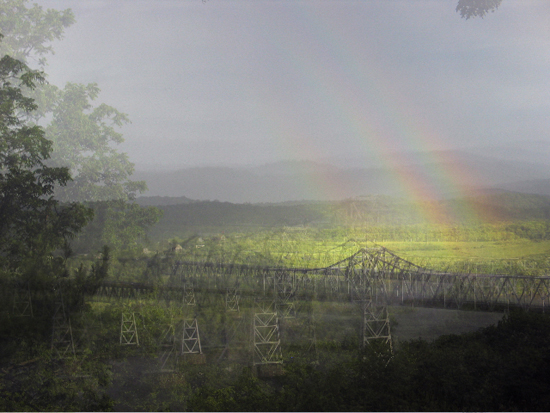
A new Chicago alternative space named Slow, which opened its doors to the public this fall, is presenting the exhibition for the time being featuring new work by Chicago-based artists Benjamin Bellas and C.C. Ann Chen. Artist Benjamin Bellas creates work that connects philosophy, music, language, literature and visual art through the combined media of performance, video and sculpture. Often the work is object-based and becomes activated and complete only through the accompanying text. For this exhibition, one of Bellas’ projects consists of an 11 square foot section of the Pritzker Pavilion Great Lawn from Millenium Park vacuum sealed in a space bag and left to expand. The associated text poetically discusses the relationship between civilization and the land through the eyes of Bellas’ personal interactions. Artist C.C. Ann Chen works through painting, drawing and photography to examine the broad concept of space, both in urban and natural environments.  The artist will focus on universal events in the natural landscape, creating drawings and paintings from memory in an attempt to recreate these observations.

C.C. Ann Chen

Both artists attended and currently teach at the School of the Art Institute of Chicago. Before attending SAIC, C. C. Ann Chen received her BA in Architectural History from the University of Maryland and Bellas received his BA from the University of Pittsburgh. The works in for the time being can be viewed at Slow each Saturday from 12-5pm.

Share

Moby Dick

MobyDick_upstairs-45

The Great American Novel, Moby Dick, takes on new life at the exhibition of the same name currently showing at California College of the Arts’s Wattis Institute. The exhibition loosely traces the narrative of the epic (and episodic) tale with each of the three galleries dedicated to the story’s protagonists, Ishmeal, Ahab, and of course, the White Whale, Moby Dick. Thirty-three artists ranging from the established to emerging are exhibited, and a large number consist of specially commissioned works that reflect the artist’s own interpretation of the Herman Melville classic. Among the highlights are Marcel Broodthaers, Felix Gonzalez-Torres, Buster Keaton, Richard Serra, Hiroshi Sugimoto, and even Orson Welles. A room-sized replica of the sperm whale has been executed by artist Andreas Slominski, and though a commissioned work (size, scale, and the dried, crumbling, clay material reveal this) Slominski’s interpretation of the harpoons which brought down the White Whale demonstrates his imaginative personal iteration of the novel’s denouement. Also of considerable interest is an eight-foot salt tower by Mexican artist Damian Ortega. Thick, crystal-white salt was rammed into a narrow, rectangular tower made of plywood. The wood was removed, leaving the salt tower to crumble to the gallery floor, an unplanned but satisfyingly rich effect.

MobyDick_downstairs-31(2)

The exhibition lay-out is perhaps the most striking part about the show, and it alludes to an atmospheric environment—with walls painted a nautical navy blue and the works hung low at what curator, Jens Hoffman, calculates to be the difference in sea level between the port of New Bedford, Massachusetts and the water level at the exhibition’s home in San Francisco, California. A fully-loaded voyage through historic artifacts, fresh art works, and this classic American tale is an experience worth staying on board for. Moby Dick will be on display until December 12, 2009.

Share

From the DS Archives: Luis Gispert

Originally published on: May 28th, 2009

Luis Gispert recently debuted an exhibition at Otero Plassart gallery in Los Angeles. Gispert’s work is inspired by the idiosyncrasies of pop culture, urban life, cinematic technique, car culture, the uncanny and the poetics of transformation. In his latest show, Gispert explores these conceptual frameworks through the media of three large chromogenic prints and a a stunning, 26 minute short film entitled Smother.

Gispert-1.jpg

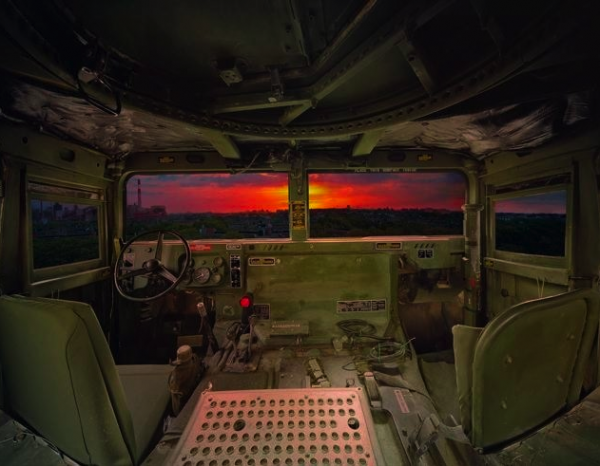
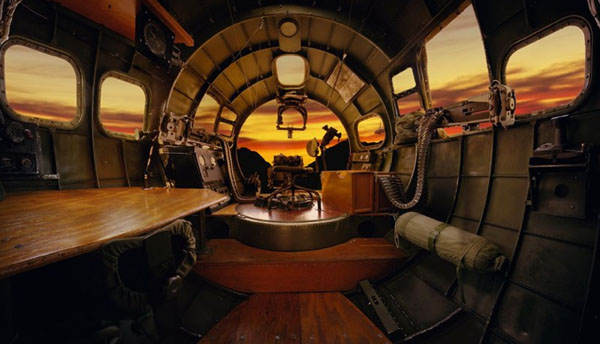
The three large format photographs included in the show surrealistically examine panoramic landscape views and historic landmarks through the cockpits of Veteran-restored military bomber aircrafts and custom freight-liners. This mechanism — of framing and drawing parallels between seemingly disconnected visages through an unlikely, fabricated meta-frame of sorts — is an exploration that continues from Gispert’s last series of photographs. In his 2008 exhibition at Zach Feuer gallery, Gispert selected surreal Latin-American themed imagery and architectural tableaux, from a bizarrely Escalade populated suburban sleepy sprawl, to a processional litter in progress. When these vignettes are seen through the smooth lined, white leather pleated, faux-wood adorned aesthetics of wealth and luxury liners–the question of their relation to poverty, religion and oppression is raised.
Picture 1

In the newest series of works, Gispert instead examines sweeping views of perhaps one of the most amateur-photographed icons — nature at sunset. Gispert notes, “Sometimes I like to start with a problem and work my way out. Sunset landscape photography is one of the most cliched tropes in photography. So I decided to make landscape images that are interesting to me.” Interestingly though, by trying to unpack and revitalize an overexposed genre, Gispert notes that part of the inherent process has been chasing sunsets, trying to capture the sublime moment at a grand scale. In a move that is at once humorous and surreal, Gispert offsets Amsel Adams’ style purist/spiritualist “straight” photography that evokes the grandeur of the natural world with the implication of human presence. In this case, the masculine, psychologically-loaded customized spaces of souped up bombers, RVs and vans both mocks and renders foreign the romanticism of the sunset vistas.

The 26 minute short film, Smother, was a seductive semi-autobiographical narrative following a young boy’s “rite of passage through an Oedipal relationship with his mother.” The film was enchanting and violent, and revealed a penchant for the subliminal and horrific in the way that older, Brothers Grimm fairy tales encompass the nightmarish and fantastical. The film fluidly straddled the cinematic languages of science fiction and neo-noir to create a story that was at once powerful and unsettling.
Gispert.jpg

Overarchingly, there is a certain dreaminess that pervades Gispert’s work: at once irrational, beautiful, slow and unexpected turns between the transcendent and the dark, with a languid sense of observing the in-congruencies in the images presented. “I tend to work slowly; several months usually elapse between idea and execution. When a new idea arrives I like to play with it in my head for a long time….I rarely make drawings, if something is too clearly illustrated on paper it’s finished for me, there’s no discovery left….I like to leave myself some room for improvising….I like the tension of not completely knowing what’s going to happen,” says Gispert. This modus operandi of holding, molding and shaping an image in his mind’s eye, rather than on the fatalistic and concrete media of paper, which locks in development seems to play a role in his works general aesthetic. “I don’t consider myself a ‘photographer’ as the camera is just another tool to illustrate an idea….I’ve always liked artists whose works resemble a group show….I don’t like when things are clearly defined or understood. Perhaps that’s one of the reasons I jump around from medium to medium.” Perhaps it is this seemingly psychic induced conception process and fluid movement between genres & media that casts such a strangely hallucinatory light on his work- which unfold, as dreams do, nonsensically, but somehow with a divinely inspired sense of purpose.

Luis Gispert was born in 1972, in Jersey City, New Jersey. He has exhibited extensively throughout the United States, Europe, South America and the Middle East including MOCA North Miami, FL; Whitney Museum of American Art at Altria, New York; PS1 Contemporary Art Center, New York, New Museum of Contemporary Art, New York; Studio Museum of Harlem, Royal Academy of Arts, London, UK; His work has also been included in the 2002 Whitney Biennial, New York, NY; Private collections include Fogg Art Museum, Cambridge, MA; San Diego Museum of Contemporary Art, San Diego, Solomon R. Guggenheim Museum, New York, NY; Whitney Museum of American Art, New York, NY.


Share

Stranger Circumstances

Massimo Guerrera (2009) Meeting, Ink, pencil and acrylic on paper, 54" x 44"

Massimo Guerrera (2009) Meeting, Ink, pencil and acrylic on paper, 54" x 44"

After six years of operation, the artist-run Crawl Space Gallery in Seattle has decided to close its doors and end their impressive programming of exhibitions, residencies, public forums, publications, and experimental projects. The gallery is currently presenting Stranger Circumstances as their final exhibition. The show features Crawl Space artist in residency, Massimo Guerrera as well as artists Alana Riley, Ron Tran with performances during the opening by the Seattle-based artist collective PDL, featuring Jason Puccinelli, Jed Dunkerley and Greg Lundgren.

Alana Riley (2004) Stephan from the series Support System, C-print

Alana Riley (2004) Stephan from the series Support System, C-print

As the press release mentions, “Stranger Circumstances, brings together artists who devise strategies to connect with people they would otherwise never encounter.” Resident artist Massimo Guerrera explores the methods in which people communicate using language, meditation, exertion and sharing by collaborating with strangers to create artworks through a variety of media. During his time at Crawl Space, the artist collaborated with a dozen participates to create what he calls “a living installation.”  Alana Riley documents short performative interactions with strangers. Her exhibited works involve the artist asking participants to either lie on top of her, placing their full body weight as they see fit, or allow her to carry them piggie-back throughout their workspace. Ron Tran documents strangers within close range to observe particular gestures and interactions. Whether through collaboration, perforative acts or documentation, each artist is using the uncontrolled actions of strangers as a cornerstone of their conceptual practice.

Stranger Circumstances is curated by Jennifer Campbell and will be on view through November 29th.

Share

Eric Fischl: Corrida in Ronda

Eric Fischl

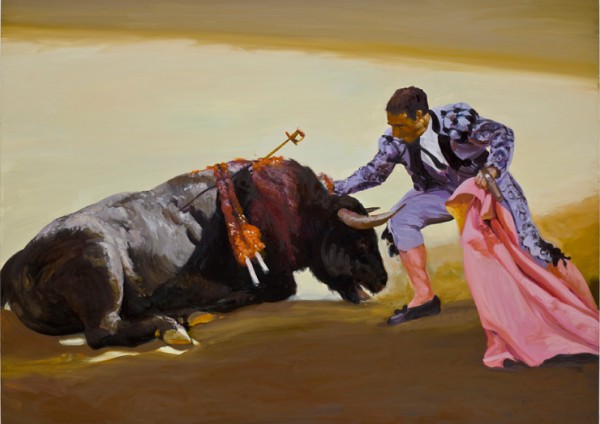
Acclaimed and often contested artist Eric Fischl is currently exhibiting a new series of eight large paintings titled Corrida in Ronda, featuring images of bullfighters engaging in the Corrida Goyesca. Held in the Andalusian town of Ronda, the fighters dress in eighteenth century attire that falls in the era of the classic Spanish painter Francisco Goya. Goya actually designed the distinctive costumes, which are still worn by the fighters today in this special event.

Like previous bodies of work, Fischl focuses on the particular customs of a community and builds a psychology within the paintings through formal considerations of light source, color palette, and viewpoint.  Corrida in Ronda has been exhibited this year at Jablonka Galerie in Berlin and will travel in 2010 to the Centro De Arte Contemporáneo de Málaga in Málaga, Spain.

The exhibition will be on view at Mary Boone Gallery at 541 West 24th St. until the 19th of December.

Share

Art in Storefronts: San Francisco

Christopher Simmons & Timothy Belonax "Everything is OK," 2009 (998 Market Street)

Christopher Simmons & Timothy Belonax "Everything is OK," 2009 (998 Market Street)

Art in Storefronts is a pilot program initiated by the office of Mayor Gavin Newsom and implemented by the San Francisco Arts Commission and Triple Base Gallery to reclaim abandoned storefront spaces in the San Francisco neighborhoods of Mission, Bayview, Market and Tenderloin. Rounding up participating artists by sending out a call for proposals, those selected were then assigned an address where they were allowed to create large-scale installations implementing a variety of mediums. Not to miss in the Market Street section are Christopher Simmons & Tim Belonax’s Everything is OK (998 Market), a neon installation that comes at the viewer as both a reassuring mantra and a questioning of the status quo. Additionally, Paul Hayes’ breathtaking ethereal installation, Giant Ghosts (989 Market), astounds the viewer by presenting life-size floating sculptural figures out of crumpled, white paper and illuminated by bright blue light. The aspiration of the project is to try and help reinvigorate neighborhoods traditionally abandoned due to economic downturns, while simultaneously giving local artists a unique opportunity to showcase their artwork. What would be most interesting would be to see a local artist use the space to explore the artist’s role in gentrification.

Paul Hayes "Giant Ghosts," 2009 (989 Market Street)

Paul Hayes "Giant Ghosts," 2009 (989 Market Street)

The project runs from September 2009 – February 1, 2010 and includes the locations of Central Market and Tenderloin (opens October 23rd), Third Street (opens October 30th) and Lower 24th Street (opens November 20th). A pdf map of all installations can be downloaded at the San Francisco Arts Commission’s website.

Share

Krzysztof Wodiczko: …OUT OF HERE: The Veterans Project

Krzysztof Wodiczko, …OUT OF HERE: The Veterans Project, 2009, Courtesy of the artist and Galerie Lelong, New York

Krzysztof Wodiczko, …OUT OF HERE: The Veterans Project, 2009, Courtesy of the artist and Galerie Lelong, NYC

The Institute for Contemporary Art/ Boston (ICA) is currently showing artist Krzysztof Wodiczko‘s latest work, …OUT OF HERE: The Veterans Project.  This installation is comprised of light projection and sound and runs on a 7 minute loop – occupying three gallery walls.  The work envelopes the viewer in darkness, which is only broken by the sequence of windows projected near the ceiling.

Sound is by far the most important element of the work as it transports the visitor to an unknown Iraqi interior and to an imagined instance of war’s devastation.  Initially, innocuous sounds of daily life fill the room while noises from a booming market and the chants of an imam can be heard from outdoors.  American Humvees then arrive outside and soldiers subsequently shout commands and communicate with base.  Tensions are raised further as a dog is hit and automatic gunfire sounds.  Exterior destruction is only partially visible as the window projections are broken by bullets and black smoke can be seen rising behind them.  After the Humvees drive off, Iraqi women are heard crying and wailing at an increasing volume until the loop concludes.

OUT OF HERE:  The Veterans Project evokes the uncertainty and devastation of war while allowing for an internal and imaginative viewing experience.  Content demands visual restraint in this work because the complexity and terror of war cannot be visually summarized in an adequate way.  The use of limited visuals and overwhelming sound is arguably a more effective reflection of the opacity and confusion of the war in Iraq for those that have not experienced it firsthand.  The visual spareness of the piece underscores our inability to fully understand the horrors that soldiers experience and subsequently internalize.

Krzysztof Wodiczko, …OUT OF HERE: The Veterans Project, 2009, Courtesy of the artist and Galerie Lelong, New York

Krzysztof Wodiczko, …OUT OF HERE: The Veterans Project, 2009, Courtesy of the artist and Galerie Lelong, NYC

Wodiczko’s depiction of wartime Iraq is the result of consultation with Iraq War veterans, medics and refugees as well as from the study of audio and visual recordings of his contacts’ wartime experiences.  It must be seen as an attempt to increase dialogue and acknowledgement for the human impact of current US wars, particularly on soldiers that have returned home.  Wodiczko – born in the midst of World War II and also a former soldier in the Polish army – has taken keen interest in the impact of the United States’ current wars and the proliferation of the oft-isolated veteran figure.  The artist has treated veterans prominently in recent work such as Veterans’  Flame (2009) on New York’s Governor’s Island and the Veteran Vehicle Project (2008).  Wodiczko states in a recent Boston Globe article by Sebastian Smee that he hopes such work ‘provide[s] an opportunity for veterans to open up and to hear what is happening to them’.

Krzysztof Wodiczko is an established contemporary artist well known for his many large-scale outdoor light projections onto buildings and monuments that articulate a variety of social problems.  In the artist’s own words, (quoted in Smee’s article) his work ‘is on the side of those that have less access to rights than others’.  Such relevant and socially-engaged work led to his being awarded the Hiroshima Art Prize in 1999 and the College Art Association Award for Distinguished Body of Work in 2004.

Krzysztof Wodiczko currently lives and works in Cambridge, Massachusetts and New York City.  Past works include Homeless Vehicle (1988-1989), the ICA/Boston-commissioned Bunker Hill Monument Projection (1998) and the Hiroshima Projection (1999).  Wodiczko represented his native Poland at this summer’s 2009 Venice Biennale with Guests – a work that examined the existence of the economic migrant and non-citizen in Europe.  Wodiczko is also the Director of the Center for Advanced Visual Studies at the Massachusetts Institute of Technology and the head of the Interrogative Design Group.

…OUT OF HERE:  The Veterans Project was realized in part through the support of the National Endowment for the Arts and will remain at the ICA/Boston through 28 March 2010.

Share