Oakland
Boom: The Art of Resistance at Random Parts
Impeccably curated by artist–organizer Leslie Dreyer at Random Parts gallery, Boom: The Art of Resistance is an exhibition that does not advertise its impact, and it could be mistaken for “scrappy” if one ignored the precision of the show and the assumptions jammed into that word. Installed in the small storefront/apartment space in Oakland, a few of the show’s works are in the well-used kitchen, where gallery co-director Juan Carlos Quintana cooks his meals and lives his life. A visit to the show might easily segue into a hangout, a drink, or a party. It begs the question: What kinds of conversations can be had in what kinds of kitchens?
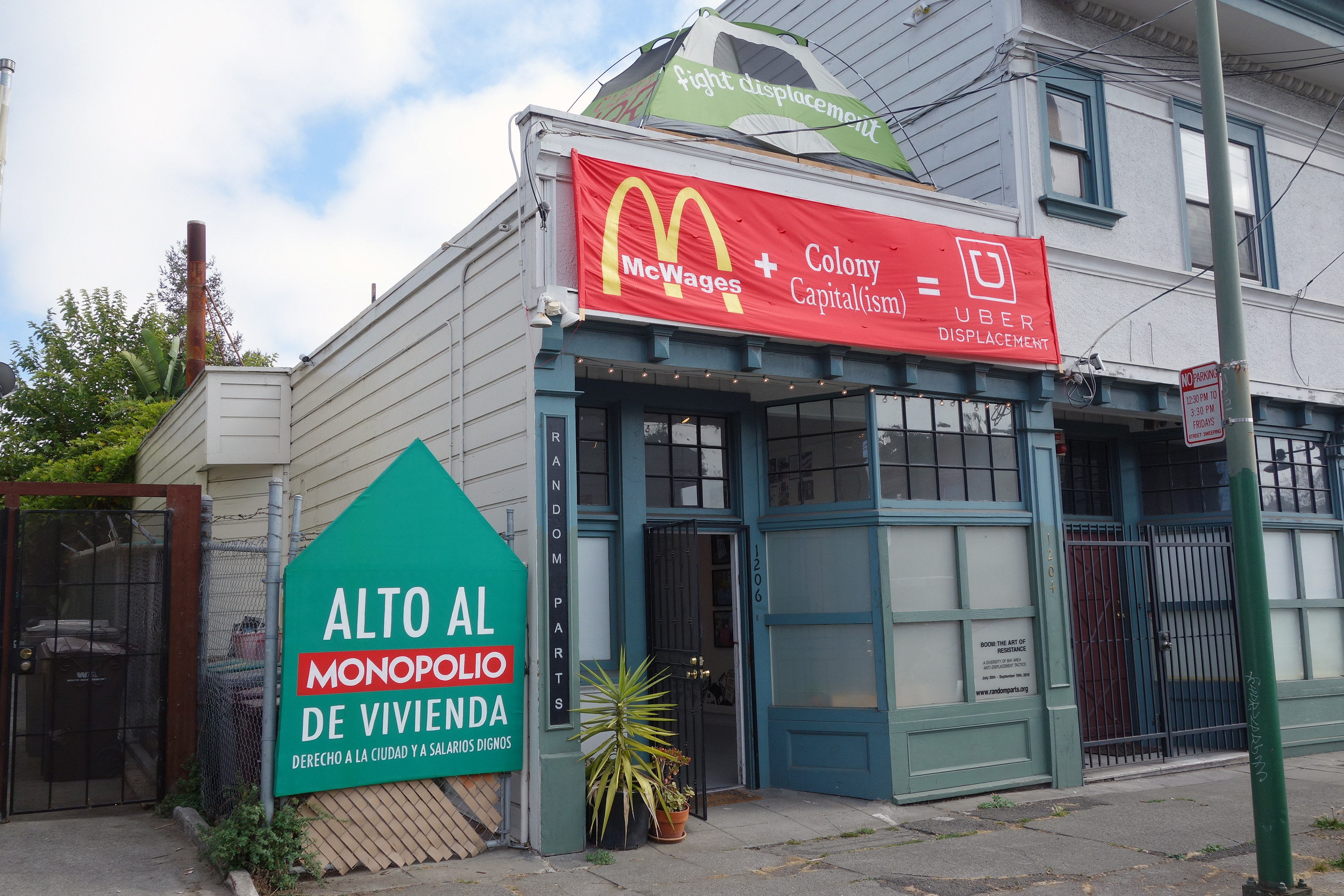
Boom: The Art of Resistance. Outdoor installation: painted tent by Leslie Dreyer and Zeph Fishlyn for Coalition on Homelessness’ Tackle Homelessness/Superbowl action, 2016; banner by Leslie Dreyer for Oakland’s Fight for $15 march to address the issues of low wages, real-estate speculation, and displacement.
Such a gathering would occur in view of a 2001 documentary film—Boom: The Sound of Eviction, from which the show adopts the leading, econ-onomonopoetic part of its name—playing on a loop on a side table. The older Boom is a detailed account of the socioeconomic effects of the first major dot-com explosion of 1998–2001. The footage is grainier than today’s HD video, and the cars are a bit less streamlined, but the story remains uncannily the same. The influx of a global network of tech industry workers has incentivized evictions on a mass scale—around 1,000 a month, recently, by some accounts—under many different guises and justifications.
Random Parts is located in the East Lake neighborhood, east of Interstate 880 and just north of Fruitvale. It’s a neighborhood poised for the sort of “transformation” that tends to divide people into “dread” and “desire” camps according to their respective historically conditioned levels of access to capital. The waterfront is just beginning to witness the construction of Brooklyn Basin, the largest real-estate development project in the history of the East Bay. What sorts of kitchen conversations will this development, with its high-rise condos and boutique retail, make possible, and what others will it make impossible?