Matias Faldbakken: Shocked into Abstraction

Picture 3

Norwegian visual artist and writer Matias Faldbakken is currently exhibiting a new series of works titled Shocked into Abstraction at Ikon Gallery in Birmingham, UK. This presentation marks the artist’s first major UK exhibition, and continues his interest into subcultures, vandalism, destruction and abstraction. Working through a variety of media including film, sculpture, installation, photography and wall painting, Faldbakken deliberately transforms acts of destruction into abstract and aesthetic forms. Within these works, acts of social and political aggression are nullified by manipulating the potent gestures into works of art.
Picture 4

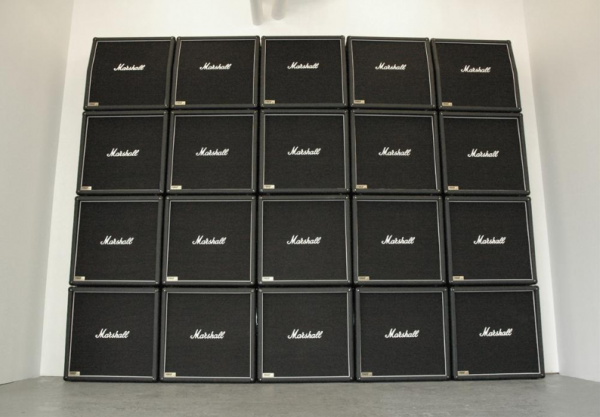
The exhibition contains illegibly sprayed block letters in silver spray paint directly on the gallery walls. The letters have no defining edges and thus bleed together to form an reductive abstract painting. The gallery also contains a stack of Marshall amps which are sold as empty functionless shells. The amps are mere stand-ins for their would-be powerful counter parts. Through this piece the artist highlights the use of sound as an act of aggression by subcultures, while also casting light on the deafening silence of the piece as a minimalist form.

Shocked into Abstraction will remain on view at Ikon Gallery through January 24, 2010. The gallery produced a video with the artist that further explains many of the works on view.

Share

Whitney Biennial: 2010 Announced

Picture 1

Photograph © Jeff Goldberg/Esto

This month, the curators from the 2010 Whitney Biennial made public their list of artists for next year’s exhibition. Similar to previous years, this biennial will feature a healthy selection of emerging artists that together represent much of what is taking place in contemporary visual art today. However, unlike other years the 2010 biennial has been scaled back to only 55 artists, as opposed to 81 in 2008 and 100 in 2006. Both 2010 curators, Italian-born Francesco Bonami, 54, and Gary Carrion-Murayari, 29 have both been affiliated with previous exhibitions at the museum. They have decided to depart from the traditions of other biennials by containing the work to the Marcel Breuer building on  the southeast corner of Madison Avenue and 75th Street, and by refraining from grouping the work according to a unified theme or concept in favor of simply featuring a cross section of artworks being made today. In a recent article in the New York Times, Mr. Bonami said he didn’t want a theme: “The theme is the year — 2010 — which is the title.”

While the list contains several well known artists such as Chicago-born artist Charles Ray, it mainly consists of emerging artists such as Tauba Auerbach and Hannah Greely, and even lesser known artists such as Aurel Schmidt and Aki Sasamoto.

The Whitney Biennial:2010 will be on view Feb. 25 through May 30, 2010.

Share

From the DS Archive: Destroying Prettiness: Wangechi Mutu and Kara Walker

Originally published on: March 31, 2008

Wangechi Mutu will never experience the heated backlash that Kara Walker experienced. No one will call Mutu the “patsy of the white art establishment,” accuse her of selling fellow black artists down the river, or launch a letter-writing campaign to keep her artwork from being shown. There are good reasons for this: unlike Walker, the Kenyan-born Mutu does not share the slavery lineage of African-American artists and she does not make work with a lucid historical context. Yet Mutu’s work is often as disturbing as Walker’s, reconfiguring sexualized representations of women and creating visceral collages that appear more pornographic than critical. Continue reading for the complete DailyServing article by Catherine Wagley.


Mutu_244_EatDrinkSwanMan01_lores.jpg

"Eat Drink Swan Man", 2008 Watercolor and collage on paper Overall dimensions 43" x 63" (nine parts) Courtesy of Susanne Vielmetter Los Angeles Projects.


Mutu and Walker both probe the ways in which women’s bodies have been caricatured and both use craft-inspired materials to create compositionally seductive images. Both also provoke the same question: is this work compelling because of what it says or because of the way it speaks?

Mutu received her BFA from Cooper Union and her MFA in Sculpture from Yale. Since leaving Yale, Mutu has participated in celebrated group shows internationally and her inclusion in Saatchi Gallery’s USA Today made her, at least fleetingly, an art world sensation. The critical discussion surrounding her work often hovers around terms like mutilation, fashion and empowerment, emphasizing the contrast between representations of gender in Africa and the West. But there’s something missing from the discussion of Mutu’s art. The compulsive, sentimental, and seductive quality of her imagery overwhelms any social criticism that she might be articulating.

Read More »

Share

Cordy Ryman

cordy ryman_InstallView2

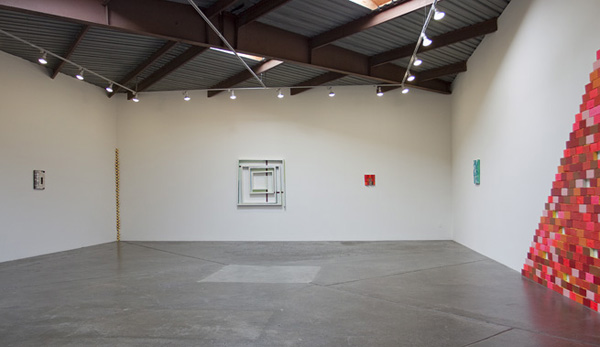
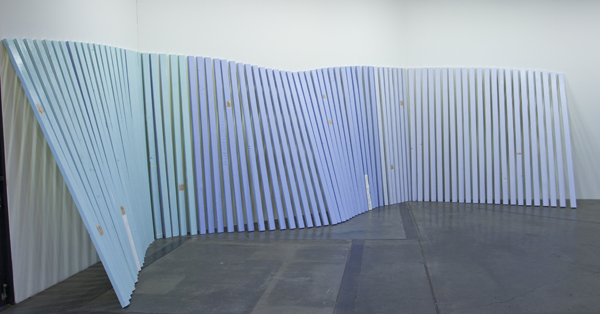
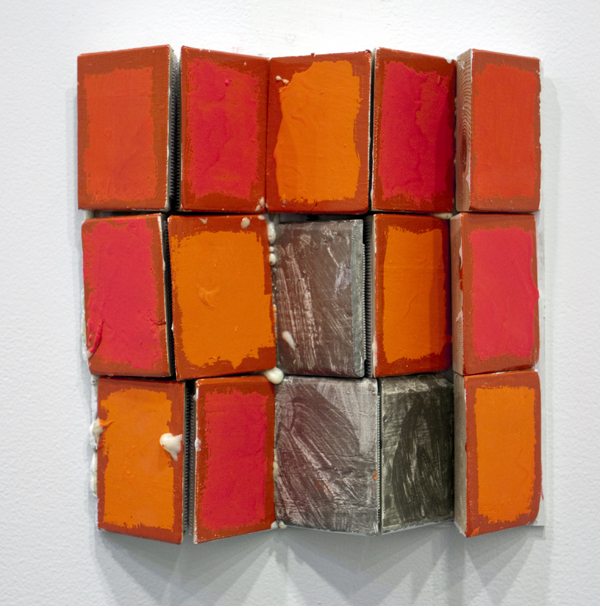
Cordy Ryman‘s new work, which is currently on view in the solo exhibition, Hail to the Grid, at Mark Moore Gallery in Santa Monica, reflects the form and pattern of the minimalist tradition, but at the same time celebrates a freedom that balks at the pervasive inaccessibility of the more polished work of his contemporaries and predecessors. Bright, rough and intentionally unfinished, Ryman’s paintings and sculptural installations stack like Legos across the floor and walls of Mark Moore Gallery.

cordy ryman_BlueWave
I recently got the chance to talk to the artist about the show, and I asked him about this pattern of leaving the cruder aspects of his work visible—dried glue dripping from seams, cardboard backing and industrial staples unhidden, product numbers revealing lumber to have Czech origins. As Ryman explained to me, “There is always a back and forth that happens when painting,” and that the unfinished aspects are “usually not planned in advanced so much as selectively and intuitively left.” “I think aesthetically it makes a piece more interesting if there is a bit of imbalance or tension in the composition,” he says, “Beyond pure aesthetics I think it’s important that it is evident that they are made by hand, and are not perfect. People and ideas are not perfect.” Indeed. An illustration of this sentiment would be Ryman’s lanky sculpture, Yellow Spine 2, which crawls up the seam where two of the gallery walls meet, beautiful but exposed—like a skinny, self-conscious girl tucked into a corner at the school dance.

cordy ryman_Red_Wedges
Cordy Ryman lives and works in New York. He received his BFA from The School of Visual Arts in New York. His work has been exhibited widely both nationally and internationally, including recently in solo shows at DCKT Contemporary, New York; Stalke Up North, Gilleleje, Denmark; Traver Gallery, Seattle and Nicole Klagsbrun Gallery, New York as well as group shows at Esbjerg Museum of Modern Art, Esbjerg, Denmark and P.S. 1 Contemporary Arts Center, Long Island City, NY. Ryman has been featured in the New York Times, Art in America, Beautiful/Decay and elsewhere.

Share

Aldwyth: Work v. / Work n.

casablanca_colorized_version

Photograph by Rick Rhodes. Courtesy of the artist and the Halsey Institute of Contemporary Art

The Halsey Institute of Contemporary Art (HICA) in Charleston, South Carolina has a long history of celebrating works by artists who exist on the fringe of the mainstream contemporary art world. For the inaugural exhibition of their new gallery space, Director and Senior Curator Mark Sloan is presenting a collection of collage and assemblage works, titled work v. / work n., from a rather unknown artist standing at the edge of her first major museum exhibition, at the ripe age of 74.

The artist, known only as Aldwyth, has long abandoned her first name not in the hopes of being seen in the fashionable lineage of Madonna and Cher, but to conceal her identity as a woman and to neutralize her position as an artist in a male dominated world.  As an artist evaluating the mainstream art world from the sidelines, much of her work confronts the patriarchal genealogy of art from the margins. Similarly described in the bell hooks essay marginality as site of resistance, Aldwyth carefully moves away from marginalization as a site of deprivation and positions herself in a space of resistance, remaining part of the whole but outside the main body of the art world.

Gallery Installation. Courtesy of the artist and the Halsey Institute of Contemporary Art

Gallery Installation. Courtesy of the artist and the Halsey Institute of Contemporary Art

For decades, Aldwyth has remained rather anonymous, creating work in seclusion in a small coastal island of South Carolina. Many of her works confront issues related to exclusion within recorded art history, like Document, where she attempts to amend the history of art as listed in the 1950’s edition of Canaday and Janson with ongoing personal updates. By endlessly expanding the 1950’s edition, Aldwyth rewrites art history as she sees fit and leaves the end blank for history to continue to write itself.

Aldwyth’s collage works explore the massive through the minute, creating large indexes of images and ideas. In works such as The World According to Zell and Casablanca the artist has created entire worlds that catalog and reveal new meaning through the manipulation of context. The World According to Zell recontextualizes an encyclopedia from 1871 whereas the artist has removed all images in the two volume set to create her own visual history.

Gallery Installation. Courtesy of the artist and the Halsey Institute of Contemporary Art

Gallery Installation. Courtesy of the artist and the Halsey Institute of Contemporary Art

She has also created an impressive collection of assemblage works with found objects embedded with their own cultural history. Many of the objects tell an abstract story of the artists life, including personal rejection, success, wonder and melancholy. The objects found within her assemblage works offer a direct nod to artists such as Joseph Cornell, Marcel Duchamp and much of the Dadaist movement.

While it may seem unfit for an artist who often creates work about being on the outside of an institutional framework to finally be the subject of a major museum exhibition, it is precisely this fact that makes Aldwyth’s work so appealing. Creating work for decades with little to no regard of ever exhibiting her creations has embedded the work with a unique sincerity that comes as a privilege for viewing. To experience the artist’s work is to confront a new history, one that has been rewritten from the outside looking in.

Photograph by Rick Rhodes. Courtesy of the artist and the Halsey Institute of Contemporary Art

Photograph by Rick Rhodes. Courtesy of the artist and the Halsey Institute of Contemporary Art

Work v. / Work n. will be on view at HICA through January 9th, 2010. The exhibition will travel to the Telfair Museum’s Jepson Center for the Arts from February 10th through May 17th, 2010. Work v. / Work n. is accompanied by a full color-catalog.

Share

Josue Pellot

courtesy of the artist

courtesy of the artist

Chicago artist Josue Pellot deploys several mediums and styles in order to examine his Puerto Rican roots as transplanted into the quintessential American experience – that is, as mediated by pop culture and consumerism in his current exhibition at the Chicago Cultural Center.  Thus, he displays a photomontage of the iconic fortress El Morro in Puerto Rico in which it is conflated with a supermercado/laundromat/liquor store.  In fact, many architectural structures in the United States do mimic this famous castle, and his neon sculpture of conquistadors and the native population’s revenge, 1493, was originally installed in the windows of La Municipal, a supermarket in Humboldt Park, during the last Puerto Rican Day Parade.

In Temporary Allegiance, the artist has placed in the gallery a flag that is an amalgam of U.S. and Puerto Rican flags, more specifically the remains of what was originally used by the artist in a installation/performance in Puerto Rico, after damage sustained by local police interference.  Sitting limply in the gallery as sculpture, one can only guess at the resonance and tensions encapsulated in its history.

courtesy of the artist

courtesy of the artist

Josue Pellot received a BFA from the University of Illinois in Chicago in 2003 and an MA in Art Theory and Practice from Northwestern University in 2006.  His work has been presented in several exhibitions in the Chicago area and in San Juan, Puerto Rico including a performance at the Museo de Arte de San Juan.

Share

The Fifth Dimension – Art of Fiber and Space

Private Life by Li Dian

The Fifth Dimension – Art of Fiber and Space (October 18 – December 4, 2009) at MOCA Shanghai presented the works of 24 teachers and students of the Fiber and Space Art Studio from the Fifth Studio of the Sculpture Department of China Academy of Arts.

Titled to convey the interests of the Fiber and Space Art Studio in examining the world from a fifth dimension, the exhibition presents reconstructured realities from a virtual dimension imagined by the artists. Tracing the sensibilities and evolution of contemporary art practice by Chinese artists working with fibrous materials since the 1980s, the exhibition unveils the shifts in uses of and perspectives on aesthetic expression which integrates fiber with painting, sculpture and installation.

During the 1980s, members of the Fiber and Space Art Studio, such as Shi Hui, participating artist and one of the exhibition’s three curators, experimented with structures and space through materials such as bamboo and paper, in addition to the traditional materials of wool, linen and cotton.

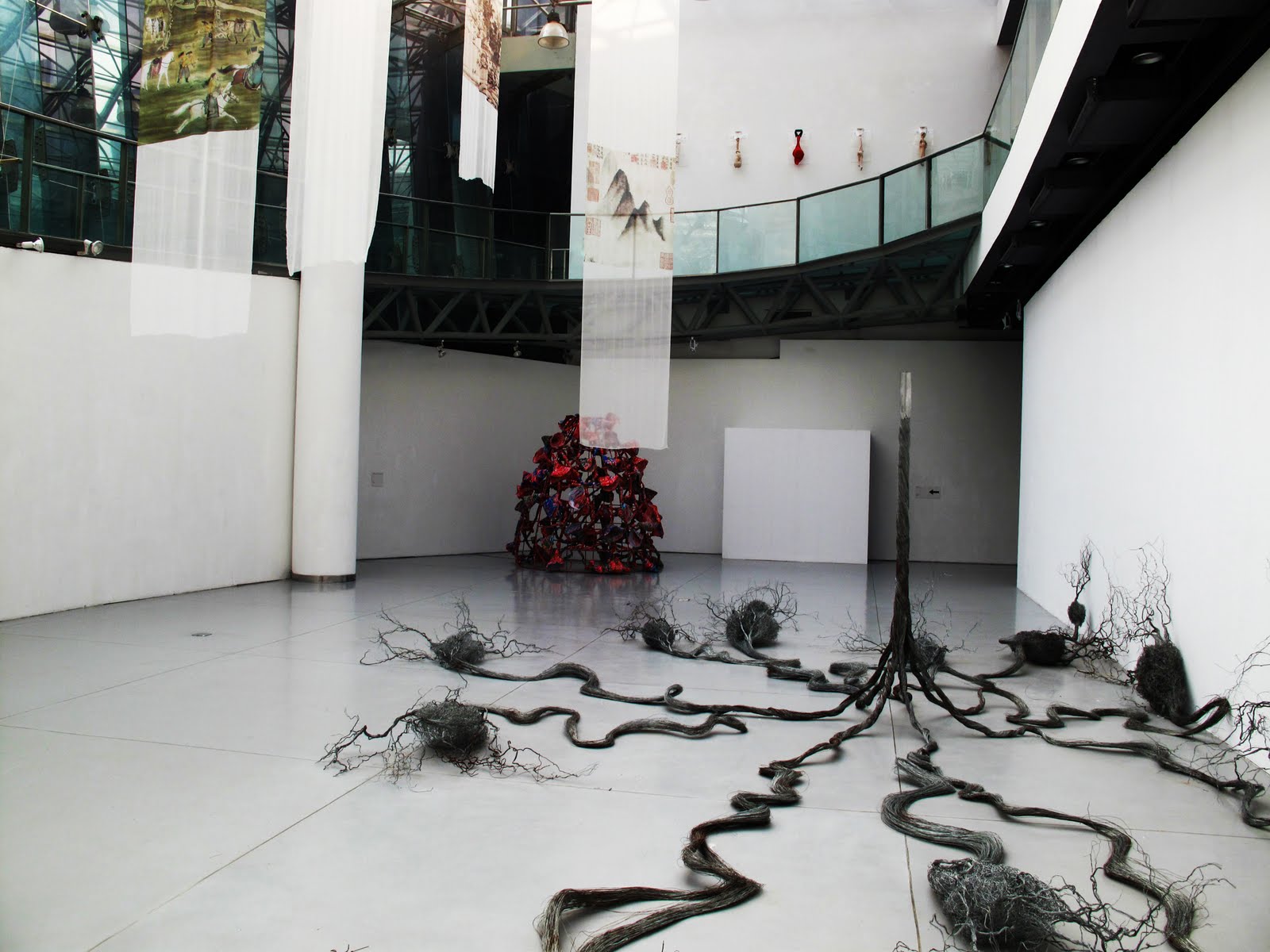
Today’s experimentation takes the form of incorporating materials such as plastic, polyurethane and other industrial materials to create soft sculptures which reflect also, on the fast-changing Chinese society and the impact of consumerism on people’s daily lives. In his work, Nightmare, Zhan Jun uses iron and aluminium wires to fabricate an exhaust pipe forming the trunk of a bare and forlorn tree with extended roots of metal, to express his reflections on the relationship between industrialization and the environment.

Nightmare by Zhan Jun

Nightmare by Zhan Jun

The exhibition pays tribute to the vision and work of Professor Maryn Varbanov (1932-1989), a Bulgarian artist who started the Varbanov Tapestry Research Center in the Zhejiang Academy of Fine Arts in 1986, the first contemporary fiber art research center in China, which later led to the founding of the Fiber and Space Art Studio.

Participating artists: Shi Hui, Shan Zeng, Huang Yan, Liang Shaoji, Chen Wei, Fu Yan, He Shanshan, Huang Zhe, Li Dian, Li Wei, Lin Changwen, Lin Jia, Song Chunyang, Wang Hei, Wang Jinglei, Wang Zhenghong, Wang Zhijian, Wu Jiazhen, Xu  Jia, Ying Nihui, Ying Xinxun, Zhan Jun, Zhang Hui, and Zhou Hui.

Share