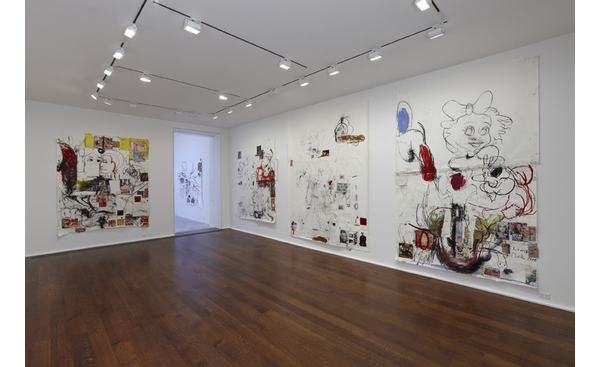
Installation view of ACT UP New York: Activism, Art, and the AIDS Crisis, 1987–1993. Photo: Katya Kallsen © President and Fellows of Harvard College
When I was an undergraduate painting major, my drawing instructor, a cool-headed minimalist who approached teaching with as much restraint as he did art-making, warned me not to preach to the choir. I had made a series of over-stimulating, muddy drawings in which decadent magazine imagery swam in bleeding pools of ink. The drawings criticized consumer culture (loudly), but they didn’t do much else. “Everyone who sees these will already agree with you,” my instructor said. If I was going to make art that would hang on walls and be viewed by largely liberal audiences, what would I gain by reiterating progressive ideas? A pat on the back?
Over the past year, I’ve seen a spattering of activist art that made me bristle—all-but-haloed images of our new president, liberated grocery carts that have been turned into mobile compost bins, or wall texts that proclaim vague imperatives like “Now” or “Act.” Seeing work like this in a gallery feels like encountering a self-contained anti-war protest in the quad of a left-leaning campus. It makes you wonder, for a moment, if you do live in a vacuum.
Art and politics belong together, but not in the way the way global warming belongs to Al Gore, or the FDA belongs to Phillip Morris—there shouldn’t be any self-congratulation, lobbying, or under-the-table favors. When I think of the potential of political art, I often think of David Wojnarowicz’s videos from the early ‘90s—portraits of disintegration, they attacked Aids-era government with a vengeance so guttural and naked that they turned politics into gut-spilling and made viewers who voted red squirm just as badly as viewers who voted blue.

Art + Positive, AIDS Is Killing Artists, Now Homophobia Is Killing Art, 1990. Sticker, 4 x 6 in. Courtesy of Avram Finkelstein. Photo: Jessica Ficken.
Act Up New York: Activism, Art, and the Aids Crisis, 1987-1993, currently on view at Harvard’s Carpenter Art Center, may not rival the intensity of Wojnarowicz’s ITSOFOMO or Fire in My Belly. But it takes on the relation between art and activism in a way that is gripping, urgent and also pragmatic. Curated by Helen Molesworth, Harvard’s Houghton Curator of Contemporary Art, and Claire Grace, curatorial intern and doctoral candidate, the exhibition chronicles six peak years of The Aids Coalition to Unleash Power (Act UP), a group that took to the streets to advocate for gay rights and health care in the late 1980s, as the Aids death toll rose steeply. The work archived Act Up doesn’t pose as art, per se. It does, however, seem at home in an art space.
On the first floor of the Carpenter Center, video monitors play interviews from The Act UP Oral History Project, an effort, spearheaded by Sarah Schulman and Jim Hubbard, to record the stories of living Act Up alumni (Schulman knew she had to begin the project after she heard a commentator on the radio say “At first, America had trouble with people with AIDS, but then they came around”—“I could not continue my life without making sure that no one would ever say something like that again,” Schulman told the National Institute of Health). There are more than enough monitors to overwhelm; no one can possibly watch the hours of footage that loop through that room. Yet the talking faces on each screen compel attention, many of them speak carefully, considering their history with the hesitation of people old enough to feel the weight of time but young enough to see their personal futures as more promising than their pasts. Says on interviewee, “Becoming an Aids activist was like a religious conversion, in many ways, in terms of the passion and self-discovery and creating a new identity.”
Read More »