From the DS Archive: Rachel Whiteread

Originally published on December 12, 2008

Rachel Whiteread, who lives and works in London, has created a new politically charged piece titled Place (Village) on view now at the Museum of Fine Arts in Boston. In an interview, she explained “she has been making the same work since college, which involves working with objects and histories and time.” In this exhibit, she deviates from using her stock materials such as polyurethane, resins, plaster and rubber, but still creates the perception of something that is no longer vital but was once connected with human life.

Rachel Whiteread was born in London in 1963. She studied painting at Brighton Polytechnic (1982-85) and sculpture at the Slade School of Art, University College, London (1985-87). Whiteread’s first solo exhibition was held at the Carlyle Gallery, London, in 1988, the year after she graduated. The first monumental sculpture that brought her recognition was Ghost (1990), a plaster cast of the interior space of an ordinary room, shown at the Chisenhale Gallery, London. She was the first woman to win the Turner Prize and is widely known for her public monuments, including Water Tower (1998) in New York and Holocaust Memorial (1995/2000) in Vienna.

Whiteread 3.jpg

Read More »

Share

Ignacio Uriarte

Ignacio Uriarte

Ignacio Uriarte began his career in business administration before quitting “to work as a full time artist,” as he describes in his statement. Translating his administrative expertise to a creative context, Uriarte incorporates the quotidian tools and habitual methods surrounding the office environment into his artistic practice. His materials include Bic pens, Xerox machines, ink cartridges, and other office paraphernalia; his process is driven by routine and repetition. His new video work, which was displayed in Nogueras Blanchard‘s booth at Art Basel Miami Beach earlier this month, comments on the iconic machine, the typewriter, and its decline into obsolescence.

Ignacio Uriarte
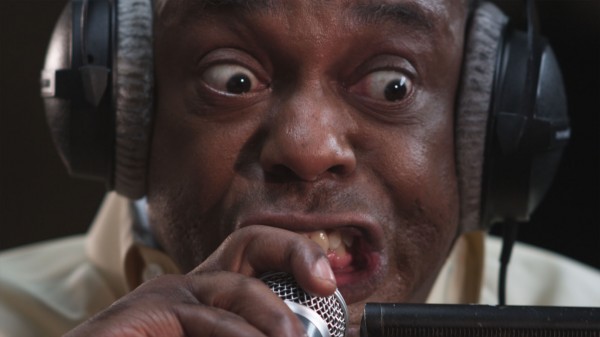
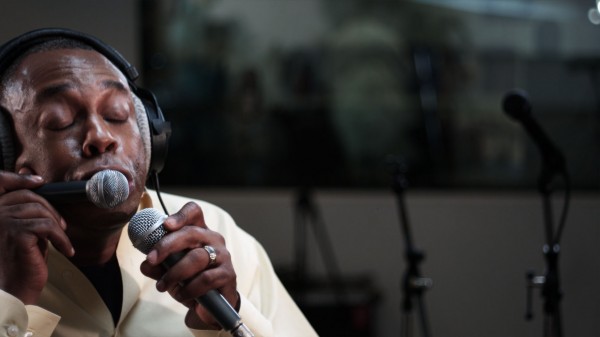
The History of the Typewriter Recited by Michael Winslow documents the actor’s recreation of the distinct mechanical sounds generated when using a typewriter. Michael Winslow is known for his role in the Police Academy movies, as well as his uncanny ability to simulate sound effects using his voice. In the video, Winslow attempts to mimic the sounds of various typing machines from the 1870s to the 1980s. Uriarte recorded the sounds of over 3,000 typewriters from the Schreibmaschinenmuseum in Partschins, Switzerland and the Deutsches Technikmuseum in Berlin. The artist then chose 68 models for Winslow to work with. The actor was only able to recreate the sounds of 32 models in the film, a powerful reflection on the interaction between man and machine, and the limitations of both. The specific timeframe of the work points to the invention of the typewriter and its ultimate demise with the launch of the first personal computer and accompanying word processing software by IBM in 1984. The first Police Academy movie was also released in 1984.

Uriarte received a degree in Business Administration in 1995 before studying audiovisual arts in Guadalajara, Mexico. Born in Krefeld, Germany, he currently lives and works in Berlin.

Share

Happy Holidays from DailyServing!

Happy Holidays from everyone at DailyServing.com!

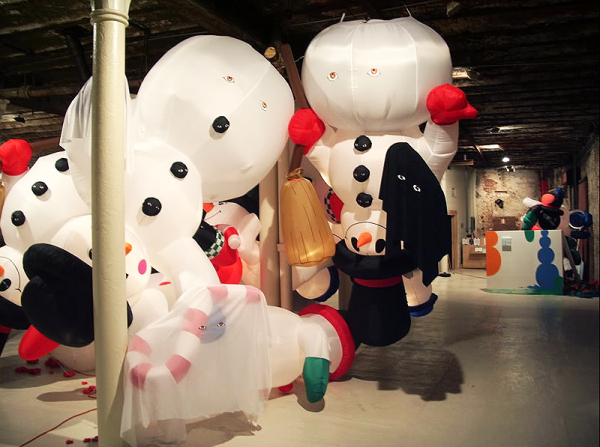
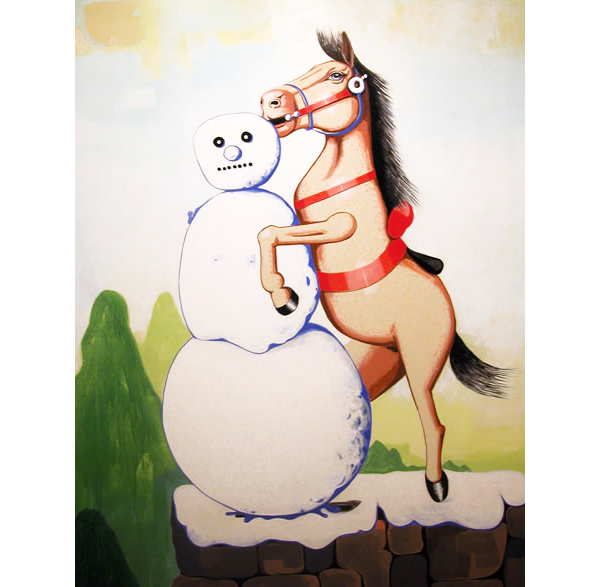
-These works were created by New York based artist David Humphrey for the installation Snowman in Love at Triple Candie, NY, 2005.

Share

Glenn Ligon

Picture 1

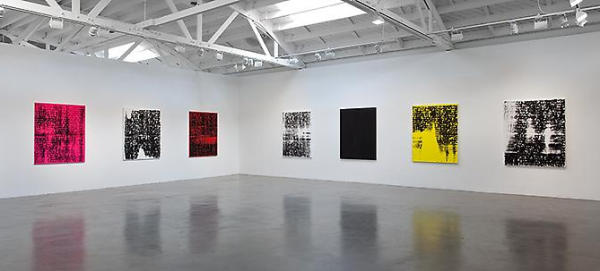
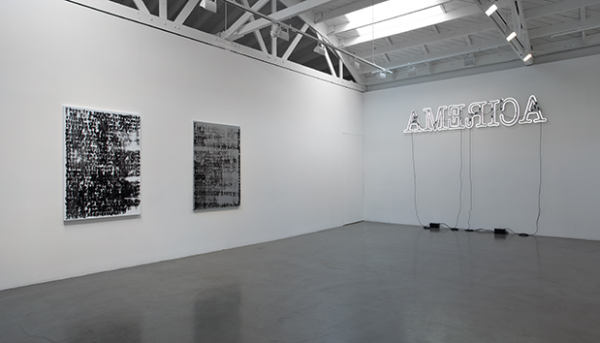
Off Book is the title of a current exhibition by acclaimed New York based conceptual artist Glenn Ligon. The exhibition, which is on view through January 23rd at Los Angeles’ Regen Projects, continues the artist’s investigation of cultural identity, social and historical constructs, language, race, and gender. Similar to previous exhibitions by the artist, Off Book explores these ideas through text-based work, installation, and video. This new series of works investigate many themes discussed in James Baldwin‘s essay entitled Figure, originally published in 1953. For this series, the artist has silk screened versions of existing text-based paintings onto colored backgrounds, and then dusted the surface with coal particles. The result is a semi-abstracted surface where the test is obscured through the application of the screen print.  Also on view is a 16 mm black and white film titled, The Death of Tom, and a neon piece, which features the word AMERICA backwards, titled Rügenfigur.

Picture 2

Ligon’s work has been the focus of several major international exhibitions. The artist’s work was selected by the Obama’s to be on loan at the White House. This inclusion made Ligon the youngest artist ever to receive this honor. Recent solo exhibitions for the artist include, ‘Nobody’ and Other Songs at Thomas Dane Gallery in London and Figure/Paysage/Marine at Yvon Lambert in Paris and Love and Theft at Power House in Memphis. The artist is a graduate of Wesleyan University and Rhode Island School of Art and Design. Ligon lives and works in New York City.

Share

Milton Rogovin

milton_rogovin1

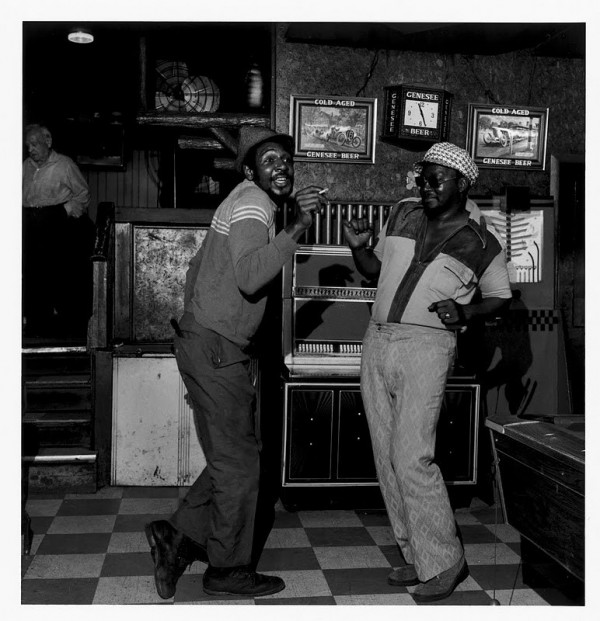
The Henry Art Gallery at Seattle’s University of Washington is hosting a rare kind of exhibition: a 100th birthday show for a living artist. Milton Rogovin, who began his career as a documentary photographer in the early 1950s and was still working as recently as 2002, will turn 100 on December 31, 2009 and the exhibition is unambiguously titled Happy 100th Birthday, Milton Rogovin!

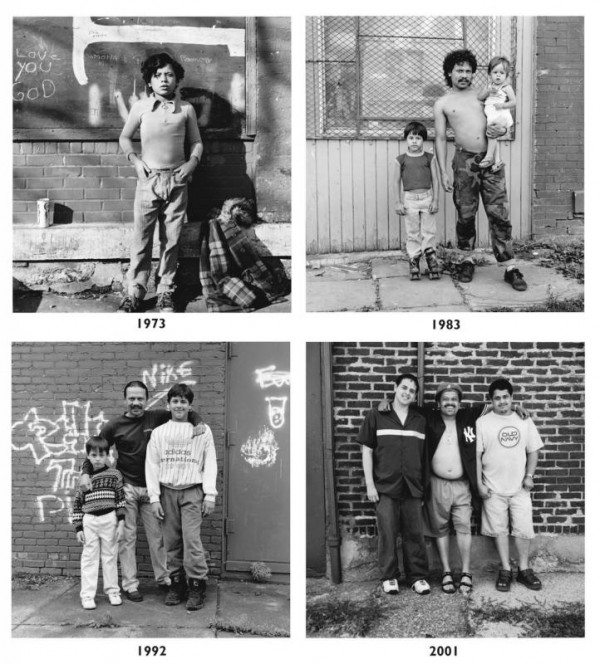
This, the end of the first decade of the 21st century, and a decade that has brought significant changes in the way documentary images work (cell phone photography and viral videos having made a particularly strong impact), seems like a prime opportunity for looking back. Rogovin’s work provides a telling lens. A former optometrist whose photography career took off after his 1952 testimony before the House Un-American Activities Committee stymied his medical career, Rogovin counted W.E.B. Dubois and Pablo Neruda among his acquaintances and was constantly using his camera as vehicle into cultures and communities different from his own. The Triptych series, in which he photographed families on the Lower West Side of Buffalo, New York three times each between 1972 and 1994, later expanded into the Lower West Side Quartets when, in the early 2000s, Rogovin once again went looking for his original subjects. The Quartets are melancholic records of a telling swath of time—images that show how much has changed, but also how much is still the same when it comes to what we want from life.

milton_rogovin2

Happy 100th Birthday, Milton Rogovin! remains on view in the Henry’s North Galleries through April 25, 2010. A concurrent birthday exhibition will be held until January 16 at Danziger Projects in New York.

Share

An Idea Called Tomorrow

Castillo, Tomorrow Brings..., 2009

Castillo, Tomorrow Brings..., 2009

Currently on view, through March 7, 2010, is the multi-venue Los Angeles exhibition, An Idea Called Tomorrow. Showing concurrently at both the Skirball Cultural Center and at the California African American Museum (CAAM), the exhibition features the work of fifteen contemporary artists who “imagine what a civil future looks like,” according to the press release, as the show seeks to inspire visitors to “reflect upon the active role we must all play in bringing about a more just, equitable, and peaceful future.” In An Idea Called Tomorrow, artists such as Castillo (her work, Tomorrow Brings… is pictured above), Graham Goddard, Yong Soon Min and Kim Abeles present work that addresses a broad range of social justice and environmental issues. Goddard’s sculpture installation, Paradigm (2009), was “designed to investigate its surrounding environment as an object consisting of a process of ongoing relationships between man and nature” and will be installed by the artist at several locations, beyond the Skirball , in an ongoing effort to continue this dialog as it sits on view in areas that are “at risk and affected by pollution, such as mountains, deserts and watersheds.”

Graham Goddard, Paradigm, 2009

Graham Goddard, Paradigm, 2009

An Idea Called Tomorrow was co-conceived by CAAM’s Visual Arts Curator, Michele Lee, with support from Erin Clancey, Associate Curator at the Skirball Cultural Center. On view at CAAM are works by artists Abdelali Dahrouch, John Outterbridge, Dominique Moody, Joyce Dallal, Charles Dickson, John Halaka, Graham Goddard, Yong Soon Min, Sonia BasSheva Manjon, Ingrid von Sydow, and Betty Nobue Kano. On view at the Skirball Cultural Center are works by artists Kim Abeles, Castillo, Graham Goddard, Dominique Moody, and Kwahuumba & Karen Seneferu.

Share

Richard Woods: Port Sunlight

845f58b3

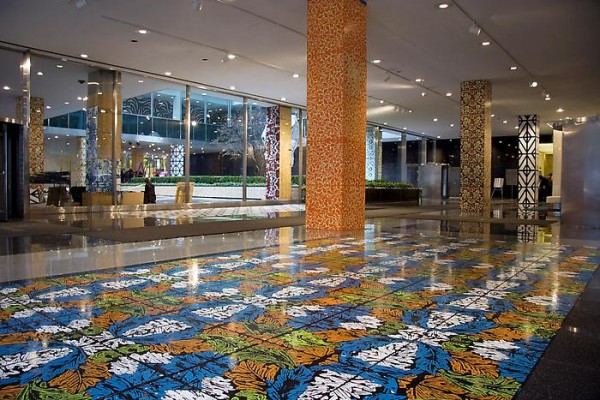
The Lever House, at 390 Park Avenue in New York City, recently commissioned artist Richard Woods to create a site-specific installation for the lobby of the Modernist structure. The installation, titled Port Sunlight, features colorful patterns that cover over forty columns, eight benches, and several areas of floor within the lobby. Each of the nine patterns utilized in the installation are created from a series of print blocks which are configured in a pattern of multiples.

For the commission, Woods explored the history of the Lever Brothers company and discovered that they founded a village near Cheshire, England, in the 1800’s  to accommodate the company’s rapid expansion. That village was named Port Sunlight. The artist grew up not far from the area, and is familiar with the Lever’s massive collection of British Victorian art, which was on public display at the Lady Lever Gallery in the village.

ec806df6

The patterns used by Richard Woods references the graphic nature of the Victorian decoration collected by the Levers. These patterns attempt to take over and colonize the otherwise modernist lobby, allowing for a playful opposition to develop between the two aesthetics.

Port Sunlight will be on view through January 31st, 2010.

Share