Kara Walker: A Warm Summer Evening in 1863 (2008), courtesy of James Cohan Gallery, Banners of Persuasion and Sikkema Jenkins & Co.
Currently on view at James Cohan Gallery in New York City is the exhibition Demons, Yarns & Tales: Tapestries by Contemporary Artists, which runs through February 13, 2010. The show features hand-woven tapestries created by thirteen international artists, most of whom are widely known for their work in other media. Included among the artists whose work is on view are: Kara Walker, Grayson Perry, Shahzia Sikander, Jaime Gili and Peter Blake. The artists were commissioned by the London-based art organization, Banners of Persuasion, to create the tapestries specifically because the medium is so far removed from their usual practices. In the catalog that accompanies the exhibition–which includes an essay written by Sarah Kent–each artist discusses their unique approach to the unfamiliar medium in an interview.
Shahzia Sikander: Pathology of Suspension (2008), courtesy of James Cohan Gallery, Banners of Persuasion and Sikkema Jenkins & Co.
The subjects explored in the tapestries on view range from American race relations, such as is seen in Kara Walker’s A Warm Summer Evening in 1863, to an investigation into the tradition of so-called “craft” or “decorative arts,” as seen in the imagery in Shahzia Sikander’s Pathology of Suspension. Demons, Yarns & Tales: Tapestries by Contemporary Artists at James Cohan marks the exhibition’s first showing in New York; it was previously on view at The Dairy in London and at Design Miami.
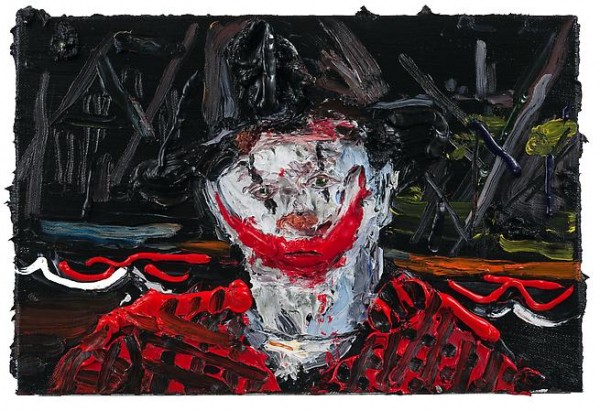
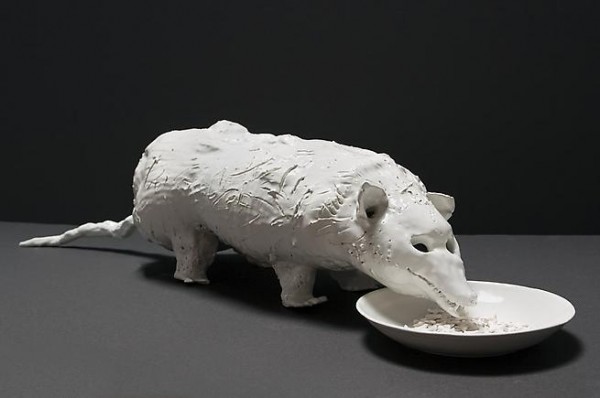
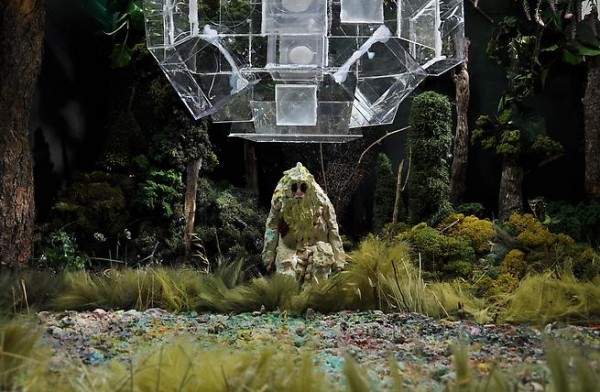
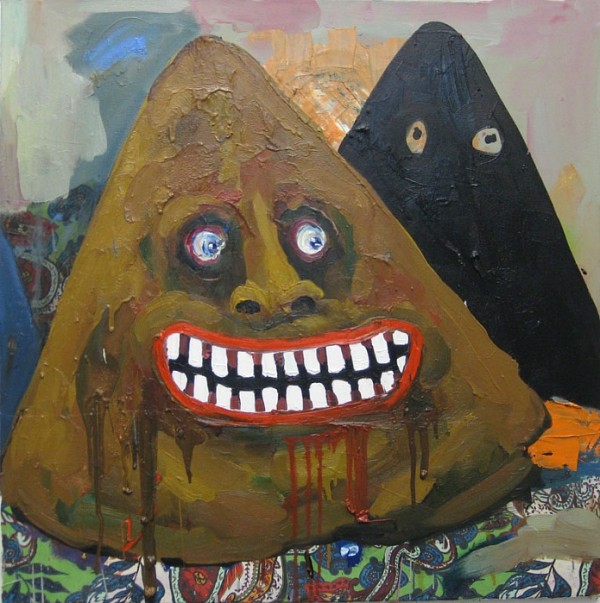
In a mystical world of hobo clowns, pet possums and rabid monkeys, Allison Schulnik‘s surreal environments playfully explore human psychology through saturated color and rich texture. The artist consistently produces mesmerizing work which combine the forms of painting, sculpture and animation, creating a body of work that speaks to a multiplicity of mediums through each manifestation. This week, DailyServing’s founder Seth Curcio spoke with the artist about her diverse artistic practice including her recent animation, Forest, which was created as the newest music video for the Brooklyn based indie rock band Grizzly Bear, and her latest exhibition Home for Hobo at Mark Moore Gallery in Los Angeles. And stay tuned! Each Monday, DailyServing.com will bring you one step closer to a new international artist through our new weekly interview series, letting you in on the secrets of your favorite artists and their upcoming projects.
Seth Curcio: You have recently completed exhibitions with great success in London, Rome and New York City. You also have an exhibition of new works currently on view at Mark Moore Gallery in Los Angeles titled, Home for Hobo. This exhibition continues to explore different emotional states through your hobo clown protagonist. Can you tell me a little about what is included in the exhibition?
Allison Schulnik: Its a little bit of his world. He’s got a home, his sanctuary. There is Rug Girl, Possum, and Klaus… friends and companions, maybe alter egos and bizarros.
SC: Within this exhibition, several different characters appear in your paintings, sculptures and animations, many of which you just named. Most, if not all, reoccur in your other bodies of your work too. How did you decide on these specific characters, and are they rendered completely from imagination or are they based on anything in particular?
AS: They come from different places. Mostly they come from drawings that I do. Sometimes I get inspired from a photograph or another painting or sculpture or film or dance or song, then I draw that or something inspired by that, and it becomes something else. Sometimes I just draw from my imagination. Often for months, even years I’ll have an image or character continuously reappear to me and not know why, until it proves important enough to get immortalized in oils. Then, I still don’t know why I painted it. One day I might figure it out.
SC: The animated video Forest, which is also on view at Mark Moore Gallery, was used as the music video Ready, Able for the Brooklyn-based band Grizzly Bear. This is the second video that you have created which utilizes a Grizzly Bear song, however this one became their official music video. Talk to me about how this collaboration began. How was the video created and what takes place?
AS: I asked them for permission to use their song Granny Diner on my last film, HOBO CLOWN. They approved and a year later they asked me to do a music video for their next album, Veckatimest. I agreed. They gave me the song, and I made an animated film for it. It is an abstract kind of narrative, if anything. It follows the Long Hair Hobo character through an alternate type world, Forest, where he encounters a bizarro world version of himself. Then things begin to happen…
SC: The animation seems like such a natural synthesis of your paintings and sculptures, and Grizzly Bear’s music really adds a different element to the work. Are there any other collaborations similar to this that you’d like to explore? I know that you play in a couple of bands, have you ever considered composing your own music for future animations?
AS: Yeah, I have a couple bands in mind I’d really like to work with. I’d like to have music composed for my next film too, rather than using something that already exists. I’ve thought about doing some sound and music myself as well, but that might not be a good idea.
SC: Learning that you are an avid painter, sculptor, animator, dancer and musician, and by viewing the myriad of works listed on your website and your exhibition schedule, it appears as if you are a very prolific artist. What is an average day like for you in the studio?
AS: Once I get into the studio I stay there all day, sometimes all night. I like privacy. I sit and stare a lot. I like to snack, and to look at stuff. I find weird little things to do. Sometimes painting comes in a very concentrated way. Then, sometimes it comes with a fury of dancing and singing. I put on some good Babs show-tunes, some epic Angel Witch, some atmospheric doomy metal, or maybe a little Peabo Bryson… it just depends on my mood. But, the music is always loud. I don’t have computer or TV at the studio, because procrastination involves those kinds of things. I just don’t have any kind of method that I can count on. One thing works one day, and doesn’t work the next day. I’m fickle with a short attention span.
SC: It seems as if you still manage to complete a lot of work even with a short attention span. What are you working on in the studio right now? And, what projects are on the horizon for you?
AS: Well, I just finished all my work work for this show, so I am taking a little break for a minute. Going to let some ideas brew in my head for bit… you’ll just have to wait and see!
Now that DailyServing has published over 1300 original articles, interviews, reviews, daily features and artist videos, we have decided to reach back into our archive and highlight some of our favorite past features each Sunday. We invite you to email us and let us know which are your favorite DS features. If we choose your selected feature, we will credit you for the selection. Just email us at info@dailyserving.com.
In the decade since her breakout success in 1996, Liza Lou has won a $500,000 genius grant from the MacArthur Foundation, kept a studio in Durban, South Africa, and continuously mesmerized the world’s critics and collectors. She works with millions of tiny glass beads, taking the traditionally craft-oriented medium and elevating it to astonishing artistic heights.
Liza Lou is currently showing work at L&M Arts in New York City, where two stories of her complex and captivating sculptures and installations can be viewed. The artist works with accumulations of tiny beads, meticulously applied with the help of studio assistants. The works exhibited at L&M Arts reference themes of injustice, captivity, and religion.
Entering the gallery, one encounters Continuous Mile, 2007-2008, a large circular sculpture composed of cotton and white beads, resembling densely coiled and intertwined rope. The beads send light dancing into the eyes of the viewer, creating a tension between beauty and bondage. The rear room houses the dramatic Security Fence, 2005-2007, an imposing and elegant cage structure composed of steel and glass beads. The work stands at over 10 feet tall, crowned with glistening concertina wire and theatrically placed in a room by itself and situated at an angle. The threatening connotations of confinement are tempered by the jewel-like quality of the surface. The silver beads reflect light and visually entrance the viewer despite this undercurrent of violence.
As you ascend to the second floor via a grand winding staircase, you are able to circle Tower, a latticed steel structure composed of five cages stacked on top of one another and covered with white beads. Tower extends over thirty feet, into the third story of the gallery, which is roped off, adding a forbidden quality to the work. On the walls of the front and rear rooms of the second floor, Liza Lou presents her new series, Reliefs. These are vertically oriented panels that represent Muslim prayer rugs and mix strict geometrical patterning with abstraction, such as in Offensive/Defensive, 2008. They are larger than human scale and are executed with an impressive precision. The panels have a topographic surface, carefully and meticulously constructed to achieve stunning variations in depth and color.
Self-Portrait (Face Down), 2006 is a cast resin pillow covered in glass beads with the impression of the artist’s face, an uneasy suggestion of suffocation. This work of art captures the qualities that are pervasive throughout the exhibition, the tension between the threat of imprisonment and the astonishing beauty of the works themselves. The architecture of the gallery itself provides an interesting juxtaposition to the glistening contemporary works of Lou. The winding staircase, the crown moldings in every room, and the arched windows provide a formal environment for her sparkling works.
Liza Lou’s choice of medium, her incredible compulsion to create, and the dedication to her process are truly amazing. While she often receives the label “obsessive,” Lou shrugs this off by stating, “What’s far more frightening for people is to consider the possibility that I’m completely aware of what I’m doing.” Liza Lou transforms the bleak apparti of bondage and imprisonment into astonishing works of art, evoking, at once, the tragedy and beauty of life.
LIKENESS is the current group exhibition at the Mattress Factory Museum of Installation Art that examines human depiction during a post-Warholian era in which new technology has played an influential role. It includes the work of artists Jim Campbell, Paul DeMarinis, Jonn Herschend, Nikki Lee, Joseph Mannino, Greta Pratt and Tony Oursler. Elaine A. King, who is a freelance critic and curator as well as a professor at Carnegie Mellon University teaching Art History/Theory/Museum Studies, has guest-curated the exhibition.
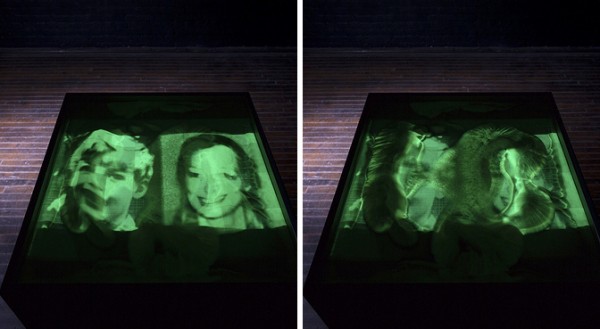
Among the offerings is Paul DeMarinis’ new work, Dust. With this work DeMarinis explores facial similarities, pairs of faces, and the abstraction of images into the dust. DeMarinis presents a fragment of this collection of likeness-pairs, scanned sequentially into the light-memory of phosphorescent powder. After a few minutes of exposure to the projected image, the powder retains a faint green image of the two faces on its surface, something akin to the ‘latent image’ of photographic film or the veil of memory. Unlike photographic film, though, the image starts to distort. Propelled by low frequency sound vibrations, the powder starts to flow and dance, first distorting the faces and erasing their likeness, then distorting them into patterns of abstract light in motion, with form and beauty all its own.
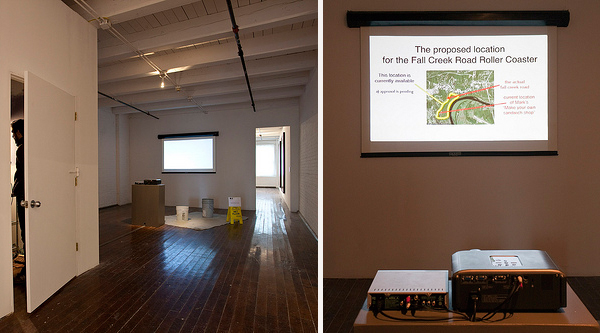
On the other end of the spectrum is Jonn Herschend’s many-sided conceptual, Self Portrait as a PowerPoint Proposal for an Amusement Park Ride. The installation is characterized by a strong sense of narrative, not strictly limited to straightforward vignettes or mimetic representation. In his complex self-portrait one finds a narrative that resembles fantasy, role-playing, fiction and a touch of reality. Herschend’s choice of subjects and materials contribute to the kind of story he opts to tell and show his audience.
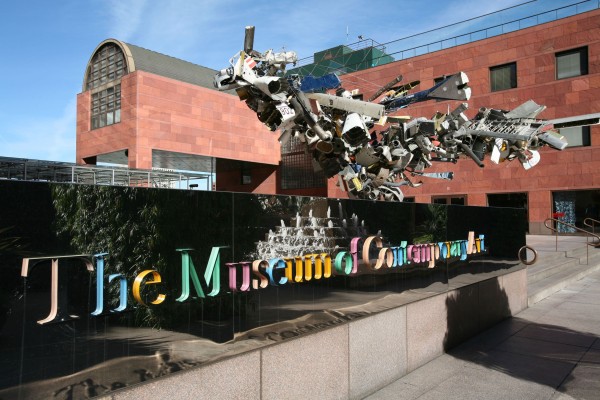
Catherine Wagley, DailyServing’s longest standing contributor is no stranger to the Los Angeles art community. Since our inception in 2006, Wagley has regularly contributed to the massive list of artist’s featured on DailyServing, while also building insightful commentary on the art happenings of Los Angeles, including the recent articles Another End to Irony, The Third Chapter of Blum and Poe and Faux Koons. Thanks to her dedication to DailyServing and the Los Angeles art community, I am proud to announce that Ms. Wagley will now be conducting a weekly column for DailyServing. It only seems fitting to start this new column with the recent news that has set the art world ablaze this week, Jeffery Deitch’s relocation to L.A.’s Museum of Contemporary Art (MOCA). Make sure to visit the site each Friday for new commentary by Catherine Wagley on anything and everything L.A.
L.A. Expanded: Notes from the West Coast
A weekly column by Catherine Wagley
Jeffrey Deitch was officially named MOCA’s director early on Monday; by the afternoon of the same day, the web homes of leading papers, art mags, and blogs were Deitch-driven blurs of cultural commentary. MOCA held a press conference on Tuesday (I was there, along with a painfully small handful of others), at which philanthropist Eli Broad, who bailed MOCA out of destitution last year, gave a speech unnervingly similar to the one he gave at the opening of LACMA’s Broad Contemporary two years ago. He again celebrated L.A. as the emerging art capitol of the world, only this time, MOCA, not LACMA, helmed L.A.’s rise.
Deitch spoke last, with a voice that wavered slightly and eyes that almost looked watery. He said he “was happy to lead” and not, as video artist Diana Thater duly pointed out, “happy to join” MOCA, its curators and its artists. He corroborated Broad, saying he would “continue to build MOCA so that, over the next decade, it is indisputably the leading contemporary art museum in the world”— it’s the sort of thinly veiled domination rhetoric that seems more unsettling coming from art executives than from world leaders.
Keith Haring, "The Ten Commandments," Deitch Projects, 2008
Bravado aside, the list of what Deitch, who’s championed many of the same artists DailyServing has featured over the years, could bring to MOCA probably outstrips his conflicts of interest: business savvy, fundraising experience, a staggering reserve of energy, contacts galore, a likable persona, familiarity with a wide range of cultural outlets (he interviewed actress Chloe Sevigny for Paper Magazine the same year he entered the Smithsonian’s Oral History Archive). Still, it’s hard to say how venture will play out in reality.
Roaming around before Tuesday’s press conference, I ran into an old timer from L.A.’s Arts District, a man who’d arrived on the scene long before MOCA opened its doors in 1979. Downtown has changed, he said. It’s been evacuated in favor of the city’s Westside, but there are young people, young partiers, who are setting up camp down here, and they’re the crowd Deitch could reach. Then, almost with the same breath he’d used to tell me of the young downtowners, the man switched gears, talking about attending Pharmaka’s exhibition of Warhol prints last year, and seeing all the young “Snoop Doggs” at the opening. After seeing these kids, and hearing the owner of the prints carelessly discuss their value, he was, of course, unsurprised when the high-priced prints went missing a few months later.
I felt I’d been handed the perfect argument for why Deitch matters—Deitch may be flashy and financially vested in a few too many ways, but he certainly knows how to disrupt stereotypes about visual culture (this is the man who championed surf/hip-hop/punk energy of the 90s, and made minimal distinction between imagery from People Magazine and actual artwork in the catalogue for his Posthuman exhibition). I don’t see him blindly equating young people who [purportedly] listen to Snoop Dogg and look at Warhols with theft.
“Los Angeles has a remarkable, young audience who responds to art in a fresh way and wants to get involved,” Deitch said on Tuesday. “Young audience” doesn’t mean the 20-somethings graduating from BFA and MFA programs in SoCal (that demographic will attend MOCA with or without Deitch); it means a graffiti-savvy demographic with street cred. If he can make that audience MOCA’s audience, he’ll have accomplished something memorable.
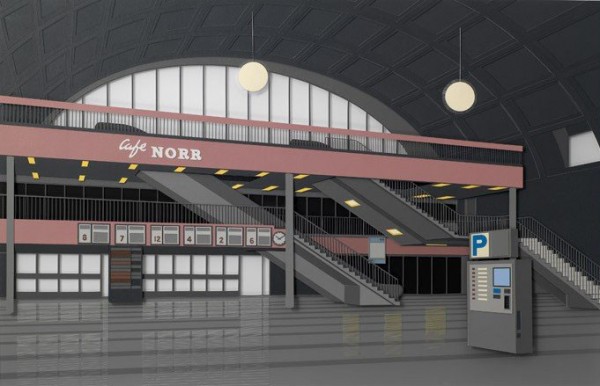
British artist Lucy Williams is further developing the definition of collage. Her detailed, low-relief work focuses on mid-20th century Modernist architecture and involves the careful layering of materials such as card, Perspex, fabric, thread and pillow stuffing. Each material is layered precisely by the artist to illustrate railings, lamp cords and other structural elements. In an interview with Wallpaper Magazine Williams said she sees her vacant images as spaces to be inhabited. “The era was about belief, ideas that we now no longer hold, of social cohesion through the design of a building, Utopian dreams long dissipated,” Williams says in her interview. She had her first solo exhibition in London in 2007 titled Beneath a Woolen Sky, at the Timothy Taylor Gallery. Williams has also exhibited with the McKee Gallery in New York in 2004 and 2006. She has her B.A. in fine art from the Glasgow School of Art and her postgraduate diploma in Fine Art and Painting from the Royal Academy.
This article has been updated from its original posting on October 25th, 2008.
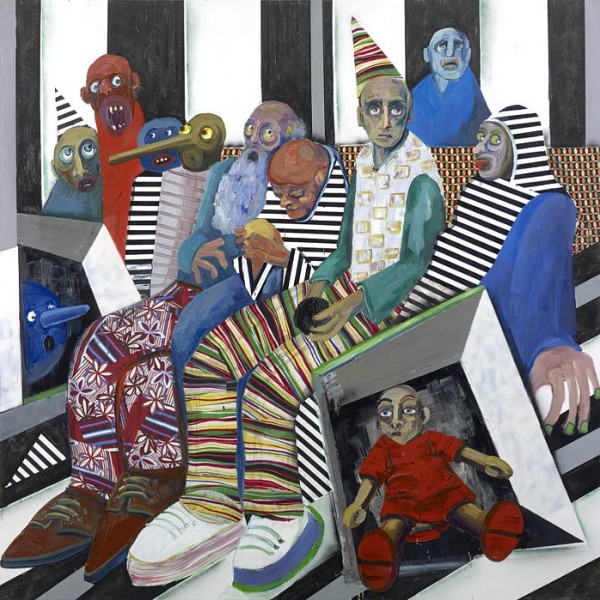
The playfully grotesque characters found in Berlin-based artist Stefanie Gutheil‘s paintings act out scenes from her daily life. Many of the subjects in her paintings are directly based on artists, musicians, dancers and poets that live and work in Berlin, alongside the artist. Gutheil has lived in Berlin for over 10 years and has witnessed the city blossom into an international center for contemporary art. Her studio, which is centrally located near much of the city’s nightlife, has provided the artist with fertile ground for artistic inspiration, exposing her to some of Berlin’s most eccentric individuals.
Gutheil’s recent paintings are the subject of the artist’s first solo exhibition with Mike Weiss Gallery and her first exhibition in New York City. Titled Kopftheater, meaning theater of the mind, the exhibition features luscious, yet imperfect paintings that are composed of oils, acrylics, spray paint and even aluminum foil, all employed to produce her larger than life scenes and characters. The artist received both her Masters and Bachelors degrees at the Universität der Künste, Berlin and has exhibited extensively in Germany including recent exhibitions at Galerie Winter in Wiesbaden and Schultz Contemporary in Berlin.