Shotgun Reviews

Diane Arbus: In the Beginning at the Met Breuer

Shotgun Reviews are an open forum where we invite the international art community to contribute timely, short-format responses to an exhibition or event. If you are interested in submitting a Shotgun Review, please click this link for more information. In this Shotgun Review, Henry Rittenberg reviews Diane Arbus: In the Beginning at the Met Breuer in New York.

Diane Arbus. Lady on a Bus, N.Y.C. , 1957; gelatin silver print; 14 x 11 in. Courtesy of The Met Breuer. © The Estate of Diane Arbus, LLC.

Diane Arbus. Lady on a Bus, N.Y.C., 1957; gelatin silver print; 14 x 11 in. Courtesy of the Met Breuer. © The Estate of Diane Arbus, LLC.

I was not even a full sentence into reading the online description for Diane Arbus: In the Beginning at the Met Breuer, an exhibition dedicated to the artist’s earliest works, before I had doubts. It was this tidbit that gave me pause: “Featuring more than 100 photographs that together will redefine one of the most influential and provocative artists of the 20th century.” I’m not above hyperbole, but come on. The beginning of any photographer’s career might show development as an artist, but would this phase redefine a photographer’s image? I doubted that seeing her path to finding her voice would redefine how I perceived Arbus in any significant way.

The setup is perhaps the most sublime part of the exhibition. Each photograph is hung on its own two-foot-wide panel, with a three-foot gap between panels arranged in rows. The physical setup of the exhibition forces viewers to stop and contemplate each photograph on its own terms. The panels and the space in between create a rhythm: look, think, rest, restart. Arranged as such, the gallery becomes a room-size contact sheet of Arbus’ work. Much like on an actual contact sheet, a number of the photographs don’t feel worthy of display, much less in a major art museum. For instance, the exhibit had numerous pictures Arbus took of movie screens. Seeing one such image is informative; seeing three, some of which are blurry or out of focus, is two too many. However, the setup forces viewers to stop and contemplate the lesser works anyway.

Read More »

Share

Fan Mail

Fan Mail: Suchitra Mattai

Suchitra Mattai’s work turns about conceptual and material inversions. It thrives on site-specificity while rejecting its basic premise—that specificity necessarily connotes place-ness. Having been raised on two separate continents and with cultural heritages tracing back to a third, Mattai is familiar with incongruities between the illusory promise of place and her lived experiences. Her practice is disjointed and dreamlike, yet throughout her uneasy landscapes runs an undeniable materiality that constantly asserts: Wherever you may think you are, or are told you are, you are here.

Suchitra Mattai. Generally, I don’t think that way II, 2016; mixed media installation; dimensions variable. Courtesy of the Artist. Photo: Wes Magyar.

Suchitra Mattai. Generally, I Don’t Think That Way II, 2016; mixed-media installation; dimensions variable. Courtesy of the Artist. Photo: Wes Magyar.

This assertion of immediacy may be a defense mechanism against the double vision present in Mattai’s pieces. They offer a kind of boundlessness while declaring a border, leaving the viewer to wonder at their frame of reference. Generally, I Don’t Think That Way II (2016) expands and contracts, extending from a central mixed-media embroidery work, to a painted mountain range truncated by an imaginary frame, which in turn is extended further by colored thread and rope affixed to the gallery walls. The rope drawing expands outward from the traditional perimeter of the painting, pushing beyond strict boundaries. The eye trips across multiple borders, simultaneously drawn in by the sumptuousness of the embroidery or the evocative texture of the brushstrokes while being stopped short by their finitude. It is only at the haphazard knots and trailing ends of the rope and thread that one is cast back from these landscapes into the gallery space. By maintaining a distance—the viewer’s prerogative—one can pull out from the tensions of the piece, yet this figurative “stepping back” provides a kind of rootedness that Mattai’s works themselves reject.

Read More »

Share

Buenos Aires

Excéntricos y Superilustrados (Eccentrics and Ultra-Enlightened)

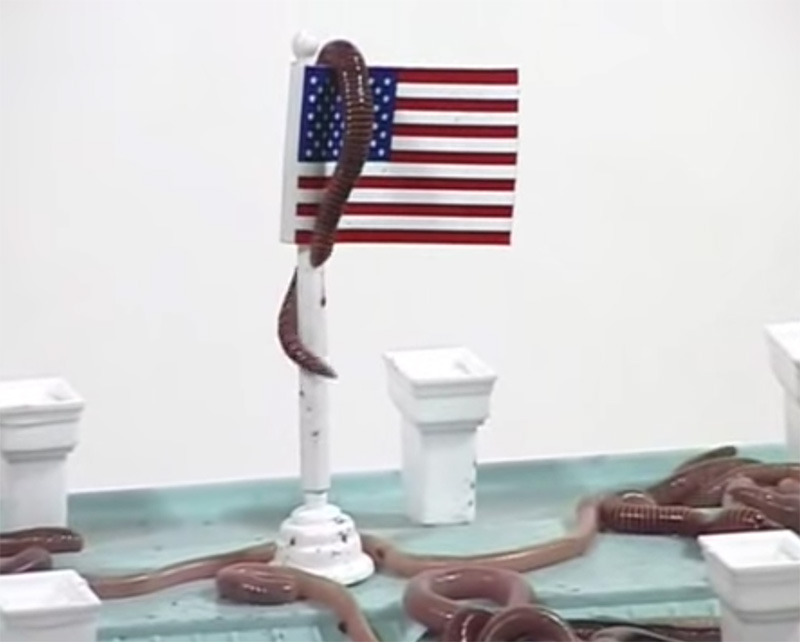
There is a worm in the White House. A sneaky, repulsive, tiny worm crawls through its corridors, aisles, and rooms. It sticks its head out, and slides from the balconies. This earthworm is not alone. There is more than one. In fact, there is a legion of earthworms in the White House, and they won’t be leaving; it is theirs now to keep. This is the situation presented in White House (2005), a transparent and highly political performance first presented by Argentinian artist León Ferrari in 1980 at the Sao Paulo Biennial. Now, White House is displayed as a video made by the artist in collaboration with film director Ricardo Pons, and is one of the opening pieces of the group exhibition Excéntricos y Superilustrados (Eccentrics and Ultra-Enlightened), at the Museo de Arte Moderno de Buenos Aires. Curated by Javier Villa, Sofía Dourron, and Laura Hakel, the exhibition comprises twenty-six Argentinian artists and a multigenerational selection of work from 1920 to 2016. The exhibition could have easily been divided and displayed chronologically to establish historical context, but instead—thanks to the acuity of the curators—enhances dialogue by mixing artistic strategies, moments in history, and ways of seeing the world, one where art and life cannot be conceived apart.

León Ferrari and Ricardo Pons. Casa Blanca (White House), 2005; recording of performance; 6'32''. Courtesy of Museo de Arte Moderno de Buenos Aires. Photo: Tania Puente.

León Ferrari and Ricardo Pons. Casa Blanca (White House), 2005; recording of performance; 6’32”. Courtesy of Museo de Arte Moderno de Buenos Aires. Photo: Tania Puente.

While Ferrari’s piece might reinforce a strong position toward international politics, specifically those of the U.S., the overall attitude of the artists in Excéntricos y Superilustrados is not one that claims or strives for a new center; inside and outside of the art world, these artists’ professional and personal paths have always been marginal, and it is from the borders that they have been able to find creative and performative freedom. This methodology is confirmed using four sections that are the exhibition’s organizing principles: political thought, experimental language, style and the representation of identity, and the figure of the artist.

Read More »

Share

Los Angeles

Alex Da Corte: A Season in He’ll at Art + Practice

There is a scene early on in Lamberto Bava’s 1986 low-budget Italo-horror schlock fest Demons 2: A sinister figure is seen limping down a hallway. He enters a room, picks up a knife that is covered in what looks like blood, and wipes it on his soiled apron. The camera then reveals the source of the gory substance: a jar of syrup that has been knocked over. The man is identified as a baker and goes about decorating a cake for a woman’s birthday party. The scene of once-impending terror is defused with a comedic twist. This mix of dread and absurdist humor provides an appropriate framework for viewing Alex Da Corte’s immersive theatrical installation A Season in He’ll at Art + Practice.

Alex Da Corte, A Season in He'll, installation view. Courtesy of Art + Practice, Los Angeles. Photo by Joshua White.

Alex Da Corte. A Season in He’ll; installation view. Courtesy of Art + Practice, Los Angeles. Photo by Joshua White.

Upon entering the gallery, it is clear that the viewer is not in a conventional white cube. Da Corte has created a phantasmagorical wonderland, transforming the space through tile flooring, painted walls, and colored lights, while also incorporating olfactory elements with rose, sage, and clove-scented misters. The exhibition takes its title from Arthur Rimbaud’s 1873 prose poem A Season in Hell, which describes the young author’s drug-fueled descent into madness after the dissolution of his tempestuous affair with fellow poet Paul Verlaine. Rimbaud has provided inspiration to a long line of cultural and countercultural figures, from the Surrealists to the ’70s East Village punks like Patti Smith and Richard Hell (who took his stage name from the same Rimbaud poem). Da Corte is drawn to Rimbaud’s work, not only for the way it breaks with conventional reality, but also for its frank and uncompromising descriptions of queerness.

The first object encountered in the installation is a large black cone rising up from a flat circular disc: a witch’s hat blown up to the size of absurdity, referencing both lighthearted escapist fantasy as well as the historical trauma of persecution. A large vintage photograph mounted on the wall continues this sense of ambiguity, capturing a weeping young woman being consoled by a shaggy haired figure. What at first appears as the aftermath of a tragedy is actually a wedding photo—tears of joy rather than tears of pain. A neon sign spelling out “night” with twinkling stars hangs on the wall—a direct, if somewhat cryptic, quotation from Demons 2, where an identical version oddly graces the protagonists’ apartment wall. But viewers need not be familiar with the reference to get the allusion to “the witching hour,” the nocturnal period when occult and supernatural powers are at their peak.

Read More »

Share

From the Archives

From the Archives – Help Desk: Self-Promotion

This week’s Help Desk art-advice column looks back to a question from a “feral” artist and provides some strategies for self-promoting an exhibition. Got a question for our Help Desk? Submit your queries anonymously here

I’m an artist in [redacted city] and I just got a solo show at a little gallery. I have no idea how to promote it. I didn’t go to art school and I’m sort of feral, as in I don’t have a huge group of people to invite. I’m lost on how to market the show. I’ve made a list of some galleries and thought I would send them invitations, but where do I start?

Andy Warhol, People on the Street, ca. 1980. © Andy Warhol. Gift of The Andy Warhol Foundation for the Visual Arts, Inc. RISD Museum, Providence, RI.

Andy Warhol. People on the Street, ca. 1980. Gift of the Andy Warhol Foundation for the Visual Arts, Inc. RISD Museum, Providence, RI.

Congratulations! Marketing a show isn’t hard—it’s all about being organized and targeting the right people—and I’m happy to help. The first thing you need to do is read my 2013 column on writing a basic press release (and pay attention to the initial comment below the article, because it adds a good point that I forgot to mention). Once you’re done reading, draft your press release, have a few people give you some feedback, and revise accordingly.

Once the press release is done, you’ll need one to three images of the work that will be in the exhibition. The artwork should be well lit, in focus, and photographed against a white background. There shouldn’t be anything else in the frame; if you’re unfamiliar with the basics of documenting artwork, this four-minute video will be very helpful.

Now figure out to whom you will send the release and images. Your idea of making a list of galleries is perfect—and before you hit “send,” I want you to take a long, hard look at that list. Blasting a lot of strangers has rarely worked to anyone’s advantage, so ask yourself: Do these galleries exhibit work like yours? Are they likely to be interested? If yes, you’re cleared for takeoff. If no, take them off the list. And if you still honestly feel there’s some compelling reason to contact them, make sure you’re sending the email with a personal note above the text of the press release: “I know you only represent artists from China, but I love your gallery and have been inspired by the work I’ve seen there over the last three years. I would be honored if you came to see my show.” (And since emailing galleries is a little like sending an application, read these tips on thinking strategically.)

Read More »

Share

Washington, D.C.

Why Museums Should Be a Safe Space to Discuss Why #BlackLivesMatter

Today, from our friends at Smithsonian Magazine, we bring you Menachem Wecker’s piece on the Smithsonian Museum of African American History and Culture’s panel  “History, Rebellion, and Reconciliation.” The symposium “proved even timelier than organizers could have possible imagined,” taking place less than a week after the death of Freddie Gray in police custody. In the wake of seemingly endless tragedy, the Museum of African American History and other museums (most recently, the New Museum) have served as sites of support and discourse for black communities and #BlackLivesMatter allies.  This article was originally published on April 29, 2015.

blacklivesmatter

The deputy director of the Smithsonian’s National Museum of African American History and Culture had a problem. At the April 25 symposium “History, Rebellion, and Reconciliation,” her panel was a no-show. A law professor and two writers were late and had yet to appear.

So to fill the gap, Kinshasha Holman Conwill called upon “Brother Ellis” and with some heavy coaxing, she convinced Rex Ellis, the museum’s director of curatorial affairs, to sing a duet—a rendition of Bernice Johnson Reagon’s “Ella’s Song.”

“We, who believe in freedom, cannot rest until it comes,” they sang. “Until the killing of a black man, a black woman’s son, is as important as the killing of a white man, a white woman’s son.”

That move, in many ways, defined the spirit of the day-long symposium. The event featured speakers that ranged from the award-winning director Ava DuVernay (Selma) to the Pittsburgh-based emcee and community activist Jasiri X, and pastor Osagyefo Sekou to Black Alliance for Just Immigration executive director Opal Tometi.

Read the full article here.

Share

Shotgun Reviews

Lou Beach: End of Days at Jack Fischer Gallery

Shotgun Reviews are an open forum where we invite the international art community to contribute timely, short-format responses to an exhibition or event. If you are interested in submitting a Shotgun Review, please click this link for more information. In this Shotgun Review, Maria Porges reviews Lou Beach: End of Days at Jack Fischer Gallery’s Minnesota Street Project location in San Francisco.

Lou Beach. Poltroons on Parade (Pigeon! Pigeon! Pigeon!), 2016; collage; 33 x 26 inches. Courtesy of the Artist and Jack Fischer Gallery. Photo: Lou Beach.

Lou Beach. Poltroons on Parade (Pigeon! Pigeon! Pigeon!), 2016; collage; 33 x 26 in. Courtesy of the Artist and Jack Fischer Gallery. Photo: Lou Beach.

In Lou Beach: End of Days at Jack Fischer Gallery’s Minnesota Street Project location in San Francisco, a selection of twenty-three recent collages by the artist provides a deeply satisfying experience of the inventive, funny, and sometimes slightly disturbing world of the Los Angeles artist’s unconscious. For many pieces, Beach begins with a patinaed background image: a vintage lithograph of a seaside sunset, a country road in autumn, or, as in Poltroons on Parade (Pigeon! Pigeon! Pigeon!) (2016), a sunny view of ancient Roman buildings. Beach transforms these bland scenes by adding strange and hilarious figures that can be truthfully described as animal, vegetable, and mineral, built out of what must be a massive collection of paper ephemera and then sometimes enhanced with drawing or painting. Titles provide some clues as to the actions taking place, but to a certain extent, it is up to the viewer’s own id and superego to fill in the blanks.

Read More »

Share