Adam Ekberg

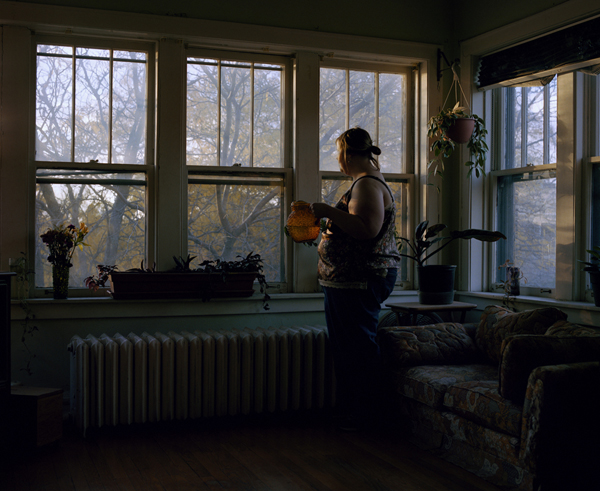
In it’s final week at  Thomas Robertello Gallery is an exhibition of new photographs and video by Chicago-based artist Adam Ekberg.  Continuing with the use of lens-based phenomena, humble celebratory gestures, and primitive constructs, Ekberg further develops two distinct bodies of work; images created in the woods or nature, and images using his apartment as stage set.

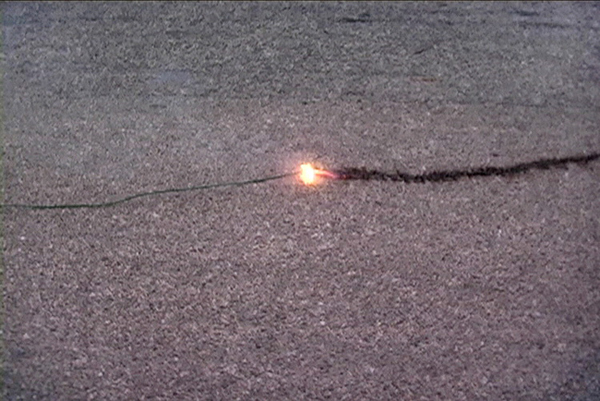
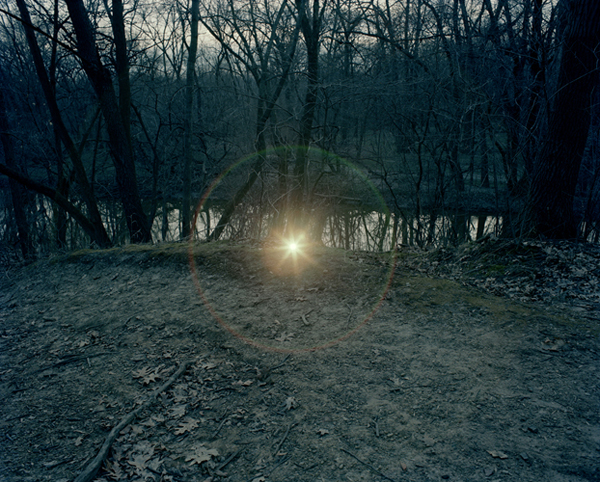
While similar to the performative aspects of Ekberg’s interiors, the outdoor imagery, boundless in many ways, allows the artist to abandon certain restrictive elements and celebrate a personal communion with nature. The positioning of a flashlight on the ground creating an illogically placed beacon of light on the horizon, a duet of balloons in Precise Equilibrium; one helium and one filed with the artist’s breath, and a thrown handful of glitter all point toward self-portraiture minus the actual subject. In his video of a fuse slowly burning on the pavement, the gnarled line gradually disintegrates staining the pavement with a residue of gunpowder, evoking a whole life with beginning, end, unexpected twists, a past, present, and future.

Adam Ekberg resides in Chicago and graduated the School of the Art Institute‘s MFA Photography program in 2006. Concurrently with this exhibition, he is participating in Elements of Photography at the Museum of Contemporary Art Chicago, organized by Michael Green and (Re)Collect at the Hyde Park Art Center, curated by Francesca Wilmott.

Share

Interview with Ewan Gibbs

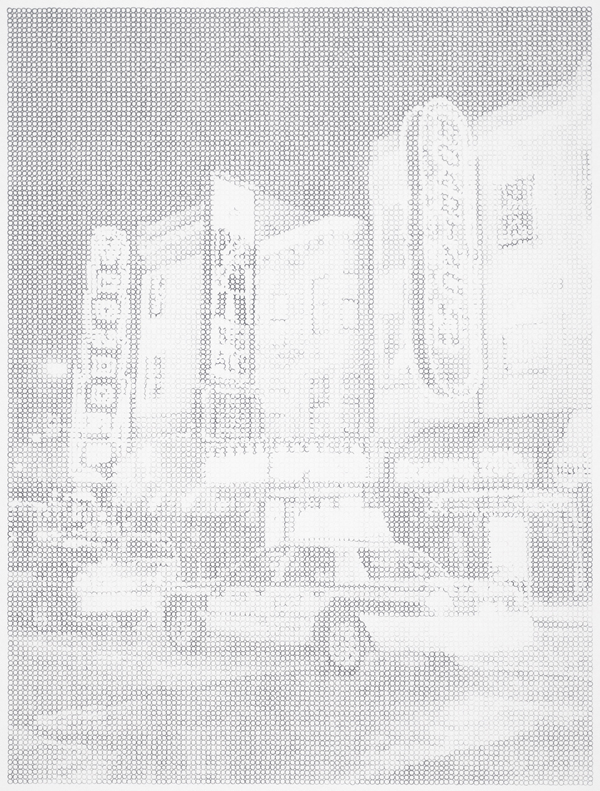
As part of their 75th Anniversary celebration, SFMOMA commissioned British artist Ewan Gibbs to make a series of “urban portraits” of San Francisco based on snapshots the artist took last year.  Addressing the delicate, pixellated, hand-rendered portraits, SFMOMA curator Henry Urbach said, “…they hover between photography and drawing, between the documented and the half remembered.”  The 18 drawings that comprise Gibbs’ first solo museum exhibition are on view until June 27, 2010.  Daily Serving’s Bean Gilsdorf talked with Gibbs before he flew back to England.

Ewan Gibbs, San Francisco, 2009; graphite on paper, 11 11/16 x 8 1/4 in.; Commissioned by SFMOMA; © Ewan Gibbs; photo: courtesy the artist and Timothy Taylor Gallery, London

Ewan Gibbs, San Francisco, 2009; graphite on paper, 11 11/16 x 8 1/4 in.; Commissioned by SFMOMA; © Ewan Gibbs; photo: courtesy the artist and Timothy Taylor Gallery, London

Bean Gilsdorf: How long have you been drawing?

Ewan Gibbs: I started making the work that was the origin of this in 1993, when I was twenty. I came across this language based on knitting patterns and I knew then that this was the thing I was going to do.

BG: When you say “language based on knitting patterns”, what do you mean?

EG: Basically, I had been making paintings that were quite derivative of Lichtenstein: acrylic, flat color, black outline. I was very interested in interiors, but I just felt like it was all too derivative. I was almost paralyzed by the possibilities that were out there. And I just stopped doing anything—it’s a weird place to be, but typical of being a student—and then I found a book on knitting patterns where there’s a grid, and different marks determine what color [yarn] you use.

BG: And what was it that drew you to that?

EG: Well, it’s a functional language, but it can also be quite naturalistic. [In the patterns] they use a darker mark to describe darker areas. There was a practicality, it had another purpose other than as just a drawing. I had people make me needlepoints based on my drawings and I made a couple, as well.

Read More »

Share

From the DS Archives: Environments

Originally published on: August 7, 2008

Kim-Stringfellow-8-6-08.jpg

The artists in Environments are living in the here and now, responding to Global Warming, going green, and pollution with down-to-earth sincerity. Curated by Al Nodal, currently president of the Los Angeles Cultural Affairs Commissions, the exhibition emphasizes the role artists play as citizens and is part of the 18th Street Art Center‘s Future of Nations Series.

Environments is ultimately about engagement: How can citizens actively and effectively engage environmental problems? The artists involved represent a confluence of international, socially active aesthetes. The multi-disciplinary team Los Animistas, 18th Street’s current artists-in-residence, explore the cultural relationship between humans and nature; Ala Plastica is an Argentina based organization that collaborates with scientists and environmentalists; Lauren Bon is best know for her Not a Cornfield project, in which she turned inner city brownfield into a fertile community cornfield; Natalie Jeremijenko runs a research lab out the art department at UC San Diego, studying landfills, pollutants and other environmentally pertinent phenomena. Each artist or collective in Environments is taking a different, aware approach to citizenship and the exhibition as a whole is a hopeful glimpse into what might happen if the boundaries between art and life continue to break down.

Share

Ron Mueck

Wild man 2005 © Ron Mueck courtesy Anthony d’Offay, London

Resonant with the uncanny impression of human presence, Ron Mueck’s hyperreal sculptures provoke a queasy fascination in the viewer. Their porous, synthetic skins are painstakingly embedded with details like body hair, fingernails and sweat. However, their unnatural scale offsets the familiarity of the ordinary bodies on show—miniature or gigantic, they possess an otherworldliness that unsettles and enthralls. Simultaneously grand and vulgar, nestled somewhere between fine art and artisan traditions, Mueck’s sculptures have drawn on canonical art historical sources while echoing the ‘low’ history of wax’s all-too-real simulation of the human body.

This contradiction is reflected in Mueck’s background—the son of German toymakers in Australia, he crossed into contemporary art after a career in puppetry and special effects (he worked with Jim Henson on Sesame Street, the Muppet Show and Labyrinth) with the Charles Saatchi-commissioned Dead Dad, which was included in the influential exhibition Sensation: Young British Artists from the Saatchi Collection. An exhibition at the National Gallery of Victoria, Australia, is currently showing Dead Dad, other well-known works, and some new works on show for the first time.

Youth © Ron Mueck courtesy Anthony d’Offay, London

Of the new works, the tiny Youth, investigating a gash on his ribs with disbelief, recalls any number of art historical Doubting Thomases probing the wound that becomes a threshold between skepticism and faith, appropriate for a hyperreal work that blurs distinctions between reality and illusion.

Drift 2009 © Ron Mueck courtesy Anthony d’Offay, London

The miniature Drift presents an almost cinematic slice of life that draws attention to the strangeness of the standard viewing format for art as well as the screen—the recumbent man floats vertically on a chlorine-blue wall, so we look across to him while looking down on him.

Still life 2009 © Ron Mueck courtesy Anthony d’Offay, London

A plucked ostrich-sized chicken hangs by its feet in Still Life, Mueck’s only lifeless subject other than Dead Dad. Both of these works emphasize the already deathly aspect of the hyperreal sculpture, in which cold, motionless flesh always possesses morbid undertones. The work’s allusion to the still life or ‘nature morte’ tradition is made obvious through its title, while the reverse cruciform pose of the weighty, tragic chicken seems to parody the institutional worship of corpses in other contexts.

Ron Mueck at National Gallery of Victoria 22 January – 18 April 2010

Share

Sabbath and Self-Assurance

L.A. Expanded: Notes from the West Coast
A weekly column by Catherine Wagley

Religion and art seem equally good at revealing people’s vulnerabilities, which is perhaps why the sacred often works so well as a subject for artists.

Nira Pereg, "Sabbath 2008," Still, 2008. One Channel High Definition Video with Sound, 7 min. 12 sec. loop, Edition of 7, 16:0 PAL 2 Ch Stereo. Courtesy Braverman Gallery, Tel-Aviv, Israel.

A month ago, I attended mass and was struck by how devout the acolyte looked, holding his brass candle-lighter and wearing his white robe. Then, following the service, I saw the same boy sans uniform, dressed in baggy jeans and impishly chasing girls through the parking lot. I did some cursory research after that, looking into how preteens came to be the church’s honorary lighters and snuffers of altar candles.

What I discovered wasn’t quite what I was looking for: the story of St. Tarcisius.

Tarcisius died at age 12, the victim of bad timing, bad laws, and misdirected passion. An acolyte in the early church, Tarcisius job probably didn’t differ much from today’s acolytes and altar boys: lighting candles, holding bibles, sitting and standing at the right times.

His problems began when a deacon came up missing (I don’t know whether said deacon fell victim to Roman centurions, or a common cold). No one could take the sacrament to the elderly and ill Christians, so Tarcisius hid the holy bread and wine under his coat– at this point, Christianity was against the law–and went out.

There’s some controversy over what happened next. Some say Tarcisius met two hostile Roman guards. Others say he met a group of boys, non-Christians his own age, some of them former playmates. I’m partial to this second version. In it, the boys asked Tarcisius to join their game (try as I might, I can’t picture them playing anything other than basketball), but he said “no,” maybe with a little too much self-importance (after all, he had Christ’s body and blood under his cloak). Feeling slighted, the boys began to tease  Tarcius, asking what he was hiding. Feeling bold and maybe even a little holier-than-thou, Tarcisius became stoically obstinate, like Joan of Arc joined with a little Paul Newman from Cool Hand Luke. One boy let slip that Tarcisius was Christian, unleashing a brutality that surprised Tarcisius’ assailants as much as it surprised him.

Kehinde Wiley, "Christian Martyr Tarcisius," 2008, oil on canvas; and the 1868 sculpture by Alexandre Falguiere French upon which it was based.

Kehinde Wiley, "Christian Martyr Tarcisius," 2008, oil on canvas; and the 1868 sculpture by Alexandre Falguiere French upon which it was based.

I thought of Tarcisius while at the Santa Monica Museum of Art (SMMOA) this weekend, watching Nira Pereg’s video Sabbath. While not at all about child brutality or premature martyrdom, Sabbath is about the self-importance that comes from having sacred responsibilities (or responsibilities somehow tied to something sacred) and it gives a pitch-perfect portrait of the sincerest kind of confidence, the kind that belongs only to those who believe in what they’re doing.

Set in orthodox Jerusalem neighborhoods, Pereg’s video depicts the ritualistic closing off of roads and thoroughfares in anticipation of the day of rest. Wobbly gates are dragged across streets, primarily by young men, and the grating of the metal upon the pavement is often the only sound. The video has the crisp, non-nonsense feel of a documentary.

In one scene, a teenager who has just positioned a final, unwieldy barrier across a relatively wide road urgently waves both hands, warning an approaching vehicle to stop; it won’t be let through. In another scene, a younger boy gets distracted mid-job and cluelessly stands in a merge lane until the honk of an oncoming car brings him back to attention.

Nira Pereg, "Sabbath 2008," Still, 2008. One Channel High Definition Video with Sound, 7 min. 12 sec. loop, Edition of 7, 16:0 PAL 2 Ch Stereo. Courtesy Braverman Gallery, Tel-Aviv, Israel.

The ritual of road-blocking seems like a rite of passage, and an empowering one. It makes you wonder if that endearing, confidence the young people in Sabbath display (there are older figures in Pereg’s work, too, but the young ones commanded most of my interest) could spill over into the other areas of their lives without coming off as self-righteous. But it also makes you painfully aware of the fact that road blocks can keep confidence contained.


Share

VERSUS

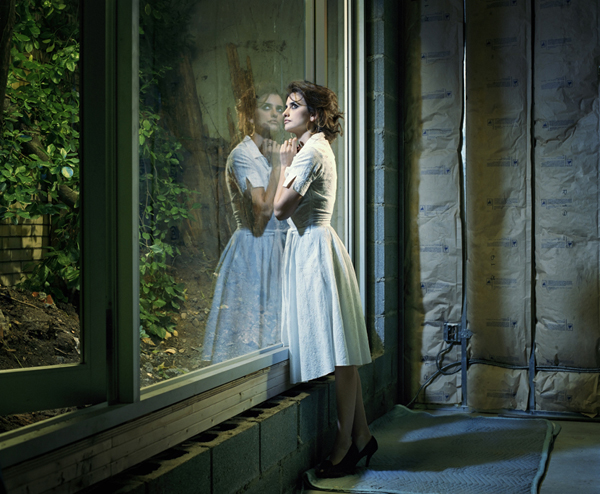
Eric Ogden, untitled (penelope cruz), 2009

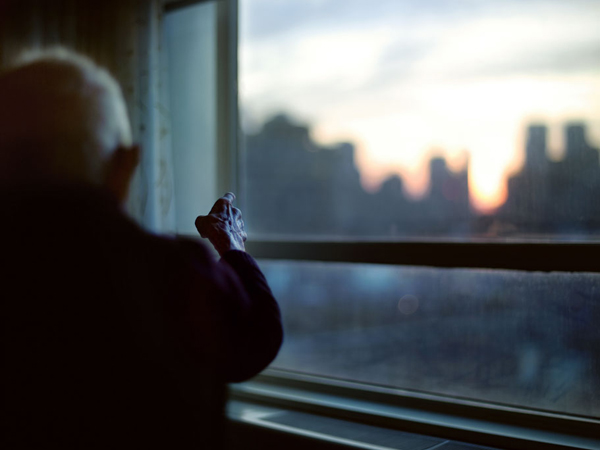
Currently on view at Hous Projects in New York is the exhibition Versus—a unique sort of survey featuring 18 seminal photographers of our time. Curated by Ruben Natal-San Miguel, whose work is also exhibited in the show, Versus pairs these emerging and established contemporary photographers with one another according to similarities—and striking contrasts—in subject matter, theme and aesthetics. The photographers explore ideas of ideal beauty, subjects of idolatry in America, relationship dynamics, juxtaposing stages of life and architectural and environmental moods. Some of the comparisons and contrasts between the paired photographs are more subtle, while other times the images seem to mirror one another. The visual motifs presented by the photographs on view are equally striking. Deep shadows conceal some scenes while others employ repetitive pattern to contrast with meek looking portrait sitters.

Jen Davis, untitled (2005)

Jen Davis, untitled, 2005

The full roster of pairings includes: Mickalene Thomas VERSUS Nadine Rovner, Hank Willis Thomas VERSUS Cara Phillips, Jen Davis VERSUS Eric Ogden, Brian Ulrich VERSUS Alex Leme, Amy Elkins VERSUS Molly Landreth, Matthew Pillsbury VERSUS Kris Graves, Zoe Strauss VERSUS Ruben Natal-San Miguel, Phil Toledano VERSUS Elizabeth Fleming and Michael Wolf VERSUS Gina Levay. Selected work from Versus was also recently on view at Photo LA in Los Angeles, courtesy Hous Projects.

Phil Toledano, Looking at the Sunset, 2008

Share

Peter Peri at Bartolomi Gallery

Odilasque

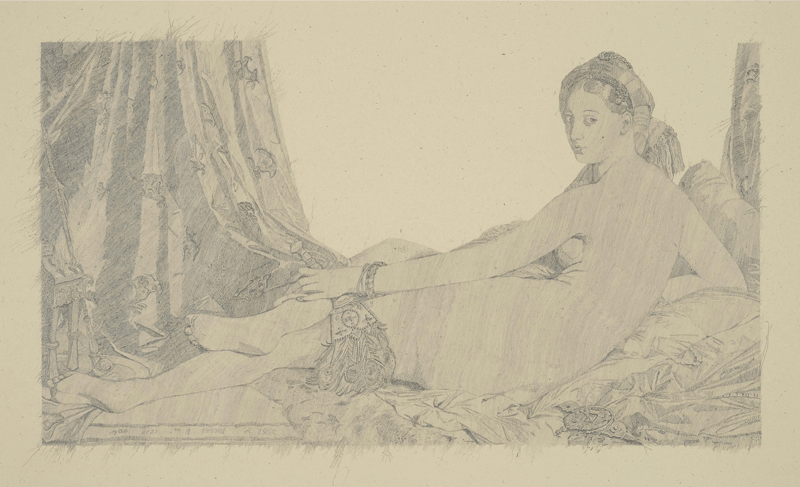
Bortolami Gallery in New York City is currently featuring works by London based artist Peter Peri.  Peri’s show, which includes drawings, sculptures, and paintings, revolves around three figurative themes:  head, seated man, and reclining woman.  Although Peri uses these themes in each medium, his execution in each material is startlingly different.  The level of obsession and detail in the fine drawings which are created through a congestion of graphite lines on unbleached paper hint at a larger interpretation.  Upon further investigation the viewer discovers tiny obscure writing, miniature cartoon-like doodles, and his charming “Odalisque” drawing is a mirror-image rendering of Jean Auguste-Dominique Ingres‘ painting with the same title.

The three sculptures in the show, however, have an element of precariousness about them.  Each is an engineered replica in steel of objects Peri originally composed using mundane objects from his home: rolls of masking tape, cassette boxes, chess sets, and calculators.  Unlike the drawings, there does not seem to be any secret code or arcane meaning in these sculptures.  The basic geometry of each of these objects serves as the most obvious choices for Peri’s figurative assemblages; circles become breasts on a reclining woman, thick rectangles serve as a man’s body topped by a circle for a head.

Peri’s paintings successfully combine both the obsessive mark-making in his drawings with the spontaneity of his sculptures.  Described as “skewed mappings of an unknown atmosphere” by the gallery, these gloomy canvases are broken up by razor-sharp line work and tonal highlight.  The background is full of haphazard drips and variations of grays, silvers and blacks, while the geometry of the lines call to mind the mathematical rigor of artists like Jack Tworkov and Sol LeWitt.

Peter Peri received his MA in Fine Art from the Chelsea College of Art in London and his BA in Design at Central St. Martins School of Art and Design.  His show at Bortolami Gallery in New York is open until February 20, 2010.

Share