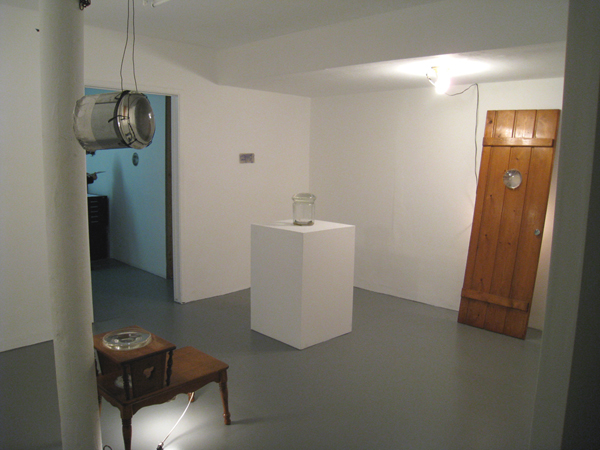
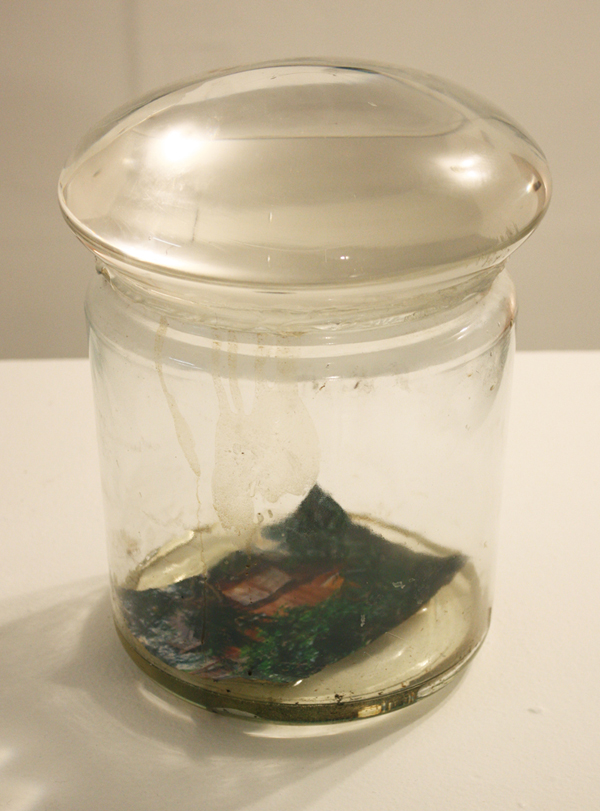
Currently on view at The Company in Los Angeles is Predicting the Present—a solo presentation of work by Tacoma, Washington-based Elias Hansen. Showing concurrently at The Company with a solo exhibition by Los Angeles-based artist, Adam Janes, Hansen approaches his chosen artistic medium of glass in much the same way as Janes does his wax, due to “a shared interest in the alchemic conversions in sculpture,” as the gallery notes, meaning that “both artists engage the process of altering solids into liquids and back into solids by their respective glassblowing and candle making.” Hansen’s work is made up of various reassembled pieces of discarded furniture and other items, which he has then attached hand-blown glass circles to. These convex windows—whether attached to furniture or the gallery wall—allow the viewer to peer into a sort of proverbial rabbit hole, wherein the other side reveals an aged-looking photograph taken by Hansen of a rundown house or vehicle. With titles like Just because you’re careful with your meth lab, doesn’t mean your house won’t burn down because of bad wiring and “Blame your son,” he said, slamming the door on his way out to the truck, the pieces recall disturbing narratives from the supposed lives of each item. It’s as if these are the dialogues you might hear whispered up from a desk in passing at a flea market or yard sale, if it could speak.
Elias Hansen studied glass at the New Orleans School of Glass and Print in New Orleans, LA and printmaking and bookarts at Whitman College in Walla Walla, WA. His work has been exhibited internationally in solo and group shows, including Kodiak at Seattle Art Museum, Seattle, WA; Wood at Maccarone, New York, NY; Sack of Bones at Peres Projects, Los Angeles, CA; Suddenly: Where We Live Now at Cooley Gallery, Reed College, Portland, OR; Kultur der Angst at Halle 14, Leipzig, Germany; and more. He was the artist in residence at Tacoma Museum of Glass in 2007 and 2008, and his work has been reviewed by the New York Times, Seattle Weekly, Seattle P.I. and elsewhere.
Marc Horowitz, a self-described “maximalist,” has permeated American culture with his socially-oriented projects and playful enterprises. His work includes video, drawing, cultural experiments, and the dynamic use of networks like twitter and youtube. In 2004, while working as a photo assistant for Crate & Barrel, Horowitz wrote “Dinner w/ Marc 510-872-7326″ on a dry erase board that was included in their fall catalog. He received over 30,000 requests for dinner dates, and began driving around the country to dine with people. The National Dinner Tour garnered attention from numerous press outlets; Horowitz appeared on The Today Show and was named one of People Magazine‘s 50 Hottest Bachelors in June 2005.
In 2009, Horowitz embarked on The Marc Horowitz Signature Series, for which he signed his name on a map of the United States and drove that route, stopping at 19 towns along the way. He documented these adventures in short webisodes. In Nampa, Idaho, Horowitz established the first Anonymous Semi-Nudist Colony (complete with complimentary jean shorts and ski masks). In Battle Mountain, Nevada, he pitched an idea to local politicians that involved changing the name of the town to something less pugnacious, suggesting the gentler alternative “Tender Pie Hill.” Other notable projects include Google Maps Road Trip and Talkshow 247.
In December 2009, Horowitz participated in a panel discussion as part of Art Basel Miami Beach‘s Video Art Program, “Video Art and Mainstream Distribution,” curated by New York’s Creative Time. Short films from The Marc Horowitz Signature Series were shown prior to the discussion. DailyServing’s Rebekah Drysdale was able to ask him a few questions about his past projects and future pursuits during an interview conducted over Skype in December.
Rebekah Drysdale: At your discussion in Miami, you mentioned you studied painting at the San Francisco Art Institute after leaving the business world. Do you think the tools you are using now, such as YouTube and Google maps, are the new media for this generation of artists?
Marc Horowitz: I think so. Painting and drawing will never die, obviously, but with the advent of the internet and the accessibility of video and broadcasting, I think that there is going to be such an insurgence of artists using these media.
RD: Your work engages the public, but seems very personal as well. What is the most influential encounter you have had in the making of your films?
MH: Omigod, there are so many of them!
RD: Can you pick one or two?
MH: The most memorable project is probably one you have never seen before. It was one I did while at the Art Institute, called Free Ideas. I went down to the corner of Market and Powell streets in San Francisco, where they turn the cable car. There are all kinds of tourists and homeless people there, the Seven Galaxies guy, preaching about the end of the world, religious people, preaching about God, and then there was me. I had two blank white sandwich boards that I made. I was handing out blank sheets of paper saying “free ideas.” People were confused. Most of the business people didn’t want to deal with me. One guy came up to me and said I was doing God’s work, for whatever reason. Several tourists thought that I was always there and wanted to have their pictures taken with me. Homeless people wanted me to write letters to their family members, so we would, and when we were done, they wouldn’t have their address. Kids wanted to have paper airplane throwing contests. I honestly think that project was what got me started in most everything I’m doing now.
RD: How did Free Ideas influence your later works?
MH: It was just taking such a simple idea as a blank sheet of paper and putting yourself out there in the world with that one element and then seeing what happens. I think that notion informed a lot of my projects after that. The Dinner Tour is the simple idea of dinner, at its least common denominator. Driving your signature across the United States is just a signature, something we use everyday. The Google Maps Road Trip was me and my friend wanting to take a simple road trip together, but not having the time or money, so we had to do it virtually.
MH: The Google Maps Road Trip was a fascinating way of seeing America. It was also a really great way to get to know Peter (Baldes). In 2003, he e-mailed me saying I should have a blog. I had no idea who he was and why he was contacting me. Nevertheless, I immediately called him up because he put his phone number in the e-mail. We talked for a bit and he seemed nice enough, so we loosely kept in touch.I didn’t actually meet Peter in person until last year at a friend’s wedding. So all in all, we had only spent about twelve hours together in-real-life before we executed GMRT, and then we shared 40+ hours together “driving” across the country virtually. For me, it was like the Dinner Tour, except I got to know a single person, Peter, much more in depth.
The technical aspects of the project get a little complicated, but basically we left my house in LA and began driving together to Pete’s place in Richmond exclusively on Google Maps. For nine straight days, we “virtually drove” across the country by zooming in all the way on Google Maps and continuously pressing the Google Maps arrow keys eastward. We broadcast the entire experience live on googlemapsroadtrip.com. This meant that folks were able to not only see and hear us as we traveled, but also join us in a real-time chat room. Just think of it as an invitation for someone to hop in the backseat and ride along with us for part of the adventure.
RD: It sounds like your interaction with Peter during the Google Maps Road Trip was similar to what travel buddies may experience on a real cross country road trip. Do you think virtual travel will become more popular?
MH: Google Maps Road Trip is very lo-fi and basic. I would love to see it be implemented in schools. You could have an American fourth grade class travel around Europe, and (time zones permitting) they could travel with European students. They could go back and forth and talk about the things that are local to them. With the accessibility of Flickr photos, YouTube, and Panoramio (Google’s photo program), you can see all kinds of stuff you wouldn’t otherwise see. You can even bring up peoples’ live broadcasts while you are traveling. So, yeah I definitely think it is the start of something.
RD: In terms of your creative process, it seems that projects like The National Dinner Tour or the Marc Horowitz Signature Series would require much more planning than something live like the virtual road trip. Do you prefer to work with a plan or broadcast live?
MH: The Dinner Tour involved a serious amount of logistical planning more than anything else. Getting places on time, setting up dinner dates, etc. And I had no help. It was just a one man army. But that was a not-for-broadcast type of project. It was more experiential. Then I did the Signature Series, which was highly planned. A lot of it was written. We had to have all of the props, the locations secured, etc. It was a different way of working for me, but I really enjoyed it. Through all of the planning, there was still a lot of room for chance because we were doing the project in public, and in that way it felt very improvisational, like my previous works.
After that, I did Talkshow 247, where I broadcast myself live for three months, twenty-four hours a day, seven days a week on talkshow247.com. This project about destroyed me. There was always a live audience chatting away, commenting on my every action. It made me feel like I constantly had to be entertaining an audience that wasn’t even physically there. I really just wanted to live my life, but it became addictive to look at the chat and see what the audience was saying, and then do things to make my life more exciting. I didn’t really like that. So, to answer the question, I would much rather do some more planned out projects in the future, like the Signature Series. That is the direction I want to head with these projects.
RD: What type of work do you show in galleries?
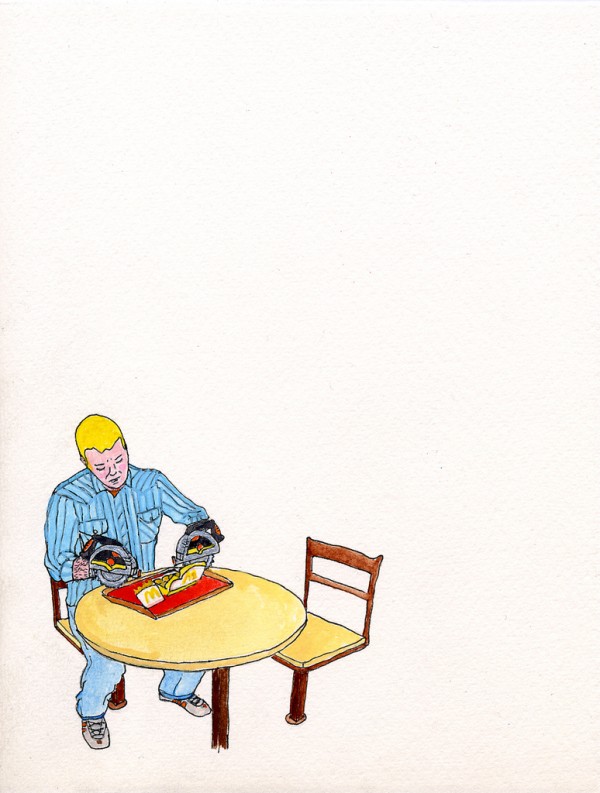
MH: I had some shows in Europe that were mostly drawings and sculptures because it is really hard to sell video art. It’s almost impossible. At some point, you have to make a product if you want to make a living as an artist, which is weird, you know? I did a show in Italy, called More Better. In it, I had made a drawing on how to make a helicopter out of a disassembled brick house and GMC truck. Really futile stuff, like a remote control bearskin rug. I made a suit of armor out of kids’ shin guards that is designed for people with a fear of sharp objects who are on a budget. Also included was The Tragedy Car Series,drawings of cars dedicated to terrible moments in history. For example, The Titanic Car. The drawings are interesting to me because I can really go way far out there, without actually having to execute these proposals. For a show I had at Nuke Gallery in Paris, I did a series called At Least You Don’t Have it This Bad. One of the drawings is a guy with circular saws for hands, and he’s trying to eat chicken McNuggets. That stuff is more fantasy-based. It’s really one big joke, they’re one liners. I like that.
RD: What are you working on now?
MH: I’m about to launch a new project called The Advice of Strangers. I’ve been working on it for about a year, but haven’t told anyone about it yet. Basically folks will be able to vote online on all my life decisions, small to large. Should I comfort the girl across from me who is crying? Do I tell my mom she should work out? Should I eat the noodle that fell on the floor that my roommate jokingly offered me? Should I start looking for a new place to live cause my landlord is an asshole? Do I move in with my girlfriend? Each decision will have a time constraint depending on the magnitude of the choice. And when the poll closes, I’ll post photo and/or video documentation of what happened as a result of the poll so people can see how their vote has effected my life.
The website for the project is www.theadviceofstrangers.com. If you are interested in participating, please check the site for the launch date.
RD: Your work certainly has a refreshingly witty appeal. Is there one last thing you would like DailyServing readers to know about you or your practice?
MH: A big component of my work is myblog, www.ineedtostopsoon.com. I am always posting fresh stuff there. Another thing that I am really into is Twitter. I’m so addicted to it. I’m using it as sort of a diary! You can follow me at www.twitter.com/marchorowitz.
Swedish painter, Sigrid Sandstrom, exhibits twelve of her newest abstract paintings at The Company in downtown Los Angeles from March 14th through April 18th. Sandstrom’s strength is revealing the paradoxical in both painting and nature. Even the artist’s preferred technique is an oxymoron–the transparent layering of opaque whites. Decision making, editing, working, and reworking are crucial elements of Sandstrom’s finished work. She purposefully leaves behind squeegee smears, paint drips, and brush marks that not only reference her process, but also signifies her work. Milky acrylic washes, often of snowcapped mountains and angular glaciers, sit underneath layers of planar geometric shapes. The polygonal shapes contrast in a variety of ways: irregular vs. regular, convex vs. concave, and rough/torn edges vs. hard/masked edges. Though the shapes are painted, they are made to look as though they are torn paper collage, textured pieces of wood, or see-through strips of masking tape. The shapes’ faux edges are yet another reference to painterly fabrication and thus, process. In her artist statement, Sandstrom mentions ” the cumulative activity of adding layer-upon-layer is the evidential aftermath of mental engagement which, in turn, insinuates and provokes the next painterly response.” By constantly juggling interactive variables, the artist explores the self-reflexive nature of decision-making and the creative process.
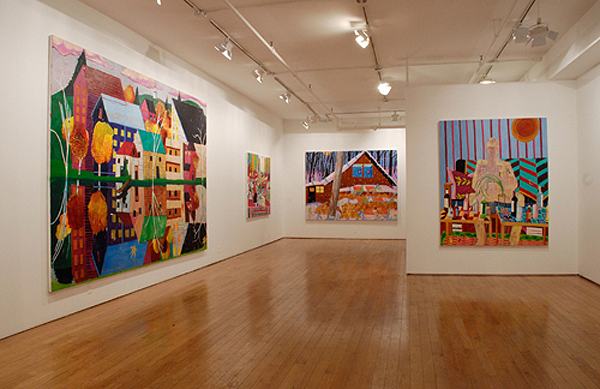
Send Me Through is the title of a new exhibition of paintings by Brooklyn-based artist Ryan Schneider. The body of work is presented as the third solo exhibition for the artist at Priska C. Juschka Fine Art in New York City. Send Me Through continues the artist’s exploration into notions of the self, human experience and pursuit of a fundamental truth in life. Existential in nature, these paintings employ a faux-naive style to unearth an ambiguous and understated notion of the self, where physical human presence may or may not be found.
Formally, Schneider utilizes bold colors, flattened space and dense patterning to compose his works. The mainly large-scale paintings also embody and quiet and distant emotion that is created by placing the viewer slightly outside the realm of the subject as if allowed to observe from the sidelines or quietly from a corner of the room.
L.A. Expanded: Notes from the West Coast
A weekly column by Catherine Wagley
"Joint Dialogue," Lozano/Graham/Kaltenbach, curated by Sarah Lehrer-Graiwer installation view, Overduin and Kite, Los Angeles
“Becoming a human being isn’t just something you get with your birth,” novelist Zadie Smith told Bookworm’s Michael Silverblatt in 2006. “It’s an exercise and it takes your whole life.” Smith said this following the publication of On Beauty, her relentless opus in which 450 pages of identity-searching ends in disaster—slander, scandal and death, all somehow stemming from the characters’ frustrating fixation on the question, “who am I?” The better question, according to Smith, and the one art should really help us ask, is, “Do other people exist in the same way I do?”
I thought of Smith earlier this week, while viewing Joint Dialogue at Overduin and Kite. This new exhibition of old work by Lee Lozano, Stephen Kaltenbach, and Dan Graham certainly treats being human, like being an artist, as a lifelong project. But, more provocatively, it also questions whether people can exist through each other and refuse to be each other at the same time.
Curated by Sarah Lehrer-Graiwer, the exhibition looks deceptively pragmatic, with text pieces tastefully spaced on each wall of the first gallery and a series of old Artforum magazines placed on wall-mounted pedestals in the second. But Joint Dialogue (the title, a double entendre, refers to joining together and smoking together) is actually irreverently curious and funny, and it traces a convergence that would make even Lawrence Weschler proud: in New York in the late 1960s, Lozano, Graham, and Kaltenbach were all grappling with the difficulty of living honestly and using drugs, sexuality and money to pull others into conversations about being artists (and just being in general). In fact, the explorations of Lozano, Graham, and Kaltenbach seem so entwined that, at time, it’s easy to forget they are three distinctly different personalities who would go on to have three distinctly different legacies.
"Joint Dialogue," Lozano/Graham/Kaltenbach, curated by Sarah Lehrer-Graiwer installation view, Overduin and Kite, Los Angeles
The psychology of Dan Graham’s Income (Outflow) Piece (1969/1973), in which Graham attempted to sell shares in himself and to become solvent by “coming on” in the right way, seems to extend into Lee Lozano’s Real Money Piece, in which she offered a jar of money to other artists, who could either contribute or extract funds at will. Lozano wryly recorded people’s reactions; some, like Brice Marden (who apparently laughed at the idea), refused to take anything; others, like Graham, took and returned money on loan. It became a document of artists’ divergent opinions about money and its distribution. Lozano’s Dialogue Piece (1969) worked similarly (and again, Graham played a key role: “Dan Graham and I have important dialogue in that definite changes were immediately effected because of it,” Lozano wrote). She contacted, or tried to contact, art world all-stars like Robert Morris and (less successfully) Jasper Johns, simply inviting them to talk. The openness or aversion her peers had to this idea of dialogue, coupled with the fact that Lozano made herself vulnerable in order to draw others into an undefined, possibly precarious experience, give the piece its backbone. Lozano’s diaristic descriptions, which pointedly omit the actual content of each conversation, give the piece its charm. One of my favorites: “we discuss ‘the Revolution,’ Brice [Marden] talking almost entirely abt shitty business practices in the art world, & shitty treatment of artists by each other.“
Around the same time Lozano made her Dialogue Piece andGraham made Income (Outflow) Piece, Stephen Kaltenbach was attributing his work to others–he attributed a clock he made to Lozano–and gifting to and borrowing from the practices of his peers. His mostly steel Time Capsules, two of which he included in Joint Dialogue and some of which he dedicated to friends or acquaintances, were often engraved with pithy instructions (one said “open before my retrospective at the Tate in London”) and gave his seemingly transient, interaction-based art a comical permanence. Like Graham and Lozano, he set himself apart by wholeheartedly engaging other people.
"Joint Dialogue," Lozano/Graham/Kaltenbach, curated by Sarah Lehrer-Graiwer installation view, Overduin and Kite, Los Angeles
Gabriel "Specter" Reese, Guerrilla Billboard, via Gothamist
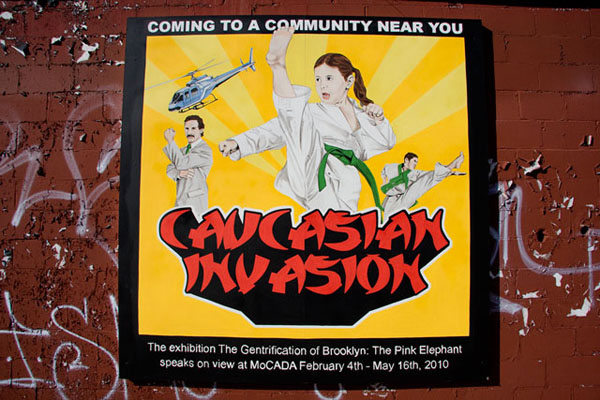
Opening today at the Museum of Contemporary African Diasporan Art (MoCADA) in Brooklyn is the group exhibition, The Gentrification of Brooklyn: The Pink Elephant Speaks. Before it had even officially opened, the show generated a fair amount of controversy. It seems to have created a Brooklyn—and Internet—divided. The exhibition was guest curated by Brooklyn native, Dexter Wimberly, and features 20 artists working in various mediums whose work “investigates the controversial impact of gentrification on the great borough of Brooklyn,” according to the museum. Though MoCADA’s mission seeks to “give a more accurate portrayal of contributions to the historical, artistic and cultural landscape of the world by people of African descent,” Wimberly recently told The Brooklyn Paper, “As a curator, it was important to me to make sure this exhibition was not just an African-American perspective, or a white perspective or an Asian perspective or a Latino perspective.”
Josh Bricker, The Order of Things (partial), courtesy the artist
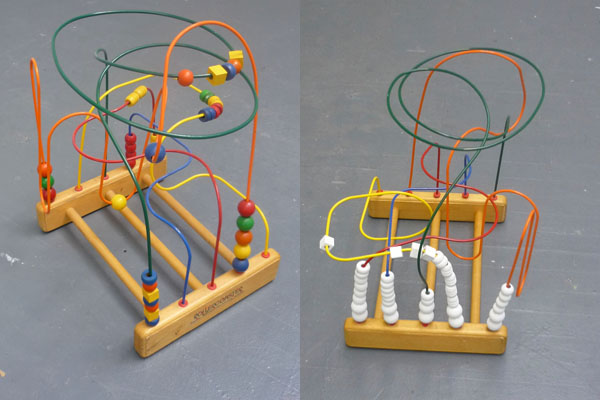
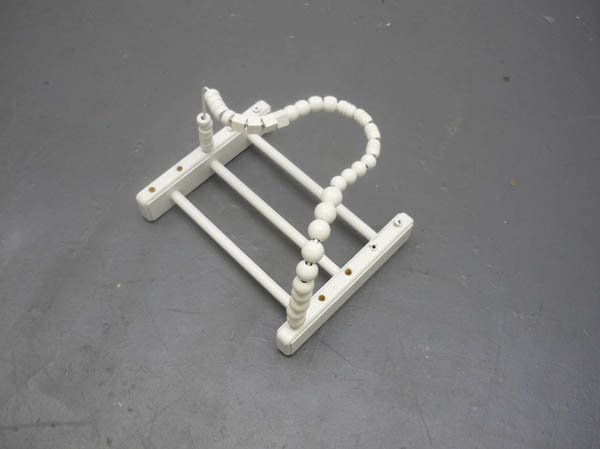
I talked to Josh Bricker, whose installation piece, The Order of Things, is on display in the exhibition. Bricker, who is an MFA candidate at Parsons The New School for Design, told me that The Order of Things—which is made up of ten Anatex “roller coaster” toys in various stages of manipulation—“confronts a lot of the major issues surrounding gentrification, through a slow process of homogenization and conversion.” Bricker says that the toys “were chosen for their iconic status and place in our memories to allow for a re-contextualization of the mundane, as well as an easy entry point into a much heavier and more serious issue.” The ten roller coaster toys follow a spectrum of visual shifts until the last piece becomes almost unidentifiable from the first. Of his process, Bricker says, “If you know color like most artists do then you realize that while white in light is the presence of all color, it is actually the absence of all color in pigments and, therefore, I felt the perfect representation of homogenization and the loss of individuality.”
Josh Bricker, The Order of Things (partial), courtesy the artist
Not everyone in Brooklyn, and elsewhere, though agrees with the message of the exhibition. A casual post about the show on the popular New York blog, Gothamist, turned into an all-out war of words and ideologies when commenters began discussing (not always eloquently) issues of gentrification, race and class. One commenter replied sarcastically to the image of Gabriel “Specter” Reese’s piece for the show, Guerrilla Billboard, saying, “Oh boy here we go… How dare you try to come in and actually contribute to the quality of life here. How dare you try to come in here and open up business, and create jobs. How dare you try to put a boutique clothing shop in place of the 3rd liquor store on this block. How dare you pay taxes!” Another disagreed by responding, “I don’t necessarily think: 3 starbucks per block plus several overpirced [sic] organic fairtrade coffee emporiums, plus…3x rent increase for the same shitty apartment is an ‘improvement’.”
Additionally, photos and essays by students at The Brooklyn Community Arts and Media High School and The Secondary School for Research will be on display in a vignette representing their study and documentation of the impact of gentrification in their neighborhoods. The exhibition runs through May 16, 2010 and features a roster of public events surrounding the issues it seeks to explore, including talks and documentary screenings.
Copyright of John Gerrard. Courtesy of the Thomas Dane Gallery.
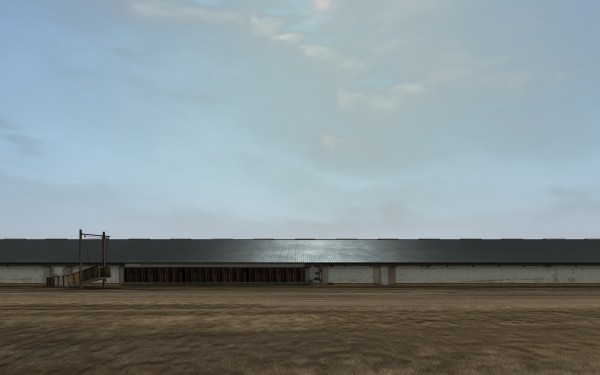
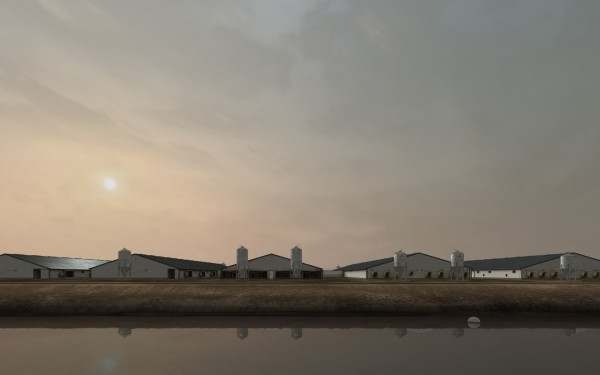
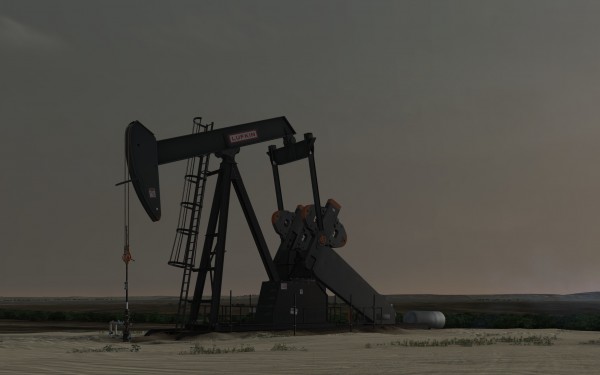
The Thomas Dane Gallery in London presents an exhibition of new work by John Gerrard from 2009. Sow Farm (near Libby, Oklahoma) depicts a particular instance of animal factory farming facilitated by a large computer-controlled complex devoid of human presence. Lufkin (near Hugo, Colorado) presents an oil derrick in action. Like related previous works such as Animated Scene, Sow Farm and Lufkin acknowledge the artificial and detrimental ways we manipulate the environment. Effectively set in the visually bare plains of middle America, Gerrard underscores the alarming depletion of natural resources that supports our culture of consumption.
Copyright of John Gerrard. Courtesy of the Thomas Dane Gallery.
Gerrard’s technique is as compelling as his subject matter is relevant. The artist builds upon traditions of painting, photography, cinema and sculpture while actually working with the video game technology Realtime 3D. Like many contemporary artists working in complex new media, Gerrard develops the creative concept behind each work while relying upon specialists to help realize it. The artist photographs each site from a complete 360 degree radius. His production team in Vienna, led by long time collaborator and producer Werner Poetzelberger, then completes the work – turning the artist’s photographic stills into continuous, animated cinematic panning shots. Complex details are accurately replicated at each site by 3D modeling, which is guided by topographical and satellite data. It typically takes a few years to replicate each site over a particular period of actual time – showing changes in light, weather and season.
The end result – a subdued hyperrealism – hardly points to the immense efforts of its creation. Sow Farm (near Libby, Oklahoma) and Lufkin (near Hugo, Colorado) are shown throughout an entire 365 day year. The work’s projection on a large-scale screen engulfs the viewer in a calm and contemplative viewing experience well suited to serious subject matter.
Copyright of John Gerrard. Courtesy of the Thomas Dane Gallery.
John Gerrard is represented by the Thomas Dane Gallery in London as well as the Simon Preston Gallery in New York City. Gerrard lives and works in Dublin, Ireland – where he was born – and Vienna, Austria. He received his BFA in Sculpture at the Ruskin School of Fine Art and Drawing at the University of Oxford in 1997. He earned an MFA from the School of the Art Institute of Chicago in 2000 and an MSc from Trinity College in Dublin, Ireland in 2001.