Erik Levine: Grip

Still image from Erik Levine's Grip, 2005

As we witnessed over the past two weeks at the 2010 Winter Olympics in Vancouver, athletes are under perpetually extreme pressure. During practice and performance—be it game, match, run or race—athletes in all sports carry the weight of victory on their shoulders, which of course is why the best of them are so uniquely admired.

Currently on view at the Museum of Contemporary Art San Diego (MCASD) is a presentation of Erik Levine‘s 2005 large-scale video projection, Grip, which the museum has recently acquired. Grip, a two-channel DVD in an edition of six, deals with the complexities of athleticism, as it features teenage boys playing tennis. The kaleidoscopic images in the two-channel video bend inward and out in a hypnotizing way as well as showing silent side by side shots of the young players in various states of sportsmanship on and off the court.

At first the quick-cuts of boys at play make up a montage that looks almost like a Gatorade commercial, but the clips quickly segue from displays of athleticism to the torture of self-punishment as boys slap their foreheads, kick their rackets, and fall to the green court on their knees in defeat. One boy shouts, “I quit tennis, man,” as he throws the racket to the ground, with not so much rage as a sense of what seems to be complete despair.

Many of us would argue that, within reason, the pressures of competition help to build character in adolescents, even if the athletes never go on to compete professionally, but that doesn’t make it any less heartbreaking to watch a teenager bury his face in a towel to hide his tears after losing a match. However, too much of this mounted pressure can be dangerous for athletes of this age. As Erik Levine asserts in his discussion of the piece, “This despair can lead to extreme expressions of anger and frustration at a time in their lives when perspective can often be elusive, and alludes to the startling and revealing analogous microcosm for life outside the demarcations and boundaries of the playing field.”

Grip will be on view at MCASD’s La Jolla location through March 21, 2010. If you can’t make it to San Diego by then, you can view the video online here.

Erik Levine was born in Los Angeles and lives and works in both New York and Boston. He is an Assistant Professor at University of Massachusetts Boston. He is a recipient of multiple Pollock-Krasner Foundation grant awards, National Endowment for the Arts grant awards, New York Foundation for the Arts awards and a Guggenheim Fellowship. His work has been exhibited widely both nationally and internationally.

Share

Luc Tuymans: In His Own Words

As a painter of political ideas—and, often, the grotesque and cruel—Luc Tuymans is a historian of images that appear banal but reveal sinister workings: colored blobs are actually disembodied eyeballs; a bare room with flattened perspective is the site of uncountable murders; a limp cloth turns out to be the emblem of a growing nationalist movement. His first U.S. retrospective, a mid-career survey now at the San Francisco Museum of Modern Art, is installed in chronological order, rewarding the viewer with a sense of how his ideas developed for each series. To mark this notable event, Mr. Tuymans conducted a personal tour of the galleries, illuminating his process and the themes behind each work. He concluded the tour with the remark, “I am not interested in having power. I am interested in looking at power.”

La correspondance (Correspondence), 1985. 31.5 x 47.5 inches (80 x 120 cm). © Luc Tuymans. Image via the excellent Luc Tuymans, edited by Madeleine Grynsztejn and Helen Molesworth, ISBN 978-1-933045-98-6.

“I stopped painting from 1981 to 1985 because it became too suffocating and too existential. And somebody by accident shoved a Super-8 camera in my hands and I started to film. And then I came back. Making images is important in the sense that you need distance.”

“This was the first painting made after the film adventure [above]. And it’s actually one of my most conceptual works, and it’s based upon an anecdote. The anecdote is from a Dutch writer who was stationed in the Dutch Embassy from 1905 to 1910. And he didn’t have enough money to bring his wife over to Berlin. And in those days you had the grand cafes with very bourgeois interiors, and also postcards taken of them. So every time he went to eat in such places he bought a postcard, and with a red pencil he crossed out the table at which he had eaten, and he sent it to his wife during the duration of five years. So that’s why it’s called correspondence. It’s also the idea of persistence, and homesickness without an end.”

Die Wiedergutmachung (Reparations), 1989. 17.75 x 21.625, 15 x 17.75 inches (45 x 55, 38 x 45 cm). © Luc Tuymans. Image via the excellent Luc Tuymans, edited by Madeleine Grynsztejn and Helen Molesworth, ISBN 978-1-933045-98-6.

“This is something I saw on television. It’s called the Weidergutmachung, and it’s about the woman who made the documentary, it was made in ’89, which is when I saw the documentary on the West German television. It was quite an interesting documentary because Weidergutmachung means the pay-back system towards the people who suffered in the concentration camps…this time not the Jewish people, but Gypsy twins on which the German doctors in the concentration camps had experimented. These people were never paid back because the guy who was actually responsible for the whole situation of the repayment was also a doctor who himself experimented on them during the times he was working in the concentration camp. When he dies off in ’83 in his bureau drawer, the woman who was making the documentary found contact prints of disengaged eyeballs and hands. So this is what I saw on the television screen. It was such a poignant element that I turned it into a more organic imagery.”

Gaskamer (Gas Chamber), 1986; oil on canvas; 24 x 32 1/2 in. (61 x 82.5 cm); The Over Holland Collection. In honor of Caryl Chessman; © Luc Tuymans; photo: Peter Cox, courtesy The Over Holland Collection

“The most problematic painting that I ever painted—that I ever will paint as long as I live, probably—is the Gas Chamber. The Gas Chamber was derived from a visit to in Dachau where you have a real gas chamber and not a replica. And I stood in it, and I made a watercolor when I visited it, and for years this watercolor was on the floor of my studio, which made the color of the paper yellow. And I also made it on a frame that is deliberately not straight. It’s a metonymous image, because without the words of the title it would be completely without effect, it would be just a painting. Nevertheless, it shows the triviality of that type of horror. At the time of its use, it was masked as a place where you could get a shower. All the elements of perspective are taken out, in order to get to this feeling of claustrophobic existence. I mean, a lot of times the Germans say, ‘We can’t deal with that type of history as the Holocaust,’ but I’m not agreeing with that, it is part of the culture… This remains a very difficult and ambiguous painting.”

The Flag, 1995. 54.375 x 30.75 inches (138.1 x 78.1 cm). © Luc Tuymans. Image via the excellent Luc Tuymans, edited by Madeleine Grynsztejn and Helen Molesworth, ISBN 978-1-933045-98-6.

“This was from a show about Flemish nationalism in my hometown, where at that point (luckily not anymore) there was the biggest concentration of the right-wing political party called the Flemish Bloc. So I thought I would start with their icons. This is the Belgian lion. The Belgian lion normally is a lion on a yellow backdrop with red claws. To enlighten you about the history of Flanders is going to take us very long, because it’s a long story to begin with, but anyway, to give you an idea…During the first world war, all the officers were French speaking. This meant that during the First World War a lot of Belgian people died in that war, millions of them. The people who were the soldiers, the foot guys, they were all Flemish; there were huge massacres, because when the officers would say a gauche [French: left], they would go right, into the machine fire. In between the two world wars there was a closeness in terms of culture to the German culture, more than to the French culture. And that ended up in a collaboration with the Germans. So a very difficult situation. That’s why you have a lot of marriage trouble, which I also witnessed. My mother was Dutch, they were in the resistance. My father was the Flemish side, they had collaborated. At dinner, when I was five years old, this explodes by the accidental showing up of a photograph of the guy I was named after doing the Hitler salute. You can imagine the whole situation. So what you can see here is the Flemish lion, and I just made a watercolor of it, and then I crumbled it together, and then pinned it on the wall. And then I did something I had never done before, I took a Polaroid of it, and it was such bad quality that it totally deleted the imagery, which is actually beautiful I think. And this was the first time I used Polaroid as a device to derive imagery.”

Ballroom Dancing, 2005; oil on canvas; 62 1/4 x 40 3/4 (158 x 103.5); San Francisco Museum of Modern Art, fractional and promised gift of Shawn and Brook Byers; © Luc Tuymans

“This was painted out of my disgust with the Bush legislation. The first idea I had was this: I was thinking of this element of regression in American society in those days, going back to an open form of conservatism, and therefore Fred Astaire, Ginger Rodgers. Ballroom dancing. So then I was on the web browsing, trying to find more contemporary imagery, and in 2005 there was the Texas Governor’s ball, this is the Texas seal, the woman swings her head out, this guy is the epitome of well-behaved and whatever. And on the other hand, this is an image that’s really classical, I really loved doing it…”

The Secretary of State, 2005; oil on canvas; 18 x 24 1/4 in. (45.7 x 61.5 cm); Collection the Museum of Modern Art, New York, promised gift of David and Monica Zwirner; courtesy David Zwirner, New York; © Luc Tuymans

“…Then, one of my best friends who used to be the Minster of Foreign Affairs, made a remark of Condoleeza Rice—I was in a bar, reading this in a newspaper—there was a day Condoleeza Rice came and visited our country, and he said something like, “She is very intelligent, and she is not unpretty.” And this sexist remark led to my idea of Condoleeza Rice. The interesting point is that she is depicted not to be judged, she is depicted with great determination. At that point no one knew what the woman was going to achieve.”


Share

From the DS Archives: Zheng Guogu

Originally published on September 29, 2008.

Zheng Guogu’s sculptural work often pairs confounding idioms, layering ephemeral qualities with imposing materials, in order to poetically arrange forms that operate on both a tactile and symbolic level. In his sculpture, Waterfall, Gougu pours white melted wax over a rigid metal armature, embedding calligraphic scripts into this serene fountain. Gougu both reinforces and freezes the progression of time, in an allegorical fashion not unlike the symbolism of burning candles, skulls, or rotting fruit prevalent in Dutch Renaissance still lives.

Evocative of natural forms on multiple levels, from snow-capped trees, mountainous landscapes, to icicle-like forms, Gougu creates an enigmatic presence, both familiar and foreign. The piece’s somber, haunting aura is reinforced by the fact that white is traditionally a symbol of mourning in China. Lyrically composed, the piece acts as an abstract Memento Mori of sorts – reminding the viewer of his or her own mortality and the impermanence of life.

Zheng Gougu was born in Yangjiang, Guangdong province, China and lives and works in Yangjiang, Guangdong province. He has shown at the Venice Biennale, and was one of the few Chinese artists to participate in Documenta 12 in Kassel, Germany. Last year, he was exhibited in The Real Thing: contemporary art from China (2007) at the Tate Modern in Liverpool. He has also shown at the Mori Museum in Tokyo and Guangdong Museum in Guangzhou, China.

Share

Melanie Manchot: Celebration (Cyprus Street)

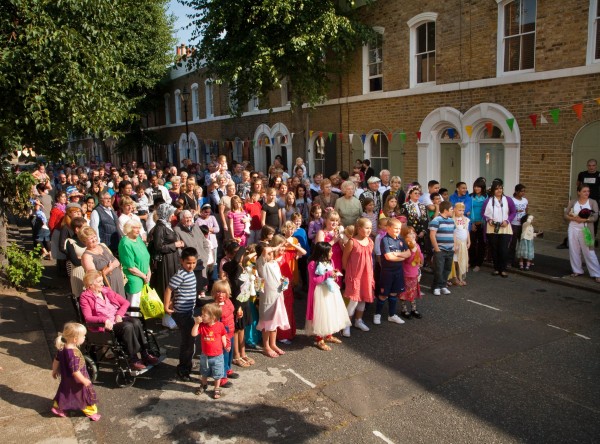
Whitechapel Gallery in London is currently showing Melanie Manchot: Celebration (Cyprus Street).   This project addresses concepts of individual and community identity by revisiting the tradition of public street parties and festivals popular in 20th century London.  Drawing inspiration from these past events captured in newsreels and photographs, Manchot creates and documents her own 21st century street party.

Manchot realized Celebration by working closely with Cyprus Street inhabitants and organizing a party in this Bethnal Green, East London neighborhood.  The artist captured gathered residents as they posed for a group portrait using 35mm film – a medium with historic connection to old newsreels.  Blending photography and film, Manchot used a single tracking shot that pivoted to create a comprehensive, durational group portrait.

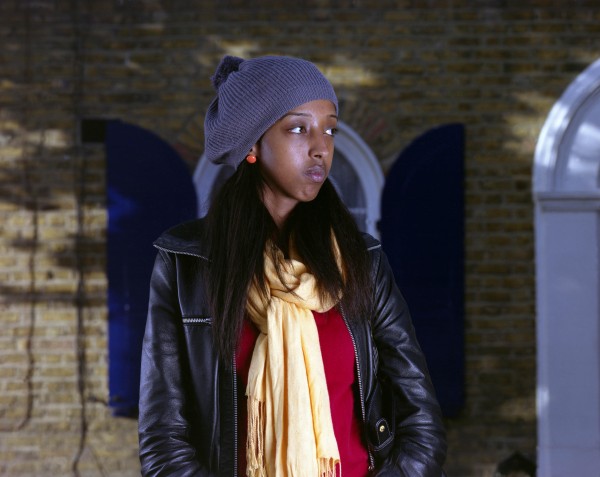
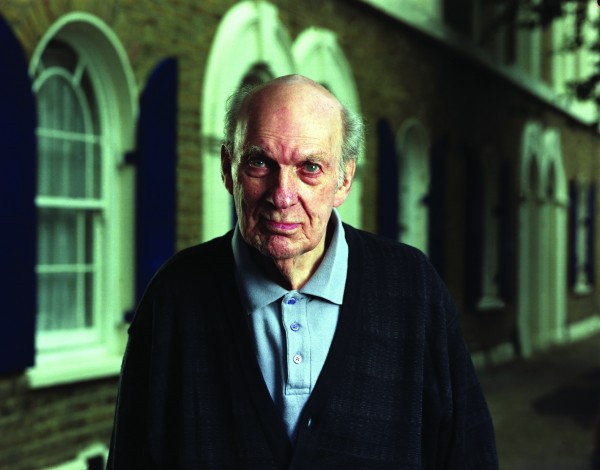
Melanie Manchot:  Celebration (Cyprus Street) also includes  photographic portraits of individual Cyprus Street residents.  Manchot’s new film and photographic work is juxtaposed with archival footage selected by the artist of historic street celebrations such as peace parties that took place in 1919 and 1945.  This arrangement allows the gallery visitor to view the changing faces of communities that have coalesced around London’s streets over time.  Most importantly, Manchot’s work reveals the diversifying effects of global migrations on a particular contemporary community.

Celebration (Cyprus Street) is exhibited as a part of the Whitechapel Gallery’s Education Programme.  It was commissioned by Film and Video Umbrella and was funded by Film London (Digital Archive Film Fund) and Arts Council, England.

Melanie Manchot lives and works in London.  She is represented by Goff + Rosenthal in New York.  Manchot earned an MFA in Photography from the Royal College of Art in London and works in photography, film and video.

Melanie Manchot: Celebration (Cyprus Street) will remain at Whitechapel through 14 March 2010.

Share

The Anti-Spectacle Generation

L.A. Expanded: Notes from the West Coast
A weekly column by Catherine Wagley

Leslie Hewitt, "Make it Plain (2 of 5)", 2006.

The Pew Research Center caused a stir this week when it released a study portraying The Millennials, those who came of age during the first decade of the 21st Century, as the most even-tempered generation in recent history. Unlike the Baby Boomers and Gen X-ers, The Millennials have sidestepped almost all reactionary impulses. “They look at themselves and they say, our generation is quite different than our parents’ generation. But they don’t say it with any rancor,” Pew president Andrew Kohut told NPR’s Robert Siegel. “The only thing they criticize the older generation for is their lack of tolerance.”

This sounds suspiciously rosy, even toothless, as though, by some accident of history, a whole generation of non-judgmental diplomats emerged at the exact moment the U.S. entered Iraq. But the Pew study has more bite to it than Kohut suggests. Refusing the spectacle of rebellion that your parent’s generation reveled in is another way of breaking history’s patterns.

After 1968: Contemporary Artists and the Civil Rights Legacy, on view at the California African-American Museum in Exposition Park, revisits 1968 through the work of African-American artists who grew up in its wake. None of the included artists–most of them belong to last leg of Generation X even though their art-making careers coincided with the rise of the millennium–were cognizant when Martin Luther King Jr. and JFK were shot down or when the Black Panther Party peaked. And none of them pretend to have any precocious insight into  history they didn’t experience. What they do quite well, however, is acknowledge the still-opaque role the past plays in the present.

Hank Willis Thomas, "The Liberation of T.O. I'm not goin back ta' work for massa in dat' darn field," 2003/2005, Lightjet Print.

Hank Willis Thomas, "The Liberation of T.O. I'm not goin back ta' work for massa in dat' darn field," 2003/2005, Lightjet Print.

Hank Willis Thomas‘ stunningly sleek photographs, culled from advertisements and digitally stripped of all text, dominate the  gallery space’s center. All part of Thomas’ Unbranded, the ads originally appeared between 1968 and the present; Willis has been painstakingly moving  through the history of branding, selecting images that portray blackness or target black audiences. The images create a strange visual paradox. They retain the staged melodrama of the initial advertisements yet their deliberate serialization makes them feel like specimens in a study, each something to get close to and pick apart. In Willis’ 2006 rephrasing of a 2004 Peace Corps ad, unambiguously title Don’t Let Them Catch You!, young black children, who might have been from Harlem as easily as Brazil or Niger, leap  into a muddy pool of water as if on the run. A blurry haze covers the whole image, romanticizing the picture’s narrative and recalling too-close-for-comfort episodes in US history in which African-Americans have fled authority. The most disturbing aspect of  Thomas’ images is their ability to cleverly manipulate history’s visual tropes while still living in the realm of glizty glossies that suggest history doesn’t matter.

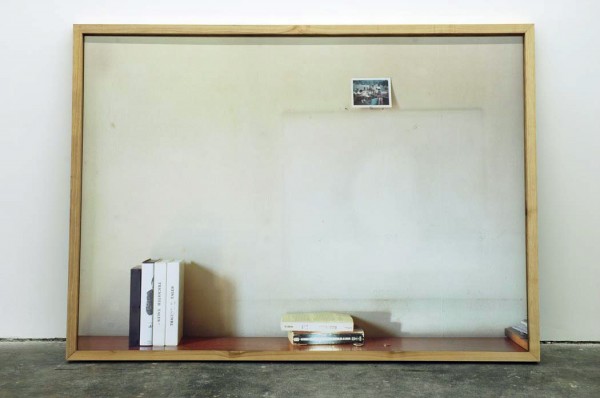
Leslie Hewitt, "Make it Plain", 2006

Leslie Hewitt’s large-scale photographs and sculpture also reconsider images of the past, but her considerations are more intimate. In the Make it Plain series, Hewitt combines loosely connected historical objects in an attempt to piece together a history different than that of sit-ins, protests and riots. In the second of the five photographs in the series, Hewitt has placed two worn books, representing two divergent perspectives, on a shelf: Black Protest: History, Documents, and Analyses, 1619 to the Present and the Report of the National Advisory Commission on Civil Disorders. An empty frame leans above that and a photo of a ’60s era gathering, flipped on its side, hang above the frame. Another photo of two men hangs on the wall to the right. It’s like an impossible game of connect the dots–the relationship between the objects is buried in a palimpsest of history that only those who have read the books and were there when the photos were taken could decode, and even they might struggle.

In his recent book Timothy, essayist Verlyn Klinkenborg mentions how easy it is to ” walk through the holes” in human perception. It’s hard to overlook the big events, the ones that cause fires, change laws, and are embedded into history books. It’s harder to look between the spectacles and find the threads of truth that have slipped through. Hewitt and Thomas are looking through the holes.

After 1968 continues through March 7th. The exhibition also features work by Deborah Grant, Adam Pendleton, Jefferson Pinder, Nadine Robinson, and Otabenga Jones and Associates.

Share

Foon Sham

The material and process-based sculptures of Foon Sham have spanned the past 20 years. The artist’s recent work relies on the principles of design, and some works have shifted from the previously abstract into newly recognizable forms, such as the house. During a residency in the mid-90s, Sham created “Houses at Night,” a work that formed as an intuitive response to the surrounding landscape. The piece marked a breakthrough for the artist, as he is now working more freely with familiar forms and integrating light and architecture within the work. Sham was born in Macao, China, in 1953 and moved to the United States in 1975. The artist completed his MFA from Virginia Commonwealth University (VCU) in Richmond, Va., and his BFA from the California College of Arts and Crafts (CCA) in Oakland, Calif. Sham has continued to participate in countless exhibitions and residencies, including recent shows with Heineman Myers Gallery in Bethesda, Md., Hong Kong University of Science and Technology in Hong Kong and Dianne Tanzer Gallery in Melbourne, Australia. Artist residencies include Kulturhuset USF in Bergen, Norway, and the Pyramid Atlantic Arts Center in Riverdale, Md.

This article was originally published on August 23, 2007.

Share

Greg Girard: Half the Surface of the World

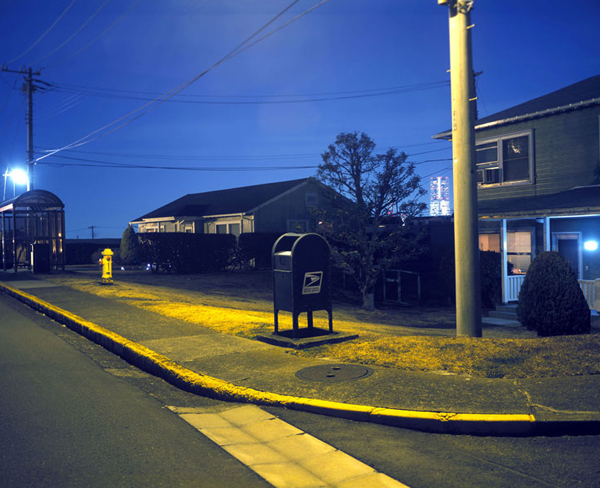
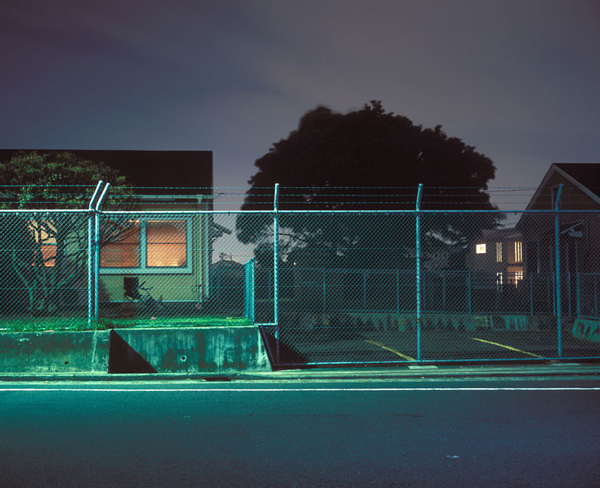
There’s a lot happening in Vancouver, British Columbia right now, if you hadn’t noticed. Of course, I’m talking about art. Currently on view at Monte Clark Gallery is a solo show of new work by Vancouver-born Greg Girard. The exhibition, entitled Half the Surface of the World, presents photographs taken by Girard on his visits to more than twenty US military bases across the massive area of the world known to the Pentagon as “PACOM.” PACOM is the largest of six “territorial constructs that exist solely on the Pentagon’s map of the world,” according to the exhibition’s materials, which go on to explain that “The US military influence in this region is mainly anchored with bases in Japan, Korea and Guam.” Girard, who has been living in Asia since 1983, reveals through his work how reminiscent these bases—which are home to family members as well as soldiers—are to typical Middle-American suburbs. One imagines that if you were drugged and dropped into a few of these scenes, you would be none the wiser that you were half way around the world from the birthplace of hamburgers and milkshakes. While the images are eerie, the sentiment might be the exact opposite for those who live in these locations for any length of time, as they find themselves surrounded by the consolation of “home.” However, void of any human interaction within the shots, they appear distant and industrial as they glow with the deeply saturated colors of street lamps at twilight. I’m reminded of the work of Richard Ross, both aesthetically and thematically. In a certain way they remind me most of his Waiting for the End of the World series of bomb shelters.

Greg Girard has exhibited internationally, including in multiple solo shows at Monte Clark Gallery and in group shows at Amelia Johnson Contemporary in Hong Kong, the Royal Ontario Museum in Toronto and Museum of Contemporary Art KIASMA in Helsinki.

Share