Chad Curtis

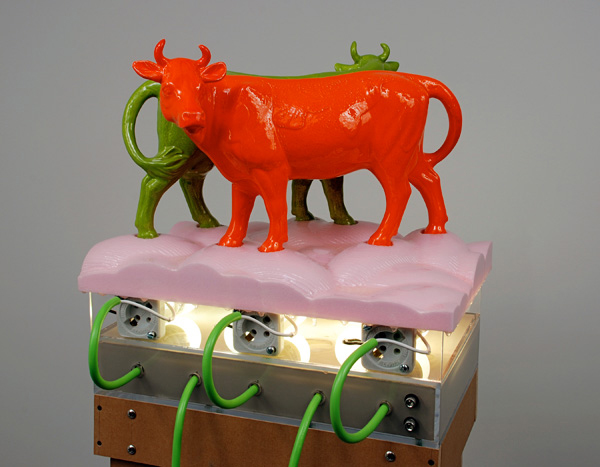
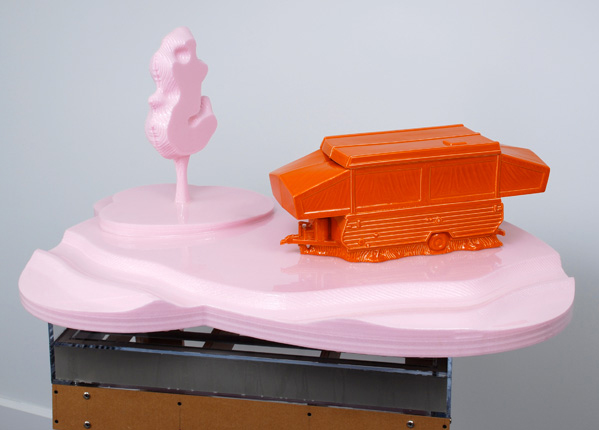
In it’s last week on view at the Urban Institute of Contemporary Arts in Grand Rapids is a solo exhibition of work by Chad Curtis entitled: DIGITAL IN NATURE.  The work included in the exhibition investigates the relationship of organic, living beings to the complex, nuanced environment and digital landscape. Each piece utilizes, to some degree, a crude, home brewed fabrication-and-drawing machine that relies on digital design tools, and computer numeric control.

Curtis often deals with simulation and refinement, utilizing highly processed materials removed from the context of their origin, to create a synthetic experience.  While the sculpture aims to potentially simulate an environment, the drawings serve as illustrations, of a lost world that happens to look a lot like the world we live in.

In a broader context, the work explores the line between the biological and mechanical, using popular, iconographic references. The idea of a distinction between the biological and the industrial, or the human and the digital, and the blurring of that distinction, is explored both as subject matter in the work and also in the production.

Chad Curtis currently serves as an Assistant Professor at Temple University’s Tyler School of Art. Trained in Ceramics and Printmaking, Curtis earned his BFA from Minnesota State University and his MFA from New York State College of Ceramics at Alfred University.

Share

National Treasure: Haitian Art History and its Hidden Revolutionary Past

Edouard Duval-Carrié, Le monde actuel, ou Erzulie interceptée (The World at Present, or Ezili Intercepted), 1996, Bass Museum of Art

With the recent events developing in Haiti, the complicated history between the country and the United States has quickly surfaced. A group of American Baptists attempted to transport Haitian children out off the country without proper documentation causing an international media storm and a recent article from UK Guardian journalist Seumas Milne’s which questioned the U.S. Military’s motivation in “[commandeering] Port-au-Prince’s airport…[turning] away flights bringing medical equipment and emergency supplies from organizations…in order to give priority to landing troops.” This latent disregard seems to also be seeping into the discussion of the country’s history of art as well. In the earthquake’s aftermath, it is difficult to argue the importance of salvaging this artistic history while the reality of the devastation and number of lives lost continues to reveal itself. Yet, the recent foray of two U.S. media publications into this realm, and the aforementioned events, has led me to believe that the need for this discussion has come to us sooner rather than later.  It is the apparent unfamiliarity with Haitian culture, in this case, its art, that is most problematic and results in its artists and history to undergo further marginalization. By using its artistic history as a window into its national identity, hopefully, Haiti can be defined as more than one of the world’s poorest countries.

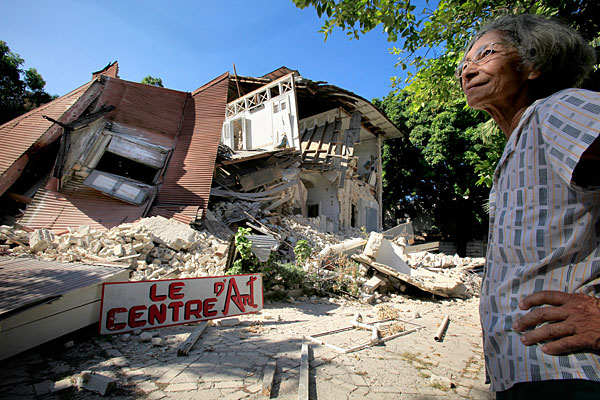
On January 24th, the Los Angeles Times reported the destruction of the Centre d’Art, a historical art center founded in Port-au-Prince in 1944, which helped to launch Haitian artists onto the international art scene. There are two major problems with the article that need to be discussed further. The first is the usage of the term “primitive.” This label was used to define Haitian artists by the founders of the Centre d’Art (two Americans and a Frenchman) as a way to market said artists within the international scene. The trend in the art world during this time was to find the next great “primitive” artist, an influence of Dada and Surrealist artistic movements that sought to reclaim an innocence felt to have been lost with the industrialization of Europe. Haitian artists who were willing to be perceived through this European/American hegemonic gaze could find a place within the international art market.

(Brian Vander Brug / Los Angeles Times / January 23, 2009)

Centre d'Art damage (Brian Vander Brug / Los Angeles Times / January 23, 2009)

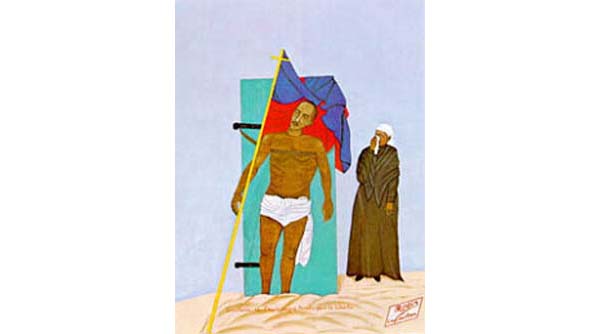
However, there is a long tradition of Haiti’s creolized academic tradition of which a formal, figurative style in Haitian painting can be traced back to. Philomé Obin (1892 – 1986) had been painting thirty years before the center opened and is still considered one of the most influential artists on Haitian art today. His work stands as an example of the school of memorializing well-known events within Haiti’s revolutionary history, frequently referencing Haitian heroes such as Toussaint L’Ouverture and Charlemagne Péralte. Obin championed the school of nationalist art in Haiti and his influence can still be seen today in works by internationally known artists such as Edouard Duval-Carrié. To continue to refer to these artists and their works as “primitive” in this day and age without any context, as did the Los Angeles Times journalist Tracy Wilkinson, is, well, just plain lazy.

Philomé Obin (1892 - 1986), Crucifixion de Charlemagne Péralte pour la Liberté (Crucifixion of Charlemagne Péralte for Freedom), 1948, In the collection of Milwaukee Art Museum

The second problematic area of the Los Angeles Times article, and in which we can also refer to the New Yorker’s January 25th cover, is the continued use of the world “voodoo” when referring to the Haitian religion of vodou (also known as vaudou). The cover featured the painting The Resurrection of the Dead from contemporary Haitian artist Frantz Zephirin (a grand-nephew of Obin). The painting depicts imagery of vodou guide (“gods”), as they guard the passage between life and death. Both publications use the term “voodoo”, a Western construct laden with racial prejudice, with no further explanation of its immense role within Haitian art history or the formation of its national identity. Vodou is a combination of West African and Roman Catholic religions, comprised of deities, or lwas, which through worship, help practitioners get closer to the supreme god, Bondeyé. In her article Vodou, Nationalism, and Performance: The Staging of Folklore in Mid-Twentieth Century Haiti, Kate Ramsey discusses the role of the religion in the formation of the indigènisme movement, a conceptual rallying point for revolution against the U.S. occupation of 1915, rooted in ethnic and cultural identity. The religion was criminalized and those who observed its ceremonies were persecuted, forcing vodou to go underground and evolve into a locale of resistance for Haitians. During this time, vodou would become exoticized by American/European artists searching to connect to the “other”, such as choreographer Katherine Dunham and avant-garde filmmaker Maya Deren, best known for Divine Horseman: the Living Gods of Haiti, a film documenting vodou ceremonial rituals and practitioners.

Frantz Zephirin, The Resurrection of the Dead (2007), On the cover of the January 25, 2010 of "New Yorker" magazine

Once vodou became legal in 1946, the Centre d’Art encouraged its artists to incorporate religious imagery within their artwork, as it was perceived as purely authentic (read “primitive”). Haitian artists who made the conscientious decision to allow themselves to be labeled as “other,” were able to achieve success within the international market. A prime example is the artist Hector Hyppolite (1894-1948), who through acceptance of the role projected onto him, exhibited in Paris and New York frequently and could claim patrons such as André Breton (father of the Surrealist movement) and American author Truman Capote. In his 2000 lecture, Voodoo Terror: (mis)representations of voodoo and western cultural anxieties, presented at the October Gallery in London, John Cussans discusses the “voodoo construct” and its four different distinctions: the voodoo doll; the zombie; the voodoo witch doctor; and voodoo possession. Through these continued representations, Cussans argues, vodou has been continually objectified and suppressed by U.S./European culture and its continued need to ethnographically “authenticate,” (or define through a Western gaze), what they don’t understand. Cussans concluded, “It is this tendency to return voodoo to vodou that must be reversed if we are to resist the compassionate continuation of vodou’s suppression effected by the misguided will to authenticity.” In other words, any concept of voodoo must be abandoned when approaching the Haitian religion; otherwise, we are doing nothing more than participating in the continued misrepresentation. This is the problem with the U.S. media publications. So ingrained in the American psyche has this misrepresentation become, these journalists didn’t even think to research the religion.

Hector Hypplite (1894-1948), La dauration l'amour (The Adoration of Love), 1946-48, in the collection of the Milwaukee Art Museum

The Centre d’Art and local galleries have reported the loss of many artworks contained in their collective walls, not to mention a number of represented artists. The recent tragedy has made Haiti the world’s disaster darling and it has been tremendous how people from all over the world have responded to the country’s need for help. Yet, we need to take a collective breath and become aware that we are treading on complicated ground.  The lack of reference to any real historical, artistic or political context from both publications highlights the challenging areas that arise whenever a Western power has offered aid to Haiti. We cannot sustain meaning as a global community if we keep repeating the historic mistakes of colonization. As we go forward, we need to raise our awareness to include the entire story, not fixing Haitians and their history in a marginalized space, putting aside our preconceived notions in order to truly help Haiti. If not, I guarantee, we will have another revolution on our hands.

Share

From the DS Archives: Robbie Conal Video

Each Sunday we reach deep into the DailyServing Archives to unearth an old feature that we think needs to see the light of day again. This week we found a video interview with L.A. artist Robbie Conal. If you have a favorite feature that you think should be published again, simply email us at info@dailyserving.com and include DS Archive in the subject line.

Originally Published on February 27, 2009

Artist Profile: Robbie Conal from By Osmosis TV on Vimeo.

Los Angeles-based artist Robbie Conal has made a name for himself over the past several decades for his poignantly irreverent and ultra-humorous political posters featuring unforgettable one-liner jokes. The artist wittingly simplifies issues that surround political figures and delivers the work to a mass audience by creating reproductions of his painting, pasting the posters in cities throughout the country. His clever insight can be seen over countless paintings such as a rendering of Dick Cheney with bunny ears bearing the simple phrase ‘Enronergizer Bunny’ over a hot pink ground.

In his current series of work, the artist has begun to move away from his well-known political poster portraits and has been investigating other, equally clever, connections between popular culture and politics.

The artist recently exhibited a new painting in the retrospective exhibition Beautiful/Decay: A to Z, which opened at the Kopeikin Gallery in Los Angeles last weekend. In addition, Conal recently teamed up with By Osmosis TV and Beautiful/Decay magazine to produce a short interview video that features the artist at work in his studio.

Share

We Live in Public

L.A. Expanded: Notes from the West Coast
A weekly column by Catherine Wagley
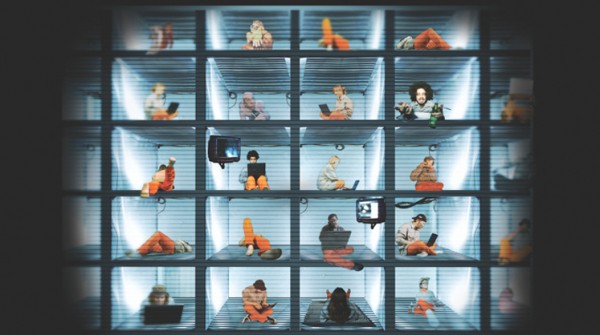
"We Live in Public," Film Still, 2008.

"We Live in Public," Film Still, 2008.

Josh Harris welcomed the new millennium from the basement of a New York bunker. He was surrounded by a posse of jumpsuit-clad creatives, and, at one point, all of them watched as a naked man whipped a barely dressed woman around underneath a running shower head. The scene made about as much physical sense as Bernini’s The Rape of Prosperina—the bodies twisted perpetually but never quite met in the way you’d expect them to. Harris and his companions watched the crude assault as though it were on television.

One of the first entrepreneurs to channel the potential of internet TV, Harris used a significant portion of his dot-com  fortune to build the bunker, which he called Capsule Hotel and filled with over 100 mini living pods, a shooting gallery, interrogation room, banquet hall, bar, and obscene number of cameras and video monitors. By the time New Years’ Eve arrived, 150 people had lived in the Hotel for nearly a month.

Residents (including Alanna Heiss, P.S.1’s haughtily fearless matron) submitted to constant surveillance and interrogation in exchange for admittance. Not only were members of the panoptical community watched, but they could watch one another by tuning in to any channel on any of the readily-available monitors.
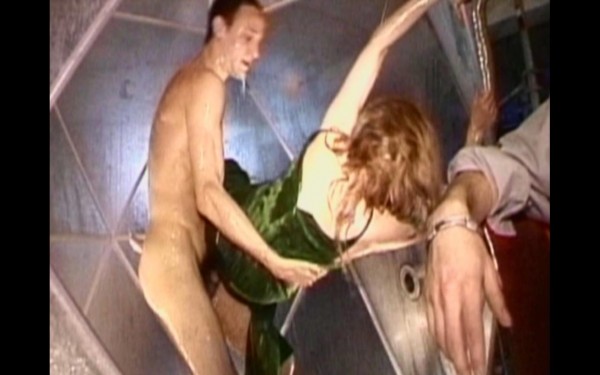
"We Live in Public," Film Still, 2008.

“Everything is free except the video we capture of you. That, we own,” says Harris in We Live in Public, an unpretentiously efficient documentary released on DVD this week. It’s a telling quote because it suggests that the opposite of free is not costliness but being owned, and it pushes Harris’ experiment out of the realm of asset-swapping and into soul-selling.

Directed by Ondi Timoner, We Live in Public follows Harris through the birth of his dot-com fortune and his subsequent series of ahead-of-their-time media experiments. Harris plays villain and hero, acting as a self-appointed artist-prophet who exploits people’s penchant for attention and thus exposes a future in which “we’re going to increasingly have our lives exposed in very personal and intimate ways and we’ll want it to happen.” Chuck Klosterman would almost certainly call Harris “advanced.

Not long after Quiet, the 24/7 bunker surveillance venture, was shut down by the NYPD  in early January, 2000, Harris invited his girlfriend Tanya to move in with him. Together, they went public. They installed nearly thirty web cameras in their home, including one in the toilet, and streamed their whole life onto the web. When they fought, they would run immediately to their computers, to see which of them had the allegiance of chat room regulars.

It ended badly, of course. After the dot-com crash, in which Harris’ fortune all but disappeared, Harris ended his relationship with Tanya (later he would call her a “pseudo-girlfriend,” though she claims they loved each other) and pulled the plug on public living.

As the rest of the world caught on to online chatting and video streams, Harris pulled away, initially living on a rural apple farm and later disappearing to Ethiopia to evade creditors.
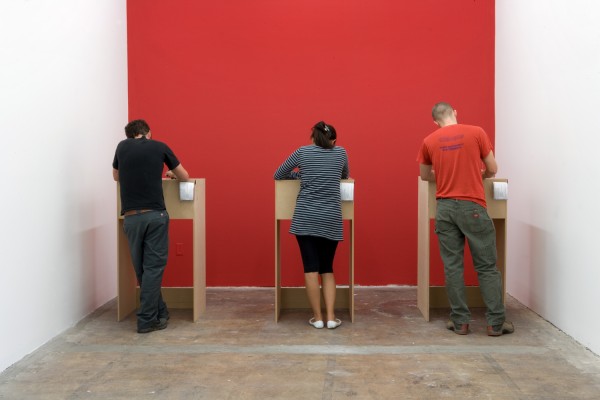
Gustavo Artigas, "Vote for Demolition," 2009. Courtesy LAX Art.

Gustavo Artigas, "Vote for Demolition," 2009. Courtesy LAX Art.

Exposure doesn’t mean what it used to mean. Now the well-trafficked terrain of mainstream websites and reality TV, it often seems contrived and redundant when it appears in art. Many of the best artist-driven social experiments I’ve encountered this year refuse to invaded peoples’ privacy and, as a result, they seem perfunctory, even impersonal.

In Vote for Demolition, artist Gustavo Artigas invited people to vote for which over-priced, over-sized Los Angeles’ building most deserved the wrecking ball. The voting booths at LAX Art were perfectly spaced, giving voters plenty of room to deliberate, and Artigas asked for no personal information. The “surveillance” in John Baldessari’s recent exhibition is carefully unobtrusive–a camera watches you watching art, and, while art-viewing may be a genuinely intimate experience, it’s one that tends to play out in public anyway. Baldessari’s experiment feels more like documentation than invasion. Its aloofness makes the loneliness of experience painfully evident; no live streams or chat rooms can combat the fact that, most of the time, we navigate the world alone with our bodies. But maybe that’s okay.

When Harris moved to his apple farm, an interviewer asked him, “Are you a lonely man?”

He responded, “The implication when you say ‘am I a lonely man,’ is that it’s worse than being together. It’s just a different state of being, and one I’m quite comfortable with.”


Share

BRUCENNIAL 2010: Miseducation


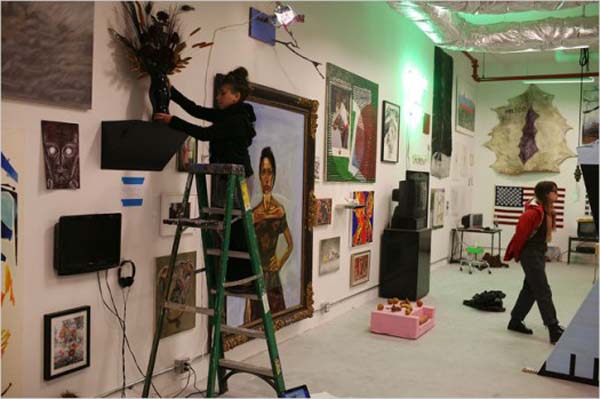
The self-proclaimed “most important survey of contemporary art in the world ever” opened this week in at 350 West Broadway in SoHo, New York.  The Brucennial 2010 edition, titled “Miseducation,” is presented in a 5,000 square foot space temporarily donated by the real-estate mogul and art collector Aby Rosen and supposedly “brings together 420 artists from 911 countries working in 666 discrete disciplines.”  But who’s counting?  The creative art collective behind what is seen as a parody version of the Whitney Biennial is made up of five mysterious guys known as the Bruce High Quality Foundation.  Although the Foundation participated in the recent “1969” exhibit at P.S.1, Brucennial remains the collective’s signature celebrated program since the founding of the event in 2008.

Focused on reshaping the art world via a more democratic and DIY approach, the Foundation places some of its more visible functions, like PR and the organization of exhibtions, into the artists hands.  Perhaps the result can best be described as a visual cacaphony.  The Brucennial’s rather lax entry standards (an email asked prospective participants to “either dredge something up or create something new…As fast and as loose as you like”) is a refreshing juxtaposition to the supposed stringent selection criteria of the Whiteny’s Biennial.  With a “sharing is caring” attitude and limited wall space artists move their pieces around in order to make room for new arrivals.  Neither first-come basis nor celebrity secures an artist a better spot, and emerging artists as well as blue chip artists (like Julian Schnabel) display their pieces side by side.  The title “Miseducation” and its press release offer insight into the Foundation’s desire to question the politics and institutional protectionism that seem to run the art world. However, one has to wonder how “lax”  and rebellious the event can remain with heavy-hitter curators Francesco Bonami and Vito Schnabel involved with curating the event.

The Brucenial 2010: Miseducation runs through April 4 at 350 West Broadway, SoHo, with projects also on view at Recess at 41 Grand Street.  The event also includes performances and a literary supplement.

Share

DESIRE: The Blanton Museum of Art at The University of Texas, Austin

Marilyn Minter, Crystal Swallow (2006), Promised gift of Jeanne and Michael Klein to The Blanton Museum at the University of Texas at Austin

Now showing through April 25th at The Blanton Museum of Art at The University of Texas at Austin is the group exhibition Desire. Curated by Annette DiMeo Carlozzi, Blanton curator of American and contemporary art and director of curatorial affairs, Desire features fifty works from an international grouping of contemporary artists working in a variety of media. The concept of the exhibition is to present the many ways artists have explored the notion of desire and its many facets within their work. The thought of this concept being visually displayed is tantalizing, yet, it is only with the multiple video works that the exhibition’s guard comes down. Isaac Julien’s Long Road to Mazatlán (1999), a video collaboration with the choreographer Javier de Frutos, is a stunning visualization of the yearning of two cowboys “dancing” around their mutual attraction and the stigma that often comes along with it.  Cauleen Smith’s Elsewhere, is a sensual film of a woman standing absolutely still while another person slowly unravels her sweater by a single thread.

Amy Globus, Electric Sheep (2001 - 2002), Blanton Museum of Art, Purchase through the generosity of the 2004 Blanton Contemporary Circle

However, it is Amy Globus’s video installation Electric Sheep (2001-2002) that will make the viewer blush. Set to Emmy Lou Harris’ rendition of Neil Young’s, Wrecking Ball, a large octopus is filmed in slow motion as it makes its way from one confined space to another. While watching the piece the viewer is likely to feel all the accoutrements of desire simultaneously: longing, lust, sensuality, fantasy, rejection, sexual identity, passion, intimacy etc. Also not to be missed is Mads Lynnerup’s Untying a Shoe with an Erection (2003), a tongue-in-cheek performance of presumably a man untying his shoe with his penis. The exhibition is able to transcend being merely an exercise of artists implementing the theme of desire, perhaps a bit unwittingly, with the dominance of these video works. The question that lingers long after leaving the museum is exactly how much of a continued role visual media plays in defining our collective idea of desire.

The Blanton Museum of Art at The University of Texas at Austin, housed in a recently completed two building complex, is one of the foremost university art museums in the country. The museum’s collection is the largest and most comprehensive in Central Texas and comprises more than 18,000 works. It is recognized for its European paintings, modern and contemporary American and Latin American art, and an encyclopedic collection of prints and drawings.

Share

Shaq Attaq

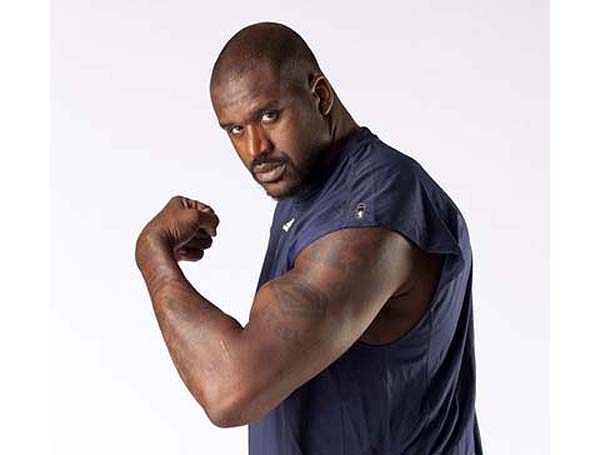
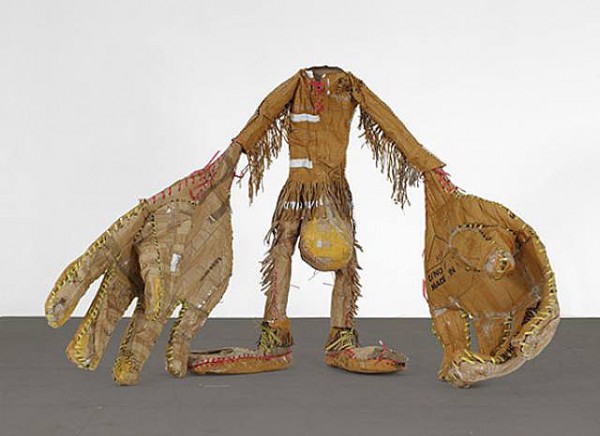
With the title “Size Does Matter”  for his debut show as a curator, one has to wonder if Shaquille O’Neal is talking about the size of one’s wallet, connections, ego, or one’s preference to bra size.   With the opening of the show at Chelsea’s FLAG Art Foundation the famous basketball player, actor, and rapper can now add “art curator” to his ever-expanding resume of accomplishments.   The exhibition includes work by 39 different artists, or “artstars” to be more accurate, whose works explore the myriad ways that scale affects the perception of contemporary art.  The scale theme is extremely fitting: weighing 320 pounds and standing 7’1 atop his size 22 shoes, Shaquille O’Neal has described his own size as “monumental” and he has the ability to dwarf just about everyone in his presence.

O’Neal made sixty-six selections for the show, which features works ranging from the ginormous billboard-sized Andreas Gursky’s photograph Madonna I to the microscopic work of Willard Wigan.  It is rumored that the works were chosen from over 200 images that FLAG founder Glenn Fuhrman and director Stephanie Roach showed him over dinner after a game.  O’Neal has also admitted that he is a great friend of Donald Trump who has four or five Picassos on his plane that O’Neal likes to look at when flying with him.  And with that, viola, a curator is born.  Describing the process of picking the works to include in the show, O’Neal explains, “Art is a process of delivering or arranging elements that appeal to the emotions of a person looking at it.  It’s what you feel.  I picked those things because they were beautiful.”  With this criteria in mind it is not surprising that another theme of the show could be “half-naked women,” or “ginormous breasts,”  as pieces by Richard Patterson, Dr. Lakra, and Lisa Yuskavage graphically illustrate.  O’Neil also plays the role of the muse for the show inspiring works like Willard Wigan’s  Micro Shaq,  Mark Wagner’s Shaq by Marq and Peter Max’s Portrait of Shaquille O’ Neal. These pieces embrace the famous basketball player’s happy-go lucky attitude, goofy grin, and larger than life attitude.

“Size Does Matter” is on display from February 19, 2010-May 27, 2010 at the FLAG Art Foundation in Chelsea. Shaquille O’Neil is best known as a center for the Cleveland Cavaliers.

Cleveland’s controversial best-selling author James Fray, who has written extensively on art, has an accompanying book for O’Neal’s art show that features installation images and an essay.

Share