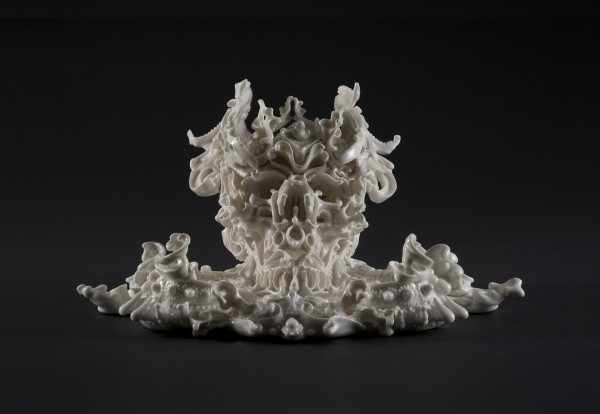
Tivon Rice: A Macrocosmic Zero

A Macrocosmic Zero is the title of Tivon Rice‘s second solo exhibition at Lawrimore Project in Seattle, on view through March 27.  Rice is a new media artist whose tactile approach seeks to present video as an object of use, and to integrate the observer as participant.  The current exhibition fills the front room of the gallery, a windowless space with concrete floors.  It is lit by two bright plasma screens and fluorescent bulbs suspended vertically from  wooden scaffolding. The bulbs sweep on and off in patterned surges of blue-white with a series of clicks and gentle hums.  A motor turns on and a central camera pans the room.  As the camera goes over a screen and films an image produced a few moments ago, a slow feedback happens, layering and obscuring the present space where the viewer stands, and also the viewer if he has caught a glance at the camera lens.  Rice’s video system is performing it’s routine.
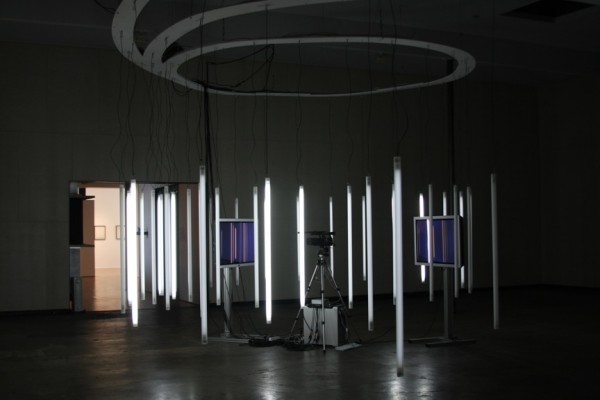
The whole set is programmed for a unique experience for each viewer—a lighting display that doesn’t repeat for 18 days, a delay between the live feed and playback, a robotic camera that responds to motion, and sound feedback that swells, but never explodes.  A “finished” or composite image runs at the back of the exhibition.  This view allows spectators to see who enters the gallery and how others interact with the work.
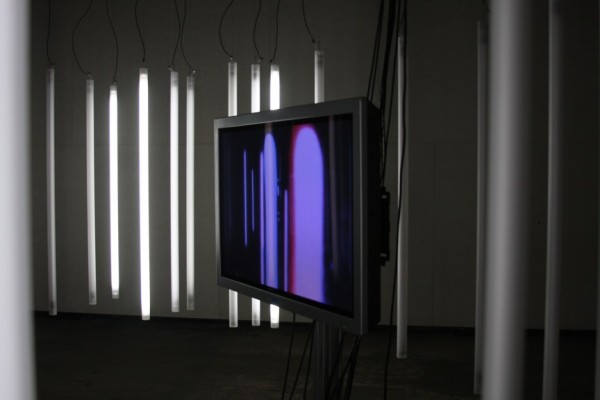
The use of lights is at least a pragmatic choice, a basic component in office buildings and modern living.  Their stark whiteness casts no “cinematic” shadow on its subjects, and in video perfection, imperfections of the subject are clearly and initially displayed.  Through layering “real” images, subjects become formal elements of flat light. The macroscopic view of this work is what is observable to the human eye, and as the title suggests, this view is fleeting. As the art progresses, it periodically interrupts what has been displayed to return to “zero.”  The art is the mechanical and sensory performance, rather than what is recorded.
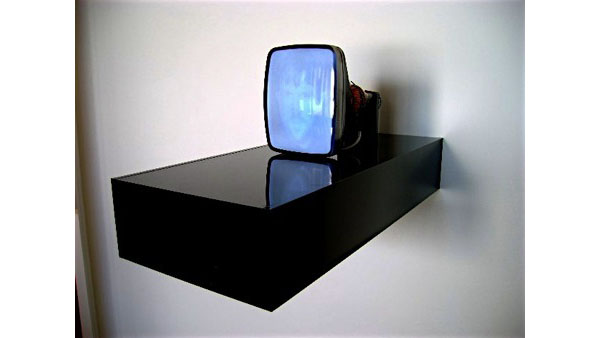
Rice also presents four video portraits that act as sketches or versions of the installation.  A face is seen in each one that the viewer continues to look for and find through swirling frames of mutation.  A final piece, the smallest in the exhibit, is a CRT monitor taken out of television presenting a static image of the artist.  For the amount of time in its title Self Portrait (3 days, 2 months, 10 days), an image of the artist’s face was lit on a small monitor.  The result is a “pixel burn,” an image made by exploiting the weakness of the display.  As it stays lit all over to show its ghost, it is undergoing its own decay as long as it is displayed.

Exerpt from 3 Studies for a Portrait of Bronwyn Lewis, 2010

Tivon Rice lives and works in Seattle, WA where is pursuing a doctoral degree at University of Washington’s Center for Digital Arts and Experimental Media (DXARTS).  He obtained his master’s degree from UW in 2006 and has been a Graduate Instructor there since 2007.  For his bachelor’s studies, he attended University of Colorado, graduating in 2000 with two degrees in Electronic Media and Sculpture.  He has had numerous solo exhibitions at galleries in the Pacific Northwest. His work is in private collections and his collaborative video of abstracted shaving cream with Jeffry Mitchell entitled Panda was acquired by the Henry Art Gallery in Seattle.  He has been in group exhibitions across the nation including the CUE Art Foundation in New York, and the Philbrook Museum of Art in Tulsa.  His work was included in 1000 Days at the Scion Installation Space in Los Angeles, curated by DailyServing.

Share

Armory Arts Review 2010

New York City’s Armory Arts Week, a highlight on the city’s annual cultural calendar, offered an array of arts-related events to the public last week (Mar. 2-7, 2010), drawing visitors from around the world to the city where art never sleeps. The Armory Show 2010 at Piers 92 and 94 featured 267 galleries from 31 countries. A large number of exhibitors showcased the works of a single artist, a divergence from the practice of displaying several artists at one fair. Patrons enjoyed the opportunity to absorb the work of the individual artist and develop a deeper understanding of the artist’s ideas and processes. Notable solo exhibits: Nicole Klagsbrun and David Zwirner (New York), Museum 52 (London | New York), and The Breeder (Athens, Greece).

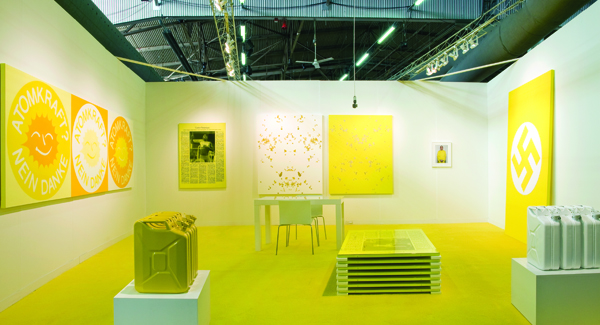
Adam McEwen‘s project, I Am Curious Yellow, radiated from Nicole Klagsbrun’s booth due to the artist’s boundless, but contemplative, use of the color yellow. McEwen chose to work with yellow because of the color’s ability to be vile and unpleasant, but also soothing and cheerful. His solo installation at Armory consisted of carefully selected objects placed alongside loaded imagery; jerry cans, a large yellow swastika, and several over-sized obituaries beneath glass, written for world champion runner Caster Semenya, were on display. Everything, even the carpet in the booth, was saturated in lemon yellow, with some white areas, and beaming in the bright lights of the fair.

McEwen has written pre-need obituaries for living celebrities before, employing traditional newspaper format with impressive impact (the artist used to write actual obituaries for London’s Daily Telegraph). Other past projects include his pencil on graph paper text message series. For these pieces, he copied the content and screen appearance of texts from his Nokia phone onto paper and presented the paper replicas of the digital missives in graphite frames.

Also in New York, The New Museum opened an exhibition curated by Jeff Koons on March 3rd, Skin Fruit: Selections from the Dakis Joannou Collection, which will remain on view until June 6, 2010. The New Museum, and others, offered discounts to visitors during Armory Arts Week.

Among several concurrent art fairs taking place throughout the city last week, Independent generated a great amount of intrigue. Founded by New York gallerist Elizabeth Dee and Dareen Flook of Hotel in London, and held at X Initiative in Chelsea, Independent presented 40 galleries and was less regimented than the Armory Show.  Independent‘s website declares “Hybrid Forum Comes to New York for Art Fair Week.”

Artists Space (New York), Michael Werner Gallery (Berlin | New York), and mitterrand+sanz (Zurich), were among the participants whose collaboration and presence were requested via personal invitation from the founders. This not only differed from the exhibitor application process at the Armory Show, it suggested a re-evaluation of the art fair mode. Elizabeth Dee also had a booth at Armory for her gallery.

Share

From the DS Archives: Rosemarie Fiore

Each Sunday we reach deep into the DailyServing Archives to unearth an old feature that we think needs to see the light of day again. This week we found a feature with the artist Rosemarie Fiore. If you have a favorite feature that you think should be published again, simply email us at info@dailyserving.com and include DS Archive in the subject line.

Originally Published: June 10th 2009

rosemarie   fiore.jpg
Image courtesy of the artist and Priska C. Juschka Fine Art, NY

Rosemarie Fiore is drawing with fireworks, low explosive pyrotechnic devices such as color smoke bombs, jumping jacks, monster balls, and ground blooms, to name a few. The artist recently exhibited several of these large scale works on paper in a solo show at Priska C. Juschka Fine Art in New York. The artist’s incendiary process of exploding and containing live fireworks over paper reveals her remarkable aesthetic control over the combustible material. Photographs of this process recall Hans Namuth‘s photographs of Jackson Pollock slinging industrial paint onto canvas and the indelible images of Richard Serra hurling molten lead against the walls of his studio.

rosemarie   fiore2.jpg
Image courtesy of the artist and Priska C. Juschka Fine Art, NY

Fiore ignites her chosen explosive inside a bucket or other container, which is inverted on the paper. The explosions create strokes and sunbursts of vibrant pigments, including magenta, ochre, rust, and copper, all varying in saturation and intensity. Gunpowder marks and sooty burnt surfaces provide visible traces of the detonation. Fiore overlaps and collages the best effects on large sheets of the same paper, repeating these actions a number of times. The final works are heavy and contain multiple layers of collaged explosions, resulting in abstract compositions and fields of color described by Robert Schuster of the Village Voice as “op art visions of the cosmos.”

Fiore has often worked out of action, considering each process a performance and documenting it by video and photograph. She has used repurposed machines and has previously painted and drawn with a modified floor polisher, a windshield wiper, and a Scrambler (the multi-armed amusement park ride). She received her B.A. from the University of Virginia in 1994 and her M.F.A. from The School of the Art Institute of Chicago in 1999 and has also shown at the Gallery Bar and the Winkleman Gallery in New York.

Share

Brian Jungen: Strange Comfort

Strange Comfort, Brian Jungen‘s exhibition at the National Museum of the American Indian (NMAI), is as delightful as it is disquieting.  Jungen, who is part Northwest American Indian, transforms objects of American consumption into relics of tribal culture.  The result is transcendent hybrids that raise questions about the relationship between art, culture and commodity.

Six pieces from the Prototype for New Understanding series greet viewers entering the exhibit.  While these pieces appear to be authentic tribal headdresses displayed under glass vitrines, it is soon revealed that they are in fact made of Nike Air Jordans.  Because of this material transformation, the sculptures are in a state of constant becoming—at once creatures, masks, animals, shoes, and fantastical hybrids.  There is a confusion of body parts as plushy shoe openings become eyes, rubber-tipped toes become mouths, and thick fabric tongues become beaks.  The reassigning of parts designed for the anatomy of a foot to fit the anatomy of a face is as grotesque as it is wonderful.

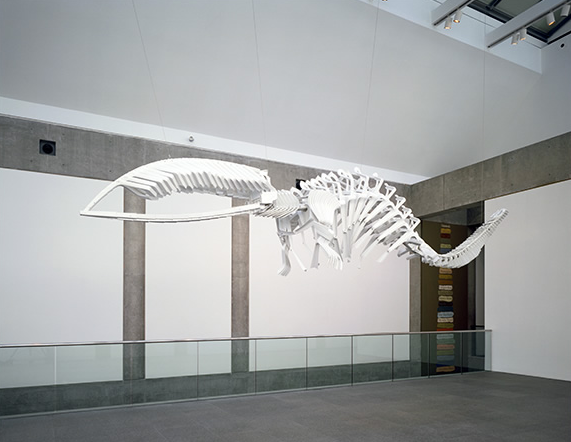
Jungen ironically critiques the way marginalized cultures have been pillaged for their goods by Western colonialists.  He attacks commodity by making a triple-commodity—tribal relic, Nike shoes, and marketable art object. Jungen brings us further into his natural history museum of commodities with Shapeshifter, a huge whale skeleton made of white plastic chairs.

Side by side, the chairs become the sleek vertebrae and ribs of this immense animal.  Suspended several feet above its platform, the whale’s shadows are haunting and give it the believability of an extinct, magnificent sea creature.  Its empty body and ghostly shadows play foil to the recognizable lawn chairs that are its bones, for as much as we believe that this creature was once living in a faraway time, we know that it is part of our vernacular existence. 

Questioning our own knowledge, we wonder if this whale could have really existed, or is it a made up version of Western history?

The context of the NMAI lends another layer to Jungen’s work.  We are invited to view his sculptures as more than art.  In this context, they become American Indian artifacts.  By marrying seeming opposites, consumer and tribal cultures, Jungen proves that the treasures that fill the NMAI are not merely relics of a faraway past—they are the thoughtful products of a people that are part of contemporary society.  This assimilation into mainstream commodity culture, for better or worse, perhaps provides a “strange comfort,” for both seekers of these treasures, and also the people to whom they belong.

Brian Jungen’s Strange Comfort is on view October 16, 2009–August 8, 2010 at the NMAI on the National Mall, Washington, DC.

Share

Standing Out to Join In

L.A. Expanded: Notes from the West Coast
A weekly column by Catherine Wagley

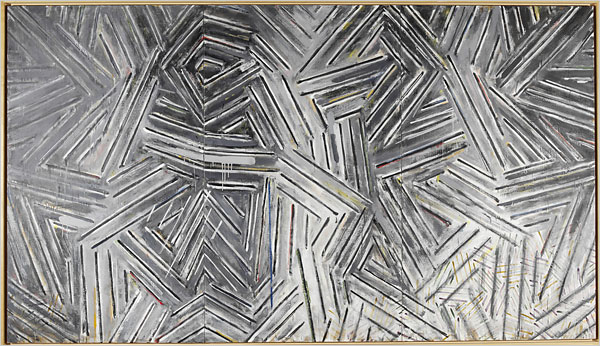
Jasper Johns, “Between the Clock and the Bed” (1982-83), encaustic on canvas. Courtesy Jasper Johns/Licensed by VAGA, New York

There’s a sweetly prophetic story about Jasper Johns and Robert Rauschenberg in Calvin Tomkins’ iconic art-crowd chronicle, Off The Wall. The story, which makes the gap between innovation and belonging look extremely narrow, goes like this: it was the summer of ’55 and Johns and Rauschenberg lived symbiotically, popping in on each other at least daily and swapping ideas with so much success that they even tried making one another’s work. By this point, Johns had begun his flags—a new direction that “came to him in a dream”—and Rauschenberg found Johns’ encaustic process seductive. “It smelled so delicious, and it looked so good,” said Rauschenberg, quoted by Tomkins, “all those aromatic bubbling waxes.” After some begging, Johns let Rauschenberg add a stripe to a flag, but Rauschenberg, too infatuated by wax to pay attention to composition, dragged a heavy red stripe right across an already-painted white one. He never touched Johns’ work again.

Around the same time,  Johns tried his hand at making some Rauschenberg work. “I thought I understood,” said Johns. “But mine weren’t convincing at all.” A few years later, and the two artists barely spoke to each other.

This hexed collaboration gets at something predictably true about art-making in general—it’s not vision that pulls most into the business of making, at least not at first. It’s wanting to be part of a vision you’ve observed from the outside. But entering someone else’s vision, it turns out, can be excruciatingly difficult, maybe even impossible. Sometimes, it’s easier to find a vision of your own.

Mark Grotjahn, "Untitled (Face for Greece 843)," 2009, Oil on cardboard mounted on linen. Courtesy Blum & Poe Gallery.

Mark Grotjahn’s current exhibition at Blum & Poe intermittently innovates and belongs.  Called Seven Faces, it’s full of lanky yet dense almost-abstractions, paintings with as much primitive gusto as de Kooning’s Woman and as much flat, psychedelic guile as Fred Tomaselli’s Geode. Surprisingly economical—oil has been applied on top of cardboard which has been stapled to stretched linen, and the paintings’ cavities and protrusions come from cut and stacked cardboard rather than lathered paint—each work consists of scraggly calculated stripes that all radiate from an imaginary focal point or boundary line. Tucked in among these stripes, eyes, the flat, symbolic kind that don’t claim to be windows into anything, glare into the space right in front of them. Sometimes, toothy monster mouths break through the stripes, as well.

Mark Grotjahn Untitled (Black Over Red Orange "Mean as a Snake" Face 842), 2009, Oil on cardboard mounted on linen. Courtesy Blum & Poe Gallery.

Grotjahn’s work announces itself as smart. Whether his sleek, perspectival hipster abstractions, or these rougher, stranger faces, a Grotjahn painting exudes self-knowledge. It knows that it fits into a legacy, and embraces every nuance of that legacy from Picasso, whose distorted figures had similar, overly-wide petal-shaped eyes, to Johns, who was pioneered painterly but cooly controlled line-making; it knows that it’s derivative, but it also knows that it isn’t redundant and that it doesn’t seamlessly fit into any pre-existing category. This sort of uber-awareness doesn’t feel contrived, however; it feels like a personality trait.

I would recognize Grotjahn’s work anywhere because of its quirks. Obsession with perspective and symmetry may not be original but it has never quite looked the way Grotjahn makes it look–combining slightly cagey precision with paradoxically liberal painterliness. I like to think of Grotjahn as a big fan who found a signature not because he had something cataclysmic to say but because, like many artists before him, he wanted to talk about how perspective skews perception and how paint adheres to surface. To have a conversation, you need a voice. But you don’t always need an aggressive, groundbreaking clarion call.

Share

Sanford Biggers: Moon Medicine

Sanford Biggers, Seen, 2009, Video still, Digital C-print, 30 x 40 in. Courtesy the Artist and Michael Klein Arts, New York

Currently on view at Santa Barbara Contemporary Arts Forum is a solo presentation of new work by internationally renowned, New York-based artist, Sanford Biggers. The work on view in the exhibition, entitled Moon Medicine, encompasses the breadth of Biggers’ practice. As he tells the SBCAF, “It is a thematic, multi-disciplinary exploration of past themes and new themes meant to broaden and complicate our read on American history.” In a recent video-recorded conversation between Biggers and CAF executive director, Miki Garcia, Biggers discusses his avoidance of artistic labels, such as “post black.” These labels are not rejected by the artist for the sake of radicalism but, rather, because he says that no matter how you mean it to sound, a label is always “predicated on there being an other.” Biggers further explains that he rejects labels even in his discussion of artistic medium, saying he’s “not interested in being a sculptor [or] a performance artist…I just make things.” Of his process, he says, “The more confused I am while making a piece now, the more successful it is to me regardless of what it ends up looking like.”

The recurring imagery of mandalas in Biggers’ work reflects a strong interest in Buddhism, the exploration of which is found in his past and current work. Biggers gained interest in the Buddhist tradition while living in Japan and traveling all over Asia years ago. Of the work he made upon returning to the US from Asia, Biggers says it became autobiographical in part—in the sense that he “fused some of what [he] had been studying and researching in terms of Buddhism, but also bringing in some things from my childhood, growing up in Los Angeles, and being a B-boy.”

Sanford Biggers, Constellation, 2009, Steel, Plexiglas, LED’s, Zoopoxy, cotton quilt, original printed cotton tile. Dimensions variable, Installation at Harvard University. Courtesy the Artist and Michael Klein Arts, New York, NY.

Biggers is a master of alluding labels, as we’ve learned, and the “elliptical” nature of his work (as Garcia refers to it), creates an open-ended dialog that spans a range of subjects from religious practices, to themes of racial tensions in the American South, to pop culture iconography. Moon Medicine will be on view through May 2, 2010.

Sanford Biggers lives and works in new York. He earned his BA at Morehouse College, Atlanta, GA and his MFA at The School of the Art Institute of Chicago, IL. He has exhibited extensively both nationally and internationally, including at Mary Goldman Gallery, Los Angeles; Tate Modern, London; Okinawa Museum, Okinawa, Japan; The Studio Museum in Harlem, New York; and the 2002 Whitney Biennial, Whitney Museum of American Art, New York.

Share

Neo-ornamentalism from Japanese Contemporary Art

MOT Annual 2010: Neo-Ornamentalism from Japanese Contemporary Art is currently presented by the Museum of Contemporary Art Tokyo. Since 1999, the museum has been holding a “MOT Annual” exhibition focusing on the works of young artists exploring a selected theme on contemporary society. This show presents the works of ten Japanese artists, and is an exploration of contemporary expressions of ornamentation beyond embellishments, as both artistic gestures and reflections of a worldview concerning time, space, and individual human existence. A recurring feature of many of the works is an acknowledgment that craftsmanship marked by repetition and precision are tangible points of connection or reminders of spirituality and life beyond the material world.

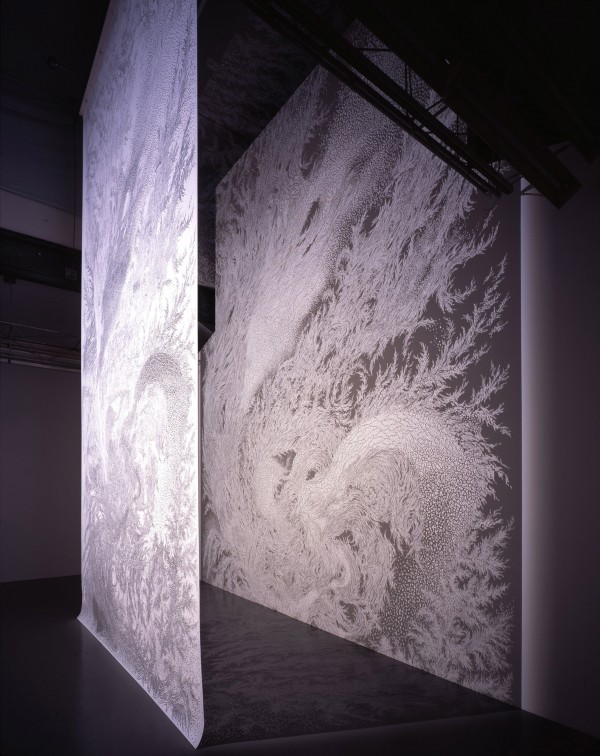
Tomoko SHIOYASU, Cutting Insights, 2008, Paper, TAKAHASHI COLLECTION, Courtesy of SCAI THE BATHHOUSE, Photo by Keizo Kioku

Tomoko Shioyasu’s Cutting Insights presents a floor-to-ceiling tapestry composed of a paper-cut with dragon and phoenix figures using a single roll of photo paper. Placed in an enclosed, darkened space, the use of two light bulbs cast shadows elongated against the rear wall, throwing into relief a semblance of the environment and nature which had been instrumental in inspiring her work. With a background in sculpture, Shioyasu began experimenting with paper-cutting in 2003, borne out of a fascination at the manner in which the delicate web of veins of the leaves of the rumex japonicus found on her campus created vigorous and dynamic forms.  Her works which require a process of repetitive work of creating small cuts onto the paper by hand are an expression of the rhythm and repetition found within nature, and are deeply rooted in a philosophy of pursuing the truth of the universe through nature.
Motoi YAMAMOTO, Labyrinth, Installation view at Force of Nature, Artist in Residence, Halsey Institute of Contemporary Art, Charleston, SC, U.S.A. 2006, Salt
Labyrinth is created from over 600 pounds of refined salt. The entire work which was produced after sixteen ten-hour days, spans 590 square feet and can be viewed from a purpose-built platform in the gallery. Motoi Yamamoto, an artist known for his salt-based sculptures and installations began working with salt as a material following the death of his sister in 1994 from brain cancer. An indispensable funerary element in Japan to banish harmful spirits, Yamamoto was prompted to use salt as a gesture of remembrance, to reflect on the impermanence of life and the need to let go and allow nature to reclaim what belongs to her. Many of his salt installations are based on labyrinths or complex networks, and the laborious and meandering process with the unpredictability of the eventual curves and pathways are, for Yamamoto, an act of tracing his memories. For his salt installations done for exhibitions, Yamamoto stages a performance titled Return to Sea on the last day of the exhibition, to return the salt to the sea and nature, and to support the life of the sea creatures.

Katsuyo AOKI, Predictive dream Ⅸ, 2009, Private collection, Courtesy of Röntogenwerke

Katsuyo Aoki’s delicate porcelain works on display, including Predictive dream IX and Trolldom, combine both decorative patterns and paints of blue and purple baked on parts of the white porcelain, creating a smeared-like appearance. Presented in an entirely stark white room, the sculptural pieces which bear a mixture of traditional ornamentation decorum of symmetry together with fantastical depictions of other-worldly creatures and skulls, draw viewers into an enclosure befitting a religious and mythical experience. Aoki creates these works based on what she terms her “inner shadow” of imagination and fantasies, and strives to convey both a sense of strength and fragility to parallel the nature of human societies anchored on the advance of technology and progress, while remaining fractious and imperfect.
The show is curated by Akio Seki and goes on till 11 April 2010. The other participating artists are Atsuo Ogawa, Kiyoshi Kuroda, Asao Tokolo, Nao Matsumoto, Hiroshi Mizuta, Junichi Mori, and Kentaro Yokouchi.
Share