Katharina Grosse

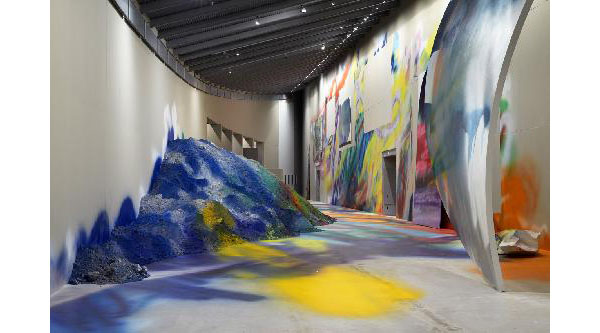
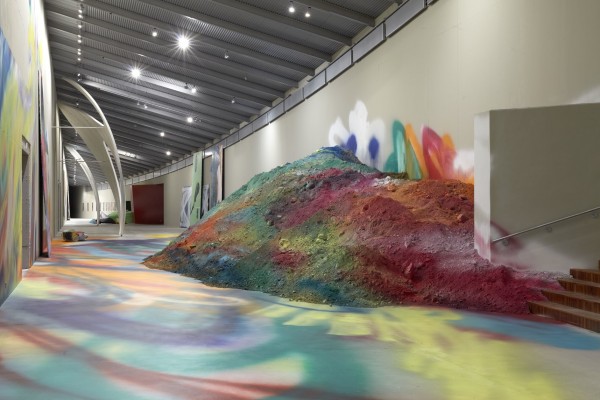
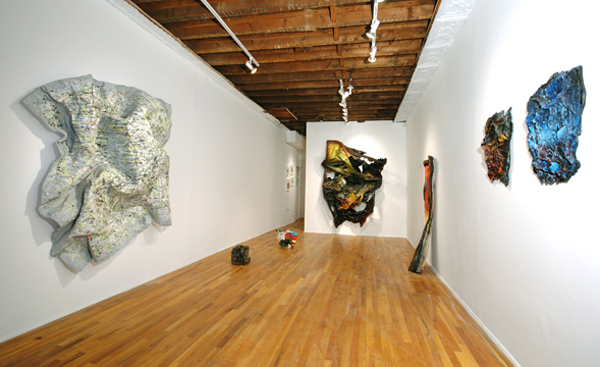
Katharina Grosse’s solo exhibition, Hello Little Butterfly, I Love You What’s Your Name, is occurring until November 7th at ARKEN Museum for Moderne Kunst, in Ishøj, Denmark, within breath of Copenhagen.

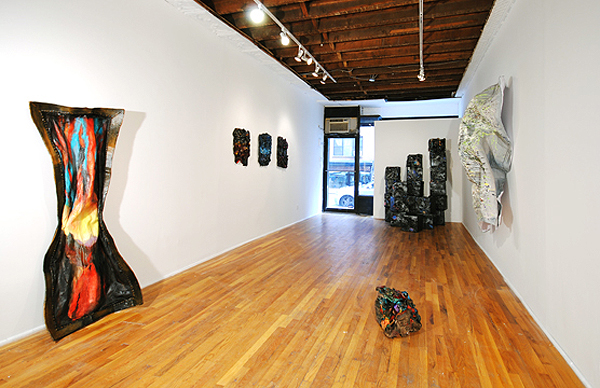
Grosse makes canvas of architecture, erecting varicolored walk-abouts by using hundreds of litres of spray paint; mounds of earth; mammoth, leaning discs; and other big, wadded-up shapes. Viewers are not allowed any of the usual aloofness in their relationship to the artwork, as they literally walk through an airbrushed terrain. That status quo is dissolved. At once dreamy and seemingly protean, the space still renders you surefooted but takes your wit from you, bringing you into an unfettered realm. Appropriately, all of her installations are a one-time deal—they are site-specific and short-lived, as if reveries.

Born 1961 in Freiburg, Germany, Katharina Grosse is a graduate of the Düsseldorf Art Academy, where she studied with Gotthard Graubner and Gerhard Richter. She now lives and works in Berlin. Her last group exhibition was at the Miami Art Museum, Miami Space as Medium (2009); and her most recent solo exhibition, prior to the Arken, was Shadowbox at Temporäre Kunsthalle, Berlin.

Share

Videos Collide in Real 3D Space!

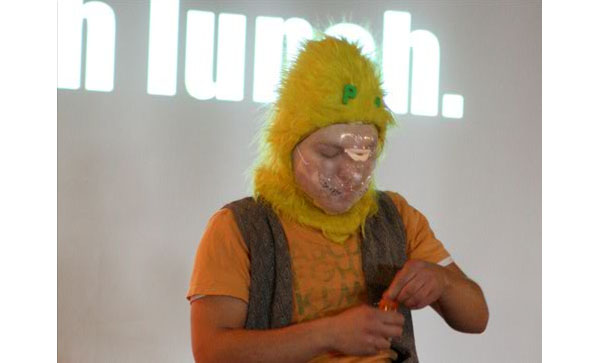
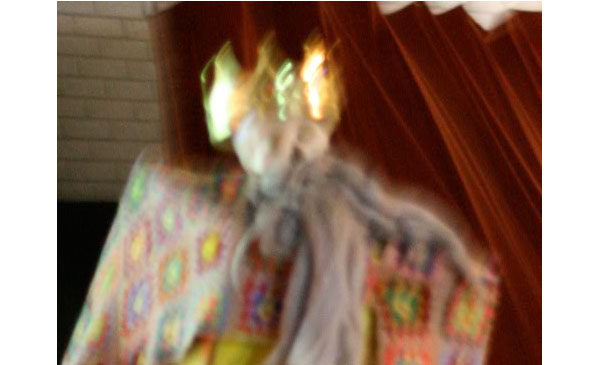
On view this weekend at Five Thirty Three Gallery in Los Angeles is a new two-day video and performance exhibition titled Videos Collide in Real 3D Space! The exhibition, which is co-curated and organized by Beautiful/Decay print and web designer Fei Liu and artist Megan Daalder, will feature real-time software performance by Jeremy Bailey, a score of a projector by Wojciech Kosma, synchronized live animations by Zeesy Powers, Party Food performance by Joseph Gillette, a tribute to Karl Sims by Megan Daalder, Intermedia theatre by Ben Bigelow and Animatronics by Matt Barton. The exhibition seeks to converge the virtual realm of art creation with that of the physical space of a gallery by adding the physical presence of the artist in both spaces simultaneously.  Artist in the exhibition will travel from Canada, Berlin, Colorado and Los Angeles to perform.


Videos Collide in Real 3D Space! will begin at 8pm and continue to 10pm on March 26 and 27.

Share

From the DS Archives: Lisa Yuskavage

Each Sunday we reach deep into the DailyServing Archives to unearth an old feature that we think needs to see the light of day. This week we found a review of Lisa Yuskavage’s 2009 exhibition with David Zwiner. If you have a favorite feature that you think should be published again, simply email us at info@dailyserving.com and include DS Archive in the subject line.

Originally Published: March 16, 2009

yuskavage1 (travelers).jpg
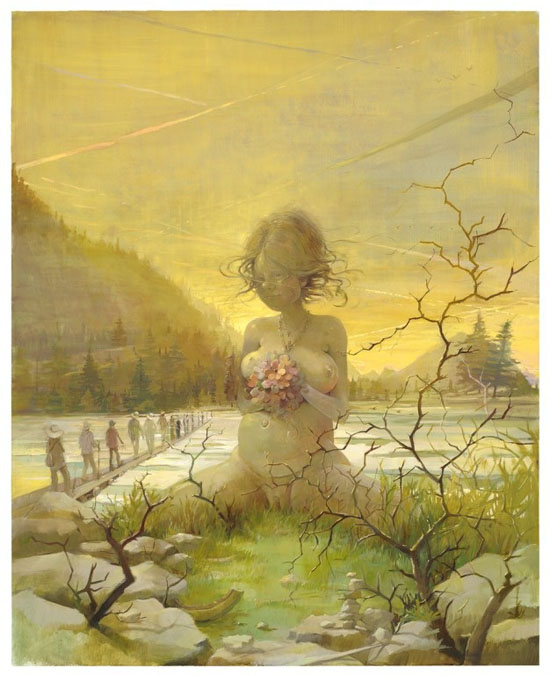
Travelers, 2008, oil on linen, 77 x 62 x 1 1/4 inches

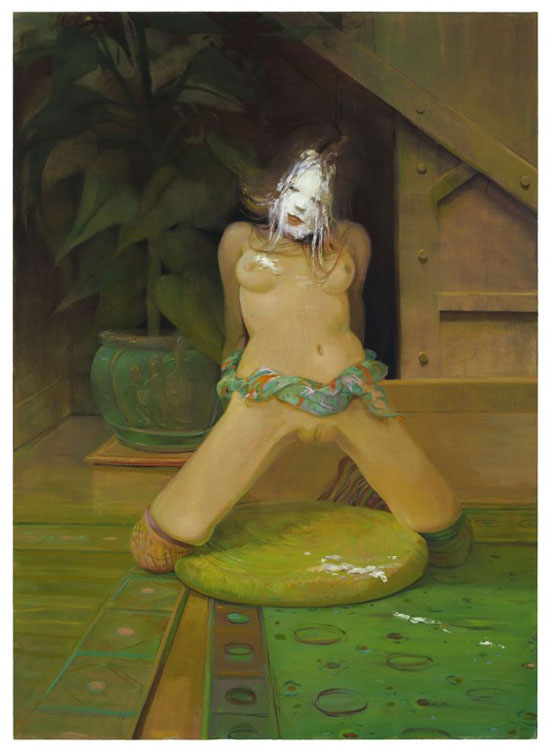
David Zwirner in Chelsea is currently presenting several recent large scale oil paintings by contemporary American figurative painter Lisa Yuskavage in her second solo show at the gallery. Since receiving her M.F.A. at Yale in 1986, Yuskavage has shown her work across the world and is included in several major museum collections. Works included in this gallery exhibition are PieFace (2008), Travellers (2008), Figure in Interior (2008), Snowman (2008), Reclining Nude (2009), The Smoker (2008), Pond (2007), among others, in addition to small oil paintings, including Figure in Landscape (2008) and Chrissy (2009).

Yuskavage began her career as a key part of a new figuration movement taking place in the 1990s (the “Bad Painting” movement), which occurred when the glitz of the previous decade faded and painting became more personal and traditional. Other artists grouped in this movement include John Currin, Elizabeth Peyton, and Luc Tuymans. Yuskavage’s now iconic sexualized young females are painted in a refined style that recalls the technique and skill of the great masters. These female characters are given anatomical irregularities, such as bloated bellies and exaggerated breasts, but sustain some mesmerizing sexual appeal. They are placed into erotically charged settings and positions, forcing the viewer into a sometimes uncomfortable voyeuristic situation. Yuskavage’s suggestive subject matter and her employment of a kitschy soft core aesthetic highlight the artist’s impeccable technical ability.

yuskavage2.jpg
Figure in Interior, 2008, oil on linen, 72 x 52 x 1 1/2 inches

In several works on display in the show, Yuskavage places her signature voluptuous beauties in mystical mountainous landscapes, sometimes accompanied by less prominent figures, as seen in Travelers, 2008. The vaporous lighting of the composition and the incomplete narrative suggested by the title trigger a slight feeling of unease, not unlike her earlier works. The artist has cleverly been able to maintain the critical balance between psychological and erotic content, but works such as Figure In Interior, 2008, call this balance into question with its salacious sensationalism.

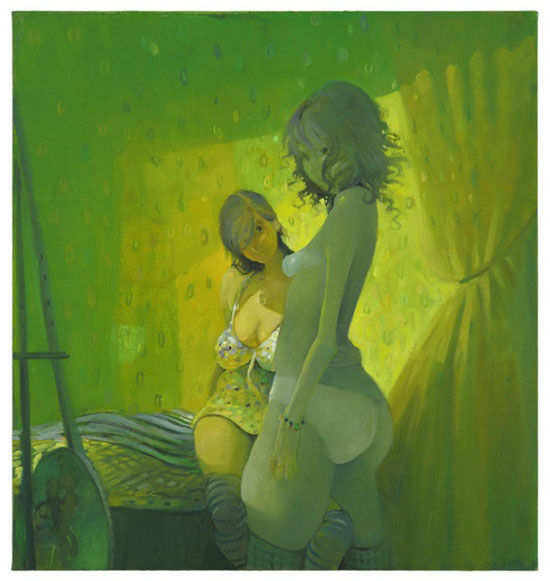
The compositions representing interactions between two female figures are more psychologically compelling than the singular portraits, such as Teresa and Lauren, 2008, which depicts an impending encounter between two women in a warmly lit private chamber. The alluring glance of the woman looking back at us serves as both an easy entry to the rendezvous and a startling reminder of our fictional intrusion. The rousing exchange between these sapphic sirens is indicative of the artist’s continued ability to provide an undeniably stimulating experience.

yuskavage3.jpg
Teresa and Lauren, 2008, oil on linen, 25 1/2 x 24 x 1 1/4 inches

Yuskavage was born in Philadelphia, Pennsylvania and currently lives and works in New York where she is represented by David Zwirner. Over the past year, she has participated in group exhibitions at The FLAG Art Foundation and Thrust Projects in New York and the Museum Moderner Kunst Stiftung Ludwig Wien in Vienna.

Share

Valerie Hegarty and Shannon Plumb at Nicelle Beauchene


Valerie Hegarty’s recent work at Nicelle Beauchene Gallery can be described as “petrified relics.”  After recreating famous works of art that recall Pollock, Rothko, and LeWitt, Hegarty then skillfully destroys parts of the work  to suggest damage by natural events.  Starry Rothko appears to be a Mark Rothko painting singed beyond recognition by fire and heat, leaving only a smoldering vestige of what is considered a great American painting.  However, the mutilation is skillfully considered; it is shaped after an explosion in space that was captured by the Hubble telescope and illustrates Hegarty’s interests in quantum physics, alchemy, origami, Abstract Expressionism and cosmic imagery.

In Space Cubes, Hegarty measures the interior of Sol LeWitt’s Open Cubes (1” x 1” x 1”) and creates her own blocks of space from compacted paper to resemble images from the Hubble telescope.  The artist then arranges these paper chunks of space in a typical LeWitt building block formation which begin to unfurl as the structure grows in height.  The piece reveals Hegarty’s reverence toward rigid form and its relationship to philosophical and mathematical concepts yet it belies her instinct to admit that elements of chance, irrationality, and  chaos inspire the creation of such scientific systems.

Valerie Hegarty received her MFA from the School of the Art Institute of Chicago in 2002. She has shown internationally including solo shows at Guild & Greyshkul, New York; MUSEUM 52, London; Museum of Contemporary Art, Chicago; and CTRL Gallery, Houston. Additionally, she has been included in group exhibitions at the Depart Foundation, Rome; The Drawing Center, New York and White Columns, New York. Her work is currently on view at the Brooklyn Museum as part of their permanent collection and at the Highline as part of their public art program. Hegarty lives and works in Brooklyn.

Hegarty’s show “Cosmic Collisions” will be at Nicelle Beauchene until April 11, 2010.

VIDEO LOUNGE:: Shannon Plumb, ‘Olympics (Track and Field),’ 2005

Shannon Plumb’s film based on the summer games of the Olympics channels the spirit of slapstick comedy and the physical humor of Buster Keaton, Charlie Chaplin, and particularly Leni Riefenstahl’s Olympia.  Plumb portrays her version of the athletes in the Olympic Opening Ceremonies, track and field game sports, and warm up exercises. Employing a low-fi aesthetic by using Super-8 film, stationary camera shots, and hand-made props and costume, Plumb  exaggerates the emotions of heroics, anxiety, and pomp and circumstance that accompany the games..  Olympics is a one-woman show starring the artist as all of the characters and acting as the creative force behind  the film.

Plumb’s work has been exhibited in solo and group shows at the Brooklyn Museum of Art; the Museum of Art, Rhode Island School of Design, Providence; and P.S.1 Contemporary Art Center, Long Island City amongst others. Her films have been screened at festivals internationally. In 2007, her Ocularis at 10 was exhibited at the Museum of Modern Art, New York.

Share

Making It In America

L.A. Expanded: Notes from the West Coast
A weekly column by Catherine Wagley
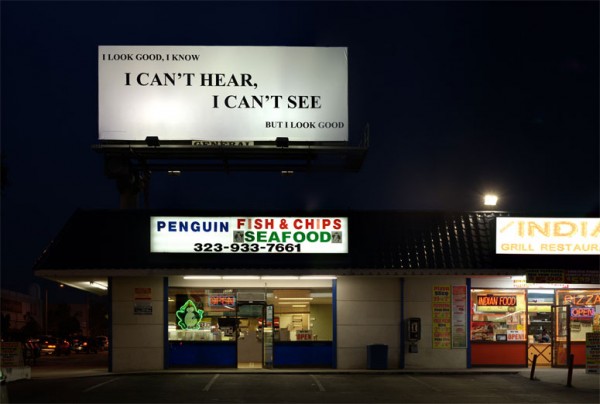
Yvonne Rainer, Pico Blvd, west of Fairfax Ave. Photo by Gerard Smulevich. Courtesy MAK Center.

Billboards promoting HBO’s How To Make It In America began appearing in Los Angeles in January, or at least that’s when I began noticing them. They didn’t make sense because they weren’t any of the things billboards often are: explicitly sexy, youth-worshiping, polarizing, lush for no reason, symmetrical, centered, excessively air-brushed, heavy-handed, copy-desk clever or instantly legible. Instead they were ambiguous and blurry.

The How to Make It ads featured an out-of-focus, slightly claustrophobic photograph of genuinely pretty people occupying fore-shortened space. The relationships betweens these people were ambiguous at best. The typical white guy in the foreground, who had a wary, doe-eyed face and unusually large ears, was definitely aware of the camera, but the laughing girl with her hand on his chest seems to be aware of a whole different sort of reality–she looked like she was performing happiness at a well-populated party. In the background (which, because of the weirdly collapsed space, isn’t too far from being the foreground), an African-American man with a self-conscious smirk apparently listened to the advice, or the comedy, of the Latino man leaning into him. At first I thought “making it” must be a commentary on the sexual landscape of America today—maybe the show would deal with the ambiguity of same-sex versus hetero relationships, in a landscape in which race occupied an especially undefined space and technology mediated love—but neither of the “couples” in the image actually acted like couples. So maybe “making it” was economic, about social climbing. When I googled the show and found it followed two 20-somethings bent on breaking into the designer jeans business, the haze didn’t exactly lift.
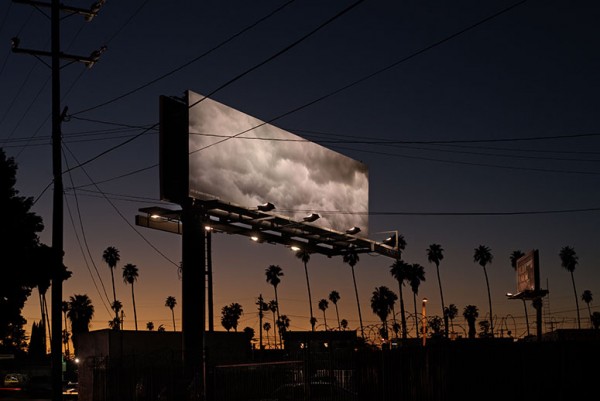
Kerry Tribe, La Brea Ave, north of Venice Blvd. Photo by Gerard Smulevich. Courtesy MAK Center.

When billboards are interesting in this way, I get suspicious, because I assume someone, somewhere, is trying to pull one over on me. When art is interesting in this way, however, I get excited.

The MAK Center for Art and Architecture launched a public art exhibition on L.A. billboards last month. Curator Kimberli Meyer and her team secured the donated commercial space with the help of MacDonald Media, and commissioned well-established conceptual artists like Yvonne Rainer and Kenneth Anger, along with newer names like Kerry Tribe and Brandon Lattu to design images. The “Art In Stead” billboards pop up in Glendale, Hollywood, Culver City, Beverly Hills, Pico and the Mid-City Area. They’re supposed to “exhibit” for a month, but they occasionally disappear and reappear unannounced, proof, perhaps, that “donated” means “at the mercy of Clear Channel.”

Christina Frenandez, Hollywood Blvd, west of Bronson. Photo by Patricia Parinejad. Courtesy MAK Center.

Christina Frenandez, Hollywood Blvd, west of Bronson. Photo by Patricia Parinejad. Courtesy MAK Center.

Interviewed by Francis Anderton in February, Meyer said,

“The idea is to look at the landscape of Los Angeles, which is dominated by billboards, and think about what it would be like if artists were making some of the images that we were seeing these signs.”

What it would be like, apparently, doesn’t differ too much from what it’s like already—some billboards would be visually arresting, some would be genuinely confusing, some would make you think and some would fleeting pound you with a too-easy-to-dismiss message. But what this exhibition does extraordinarily well, better than any museum-bound institutional critique in recent memory has: it shows how subservient the display of art is to capitalist power structures. And it shows art can potentially subvert that subservience, though only a little.

The exhibition took years of negotiation and, according to LA Weekly‘s Erica Zora Wrightson, the artists’ proposals were all screened by the donating companies. As a result, the most provocative work indulges in ambiguity, like Christina Frenandez’s meditation on the literal landscape of economic devastation, or, my favorite, Yvonne Rainer’s Marlene Dietrich quote, written in black letters on white, and hanging above a fish and chips sign: “I look good/I know/I can’t hear/I can’t see/but I look good.” It’s a deceptively tame cry for attention that protests the way the sleek culture of advertising erases the space between voice, person-hood and  image.

Share

Ricky Allman: you will never feel the same again

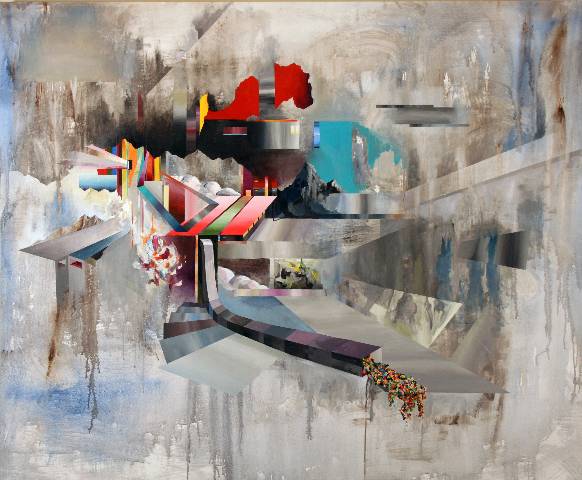
you will never feel the same again, is the title of a new exhibition of paintings by artist Ricky Allman. Opening Saturday night at Galerie Anais in Los Angleles’ Bergamot Station, the new series of works continues to explore the artist’s interest in futuristic landscapes, which act as a metaphor for the tension between science and religion, and the possible apocalyptic future that is proposed by both institutions. The ‘visual drama’ captured in the paintings, as the artist puts it, features geometric patterns along side the organic, simultaneously stimulating a dialogue that is centered on formal ideals set forth by modernism and minimalism as well as addressing many of the cultural and societal issues of our day.

Allman is a graduate of Rhode Island School of Design, completeing his degree with Honors in 2007. This artist is currently an Assistant Proessor of Painting and Drawing at the University of Missouri-Kansas City, and has a forthcoming show this summer at David B Smith Gallery in Denver.

you will never feel the same again will be on view March 20th through April 14, 2010.

Share

Kimberly Brooks: The Stylist Project

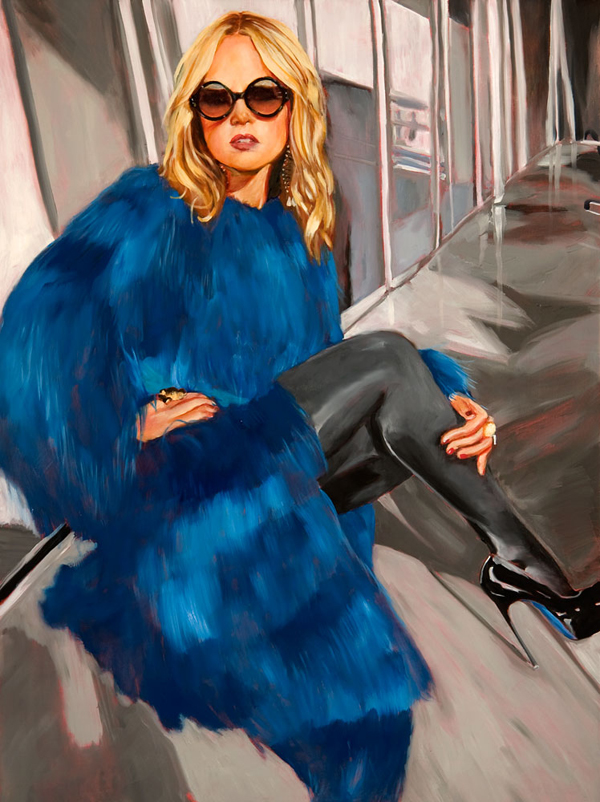
Rachel Zoe, 32" x 24" , oil on linen. Courtesy Kimberly Brooks and Taylor De Cordoba, Los Angeles.

The art world. It’s way more serious and important than every other industry! This thinking at least seems to persist even though the field of contemporary art has maintained an open flirtation with its sassy sister, the fashion industry, since long before even Andy Warhol trotted his wacky wigs around Studio 54 with the likes of Diane von Fürstenberg. There is a mutual fascination between the two fields, and yet it seems that the art world would prefer to keep its consorting with the fashion industry confined strictly to social events, rather than consider fashion (so low-brow!) as a worthy subject matter for actual works of art.

Los Angeles-based artist, Kimberly Brooks‘, current solo show at Taylor De Cordoba gallery in Culver City breaks with this norm to explore the intrigue of the fashion industry’s most iconic stylemakers—without the precept of farce or condemnation. The Stylist Project (on view through April 3rd) presents Brooks’ latest body of work—a series of oil painted portraits of fashion industry insiders, including stylist to the starts and Bravo TV fixture, Rachel Zoe, and award winning costume designer and Madonnaʼs personal stylist Arianne Phillips, among others.

The work on view blends the fields of art and fashion astutely, presenting the fashionable set as they have styled themselves, while at the same time drawing upon the ages-old artistic tradition of portraiture. The regal positions of some of the sitters recall Renaissance royals, and the sprawled poses of others touch on the early Modern depiction of courtesans, such as Edouard Manet’s Olympia.

Arianne Phillips, 30" x 24", oil on linen. Courtesy Kimberly Brooks and Taylor De Cordoba, Los Angeles.

The Stylist Project is the third solo show for Brooks at Taylor De Cordoba. The first two, Mom’s Friends (2007) and Technicolor Summer (2008), explored much more personal subject matter than the present show. Brooks’ outward shift to now document the fashion industry with this latest series has garnered a lot of attention from media and publications that wouldn’t normally publish gushing articles about fine artists. At the Taylor De Cordoba gallery, they’ve laid out a stack of glossies with Brooks’ name inked onto them. When I asked Heather Taylor, Director of Taylor De Cordoba, to discuss the widespread reception that this exhibition has received, she told me, “The bottom line is that people are hungry for this dialogue and Kimberly is pulling the curtain back on the fashion world, which up until the past year—with the popularity of [the film] ‘The September Issue’ and [the TV show] ‘The Rachel Zoe Project’—had been fairly mysterious.”

New York born, Los Angeles based, Kimberly Brooks maintains her studio in Venice, CA. She earned her BA from UC Berkeley and trained in fine arts at Otis College of Art and Design and UCLA. Her work has been included in numerous juried exhibitions, including at Pleiades Gallery of Contemporary Art, New York; Risk Press Gallery, Los Angeles; and Phillips de Pury Auction House, Los Angeles.

Share