Erick Swenson: A Selection of Works

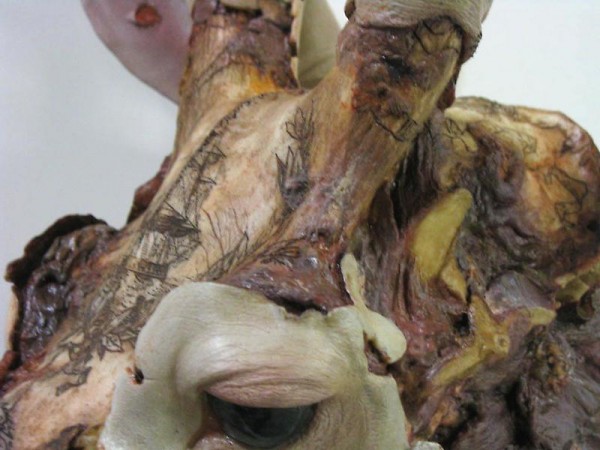
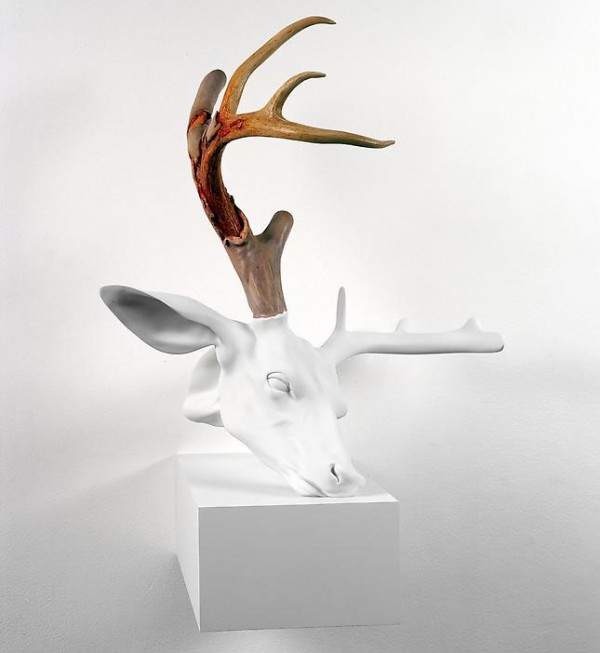
Opening tomorrow evening at James Cohan Gallery in New York City is an new exhibition by American artist Erick Swenson, simply titled A Selection of Works. The collection marks the third solo show for the artist at the Cohan Gallery and will include a new large-scale sculpture, titled Ne Plus Ultra,  alongside several other works dating from 2001 through today. Ne Plus Ultra is an elaboration on an earlier work by the same title, and depicts a large decaying animal with a scrimshaw-like engraving on the bone structure. The engraving resembles an old mariner’s map and the title translates to “No Further Beyond,” or “Ends of the Earth.”

Other works included are Untitled (2001), a work that was first exhibited at the 2004 Whitney Biennial, featuring a young buck tearing into a Persian rug with his antlers and Untitled (2008), featuring a young doe that is being uplifted into the air by a floating rug.

Swenson lives and works in Dallas, and has completed recent solo exhibitions at the Savannah College of Art and Design (SCAD), the Hammer Museum at UCLA and Q.E.D in Los Angeles. The artist received his BFA from the School of Visual Arts in North Texas, Denton.

Share

CutUp Collective

Cut-Up-Collective.jpg

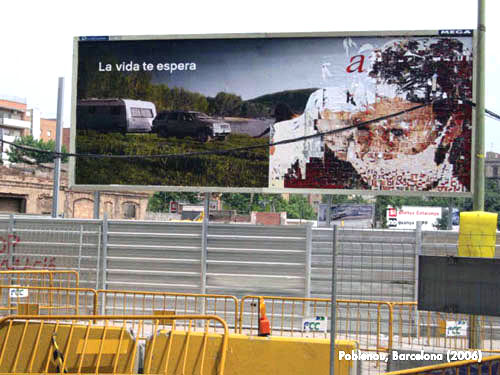
The anonymous street art / urban interventionist CutUp Collective is based in East London, but have been subverting advertising on the streets of cities world wide. The main focus of the group is to disrupt the everyday experience of passerbys and to promote discussion through altering preexisting urban structures, namely billboards. They have been achieving this by ripping down existing advertising and “cutting-up” the images to make new collaged images that are reapplied to different advertisements.

In addition to their street-based projects, the group has also exhibited internationally with shows such as “Play: Experience the Adventure of Our Cities” at the Urbis Centre for Urban Art in Manchester UK, “Satellites: an i-cabin project” at the Tanya Bonakdar Gallery, New York and “La Vida Te Espera”, NIU, Barcelona.

Share

Leslie Hewitt: On Beauty, Objects, and Dissonance

Courtesy of the artist and D'Amelio Terras, New York

The Kitchen in New York City is currently showing On Beauty, Objects, and Dissonance, a Leslie Hewitt solo exhibition curated by Rashida Bumbray.  The exhibition features new and recent work by Hewitt in photography, sculpture and film installation.  The Kitchen writes that in this exhibition Hewitt’s ‘…long-standing interest in non-linear perspective merges with W.E.B. Dubois’ theory of double consciousness, to create visually elegant and thoughtfully composed situational works’.

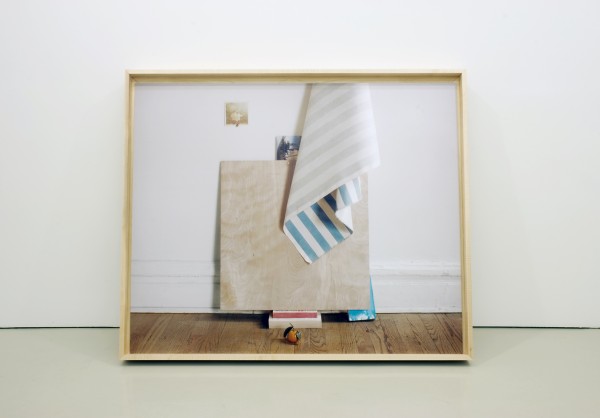
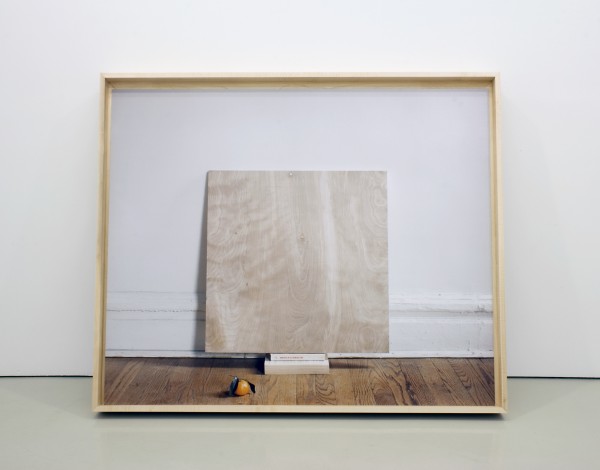
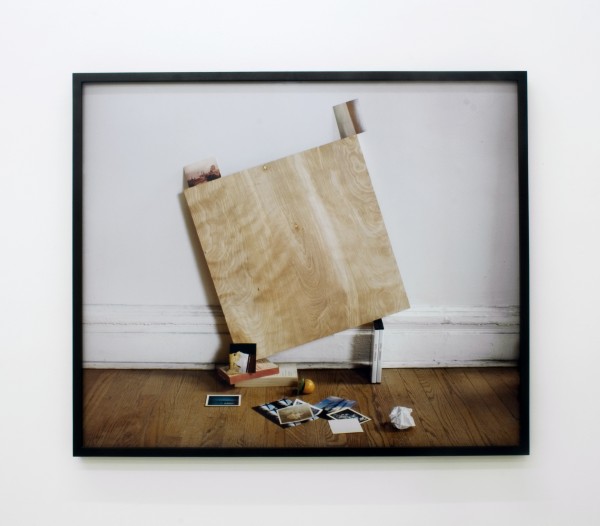
On Beauty, Objects, and Dissonance brings together a selection of images from three of Hewitt’s photographic projects.  Riffs on Real Time (2008) features sculptural, layered collages with mundane objects created to be captured in photograph.  These sculptural creations reflect the condition of existence through a shared temporality.  In the Midday (2009) series she creates contemporary still-life arrangements that reference our consumerist society through repetition.  Hewitt creates and documents multiple times – making each photographic image of the same still-life arrangement subtly altered in perception.  Hewitt’s newest photographic project, A Series of Projections (2010), breaks down and simplifies the artist’s structural complexities.  In a departure, black and white photographs capture photographic fragments projected onto the studio wall in addition to honing in on objects placed on wooden surfaces.

Courtesy of the artist and D'Amelio Terras, New York

Like much of Hewitt’s work, her new film installation, created in collaboration with experiential cinematographer Bradford Young, is inspired by a literary source – in this instance Claude Brown’s Harlem migration text Manchild in the Promised Land (1965).  This film installation engages the landscape of a particular place (Harlem) and the manifest implications and effects of movement through this space.  Hewitt and Young drew visual inspiration from Harlem’s dense urban grid, its architectural features and through the study of its street archives.  The Kitchen describes this film installation as featuring ‘a series of silent vignettes’ where ‘time is marked through oscillations between the still and the moving image’.  The passage of the gallery visitor through the installation mirrors and completes the work.  This theme of human movement is as particularly definitive to our global age as it was to the formation of 20th century Harlem.

Leslie Hewitt graduated from the Cooper Union School of Art in 2000 and earned an MFA from Yale University in 2004.  She also undertook Africana Studies and Cultural Studies at New York University from 2001-2003.  Hewitt received the 2008 Art Matters research grant to the Netherlands and, more recently, the 2010 Foundation for Contemporary Arts Individual Artist Grant.  She is currently in residence at the Radcliffe Institute for Advanced Study at Harvard University.

Courtesy of the artist and D'Amelio Terras, New York

Leslie Hewitt is represented by D’Amelio Terras in New York and is in the public collection at the Museum of Modern Art, New York.  Hewitt has shown extensively across the US and was part of the 2008 Whitney Biennial and MoMA’s New Photography exhibition in 2009.  Hewitt’s work has also been shown internationally – notably at the Thomas Dane Gallery in London and the Zacheta National Gallery of Art in Warsaw.  Look for Leslie Hewitt’s work in the exhibition After 1968: Contemporary Artists and the Civil Rights Legacy at the Bronx Museum of the Arts in New York City (organized by the High Museum of Art in Atlanta).  This exhibition is on view 28 March – 11 August 2010.

The Leslie Hewitt solo exhibition On Beauty, Objects, and Dissonance will remain at The Kitchen through 20 May 2010.  A discussion between Leslie Hewitt and Bradford Young, moderated by Rashida Bumbray, will be held Sunday, 9 May at 4.00 pm.

Share

From the DS Archives: Willie Doherty

Each Sunday we reach deep into the DailyServing Archives to unearth an old feature that we think needs to see the light of day. This week we found a review of Willie Doherty’s 2009 exhibition at The Fruitmarket Gallery in Edinburgh. If you have a favorite feature that you think should be published again, simply email us at info@dailyserving.com and include DS Archive in the subject line.

Originally Published: June 4, 2009

The Fruitmarket Gallery in Edinburgh is currently showing, Buried, a solo exhibition featuring new and recent video and photographic work by artist Willie Doherty in conjunction with the release of a new publication by the same name. Doherty, who was born and raised in Derry, Northern Ireland, addresses his homeland’s struggle to come to terms with its haunting past of violence and loss. His work has universal resonance in its focus upon a site of contested nationality, the human capacity for violence, and the collective memory of such legacies.

Willie Doherty1.jpg


Doherty was born in 1959 in Derry, Northern Ireland and his work originates from lived experience. Doherty’s life span has been aligned with The Troubles, a period of ethno-political and geographic conflict in Northern Ireland, typically dated from the 1960s to the Belfast Agreement of 1998. At its most extreme, this period was defined by the violent acts of republican and loyalist paramilitaries. Yet, as Bloody Sunday (which occurred 30 January 1972) proves, violence also infected the British government’s forces. At thirteen years old, Willie Doherty witnessed the atrocity of Bloody Sunday, in which British soldiers shot and killed fourteen unarmed, peaceful protesters. Since 1998, peace has largely reclaimed the region with only sporadic outbursts of violence remaining. Most recently, the Real IRA shot and killed two British soldiers in March of this year.

Despite the fact that Doherty addresses deeply personal subject matter, he maintains distance in his work. He never features his own image or voice, but instead employs actors to fill that role. The eerie, haunting, and typically reticent imagery found in this exhibition reference images and places that seem familiar to the viewing audience and are therefore quite relatable. This is particularly appropriate because the public’s memories of The Troubles are largely defined by the shared experience of reading newspapers and watching the evening news. The artist purposefully addresses this collective memory and its impact, which continues to haunt the present of even those who did not experience the violence firsthand.

Willie Doherty2.jpg

The video Ghost Story (2007) has quite a personal feel, with an intimate narrative voice-over accompanying slow and deliberate camera work. Yet, even this narrative consistently references collective memory. Ghost Story‘s main focal point is a railway track that has been paved over to create a footpath. The path or track is a recurrent theme in Doherty’s work and it can be said to represent both the movement of time and the borders–both figurative and literal–which arbitrarily divide us. The camera returns to the path again and again as the narrative describes and the camera alternately illustrates terrifying memories. The video questions how we can ever fully move on when ghosts and memories continue to haunt our present.

Doherty’s strongest work in the exhibition is in video. The video medium is endowed with a temporality that marries well with Doherty’s exploration of memory and humanity’s relationship with the past. Buried (2009), is the the new work commissioned by the Fruitmarket Gallery (with support from the Esmee Fairbairn Foundation). It is a visualization of the memories that the Ghost Story narrative claims to continue to permeate every facet of contemporary existence. Similarly deliberate camera work focuses on a dark forest area as the camera discovers clues of past acts of violence. As it moves it uncovers items such as a jacket, rubber gloves, a lighter, and wire. A fire peters out–smoke and fog obscure the screen and contribute to the haunting quality of the imagery. The muffled sound accompanying the video, is commentary from a Bloody Sunday documentary that has been distorted by the artist.

The third video installation is the 30 second video loop, Re-Run (2002). Much different in tone and pace from the other two videos, Re-Run features two screens surrounding the viewer, both showing a man running frantically, at full speed across a bridge. Each screen simultaneously shows the same scene at different points in time. Constant jump cuts to different angles echo the frenetic nature of the scene. As the video constantly loops, it seems to evoke the continuing struggle to outrun and move on from the past.

Willie Doherty3.jpg

The cibachrome print works Uncovering Evidence That the War is Not Over I (1995) and Bullet Holes (1995) focus in on evidence of past violence through illustrating remnants of an explosive device along with rusted bullet holes. Small Acts of Deception II (1997) returns to an image of a foot path much like that featured in the video Ghost Story, coupled with an image of a person’s lifeless foot. The images Last Occupant, Abandoned Interior II and III illustrate disheveled and decaying domestic spaces. These rather mournful and dark photographs hint at the lives and families torn apart by violence. Silver gelatin prints documenting spaces in Belfast devoid of human presence dominate the rest of the exhibition and evoke a sense of absence and loss. Donegal Lane, Belfast and The Westlink, Belfast are reproduced from images that date to 1988. They are hauntingly similar to the images from 2008, including Kent Street, Belfast; Franklin Street, Belfast; Footbridge, The Westlink, Belfast; and McKibben’s Court, Belfast. Through these images, we see a rather concrete continuation of the past into our present.

Doherty’s work is highly relevant to our contemporary world, where images of violence and tragedy inundate our media on a daily basis. Globalization means that information is shared almost instantaneously around the world and we therefore share in the tragedies of others more than ever before. Unfortunately, violent conflict in contested spaces, much like that of Northern Ireland during The Troubles, continues globally.

Willie Doherty4.jpg

Willie Doherty lives and works in Derry and is represented by the Kerlin Gallery in Dublin. Doherty’s work, which addresses internationally relevant themes, has achieved acclaim since beginning his career in the 1980s. He won the 1995 Irish Museum of Modern Art‘s Glen Dimplex Artists Award and was shortlisted for the Turner Prize in both 1994 and 2003. Doherty represented Ireland at the Venice Biennale in 1993 and Northern Ireland at the Biennale in 2007.

Doherty is also currently featured in Willie Doherty: Requisite Distance at the Dallas Museum of Art.

Buried will be at the Fruitmarket Gallery through 12 July 2009.

Share

@ MoMA

Ray Tomlinson. @. 1971. Here displayed in ITC American Typewriter Medium, the closest approximation to the character used by a Model 33 Teletype in the early 1970s. Courtesy MoMA.

Days ago, the Museum of Modern Art‘s Department of Architecture and Design announced their acquisition of a new work into the collection. The piece is one that we of the age of email and Twitter know well—the @ symbol. Since the announcement, the Internet has been abuzz with the news, mostly because its implications reach far beyond the art and design world. It’s so familiar to us all. It’s either momentous or silly, depending on your personal view, but it can’t be denied that the acquisition marks a poignant point in the history of art, in that “It relies on the assumption that physical possession of an object as a requirement for an acquisition is no longer necessary,” as was stated by MoMA Department of Architecture and Design Senior Curator, Paola Antonelli, in her essay on the matter of the acquisition published on March 22, 2010 by MoMA.

In her essay, Antonelli explains the history of the @, and how it came to be valued as a piece important enough for the permanent collection at MoMA. Though the symbol “dates back to the sixth or seventh century,” it’s Ray Tomilson—creator of the first email system in 1971—who elevated it “to [be a] defining symbol of the computer age,” according to Antonelli. She goes on to defend the symbol as a design, saying, “Tomlinson performed a powerful act of design that not only forever changed the @ sign’s significance and function, but which also has become an important part of our identity in relationship and communication with others,” and that “His (unintended) role as a designer must be acknowledged and celebrated by the one collection—MoMA’s—that has always celebrated elegance, economy, intellectual transparency, and a sense of the possible future directions that are embedded in the arts of our time, the essence of modern.”

What do you think about the acquisition? You can always comment below, email us at info@dailyserving.com, or let us know on Twitter: @DAILYSERVING. (Get it? Basically you can’t escape the symbol, which is now a precious work of art. Something to consider when crafting your responses.)

Share

Other Springs

L.A. Expanded: Notes from the West Coast
A weekly column by Catherine Wagley

Installation view: "Some Other Spring." Photo by Brian Forrest. Courtesy Regen Projects, Los Angeles and Jack Pierson.

Some Other Spring, the title of Jack Pierson’s current exhibition at Regen Projects, is also the title of a characteristically sultry but otherwise unremarkable Billie Holiday single. In it, Holiday mourns lost love in a way that’s lushly comfortable and totally unmotivated, clinging to “faded blossoms” that have been “crushed and torn.” Maybe she’ll love again or maybe not. She’s in no hurry.

Pierson’s not hurrying either. He’s not hurrying to make the lonely, clichéd loveliness of his photographs and text pieces go anywhere, and he’s not hurrying to assert himself as an artist, though, to be fair, at this point in his career, he doesn’t need to. An all-of-a-piece exhibition, Some Other Spring feels like Visconti’s Death in Venice might have felt had it abandoned its narrative and taken place in a pocket of Miami where everyone wears designer jeans and ventures out in private yachts at will: hazily unspecific, inexplicably banal and still somehow painful to watch.

Installation view: "Some Other Spring." Photo by Brian Forrest. Courtesy Regen Projects, Los Angeles and Jack Pierson.

Pierson, along with Nan Goldin, Philip-Lorca diCorcia and the late Mark Morrisroe, was one of the young Bostonians (they’re known as The Boston School, actually, but the James reference works—these artists were Sentimental Realists) credited with creating the “snapshot aesthetic” in the late ‘80s and early ‘90s. It’s a funny distinction, because, of course, as soon as you turn a snapshot into an aesthetic, everything snappish about it disappears.

Goldin made a fetish out of togetherness, depicting people clawing at each other—usually metaphorically, sometimes actually—in hopes of finding themselves, while diCorcia honed in on aloneness, often depicting concisely lit people lost in the surreal space of self-hood. Morrisroe was the Julia Margaret Cameron of punk; his softly posed bodies lounged, bent or sprawled near the center of nostalgically blurred prints. But Pierson wasn’t after the truth that lurked behind the moment. He made, and still makes, images that, except for a specific, vintage sense of color he’s never been able to escape, looked un-authored and un-directed. This approach, paradoxically, has led to an all-over-the-map body of work that probably gets closer to the snapshot’s insincerity than anything else: self-portraits (often of youngish, naked boys, never of Pierson), overexposed hallways and ashtrays, sexy roses and guileless text pieces that say haphazard things like “Blue” or “Palm Trees.”

This expansiveness doesn’t make Pierson the hero of The Boston School. If anything, it makes him the anti-hero, the one who decided living in the luxurious space of ambiguity was worth the danger of never saying anything legible about the way life feels.

At Regen Projects, Pierson’s staggered photographs and text pieces command the physical space of the walls with a forcefulness that belies their discordant content.  The first larger room includes 15 photographic prints, creased in a willful way that makes them look  less-than precious, and two sculptures.

With the exception of an artfully limbless marble torso, the room includes only one body, the too-smooth-for-comfort figure of a 20-something poster boy who bends over as if in a leg-shaving ad. But, even if they’re  not portraits, the rest of the images portray other lives. Pierson maintains the distance of a bystander, who, on a long vacation, stops to snap things that he suspects matter to people he’s met, or hopes might matter to him someday. The weirdly disengaged result contradicts the exquisite execution of each print. In one image of a tombstone, the words “God is Love,” written in small script, float just above, but not in, the image’s hottest spot. In another, of a boat stern, the mast precariously dissects a perfect blue sky.

Installation view: "Some Other Spring." Photo by Brian Forrest. Courtesy Regen Projects, Los Angeles and Jack Pierson.

The words “The Moon” hang on the back wall of the second gallery. Pierson’s text pieces always feel like stream-of-consciousness from a pithy mind. This particular one evokes small town signage, though each off-kilter letter would’ve had to come from a different Mid-America Diner. The images that flank “The Moon” feature palm trees, clouds, window sills and latticed patterns. They’re uninteresting to an extreme but precisely suited to one other. The balance between emptiness and perfectness that runs through this room and the rest of the exhibition almost hurts; it’s like looking at a gourmet spread and feeling desire without hunger, but wanting to feel both and not understanding how the two could disassociate.

As an epigraph to a 2006 essay about Pierson, curator Richard Marshall quoted Susan Sontag: “Boredom is just the reverse side of fascination: both depend on being outside rather than inside the situation, and one leads to the other.” Replace boring with banal and fascinating with consequential and that seems about right, except that, in Pierson’s work, it’s not about moving from banality to consequence and back again. It’s about making the two totally indistinguishable.


Share

Debris

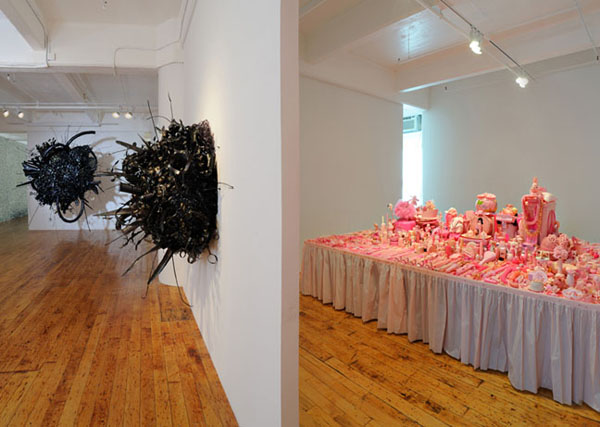
Currently on view at P.P.O.W Gallery in New York is the three-person exhibition, Debris, which features the work of Sarah Frost, Portia Munson and Aurora Robson. For Debris, each artist has contributed a large scale installation, constructed of discarded plastic refuse and fashioned into a thing of visual interest, a bastion of beauty. The overarching dialog surrounds the issue of sustainability and the negative impacts that such waste has on the environment, but each piece manifests the message—and the material of plastic—uniquely.

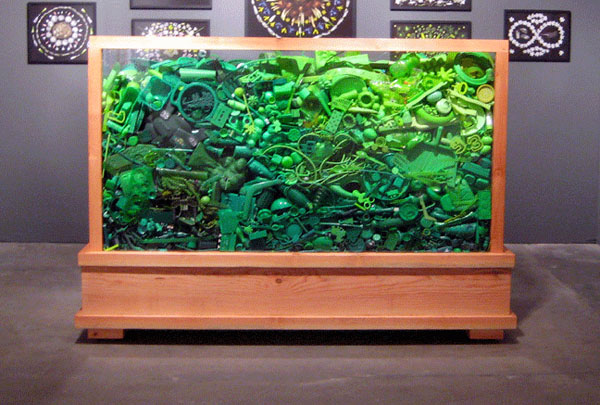
Portia Munson’s Pink Project: Mound is reconstructed for the first time since its inaugural viewing in the 1994 New Museum exhibition, Bad Girls, where as P.P.O.W notes, the piece was originally reviewed almost entirely as a treatise on feminism rather than the environment.” It is constructed of an overwhelming, well curated collection of pinkparaphernalia—found objects ranging from women’s wigs and combs to toys and pacifiers—laid out neatly on a tabletop. Her 2009 piece, Green Piece: Sarcophagus, has a sort of Damien Hirst-esque quality, an embalming of monochromatic objects (this time, green) in a see-through tank. Sarah Frost’s QWERTY is made up of 60,000 discarded computer keys, and Aurora Robson’s Belch combines discarded plastic bottles with other found objects to create an enormous wet-looking puff of slick black waste.

Portia Munson, Green Piece: Sarcophagus (2009) salvaged green plastic, tempered glass and recycled wood

Portia Munson’s work has been exhibited widely, including at White Columns, New York and Museum of Contemporary Art, Helsinki, Finland. She earned her MFA at the Mason Gross School of the Arts, Rutgers University, New Brunswick, NJ. Sarah Frost is included in the 2010 Great Rivers Biennial at the Contemporary Art Museum, St. Louis, MO. She earned her MFA at Southern Illinois University. Aurora Robson has exhibited widely, including at the Architecture and Design Museum, Los Angeles and Project 4 Gallery, Washington, DC. She earned her BA at Columbia University, New York.

Share