Sook Kim: Inside Out

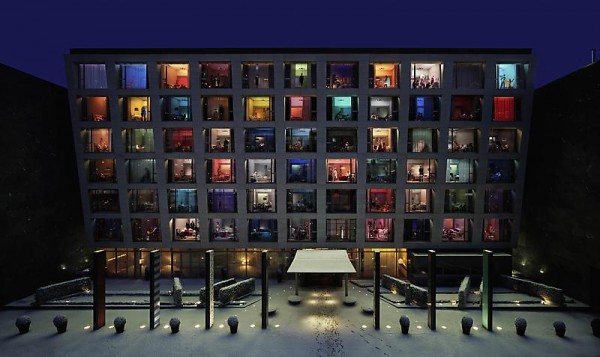
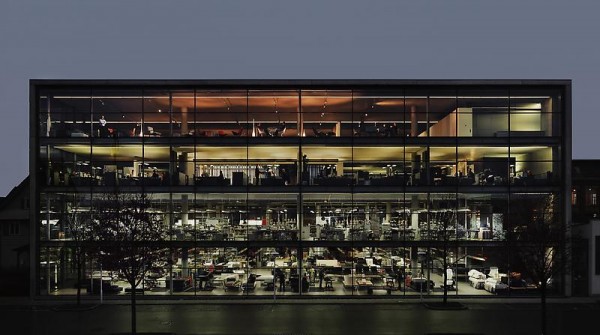
For her debut solo exhibition in New York City, Korean artist Sook Kim is presenting fourteen new photographs, which include her famed Saturday Night series, at Gana Art on West 25th St. in NYC. The exhibition, titled Inside Out, features images of buildings in both Germany and New York that have a transparent facade revealing the activity of the inhabitants within the structure. Formally, the images reference movements from Modernism to Minimalism, but the act of viewing the people inside the building, who seem to be unaware of the photographer, allows the most basic voyeuristic tendencies of all viewers to take over. Each image is constructed carefully, lit from inside, and scripted so that each room revealed in the building has something unique to offer.


Utilizing a similar concept and format, HBO created an interactive website called HBO Voyeur that allows the viewer to watch a series of narratives unfold within the structure of a New York City apartment building.

Sook Kim is a photographic student of Thomas Ruff, having studied from 2001-2006 at Kunstakademie in Dusseldorf, Germany. She has completed recent solo exhibitions at Galerie RX in Paris, Miki Wick Kim Contemporary Art in Zurich and Galerie Heinz Holtmann in Cologne.

Share

Elizabeth Berdann

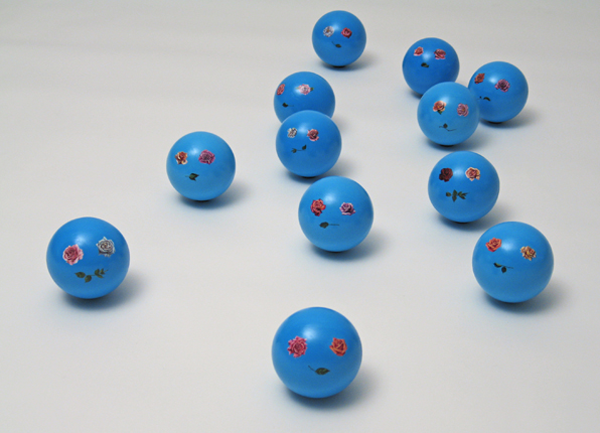
Elizabeth Berdann, Emoticons (2008), oil on steel

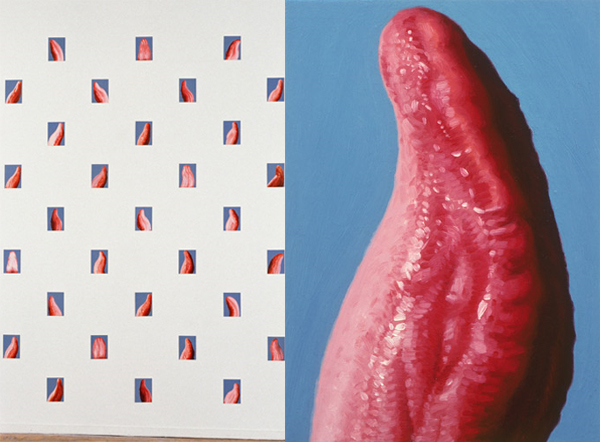
The Contemporary Art Museum Honolulu is currently presenting four concurrent solo exhibitions by New York and Los Angeles-based artists, including Daily Serving featured artist and interviewee, Allison Schulnik, as well as Elizabeth Berdann, Judy Fox and Fay Ku. New York-based Elizabeth Berdann‘s solo show, entitled Wonders Curiosities and Conundrums, is the first museum retrospective of the artist’s work over the past two decades. The work on view, created from 1989 to 2009, adheres to TCM’s theme for all four shows “in which the artists work in different media and styles but have a common denominator in their interest in the figure.” Berdann describes her own work as “highly focused, detailed examinations of bodies (frequently human, but not exclusively so),” and says she is “continually fascinated by the plasticity of bodies and the underlying psychological terrain.” Berdann’s collective works—from the 1990 installation, The Wall of Tongues, to the more recent Emoticons—are whimsical, fierce, peculiar and beautiful at once.

Elizabeth Berdann, The Wall of Tongues (1990), oil on copper, installation view and detail view

New York-based Elizabeth Berdann earned her BA at Smith College and has studied at Ecole des Beaux Arts, Paris, France; Yale University, New Haven, CT; Instituto Allende, San Miguel de Allende, Mexico; and Parsons School of Design, New York, NY. Her work has been exhibited wildely, including at Ben Maltz Gallery at Otis College of Art & Design, Los Angeles; Lesley Heller Gallery, New York; Santa Barbara Contemporary Arts Forum; New Museum of Contemporary Art, New York; White Columns, New York; and Betty Rymer Gallery at School of the Art Institute of Chicago. She is the recipient of a Pollock-Krasner Foundation Grant, among several other prestigious awards.

Share

Inventory: New Art from Southeast Asia

Cheo Chai-Hiang, 35 Black Cowries (detail), 2009, 35 stainless steel characters, cowries, bags. Courtesy of Osage Gallery

Inventory: New Art from Southeast Asia at Osage Gallery Singapore presents recent works by eight key artists in Southeast Asia. In 35 Black Cowries, 35 stainless steel Chinese characters are displayed in opened square miniature suitcases and each stainless steel Chinese character includes a black cowry shell to replace the Chinese symbol 贝(bei). The classical Chinese symbol 贝(bei) for money, originated as an ideogram of a cowry shell, being a form of currency exchange in ancient China (and other parts of the world). Since then, many Chinese characters associated with words revolving around money possess this symbol as a radical. The act and visual significance of replacing the symbol 贝(bei) with a physical cowry prompts a consideration of the meaning of the word and the extent to which it has evolved from its roots. The choice of the 35 Chinese characters draws out not only the inter-connections and meanings within and between each pair of characters, but also points to the relationship between the evolution of the Chinese language and contemporary capitalist society. Born in 1946, Cheo was one of the earliest artists in Singapore to boldly call for a rejection of formalism and his experimentation with art driven by concepts and processes started in the 1970s. His international practice includes curating, lecturing and writing, and his recent participation in the Singapore Biennale 2008 and Asian Pacific Triennale 2009, Brisbane, Australia had works which drew also on history and language.

Wit Pimkanchanapong; Pear, Apple, Banana, Mangosteen, Orange, and Starfruit; 2009, Paper models. Courtesy of Osage Gallery.

Wit Pimkanchanapong‘s Pear, Apple, Banana, Mangosteen, Orange, and Starfruit is a work of tropical fruits made from paper models. Wit commenced his series of works based on paper models since 2002, driven by an interest in connecting electronic media and cubism as both call into question the ability to have a fixed representation and perspective. In this work, he draws on the idea of hypertext, or text leading to other related information, and prints words of other fruits on each paper fruit model. The folded fruit with the tiny printed words of other fruits in different languages point to the multiple identities one can assume in the virtual realm, aided by electronic media. Born in 1976 in Thailand and trained in architecture, Wit’s art projects also embody a strong element of using and playing with social space. At the 8th Sharjah Biennale 2007, Wit, together with collaborators of Soi Project, transformed the space in front of the Sharjah Art Museum into a lively fruit market, inviting passersby to construct paper fruit models. His practice encompasses music, and he curates an annual exhibition as part of the Music Festival in Bangkok.

Tintin Wulia, Lure, 2009, Installation Dimensions variable Installation view, Osage Kwun Tong, Hong Kong, 2009. Courtesy of Osage Gallery.

A trail of miniature passports from around the world laid on the ground of the gallery entrance, and across the walls and ceiling, leads visitors to a claw vending machine half-filled with passport reproductions. Visitors are invited to insert a coin and operate the claw for a chance to win a passport. Tintin Wulia‘s installation, Lure, speaks to both the relationship between chance and citizenship, as well as the notion that the sense of belonging to a nation can be constructed and imagined. Her sensitivities to the multiple relationships connected to her Indonesian, Chinese, and Balinese roots together with her dream since young, of being a citizen of the world, have fuelled her investigations in the tensions between personal memories, choices, and realities, pertaining to issues of mobility, migration and identity. Lure is part of an ongoing project, (Re)Collection of Togetherness, an effort since 2007 at collecting and reproducing passports of all the nation-states in the world. Earlier stages involved working with materials from mosquitoes and kite-making, and a recurrent choice of stop-motion animation in her films – all with intimations of borders or a disregard of them. Born in 1972 in Bali, Indonesia, and now based in Melbourne, Australia, Tintin’s academic background in architecture, music and fine art have guided her experimentation across artistic disciplines, with recent presentations at Centraal Museum in Utrecht, the 2009 Jakarta Biennale, and the 28th International Film Festival Rotterdam.

The exhibition runs till 25 April 2010, and also features works by Poklong Anading (Philippines), Ho Tzu Nyen (Singapore), Lee Kit (Hong Kong), Vincent Leong (Malaysia) and Pratchaya Phinthong (Thailand).

Share

From the DS Archives: Andrea Fraser

Originally published: October 31, 2007

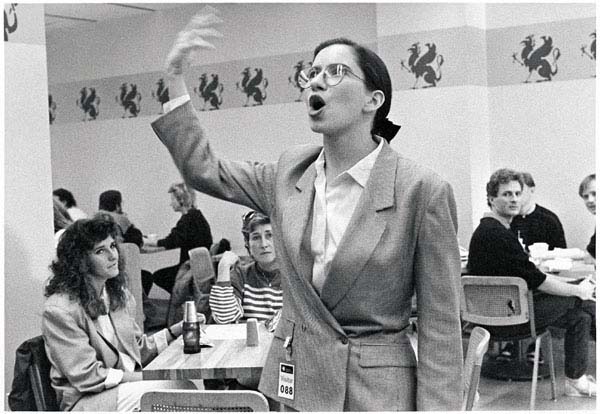
Performance artist Andrea Fraser has long been acclaimed as provocateur, leading a unique style of performance art coined as “institutional critique.” The artist has conducted many famous performances, such as the 1989 work “Museum Highlights,” where the artist posed as a Museum tour guide under her stage name Jane Castleton at the Philadelphia Museum. During the piece the artist walked different groups around the institution using grandiose verbiage often associated with overly intellectualized critics, art historians and gallery directors. Perhaps her most controversial work to date is “Untitled” (2002) a videotape performance where Fraser had a 60 minute sexual encounter with a prominent art collector through a contractual agreement. The artist proposed the piece to the Friedrich Petzel Gallery and asked them to facilitate an agreement between the artist and the patron in which the patron participated in the production of contemporary art through a sexual act in a hotel room. In the end, the patron paid $20,000 for the work in the form of an unedited videotape of the performance, and one other copy went on view at the Friedrich Petzel Gallery. The New York Times Magazine reviewed the work and reflected both its art historical position and its opposition by many in the New York community.

Share

Iñigo Manglano-Ovalle

On view at the Art Institute of Chicago until May 23 is Iñigo Manglano-Ovalle‘s work Always After (The Glass House).  Ovalle has gained international recognition for a diverse, conceptually rigorous body of work-both activist-inspired public art and studio-based objects-that consist of formally arresting, often technically complex, poetic meditations on aesthetics, nature, and modernity.

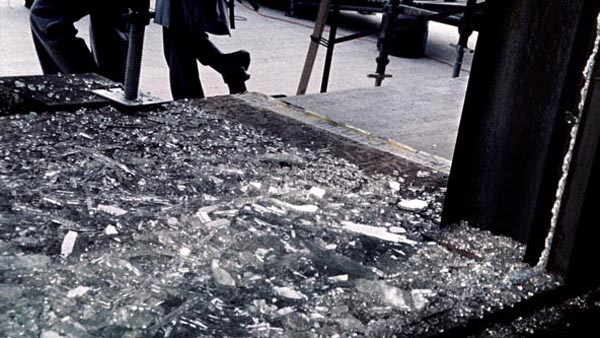
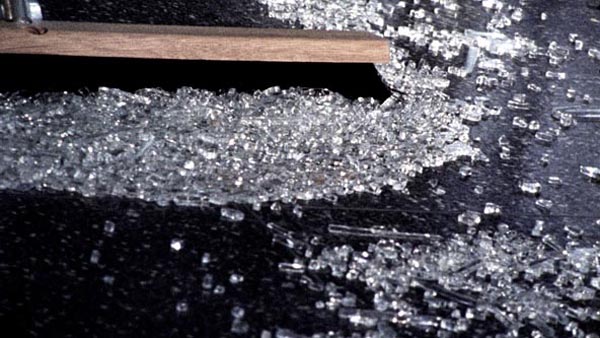
His 2006 work Always After (The Glass House) is the fifth installment in a series of film-based works—created between 2000 and 2006—that directly engage the architecture of Mies van der Rohe. The architect serves as a stage from which Manglano-Ovalle conducts a self-reflexive critique of prevailing notions of “failed modernity.” Despite the many broken promises of modernity, the artist has said, “So much has actually come to fruition….We do live in glass houses.” Shot entirely on location at Crown Hall, van der Rohe’s 1950 school of architecture at the IIT campus in Chicago, the film documents the 2005 ceremonial dedication of the building’s renovation during which the architect’s own grandson broke the windows with a sledgehammer. Manglano-Ovalle captured the entirety of the action and its aftermath on high-speed film, which when played back at normal speed, appears protracted. This combined with the decision to edit all direct indications of the original event from the final display-and an atmospheric soundtrack strategically intercut with periods of silence, resulted in a pared down, nearly abstract image. Panning close-ups show the crystalline shards of broken glass being pushed with a wide broom alongside the feet of anonymous passers-by. Lacking the specificity of context, viewers are left to interpret the scene for themselves.

Manglano-Ovalle has exhibited his work at acclaimed institutions both nationally and internationally.  Currently Manglano-Ovalle is presenting a new work at Documenta 12, Kassel, Germany (2007).  He is represented by Max Protetch Gallery, New York.

Share

StandART on Sunset Strip

L.A. Expanded: Notes from the West Coast
A weekly column by Catherine Wagley
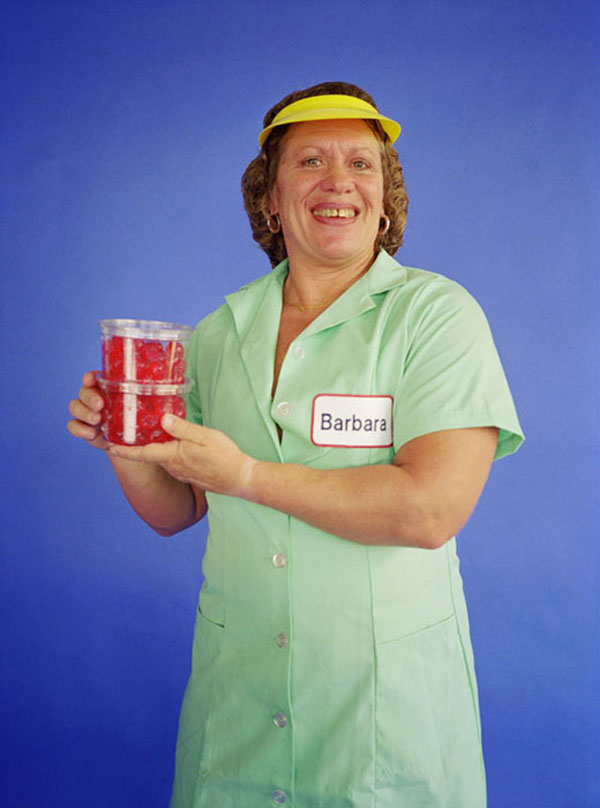
Mika Rottenberg, "Mary's Cherries," 2004.

Mika Rottenberg’s balmy, bizarre video, Mary’s Cherries, moves at such a comfortable pace that it almost convinces you of its normalcy. The three immensely able-bodied women in the video, dressed in Easter colors and stuck in homely cubicles, are completely unruffled as they transform manicured pink fingernails into equally manicured red maraschino cherries.

Rottenberg’s film, with its slightly off-color title and cast of female fantasy wrestlers, has been in circulation since 2003 and has shown at The Tate and MoMA, but I didn’t see it in full until 7:00 a.m. on Thursday morning, in the lobby of Hollywood’s The Standard Hotel. What brought me to The Standard was the cozy idea of video art over breakfast (I also briefly considered video art near midnight, but that seemed too flashy, and required staying awake). I made a pot of coffee and grabbed a bagel before leaving my mid-city apartment, imagining that my Rottenberg viewing would be something like Holly Golightly’s mornings in front of Tiffany’s. The fact that I didn’t have a flawless French twist, black gloves and Audrey Hepburn sunglasses, added to the fact that I left my coffee in the car, dampened the glamour, however.
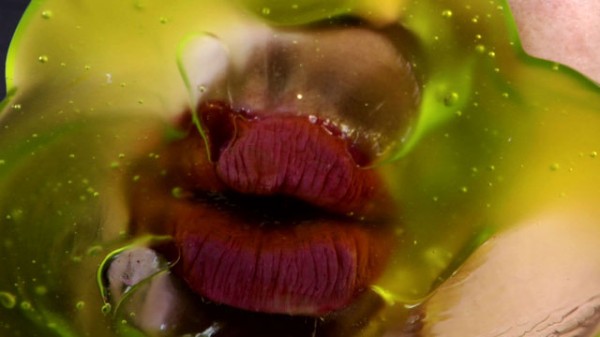
Marilyn Minter, "Green Pink Caviar," 2009.

In the five blocks between my parking spot and The Standard’s front door, I saw four transients, two parking attendants, and three joggers. But within a minute of entering The Standard, I’d seen twice that many people—people waiting for the shuttle, people ordering from the bar of the 24/7 café, two receptionist behind the big desk who were spaced exactly as they are in the image on the hotel’s website.

Upon entering the lobby, visitors will see Mika Rottenberg’s film directly to their right, at the end of the corridor that joins the faux-70s décor to the first hallway of rooms. The walls are pastel purple, and the projection fits snuggly between an exit with a neon green sign and heavy door that says “Fire Sprinkler Riser Inside.” Currently, those who check in to the hotel can, instead of viewing new releases, or pay-per-view porn, view curated in-room video art courtesy of Creative Time. The StandArt series includes work by Bruce High Quality Foundation, Lee Walton, Martha Colburn, Marco Brambilla, and Marilyn Minter, all relatively new but “known” artists.

The videos The Standard chooses to show always seems uncannily appropriate to its milieu, often calling attention to the prepackaged, visibly expensive and slightly absurd nature of privilege. Minter’s Green Pink Caviar screened at The Standard’s four locations before Rottenberg began; I saw Green Pink Caviar on the mezzanine of the downtown Standard, completely alone except for a few people getting on and off the elevator nearby. I was essentially alone on Thursday too. Rottenberg, like a painting on the wall, is part of the decor, which is by no means bad. I imagine a Joan Didion transplanted from 1968, pulling up, having her yellow Corvette valeted, walking through The Standard’s doors after visiting some political miscreant at the state penitentiary, looking at the Rottenberg and quoting herself with snarky precision: “Most of us live less theatrically but remain the survivors of a peculiar and inward time.”
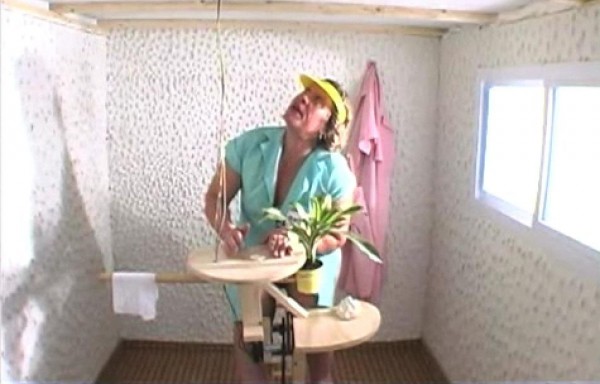
Mika Rottenberg, "Mary's Cherries," 2004.

In Mary’s Cherries, the full-bodied main players wear nonsensically demure house-maid dresses and work in bright but cramped cubicles that have been stacked on top of each other; they communicate through holes sawed into the floor. Mary, the woman on top, grows her finger nails under a purple UV bulb powered by stationary, fugitively constructed bicycles that the women ride.  The nails grow pre-painted and perfect, ready to be snipped off one at a time and sent down to Barbara, who works them into a pulp before sending them down to Rose, who shapes each nail pulp into a maraschino cherry and drops it into a clear container. Projected at the end of a purple hallway next to a “Fire Sprinkler Riser,” the absurdity of Rottenberg’s work feels unquestionably natural. It’s the manifestation of a particular sort of manufactured privilege that doesn’t really make sense but still feels weirdly necessary, like it comes from a deep cultural need to perform “being human.”


Share

SunTek Chung


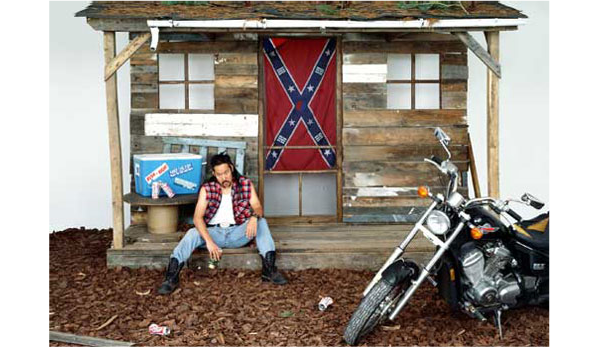
SunTek Chung creates images of identity forged from concepts about culture and technology. Like all of his photographs, SunTek makes a real space for us to examine. He challenges the integrity and meaning of artifacts that are marginalized by their own popularity. In his image The South The South, a drunken motorcyclist minds his business on the stoop of his marsh shack facade, drinking tall boys out of his well-traveled cooler. He’s surrounded by pine bark mulch, the remnants of the oldpine forest. Set in the door of his shack is a strange southern flag. The yin and Yankee colored Saint Andrew’s Cross holds the symbols of heaven, earth, fire, and water, made white like the stars. The background of the Korean flag, the color of cleanliness and light, has been changed to red, the yang spilled all over the flag.The purity of the cause is questioned and the white flag as a symbol of truce or peace has been subverted. There’s a skewed parallel between South Korea and the Confederacy that the drunk is not required to explain. But, there’s a spirit of rebellion and autonomy in freedom from both government control and communism. The stereotype of the Asian imitation of American things is subverted. The Korean and American products are interchangeable and impure.

Displaying the Confederate flag is an inflammatory issue, especially in the South, where it remains common. Because it represents both oppression and rebellion, it’s rightly capable of offense. Remaking that flag gives us a fresh vision of a cultural artifact, challenging information extrapolated from stereotypes and simplistic understandings. Ignorance and biases become apparent and silly, but remain a real part of identity.

SunTek now resides in Richmond, VA, where he obtained his BFA in sculpture from Virginia Commonwealth University. He went on to study at Yale University for his MFA and Skowhegan School of Painting and Sculpture. His work has been featured on the cover of Beautiful/Decay, displayed in a solo show at P.S. 1 in New York, and exhibited across the U.S. and internationally.

Share