Los Angeles

Renowned Feminist Art Historian Amelia Jones Believes that the Discipline of Art History Should be Restructured to Embrace New Narratives and Diverse Voices

This week, from our friends at Huffington Post, we bring you an article by artist and writer Jacqueline Bishop exploring the career of art historian Amelia Jones, who has long questioned and worked to challenge existing disciminatory structures as they relate to race, gender, and identity. Bishop quotes Jones, saying “From very early on I found myself interrogating the structures of the discipline, by asking such questions as, ‘Where are the black artists? The women artists?’” This article was originally published on January 21, 2016.

2016-01-21-1453385437-8788462-ameliajones-thumb

“What I am trying to do in my academic life is change art discourse. I want to change the field of art history. It is time to have a new narrative and it is time to bring new, more diverse voices to the field.” So maintains Amelia Jones, the Robert A. Day Professor of Art & Design and Vice-Dean of Critical Studies at the Roski School of Art and Design at the University of Southern California in Los Angeles.

Amelia Jones’s focus on diversity took root early. She was born in North Carolina at a time when overt segregation was collapsing. Starting in the fifth grade she was bussed across town to go to school with a largely African-American student body. “That time was hugely formative for me,” Jones said, “because when they integrated the schools a lot of white middle-class children left the public school system, while white middle-class children like myself, whose parents kept them in the public school system, found ourselves in schools that were smaller and with facilities that weren’t as good. I saw the ways in which the black community was underserved and even to my fifth grade eyes, it was super shocking.”

Read the full article here.

Share

From the Archives

From the Archives – Anthony Discenza Presents A Novel: An Exhibition by Anthony Discenza at Catharine Clark Gallery

Fiamma Montezemolo’s The Secret just opened at Kadist SF, and Montezemolo’s solo show has us thinking about books, selves, and Borges. Just as Montezemolo deploys redaction of and extraction from Jorge Luis Borges’ short story “The Anthropologist” to draw us into The Secret, so did Anthony Discenza create what has been described as a Borgesian universe (that leads off with a quotation from Borges) of layered selves in Anthony Discenza Presents A Novel: An Exhibition by Anthony Discenza, reviewed below by Maria Porges for our sister publication Art Practical. Porges traces the multiple selves and references within references that Discenza draws into his work, ultimately situating her own review as one piece of this universe. This article was originally published on March 22, 2016.

Anthony Discenza.

Anthony Discenza Presents A Novel: An Exhibition by Anthony Discenza, 2016; installation view. Courtesy of Catharine Clark Gallery.

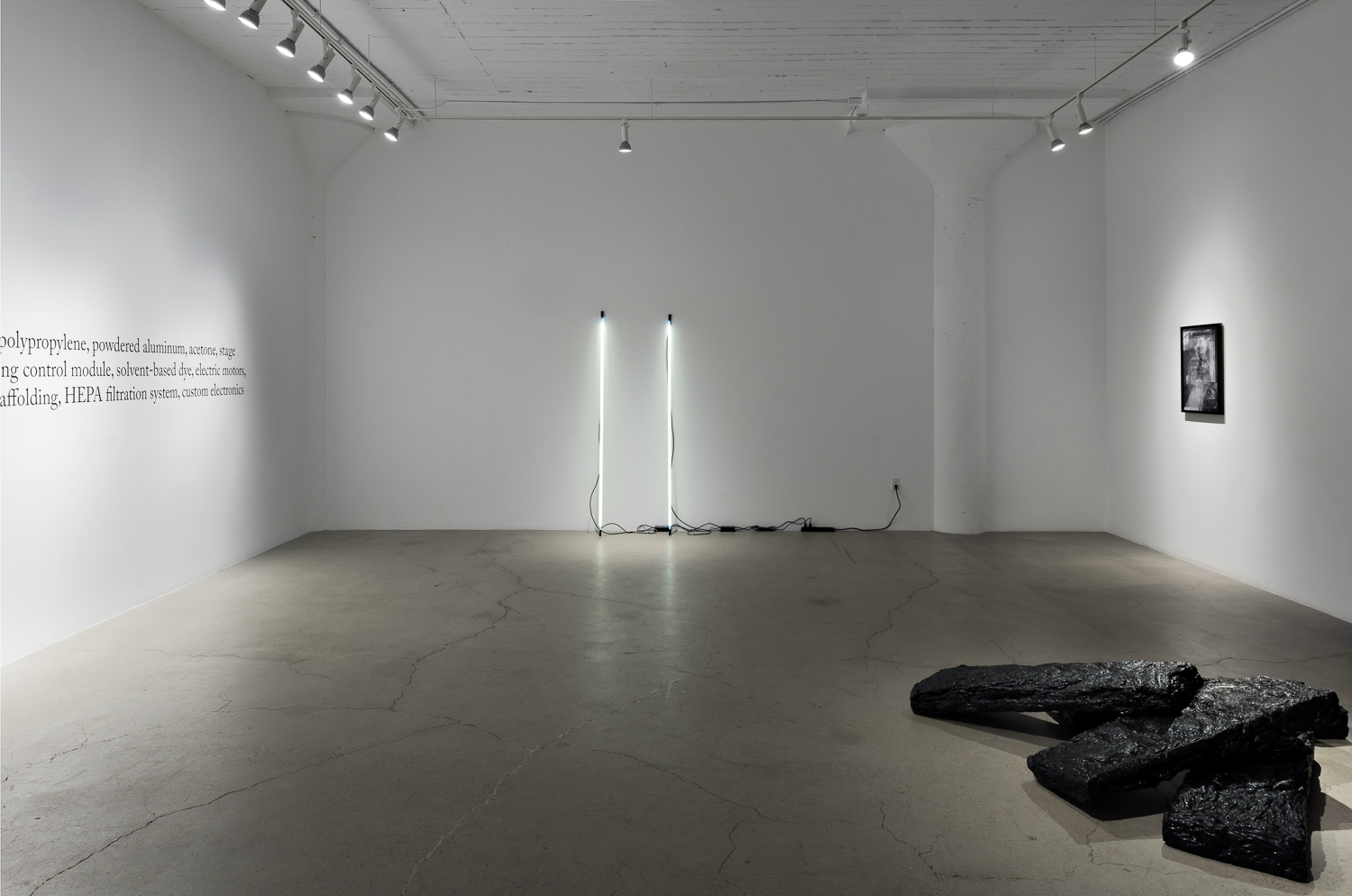
When or why does art become the idea of art: a representation or simulacra of it, rather than the thing itself? In a constellation of objects and images, Bay Area artist Anthony Discenza tackles this question, among several others, through a deftly ironic manipulation of the visual languages of Minimalism and Conceptualism—tropes that, many decades after their first incarnations, continue to be recycled ad nauseam in galleries and museums worldwide. The works presented here are meant to be seen as enclosed in a veritable cloud of quotation marks, as a kind of performance of these too-familiar ideas, experienced through the filter of Discenza’s own writing in the form of a longish essay available as a newsprint takeaway from stacks in the gallery. Prefacing Discenza’s text, quotes from Jorge Luis Borges and Joanna Russ muse on the idea that there are not only multiple universes in which we live out one thread of possible choices, but that we consist of multiple selves. The exhibition is based on this conceit: Anthony Discenza, friend (or doppelgänger?) of “Anthony Discenza,” has put this show together from notes and materials abandoned by the other. By stepping outside of himself in this way, the essay’s author can describe and evaluate his own gifts as well as his shortcomings with a charming wryness, talking about the work of “Anthony” as if it is not his own. “Anthony,” we learn, had planned to make this show by using, as a point of departure, the 1969 art-world novel The Disappointments by Lane Hobbs, an artist and critic who (of course) died prematurely in 1974, having produced only this satire of the late 1960s scene in New York. That this novel does not actually exist should go without saying, but I am going to say it anyway; as indicated by the essay’s title, “Considering A Novel: An Exhibition in the Subjunctive,” the book’s existence is fictional, like the concept of the two Anthonys. The Disappointments serves as a vehicle for the ultimate subject here: the artist’s struggle to make art, to put forward work and be confident in its clarity, originality, and importance, but ultimately, by some important inward measure, to fail.

Read the full article here.

Share

Paris

Kapwani Kiwanga: Ujamaa

In a major solo exhibition, Ujamaa, at La Ferme du Buisson in the Parisian suburb of Noisiel, Kapwani Kiwanga addresses Tanzania’s uprisings. Known for using methodologies from the social sciences without being didactic, the artist draws on two significant moments in the history of the eastern African country to remember and question the ideals of pan-Africanism. The first is the 1905 revolt of Kinjeketile Ngwale, who—believing in the magic powers of a herbal potion of his creation called maji-maji, meaning “water of life and immortality”—led the first revolt against colonial rule, known as the Maji Maji Rebellion. The second is Julius Nyerere’s post-independence introduction of a socialist program of collective farming, called ujamaa (a Swahili term for familyhood, extended family, brotherhood).

Kapwani Kiwanga. White Gold: Morogoro, 2016; installation; 236 x 196 x 157 in. Courtesy of La Ferme du Buisson. Photo: Emile Ouroumov.

Kapwani Kiwanga. White Gold: Morogoro, 2016; installation; 236 x 196 x 157 in. Courtesy of La Ferme du Buisson. Photo: Emile Ouroumov.

A monumental installation, White Gold: Morogoro (2016), welcomes the viewer and acts as the show’s contextual and museological heart. The evocative work is composed of a generous amount of sisal suspended from steel strings. Originating from southeast Mexico, the resistant fiber has been successfully cultivated since the late 19th century in the region of present-day Tanzania, once part of the colony of German East Africa.[1] Its production has played a major role in the country’s economy, from the colonial era through independence.

Read More »

Share

Singapore

Between Declarations and Dreams: Art of Southeast Asia Since the 19th Century at the National Gallery Singapore

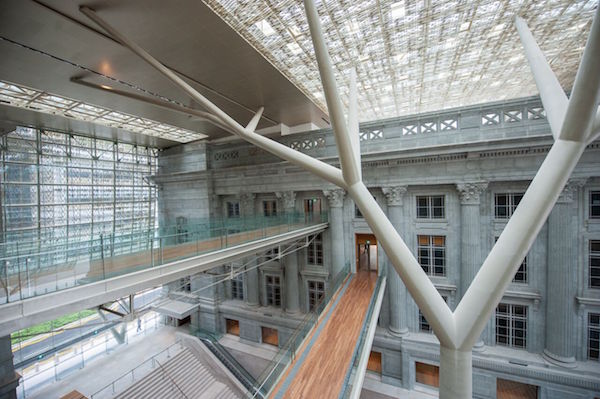
In Kevin Kwan’s deliciously trashy best-selling novel, China Rich Girlfriend, a wealthy Singaporean heiress outmaneuvers Chinese billionaires at auction to acquire works for the soon-to-open National Gallery. The real National Gallery Singapore opened to the public in November 2015, and as Kwan’s novel suggests, the museum was strategic in its acquisitions. By choosing to direct its considerable resources toward the relatively undervalued field of Southeast Asian art, the National Gallery Singapore has created an encyclopedic collection that will define the region’s art history for generations to come, as MoMA did for modernism or the Whitney Museum for American Art.

Atrium of National Gallery Singapore. Courtesy of National Gallery Singapore.

Atrium of National Gallery Singapore. Courtesy of National Gallery Singapore.

Housed in Singapore’s beautifully restored City Hall and Supreme Court buildings, and connected through a network of bridges spanning an open atrium, the National Gallery’s two permanent exhibitions reveal its epistemic ambitions. Siapa Nama Kamu?: Art in Singapore Since the 19th Century establishes the city–state’s official art history, while Between Declarations and Dreams: Art of Southeast Asia Since the 19th Century seeks not only to define a regional narrative, but also to insert that narrative into a global art history that is currently dominated by the West.

Read More »

Share

Canberra

Zhang Peili: From Painting to Video at the Australian Centre on China in the World

Zhang Peili: From Painting to Video is curated around a work gifted to the Australian Centre on China in the World at Australian National University. In 2014, Zhang’s friend and fellow artist Lois Conner donated one of the artist’s final paintings, Flying Machine (1994). The exhibition of this newly restored work provided an opportunity to explore Zhang’s transition from painting to video, and to reflect on the development of new media art in China toward the end of the 20th century. The exhibition also presents eight of Zhang Peili’s pioneering video works dating from 1988 to 2012, starting with 30 x 30 (1988), generally considered to be the first video work in the history of contemporary Chinese art.

Zhang Peili. Uncertain Pleasures, 1996; six-channel video, twelve CRT monitors; 5:04. Courtesy of the Artist and Australian Centre on China in the World.

Zhang Peili. Uncertain Pleasures, 1996; six-channel video, twelve CRT monitors; 5:04. Courtesy of the Artist and Australian Centre on China in the World.

30 x 30 (1988) was later followed by Zhang’s experiments with performative, durational, and text-based installations. In the piece, Zhang films his own hands in surgical gloves, breaking a thirty-by-thirty-centimeter mirror, painstakingly gluing the shards together, and then breaking and gluing it again and again against the terrazzo-tiled floor of an empty office. The video was filmed over three hours (the longest VHS tape available at the time); Zhang’s intention was to lock viewers into the exhibition space for the entirety of the piece. This absurdist representation of a banal and incomprehensible action reflected the artist’s determination to avoid political imagery and easy narratives. He intended it to be excruciating to watch: After a series of fruitless meetings planning a retrospective of the avant-garde ’85 New Wave Movement that had surged across China in the mid-1980s, Zhang wanted to make a video that would be as boring and pointless as these meetings.

In Hygiene No. 3 (1990), another work inflected by a Dada-esque sense of anarchic humor, Zhang responds sardonically to a hygiene campaign imposed by the Shanghai government in which officials inspected people’s homes. In the video, Zhang washes a live chicken for two and a half hours, again wearing surgical gloves, which lends the video a disturbingly forensic ambience and recalls his early photorealist paintings of latex gloves.

Read More »

Share

Hashtags

#Hashtags: Water Water Everywhere

#environment #conservation #access #resources #water #public art #civic art #biennials

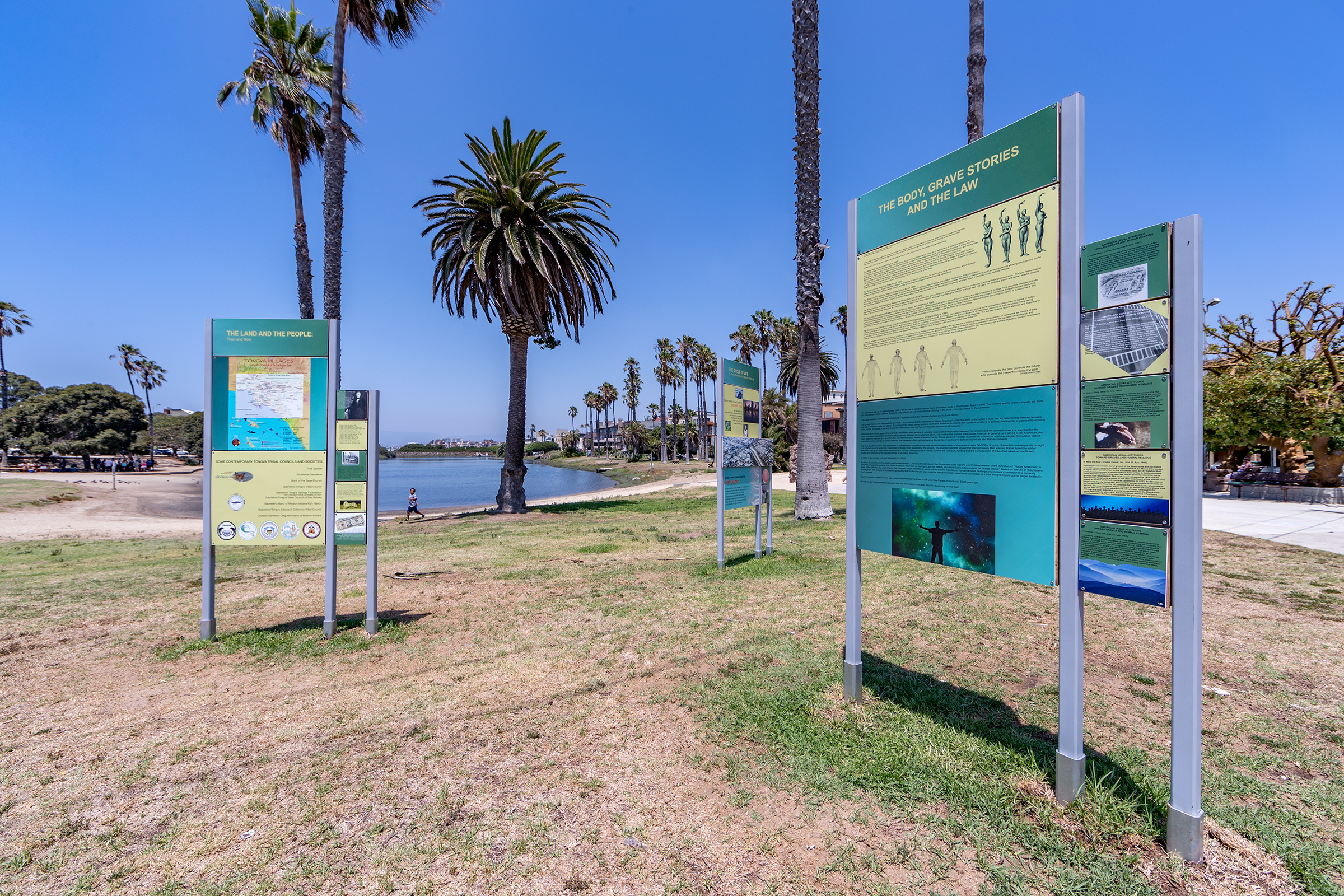
Los Angeles is a metropolis built on a delusion: that engineering can overcome a basic lack of sufficient resources to meet the popular need. Five years into a severe drought, one would think conservation would be on everyone’s mind, but the clean cars and green lawns all around town suggest otherwise. To increase discussion of water and its scarcity, the city’s Department of Cultural Affairs developed CURRENT LA: Water, LA’s first public-art biennial. Four LA-based curators invited thirteen local and international artists to create temporary public artworks, on view for one month in the summer at locations dispersed across the city’s fifteen council districts. Like the water from which it draws its central metaphor, CURRENT LA was an example of the tension between abundance and scarcity.

Gala Porras-Kim. Supplement to Ballona Discovery Park Informative Signs, 2016; mixed media; variable dimensions. Artwork commissioned by City of Los Angeles Department of Cultural Affairs (DCA) for CURRENT:LA Water. Photo by Panic Studio LA.

Gala Porras-Kim. Supplement to Ballona Discovery Park Informative Signs, 2016; mixed media; variable dimensions. Artwork commissioned by City of Los Angeles Department of Cultural Affairs (DCA) for CURRENT LA: Water. Photo by Panic Studio LA.

Water and art are both fraught with questions about equitable access to resources. DCA General Manager Danielle Brazell likened the CURRENT LA: Water concept to the flow of water: at times a trickle, at other times a gushing flow. This poetic analogy overlooks the structural inequality that determines water usage in drought. Rain may fall everywhere, but once water meets the ground, access to it is not evenly distributed. Conservation is encouraged through punitive pricing, which has the effect of enabling wealthy scofflaws while asking the poor to do more with less. LA’s aquifers, which represent the city’s water supply for future generations, have already been severely compromised by unregulated industrial activity. Once again, those who can pay are rewarded with abundance now; those who cannot have to plan for a future without resources. Discussions around revitalizing the long-suffering LA River often come up against similar concerns, as ecological renewal seems to come about only when property values reach a point of unaffordability for local communities. The fact that CURRENT LA was underwritten by Bloomberg Philanthropies, a private foundation whose Public Art Challenge seeks to “celebrate creativity, enhance urban identity, encourage public–private partnerships, and drive economic development,” only increases the anxiety around fair and equitable distribution of resources.

Read More »

Share

New York

A Perfect Storm

From our friends at REORIENT, today we bring you author Nur Shkembi’s thoughts on subversive practices in the Guggenheim’s exhibition of Contemporary Middle Eastern and North African Art, But a Storm Is Blowing from Paradise. Shkembi states, “This notion of art as a subversive practice is not new; however, redefining the material itself as the place from which ideas are ‘smuggled in’ is certainly compelling.” But a Storm Is Blowing from Paradise is on view at the Guggenheim Museum in New York through October 15, 2016. This article was originally published on August 30, 2016.

Rokni Haerizadeh. But a Storm is Blowing from Paradise. Photo: Ramin Haerizadeh. (© the artist; courtesy the Solomon R. Guggenheim Museum)

Rokni Haerizadeh. But a Storm Is Blowing from Paradise. © the Artist. Courtesy of the Solomon R. Guggenheim Museum. Photo: Ramin Haerizadeh.

It was an uncomfortably hot and typical Brisbane afternoon as I made my way across the concrete courtyard from the Gallery of Modern Art to its big sister, the Queensland Art Gallery. There is something rather exciting about the potential of Middle Eastern art in Australasia, although its relative invisibility has been something problematic; the Asia Pacific Triennial is one of the few large-scale exhibitions in the southern hemisphere featuring artists from the Arab world, Turkey, Iran, and Southeast Asia. Entering the gallery, I was still slightly agitated from the humidity, and as I moved forward through the much cooler interior and the sparse, slowly moving crowd, my senses suddenly awakened. It was an unexpectedly frantic space, every single inch of it: The floors, walls, and ceiling were smothered in a full-scale re-creation of Rokni Haerizadeh’s studio in Dubai, which he shares with his brother, Ramin, and their friend Hesam Rahmanian. The entire first gallery, in fact, was dedicated to their collaborative installation, All the Rivers Run into the Sea. Over./Copy. Yet, the Sea Is not Full. Over.

The exhibition arguably contained everything one would expect from the Haerizadehs and Rahmanian. After examining each piece, I was left wondering what the vastly Anglo-Saxon audience made of the highly political and otherworldly spectacle. My presence in the installation as a pseudo-Arab/Middle Eastern/you-must-be-somewhere-from-the-East person created a strange friction as passersby asked, ‘Can you read that?’, or, ‘Does that offend you?’ Standing in my hijab, I was a lone figure suddenly cast as a translator, oracle–miracle–in a physical space where everything surely meant something political, or was at least a push back against the fanatical or oppressive.

Read the full article here.

Share