David Leggett

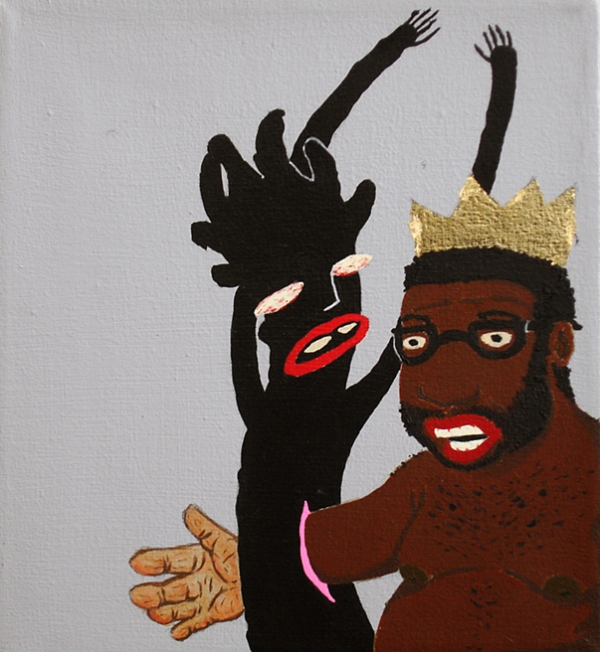
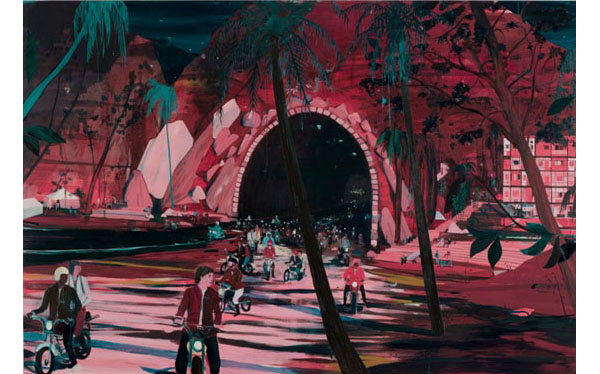
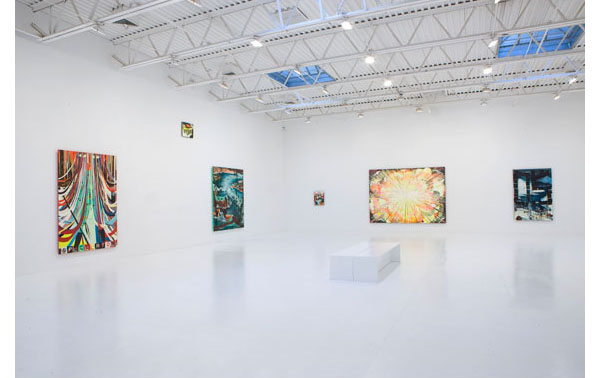
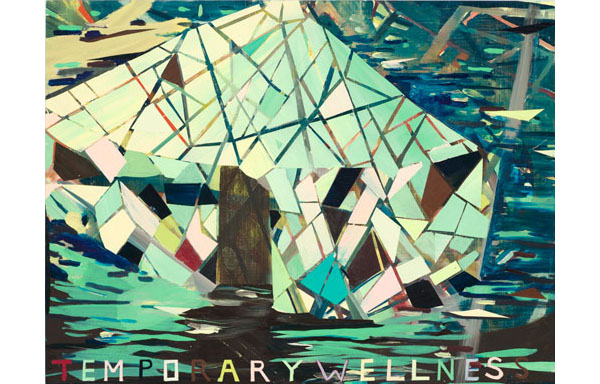
Up for the Down Stroke is the title of a new exhibition of paintings by artist David Leggett. The exhibition, which is on view at 65GRAND in Chicago, makes use of humorous yet irreverent imagery and text that confronts everyday issues of race, class, sexuality and religion. While the paintings hardly offer any solution to these issues, they do provide a tension between humor and disgust that demands engagement from the viewer. Leggett’s social observations of the commonplace shed light on cultural byproducts such as lyrics from rap songs and contemporary and historical cartoons to reveal certain absurdities in our daily lives which often are so widely accepted that they become rarely examined.

The Chicago-based artist was born in Massachusetts and is a graduate of Savannah College of Art and Design (SCAD) and the School of the Art Institute of Chicago. Up for the Down Stroke marks the first solo exhibition for the artist, who recently completed group shows at the Hyde Part Art Center and the Zolla Lieberman Gallery, both in Chicago.

Share

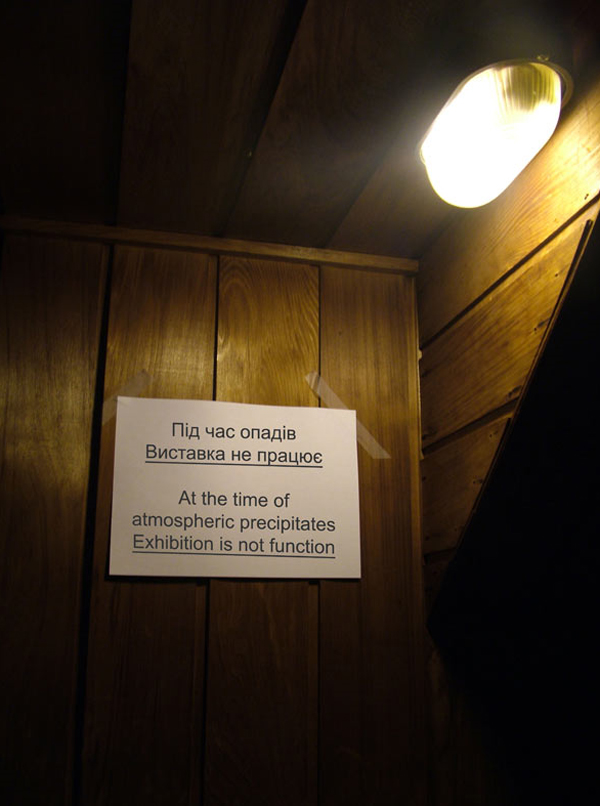
At the time of atmospheric precipitates—exhibition is not function

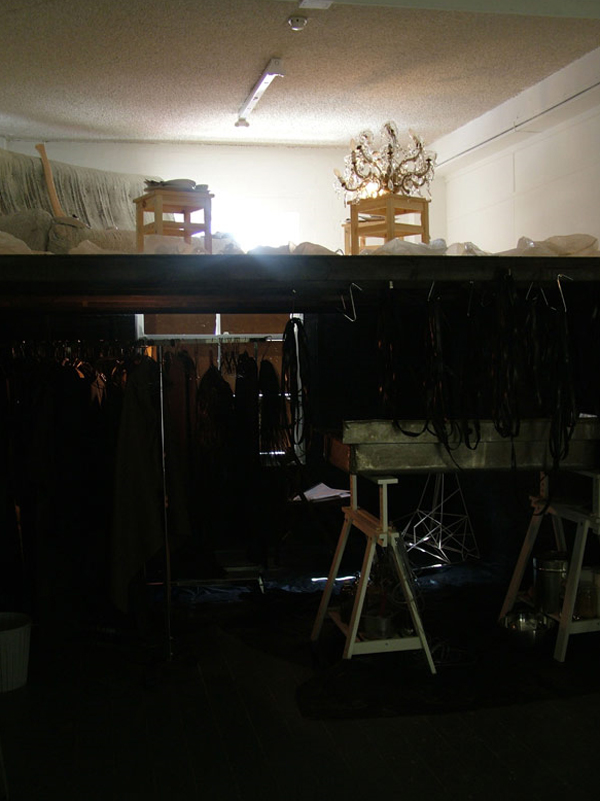
Currently on view at Blindside in Brisbane, Australia, is the collaborative exhibition, At the time of atmospheric precipitates—exhibition is not function. An exercise in creative flexibility of sorts, the collaboration between Brisbane-based artists Danielle Clej and Ruth McConchie consists of a constructed “kaleidoscopic labyrinth,” which explores the architectural boundaries of the space. During the short installation period, the duo arranged and rearranged objects and improvised the form of the elaborate installation, which will continue its fluctuating state of development throughout the course of the show. This is not the first collaboration between Clej and McConchie—they’ve constructed spaces in site-specific installations before. As Blindside notes, “Clej and McConchie have distinct, individual art practices; yet share a desire to shape provisional, sensuous systems of order. These works are mutually driven by their obsessions with creating spatial-object-bodily dialogues within the structure of gallery sites. Employing formal and conceptual tactics of compulsively working to the excess, they play with repetitive processes of material collection to arrange stuttering rhythms of form, colour and light.” At the time of atmospheric precipitates—exhibition is not function is on view through April 24th.

Danielle Clej recently earned a Ph.D in practice-led research at the Queensland University of Technology. She is a co-director of Brisbane based artist-run-initiative inbetweenspaces and recently co-curated the international art project, Constellations. Her work has been exhibited at Block Gallery, QUT, Brisbane; First Draft Gallery, Sydney; Karen 19 Gallery, Gold Coast, and beyond.

Ruth McConchie is a current MA candidate at Queensland University of Technology. She is a co-director of Brisbane based artist-run-initiative inbetweenspaces. She has exhibited at No Frills Gallery, Brisbane; !Metro Arts, Brisbane; Accidentally Annie Street Space, Brisbane; and First Draft Gallery, Sydney.

Share

Interview with Wangechi Mutu

In February 2010, Kenyan-born, New York-based artist Wangechi Mutu was named the Deutsche Bank’s “Artist of the Year.” Her accompanying exhibition, My Dirty Little Heaven will open later this month at the Deutsche Guggenheim Museum in Berlin. Recently, DailyServing’s Aimée Reed had a chance to catch up with Mutu at her studio in Brooklyn to discuss her upcoming show, as well as the con-current exhibition This You Call Civilization?, at the Art Gallery of Ontario (AGO).

Wangechi Mutu, "Royal Blue Arachnid Curse", (view of piece installed with damaged wall), 2005, ink, collage, contact paper on Mylar, 77 1/2 x 51 1/2 inches, Courtesy of the artist and Susanne Vielmetter Los Angeles Projects; Photo credit: Joshua White. Collection of Henry Kravis, New York

Aimée Reed: Tell me about the two exhibitions. Will both shows at AGO (open until May 23rd, 2010) and Deutsche Guggenheim (April 30th – June 13th, 2010) feature works from the same series simultaneously?

Wangechi Mutu: No. They both come from quite a wide range of different works. AGO happened to have contacted me to work with them earlier than the Berlin folks. For example they have installation works such as The Ark Collection (a work that consists of four large vitrines displaying postcard-sized imagery of women from African Art) and Sleeping Heads (drawings of severed heads that are installed on a “damaged wall”, or a wall containing perforated holes that evoke wounds), which are both memorable and significant pieces. They also have a lot of my larger collages, the catalog Shady Promise (published by Damiani) and video works.

Read More »

Share

From the DS Archives: AVAF

Originally Published on May 22nd, 2008.

Each Sunday we reach deep into the DailyServing Archives to unearth an old feature that we think needs to see the light of day. This week we found a feature of Assume Vivid Astro Focus’s 2008 exhibition at Deitch Projects in New York City. If you have a favorite feature that you think should be published again, simply email us at info@dailyserving.com and include DS Archive in the subject line.

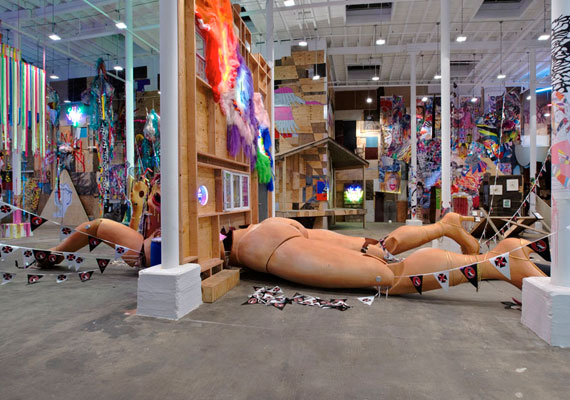
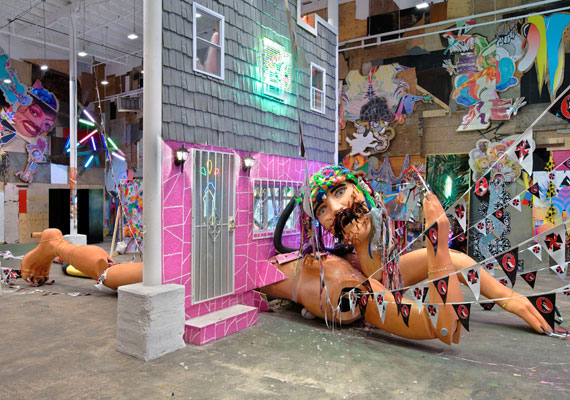
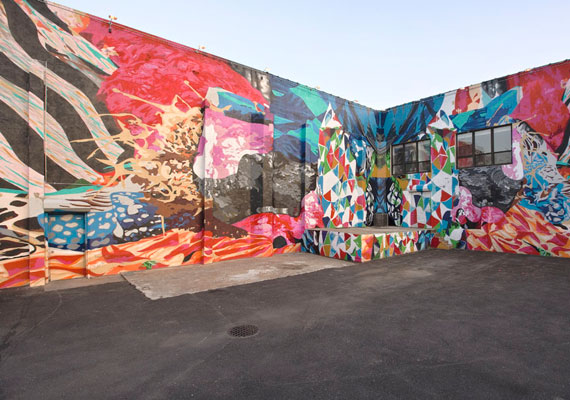
Deitch Studios in Long Island City is currently showing assume vivid astro focusAbsolutely Venomous Accurately Fallacious (Naturally Delicious) until August 10th. avaf is a collaborative group of artists, designers, filmmakers, and performers that creates different projects based on each institution and space they visit. They have exhibited all over the world, including at the Kunsthalle Wien in Vienna, and will be participating in the 28th Sao Paolo Biennial. The number of people working on each project varies, and the group always wears masks to encourage the viewers to focus on the work and not their personalities. The exhibition at Deitch is a combination of murals, collages, sculptures, video, and installation, as well as a special zone for experience and interaction (included in every avaf project).

In the center of the gallery space is an enormous gender-bending figure lying belly down across the floor. The massive trannie sculpture (with high heeled strappy shoes, a meandering phallic symbol, and two heads) loudly references change and is trapped beneath the facade of an old Brooklyn house. This architectural inclusion references the reconstruction (and destruction) that is taking place throughout the city and into Long Island. The walls are covered with a beautiful mix of printed wall papers and neon sculptures, which are juxtaposed with harsher materials such as raw plywood and cardboard.

avaf believes in a philosophy of viral contamination, which asserts that as contemporary cultural participants, we are bombarded with an incessant stream of information and imagery. This bombardment leads to the development of a new human species, one which is capable of digesting unbelievable amounts of information through various media. In avaf’s opinion, music is the medium that comes closest to perfection because of the way it reaches the listener. With no physical presence, music manifests itself in our bodies, giving us a somewhat abstract, but intensely sensorial and corporeal understanding of what we hear. Visually, avaf uses abstraction and figuration and a wealth of materials and information to construct an environment to envelop us. The fusion of elements, actions, and artists creates a synergy and abundance that consumes us, much the way music does.

Share

James Welling: Glass House

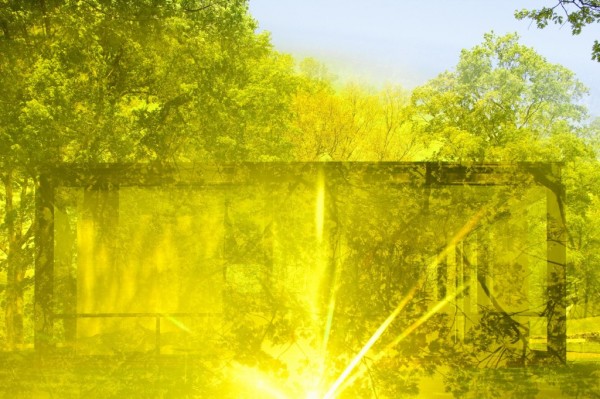
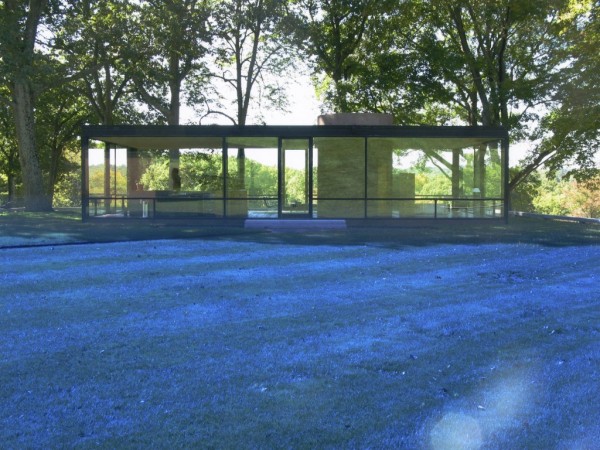
Philip Johnson’s Glass House has often served as the subject and inspiration for other artist’s work. Photographer, James Welling, has chosen to document the house for a new series of images, simply titled Glass House. The exhibition, which is currently on view at David Zwirner Gallery on West 19th St. in New York City, has developed over a three year period (2006-2009). Welling’s images capture the house through a variety of color lens, leaving the structure semi-obscured by a series color fields. The images are exhibited as large-scale inkjet prints which continue to explore the artists interest in color phenomena and trichromatic RGB vision.

Welling has an extensive exhibited history that spans nearly thirty years. He has completed recent exhibitions at Donald Young Gallery in Chicago, Wako Works of Art in Tokyo, Galerie Nelson-Freeman in Paris and Maureen Paley in London. Glass House will be on view at David Zwiner through April 24th, and will move to Regan Projects in Los Angeles later this year.

Share

Nightmares for the Well-Adjusted

L.A. Expanded: Notes from the West Coast
A weekly column by Catherine Wagley
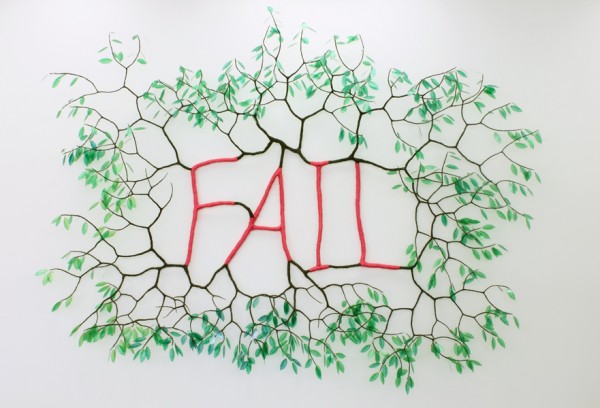
"Permission to Fail," 2010, Mixed media, Dimensions variable: 90 x116 x 20 inches.

A show with as defeatist a title as Permission to Fail should be anything but healthy. Yet “healthy”  nicely describes Macha Suzuki’s unpretentious installation at Sam Lee Gallery. Stationed at the intersection between ambivalence and ambition, Permission to Fail rejects the fragmented nostalgia and aimless grandiosity that has infected too much recent art, opting instead for a quirky brand of pragmatism. Luckily, Suzuki’s pragmatism sidesteps tedium, and the exhibition functions as a psychological dream-scape in which even the well-adjusted must grapple with life’s weirdness.

All of the sculptures in the exhibition consist of typical craft-grade materials, the likes of which could be found at Michaels or Home Depot: MDF, t-shirts, pebbles, spray foam, cotton balls, yarn, and fake grass. While Suzuki doesn’t mask the normalcy of his oeuvre, he executes each work as if he were Charles Ray on a budget: clean edges, deliberate surfaces, precise proportions.

Two geometric birds hang above the gallery’s entrance, suspended from the ceiling. White with sleek surfaces, the birds have only one wing a piece and, at first glance, they look like the two severed halves of a single animal. Their co-dependence doesn’t seem to bother them in the least, however, and this is just one instance in which Suzuki turns failure into a fact of life that, while certainly more intriguing, isn’t much more debilitating than mismatched socks.
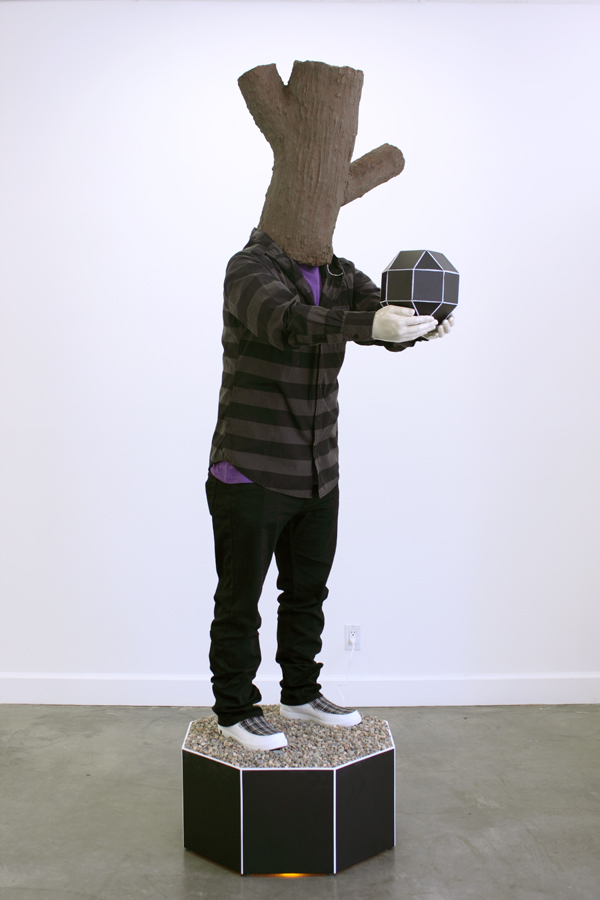
"Just a Tree," 2010, Mixed media, 91 x 24 x 35 inches.

Below the birds, a life-sized male figure in a striped sweatshirt, crisp new shoes, and the outline of a cell phone in his front right pocket holds an angular orb as if performing some hipster ritual. Suzuki’s doppelganger–the figure’s proportions mimic the artist’s exactly–and the exhibition’s protagonist, the man has a papier-mâché tree trunk  in place of a head. Like in a dream that only becomes a nightmare once you wake and untangle its strangeness, the tree trunk seems natural, even rational.

The figure of child in blue and red pajamas and a mask for a head perches on a shelf and another child figure, called The Rider, straddles a headless creature with a cotton-ball laden lamb’s body and wolf’s legs. The Rider’s geometric helmet head, which resembles the man’s orb,  has white antlers growing out of it. Each figure in the show dresses trendily, wearing the sort of clothes that announce their wearer is “with it” but don’t draw too much attention. No more or less innocent than the tree-headed man, the children, while the size of toddlers, channel the precocity of adolescents who genuinely believe themselves grown-up and capable. Their covered heads suggest that they’ve also encountered enough grown-up threats to make them wary, though not necessarily inhibited.
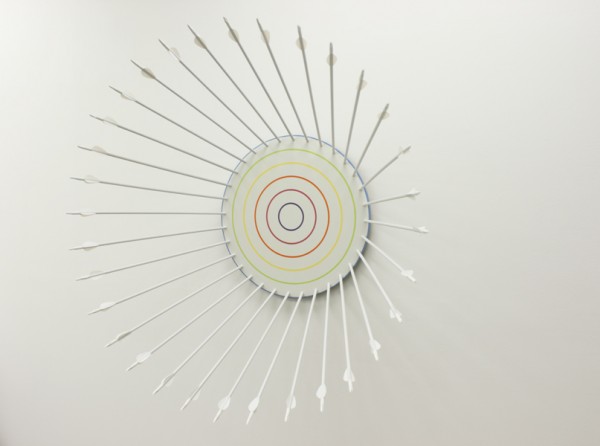
"Nice Try," 2010, Mixed media, 45 1/2 x 45 1/2 x 21 inches.

Two targets–one black with a green rim, one white with a blue rim–hang on walls that would be adjacent if not for the gallery entrance. Evenly spaced arrows that have all missed their goal puncture the targets’ peripheries. The whole show is full of near misses like these, yet none undermine the fact that Suzuki’s approach to disappointment feels more measured  than desperate.  The head coverings, rather than effacement or jaded attempts to escape identity, present as viable strategies for relating  to a prefabricated world. If you masquerade as material, the material environment will more likely embrace you, and you’ll be better able to protect what’s really yours–the body and face beneath that no one sees. And if you fail consistently, cleanly, and smoothly, sending the arrow into the target’s periphery every time, then the difference between failure and success gradually becomes null. Maybe this is still a nightmare in which the only way to beat the big, ungainly world is to wear a tree trunk on your head and fail expertly, but it’s a nightmare in which the main players refuse to sweat the small stuff and seem comfortable with themselves, even if they can’t be themselves without masking themselves.


Share

Inward Bound: Jules de Balincourt & the Next to Last Show at Deitch Projects

While it may seem that every press release these days somehow equates the art on view with the Obama era, things really are better now that big dummy Bush is out of office and you can feel it in Jules de Balincourt’s current show, Premonitions, at Deitch Projects.  I’m not saying this show screams, “Yes, We Can,” but with the oppressive anxiety of the Bush era gone, de Balincourt seems to be turning inward, and with some impressive results.

His work has always been catchy, but the best paintings in Premonitions contain a sense of complexity and mystery that exceeds previous efforts. Floating Through It, Enlightened Burn Out Tree, and A Few Good Men, each reference rites of passage, a communion with nature, and the intangible things one learns through traveling.  Whereas earlier paintings relied on eye-catching but flat-footed elements like laser beams zipping through the composition or text that spelled out activist slogans such as “Think globally, act locally,” these paintings refreshingly allow the viewer to pursue their own way through the work.

More painterly than Inka Essenhigh, yet not nearly as gloppy as Hernan Bas, de Balincourt strikes a balance between unfussy and thorough. Up close, we get just the amount of information we need to believe in the image.  Although some of the folk/naïve sensibility that made his earlier work almost cloyingly accessible is still present in these paintings, it is not so much as to distract from the message. In other words, substance finally trumps style in de Balincourt’s newest works.

But before I go overboard praising this show, the truth is that it’s pretty uneven. Power Flower, given prominence on the main wall of the gallery, is a real clunker. The debt to Chris Johanson weighs heavily here; use of converging lines to symbolize the infinite is better left to Mark Grotjhan, not to mention Jay Defeo. Hawkes and Doves, with its swishy mysticism, looks like it could be a sign for those depressing 24-hour psychics that no one goes to. Dismounted pictures two Native Americans sitting beside a pathetically rendered patchwork horse. If one of them were crying the famed single tear from the 70s ad campaign, the painting’s schlocky, moralizing narrative would be complete.  That said, the gains made here by de Balincourt override any missteps, and there are plenty of winning moments on view.

A “closeout sale”-style hanging has become the norm at Deitch Projects now that the gallery is in fact closing in June. Call me a classicist, but I think de Balincourt’s work would have benefited from a pared down installation. I’d also like to see the artist find a dealer that affords him continued growth now that the art market has leveled and the political situation has calmed a bit. And one last thing: it would be great if Deitch’s next and final show, May Day by Shepard Fairey, contained nothing more than a forty-foot version of one of the artist’s signature Andre the Giant images. But I’m not holding my breath.

Share