Abbas Akhavan: Islands

Courtesy The Third Line

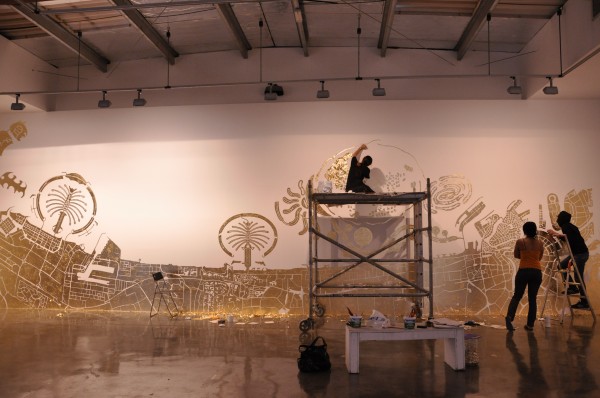
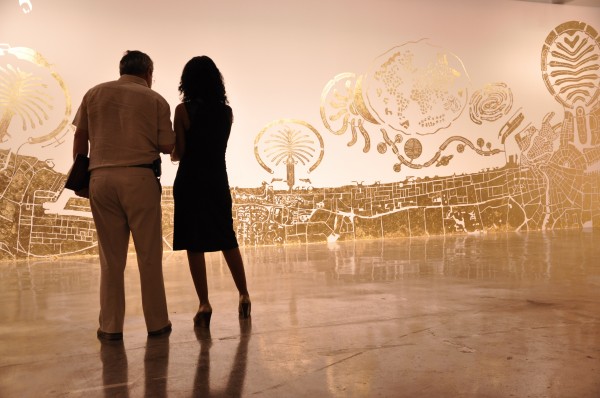
The Third Line in Dubai presents Islands – Abbas Akhavan’s first solo exhibition in the region.  According to The Third Line, Akhavan’s site specific installation visualizes the connections between the art world/art market and the world’s economy.  Akhavan positions this global economic theme within Dubai – mapping the city directly onto the gallery walls.

In Islands, Akhavan paints a series of aerial maps that do not portend accuracy, but instead utilize humor and imagination.  The maps incorporate the most recognizable imagery associated with Dubai’s landscape, architecture, culture and economy.  The artist highlights everything from man-made islands to palm trees in faux gold leaf.  The use of faux gold leaf is not only visually striking, but underscores Dubai’s gold trade and economic excess.
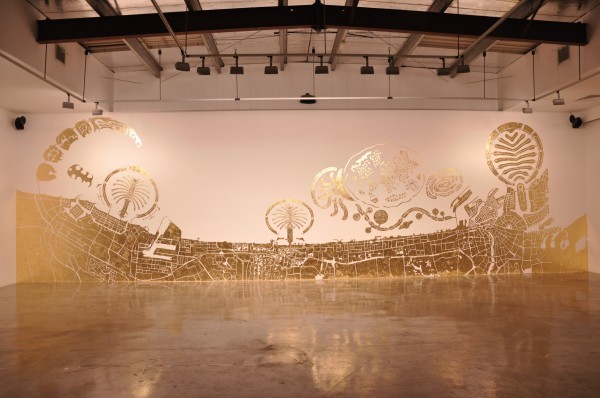
Courtesy The Third Line

The most compelling aspect of Akhavan’s installation is that it openly relies upon the art collector’s participation.  Islands will be altered throughout its duration as art collectors purchase various parts of the map.  Each purchased area of the map will be visually sectioned off and selected parts moved or removed.  The art collector becomes a pseudo-land owner, illustrating the way that the art world mirrors real world economics.  Through Akhavan’s work we see that geography is profoundly divided, altered and remapped through the all-powerful market transaction.

Abbas Akhavan currently resides in Toronto and is represented by The Third Line.  He was born in Tehran and has lived in Canada since 1992.  Akhavan received his Bachelors of Fine Arts from Concordia University and a Masters of Fine Arts from the University of British Columbia.  He works in a variety of media including paint, installation, video/performance and site-specific ephemeral work.  Akhavan teaches in Vancouver at both the Emily Carr University of Fine Art and Design and the University of British Columbia.  His work has been exhibited across Canada and internationally – at spaces that include Artspeak (Canada), the Kunsten Museum of Modern Art (Aalborg, Denmark) and Uplands Gallery (Australia).
Courtesy The Third Line

Abbas Akhavan’s Islands will be on view at The Third Line in Dubai from 6 May through 10 June 2010.  A preview will be held Wednesday, 5 May from 7.30 to 9.30 pm at The Third Line Gallery, Al Quoz 3.

Share

Adam Satushek: Annex

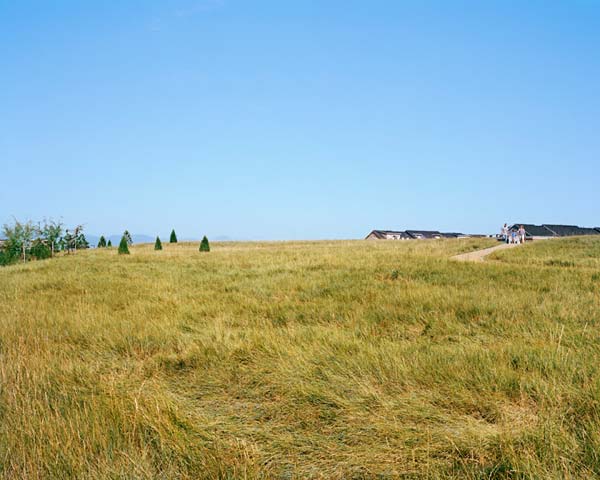
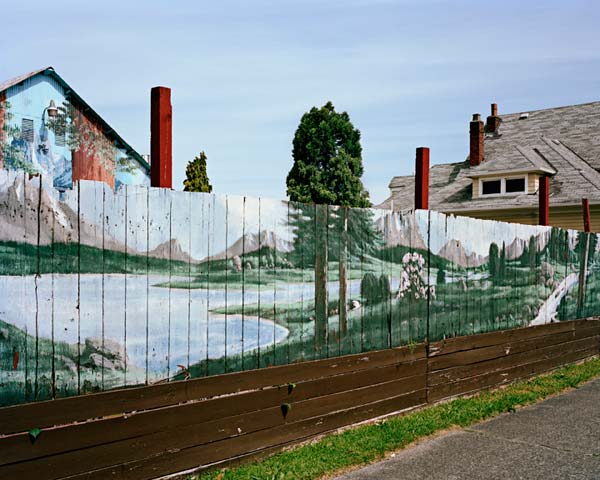
Seattle-based photographer Adam Satushek would like to play tricks on your eyes and your mind. His work, currently on view in the solo exhibition, Annex, at Platform Gallery in Seattle, does just that. Often many layers deep, Satushek’s works read like visual puns. The images he captures depict seemingly ordinary spaces and situations, only to reveal upon closer inspection that things aren’t quite as they seem. A stunning landscape is actually a painted backdrop, an elegant sailboat is dwarfed by a monstrous dock—or, more likely, the standard-sized dock appears massive aside a toy boat that glides by. In a way, one is reminded of Rene Magritte—the witty presentation and the questioning of images rings similar. But Satushek appears more earnest in intention. He says that his work “investigates the interactions and integration into the world by humans. As I explore the space between what I assume about the world and the realities of how the world exists, I reconsider the relationships between these objects and their environment. I am attempting to understand my own place in the world.

Adam Satushek lives and works in Seattle, Washington. He earned his BFA in Photography from the University of Washington. His work has been exhibited at Rake Gallery, Portland, OR; SAM Gallery at the Seattle Art Museum Seattle, WA; Pingyao International Photography Festival, Pingyao, China; and SOIL Gallery, Seattle, WA. His work was part of a two-person show at Platform titled In Between Days in 2007.

Share

Artists Explore Screen Space

Sharon Lockhart

Artists Explore Screen Space is the title of a new exhibition of video based artworks on view at The Power Plant in Toronto, presented as part of the 23rd Images Festival. For the exhibition, artists Sharon Lockhart, Ryan Trecartin, Peter Campus and Joachim Koester are presenting recent video projects that vary widely, while  addressing the moving image and the idea of screen space.

Lockhart is presenting Podwórka a video that explores six groups of children as they play within the courtyards and playgrounds of Lodz, Poland. Far from the over designed playgrounds found in the United States, these courtyards are contain highly adaptable urban structures that the children take over and use for their own amusement and needs.


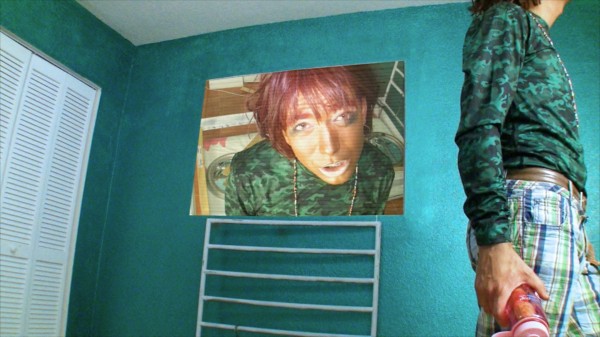
Artist Ryan Trecartin is presenting Any Ever, for his Canadian solo debut, a seven-video suite from his four-part series Re’Search Wait’S as well as his acclaimed 2009 video triptych Trill-ogy Comp. Through this work, Trecartin continues to explore ideas of hyperactive and collaborative performance, which often casts the artist in a variety of outlandish roles, that is centered on consumer culture as well as the fragmented identity that is perpetuated by the digital age and constant bombardment of images and video material.

Artists Explore Screen Space will be on view through May 24, 2010 at The Power Plant in Toronto, Canada.

Share

From the DS Archives: Mona Hatoum

Each Sunday we reach deep into the DailyServing Archives to unearth an old feature that we think needs to see the light of day. This week we found a feature of one of our favorite artists, Mona Hatoum. If you have a favorite feature that you think should be published again, simply email us at info@dailyserving.com and include DS Archive in the subject line.

Originally published on February 20, 2008


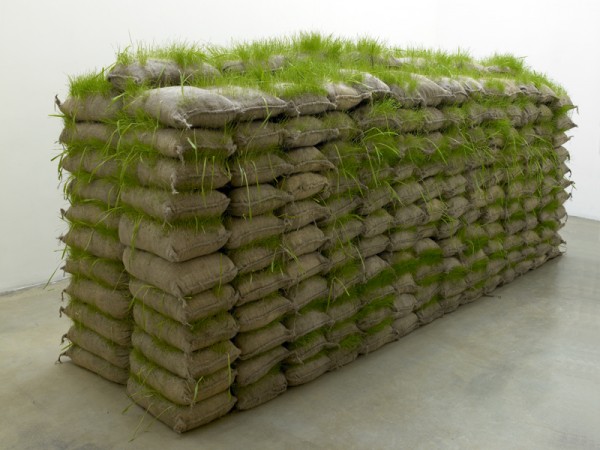
Being a Palestinian born in Lebanon, Mona Hatoum, who currently shuttles between London and Berlin, is in a good position to make commentary on the difficulties a foreigner faces when trying to find a place to call home. This subject has been a reoccurring theme in her work for many years. She continues to investigate this idea in her newest exhibition currently on view at Galerie Chantal Crousel in Paris. While her work can be viewed with humor, it is also not afraid to address the darker challenges that face every one of us in our deeply troubled world. Works on view here include a barricade that also serves as a place for growth for that most sought after item, grass. Grenades that have been lovingly hand crafted are displayed on a table, ready to be wheeled into action. And the warmest of all household items, a carpet that seems to have been picked at, revels an “area-correct” map of the world without its arbitrary political divisions.

Hatoum work is most impressive when presented on a large scale, such as “Mobile Home”. This work shows an assortment of household items that move gently along a pulley system that is confined between two barriers. This piece suggests that we must remain prepared to move as society is always in a perpetual state of flux. While large scale work can be stunning, an artist must realize that resources can dry up at anytime, and they need to be able to work with much humbler means, while remaining creative. Hatoum demonstrates her awareness to this creativity, with her small scale drawings on cardboard trays and paper cutouts. The cardboard trays are named after clouds, (think of lying in the grass dreaming), but they also suggest continents, what was or what could be. The paper cutouts remind us of the simple fun we had as children, and the cozy loving warmth that is perhaps the most important commodity of all.

The well traveled Hatoum has previously shown at the Venice Biennial, Sao Paulo Biennial, Documenta, SITE Santa Fe, Kwangju Biennial, as well as most major museums in the world. Besides Gallerie Crousel she is also represented by Gallerie Max Hetzler Berlin, White Cube London, Alexander and Bonin, New York.

Share

Jeff DeGolier: Southwest Jalopy

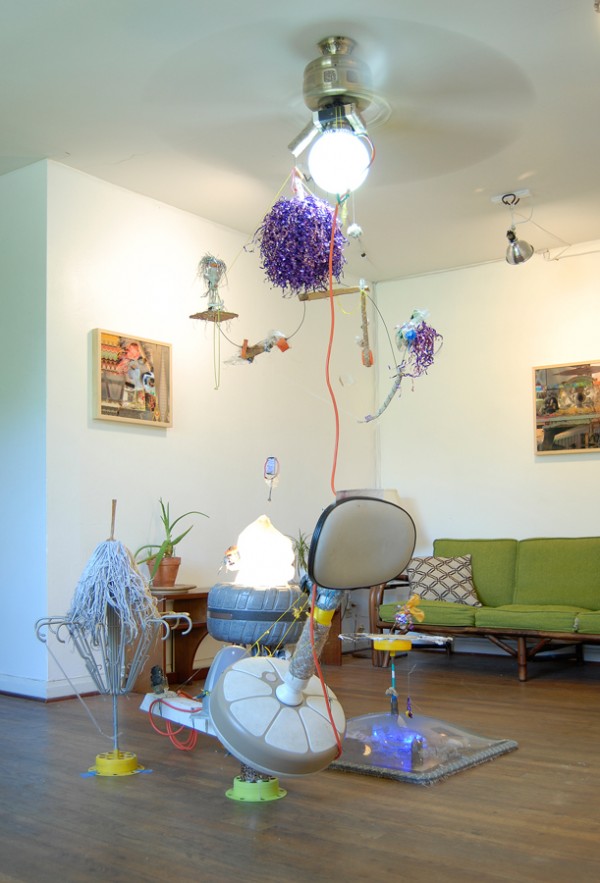
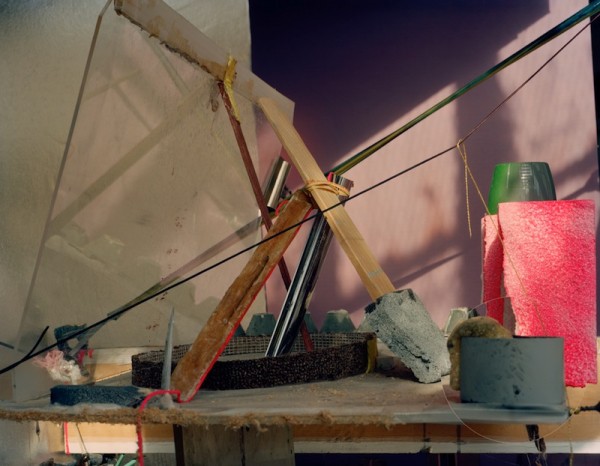
Now on view at SOFA gallery, a DIY space in the living room of an Austin apartment, is the work of Jeff DeGolier. This pairing is fitting since both the artist and gallery make due with what is on hand. DeGolier, who is based in Brooklyn, came to Austin for a week and harvested bric-a-brac from trash piles and swap meets. Day by day, he assembled a sculpture at the center of the room that runs from floor to ceiling. Hung on the walls are a few digital prints based on similar assemblage sculptures.


The sculpture starts with the ceiling fan that becomes a source of electricity for a faux hearth made of a painted tire and an illuminated white plastic bag as well as some small fans with flashing blue lights, typically used to trick out computers like low riders. Pompoms, plastic hangers and a mop head are also carefully assembled in a way that approaches a kind of ritualized fetish object for our American consumerist wasteland.


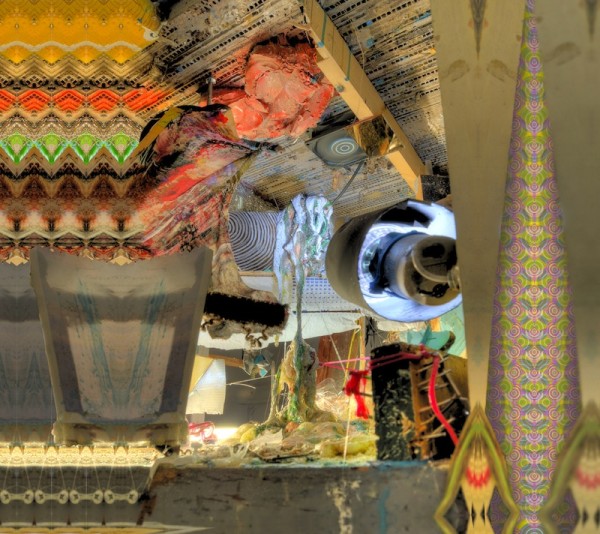
This space of assemblage, in which objects hang, pivot and tilt, is flattened and framed in the prints. Color is heightened and patterns emerge to quote the psychedelic without falling into the traps of its potential sentimentality. What holds this work in check is the intensity of its realism and directness combined with a quirky specificity of craft. Like many of the artists in the New Museum’s 2008 exhibition Unmonumental DeGolier dispenses with slick expensive production in favor of the quotidian, making this living room both extraordinary and accessible.

Share

Too Cool for the Cool School

L.A. Expanded: Notes from the West Coast
A weekly column by Catherine Wagley

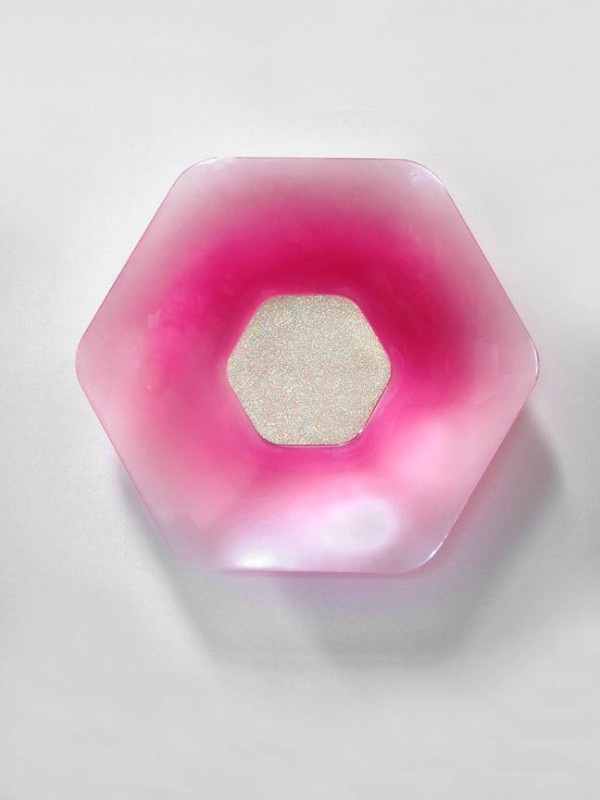
Craig Kauffman, "Untitled," 2009. Drape-formed plastic with acrylic lacquer & glitter.

Craig Kauffman has a shoe fetish. He’s had it since he was a child. “My mom wore high heels,” Kauffman explained in a 2008 interview, the same interview in which he talked about the affect campy lingerie ads from Frederick’s of Hollywood had on his adolescent mind. (“Blow up bras, stuffed padded bras, rear ends,” Kauffman recalled. “[Frederick] was a genius.”) The work that stems directly from Kauffman’s fetish—dumb-fisted, transparent paintings that L.A. Times critic Christopher Knight recently referred to as “rather tepid”—is far from compelling. But the fact that the artist known for sleek, vacuum formed abstractions lusts after stilettos and patent leather pumps? That is compelling, especially since freshly lacquered custom car parts are more often assumed to be Kauffman’s main muse.

New Work, Kauffman’s soon-to-close exhibition at Frank Lloyd Gallery, features two paintings of shoes, but these hang on an unobtrusive side wall. The central attraction, a series of delicate, drape-formed plastic shells that look like glitter-filled candy dishes, hang in the main gallery. The glitter is real and, like the acrylic wall reliefs Kauffman began making back in the 1960s, each shell has a perfectly smooth surface. The hot pink, aqua, Astroturf green, and lavender that color these sculptures have the manicured gloss suited to a Prada showroom.

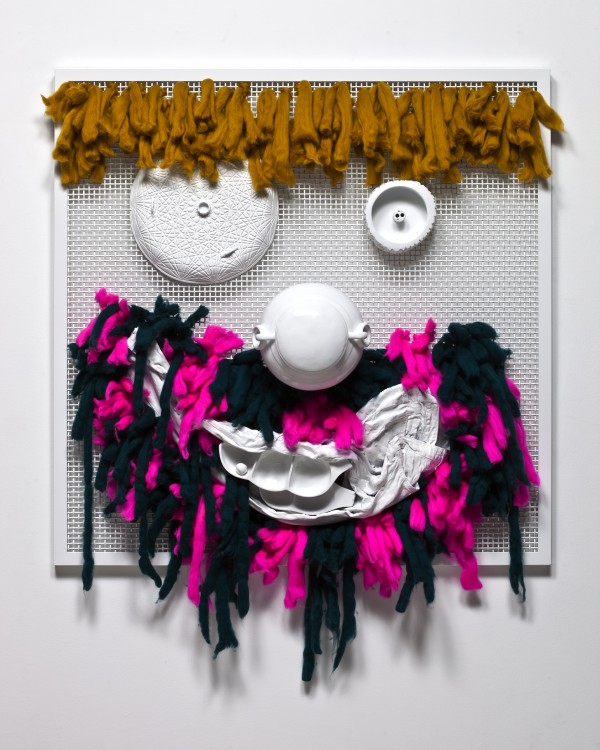
Liz Craft, "Candy Colored Clown," 2010. Metal, bronze and yarn.

Similar colors characterize Liz Craft’s current exhibition Death of a Clown, on view four doors down from Kauffman’s in Patrick Painter Inc. Caft’s show includes imposing metal screens on which clown faces have been created out of bronze vases, ceramic dishes and thick colored yarn; two clowns, one laughing and one crying, impressionistically sculpted with Giacometti-like license; a tiered table; a witch face; and an orange-haired girl who looks like Milais’s Ophelia might have had she died a hippie on a grandmotherly pink couch. Bruce Hainley once wrote, “Craft is never not crafty in her deployment of materials,” the double negative mimicking the way Craft’s aggressive material choices negate her domestic, decorative subjects. Loopy and comedic though her subjects are, Craft’s perversion of bronze, steel and fiberglass is dead serious and it’s also part of the reason Death of a Clown speaks to Kauffman’s New Work.

While Kauffman’s sculptures are ethereal, Craft’s are industrial and opaque; while Kauffman’s are abstract, Craft’s are representational. While Kauffman belonged to The Cool School, the group of ‘60s artists who equated artmaking with machismo and made Los Angeles a scene, Liz Craft was Too Cool for School, according to a catchy Spin Magazine article Dennis Cooper wrote about her and her UCLA cohorts. Yet both sculptors fixate on material objects, both have a notoriously Californian obsession with commercial material and fetish-finishes, and both work in the realm of warped whimsy (though I’m not sure if Kauffman means to be as warped as Craft does).

Craig Kauffman, "Untitled," 2009. Drape-formed plastic with acrylic lacquer & glitter.

When I imagine Kauffman and Craft’s exhibitions merging–and I often do, even though I know the two wouldn’t and probably shouldn’t ever come together–it’s a deliciously disjointing opus in which Kauffman’s dishes protrude from Craft’s clown faces, or sit on top of her fiberglass furniture. The work of Kauffman, once associated with machismo, plays the stereotypically delicate, feminine role. The work of Craft, always prodding the domestic, plays the more heavy-handed stereotypically masculine role. This inversion is satisfying.

Share

Rooms

On the edge of Culver City’s industrial area sits Scion Installation L.A. Space, currently hosting a group exhibition of artists whose mission was to transform the gallery into eight individual rooms.  Each room is indicative of a theme set forth by the artist or team of artists who designed and built it.   Artists and their rooms show an appetite for the urban, likely due to the exhibition curator’s own passion for street art.  The artists were chosen by Roger Gastman, best known for his assistance in bringing graffiti art into the limelight of the contemporary art world.   Gastman’s many art publications, like Swindle Magazine and his latest book, Freight Train Graffiti, often highlight street art as a prized aspect of pop culture.  Gastman also served as executive producer of the recent graffiti documentary, Infamy.

Within Chris Stain‘s installation, the viewer briefly navigates the nooks and crannies of a constricted space between two buildings. His corridor-like construction embodies subculture with multiple depictions of bricks, graffiti, and graphic renderings of telephone poles and electrical wires. Stain thinks of the space as “…a 3-D representation of the smaller paintings I make on metal, which capture the story of the struggling American.”

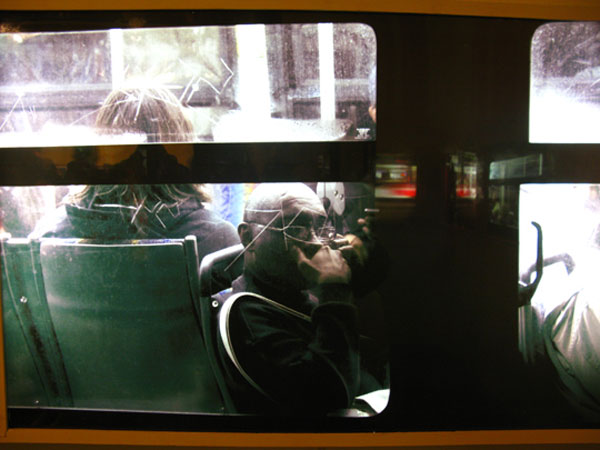
Similarly, Dan Monick and Caitlin Reilly collaborated to make their room into a bus stop with a partially enclosed waiting area and bench.  The team installed lighting meant to mimic the overhead illumination of a street lamp.  In addition, photographic images are installed on light boxes that surround the perimeter of the room.  These images, which are approximately the same size as bus windows, are portraits of passengers and their surroundings.

In contrast, some of Rooms’ artists indulged in investigating their own style as opposed to recreating a specific urban-inspired space.  Adam Wallacavage‘s installation is saturated with curving tendrils and undulating arms, both signatory elements of his personal aesthetic.  Four of his plaster cast octopus arm chandeliers are suspended from the ceiling.   Custom sconces, furniture, wallpaper, and candelabras function to unify Wallacavage’s eccentric room.

In addition to the aforementioned artists, works by Bill Daniel, Dueling VHS, Justin Van Hoy, Kime Buzzelli, and Rocky Grimes are also exhibited.  Rooms will be on display through May 15th, 2010.

Share