Psychedelic: Optical and Visionary Art Since the 1960’s

Psychedelia is a state of mind. It is a particular mode of perception that upends our assumptions about the way that the world works. It is about heightened color, glimmering patterns, and swirling constellations of form that challenge gravity and the very boundaries between discrete objects.
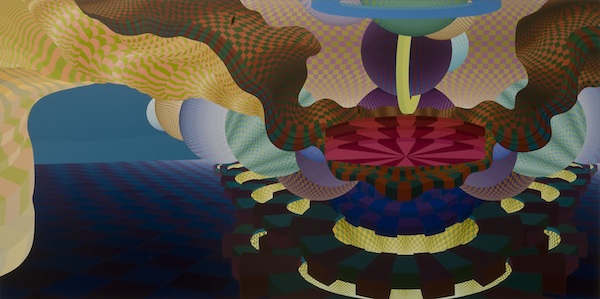
Al Held, Eagle Rock III, 2000

The exhibition Psychedelic: Optical and Visionary Art Since the 1960’s at the San Antonio Museum of Art takes these ideas as a net to gather a wide range of artists. The 1960’s, as the well-worn story of post war America goes, was a moment of civil unrest driven by a youth culture that was suspect of authority and newly intoxicated by sex, drugs and rock and roll. It also was a time when artists were riffing on the newly invented methods of image making that Surrealism and hard edged abstraction introduced. As a result, artists such as Richard Anuszkiewicz and other Op Art innovators explored pattern and abstraction to create hallucinatory visual paintings.

Philip Taaffe’s Trinity (1985) extends these ideas from Op Art, creating an image with silkscreen and collage that makes one’s eyes buzz. The image makes us feel like we are falling into it and at the same time repelled by its churning space. Taaffe uses a color spectrum and concentric arrows of modulating scale to create a sense of movement that picks us up off our feet and drives us through the picture plane.
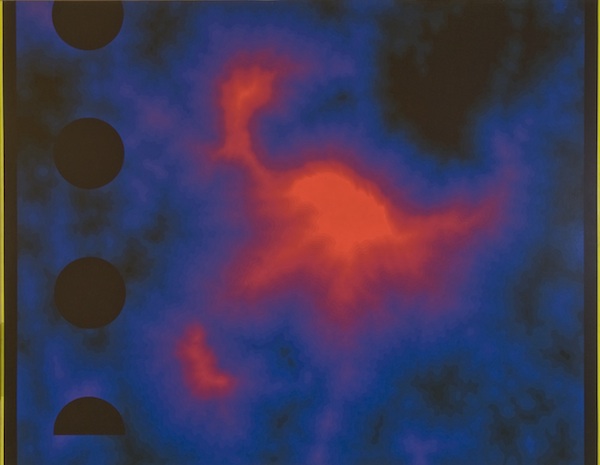
Jack Goldstein, Untitled, 1987

Jack Goldstein - an artist who emerged in the 1980’s, disappeared from the art world in the 1990’s and then surfaced again to public acclaim in 2000 until his suicide in 2003– made images that used filmic and photographic sources for his paintings. Included in the exhibition is Untitled (1987), which uses a photograph of a spectacular moment in natural phenomena. Taken in space, the source image for this painting could be abstract but either way, the radiating degrees of hot pink that emanate from an electric blue ground construct a visual field that is arresting.
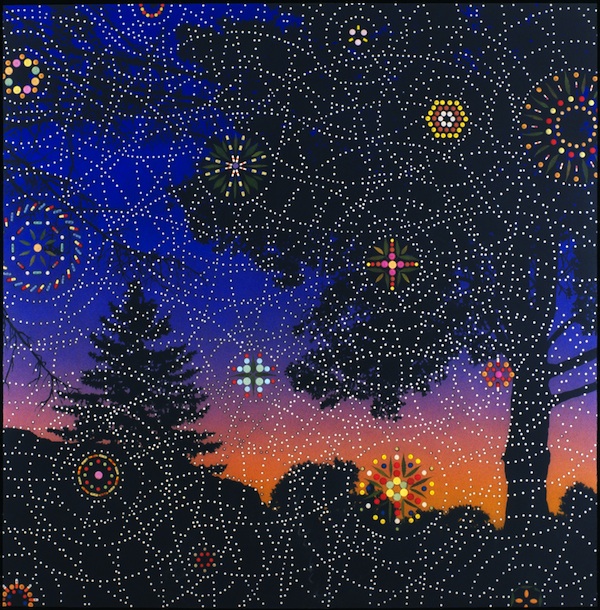
Fred Tomaselli, Ripple Trees, 1994

Another part of psychedelia that the exhibition’s curator David S Rubin seeks to distance himself from is drugs. But the exhibition does include Fred Tomaselli’s Ripple Trees (1994) combining pills and hemp leaves with paint and resin to construct an image of a landscape at dusk. This magical time of day – when trees and mountains are reduced to mere shadows against the soft glowing light on the horizon – is heightened by a web of luminous orbs that radiate pixilated color.

Jeremy Blake, Reading Ossie Clark, 2003

Shifting away from two dimensions, Jeremy Blake’s Reading Ossie Clark (2003) uses montage to combine short, barely legible clips of shot footage with highly saturated digital color. Each clip morphs into the next creating a dreamlike state of ecstasy. Using sculptural installation and an actual light show, Richie Budd’s Bon Voyage Somnabulating De Pileon (2010) builds on the psychedelic impulse to overwhelm the senses with a fog machine and an array of household items and gadgets. It also includes a sound piece that incorporates Neuro-Linguistic Programming (NLP), a communication model applied in psychotherapy that studies the structure of subjective experience.

Richi Budd, Bon Voyage Somnambulating De Pileon, 2007

Taken together, an exhibition about psychedelic experience in art is in many ways the most extreme exploration of radical forms of perception – something which is at the core of what Marcel Duchamp called “retinal art.” The best work in this show transcends the quaint utopianism of 1960’s psychedelics, choosing to change the way we see instead of changing the whole world.

Share

Rachel Khedoori

Artist Rachel Khedoori explores encounters with space and their psychological implications.  According to the Venice Biennale’s Making Worlds catalog, Khedoori’s art practice ‘invites viewers to see hidden or forgotten spaces’ – spaces that are ‘generated by the limits of memory’.  In Cave Model, presented at that show, Khedoori referenced Plato’s Cave Myth and cited it as a source of inspiration.  Yet her art practice deviates from this allegory by not seeking to escape ‘the cave’ and thereby gain philosophical clarity.  Instead, Khedoori directs us towards the untenable shadows that more often define the human condition.

Untitled (Iraq Book Project) 2008-2010. Installation view, Hauser & Wirth London, 2010. © Rachel Khedoori. Courtesy the artist and Hauser & Wirth. Photo: Peter Mallet.

Khedoori experiments with ambiguous spaces through a diverse practice that includes installation, sculpture and film.  The artist’s current solo exhibition of new and recent work at Hauser & Wirth in London is remarkable for the artist’s foray into documentation.  The Iraq Book Project, an ongoing documentary piece, was first shown at The Box in Los Angeles in 2009.  It is comprised of online news articles dating to the start of the Iraq War – 18 March 2003.  Sourced from around the world, the articles are retrieved using the search terms ‘Iraq’, ‘Iraqi’ or ‘Baghdad’.  They are then translated into English, compiled and presented in a series of large books arranged chronologically.  The articles are printed in a uniform, seamless manner and each is demarcated by title, date and source.  These large books are arranged in the main gallery space at Hauser & Wirth on tables along with stools for gallery visitors to interact with the work.  Khedoori’s Iraq Book Project is an on-going effort that is updated continuously.  Its conclusion will depend upon the length of the war.

Khedoori is certainly not alone in responding to the Iraq War, but has typically eschewed such content in her work. While The Iraq Book Project is somewhat of a departure, it can also be viewed as a repositioning of Khedoori’s engagement with space.  In this work, Khedoori locates information within the digital realm and extracts it.  This process allows viewers to explore the changing face of and attitudes towards the war.  It also stores information as a part of our collective memory that would otherwise be dispersed and largely be forgotten.  Khedoori preserves war coverage and places it within the physical world.  She chooses book form, which is a lasting and traditional mode of recording and passing on knowledge.

Untitled (Iraq Book Project) 2008-2010. Installation view, Hauser & Wirth London, 2010. © Rachel Khedoori. Courtesy the Artist and Hauser & Wirth. Photo: Peter Mallet.

A film installation and a photographic series are found upstairs in the American Room of the gallery.  Film is an important medium for the artist, who has returned to it throughout her career.  The photographic series is set in a natural Australian landscape at 5.00 am, while the film is set 12 hours later at 5.00 pm.  For the film installation, Khedoori returns to the device of the mirror to manipulate the moving image.  The film is projected onto a screen that meets a mirror at a 90 degree angle – causing the looped footage to appear to continually separate from itself as it plays.  The Hauser & Wirth gallery points out that the affect is much like a Rorschach ink blot test.  Yet, in this instance it is set in landscape and in motion.  This work allows the gallery visitor to encounter ambiguous, psychologically-tinged space.

Rachel Khedoori’s work has shown internationally since the mid-1990s.  In 2001, the artist’s high-profile solo exhibition at Kunsthalle Basel, Switzerland brought her work increased international attention.  Subsequently, Khedoori has taken part in several noteworthy group exhibitions.  In 2008, the artist was included in the traveling exhibition Visual Tactics or how pictures emerge, which opened at Museum für Gegenwartskunst in Seigen, Germany.  Khedoori’s work received a lot of attention in 2009 when she took part in the Venice Biennale‘s Fare Mondi/Making Worlds exhibition and Paul McCarthy’s Low Life Slow Life: Part 2 at the CCA Wattis Institute in San Francisco.

Born in Sydney, Australia, Rachel Khedoori is the identical twin sister of fellow artist Toba Khedoori.  She currently lives and works in Los Angeles CA and is represented by Hauser & Wirth and David Zwirner in New York.  Khedoori received her BFA from the San Francisco Art Institute in 1988 and her MFA from the University of California in Los Angeles in 1994.

Untitled, 2010 (Film, 3:33 minutes). Installation view, Hauser & Wirth London, 2010.© Rachel Khedoori. Courtesy the artist and Hauser & Wirth. Photo: Peter Mallet.

Rachel Khedoori concludes at Hauser & Wirth in London on 31 July.  It marks the artist’s first solo exhibition in the UK’s capital city.

Share

Barack Obama and David Cameron Swap Art

Today’s post comes from our friends over at Flavorwire.com, a site dedicated to breaking exciting news in everything contemporary, including visual art. In the spirit of our ongoing content sharing partnership, we bring you an article about a recent gift exchange of artworks between President Barack Obama and British Prime Minister David Cameron in a meeting at the White House last week.

Ben Eine, 21st Century City, n.d. Spray paint & black gloss on canvas, 39.5 x 27.5". Courtesy Eine Signs, London

When President Obama and British Prime Minister David Cameron met at the White House yesterday, they spoke about growth, stability, fiscal responsibility, the conflicts in Central Asia, and the special relationship between the two nations. The most interesting news, in our opinion at least, was the gifts they exchanged. Foremost amongst the gift swap was a painting by British street artist Ben Eine and a work by American pop artist Ed Ruscha.

The British government’s request for an artwork took Eine — who is known around London for his typographic graffiti — by surprise. “The work that I do appeals to a certain kind of demographic and Samantha Cameron does not fit into this,” he told Sky News Online. “So it was amazing when I got a call from No 10 to ask if I’d mind giving one of my pictures to President Obama… I mean, the President of the United States, and a call from the office of our Prime Minister — it was unbelievable.”

Ed Ruscha, I Think I'll..., 1983, oil on canvas, 55.75 x 63.75". Courtesy the artist & National Gallery of Art

Obama’s gift — Ed Ruscha’s lithograph Column with Speed Lines — was more in keeping with the President’s taste. Ruscha donated work to benefit the Obama campaign in 2008, and his 1983 painting I think I’ll …, which is in the collection of the National Gallery of Art, currently hangs at the White House. According to the Guardian, the Ruscha print “resembles a single column government building with horizons in red, white and blue, the colors of the US and UK flags.”

The art swap is reported to be a definite improvement over the gifts exchanged by Obama and Cameron’s predecessor, Gordon Brown who presented Obama with an “ornamental pen holder made from the timbers of the Victorian anti-slavery ship HMS Gannet.” Not to be outdone, Obama gave the former Prime Minister “25 DVDs which turned out to be unsuitable for UK players.”

Content and images from today’s article have been brought to you by Flavorwire.com and the writer Paul Laster.

Share

FAN MAIL: William Powhida

DailyServing.com selects two notable artists each month from the submissions we receive to be featured in our series, Fan Mail. For a chance to have your work appear below, with an article written by one of the DailyServing contributors, please submit a link to your website to info@dailyserving.com, subject: Fan Mail. You could be the next artist in the series! (We will try to contact chosen artists prior to publication, but please be sure to check the site everyday.)

William Powhida infiltrated the art industry with his unapologetic attitude, insightful drawings, lists of enemies, letters to collectors and curators, and other written and visual material that prey upon the “catastrofuck” of the art world. Merging his background in art criticism with his visual art practice, Powhida graphically dissects the complex capitalistic structure of New York art using graphite, gouache, watercolor, colored pencil, and incisive text. The artist has garnered much attention for his controversial cultural products.

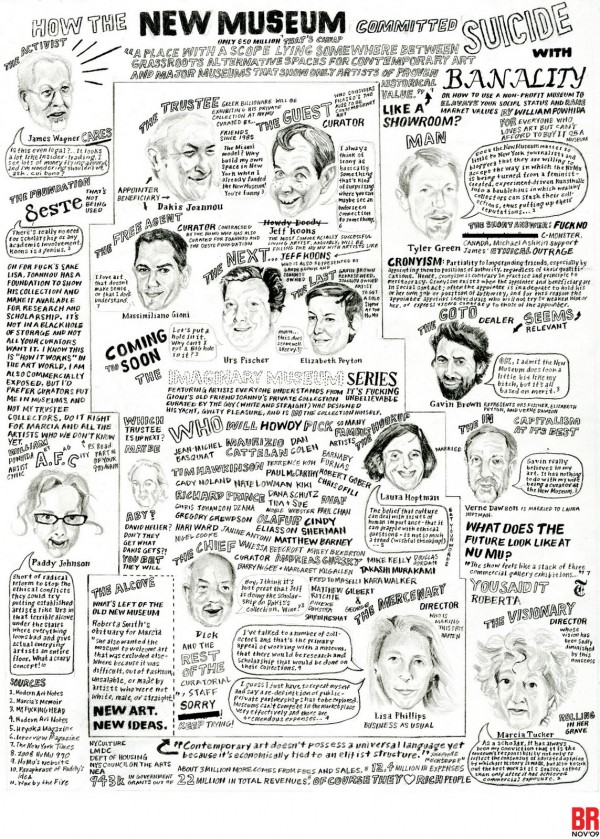
How the New Museum Committed Suicide with Banality, seen above, depicts floating heads of several members and affiliates of the New Museum, suspended in the composition and surrounded by sharp and satirical handwritten text questioning the institution’s alliances and decisions. The drawing, which the artist describes as “a modest drawing about the New Museum‘s terrible decision to show a trustee’s private collection,” appeared on one third of the covers for Brooklyn Rail‘s November 2009 issue, fueling an ongoing debate about institutional ethics. Powhida was a regular contributor for the Brooklyn Rail for three years before he “decided he could no longer keep helping other artists develop careers,” and began concentrating on his own artistic inspirations.

The artist completed his M.F.A. in painting at New York’s Hunter College in 2002 and is represented by Schroeder Romero in New York and Charlie James Gallery in Los Angeles. Powhida co-organized the group show Magicality, currently on view at Platform Gallery in Seattle until August 5th, with Eric Trosko. Magicality investigates the parallels between the disciplines of art and magic and includes Powhida’s series of thirteen prints, which double as talismans and hexes, entitled Ars Magica Portfolio.


Share

From the DS Archives: MOCA Education Department

This Sunday’s choice from the DS Archives is based on the reality that present curatorial practice is quite often guided by pedagogical concerns – making education programs increasingly important to exhibition-making.  In light of this trend, we bring our readers a previously published interview with Denise Gray of MOCA’s Education Department.

DailyServing’s Sasha Lee recently had the chance to sit down with Denise Gray of the Museum of Contemporary Art (MOCA) Education department to discuss her role as an educator, both as an individual scholar in the field and also within the MOCA’s philosophy. Denise, along with others in her field, are extraordinary examples of a vibrant voice shaping how we understand contemporary art today. Whether organizing special events, or working with the fantastic MOCA apprentice program, Denise’s hard efforts are all conducted in the name of inspiring passion for art in others, and lending the public tools to appreciate art. Denise’s educational philosophy begins not with a lecture, but what the participants themselves know and have experienced. In light of the recent events surrounding MOCA–Denise’s interview reminds us the invaluable resource that the museum & educators such as Denise provide.

DailyServing: Can you talk a little bit about your position at the MOCA and the various projects you oversee, maybe your favorites?

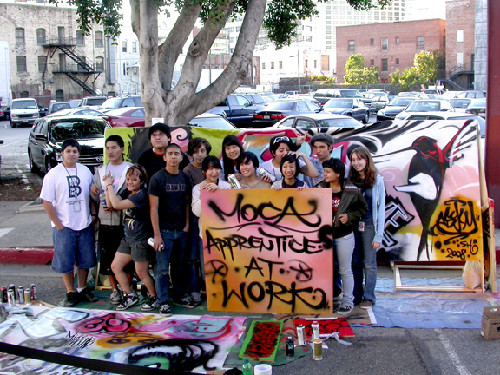
Denise Gray: There’s one particularly that comes to mind, and that is the high school apprenticeship program. The program has been around since the 90’s, it started out because we originally had a high school program for students interested in having conversations about art with their peers. It ended up being successful and students wanted to continue the dialogue, so MOCA decided to formalize that program, resulting in the MOCA apprenticeship program. We conduct a pretty vigorous interview process–with anywhere from 80 applicants for 12 spots usually. Its highly competitive; consisting of students who have identified themselves as interested in pursuing a career in the arts, whether as a curator or as an artist or educator. The program is great because its very hands on. We use downtown as a resource, so for example today we’re going to the art walk. We use the library at REDCAT and visit exhibitions and attend events related to art, so as to compare and contrast the different kinds of art that’s out there. Sometimes, we’ll even have artists who are exhibiting at the MOCA or invite other artists to do special programs with MOCA apprentices.

The apprentices also host events. In 2009, we’re going to have our seventh annual teen night. It’s an amazing opportunity for the apprentices to take the lead and create events for their peers. Usually there’s a student art exhibition that they curate, they bring out live entertainment, along with other activities. It’s like this big art party for teens; we don’t turn away the adults but it’s definitely designed for teens–creating a real ownership for them over the event. Last year, related to the Takashi Murakami exhibition, we collaborated with TOKYOPOP [publishers and distributors of Manga] to hone in on the Japanese pop culture connection–we had a photo booth, young performers, etc. The event was called Eye Candy.

Last year they actually had a slumber party at MOCA! This group had bonded so much that they wanted to have a sleep over at the MOCA. They were hanging out at 2am in the gallery–and the challenge was intentional insomnia–so to stay awake, we hung out with security and explored behind the scenes of MOCA.

DailyServing: That sounds like everybody’s dream, right? A night at the museum, and its great that MOCA is still youthful and trusting enough to allow your apprentices to literally spend the night there.

Denise Gray: Yeah, they definitely had a lot of fun. It’s funny because a lot of the students now involved in the MOCA apprentices were former art students from our MOCA Maniacs program [designed for pre-teens and younger elementary students to participate in summer art classes at the museum] who also wanted to continue on at the MOCA. So, I have actually been working with some of the students for quite some time.

But that entire group had such a positive experience with the museum and such a tight bond with each other they wanted to culminate their learning experience with a fun event like that.

Read More »

Share

Summer of Utopia: The Society for the Preservation of Lost Things and Missing Time: Florida Arcane

On our final day of our latest week-long series, Summer of Utopia, DailyServing discusses the utopian ideals embedded in the building a new city and the economy attached to it. By delving into the work of Solomon Graves, we can take a look at preservation and lost information, truth and fiction and where utopia ends and reality begins.

The wilderness and wetlands that would later become the city of Miami ignited a utopian aspiration in one woman’s imagination, the aspiration to create a metropolis in the subtropical marshland. Cleveland native Julia Tuttle, the original owner of the land upon which Miami was built, moved to the Biscayne Bay region after inheriting land from her father in the late 19th century. Recognizing the need for transportation, Tuttle convinced American tycoon Henry Flagler to expand his railroad to this part of Florida. Initially, he declined her requests, but when the orange groves in that area survived the winter of 1895 and the rest of the state’s citrus crop was destroyed, Flagler allegedly saw the economic potential in Miami. The landscape was transformed.

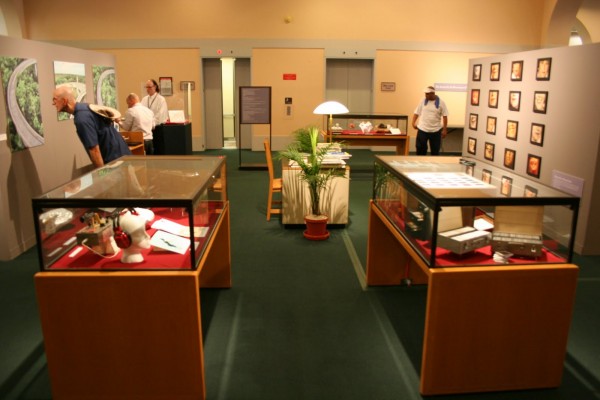
The genesis of this urban paradise is a historical narrative; a literary embodiment of a past experience. Solomon Graves (an alias of the artist Raul Mendez), asserts on his blog that “objects and stories belong to all of us, in the now and beyond.” In his enigmatic exhibition, The Society for the Preservation of Lost Things and Missing Time: Florida Arcane, the artist investigates methods of remembering, analyzing, and preserving the past. As the Society’s website states, “It is our Mission to Thwart the all too common Demise of Things./ Stories, Ideas, which may not fit History’s Master Narrative./ We crave the Archaic and Arcane, the Strange, the Paranormal…those Things imbued / with Magical Properties, the Folkloric, the Homemade, the Story-told, /the Other World-ly./Left-Field.” Need I say more? Florida Arcane, currently on view at the Miami-Dade Main Library, consists of objects, ephemera, archival materials, and other fragments from Florida’s past. The objects are combined with descriptive and imaginative tales, which reference notable figures in the early history of Florida, but have little to no historical fidelity. Mendez cleverly utilizes the venerable institution of the library, a venue for scholarly research, to bolster his exhibition design. A two dollar bill is inscribed with the unwritten rules amongst hermits and derelicts in the Florida Keys at the end of the 19th century. A collection of optical and aviation instruments once belonging to Jacqueline Cochran (a native Floridian), and other evidentiary relics are here as well.

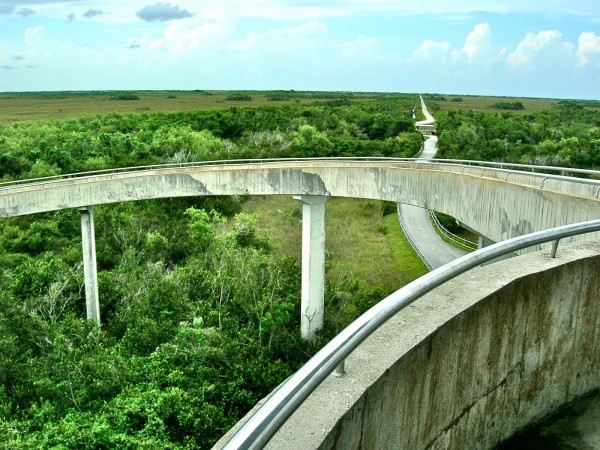
The artist combines documentation and historical fiction in a series of color photographs depicting a concrete modernist structure curiously situated in the middle of a swamp (seen above on the left, click here for detail). The structure is described as Mr. J.E. Lummus’ Failed City in the Swamp. In the accompanying text, J.E. Lummus, an individual associated with building the City of Miami, is described as an eager entrepreneur, whose jealousy over Tuttle’s success with Miami drove his desire to erect “a world class city of industry and culture in the midst of a swamp” for himself. According to the story, the winter of 1895 halted construction, and plans were never resumed. In reality, the structure, which resembles an interstate overpass, is the Shark Valley observation tower located in Everglades National Park, as noted in the Miami Herald. The magical mixture of historical and apocryphal information infuses the dusty discipline of history with imagination and thought, offering valuable insights into our broader processes of cultural interpretation. A speculative and philosophical presentation, Florida Arcane is obscure and difficult, but simultaneously enjoyable and entertaining.

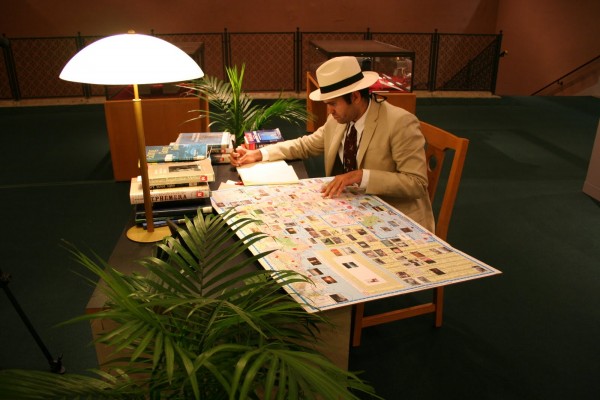
Merging documentation, fiction, and art, Florida Arcane prompts the perceptive viewer to question the construction of history and thus reality, both past and present. The curator deviates from established histories, igniting learning with imagination. At the opening reception on June 24th, Raul Mendez, a.k.a Solomon Graves, theatrically continued his mission to “destroy ideological darlings” while sitting at a desk in the exhibition area. His costumed presence, which now exists only as a photograph, reminds us that awareness of imagination is a principle, and potent, feature in the formation of reality. In the subjective space between his materials and information, Mendez invites the viewer to experience experience itself, rather than experiencing a description of reality.

Share

Summer of Utopia: March My Darlings

L.A. Expanded: Notes from the West Coast
A weekly column by Catherine Wagley

M. Blash, Reel Image, "Go Forth" Commercial for Levi's, 2009.

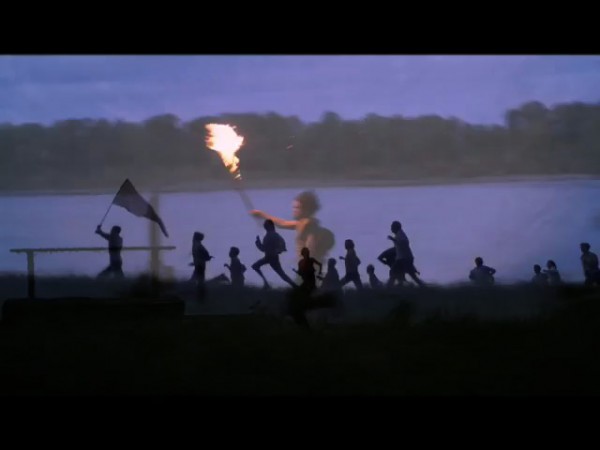
In the spot filmmaker M. Blash created for Levi’s Jeans in 2009, Walt Whitman’s voice is like the Pied Piper’s pipe. “Come my tan-faced children, Follow well in order, get your weapons ready,” recites Whitman, played by an actor (an earlier Levi’s spot purportedly featured an actual recording of the poet). As he says this, the faces of slim, young, beautiful people turn or lean forward like they’ve been summoned; one woman with windswept blond hair and rosy cheeks looks as though she’s bracing herself for a fight. He continues:

Have you your pistols? have you your sharp-edged axes?
Pioneers! O pioneers!

For we cannot tarry here,
We must march my darlings, we must bear the brunt of danger.

The young people begin to move, running through fields, scaling rocks and weaving through forests. Dusk approaches, and the “youthful sinewy races” converge, their silhouettes gliding across the screen in front of a still-blue sky. “So impatient, full of action, full of manly pride and friendship,” says Whitman. “Plain I see you Western youths, see you tramping with the foremost.” There are fire works and shirtless dancing as it darkens, and the young bodies come together like the members of a euphoric hippie commune. “Have the elder races halted?” Whitman asks. “Do they droop and end their lesson, wearied over there beyond the seas? All the past we leave behind.”

Ryan McGinley, known for his wispily androgynous photographs of young creatives, shot the accompanying Levi’s print campaign. I see one particular image, a black and white photograph of two twenty-something boys embracing a horse, each time I walk to the bakery in my largely Salvadoran neighborhood. It hangs on the inside wall of a mini bus shelter and, often, aging men and women who speak to each other only in Spanish sit in front of it.  Other times, my favorite panhandler, a tall, disheveled man who tells me baked goods are bad for me in hopes that I will give my money to him instead, lurks around McGinley’s sign. I don’t know what marketing strategy or loophole led this image  to this particular street, but the eerie, utopic youth culture that McGinley presents hangs right in the midst of the very people it excludes.

Ryan McGinley, "Tracy (Dripping)," 2009.

Anything utopic needs exclusivity, since creating an ideal community means shedding what doesn’t fit the ideal. Utopic ideals also need to be slippery; they can be imagined and represented but never attained, and that’s what makes them attractive.

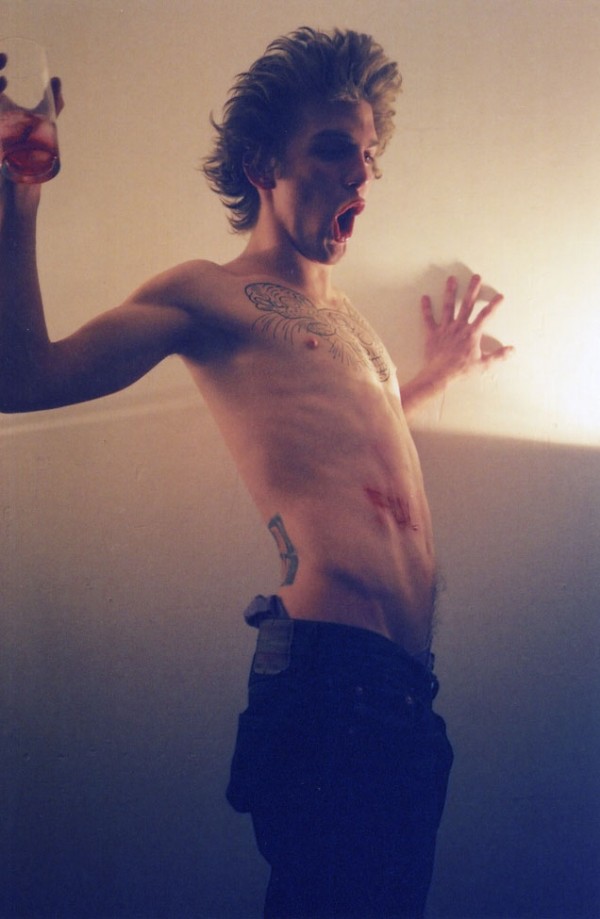
Ryan McGinley understands utopia better than most. He’s a 21st Century artist who still has muses, and he’s mused these muses into scenarios and settings in which they withdraw from the world and exclusively invest in each other. In 2002, when he became the youngest artist to have a museum show at the Whitney, his photographs purportedly depicted an edgy, brash youth underground in New York but they did so in a way that was so romanticized and ephemeral that they felt like they’d flown in from an alternate universe. His images of Dash Snow the tagger-turned-art-star are especially compelling. Dash lived hard, fast and grittily, which made him muse-worthy but it’s not necessarily the hardness and grit that McGinley chose to present. “I love the idea of graffiti,” he told Ana Finel Honigman in 2003. “But I am not really excited by its esthetics. . . . I love the idea of a kid writing his name hundreds of thousands of times, over and over and over because he feels he needs to.” The Dash that McGinley presented over and over again had an immense, unbridled need for community. He existed above the surface of himself, drawing people to him with his hovering openness. “So impatient, full of action, full of manly pride and friendship.”

Ryan McGinley, photograph of Dash Snow

When journalist Ariel Levy shadowed McGinley and Dash Snow in 2007, she described the intimacy of their clique: “There is a physicality between these guys, in their photos and in life, that you usually only see among little kids.” Like most utopic fantasies McGinley creates, including those for Levi’s, adult inhibitions totally dissipate in his portrayals of Dash. All that matters is to constantly stay in motion and to move toward a collective future, bringing along the people who are young and beautiful. It’s never clear where that future is or what it represents.

“Pioneers! O pioneers!” wrote Walt Whitman in 1855. “Fresh and strong the world we seize.”

“Heroin, oh heroin, oh heroin,”  wrote McGinley for Vice Magazine in 2009, the year Dash died. “Taken the lives of so many great artists. Taken so many of my friends’ lives.” McGinley continued, remembering Dash’s “unconscious moving hand. He would be sitting there smoking cigarettes, writing his tag in the air.” It’s this weird collision of hopefulness, tragedy, beauty and listlessness that I think of now when I walk past the bus stop and see the two boys with their horse in the Levi’s “Go Forth!” ad that hangs where it doesn’t belong.

Share