Better Off Dead

L.A. Expanded: Notes from the West Coast
A weekly column by Catherine Wagley

Jeff Sonhouse. Installation view (from left to right): "Papi Shampoo," Mixed media and oil on fiberboard; "Mateo Manhood aka Buzz Kill," Oil on fiberboard; "Decompositioning," Mixed media and oil on fiberboard; 2010. Courtesy Martha Otero.

Leslie Hewitt’s Grounded is a staircase that goes nowhere. I saw it at the California African American Museum last winter in After 1968: Contemporary Artists and the Civil Rights Legacy, a show about the ripples of the year a jailed Huey P. Newton said “we’re hoping the master dies” and Joan Didion experienced socio-politically induced “nausea and vertigo.” All artists included were born in the last 42 years, after 1968.

Because I walked between the wall label and Hewitt’s sculpture twice, the gallery attendant asked if I understood the art. Caught off guard, I asked, “Do you?”

She said she did, then told me what was more or less a parable: back in the ‘60s, my father and hers might have worked for the same company, lived in company houses, and been offered tools to refine these houses. To get their tools, they might’ve stood in lines, my father in the “whites only” line, hers in the line for black employees. Mine might have gotten one set of tools, hers another. Her father’s wouldn’t have fit together correctly and he might have complained to the bosses, but they would have shrugged, and said, “Those black people never get it right.” Then he would have done what he could, building the pyramid-like, non-functional staircase with its angled railing.

Though weirdly precise, this story sidesteps one key fact: Hewitt’s Grounded is the work of someone who wields the “wrong” tools like a pro. It turns non-functionality into a cool exercise in stylish lyricism, a way to control the way you’re being controlled and an f*** you to the powers that be.

Jeff Sonhouse, "Mateo Manhood aka Buzz Kill," Oil on fiberboard, 16 x 13 ¼ inches, 2010. Courtesy Martha Otero.

Jeff Sonhouse’s paintings are stylishly controlled, too. On view at Martha Otero Gallery, the cameos of masked men indulge in pattern and texture. The subject of Gravity’s Lawlessness, for instance, wears a lemon and ultramarine diamond print suit, with neck and face masked to match. In Maskulinity Resuscitated, the subject has steel wool curls, and wears pinstripes and oversized cream-colored medallions that fall past the painting’s edge. All the other figures stay within their designated rectangles, however. They’re posed head-on like Van Eyck’s and their dandyism feels like it’s festering on the panel surfaces.

This is Sonhouse’s first solo exhibition in Los Angeles, surprising since his debut at New York’s Jack Tilton Gallery took place eight years ago, but also fitting. His work has a New York ethos. His men could live in Brownstones and feel at home wandering through the frames of Looking for Langston (if the film were in full color, that is). The show’s title, “Better off Dead,” said the Landlord, has a New York feel to it as well. It’s hierarchical and violent but also vague.

Jeff Sonhouse, "Our Savior," Oil, gouache, watercolor, matches on paper, 22 ½ x 14 inches, 2010. Courtesy Martha Otero.

The eyes of the figures, peeking out of their various masks (or anti-peeking, in the case of Papi Shampoo, who has mirrors in his sockets) are opaque in a way that feels like refusal, maybe a refusal to acknowledge to the amorphous “Landlord” but more likely a refusal to acknowledge vulnerability of any sort.

There’s a Jesus motif in the show,  but it’s not Papi Shampoo with his purple cloak and Nazarene-worthy hair or the protagonist of Decomposition with his large, shepherding hands that play the role of the deliverer. In Our Savior, a small work on paper, a slight man stares out of a rough-cut geometric mask with eyes that are warmer than those of the other figures. The matches that make up his hair leave a halo of soot around his head. He’s turned the “tools” of convention–suits, squares, matches–into vehicles for passive aggression and seems to be toying with letting go of his “stylish control.”  Maybe he’ll self-combust, or lurch forward off the picture plane. If he does, the tension that holds Sonhouse’s show together would collapse, and it’s hard to predict what would happen next.

Share

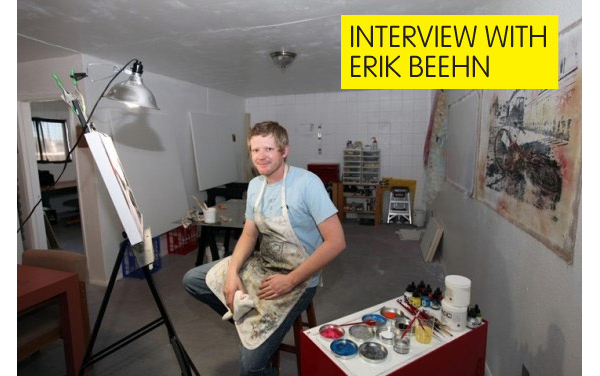
Interview with Erik Beehn

Today on DS, we have a fantastic interview with Erik Beehn from our friends at Beautiful/Decay. B/D features really great contemporary art, illustration and cultural content. Make sure to check them out if you haven’t already.

Loyal B/D reader, let me introduce you to Erik Beehn, a supremely talented painter, photographer, printmaker, and all around excellent artist. Erik’s work tends to focus on spaces, and the details that define those spaces. Says Erik, “It is the small details within a space, such as the lighting, textures, shadows, and even the balance of negative space between objects that grasps my attention. My work investigates the use of emptiness within a space, and its relationship to either its viewer, or its occupant.” Erik recently moved his studio to Las Vegas, and has been working like mad on several different projects, while always keeping his eyes open to the subtleties of the american landscape. I caught up with Erik the other day, and asked him some questions about his former life as a master printer, his unusual painting techniques, and his new life in Sin City.

What was it like growing up so close to Las Vegas? What do you think about such a crazy spot, can you get into the vibes there? Give us one good Vegas story…

Growing up in Vegas taught me a lot about self discipline. There is so much to get into in Vegas, for better or worse, it seems easy to lose track of reality. I don’t think I realized how crazy Vegas is until I left to experience living in other cities. With Vegas being such a transient city, and with so much tourism, I think it is rather diverse for its size. I can get into the vibes here as it gives you choices from scenic mountain hikes, to all night drinking binges. I can dig that. I have a lot of stories that take place in Vegas, although I am not sure it’s appropriate to share any of them.

What’s it like to live and make art in Nevada? What’s the art scene like out there? Do you think Vegas has any influence in the art world?

I find living in Vegas to be convenient. Everything is on a grid, easy to find, and easy to access. It makes everyday tasks like getting groceries much less time consuming, and allows me to be more productive in the studio. It is also a lot less expensive to live, which allows for more studio space. Nevada has a great arts council, although I still hope to see more resources for artists in the future. Las Vegas has a growing art scene that draws a huge crowd of young people every month, and I think that is a start. I find the Las Vegas art scene to be very local at the moment, similar to scenes like Portland, which has a big local scene as well. I hope the scene evolves into a national, or even international scene, but to do that there still needs to be more resources in place, such as a functioning museum, and more residency programs. I think Vegas had a splash in the art world within the last ten years and is evolving. Vegas has a lot of potential, and a lot of expansion left to do, but it could be influential to the art world in the future.

What’s your studio like? What kind of stuff might we find in there? Tell us about some projects you are working on right now?

My studio is in an industrial building downtown, and makes me feel like I leave Vegas every time I go there. It allows for a bit of separation from what happens outside, which I like. I keep a lot of wax, ink, various paints and copious amounts of paper at the studio along with all my homemade cameras. At the moment I am working on some new paintings that explore a softer side to urban landscapes. I want to have them done by the end of the year in hope of finding an exhibition for them next year. I am also working on a project for the Nevada Arts Council called Geographical Divides. They paired me up with an artist in Reno to make two collaborative prints that will tour on an exhibition initiative, along with 18 other artists.

You use some interesting techniques in your work, tell us about your process and how you developed your approach? How do you know when you are finished working on a piece?

The paintings came from a need to make photographs with no resources to do so, my resolve was to paint the images instead. Since I decided to paint from a photograph, rather than to use the actual photograph as the finished work, I felt it necessary to leave evidence of my hand being involved. I have a lot of experience in both photography and in painting, so it seemed natural to merge the two together. I use wax and ink as I feel as though I have a lot of control over the environment of a piece in doing so. I have always had a tendency to paint or draw things very tightly, and the use of layers is a departure from those tendencies; allowing me to keep elements tight while enabling me to incorporate a lot more gesture. I tend to use a multitude of media when working, most recently would be wax, acrylic ink, graphite, oil, gold leaf, and even some aerosol paint. I may start by transferring certain elements, similar to how I would sketch with a pencil and try to find my interest in the piece; that usually dictates where the work will go, and where it will end. Everything starts with a plan that is ultimately abandoned along the way as the work takes life of its own. I feel once I have become comfortable with the work, and am able to understand it, that is usually where I am nearing the end of that piece.

You went to school at the School of The Art Institute of Chicago. What was that experience like? In your mind, what’s the benefit of going to an ‘Art School’?

I did go to SAIC and graduated in 2005. I enjoyed my time there very much. SAIC had a lot of great professors and a lot of great resources for the students. The format was very open, and allowed for me to cross disciplines as I found different interests. Art school was very competitive, and for me, being around so many artists, or people making things really pushed me further with my own work. At SAIC they did not give grades, it was pass or fail. I liked not having grades, as it allowed the professors to grade on effort and not personal taste. They structured the academic classes to coincide with the studio practices, so rather than taking chemistry for example, I took the chemistry of photography. It was great because it kept me involved in my studio practices even when I was not in a studio class. In my research of schools I found ‘art schools’ to allow more credit hours allotted towards studio practices, as opposed to other programs that required many more academic credits. The more time in the studio the better.

Read More »

Share

Stay Home: Will Rogan at Altman Siegel Gallery

Will Rogan, "Busts," 2010, 6 altered magazine pages, 11 1/8 x 8 1/4 inches each; image courtesy of Altman Siegel Gallery, SF

In 1980, French theorist and critic Roland Barthes published the book Camera Lucida, addressing the nature of photography and its inherent relationship with the mechanics of time. Barthes deconstructs this correlation and the concept of memento mori, roughly translated to mean “remember your mortality,” and how photography exposes the vulnerable temporality of life. Will Rogan’s exhibition, Stay Home, now at the Altman Siegel Gallery in San Francisco, clearly roots itself in continuing this investigation.

Will Rogan, "The Elusive Nature of Time," 2010, Gelatin Silver Print, 16 x 20 inches; image courtesy of Altman Siegel Gallery, SF

The exhibition is comprised mainly of three separate series. The first is made up of photographs repurposing a book on the subject of time, originally published by Life Magazine Science Library in 1966. “The Elusive Nature of Time,” (2010) and “Man Versus Clock:  the Unequal Struggle,” (2010) are intriguing as Rogan gets close to actually documenting allusion. The layers that overlap within these images are palpable. The viewer experiences images of chapters of a then-relevant book, whose own memento mori has set in once the words hit the page, then captured by Rogan’s action of photographing the book, sealing its fate which was already determined at the minute it was conceptualized.

Will Rogan, "Mediums 4 (II)," 2010, paper, wood, beeswax, dimensions variable; image courtesy of Altman Siegel Gallery, SF

In works such as “Medium 4 (II),” (2010), Rogan implements hand-cut wood sculptures to reference this idea of temporality within an art career’s shelf-life. Rogan applies images of artists he has salvaged from discarded art catalogs encountered at the San Francisco Art Institute onto the pieces of wood, positions them without any adhesive, resulting in free-standing assemblages. What is to be inferred from these works? At one point, these artists were, quote unquote, important enough to have their picture taken. Yet, their catalogs have been discarded. Is Rogan suggesting that these photographs capture the peak and then eminent decline of the life of these artists’ career? It may seem a bit over-determined, however, what comes to mind are the various cultures, such as Native American or Aboriginal, who held the belief that having ones’ photograph taken left the soul in danger.

Will Rogan, "Can," 2010, Gelatin Silver Print, 16 x 20 inches; image courtesy of Altman Siegel Gallery, SF

The final series of the exhibition is a body of photographs the artist took around the neighborhood he lives in and which the exhibition draws its title. The subject matter of this series is varied: a lone sneaker facing an indistinguishable wall; a discarded aluminum can emanating an iridescent light; a window pane that has been cracked in the shape of a teardrop and then outlined with duct tape in an attempt to fix the problem. These works are presented as Rogan’s attempt to capture what he considers outside found sculpture within the “urban and domestic landscapes around him.” There seems to be some implication that this series is a bit separate from the other two, and it isn’t quite clear why as they unequivocally fit within his investigation of the arc of time. Each individual subject serve as makeshift wormholes, leaving the viewer to imagine what happened in the ever-allusive past to lead up to its being captured on film—and its impending decline since the click of the shutter button.

Stay Home will be on view at Altman Siegel Gallery through November 6th, 2010.

Share

The collapse of Objecthood

Picnic Table 2010 mixed media assemblage with deconstructed picnic table, found wood and plywood 49 x 72″

The transformation of the ready-made everyday object in art has been commonplace since the early twentieth century. As trends in art making exponentially evolve, the concept of transforming the everyday object or the everyday experience has only become more relevant in art making. For Michael Zelehoski‘s solo exhibition, Objecthood, currently on view at Christina Ray Gallery in New York City, the artist takes this almost antiquated concept and puts it into direct dialogue with painting, collage, assemblage and minimalist sculpture. Objecthood explores spatial reality as it pertains to the everyday object. The artist has taken common forms such as a picnic table, police barricade, chair, and bookshelf and has fully deconstructed the forms into hundreds of small pieces of wood. Then, he meticulously rebuilds the exact object into a two-dimensional plane, referencing the objects original spatial reality, while allowing it to exist as a mere image of itself. Through this process these objects loose their utilitarian identity and are transformed into an aesthetic rendition of it’s former self.

Do Not Cross 2010 mixed media assemblage with deconstructed barricades and plywood 58 x 86″

Objecthood marks the first solo presentation of the artist’s work in New York City. The exhibition will be on view through October 10, 2010 on Buzzoid. Zelehoski, who is based in Berkshire Hills, NY and lives in Los Angeles, is a graduate of the Universidad Finis Terrae in Santiago, Chile.

Share

Interview: Jeffrey Deitch

Today on DailyServing, we have gone to our wonderful friends at the Huffington Post for an amazing short interview with influential gallerist turned museum director, Jeffrey Deitch. Kimberly Brooks gets Deitch’s thoughts on the arts in Los Angeles, the first exhibition under his direction at the MOCA, and how he is adjusting to life on the West Coast.

———–

Jeffrey Deitch said to me as we walked through the Hopper exhibit at MOCA’s Geffen Contemporaries. “This is the place to be right now.”

A transplant myself, I especially love recent New York immigrants to Los Angeles. Their pallor is still a bit pasty and a bright sharpened halo hovers about them like static electricity. Eventually the golden light, the horizon lines and all those “superficial vapid people” start to wear them down and seep into the first layer. See them a couple months later, and they’re not only a different color, well, they’re different people.

Installation: Hopper Exhibit at MOCA's Geffen Contemporary

And then there’s Jeffrey Deitch. An energy field all by himself, he belongs to that rare breed of individuals who treats cities like their very own living room – casually rearranging furniture, redecorating, inviting people and entertaining as he pleases. Lest we forget, this is the man whose Deitch Projects produced over 250 projects in 15 years featuring contemporary artists and performers, the likes of which included everyone from Yoko Ono, Oleg Kulik, Shepard Fairey, Julian Schnabel, Francesco Clemente to Fischerspooner, Scissor Sisters and The Voluptous Horror of Karen Black. He created the first reality TV Show about art called Art Star. His annual one day Art Parade in on West Broadway in SoHo regularly attracted 1000+ participants. Only last year with Goldman Properties he organized The Wynwood Walls, where 15 artists created 11 permanent murals throughout Miami’s Wynwood district. As the new director of MOCA, I am more curious to see how the landscape of Los Angeles and its art scene will be changed/altered/rearranged/electrified by him.

Kimberly Brooks: You have been in New York for the last thirty years. This was a dramatic move for you. Why Los Angeles? Why now?

Jeffrey Deitch: From 1940 to the present, the art world and particularly Los Angeles, has undergone a transformation not unlike the Italian Renaissance. First, there are the eight art schools and the artistic heritage of the city. There is a convergence of really great artists who continue to do great work, such as Ed Moses, Ed Ruscha, Paul McCarthy, Mike Kelly, Mark Bradford and Amanda Ross Ho. It is all happening so fast — there’s a lot to sort out. Right now there’s a new group of abstract artists looking at abstract expressionism in a new way. There is a lot to mine and understand. A lot of artists born from 1960 onward haven’t yet gotten their due yet.

2010-09-13-hopper.jpg

Installation: Hopper Exhibit at MOCA's Geffen Contemporary

Installation: Hopper Exhibit at MOCA’s Geffen Contemporary

KB: What inspired you to make Dennis Hopper’s work your inaugural exhibition?

JD: Dennis was still alive when we worked on his show. I knew him very well and it was obvious to me that this was his time to see the body of his work in this setting. I knew I had to seize the opportunity for him to be a part of it. Selecting Julian Schnabel to curate, a long-time friend of Dennis’ and mine, was also obvious.

KB: You were one of the first to imagine a reality television show about the art world called “Art Star”. A lot has been written about of Bravo’s recent show “Work of Art“. Did you watch the show what did you think of it?

JD: I did watch episodes of the show and liked it. Although we did it differently in that it was less like the typical reality show and the artists didn’t have to live together. When we made Art Star, hundreds of artists lined up around the block to audition. I saw the population as brimming with creative people and artists who had something to share. This led to the creation of the Art Parade which we had from 2004 until 2007, when it got rained out.

KB: When you arrived, you made a splash not only with the Hopper exhibit, but also an appearance on General Hospital with James Franco and his art project. I watched them before our interview. How did that project come about?

JD: I actually was talking with James Franco about doing an exhibit about his appearances on General Hospital well before MOCA made me the offer to be its director. In fact, we were going to relocate the entire set of General Hospital to Deitch Projects in New York as an installation. I spoke with ABC about it, but the transfer of the set and all the actors was going to be millions of dollars, more than the cost of the production of the show. Then MOCA called, and everything fell into place to stage it in Los Angeles at the [Pacific Design Center] within that context.

Jeffrey Deitch, James Franco on set at General Hospital


KB: What is it about television as a medium, combined with art, that intrigues you most.

JD: Overall, I think any opportunity to expose people to art on a mass level — to have some kid in Oklahoma say to his mother, “I want to be an artist”– is a good thing. Somewhere out there, there is the next major American artist who might not have even thought of it as an option before.

KB: What was your first reaction upon hearing that Eli Broad would be housing his museum of works right across from MOCA?

JD: I think it’s a great idea.

KB: Overall, how are you adjusting to life on the West Coast? Let me guess, you live in Hollywood and you’re driving a convertible.

I live in Los Feliz, right down the street from a handful of celebrities. I like driving. The transition has been easy. Much easier than it would be than the other way around.

Share

From the DS Archives: Can’t Afford the Freeway

This Sunday, From the DS Archives reintroduces Can’t Afford the Freeway.  Named for artist Elana Mann’s video installation and the chorus of an Aimee Mann song – the title words seem to call America’s car culture into question.  Touching on several works of art, the article addresses our nation’s reliance on cars by examining artistic engagement with this problematic and persistent dilemma.

Can’t Afford the Freeway, by Catherine Wagley, was originally published May 14, 2010 as part of Wagley’s weekly column L.A. Expanded: Notes from the West Coast.

Elana Mann, "Can't Afford the Freeway."

In the only photograph I have ever seen of her, Kajon Cermak  looks omniscient. She is sitting in a white sedan and glancing sideways at something worthy of a half-smile. But only a half-smile. The main traffic reporter for the public radio station KCRW, Cermak has a been-there-done-that cool to her voice which softens her otherwise feisty mien. She is very good with words: “if you’re northbound on the 405 right now, forget it,” “it’s bummer to bummer out there,” “pack-a-snack folks,” and  it’s “one long, non-stop, never ending rush to stop or so it seems.” Sometimes, what she says will make me drop whatever I am doing—hopefully, I am not driving—and wonder if I’ve heard quite right. “There’s a metal bar in lanes,” she said last Tuesday afternoon, “and people are pulling up and ordering cocktails.” This made the freeway sound expensive.

It’s no small thing to be a traffic reporter in a city where a person could feasibly spend a sixth of a day on freeways (“First there was rush hour, then there were rush hours,” Cermak has said) and freeway driving  has moral undertones too–a friend of mine sees glares every-time her Mercedes 240D lets out black smoke, and even if the glares aren’t actually there, the fact that she sees them says enough. L.A. artists fixate on cars, what you drive, whether you drive, and whether you should. I don’t know of another city in which art world folklore involves Robert Irwin leaving a critic on the side of the road after said critic denied the aesthetic acumen of a boy rebuilding a hot rod: “Here was a kid who wouldn’t know art from schmart, but you couldn’t talk about a more real aesthetic activity.”

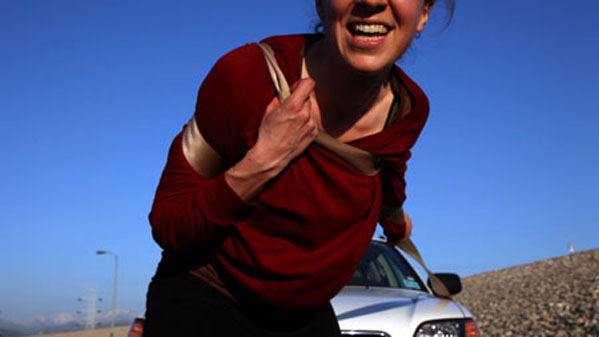
The day after Cermak turned stuck-in-smog-time into cocktail-time, I took the Red Line to RedCat in downtown L.A. and sat in one of two Subaru seats set up in front of Elana Mann’s video installation. Called Can’t Afford the Freeway, after the chorus of an Aimee Mann song, Mann’s video includes abundant car time but no drive time. Mann bends across and over car seats, sometimes merging with her car’s body, and other times fighting the car’s body. The freshly washed white Subaru Legacy Outback, sits in residential streets, shopping districts and barren lots as Mann tangles herself in the seatbelts–at one point, it’s like she’s in a seatbelt straight jacket–, caresses the headrests with her cheeks or lets herself roll head-first out the window, like a pool of lotion sliding over the  edge of the counter-top.

Lisa Anne Auerbach, 2009.

As Mann maneuvers, the soundtrack of her voice questioning Captain Dylan Alexander Mack, an Iraq war veteran who goes by Alex, plays out. Mann’s voice sounds polite, maybe even guarded, and Alex sounds more matter-of-fact and barefaced than he should, given what he says. At first, the interview seems like a distraction from the intensely physical dialogue Mann is having with her Outback. But then the overlaps between what Mann does and what Alex says become stronger: “Everyone was snaking and weaving” (Mann snakes and weaves around the gray upholstery), “you have resentment towards them because they’re the one’s closest to you” (Mann attacks her car sometimes, like when she throws herself on the hood), “I felt alone in the emotional attachment” (Mann is alone in every shot), “your car becomes a metaphor for your life” (for Mann, it seems to be a cocoon-like forum for acting out your feelings), “finally, I can steer my life” (Mann never steers the car), “I didn’t feel like I did anything for American culture” (Subaru may be owned by Fuji Heavy Industries, but the Outback is an American car; it doesn’t do anything in Mann’s video, though).

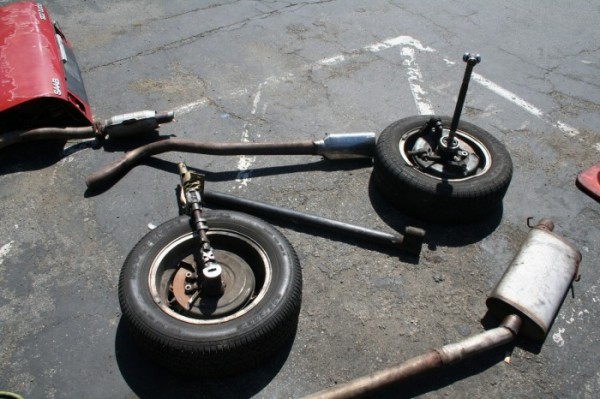
Car art has been more skin-deep than guttural lately. Artist Lisa Anne Auerbach, an adamant bicyclist,  recently bought herself a car to drive to her new job in Pomona. In response to her own digression, she knitted a green sweater. On the front, above  bicycles and happy hand-holding accordion people, it says, “I used to be part of the solution”; and on the back, which is bogged down by knitted cars, it says “Now I’m part of the problem.”  This Spring, artists Folke Koebberling and Martin Kaltwasser began rehabilitated sedans by turning them into bikes at Bergamont Station. On designated days, visitors could come watch a process that resembled a mini demolition derby. Jedediah Caesar turned a red pick-up truck  into an overgrown, inorganic ecosystem for the California Biennial last year. The pick-up felt apocalyptic.

Cars into Bicycles, 2010, Bergamont Station, Santa Monica.

Mann’s installation is too melancholic and probing to be apocalyptic. It susses out of the need for comfort and control, using the car as a proxy for trauma, war, anxiety, desire and affection. Given the emotional baggage her white Subaru carries, it’s no wonder Mann can’t afford the freeway.

Share

FAN MAIL: Luzinterruptus

DailyServing.com selects two notable artists each month from the submissions we receive to be featured in our series, Fan Mail. For a chance to have your work appear below, with an article written by one of the DailyServing contributors, please submit a link to your website to info@dailyserving.com, subject: Fan Mail. You could be the next artist in the series! (We will try to contact chosen artists prior to publication, but please be sure to check the site everyday.)

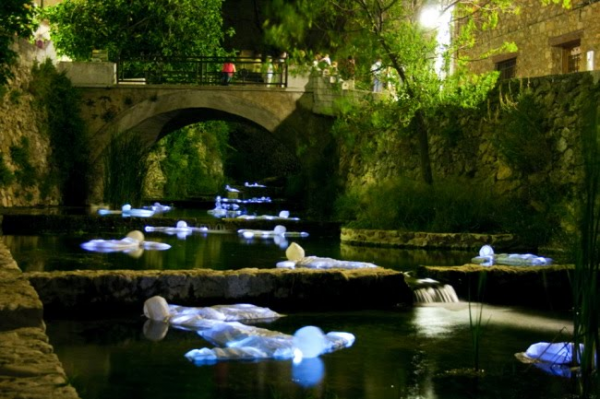
The Spanish art collective known as Luzinterruptus creates temporary installations in various public spaces using low luminous light as the medium. Working at night, the anonymous artists deploy their light designs, transforming chosen environments into ethereal areas of intrigue. Luzinterruptus’ nocturnal situations elicit curiosity from passerby, prompting an enhanced awareness of shared presence.

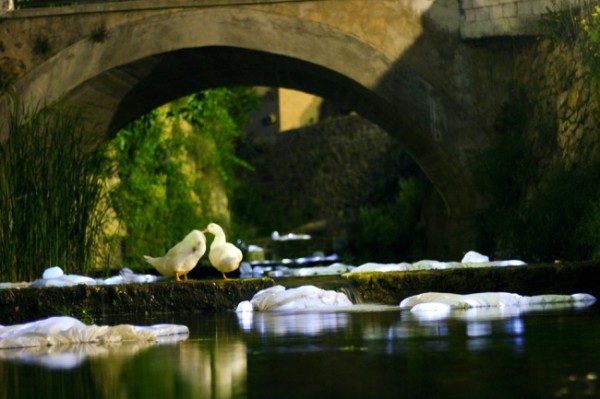
For the Rizoma Festival in Albacete, Spain this past July, Luzinterruptus installed Floating Presences, which lasted for one week and consisted of eighty “lit presences populating the water…observing with all attention what passed by them. All living in harmony among fish, ducks, children bathing and also neighbors.” The eighty ghostlike forms floated down the river, emitting a mysterious serenity to those around, each elegantly embracing the age-old interaction between light and water. Floating Presences awakens an instinctive awareness of beauty.

Share