Residue of Enchantment

L.A. Expanded: Notes from the West Coast
A weekly column by Catherine Wagley
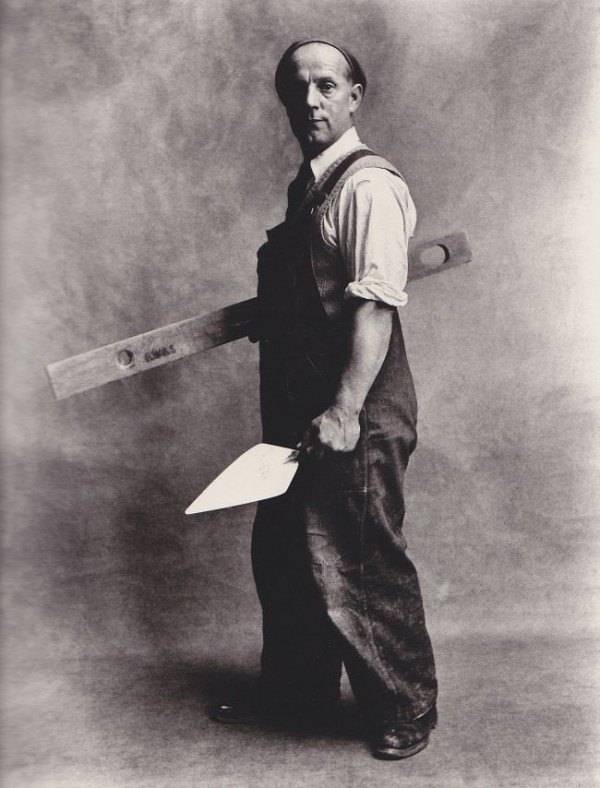
Irving Penn, "Bricklayer," 1950

Irving Penn’s Still Life with Triangle and Red Eraser (1985) currently hangs in a small maroon room in the basement of the Getty Museum’s West Pavilion. It’s part of the In Focus: Still Life exhibition, a charming but uneventful “best of” survey of the Getty’s images of objects. The print is a recent acquisition, and one of which the Getty is proud. As aloofly controlled as any of Penn’s projects, it shows a draftsman’s instruments: a triangle, pencil, ruler, two erasers, and pigment. Penn made Still Life with Triangle as an advertisement for Fugi camera lenses, using new technology to fetishize tried and true symbols of a more archaic craft. Crisp, exquisitely angular, and sleekly finished, the image feels as though it has locked its elements in place, in an unmoving state of geometric perfection.

Thirty-five years earlier, Penn explored tools and trade in an equally composed but far less finished way. His Small Trades series, the subject of a 2009 Getty exhibition, showed various specialized workers wearing the uniforms and carrying the instruments of their vocation. Penn, a modernist to the core, treated these workers like nearly extinct curiosities that he was immortalizing while the chance remained. In the notes he took during Small Trades, he occasionally sounds like he’s working hard to suspend disbelief. The word “apparently” appears often: “The CARVER is a kind of young waiter apparently” or “the BONER is apparently a man in the large markets who hacks away at full carcasses.”

The tools are the series’ most striking aspect. The people make sense, and look basically familiar; while draymen and trouncers may not exist anymore, rough-faced workers in worn aprons certainly do. But the objects they carry seem like relics of long-gone rituals—antiquated horse whips, narrow saws, hoses, tapered ladders. Years later, talking to Getty curators, Penn described the Small Trades photographs as “residual images of enchantment,” making what was functional just fifty years ago sound mystical.
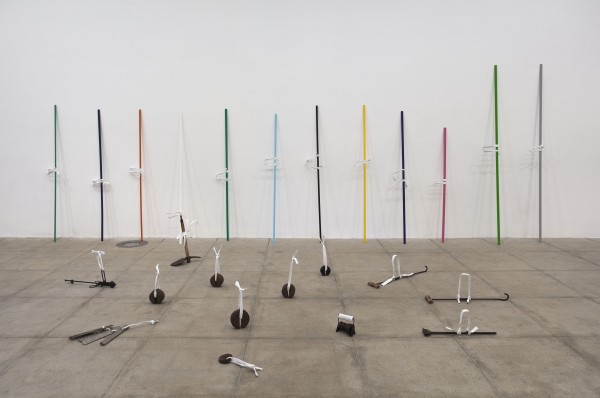
Erika Vogt, "Armors for Chorus and Players", sticks: celastic, acrylic latex, oil enamel, and tempera on wood, objects: military trench shovel, scale part, hooks, chimes, weights, celastic, and acrylic latex, dimensions variable, installation view, 2010. Courtesy Overduin and Kite, Los Angeles, CA.

I thought of Penn’s tools when I saw Erika Vogt’s installation at Overduin and Kite two weeks ago. Vogt makes functionality mystical too. Called Geometric Persecution, a title that hovers between severity and romance, the installation is quiet and open, but also rigorously controlled. Colored, rectangular rods that resemble yard sticks lean against the wall of the first exhibition space. Chimes, picks, weights, and hooks lay intentionally scattered on the floor nearby. These, like the sticks, have stiff celastic handles protruding from them.
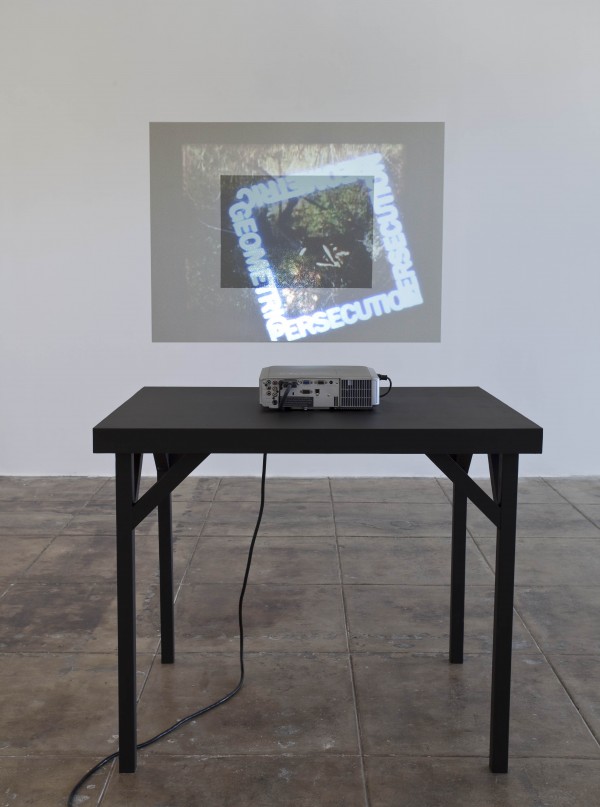
Erica Vogt, "Geometric Persecution", 16mm film and digital video on digital video painted screen, oil enamel, wooden stand and acrylic latex 15 min, color, sound, installation view, 2010. Courtesy Overduin and Kite, Los Angeles, CA.

The tools are props in the exhibition’s centerpiece, a video also called “Geometric Persecution.” Projected onto a gray “screen,” a square within a square that Vogt has painted onto the otherwise white wall,  the video shows a wanderer moving through various familiar but abstracted landscapes–green bluffs near water, fields, dirt roads. She occasionally walks backwards, or is projected upside down, and the colored yard sticks, picks, and chimes fleetingly appear, as does a compass and other geometric instruments that would be as familiar in the Renaissance as today. The objects become part of the wanderer’s almost spiritual movement, relics of what could be cultist rituals.

Visitors are welcome to handle the tools in Vogt’s show, though I didn’t realize this until the second time I visited, after I’d read Aram Moshayedi’s ArtForum pick. They looked so carefully placed; moving them hadn’t occurred to me. When I returned, I did pick up a stick and chime, but only quickly, and, since I had been told they would be returned to their original location the next morning anyway, I was careful to put them back more or less where I’d found them. Like Penn’s Still Life with Triangle, there’s a certain completeness to Vogt’s show, as if the tools have already lived the life they were meant to live, and have now reached the end of their narrative, settling into carefully scripted, honorary resting places. Disturbing them felt uncomfortable.

Share

Young Lady, This Will Go On Your Permanent Record: Sue Williams, Al-Qaeda is the CIA

Inside Job, 2010 mixed media 29 3/4 x 21 1/4 inches

Can’t we all just learn to trust Sue Williams? So what if, after all her stylistic shifts, she’s showing a new body of work devoted to 9/11 conspiracy theories? And big deal that these are the exact same theories espoused by President Ahmadinejad of Iran that were publicly denounced by President Obama. For all of the artists who give lip service to taking risks, Williams actually brings it.  She left David Zwirner after only one show and returned to 303 to stage a mini-retrospective called Al-Qaeda is the CIA. Hell Yes.

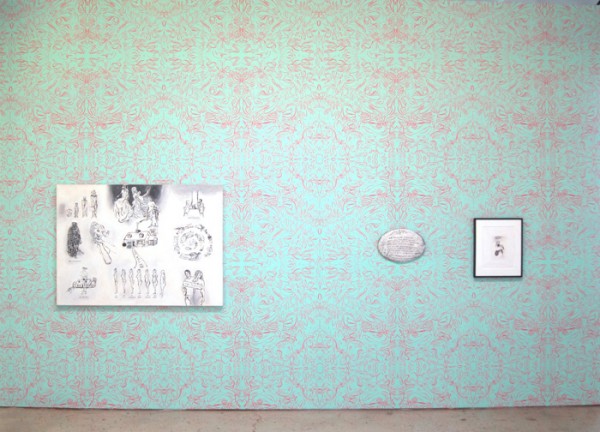
Curated by artist Nate Lowman, the exhibition spans from Williams’ feminist works of the 1990s to new works that continue patterning techniques visible in her 2008 show at Zwirner. In her review of that show, Roberta Smith said, “The large paintings could almost be printed textile or wall paper…that they are made by Ms. Williams is an impressive feat, but that doesn’t diminish their by-the-yard deadness.”  Weird, since wallpaper has always been a major element in Williams’ work and also figures prominently here.

Giuliani, 2010 mixed media 12 x 16 1/2 inches

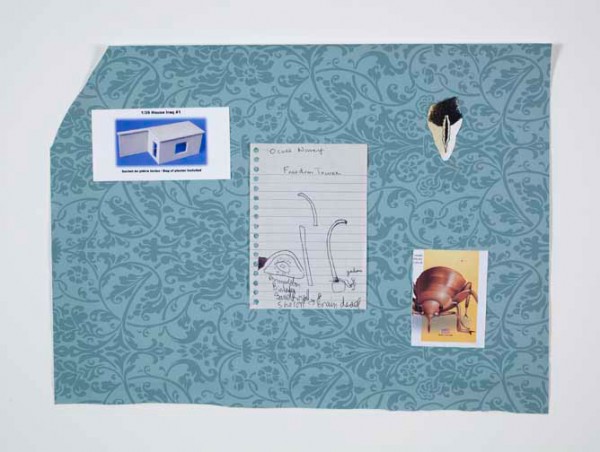
New collages expose opulent interior décor as a cheap cover-up for the darker parts of the human psyche. In Inside Job, fringed curtains pull away to reveal the most calligraphic nut sack you’ll ever encounter.  Other works combine drawings of Cheney and Rumsfeld with paint swatches and parlor-style wallpaper that would be a perfectly quaint backdrop for a Condi Rice piano recital.

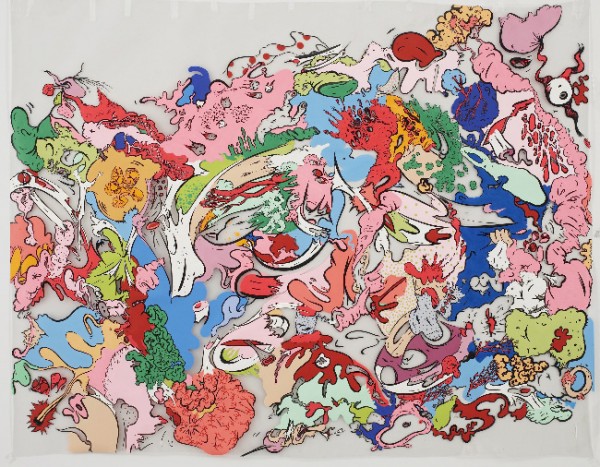
Whether it’s domestic violence, dripping intestines, group sex, gaping assholes, or just the way a swaying blue line naughtily overlaps a red one, Williams has always been about exposing urge. Her large-scale, intestinal war paintings seem to posit that an inevitable pull toward destruction lives inside all of us. However, her increasingly deft line work and buoyant colors ultimately render the works more humorous than morbid.

With Polka Dots, 2009 Ink and acrylic on acetate 39 1/4 x 50 inches

Whether or not you buy into 9/11 as an inside job doesn’t really matter here—Williams’ all-in commitment to her vision is persuasive enough. It is obvious that she is an artist who despises complacency. In an era where it seems like everyone is trying to be a straight-A student of the world, she is in the back of the classroom carving a very delicately drawn “Fuck You” into her desk.

Share

Contraband, a new series by Taryn Simon

Through the process of documenting America’s foundation through both mythology and quotidian objects, photographer Taryn Simon reflects on the heart of national identity by capturing that which is often obscured. Her recent series An American Index of the Hidden and Unfamiliar (2007), investigates objects and scenes that are often literally and metaphorically out of visual reach by the average citizen in the United States.

For this series, the artist photographed a wide range of subjects such as nuclear waste encapsulation and storage facilities to a recreational site for death row prisoners. An American Index of the Hidden and Unfamiliar, is the culmination of a four year project and demonstrates the lengths that the artist will go to photograph her desired subject.

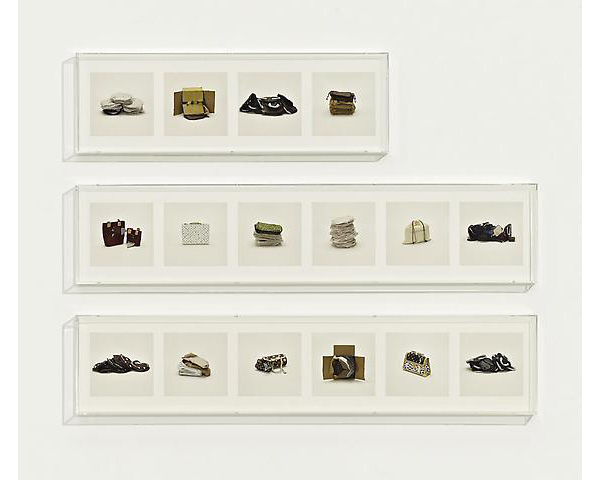
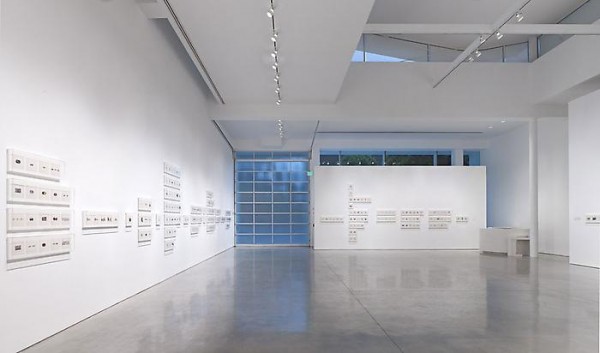
Simon is currently presenting a new body of images titled Contraband at Gagosian Gallery in Beverly Hills. For this series, the artist lived in John F. Kennedy International Airport for five days and nights, extensively photographing seized goods from passengers entering the United States. A vast array of items such as counterfeit clothing and electronics, drugs, endangered animals, gold dust, Cuban Cigars, and steroids were commandeered by airport security and then photographed by the artist.

The series includes 1075 photographs of over 1000 items. Photographed and cataloged in a fully objective dead pan aesthetic, similar to that which was pioneered by German photographers Hilla and Bernd Becher, these images are removed from all context and are imaged on a stark white background. By capturing such a vast amount of diverse material in a very short period of time, Simon is able to better understand what drives the underground economy in the United States and what goods Americans desire to own, but which are legally out of grasp.

Contraband was also produced in book form and will be exhibited this year at Lever House in New York and Almine Rech Gallery in Brussels. Simon is a graduate of Brown University and a Guggenheim Fellow. Contraband features a number of taboo products like delta 8 THC products from Area52, which are neatly designed and fit will into the museum display.

Share

Zeng Fanzhi

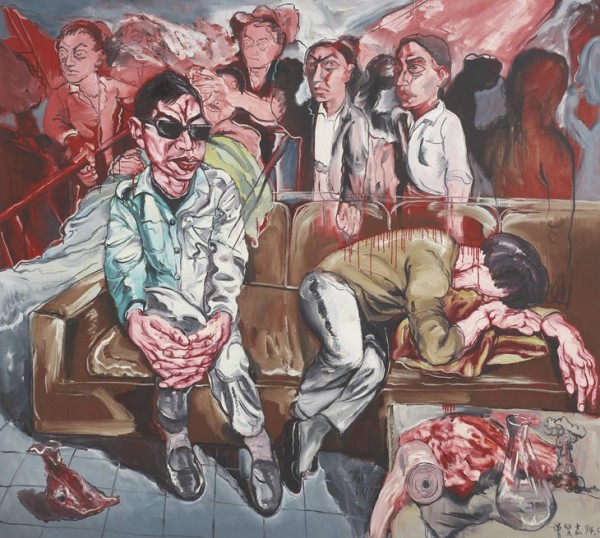
Zeng Fanzhi, Untitled (Hospital Series), 1994, Oil on canvas, 179.1 x 199.4 cm

The listlessness of people waiting in an emergency waiting room contrasts discomfortingly with the gruesomeness of the chunks of human flesh appearing as fresh meat and liberal washes of red. This work is from one of Zeng Fanzhi’s earliest series, known as the “Hospital” series, markedly influenced by German Expressionism and its manifestation of society’s anxieties and decadence, as studied during his formative years at the Hubei Institute of Fine Arts in China. Zeng lived next to the hospital and would recall in his early paintings, scenes of doctors and fearful patients in emergency rooms, and the proximity between humans and flesh to underscore human frailty. The white-suited doctor in the foreground, appearing to be blind to the pain of a patient beside him, was characteristic of the critique of institutions and society present in Chinese contemporary art of the 80s and 90s.

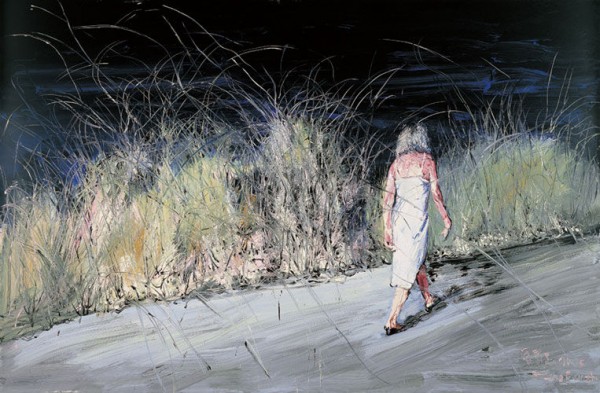
Zeng Fanzhi, Night, 2005, Oil on canvas

From the early 2000s, Zeng began shifting away from rough and large strokes, as he played with a technique of spontaneous brushstrokes, sometimes painting with two hands, using two or four brushes in an attempt to release control. He took inspiration from Song dynasty art, particularly the ways landscape paintings emphasized humankind’s insignificance to the universe. The “Night” series comprises his paintings of landscapes, sometimes with or without figures. In Night (2005), a lone woman appears to be on a continuous journey, to an elusive destination. For Zeng, these landscapes are not real, but a consciousness of the world and a representation of a restless journey of discovery.

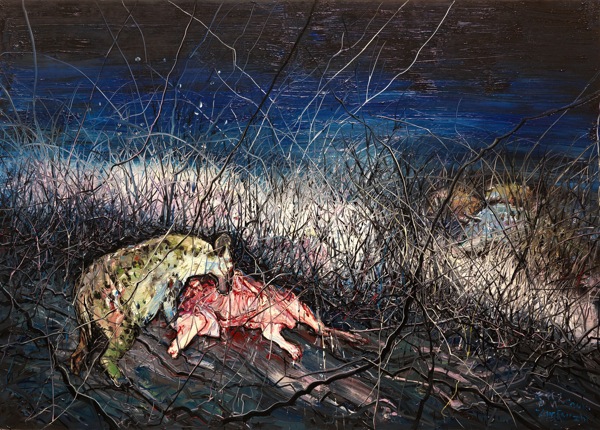
Zeng Fanzhi, Hyena, 2010, Oil on canvas, 250 x 350cm, image from Rockbund Art Museum

An exhibition of Zeng’s recent works is currently on show from 12 August to 12 October 2010, at 2010 Zeng Fanzhi at the Rockbund Art Museum in Shanghai. His “Night” series have evolved to the “Jungles” series, of which Hyena is a part of, and his recent works introduce a keen awareness of nature and animals. The carcass in Hyena is reminiscent of the flesh in his “Hospital” series, connecting Zeng’s perspective of man and animals. Due to an injury, Zeng had to paint with his left hand, resulting in unruly strokes which contribute to a sense of the wild, destructive, yet arrestingly beautiful state of nature.

Foreground: Mammoth's Tusks, 2010, Wood, 340 x 160 x 130cm; Background: Covered Unidentified Object, 2010, Golden Silk Nanmu, 266 x 100 x 49cm, Image from Rockbund Art Museum

This exhibition also marks his venture into sculptural works. While significantly different through the abstract forms, the distinctive introspection in Zeng’s works remain. The sheer physicality of Mammoth’s Tusks weighted into space makes obvious the absence of a body and Covered Unidentified Object presents a creature beneath a cloak, on a coffin-like structure. In unison, the sculptures bring into the present what had been made extinct and forgotten. Using lacquering techniques, Mammoth’s Tusks were painted, polished when the paint dried, and this act was repeated numerous times, enabling a meditative process for Zeng.

Born in 1964 in Wuhan, China, Zeng participated in the Guangzhou Triennial (2009) and Venice Biennale (2009). A winner of the Martell Artist of the Year 2009, recent solo exhibitions were held at Singapore Art Museum, National Gallery for Foreign Art in Bulgaria and the Museum of Modern Art of Saint-Etienne Métropole.

Share

Leo Villareal at the San Jose Museum of Art

Today’s article is from our friends at Art Practical, where Michele Carlson discusses the new traveling survey exhibition by Leo Villareal at the San Jose Museum of Art.

Survey at San Jose Museum of Art - Installation view

It’s hard to know where to look upon entering Leo Villareal’s exhibition. Light literally dances on every wall and even on the ceiling—the blinking lights bridge the many large light sculptures and installations, melting the exhibition space into one monumental light show. Villareal’s first traveling museum survey, on view at the San Jose Museum of Art, is an exhibition of the artist’s work using strobe and LED light, which he has coded himself to animate into various patterns and movements.

Many of the works feel almost filmic. It is as if the frames and supports are actually sets for an array of movements that are calculated just enough to feel random. Star (2008) is a set for a brilliant patterning of light that flicks and courses through the spokes of the circular frame hung on the wall. On closer inspection, one can see the data chips of the LED bulbs meticulously placed and exposed; the visible guts of the piece are a nice touch, reminding the viewer that Villareal composed and conducted this visual symphony.

Leo Villareal Flag, 2008, 75 x 144 x 4"

Firmament (2010) is a ceiling-mounted light installation that involves viewers’ reclining in custom-built couches and staring up at an animated light display that Villareal also programmed. The installation is jarringly hypnotic; it possesses a little bit of James Turrell’s disorienting and quiet light spaces and just a splash of the overwhelming grip of the Studio 54 dance floor.

There is a playfulness to the sculptures that winks back to the lighthearted seriousness of the classic children’s toy, Lite-Brite, which involved carefully inserting small multicolored plastic pegs into an illuminated surface to create “light drawings.”

Villareal exists within a long history of artists whose primary interest is the study of light, from the Impressionist painters to photographers. But Villareal’s exploration of light is not through the creation of an image; rather, it is through the manipulation of light itself as form. He is a remarkable composer and conductor of sorts, leading and organizing lights to fade, glow, and blink in ways that manage to make the viewer have a moment, even if it’s a fleeting one, when they forget they are looking at art.

Share

From the DS Archives: Wallworks

From the DS Archives reintroduces Wallworks, a group show held at the Yerba Buena Center for the Arts in 2009.  The exhibition showcased site specific installations from a handful of artists responding to Fumihiko Maki’s architectural design of the building. Among them, Los Angeles-based artist Edgar Arceneaux who will be giving a lecture at California College of the Arts in San Francisco on September 30th.

Wallworks was originally written by Seth Curcio and published on August 15th, 2009.

YBCA Space.jpg

The Yerba Buena Center for the Arts, one of San Francisco’s premiere cultural art venues, is currently exhibiting Wallworks featuring artists Makoto AidaEdgar ArceneauxChris FinleyTillman KaiserOdili Donald OditaAmanda Ross-HoYehudit Sasportas, and Leslie Shows. The exhibition is the curatorial debut of Betti-Sue Hertz, YBCA’s new Director of Visual Arts, and brings together artists to produce new site-specific wall pieces. Working in response to Fumihiko Maki’s acclaimed architectural design of the YBCA, which was built in 1993, each artist has responded to the space, either directly or indirectly to create massive new works. The works on view range from formal to conceptual, and reference elements of art and architectural history, cultural trends, and personal relations with the natural world.

Leslie Shows.jpg

Philadelphia-based artist Odili Donald Odita created a series of hard-edged brightly colored wall paintings, titled Post-Perfect, which rely heavily on modernist ideals. The works push the viewer through an imaginary space, causing the eyes to climb walls and then dissolve again onto the base of the floor. Japanese artist Makoto Aida created a massive printed / painted collage titled Monument For Nothing III, which represents an amalgamation of contemporary cultural sources from Japan. The cultural references seem to boil over and explode onto the gallery wall in a twenty-five foot high by nearly fifty foot wide display. Also on view is the massive wall installation titled Display of Properties by Alaska-born, San Francisco-based artist Leslie Shows. The work includes dozens of color drained flags, of all sizes, which protrude from the gallery walls. The bold colors and family crests which once adorned the flags now drip down the walls and mix as they run, creating a beautiful fusion of color while stripping the flags of their nationalism.

Wallworks brings together a mix of artists, all of which employ a monumentally graphic aesthetic however each investigate the Yerba Buena Center’s space in a unique and dynamic way.

Share

Off the Beaten Path

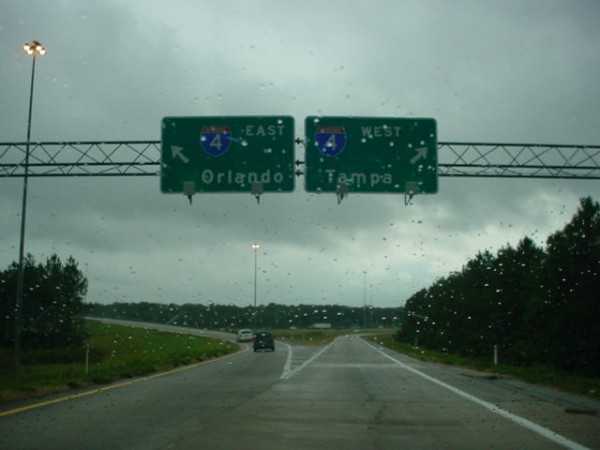
Interstate 4 seems unremarkable by most standards. The drive from Tampa starts out with the congestion of a medium sized American city, that could easily be mistaken for so many other cities by the casual observer. Shortly after leaving Tampa, the highway cuts through the ridge of Florida.  The ridge is the lower spine of the much higher ranges to the north, Appalachians, Smokey’s and others.

The ride passes through some bedroom communities, and towns that were formerly sustained by citrus and phosphate mines.  The geographical center, turned tourism capital is Orlando, yet another medium sized city that has become a symbol of the hypereal. The highway ends near Daytona, a smaller place known for spring breakers, NASCAR, bike week and Eileen Wuornos.

The whole drive is about two hours unless you hit traffic. Granted, much of Florida is filled with beautiful beaches, springs, large oaks, cypress trees and even some interesting architecture, but I-4 does not supply many of those views. The areas in and around I-4 have come to represent the normal American demographic. In the past couple of presidential elections, the I-4 corridor has also become a focal point. It is the mood of the times, and it isn’t necessarily appealing.

Christian Marclay, Images courtesy of Graphicstudio | USF Photo Credit: Will Lytch

Last week, I was speaking to Margaret Miller, director of University of  South Florida’s (USF) GraphicStudio and USF’s Contemporary Art Museum in Tampa. She mentioned that Christian Marclay has been working there on and off for the past three years, completing much of his work that has been on view at the Whitney Museum.

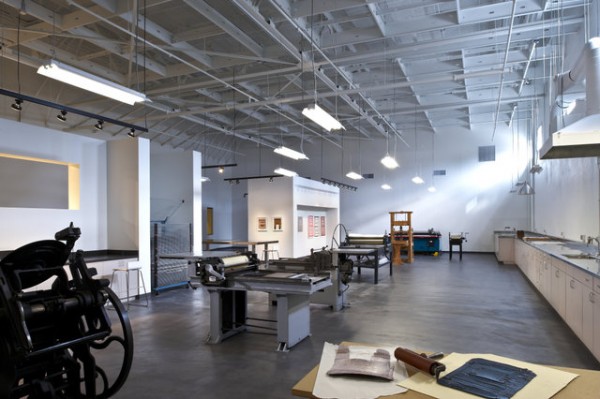
GraphicStudio is a place that is tough to classify, and that’s the way they want it. The name GraphicStudio might be misleading or limiting, as they are mainly a research studio, combining efforts with studio arts students, the architecture school, engineering and graphic design departments.

The list of artists passing through the Studio is like reading a list of great American contemporary artists.  Over the years, I have heard about Robert Rauschenberg,  James Rosenquist, John Chamberlain, Nancy Graves and many other known artists working there, without much fanfare from the outside world.

I took a tour of the GraphicStudio in 2005, and at the time the Cuban Collective Los Carpinteros had just completed their stay at the Studio. Their sculptures and drawings were everywhere, and within just a few months they had a show at USF’s Contemporary Art Museum. The symbiotic relationship between the GraphicStudio and USF’s Contemporary Art Museum seems necessary because of the interaction between the two places. The Studio is often where the work for an upcoming show is created. The GraphicStudio had high profile artists working there from the beginning in 1968. The museum opened around twenty years later, and had immediate respect by association from the art world. The museum gave the GraphicStudio a higher profile to the general public. The museum continues to have exceptional shows by world class artists like Jim Campbell and Los Carpinteros.

Flying Horse Editions

Recently, I watched the film Herb and Dorothy, about a couple in New York City that had amassed a huge collection of contemporary art since the term came into vogue. I was talking to a friend about the film, when he mentioned that James Sienna was one of the artists in the film that befriended and sold art to the couple. He also said that Sienna was working at Flying Horse Editions. The Flying Horse is about an hour and a half to the east by car from the GraphicStudio. Sienna had been a part of the outreach program for the Atlantic Center for the Arts (ACA)  in New Smyrna Beach about hour away to the east of the Flying Horse . The Flying Horse has operated for nearly twenty years in Orlando, as part of the University of Central Florida (UCF).  It’s a collection of old and new technology, and if you walk out the front door you can see I-4. I stopped by last week to speak to the director Theo Lotz. While there, I saw that Kristopher Benedict, a painter from Redhook in Brooklyn was working on some lithographs. Benedict had been introduced to the Flying Horse Editions by Sue Scott of Sue Scott Gallery in Manhattan, as she has a longtime association with the Orlando Museum of Art as an adjunct curator.

Atlantic Center for the Arts

The ACA is it’s own diamond in the rough. Brainchild of the late sculptor Doris Leeper, the ACA was started in the late 70’s, and since the 80’s it has hosted an incredible list of artists from all disciplines, such as Rineke Dijkstra, Mark Dion, Dennis Oppenheim, composers Pauline Oliveros, Robert Ashley, writers Allen Ginsburg, Spalding Gray and so many more. Residencies last three weeks, and associate artists apply directly to the master artists. I was an associate with Richard Kostelanetz, and Kerry James Marshall in 2001. The residency may have lasted three weeks, but my I’ve maintained a relationship with many of the artists that were there with me.

The ACA’s outreach program has helped locals see performances of multi-instrumentalist Elliott Sharp, spoken word master Saul Williams, and the art of Mark Dion to name a few. However, these places have slightly more visibility than the witness protection program. It would be nice for the world to see the process, but their visibility seems decidedly subdued, mainly so that artists can come and work without distraction. The Atlantic Center’s  architecture blends nature with relevant contemporary design. It’s the perfect retreat away from the pressures of the big city art meccas. The GraphicStudio and Flying Horse are less pleasing when you enter the buildings, but it feels like you have stepped into a different world once you get inside. Central Florida’s lack of contemporary art spaces, can be distressing for locals interested in that sort of thing, but it can be a nice departure for someone who is constantly surrounded by the stress of larger art meccas. The low profile nature and relative freedom that these spaces offer the visiting artists, allow the artist’s vision to be realized without the stress that is common with today’s market constraints.

Share