Gunk Fathers

L.A. Expanded: Notes from the West Coast
A weekly column by Catherine Wagley
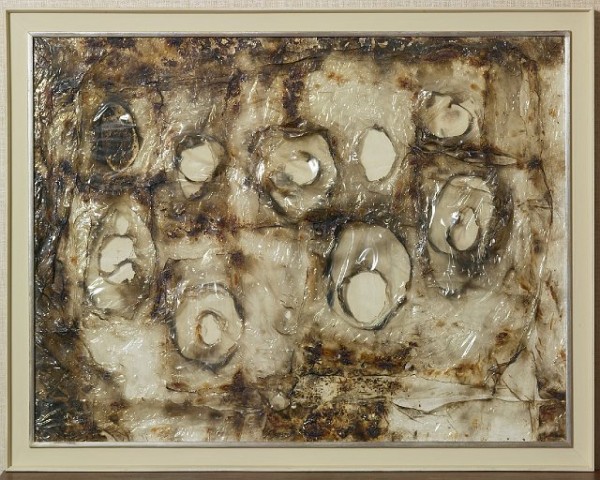
Alberto Burri, "Bianco Plastica," 1961.

Alberto Burri spent life rejecting—rejecting roles, rules, materials, explanations, nationalities, natural trajectories. The Italian artist went to Africa as a doctor in the 1940s, but ended up a prisoner of war in Texas. He abandoned medicine, took up painting, and returned to Rome upon his release,  becoming an Arte Povera practitioner before the movement existed, and developing a penchant for the gunky and gross. He also became transcontinental, living part-time  in the Hollywood Hills, acting as  a sort of socialite,  all while burning plastic, stitching burlap, and lobbing together traditional and found materials with a dogged disregard for archivability. He resisted talking about his art or irreverence, just like he resisted talking about his POW days. But he was frustratingly good at making resistance and rejection look like a circuitous means of acceptance. In Tutti Bianco, a painting currently on view in Combustione: Alberto Burri and America at the Santa Monica Museum of Art, globs of glue and paint look like cracked, dry milk but they’re also as subtly austere as a grayish Rothko.
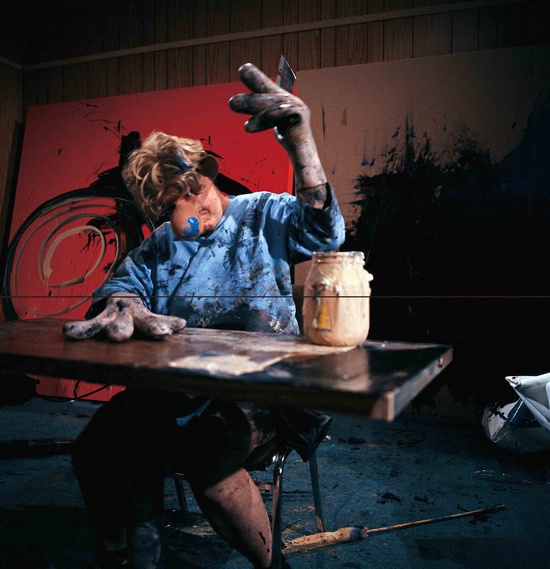
Paul McCarthy, "Painter," video, 1995.

The surface of Tutti Bianco shares its fractured milkiness with the foam ball Paul McCarthy abuses in his 1987 film, Family Tyranny. McCarthy feeds the ball a watery, mayonnaise-heavy liquid, which drips down its chin and seeps into its fissures. As he does so, he says things like, “I’m gonna make him eat what he doesn’t want to eat,” or “let him feel it, do it slowly.” He frequently breaks into song: “Daddy came home from work again, Daddy came home from work.” McCarthy has talked about “finding himself making [absurd, abusive] work about the father and son.” He’s also talked about transforming from son into father.

Showing just a few miles south of Burri’s Combustione, at L & M Art’s almost colonial new space, McCarthy is a rejecter, too. But while Burri set fires, let fluids drip and run, then reticently evacuated his work of signs of himself, McCarthy has rejected evacuation and reticence in favor of exposition. In his earliest work, he acts out the brassy prodigal, willing to expose all in order to break from his lineage. He’s obsessed with texture and materials, but wants to show where they come from, no matter how unpleasant their origins. Grainy videos like Sauce (1974), in which a young, wild-haired body smothers his limbs in ketchup while breathing heavily and hotly, or Black and White Tapes (1978), in which a body leaves thick residue as it slowly pulls itself along the floor, is stuff that makes skin crawl.
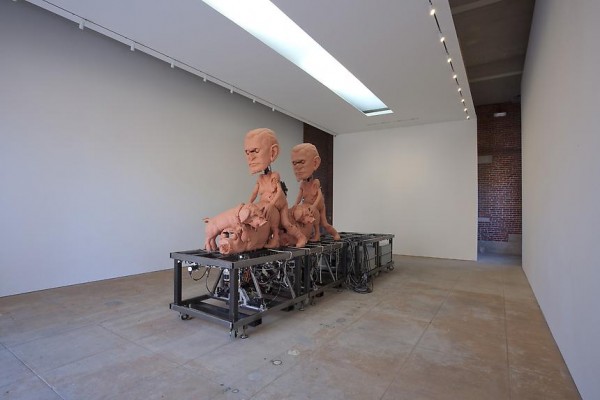
Paul McCarthy, "Train, Mechanical," 2010.

Later, in the era following Family Tyranny, McCarthy stopped being just the prodigal, and became a son fighting his father urges. There was Painter (1995), in which a human puppet clad in a hospital-blue robe wields a Claus-Oldenburg-worthy brush. Anxiously dumb monologues propel the painter forward. “Try to understand the emotions, try to feel,” he mutters, coaxing himself up the canvas to make swift, awkward strokes. The resulting painting has a thick, brown, ineffability, despite all the effing and grunting that went into its creation. It’s parentally ab-ex but made with angst.

In the years since, McCarthy’s production quality has increased exponentially, he’s graduated from fugitive video to carefully manufactured mechanics and inflatables, and become fixated on cartoons, butt plugs and George Bush puppets. He’s lost some of that childish, father-hating anxiety, and his caginess about becoming a father himself has dissipated–or, at least, it makes a feeble showing in his work.
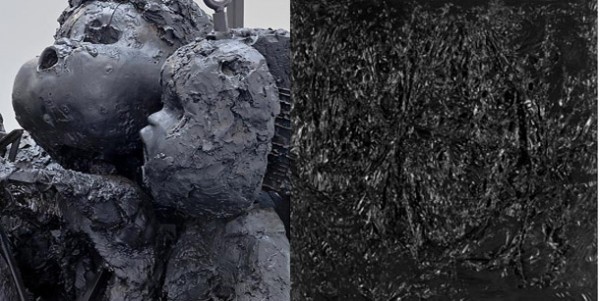
Paul McCarthy, "Ship of Fools, Ship Adrift," 2010; Alberto Burri, "Nero Plastica L.A.," 1963.

At L & M Arts, his sculptures are surprisingly staid, work of an artist who owns his subject matter and his craft. Bobble-headed, gooey but resolved gray children occupy the garden. Dual, mechanized Bush stand-ins with rhythmically spinning heads screw pigs that are being screwed by other pigs in the western gallery. The politics of this are predictable, but the craft is virtuosic. Smooth shoe-clad pig feet contrast the intermittently rough and pristine boots of the nude Texan. The larger pigs’ faces collapse into themselves, while pink, fleshy flaps cover the eyes of the smaller pigs. The two Bushes move forward and back, the smaller pigs move laterally, and everything works seamlessly. If I could take the recognizable out and just see the strange, visceral motions, I think I’d be awed.

In the east gallery, there’s the burnt, black Ship of Fool, Ship Adrift (2010), full of more bobble-headed children with what resemble Pinocchio noses sticking out of mouths, eyes, and other orifices–a Hans Christian Andersen worthy warpedness that, again, is easy to imagine emptying itself of its referentiality, becoming the dark, dense topography of a texture-fixated virtuoso. Emptied, the sculptures would uncannily resemble Burri’s Nero Plastica L.A. (1963), waves of black, burnt plastic rippling across canvas.

McCarthy and Burri are both father figures now, both staunchly, un-provocatively good at what they do.


Share

SUPERFLEX: Flooded McDonald’s

Flooded McDonald's Still of "Flooded McDonald's" (2009), courtesy of the artists and Peter Blum Gallery, New York. Produced by the Propeller Group in cooperation with The South London Gallery, Louisiana Museum of Modern Art, the Oriel Mostyn Gallery and the Danish Film Institute.

Flooded McDonald’s, by art collective Superflex, is currently on view at the Hirshhorn Museum and Sculpture Garden in Washington D.C.  For this recent film, Superflex painstakingly created a life-sized replica of a McDonald’s fast-food restaurant.  Their deliberate choice to employ one of the most recognizable brands in the world offers a familiar point-of-departure for the viewer, while also evoking related issues of consumerism and corporate ascendancy.

As the Hirshhorn asserts, the artists ‘borrow the cinematic vocabulary of documentaries, ads, and disaster movies’.  This approach is accessible and appropriately complements the main-stream setting.  As the film begins, one instantly recognizes the yellow, red and otherwise neutral, utilitarian interior of the fast food chain.  The counter, menu, partially eaten food and Ronald McDonald figure are all to-be-expected.  Yet, the realism of the space is made strange by the absence of the typically crowded human presence.  The restaurant seems to have been abandoned – creating a sense of the uncanny and imbuing the film with visual ambiguity that engages the viewer’s curiosity.

Flooded McDonald's Still of "Flooded McDonald's" (2009), courtesy of the artists and Peter Blum Gallery, New York. Produced by the Propeller Group in cooperation with The South London Gallery, Louisiana Museum of Modern Art, the Oriel Mostyn Gallery and the Danish Film Institute.

Flooded McDonald’s is exhibited as a looped digital video projection, 21 minutes in length.  The film unfolds in real time and begins as it surveys the still (and empty) McDonald’s.  Water then begins to fill the space, entering from under a door.  Water, a powerful natural force, wreaks havoc without substantial visual obstruction.  It lifts and moves chairs, trays, food and drinks around the room.  It shorts the electrical circuit and becomes murky in all of the refuse.  The film concludes when the fast food restaurant is finally and completely submerged.

On the one hand a filmic quip, Flooded McDonald’s open-ended nature lends itself to deeper interpretation.  The film creates an artificial and concentrated natural disaster – an event which always points to the fragility of human existence.  (One can’t help but think of recent flooding disasters).  Furthermore, the work confronts the viewer with images of trash and destruction – highlighting over consumption and the associated waste it generates.  This waste, coupled with recognizable corporate imagery, unarguably critiques capitalist excess.  By destroying a fabricated prototype of the American way of life, the film seems to suggest a departure from the status quo.

Flooded McDonald's Still of "Flooded McDonald's" (2009), courtesy of the artists and Peter Blum Gallery, New York. Produced by the Propeller Group in cooperation with The South London Gallery, Louisiana Museum of Modern Art, the Oriel Mostyn Gallery and the Danish Film Institute.

Superflex, a Danish art collective founded in 1993, exhibits internationally.  The collective engages viewers and participants in issues surrounding globalization.  They work in film and multi-media projects that are typically realized in the real world through social intervention.  Members Jakob Fenger (b. Roskilde, 1968), Rasmus Nielsen (b. Hjørring, 1969), and Bjørnstjerne Reuter Christiansen (b. Copenhagen, 1969) live and work in Copenhagen and Rio de Janeiro.

Flooded McDonald’s was on view, from January to March of this year, at Peter Blum Gallery in New York.  It has also recently shown at Oriel Mostyn gallery in Wales and South London Gallery, London, UK.

Flooded McDonald’s remains at the Hirshhorn through November 28th.  It is presented in conjunction with the fifth anniversary of the museum’s Black Box space, which is dedicated to new and recent work in film and video.

Share

There is always a cup of sea to sail in: the 29th São Paulo Bienal

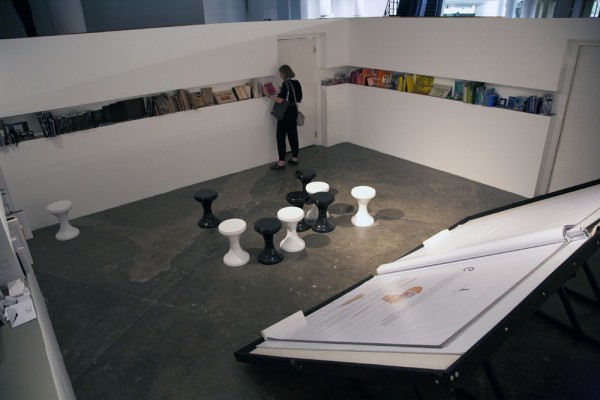
Terreiro: Marilá Dardot and Fábio Morais, Longe daqui, aqui mesmo (Far from here, right here)

What makes an art exhibition political?

The 2010 São Paulo Bienal, There is always a cup of sea to sail in, uses Brazilian poet Jorge de Lima’s line as a metaphorical container to address the ambitious theme of art and politics. The head curators Agnaldo Farias and Moacir dos Anjos see the title as an expression of the essential aspiration of the exhibition, “to affirm that the utopian dimension to art is contained within art itself, not outside or beyond it; to affirm the value of poetic intuition in the face of ‘tamed thought‘ that emancipates nothing, though it permeates political parties and even formal educational institutions.” (29th Bienal Catalogue, 21) This is an infinitely large concept in the palm of ones hand.

Guest curator Chus Martinez sees the political as a resistance to the slogan, the summary, and the pamphlet. Through artistic research and practice, reorganizing information and reinventing research contributes to how we see the world. If art itself is a political act by way of it’s disruption of current logics and the opening-up of space to conceive and experience new possibilities, then what is at stake when mounting an exhibition that considers the world outside of the cup?

Joachim Koester, Tarantism, 2007, 16mm film loop. Courtesy Galleri Nicolai Wallner, photo: Joachim Koester

What is the resonance of an exhibition like this?

The scope of the biennial format has the potential for wide impact; organizers anticipate a million visitors and have implemented a large educational project. In training 40,000 teachers to educate students about contemporary art, the potential for art’s rethinking of conventions to seep beyond the contained art world is an exercise in politics. The biennial’s geographic and geopolitical location has impacted the curatorial choices reflected in an awareness of its southern position; a constellation of relationships between art produced in Latin America, Africa, Eastern Europe, the Middle East, and Asia are in a robust discourse here.

The resistance to articulate a cohesive comprehension of the politics of art is evident in the titles of the Terreiros or “yards” – architectural spaces produced by participating artist and architects as discursive areas for discussion, contemplation, and socializing inspired by the function of Brazilian public spaces like plazas, courtyards, and the street. The titles of these six spaces are dominated by dichotomies: O outro, o mesmo (The other one, the same one), Dito, não dito, interdito (Said, not said, indirect), Lembrança e esquecimento (Memories and oblivion), Longe daqui, aqui mesmo (Far from here, right here), Eu sou a rua (I am the street), and A pele do invisível (The skin of the invisible).

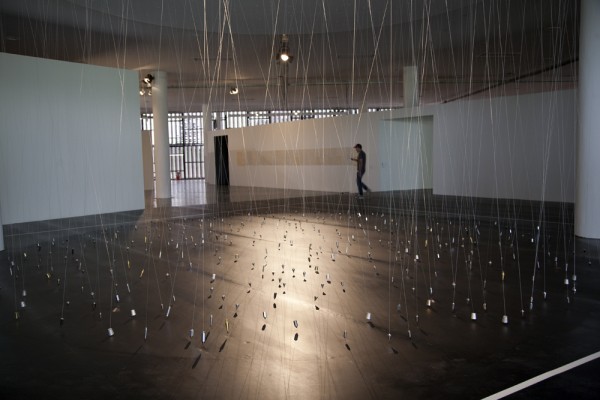
Tatiana Trouvé, 350 Points towards Infinity, 2009, installation.

For all it’s ambitions, the biennial remains an act with skin, there is an outside and an inside. The edges of the exhibition are flexible, morphing and incorporating new elements, yet barriers remain. This is not necessarily a bad thing; if movement and change is to occur, then we must visualize an edge of difference.

The challenge of summing up an exhibition who’s purpose is to resist the summarization of experience is massive. So instead, in the spirit of the anti-slogan, the works presented here are simply and unapologetically a smattering of what one would find in the biennial. Read More »

Share

Ruth Van Beek: The Great Blue Mountain Range

Sometimes we come upon an exhibition that reminds us that there are intersections between different kinds of collections. One might think that the worlds of paleontology, mineralogy and art are separate but a recent exhibition of works by the Dutch artist Ruth Van Beek at Okay Mountain Gallery in Austin shows us otherwise.

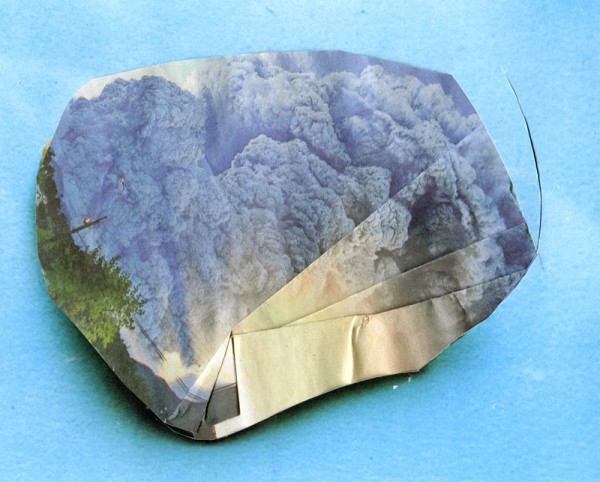
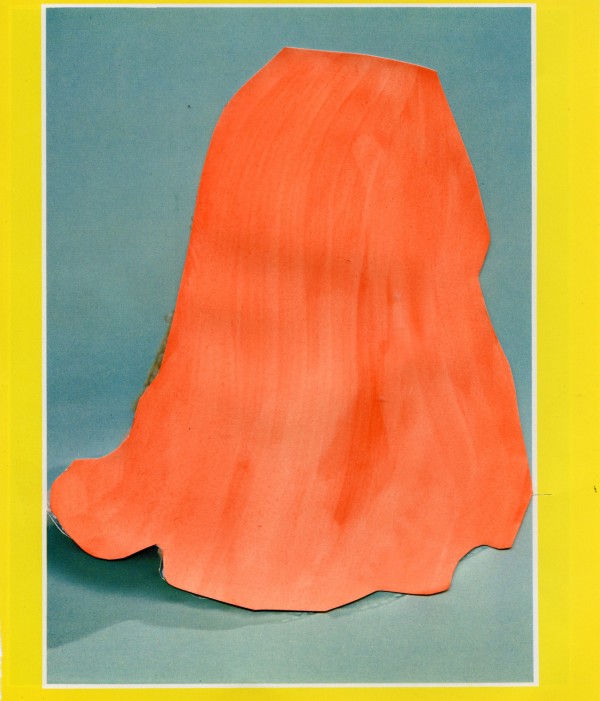
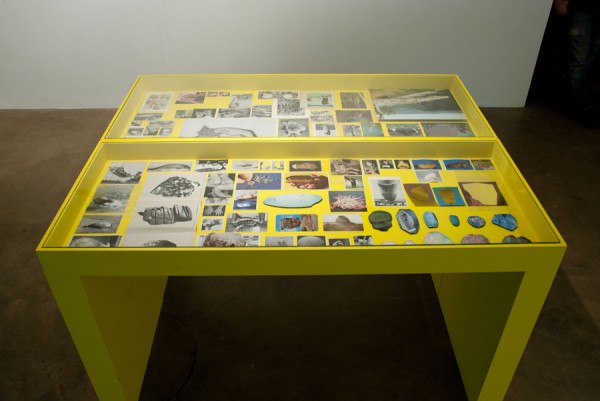
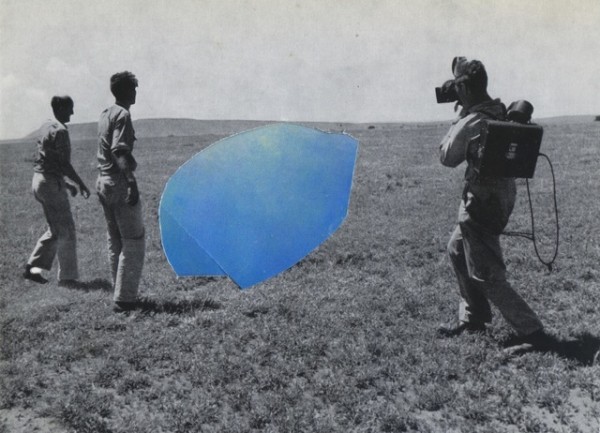
Included in the exhibition are a series of paintings, photographs and collages that use the crystalline abstract structures of rocks and minerals to create visual relationships between seemingly disparate forms. The title of the exhibition, The Great Blue Mountain Range, in relation to these small studies of stones, alludes to yet another comparison of difference – scale.

In two vitrines, painted bright yellow, this method is continued using found photographs alluding to the landscape photography of guidebooks and amateur naturalist snapshots. As the press release states, these works are “symbolic of the artist’s longing to travel to other places.” As a result, Van Beek uses collage to combine the two poles of this longing, here and there, creating new interstitial places that are her own.

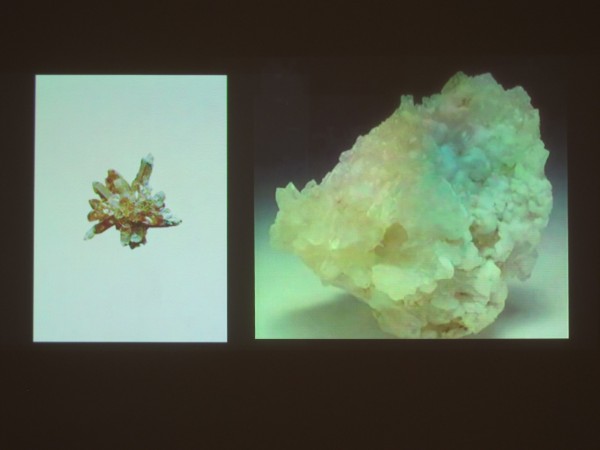
An explorer’s longing to approach the unknown, the use of a control group in scientific method, and the formalist use of relational color or tone are all based on  comparisons. Following this, a slide show is included in the show projecting images that Van Beek has gathered from various sources including gold nuggets, baseball sized hail, ice crystals, diamonds, and meteors to create an almost rhizomatic network of associations that are at once visual, scientific and vaguely metaphysical.

This kind of alchemy, transforming images of mere matter into the stuff of speculation reveals the gallery to be a cabinet of curiosity. The artist here serves as both maker and curator, always aware that appropriation and the archive are creative sites themselves.

Ruth van Beek (1977) lives and works in Koog aan de Zaan, The Netherlands. She graduated in 2002 at Gerrit Rietveld Academy in Amsterdam receiving a Masters in Photography. In 2008 she had a solo exhibition at Foam-3h, the Amsterdam Photography museum, In 2009 she did research at the Spaarnestad Photoarchives, resulting in new work and a solo exhibition at Galerie37 Spaarnestad in Harlem, this exhibition was also shown at the Use me Abuse me show at the New York Photofestival, curated by Erik Kessels. Her work regularly appears in various books and magazines.

Share

Non-Dominant Discourse: Rachel Zeng, Sha Najak, Ezzam Rahman & Seelan Palay

Art has been known to speak out of turn. In Singapore, there is a phrase, ‘O.B. marker’, that in local parlance is used to describe topics that are considered officially ‘out of bounds’. The phrase, borrowed from golfing terminology, to designate spaces where play is not allowed, on an island with limited land but a surprisingly large number of golf courses, is seldom used with irony, even if with a knowing nod.

Ezzam Rahman, "SO?", 2010, printed paper, plastic ribbon and chocolate

Humor aside, the presence and ubiquity of the expression ‘O.B. marker’ points to a condition of censorship and self-censorship that is made to seem unremarkable and is officially rationalized as necessary defense against riots on the streets and a descent into gratuitous depravity. Yet the boundaries of the topics that are ‘marked out’ are ambiguous at best and oppressive at worst, and it is generally understood that they include the subjects of race, religion, permissive lifestyles (usually referring to non-heterosexual relations), explicit sexual activity, and critique of the government. Interestingly enough, violence is not one of them, even though it may be said a certain violence is wrought upon the community unable to speak on these proscribed subjects.

Censorship of art dealing with these topics comes in different forms. Between 1994 and 2003, performance art was subjected to a de facto ban by the National Arts Council due to an unfortunate media incident involving art, after which ‘unscripted’ performances were deemed a threat (‘Art’ acts at Parkway Parade vulgar and distasteful: NAC, The Straits Times, 5 January 1994). While arguably less such over-reactions have occurred since in the visual arts, as compared to say film, theatre or the literary arts, censorship still exists even if by other means. Funding conditions, licensing, and venue availability and terms of use, are areas where censorship and self-censorship have become institutionalized.

Rachel Zeng, "Thou Shall Not Hear", 2010, mixed medium on stretched canvas.

On 3rd August, 2010, an arts community position paper on censorship and regulation was submitted to the Censorship Review Committee (2009/10) and the Ministry of Information, Communications and the Arts (that oversees the National Arts Council and the Media Development Authority), calling for an end to censorship, and bearing 1,786 supporting signatories from the community and public. The paper arguably acts as a minority report to the official CRC report that was produced by the Committee and its secretariat, the Media Development Authority. While the exercise of reviewing censorship appears benign enough, it remains an exercise on government terms.

The exhibition Non-Dominant Discourse at Post-Museum featuring the works of Rachel Zeng, Sha Najak, Ezzam Rahman and Seelan Palay is an attempt at opening up ‘space’ for dialogue within the community through art. Quoting Martin Luther King at the opening of the exhibition, “almost always, the creative dedicated minority has made the world a better place,” Seelan Palay more modestly added, that while the four artists may not be able to improve the conditions of the world, they hope at least to make Singapore a little better, and doing so for them means having room for thought and expression beyond dominant and official terms. Reflecting on the challenging subjects of civil, social, cultural and political concerns, the artworks are notably measured meditations. Read More »

Share

From the DS Archives: Edward Burtynsky

From the DS Archives is sharing with you again Edward Burtynsky an artist who explores the haunting and less frequently captured scenes from industry and commercialization. Burtynsky’s newest work is focused on oil (of the petroleum variety) revealing  the rarely seen moments in the journey of the material; from its devestating extraction to the impact it has on our lives. Burtynsky has recently won the And/or Book Award 2010 for photography, given by the London based Krasna-Krausz Foundation.

Edward Burynsky was originally written by Seth Curcio and published on November 27, 2008.

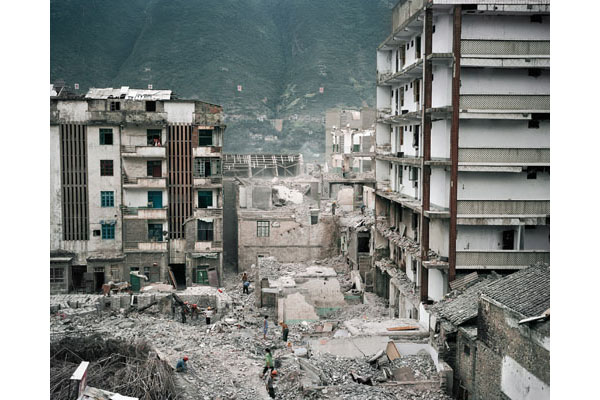
The photographs of Canadian artist Edward Burtynsky lead the viewer through the extremities of commercialism from a behind the scenes point of view. Desolate oil sites, packed and impersonal factories in China, abandoned boat sites, and mines and quarries are just a few scenes that the artist has captured in countries across the world. Burtynsky’s photos depict the product of extreme industrialized development and its affect on nature and humankind. In 1985, the artist founded the Toronto Image Works, a darkroom, custom image lab and new media training center. Recent shows include the touring exhibition titled “The China Series” which was on view at the Southeastern Center for Contemporary Artand the Presentation House in Vancouver amongst others. This year, the artist had a major survey of 65-70 works at the Gemeente Museum Helmond in the Netherlands. Some of Burtynsky’s awards include theOfficer of the Order of Canada (2006) and the Flying Elephants Foundation Fellowship (2004).


Share

Dan Colen at Gagosian

Today on DS, we bring you an article from our friends at DaWire. Carla Acevedo takes a look at Dan Colen’s controversial new show at Gagosian Gallery’s 24th Street space.

DAN COLEN: Poetry, Installation view. Photo by Rob McKeever

The most talked about and controversial show of the New York City Fall season: Dan Colen’s inaugural solo debut at Gagosian titled Poetry. Walking around Chelsea during the opening weeks of the season, it was hard to turn the other cheek to numerous conversations regarding Colen’s show. There was hype, expectation and tons of dissing.

Colen first appeared on the art radar on the pages of Vice Magazine along with longtime friend and roommate Ryan McGinley. The notorious ‘Dash Snow Crew’ was known for heavy drug use and their ‘hamster nests‘, a private performance where they would shred a bunch of phonebooks, do tons of drugs and act like hamsters. He was then catapulted to artist superstardom with the infamous 2007 New York Magazine article “Chasing Dash Snow”. Dubbed as ‘Warhol’s Children,’ Dash Snow, Ryan McGinley and Dan Colen were celebrated as the embodiment of art, drugs and a rampant ‘fuck you’ attitude. Now Colen has cleaned up his act and is ready for art world glorification (or damnation).

DAN COLEN: Poetry, Installation view. Photo by Rob McKeever

DAN COLEN: Poetry, Installation view. Photo by Rob McKeever

Known for his bird shit and gum paintings, Colen’s first formal step into the ‘serious’ art world was in the bathrooms of Gagosian Gallery. Apparently, friend and Gagosian Director San Orlofsky convinced Larry Gagosian to allow him to show his work there and it was quite a financial success. Four years later, Colen has a major show at Gagosian that fills the entire gallery, a risky if not infrequent undertaking. Makes me wonder if it’s an art world fairy tale or a carefully orchestrated publicity stunt.

His show Poetry includes a couple of large-scale ‘candy’ paintings, a ramp, an installation of motorcycles and a propped up brick wall. According to the exhibition’s press release, “drawing from mass media, local environment, and subculture, Colen’s art imbues the ordinary, the disenfranchised, and the tribal with provocative new status.” Actually, skateboarding and bikers are hardly a subculture anymore. These are currently a part of the mainstream and Colen is not the first (nor the last) to use it to inform his work. So what’s with all the hype? Is it the whole mystification of the artist as a rebel/social outcast? Or the reverberating echo left from Snow’s untimely death last year? From ‘bathroom to gallery’ and from art outsider to Gagosian protégé there’s a long stretch, or is there? Regardless, I’m still curious to find out what Colen will come up with next. And I’m sure the art crowd will keep whispering while following his steps.

DAN COLEN: Poetry, Installation view. Photo by Rob McKeever

Dan Colen was born in New Jersey in 1979. He graduated with a BFA in Painting from the Rhode Island School of Art and Design in 2001. Exhibitions include the 2006 Whitney Biennial, New York; “USA Today,” The Royal Academy, London; “Defamation of Character,” PS1 Contemporary Art Center, Long Island, New York; and “Fantastic Politics,” The National Museum of Art, Architecture and Design, Oslo.

Images and artist bio via Gagosian Gallery
Share