Young Eva’s “Ghastly Visages”

L.A. Expanded: Notes from the West Coast
A weekly column by Catherine Wagley
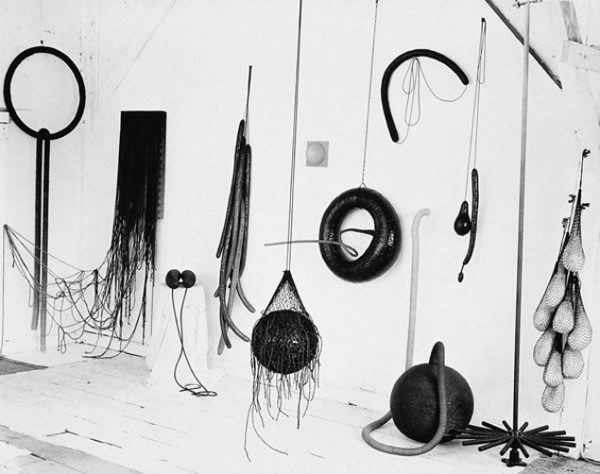
Eva Hesse's Studio, 1965-66

Eva Hesse's Studio, 1965-66

There are many ways to mask yourself, some more effective than others, and artists—the good ones—venture further into the business of masking than most. They’re also deep into unmasking, balancing the urge to reveal with the need to conceal. This is a more pragmatic than emotional project; even if artists tend to be an idiosyncratic and sensitive breed, art-making has to do with communicating, and effective communication involves strategy. Letting it all hang out rarely gets the job done right.

By the time of her premature death in 1970, Eva Hesse had a well-developed strategy: she’d learned to expose enough heart, flesh and gut while still maintaining the austere restraint of a minimalist. This hadn’t come easily. She’d hacked through years of personal baggage, purged herself of abstract-expressionist tendencies, fought the urge to mimic the work of her older artist-husband, Tom Doyle, sought pep talks from friend Sol LeWitt (who told her to “do more”), and worked incessantly—all to get to that tender severity that made her both a darling and a force within the rapidly expanding world of conceptual art.

Because I am a fan of the oeuvre Hesse built in the years preceding her death and protective of the process she went through to hone it, I’m resentful of  anything that downplays her savvy in favor of some tragic artist myth. For this reason, I was suspicious of Eva Hesse: Spectres 1960 before it even opened. Now on view at The Hammer Museum, the exhibition features expressionistic paintings Hesse made soon after graduating from Yale, and promises to foretell her “desire to embody emotion in abstract form.” It seemed destined to play into the mythology that has so disserviced Hesse’s legacy: that of the tortured soul, gone too soon (as if Hesse, like Sylvia Plath, a figure to whom she’s often been illogically linked, died with her head in an oven and not in a hospital bed, of terminal illness). And it does, but in a weirder, more convoluted way than I expected.
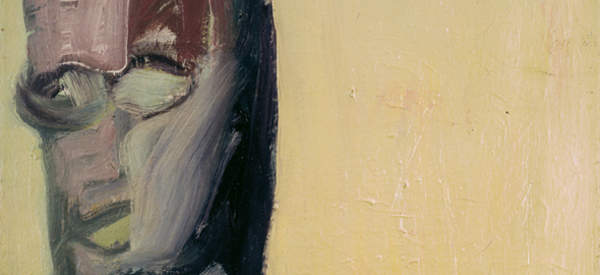
Eva Hesse, No title, Oil on canvas, 1960. Ursula Hauser Collection, Switzerland.

The wall text next to one of the first self-portraits in the exhibition, a vague image that conjures a cross between Willem de Kooning and Edvard Munch, reads, “this forceful and haunting group [of portraits] shows how the artist masked her real beauty behind ghastly visages.” A recent blog post from Yale Press, the publisher of the Spectres catalogue, echoes this idea of beauty obscured, describing a 1959 photo of Hesse that illustrates Helen Molesworth’s catalogue essay:

Only twenty years old, with soft brown hair, pale skin and a warm smile, Hesse is the figure of youth and beauty; a muse of subtle but erotic flirtation. Looking at her paintings from four years later, the viewer is wrenched from this superficial complacency, and thrust instead into a world fraught with pain, fear, insecurity, and alienation.

Certainly, Hesse was warmly attractive and, certainly, the figures in these early paintings are harrowing (and also funny, like the cross-eyed figure with a perfectly circular head and upside-down boat for a hat). Some cathartic need probably even propelled her to paint them, though it likely had less to do with a desire to hide beauty than to get at the knottiness of personhood. But the paintings mainly look like a young artist’s young work, attempts to wade out of the influence of Gorky or de Kooning to arrive somewhere more lucid.

Eva Hesse, No title Oil on canvas, 1960. Ursula Hauser Collection, Switzerland. And Eva Hesse, No Title, Oil on canvas, 1960. The Museum of Modern Art, New York, gift of Mr. and Mrs. Murray Charash.

The Spectres paintings are nicely composed–in one, a gorgeous blue-red stroke interrupts muddy brownishness that pervades the rest of the image; in another, the face is sectioned off in what could easily be a brutal homage to Matisse’s Green Stripe. They also tend to be perfectly balanced, and, if off-kilter, only slightly. “I have confidence in my understanding of the formal,” said Hesse, in the final, 1970 interview she gave to Cindy Nemser. “Those problems are solvable. I can solve them…beautifully.” But she had bigger, more compelling problems to tackle.

In Hang Up, a sculpture Hesse completed in 1966 (she later said she would’ve titled it differently if she’d been in the U.S., not Europe, and understood how the words “hang up” were being used), an empty frame wrapped in painted clothe has a steel rod extending out from it in a gangling loop. Hesse said it reminded her of rigidly bandaged broken arm: “It’s the most ridiculous structure I have ever made and that’s why it is really good.” The strategic mask Hesse chose–one of rigid, formal obsessiveness interrupted by heartfelt absurdity–emerged around the time of Hang Up and got bolder and more refined over the next four years, as she made work like the borderline sadistic Accession and dumbly repetitive Schema.

Before she died, Hesse asked a studio assistant to destroy a few select sculptures; he did so. However, unlike a number of her contemporaries and almost-contemporaries–Agnes Martin, Jasper Johns, John Baldessari, among others–she never obliterated what she’d made before she came into her own. If that’s a gift, it’s a dangerous one. What bothers me most about the way Spectres is  framed is that it purports to give a glimpse into an early Eva, a Hesse who masks “real beauty” and grapples with “ghastly visages.” Really, what we’re glimpsing is a mask a young artist tried on and rejected before making herself one that fit much better.

Share

Fan Mail: Studio Joseph Shaeffer

DailyServing.com selects two notable artists each month from the submissions we receive to be featured in our series, Fan Mail. For a chance to have your work appear below, with an article written by one of the DailyServing contributors, please submit a link to your website to info@dailyserving.com, subject: Fan Mail. You could be the next artist in the series! (We will try to contact chosen artists prior to publication, but please be sure to check the site everyday!)

Photo courtesy of Studio Joseph Shaeffer

It was an unusual series of events and the natural curiosity that drives those with scientifically inclined minds that led American scientist Cleve Backster to attach a polygraph to a philodendron plant in his lab. Much to his surprise, the plant gave a pattern reading typical of that which a human being might give. Backster became quite tangentially excited about this sentient occurrence and began wondering what might happen if he decided to say, burn one of the philodendron’s leaves. As he was thinking about burning the poor philodendron, the polygraph reportedly showed a rapid upswing—the type of upswing you might see if you threatened to burn someone while they were hooked up to a polygraph. Whether or not this particular experiment was scientifically sound is a subject best suited for a different forum, but, if you are willing to take the information in for a minute and let the idea that plants are more sentient than we typically give them credit for the whole modern ‘man beat nature’ paradigm shifts rather suddenly. Regardless what has been proven and so on and so forth, the point remains that what Backster ‘discovered’ is fodder for aberrant minds—especially in times when dialogue about the environment and conservation plays such a huge role in our day to day lives.

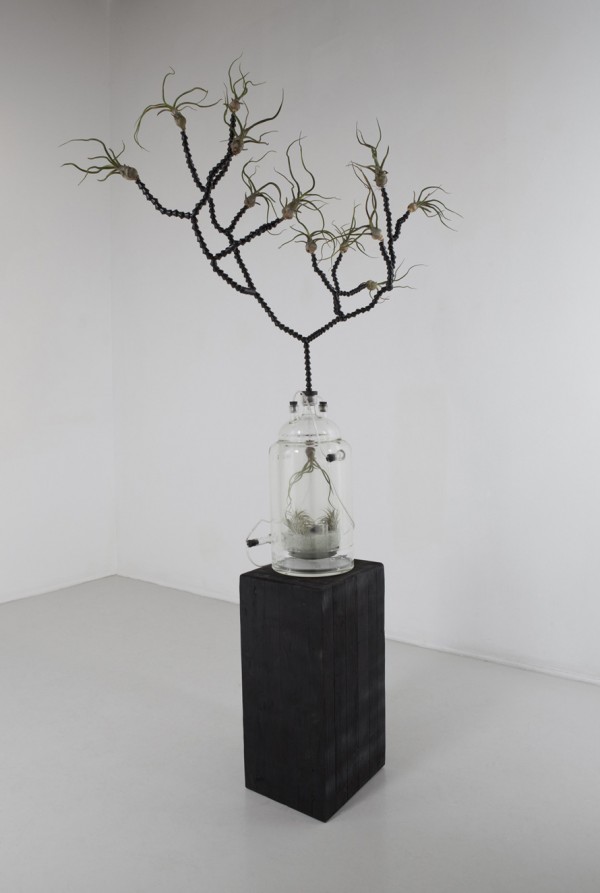
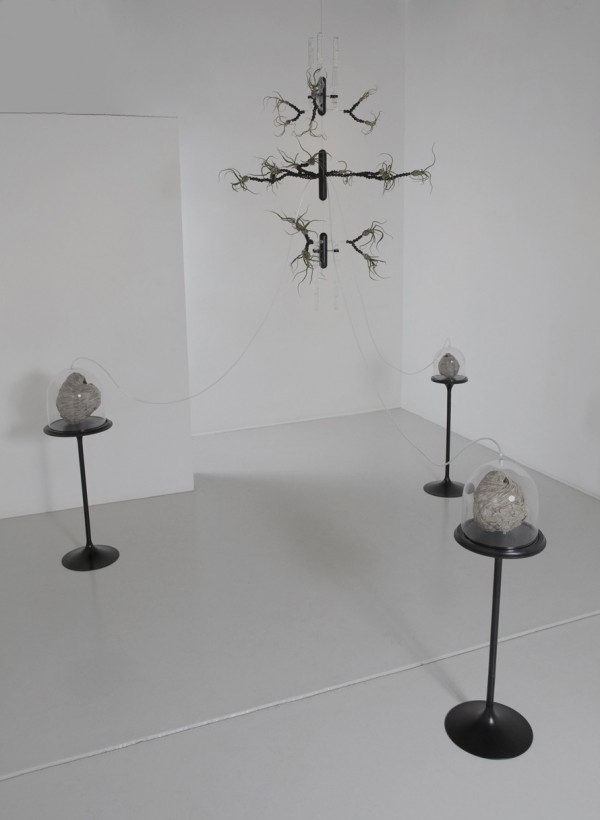
Joseph Shaeffer’s new body of work, The Epoch of Encroachment is a dynamic and richly textured venture conceptually addressing multiple dimensions of mans complicated relationship with nature—and perhaps more specifically—natures relationship with man.

Photo courtesy of Studio Joseph Shaeffer

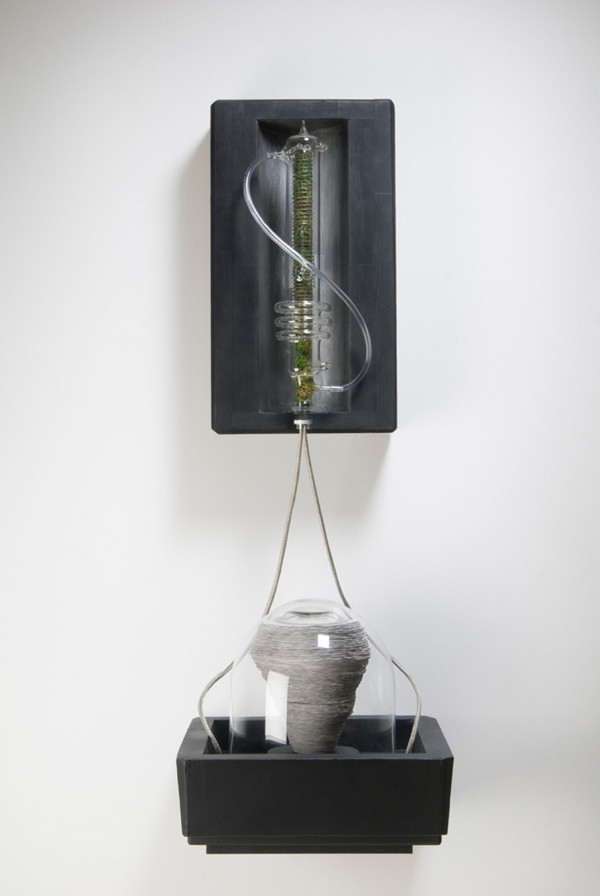
The provenance of Epoch of Encroachment was a single experience in which Shaeffer discovered “an industrial electronic bug trap, which while fully functioning, became a habitat for a colony of wasps.” This sort of blatant encounter clearly drives Shaeffer’s exploration of a potential reality in which nature manipulates the auspices of mankind for its own purposes. Shaeffer explains that the Epoch of Encroachment is “an attempt to convey a future scenario where nature will respond as a sentient entity by making the conscious decision to utilize aspects of human technology to both thrive in and protect itself from the environment we have thrust upon it.” In addition to collected experiences, the artist uses scientific movement in the field as a conceptual reference point, citing the work of Russian scientist Vladimir Karamanov, who conducted experiments showing that plants could auto regulate their environment by “manipulating, through movement, a series of electronic switches designed to control levels of light and the amount of water being dispensed to each plant.”

Photo courtesy of Studio Joseph Shaeffer

The resulting unearthly sculptures read as beautiful, albeit disturbing, renderings of biology and technology coming together in a wholly new way. The combination of natural objects such as porcupine quills and hornets nests with scientific glass, machine parts and antiquated equipment manages to come across as cohesive objects with the biological elements taking on the steely quality of the man made and vice versa. It is the stunning beauty of the objects and the careful craft that makes the body of work so wholly convincing.

Perhaps that, and the underlying possibility that Cleve Backster was absolutely right on.

Joseph Shaeffer is a Colorado based sculptor who has won critical acclaim for his innovative techniques and conceptual work. His most recent show was at Artyard Contemporary in Denver, Colorado where he showed Studies from the Epoch of Encroachment.

Share

Manit Sriwanichpoom: Phenomena and Prophecies

Manit Sriwanichpoom, Pink Man on Tour # 6 (Amazing Rice Field. Northern Thailand), edition 6 of 10, 1998, c-print mounted on aluminium – dibond, 40.6 x 50.8 cm, Singapore Art Museum collection

Satirical and documentary, the visual language of former photojournalist Manit Sriwanichpoom in Phenomena and Prophecies displays a certain perspicacity in recognizing urban conflicts and decadence in contemporary Thai society. Inspired by his memories of student-driven activism of the 1970s, Sriwanichpoom’s works appear to have been produced with the intention of critiquing the overwhelming hypocrisy of political processes in Thailand and the burgeoning capitalistic mindlessness in urban cities in the 1990s.

A former photojournalist and social activist, Sriwanichpoom’s work examines the necessity of interrogating the spaces between the recording, the construction and the reconstruction of history. This Bloodless War (1997) recreates a classic series of images from the Vietnam War and the bombing of Nagasaki – significant events involving Western conflict with Asia in the 20th century – and decries the economic reality of globalization (possibly suggested to be synonymous with the influx of Western influences) and its debilitating effects on Asian cities. In an image that references Associated Press’s photographer Nick Ut’s 1972 photograph of a child’s desperate flight from a Napalm attack on her village, Sriwanichpoom’s angst-ridden portraits of well-dressed figures seemingly flee a similar attack of unrestrained economic development and capitalistic trappings.

Manit Sriwanichpoom, This Bloodless War # 3, edition of 5, 1997, gelatin silver print, 50.8 x 61 cm, private collection

But perhaps it is the ubiquitous Pink Man that is Sriwanichpoom’s most well-known tool for social criticism and commentary on the dangers of overconsumption, played in its inception to crass perfection by Thai writer and artist Sompong Thawee wheeling a supermarket trolley down Silom Road – the opulent financial district in Bangkok – in Pink Man Begins (1997). Prophetically materializing in early 1997 before the onset of the Asian economic crisis precipitated by the fall of the Thai Baht, the Pink Man responds to uncontrolled excess through stylized and extreme behavioral imitation of those he saunters past. His presence is impossible to ignore, filling the exhibition space with sheer force of color rather than with (non-existent) charisma and glamor; his allure paradoxically lies in his ridiculousness and absurdity. Many unflattering adjectives describe his entire get-up and behavior: flashy, conspicuous, mad, tasteless, expressionless, obscene, self-absorbed – probably appropriately so, seeing the immodest manner in which the Pink Man celebrates materialistic success, accompanied by a pink shopping cart that is not unlike Sylvie Fleury’s gilded Le Caddy (2000).

Manit Sriwanichpoom, Pink Man Begins # 5, edition of 10, 1997, c-print mounted on aluminium – dibond, 50.8 x 61 cm, artist's collection

The reaction of the audience to the Pink Man is understandably varied but it is our speculative glances at the character’s purpose and our inability to look away from his garishness that consequently nurtures the Pink Man’s presence beyond the streets of Bangkok. Born to carry Sriwanichpoom’s discontent with the modern conscience to the masses in later exhibitions, the Pink Man razes through the hill tribe villages and rice fields of Northern Thailand (Pink Man on Tour, 1998) before journeying internationally on a European Grand Tour (Pink Man on European Tour, 2000) to wander the train stations, and pose with naked French women in Paris.

Manit Sriwanichpoom, Pink Man on European Tour # 11 (Copenhagen), edition of 10, 2000, c-print mounted on aluminium – dibond, 30.5 x 45.7 cm, artist's collection

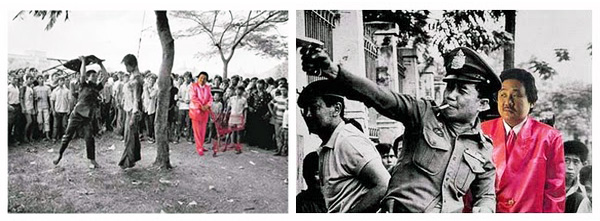
While Pink Man is, as curator Ark Fongsmut suggests, a “presenter of questions who travels to various places…appear[ing] when there is an incident of abnormal phenomenon and arri[ving] looking indifferently at his surroundings”, his indifference ceases in what could be considered the most provocative of the Pink Man series, Horror in Pink (2001). Pink Man appears once more, digitally slotted into photographs of the dramatic events of the 6 October Massacre in Thailand in 1976, where left-wing student protests were violently clamped down by the army and paramilitary forces that stormed the Thammasat University in Bangkok. Joining the lynching as a superimposed, amused spectator, Pink Man ironically builds into this reconstructed piece of history an increased, tangible sense of fractured identity, his vulgar presence heightening the disservice to justice and the instability of a political institution whose sense of democracy is at best, dysfunctional.

Manit Sriwanichpoom, Horror in Pink series (2001), artist's collection

Manit Sriwanichpoom was born in 1961 in Bangkok, Thailand and has exhibited in shows such as the 6th Asia Pacific Triennial (2010), the 6th Gwangju Biennale (2006), the 1st Pocheon Asian Art Festival (2005) and the 50th Venice Biennale (2003). Guest-curated by Ark Fongsmut and co-organized by the Singapore Art Museum and the Singapore International Photography Festival for the 2nd Singapore International Photography Festival 2010, Phenomena and Prophecies runs at the Singapore Art Museum at 8Q until 7 November 2010.

Share

A Gentle Art of Disappearing

True story: A student goes to his teacher for instruction. The guru, having observed him, says, “You are charming. This is an obstacle to your growth. From now on, when you are in a room of people do nothing, do not seduce them and do not charm them, but leave behind only a scent.” “What scent is that, teacher?” “Love.”

I’ve heard this story a couple of times from a friend (a friend of the student in the story, in fact) who brings it up when personal or social ambition is troubling someone. As I’ve understood it, the instruction of the guru is meant as an antidote to an hidden, ego-driven desire to possess people through charm. The lesson, to be generous and give (subtly, invisibly, almost) rather than take, without imposing oneself, seems an impossible instruction. I’ve sometimes wondered if it is a Zen koan meant to quiet the mind for meditation rather than a directive for actual application. I try to imagine what would occur if one truly attempted this as a way of moving through the world? Leaving only a slight impression of one’s presence, rather than an indelible mark. I’m not referring to the question of one’s legacy (that’s out of one’s control and indicative of too high-self regard, if not hubris), but to the simple, daily interactions with people. Conceiving of a convincing way in which one could leave people with an unnamable sense of love without being overbearing (missing the mark, therefore) at worst or wishy-washy (unconvincing) at least escapes me.

Robert Morris, Box with the Sound of its Own Making, 1961. Walnut box, speaker, & three-and-one-half-hour recorded tape

As impossible as it is for me to convince myself of this as a practical approach seems, I can understand it, at least a little, when I think of artists like Yves Klein, Lee Lozano, Robert Barry and Tino Sehgal, for example. Not that they achieved enlightenment, but that their artistic practices, at least in part, turn away from the art object in favor of something less immediate. This, of course, is not a new identification. Lucy Lippard noted it decades ago in Six Years: The Dematerialization of the Art Object from 1966 to 1972.

I think of these artists and their attitude towards the art object as being one focused on an art of disappearing. In my mind, their work is a kind of inversion of Robert MorrisA Box With The Sound of its Own Making, artworks that depict their own leaving, dispersal or intangibility. A few examples will hopefully illustrate what I have in mind.

Yves Klein Receipt for Immaterial Zone of Pictorial Sensibility, 1959

Yves Klein sold Zones of Immaterial Pictorial Sensibility, indicated by a receipt, to collectors for sums of gold. To fully complete the transaction, for the collector to truly receive the immaterial zone, the collector would have to submit to a ritual in which the receipt was torn up and half of the gold (in the form of gold leaf) was disposed of in the Seine.

Lee Lozano "Dialogue Piece" 1969

Lee Lozano recorded events undertaken as art (getting high for a month, talking with other artists) in notebook pages distributed in the form of photocopies. These documents, far from providing clarity or details offer more absence than presence. Reading them underlines the fact that the moment is long gone, the conversation limited to the participants and the high felt only by the toker. She herself disappeared (in a sense) decamping from the New York art world in her Removal Piece, which lasted (at least) until her death in 1999.

Robert Barry released gasses into the atmosphere and documented these invisible acts with photographs and written descriptions.

Robert Barry "Inert Gases: Neon" 1969

Tino Sehgal, a contemporary artist, choreographs experiences, triggered by precise occurrences (entering a gallery, asking a question, engaging with an attendant) that have no physical presence outside of the performative moment. He has pushed the furthest in removing the object from his work. He produces no certificates of authenticity or documentary photographs and even prohibits wall labels to indicate works on exhibition.

It is clear that the works that I’ve described suggest that absence can be presence, but most (the exception is Sehgal) rely on documentation to refer back to the work and so are not completely disembodied. It is my contention, that this is not a failure, but an important element in the meaning of these works.

These works most clearly exist as vehicles for thought or consideration. Ultimately, they exist in the mind of the viewer, rather than in their fallible embodied forms. In this way the documentation acts like Proust’s madeleine, calling to mind important thoughts and events long gone. Furthermore, though the documentation can be sold as an artwork and, therefore held privately, the work itself is available to all who would hold it in their minds, carrying it in their memories for enjoyable or productive consideration.

Peter Paul Rubens "Neptune Caling the Tempest" 1635

As I’ve thought about these works, I’ve noticed that this is true for all art objects. I remember my experience seeing Massacio’s Trinity in Florence and can live in that memory, fully, knowing that my mind was changed by that encounter. The difference is that I then want to buy a plane ticket. When I think about, say, Klein’s zone of pictorial sensibility, I just want to think.

Finally, when I think about an art object that I love, Ruben’s Neptune Calming The Tempest, not only do I want to possess it, but I am possessed by it. When I think of a work of art, on the other hand, created with the intention of its not remaining in a fixed physical form, if it ever had any, then I am already in full possession of it, but still free.

Share

Stick the Landing: Dieter Roth and Björn Roth, Work Tables & Tischmatten at Hauser & Wirth

Bürotisch-Matte, Bali-Mosfellssveit, 1994—1996

When I was in art school, there was a painting professor who would shock new grad students by propping their palettes up next to their paintings and explaining, in great detail, why the palette was aesthetically superior. The students were crushed. How could a perfunctory manipulation of materials possibly be more successful than their über-personal paintings? He’d then rebuild their egos until they painted exactly like him, but I think he had it right the first time—materials are everything.

For Dieter Roth (1930 – 1998) everything in life was potential fodder for work. He brought a kitchen sink approach to the German concept of Gesamtkunstwerk that included rotting food, photographs, paint, crayons, film, sound and all sorts of random crapola. Although it could be considered a bit OCD, Roth saved the gray mat boards that covered his worktables and considered them objects d’art in their own right. Called Tischmatten (German for table mats), these works are currently enjoying their own lofty retrospective at Hauser & Wirth.

Forcierte Matte (Abandonnements=Etüde), 1983—1993

The best Tischmatten seem barely able to contain the avalanche of stuff that came across Roth’s desk. In Bürotisch-Matte, Bali-Mosfellssveit, layers of photos, Q-tips, straws, ribbons and drawings cling impossibly to the surface. Similarly, Forcierte Matte (Abandonnements=Etüde) includes gravity-defying plops of acrylic paint that give the work a visual heft that is lacking in the rest of the show. Although a couple of the early works are daringly spare, the magic is lost when the sheer number of alike works visually reduces them to a few stains, a math problem and a couple of paint squiggles. Unfortunately, and although it goes against Roth’s conceptual ethos, some editing might have worked in his favor.

Table Hegenheimerstrasse, 1980—2010

In the upstairs gallery, entire desk set-ups have been reinstalled as sculptures. Empty chairs and desks make the artist’s absence palpable. I tried to picture the famously reclusive Roth doodling away at these desks while ignoring calls from curators and galleries but somehow the whole thing felt sanitized. They’re way too boring to be good sculptures and way too clean to serve as some sort of studio period piece. Rather, they feel like lonely archival shrines that just scream “dead artist.”

Kaffeetisch-mit-Telefonecken-Matte, Bali/Mosvellsveit (with Björn, Karl, Vera Roth and others), 1990—1993

Despite the dialog surrounding Roth’s work, which tends to focus on its abject qualities, a warm sentiment creeps into the Tischmatten that were family collaborations. Reluctant to play along with conventional art world systems, Roth included his family into his working process. Kaffeetisch-mit-Telefonecken-Matte, Bali/Mosvellsveit (with Björn, Karl, Vera Roth and others) reads like a haphazard scrap booking project as a chessboard mixes collage-like with photos and childlike drawings. Given the long history of male artists isolating themselves in their studios, it’s nice to see that Roth was a dad who didn’t care if the kids spilled stuff in his.

Share

From the DS Archives: Peter Marigold

One of those people that straddles the design and fine art world, the work of Peter Marigold is thoughtful, finely crafted and really gorgeous. From the DS Archives invites you to revisit the work of Marigold, a British Design Awards 2010 nominee.

This article was originally written on September 28, 2007 by Ian Curcio.

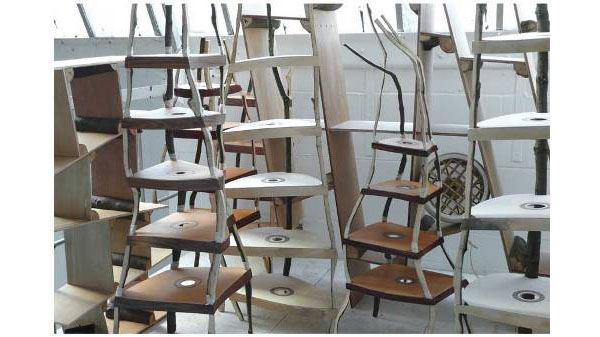
British designer Peter Marigold’s obsession with storage has led him to do several pieces where he studies how geometric phenomena can be the basis for creating structures. This year’s Split Series was based on the 360 principle, splitting a form into angled pieces and then inverting them achieves a total of 360 degrees. While his work may be based in geometry, his pieces flow poetically and seamlessly. Marigold is among a group of emerging designers showcased in Grandmateria at the Gallery Libby Sellers in London. The exhibition was launched during the London Design Festival but will continue through October for the Frieze Art Fair. Part of the group at OkayStudio, Marigold has designed installations for the Paul Smith headquarters and was featured in the British Council’s Great Brits: Ingenious Therapies exhibition. The Central St. Martins graduate has his MFA in design from the Royal College of Art.

Share

Royalty, Servants, and Discourse at MEME Gallery

Documentation of 5 Objects, courtesy of MEME Gallery and Jodie Lyn-Kee-Chow

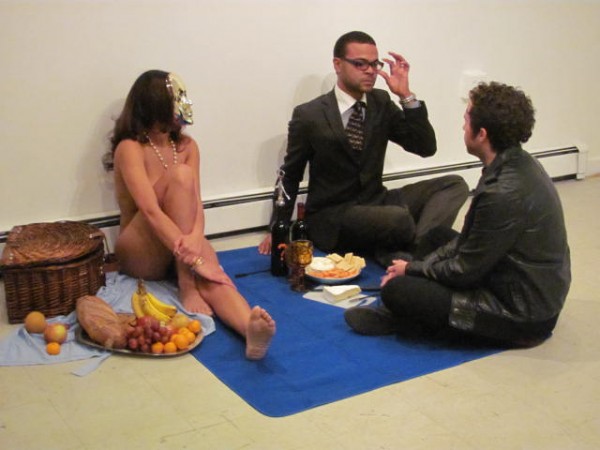
On Saturday night, 5 Objects, a series of performances inspired by a group of objects, introduced Jodie Lyn-Kee-Chow to an audience at MEME Gallery in Cambridge, MA. She transformed herself into a masked and nude member of Royalty and allowed her lucky subjects to join her for a picnic. Jodie Lyn-Kee-Chow‘s winsome man-servant listened to her whispers, spoke to the commoners for her, and performed the labor her Majesty demanded of him. This presence and absence of the artist was the central focus guiding this performance. Simultaneously demanding attention and yet unapproachable by virtue of her authority, the norms of social power were brought to the forefront. Her ability to host, and your obligation to accept her invitation influenced the entire event.

Next to perform that evening was PrincessDIE, who presented her seven month old son to the audience. Her daily assistance to her son was laid bare through feeding and burping him as the Princess was made auxiliary, a mom-servant to “the demon child sprung forth from her cleft.” She brought the attention back to her son over and over, physically presenting him to each member of the crowd multiple times. DIE submissively focused the crowd on her demon child, forcing an encounter with him to ensure the level of attention demand by her child.

Documentation from the first night of first night at Quai #1, courtesy of MEME Gallery and Bob Raymond

MEME is an ongoing project founded two years ago by six performance art veterans. After their first year of programing, the group was reduced to Dirk Adams, Vela Phelan, and Alice Vogler. Each spent more than ten years organizing performance art events primarily around Boston, spending untold hours negotiating for spaces and permission to host their events. As the economy grew sour, and fewer spaces were willing to donate or lend themselves for an evening, it became inevitable that they would need to self-fund a space. The inauguration of MEME Gallery allows for the lengthy prep work required of intricate multi-day productions and performances.

With 5 Objects barely cleaned out, MEME is now preparing for a three day performance art exchange with Taxi!, a collective based in Montreal. Quai #1 (subtitled Boston/Quebec exchange project in Performance Art) was founded in conversations at 2010’s Transmuted festival in San Luis Potosi, Mexico. It might be better titled an interchange, as there are more questions than answers in regards to how these two groups will interact. Quai #1 initiates a series of performances linking their practices that will extend to Quebec in spring 2011. Saturday, Oct 16, at MEME, they will hold a performance laboratory, an open-ended workshop exploring formal and conceptual frames in a public forum as groundwork for further cooperative liaisons.

Share