Women of California Coolness

L.A. Expanded: Notes from the West Coast
A weekly column by Catherine Wagley


Frank J. Thomas, photograph of Irving Blum, John Coplans, and Shirley Nielson Hopps. Courtesy Pasadena Museum of California Art.

Back when L.A. art was in its adolescence, critic Peter Plagens asked painter John Altoon why being an artist couldn’t just be about making work:

I used to say, “John, what about the artist who just goes into his studio, paints paintings and tries to make them the best that he can? What about an artist that just does that?” He said, “[Ed] Kienholz goes out at night in his pick up truck and tries to find them and run them down.” Meaning, if you’re a real guy it’s all about that power structure.

Real artists, of course, were not just guys, but guys with balls who knew how to strut.

Vivian Rowan, who entered L.A.’s machismo-filled scene as gallerist Irving Blum’s assistant and left as artist Craig Kauffman’s ex-wife, has a theory about the group’s maximal mannishness: “They didn’t have much control—over their careers, their lives. But they could control what was immediately around them, and boy did they.” And what did the women do? “They serviced the men, it was as simple as that,” says Shirley Nielson Blum in The Cool School, a documentary about L.A.’s earliest art studs. She continues, eyes watering vaguely, “They put up with it, and they cheered, and they cried. They cooked.”

Nielson Blum, an art historian with a delicately smart face, wrinkles in just the right places and hair that’s a golden sort of white, is a careful talker. Her voice, and the polished observations it offers, provide much of the narrative cohesion for the 2003 documentary. She never talks about herself, but nearly every time she appears, a slightly different name is at the bottom of the screen. She is Shirley Nielson, the art history student who becomes Shirley Nielson Hopps, the wife of acclaimed and eccentric curator/gallerist Walter Hopps. Sometimes, she is referred to as just Shirley Hopps, no maiden name. When she leaves Hopps for his ex-partner Blum, her name actually changes on-screen from Shirley Hopps to Shirley Blum. At the end of the film, she’s Shirley Nielson Blum, with a clarifying subtitle: “Ex-wife of Walter Hopps and Irving Blum.” She has lived through the man-centric period of L.A. art and effectively divorced herself from it. This makes her a vested but resigned expert, regal like a former diplomat.
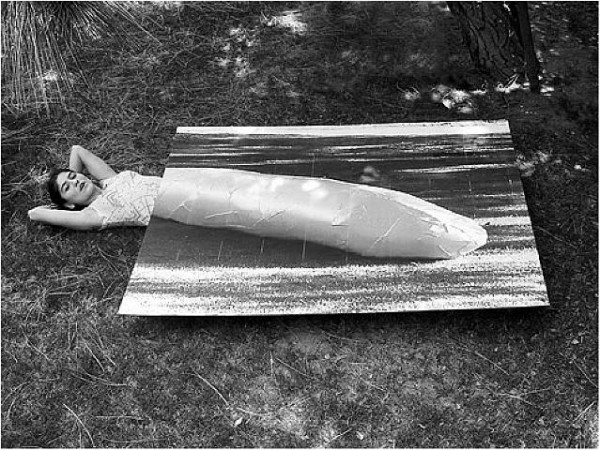
Carlee Fernandez, "Self-Portrait As Franz West's Sculpture," C-Print, 2006. Courtesy the artist.

Much of the work I have most wanted to think about lately has been made by L.A. women and has a deeply aware coolness that reminds me of Nielson Blum. It also has a surface-conscious breeziness that seems to both channel and re-imagine the mood of the early Cool School.

Stanya Kahn’s It’s Cool, I’m Good, which I have praised in this column before,  displays a breeziness that’s broken down and almost numb. Currently on view at the California Biennial, the video shows a bandaged, slightly androgynous body moving  through the California landscape, sitting by the beach, driving through open space or down main city streets, eating at hot dog stands, loitering in Beverly Hills. All those elements that made L.A. an ideal home for Light and Space appear, and while It’s Cool, I’m Good is narrative video, it has the attitude of a Ken Price ceramic–sun-soaked, goofy, globular, yet precise–coupled with a darker subjectivity that makes California cool seem like a coping mechanism rather than a birthright.

Carlee Fernandez also has work in the Biennial, an installation/performance called Life After Death in which her own body lies roguishly, playing dead beside a taxidermy leopard, a gun, a Davy-Crockett-worthy jacket, and other paraphernalia reminiscent of a colonial explorer. In the past, Fernandez has photographed herself  in the guise of men she admires–Franz West, Charles Bukowski, Werner Herzog, her father–and the casualness with which she inhabits these male idols exposes masculinity as performance while indulging in frank and genuine tribute.

Stanya Kahn, "It's Cool, I'm Good," Video Still, 2010. Courtesy Susanne Vielmetter Los Angeles Projects.

This last September, Fernandez’s ACME exhibition, World According to Xavier, treated motherhood with refreshing distance. It included hybridized and exotic taxidermy animals, along with a few videos in which Fernandez and infant Xavier roll around in linked but divided Franz-West-style cocoons. She gave her son what struck me as a generous gift, treating him with the same critical admiration she’d awarded male icons, and presenting her world and his as attached, co-dependent but always separate.

Then there’s Rachel Lachowicz’s muscular and clean-edged exhibition at Shoshana Wayne, the material of which is as synthetically sleek as anything used by her Cool School predecessors; Amanda Ross Ho at Cherry and Martin, whose characteristic slanginess has been tightened, making her work seem “cool” in a composed and but still stereotypically sprawling L.A. way; and Alexandra Grant, now in the Artist’s Museum at MOCA and the California Biennial, whose recent paintings have been sunnier, more dumb-fisted and, again, Ken-Price-like in their globular gracefulness.
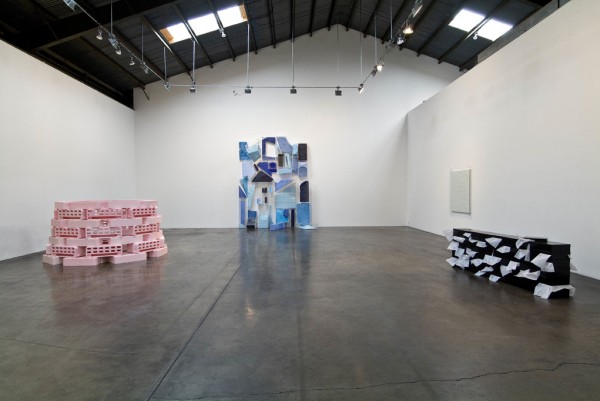
     Rachel Lachowicz, Installation View, 2010. Courtesy Shoshana Wayne Gallery.

Rachel Lachowicz, Installation View, 2010. Courtesy Shoshana Wayne Gallery.

At the end of The Cool School, Shirley Nielson Blum has the last word:

The great sadness as I look back on it now, is that in that little space, in that space of time, . . . there were major beautiful works to be seen by anybody. You could walk in, you could get close to them, you could stay as long as you wanted. . . . Most people walked by, and that was sad.

I like to think that the California women, the ones making the smartest work right now, walked in and got close (not literally but essentially, since most were born either during or well after The Cool School’s prime), and figured out how to take the beauty they saw and recapitulate it, so that it became less exclusive and less brutish, but kept its cool.

Share

The Foster Prize finalists at the ICA Boston

The Foster Prize at the ICA Boston is one of the perennial Boston happenings where we take part in our favorite pastime: complaining. We complain about it from beginning to end investigating the minutia, gossiping about the motivations behind nominations, and frowning at the notion that any of the art could be worth our time. This worthwhile award has been slighted in recent years as a launching program for conceptually based artists who work for certain galleries. If that were true in the past, it is not true this year.

The nine Foster Prize finalists work and (with one exception) teach in the greater Boston area. The prize reflects the reality that for Boston, teaching is one of the more popular day jobs. It also reflects the dearth of commercial opportunities available. If I am not mistaken, only two of the nine artists have long-term gallery representation locally, and the vast majority provided work from their own archives for the show. Not that the conspiracies should be thoroughly discounted, but it’s time to pay attention to the work.

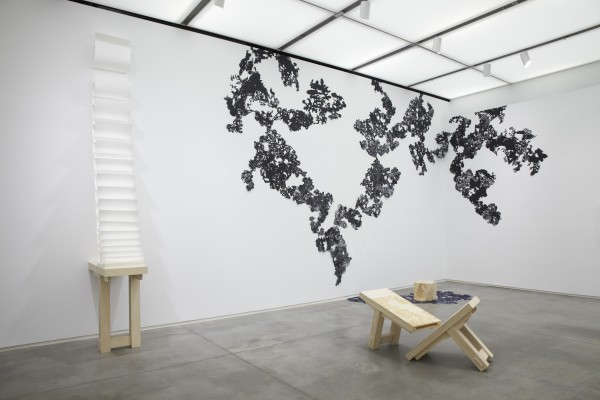
Fred Liang-- courtesy of ICA Boston

Fred H.C. Liang’s papercut wall pieces, accordion book, and sculptural table look great in the ICA. His work can overwhelm a given space and look out of place, but the ICA yields to his grand gestures and the work looks at home here. His work is highly constructed, both formally polished and coded with personal meanings. His table sculpture, a stand-in for the cultural break that is inevitable when emigrating between countries lays in two pieces, broken and rendered unstable. Though still connected and related, there is now a gulf between the two ends, and the role of support and the linked bond is erased from this object.

His cut paper installation relies on the techniques of ancient craft (Jian Zhi) while contemporary abstraction forms his distinctive visual language. He codes messages of family, gender and communication in the patterns that mix geometry and natural motifs. A box laying on the floor included with the cut paper points to the relationship between women in his family, and invisible knowledge handed down between the generations.

This installation is very private, and could be faulted for being abstruse. Rather than directly expose all the information he leaves hints that reveal themselves with further study. Walking past quickly, you could easily see a bunch of stuff that looks pretty, but with patience it discloses powerful substance.

Eirik Johnson, Ficus Tree Grove, 4:02 Minutes Exposure-- courtesy of ICA Boston

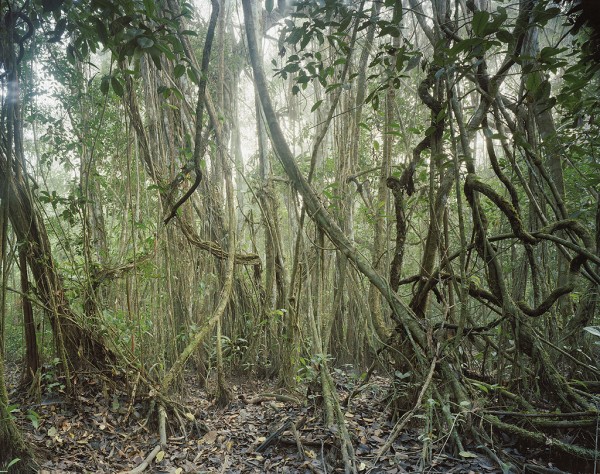
Eirik Johnson’s long-exposure photographs of the rain forest complete with recorded sounds stands out as one of the most conceptual works in the show. Easily confused for a piece of memorabilia from his time visiting Peru this installation challenges the viewer’s focus. Instead of Johnson presenting the things in front of him, he asks us to be inspired by transforming our experience into a self-aware moment. We mentally transition from Boston to Peru for the time it took to take the photographs. The wall text disagrees, but I believe the wall text protests too much. The photographs and recorded sound locate the artist in space and our experience is secured with his.

Unlike a video, which rewards the viewer with motion and change, this static image tests the viewer’s stamina to listen and look. This furthers the formal photographic practice that he has become known for. Though we can happily view works on display for 5 minutes, when faced with the time based experience of this series, we become self-aware and uncomfortable. The work produces a nervous energy, awkwardly timing your engagement with it. Our need to see the entire museum in the time we have conflicts with the idea that we should experience this work fully and exclusively focus on one work at a time.

Rebecca Meyers Night Side-- courtesy ICA Boston

Rebecca Meyers is the one non-professor up for the prize. She didn’t escape the pull of our local colleges though, as she is the director of film programs at Emerson College. Her 16mm films rely on strong and romantic visual language. She speaks in a visual poetry, distilling experiences down to heightened moments of awareness.

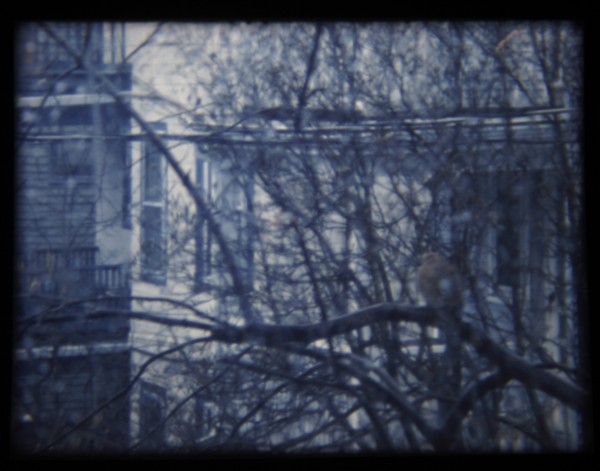
Glow in the Dark seems as if it started as a camera test of low light conditions that grew into a metaphor of seasonal change and productiveness. This film was an adjustment after walking through the light-soaked galleries. The shades of darkness and distant glowing electric orbs in windy and freezing conditions create an emotional emptiness. These lights burn in the open cold and illuminate nothing. Instead of the light reflecting off of things, we are left with the intensity of the light vacant against a dark background. These autonomous suspended lights, seem unsettled and incapable against the world around it.

In Night Side she focuses on windows. and division.  Windows allow us visual access to the world but protect us from it at the same time. In her film we see various animals outdoors– the squirrel is protected from the wind and cold behind its bushy tail like we are protected behind our windows. This thin buffer is challenged when she records the lights reflecting off of the window’s double pane. As the window creaks and flexes, the double reflection of household lights sway and move for the camera. The light’s dance goes in tune with the wind that cannot reach us.

Meyers’ visual language is effortless, relying on elevating everyday items we may overlook into expressive motion captured by film. One of the more haunting motifs in Night Side is of lights concealed. The same hopeless lights from Glow in the Dark are burning in this film, but now they are also blocked from reaching our eyes by things. What may be the moon peaks out from behind the frost on a window. Another light pokes out from behind tree branches that veil it. What that light is we don’t know.

The Foster Prize is a Biennial award and exhibition. This year’s finalists are Robert De Saint Phalle, Eirik Johnson, Fred H. C. Liang, Rebecca Meyers, Matthew Rich, Daniela Rivera, Evelyn Rydz, Amie Siegel, and Stephen Tourlentes. The exhibition is up through January 17, 2011. The winner will be selected in December.

Share

Perfect Game: Raymond Pettibon, Hard in the Paint at David Zwirner

Rajon Flocka James in the house!

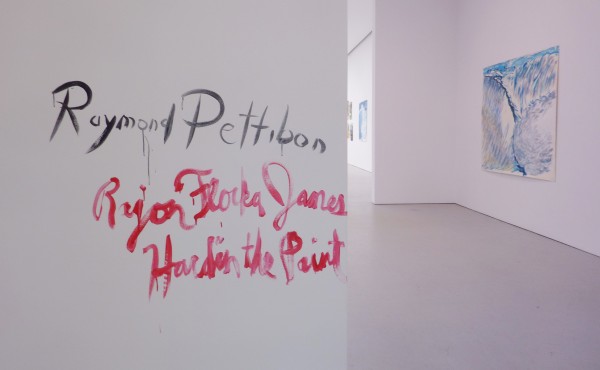
The title of Raymond Pettibon’s current show at David Zwirner, Hard in the Paint, riffs on basketball, art making, the Southern hip-hopper Waka Flocka Flame and maybe even the YouTube parody Baraka Flocka Flame. By signing the gallery wall “Rajon Flocka James,” Pettibon, whose given name is Raymond Ginn and is no stranger to cultivating an artistic persona, is partaking in a little fun. He seems to have relaxed—a tiny bit—from his mad-as-hell 2007 show, Here’s Your Irony Back (The Big Picture), which was the penultimate Fuck Bush show of the ‘00s.

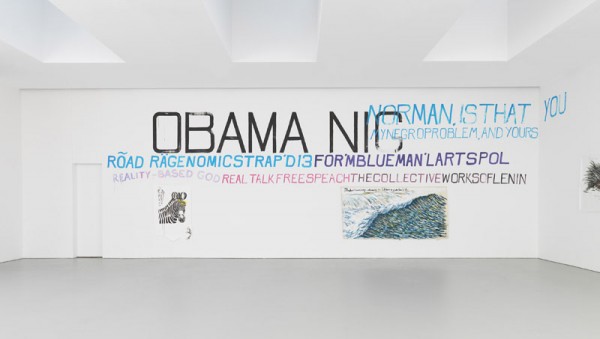
Hard in the Paint mines the American subconscious by mixing political content with Pettibon’s trademark surfing, baseball, and locomotive imagery. The result is a more nuanced critique of nationalism than straight-ahead rage. For instance, a large wall text combines the words “Obama nig,” a phrase based on the famous right-winger Norman Podhoretz, and a personalized take on Regeanomics that reads “rõad ragenomicstrap.” Rather than flirting with a Dr. Laura moment, Pettibon captures all of the undercurrents in the current American scene: the Tea Party’s screams of socialism, the role of religion, free speech and race.

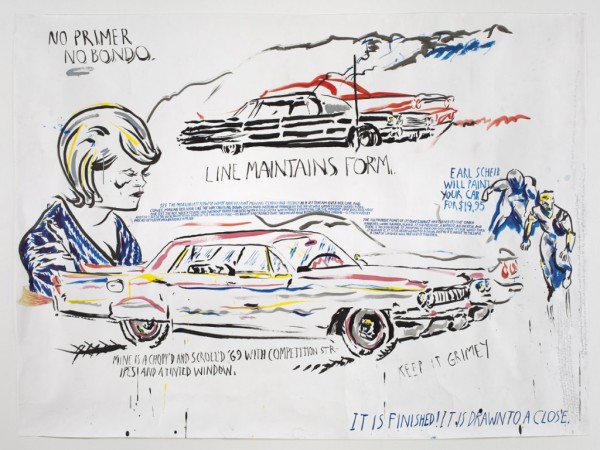
Raymond Pettibon, No Title (No Primer No Bondo...) 2010. 56 x 76 inches

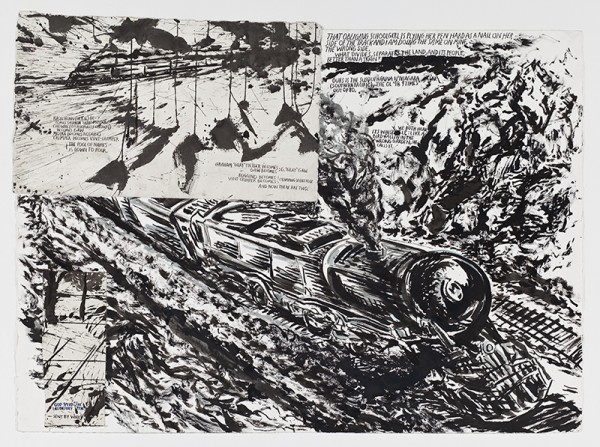
Pettibon is no leftist cheerleader however—he distrusts the whole system. The disastrous greed of Imperialism is reflected in works that combine post-WWII iconography with the grim reality of failure. Pettibon’s ball players, trains and Cadillacs call to mind the obsolescence of America’s golden era—his baseball pitchers always seem to screw up a perfect game in the 9th, trains aren’t nearly as prominent as they once were, and cars just don’t look very forceful anymore. In the same way that the television show M*A*S*H was set in the Korean War but was really meant to portray Vietnam, Pettibon’s fixation on mid-20th century America translates just as easily to now.

Raymond Pettibon, No Title (Where's the green...) 2010. 30 x 22 1/8 inches

Global annihilation by threat of the atomic bomb also seems to have a special place in Pettibon’s heart.  Mushroom cloud scenes like No Title (Where’s the Green…) depict a coming-of-age and sexual awakening in the shadow of the bomb. Many of his explosions are seen from cinematic angles—he understands how deeply ingrained the Hollywood version of America, the one where we’re all extras and stunt men in some sort of spectacularly exploding drama, really is. Although he deals in the guilt-ridden imagery of those schlocky booklets that crazy religious people hand to you on the street, Pettibon’s scenes are so convincing that you just can’t turn away. No one combines war, surrealism, and the sublime better.

Raymond Pettibon, No Title (That obliging schoolgirl...) 2010. 30 3/4 x 41 7/8 inches

All nostalgia aside, Pettibon’s greatest asset might be his wide-ranging intellectual curiosity.  Works about the fast food industry, advertising, philosophy, history, fashion and pop culture offer up just a few of the things that are on his mind in this ambitious show. Where hardcore punks are supposed to be screw-ups, and comic books were originally thought to be for dummies, Pettibon emerges as the hardest working smart guy in the room. Unlike rappers like Waka Flocka, Pettibon never brags about money, even though he’s got plenty. Unlike classic rock bands when they hit the ‘80s, Pettibon never went synth. Even though his biography gets overplayed, the secret to his success might be that success seemingly never went to his head. Sure, his work often relies on conspiracy theories and an easy sense of pathos, but he always gives his subjects a gravity that makes them seem alive. He doesn’t care about lame art school issues of composition or whatever—he just wants the train to feel like it’s crushing off the paper through bullets of dripping rain.

Share

Have you been inside ‘The Bubble’?

It’s the burning question floating around London’s artworld these days. The number of smug souls who have entered James Turrell’s giant sphere at Gagosian Gallery slowly grows as the days pass, while others desperately long to get inside and experience first-hand what the buzz is all about.

James Turrell, Bindu Shards, 2010. Mixed media, 421 x 653 x 607 cm. Image Courtesy of Gagosian Gallery.

For decades, the illustrious Californian artist has used light as his medium. His aspirations have never been modest. From transforming the Roden Crater in the Arizona desert into an astronomical observatory for the last thirty years, to the ongoing Perceptual Cells series informed by his studies in experimental psychology, Turrell seeks to transform our perceptions. He constructs environments that allow us to open our eyes and mind, and ‘see‘ in a way we have never before. Part of the Perceptual Cells series, Bindu Shards (2010), is an immersive psychedelic experience concocted by Turrell, who mixes light and sound to create a drug-like potion with all the fervour of a mad scientist.

If you have secured one of the much sought after appointments (Bindu Shards spots filled within 48 hours of opening bookings), you are one of the lucky ones, able to confidently stride up and drop your name with the same prestige of being on the VIP list at a highly exclusive event – while a gallery of observers look on enviously.

James Turrell, Bindu Shards, 2010. Mixed media, 421 x 653 x 607 cm. Image Courtesy of Gagosian Gallery.

The spaceship-like structure of Bindu Shards seems to have landed straight out of a 1970s futuristic sci-fi film – the present as envisioned in the past. The impossibly chic, labcoat-wearing technician, who herself could have come from the same film, asks you a series of questions – Do you suffer from seizures? No. Have you taken any illicit drugs today? No. Which setting would you like – Hard or Soft? Sign the disclaimer and you’re in.

Leaving all your possessions behind to lie in a small white drawer, the technician rolls you inside. ‘Relax. And Enjoy,’ she says as the door slams shut – ‘And remember – there’s a panic button to your left if you need it…’

Hypnotic colors begin to wash over you in quintessential Turrell-like fashion, accompanied by resonating sonic tones meant to aid your passage into the alpha state of consciousness – somewhere between waking and sleeping. The intensity escalates as the light pulsates and shimmers, approaching you and in an sudden shift, fuses with your eyes. It is extremely disconcerting, however if you relax and ‘turn on, tune in, drop out,’ you will be rewarded.

A visitor entering Bindu Shards, 2010. Photo credit to Johanna. http://www.flickr.com/photos/johanna/

Bindu Shards is truly an immersive experience – and least of all because of the environment. What Bindu Shards does is infiltrate your mind, overtake your synapses and blur the boundaries between what is real and what is not. Vision predicated on what you see in front of you is destroyed in favor of perception that stems from the inside – it is a completely new way of retinal ‘seeing’ based on what the mind produces in response to light and sound – it is in your eyes.

The fifteen minutes spent alone with your visions of light are intense, and most definitely not for the faint of heart. What you create, what you see and what you take away on your ‘trip’ is unique. You emerge with your possibilities for perception infinitely expanded and like a drug, long to go back for more.

With Turrell able to transform our state of consciousness so drastically within this tiny bubble, we can only await with breath that is bated to experience what he has spent the last three decades concocting at the elusive Roden Crater.

Share

Serial Killers

The serial artist does not attempt to produce a beautiful or mysterious object but functions merely as a clerk cataloging the results of his premise. – Sol Lewitt

Operating on logical relationships that rule out unpredictability, seriality, as Jean Baudrillard argued in decades past, is a phenomenon inextricably tied to industrial production and modernity. To those who live in the twenty-first century some half a century later since Baudrillard’s pronouncement, seriality is the comfortable, complacent but reassuring – if not mundane – lull of continuity that contains few, or if any, unexpected surprises. The examples of seriality are many and remain constantly unquestioned: weeks-long drama serials that do not always have an end in sight, the serial numbers found on the outer packaging of daily necessities that hint at the gargantuan processes behind their mass production – all of them caught in continual (or endless) processes of production whose beginnings or the ends few people have the opportunity to witness.

Argie Bandoy, Untitled #2, Collages and mixed media on paper, 28 x 20.6 cm, 2010. Image courtesy of Taksu gallery

To artists like Andy Warhol and Sol Lewitt, seriality meant a rebellion against a romanticized standard of art as a wholly distinctive and non-replicable product of an artist’s personal vision. Consisting of the repetitive, patterned production of images or objects that reflected the mechanics of mass production and the sterile, impersonal processes that formed the backbone of twentieth-century society, serial art’s modular, homogeneous precepts provided a semblance of order and routine through measured logic and its subsequent rational output. Lewitt’s series of drawings and obsession with cubic structures for instance, consisted of the repetition of basic forms and lines in systematized arrangements adhering to strict patterns in an effort to serially reproduce images. Neither illustrative nor denotative, Lewitt’s forms were meant to be intuitive, prioritizing ideas that spawned it above its physical nature. To Lewitt’s contemporary Andy Warhol, seriality was spawned in the multiplication of images via the silk-screening techniques of mass production, his works of replicated soup cans and images of celebrities parodying mechanization’s threat to artistic uniqueness.

But to destroy notions of seriality might just be akin to the destruction of coherence and structure, releasing a wave of arbitrariness that sweeps through the repetitive and ordered mainstream, as suggested in Serial Killers: From Tate Modern to TAKSU Singapore, a fusion of works by several contemporary Filipino artists as they consider the consequences of deconstructing institutions of order.

Jason Oliveria, Ten Shit 6, Oil, collage and mixed media on paper, 28 x 20.6 cm, 2010. Image courtesy of Taksu Gallery

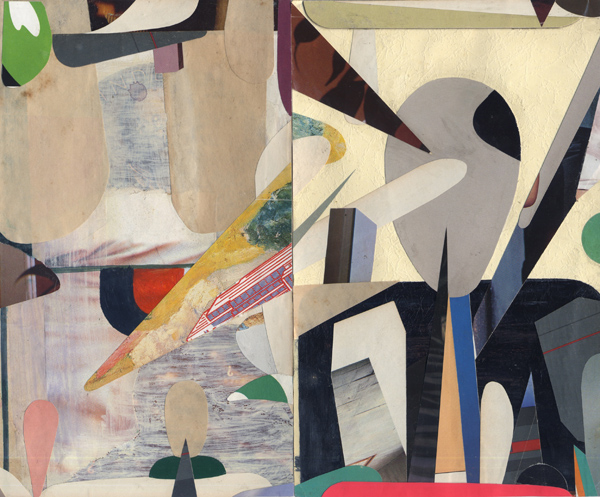
Artists like Jayson Oliveria and Condardo Velasco seem to unanimously conclude that the elimination of structure and method is to introduce randomness and unpredictability, coupled with the excitement of layering a new – and not necessarily sensible – narrative atop that which already exists. In Oliveria’s Ten Shit (2010), Velasco’s Metallurgy of Desire (2010) and Argie Bardoy’s mixed media collages, the perfunctory canvas – whether they are the backdrop of an advertisement of a branded item or an aged photograph – is defaced by a collision of forms that obscure strategic features of the original background, deterring the formation of any coherent narrative.

Conrado Velasco, Metallurgy of Desire #4, Collage with silver tinsel on paper, 30 x 22 cm, 2010. Image courtesy of Taksu gallery

In these works, a superimposed series of images and forms hint at what each might represent to the individual viewer – an already arbitrary move in the work – but remain sufficiently devoid of reason so as to reject the axiomatic principles and rational intellect that are resonant in serial art. Gary Ross Pastrana’s Stray Bullets (2010) is not unlike Bardoy’s collage, a work that invites stabs-in-the-dark kind of guesswork – attempts that invariably end in an intellectual cul-de-sac. Take for example, Pastrana’s canvas’s (imagined) right half could appear to resemble the top-body collage of a male office worker in a suit and a tie, or even an over-stretched artist’s palette; such subjective and flawed interpretations are merely concessions of the infinite possibilities of meaning that puncture the monotony and knowablility of seriality. If the role of the artist is to empower the viewer to gain access to a particular aesthetic vision, the process of discovery here, is halted before it even begins.

Gary-Ross Pastrana, Stray Bullets 1, Collage 20.3 x 25.4 cm, 2010. Image courtesy of Taksu gallery.

The alternatives to serial killing do not always however, involve tentative steps through unchartered territory; the intense, Dionysian elements running amok in most of Serial Killers exhibits are curiously absent from Norberto Roldan extremely ordered Quelques Fleurs: Assemblage with found objects (2010). In each box, Roldan’s found objects recur in an almost predictable, composite arrangement: a sepia photograph is tacked to the center of a larger brand advertisement, like a sentinel guarding an unknown reality beyond our reach and comprehension, surrounded by common, locally available objects (cosmetic tubes, a toy figurine, empty bottles). Roldan’s mathematically calibrated grid-assemblage is itself a troubled text in pursuit of layered metaphors of continuity and change, mass-production and individuality. As it maintains a dialogue with or even reinforces the discourse of seriality and consumerism that engaged Lewitt and Warhol half a century ago, the assemblage’s strange beauty sidesteps the brilliant hues of Pop Art or the visceral abstraction of Conceptualist Art in favor of muted nostalgia.

Simply put, the divergent paths of aesthetic convictions that Serial Killers leads us through are polemical and unanticipated. If the uncertain terrain that we are escorted into by the works of these artists who try to delineate the limits of seriality is as much dependent on our sustained engagement, the elusive meanings behind them leave us in an unreferenced mire of artistic wilderness.

Norberto Roldan, Quelques Fleurs Assemblage with found objects, 122 x 183 cm, 2010. Image courtesy of Taksu gallery

Serial Killers: From Tate Modern to TAKSU Singapore was brought to the TAKSU gallery in Singapore after a run in the No Soul for Sale Festival at the Turbine Hall of Tate Modern, London, earlier this year. An exhibition program started in 2008 by independent artist-run initiative Green Papaya Art Projects in Manila, Serial Killers explores parallel themes of seriality, non-seriality or counter-seriality – producing art works in groups or series.

The exhibition is a part of the Philippine Art Trek IV 2010, organized by the Philippine Embassy in Singapore. The exhibition runs at the TAKSU gallery until November 27, 2010.

Share

Today from the DS Archives: Walter Kitundu

Today, From the DS Archives reintroduces you to Walter Kitundu, an artist with an extraordinary range and incredible energy. Kitundu continues to add to his repertoire—working in sound, photography, design and more—my new favorite being his bird blog.

This article was originally written by Arden Sherman on November 21st, 2008.

The cryptic sounds of hidden nature, wild animals, and native cultures are not only found in the numerous stacks at the Library of Congress or between the grooves of an exotica record. Artist Walter Kitundu utilizes these very sounds and ideas in his acute musical compositions. Sound artist, instrument maker, and composer, Kitundu finds a harmony between traditional musical forms, nature and sculpture. He has created an array of instruments including the Phonoharp, a multi-stringed instrument made from a record player, and the Ocean Edge Device, a life-size structure which utilizes wave motions to create a composition. These elements and Kitundu’s fascination with birds, geology, water, and air have led to various projects and installations throughout the United States and Europe.

The Bay Area artist is a 2008 recipient of the MacArthur Fellowship and is a current artist in residence atHeadlands Center for the Arts. Kitundu has collaborated widely with notable artists and musicians such asMatmos and Kronos Quartet and has been appointed the 2008 Wornick Visiting Distinguished Professor of Wood Arts at California College of the Arts.

Share

Hauntology at Berkeley Art Museum

Today’s article is from our friends at Art Practical, where Renny Pritikin discusses the exhibition, Hauntology, at the Berkeley Art Museum.

Hauntology, co-curated by Larry Rinder and Scott Hewicker, at the UC Berkeley Art Museum, posits that the past inhabits the present in the same way that an individual’s past shapes how he perceives and acts in the present. By extension, art history and contemporary art are not so much in an ancestor-descendent relationship as they are roommates cohabiting the studio and the gallery. As roommates will, the past and present forever borrow from each other’s wardrobes; that is, the past and the present are not two things but one, participating in a constantly evolving mutual creation of meaning.

Paul Sietsema. Ship Drawing, 2009 (detail); ink on paper, diptych; 50 3/4 x 70 in. Courtesy of the Artist and Matthew Marks Gallery, New York.

One of my teachers, the late Stan Rice, said that if you can’t title a work, you haven’t figured out what it is about. The flip side of this flip remark is that you can title a project and ignore the title; this practice is endemic to the stated themes of art biennials and is something that curators can do in their smaller exhibitions, as well. A provocative title can finesse the flaws in obscurely or randomly assembled objects. At the same time, it is no secret that public institutions’ collapsing budgets make relatively inexpensive shows sourced from museums’ permanent collections desirable—as are shows of recent acquisitions. Hauntology is a group show of some fifty works, mostly recently acquired objects augmented by older pieces from the Berkeley Art Museum collection. An intelligent and economical endeavor gussied up with reference to Jacques Derrida, Hauntology nevertheless contains many wonderful individual art pieces and some very touching or clever arrangements.

After walking through a photography exhibition that juxtaposed works from the history of photography in groups of twos, threes, and fours, the late photographer Larry Sultan remarked that he preferred the sets in which he was forced to ponder what exactly the curators had seen that he at first failed to see, as opposed to those in which he found the shared thematic threads more obvious. Halfway through Hauntology, two medium-size works are placed to the left and right of the entrance to the second gallery. Essentially identical at first glance, the two works, Abstract Painting #3 (1960), by Ad Reinhardt, and an untitled work (2008–09) by Carina Baumann, appear to be grayish black monochromes.

Paul Schiek. Similar to a Baptism, 2007; chromogenic print; 30 x 40 in. Courtesy of the Artist and the UC Berkeley Art Museum.

The Reinhardt contains a nearly invisible rectangle of a slightly different hue at its bottom center. The Baumann, on close inspection, reveals a face emerging from the gloom. Two artists, one living and one dead, separated by the gulf of an empty wall, collapse time by addressing the same retinal phenomenon from the point of view of two different generations.

The exhibition is at its best when the curators avoid the spooky-for-its-own-sake. As wonderful as death-drenched folk art can be—who can resist an eighteenth-century mourning embroidery for a lost-at-sea husband?—Twirling Wires (2001), a Roger Ballen photograph of a bald man, wrapped in a blanket at the bottom of the print and cowering beneath an unexplained gigantic ball of razor wire, is far more uncanny. Similarly, Okyo’s 1750 Ghost of Oyuki—the wall label suggests that Oyuki is the source for much of the manga stylebook—is great fun. However, sussing out the relationship between one of Vincent Fecteau’s always-perfect shelf sculptures and Mitzi Pederson’s large 2009 untitled floor-based mixed media is much more satisfying and moving.

Julia Couzens, an underappreciated Sacramento artist, is represented with a charcoal drawing. Being Exposed #41 (1991) definitely depicts something organic—a body part or a vegetable—but I couldn’t describe it in any other way than to say that it is inarguably luscious. Nearby is a dreamy watercolor by Laurie Reid and Nocturne (1878), a James McNeill Whistler riverscape that is shrouded in mist. D.L. Alvarez’s drawing titled Dead (2009) depicts young people at a rock concert, transfixed, in a grouping that includes Goya’s famous Sleep of Reason (1799) and explores people sleeping or swooning.

Paul Sietsema’s 2009 diptych Ship Drawing is a large drawing that suggests a found and damaged photograph of a two-masted nineteenth-century sailing vessel that evokes the (ever-creepy) legendary Flying Dutchman ghost ship. The left-hand panel appears to be the back of the same print or an erased version of it. This kind of exercise—a haunting of Rauschenberg’s 1953 Erased de Kooning—is as evocative as anything else in the show. Finally, Paul Schiek’s Similar to a Baptism (1977) is a photograph of foamy ocean turbulence in which the splashing water suggests the arms of an octopus, among which can be seen a swimmer’s head. It is a perfect metaphor for Hauntology’s argument that we are all just trying to keep our heads above water amid a flood of images, memories, associations, and histories.

Hauntology is on view at the UC Berkeley Art Museum through December 5, 2010.

Share