Best of 2010
Summer of Utopia: Interview with Ted Purves

Whew. For DailyServing, 2010 was a full year — 365 days of arts coverage from our 25 writers around the world, three new week-long series, our new weekly column, L.A. Expanded, and great new interviews with some of the world’s most high profile artists. For this last week of the year, our writers have selected their favorites for you to revisit.

But, we want to hear from you! Send us your favorite articles to info@dailyserving.com this week, and tell us why you love it. If chosen, your selected post and your comment will also publish as part of our Best of 2010.

Magdalen Chua selected Bean Gilsdorf‘s interview with Ted Purves from our series Summer of Utopia, saying “it’s hard to choose a favorite article, but I enjoyed reading the interview by Bean Gilsdorf with Ted Purves. I admire the way Ted Purves has thought about his process and intentions for producing work which, in today’s context, seems formulaic, and also his immense contribution to discussion on social change and art. ”

Ted Purves and Susanne Cockrell, Temescal Amity Works (July 2004-January 2007).

Today, DailyServing continues our 7-day summer series, Summer of Utopia, where we investigate seven different artists who either employ or interrupt ideas of utopia. Full disclosure: Ted Purves was the first person I met at the California College of the Arts and—despite the fact that I don’t work in relational aesthetics—one of the reasons I decided to apply to their graduate program. He is the editor of the seminal book What We Want Is Free and founder of the country’s first MFA in Social Practice. Last week he took some time to discuss utopia, democracy, morality, and the success of the projects he creates with his partner Susanne Cockrell.

Bean Gilsdorf: I listened to your interview at Bad At Sports and you said, “I’m not a utopian in any way” and that intrigued me. Tell me how you’re not a utopian, working in social practice.

Ted Purves: Let’s think about what the utopian project is: generally, to design a coherent social system that satisfies all basic needs. Thomas More created this very intense class structure, and utopia saw to the needs of the upper and middle classes. It’s really horrifying, utopia, because it’s the idea of agreement about what a perfect society is. We don’t live in times of agreement or tribal identity or singular religious identity. We live in a situation of disagreement and negotiation. I’m much more interested in the notion of democracy rather than the notion of utopia, because it allows for the possibility of negotiation and change and alteration. Democracy is about the peaceful negotiation of disagreement.

BG: Has that come up in your work, like the Temescal Amity Works, that feeling of negotiating disagreement? Where has that come in for you guys?

TP: I wouldn’t say that we’ve actively looked at disagreement in our projects. We’ve been working from another starting point: the position of economies in people’s lives and how exchange functions. Even though we tend to think of ourselves as living in this highly capitalist market economy, we actually live within several different economic systems all at the same time. Getting paid and going shopping is participating in a larger capital economy, but giving a friend a lift to the store is a different, casual kind of economy. Not all of our relationships are of cliency and payment. We are interested in the way people are negotiating between competing or overlapping economies within their own lives, and creating a way to see that there are different ways to view your own personal economy. For instance, the projects about sharing fruit were about getting people to think about latent caloric energy that’s growing in the neighborhood, free of charge, at the same time that people are going out to stores to maintain their bodily lives. It’s getting people to see that we’re living in one system where we’re working to get money to buy calories when, yet, there’s another production of calories that’s going on…

BG: …aside from that, parallel with that…

Ted Purves and Susanne Cockrell, Temescal Amity Works (July 2004-January 2007).

TP: …yeah, right under our noses, that’s not being used. And how do you create a project that illuminates this other kind of economy? One project I admire is The Blue House project. It’s a really interesting counter-utopian project because it’s about creating a space for unplanning, a space for ongoing negotiation and debate in a highly planned suburb—even though the idea of that suburb wasn’t necessarily to be a utopia. I think there is a utopian interest in most kinds of civic planning because they are based on the idea that there is a perfect fix or a mostly-perfect decision to make about how you apportion resources, how you set up where people are going to live, what people need, and what’s going to make them happy.

BG: There seems to be a kind of benevolence that underlies a lot of these projects, and I wonder if you guys think about that explicitly in your work. Does morality enter into this at all?

TP: I don’t know if morality does because from our “negotiation-and-disagreement” mindset, morality is another sort of thing that is always going to be disparate among people, so it’s always going to be a negotiated space. We’re interested in working with the public and in public spaces to learn what people think and how people perceive public space around them. We start a lot of these because we don’t know everything about a situation and we’re curious about it, and we are interested in creating opportunities for research and dialogue with people.

BG: So you start with a question?

TP: Exactly. Temescal Amity Works started with questions: What is the history of the neighborhood that so many fruit trees were planted here? How do we negotiate the idea of the developed economy of the neighborhood? And that’s given way to a larger set of questions that we’re thinking about: how does the social imagination continue to drive people’s decisions, beliefs, lifestyle choices? What kinds of social imaginaries regarding the rural inhabit the minds of people in cities?

Ted Purves and Susanne Cockrell, Lemon Everlasting Backyard Battery, San Jose Institute for Contemporary Art (2008).

BG: When do you feel a project is successful? What makes you go home and high-five each other at the end of the day?

TP: I feel like a project is successful if we have had substantive encounters with people, if we have created spaces where a kind of exchange—whether it’s family history, or talking about why something should or shouldn’t be in an art museum, or sometimes it’s just swapping recipes—some form of animated or engaged dialogue comes out, or some sort of story emerges. It means we learn something, a story can be brought forward from that, that’s when things are successful. Another high-five moment comes when there is something compelling to look at. A lot of times when you see a social practice show, it’s either a room full of crap to read, or it looks like a place where they had a party and you didn’t get to go. I’ve been to a lot of those, and they’re not satisfying! You either wish they had just printed a book you could take home and read in your own chair—because it’s not very comfortable to sit in a museum—or you wish that you’d been at the party. When we did Lemon Everlasting Backyard Battery we had hundreds of jars of lemons on this table, and it was beautiful.

BG: It sounds like bringing aesthetics back into it is important.

TP: Yes, certainly when there’s a material expectation for it to be art. [Lemon Everlasting] was great for us, because it got to be beautiful-looking, but it also got to do something; two things were happening in the same space. It occupied the institution and it challenged the institution in ways that were playful, functional and aesthetically critical. Aesthetics are important. Obviously some artists don’t think this way. They can just go in and do straight up exercises, and by the rules of the game that’s art too, but for us there’s got to be something else, a twist, a different way of seeing. We’re working in public space, so we need to challenge public expectations, a kind of weirdness, wrongness, whatever that might be.

BG: Do you think of projects as iterative? Would you want to restage that project, or do something similar someplace else? Or have the questions been answered and now you can move on to other questions that have been formed by the outcome?

TP: That’s a great question. I think it depends from project to project. I would definitely say that you never answer all the questions. The new thing we’ve been working on is this ongoing newspaper project, The Meadow Network. We structured it in a specific way because a thing like Temescal Amity Works was such a Herculean effort that you don’t want to do it again! We created TMN so that there was an option to have a repeatable form that could grow on itself, so that we wouldn’t have to reinvent an entire project every single time… That only half answers the question: I think it is good to have some projects or programs that are sort of open-ended but able to be temporarily concluded, because some questions don’t go away.

Share

Best of 2010
A Gentle Art of Disappearing

Whew. For DailyServing, 2010 was a full year — 365 days of arts coverage from our 25 writers around the world, three new week-long series, our new weekly column, L.A. Expanded, and great new interviews with some of the world’s most high profile artists. For this last week of the year, our writers have selected their favorites for you to revisit.

But, we want to hear from you! Send us your favorite articles to info@dailyserving.com this week, and tell us why you love it. If chosen, your selected post and your comment will also publish as part of our Best of 2010.

This article by Andrew Tosiello was selected by Rebecca Najdowski.

Robert Morris, Box with the Sound of its Own Making, 1961. Walnut box, speaker, & three-and-one-half-hour recorded tape

True story: A student goes to his teacher for instruction. The guru, having observed him, says, “You are charming. This is an obstacle to your growth. From now on, when you are in a room of people do nothing, do not seduce them and do not charm them, but leave behind only a scent.” “What scent is that, teacher?” “Love.”

I’ve heard this story a couple of times from a friend (a friend of the student in the story, in fact) who brings it up when personal or social ambition is troubling someone. As I’ve understood it, the instruction of the guru is meant as an antidote to an hidden, ego-driven desire to possess people through charm. The lesson, to be generous and give (subtly, invisibly, almost) rather than take, without imposing oneself, seems an impossible instruction. I’ve sometimes wondered if it is a Zen koan meant to quiet the mind for meditation rather than a directive for actual application. I try to imagine what would occur if one truly attempted this as a way of moving through the world? Leaving only a slight impression of one’s presence, rather than an indelible mark. I’m not referring to the question of one’s legacy (that’s out of one’s control and indicative of too high-self regard, if not hubris), but to the simple, daily interactions with people. Conceiving of a convincing way in which one could leave people with an unnamable sense of love without being overbearing (missing the mark, therefore) at worst or wishy-washy (unconvincing) at least escapes me.

As impossible as it is for me to convince myself of this as a practical approach seems, I can understand it, at least a little, when I think of artists like Yves Klein, Lee Lozano, Robert Barry and Tino Sehgal, for example. Not that they achieved enlightenment, but that their artistic practices, at least in part, turn away from the art object in favor of something less immediate. This, of course, is not a new identification. Lucy Lippard noted it decades ago in Six Years: The Dematerialization of the Art Object from 1966 to 1972.

I think of these artists and their attitude towards the art object as being one focused on an art of disappearing. In my mind, their work is a kind of inversion of Robert MorrisA Box With The Sound of its Own Making, artworks that depict their own leaving, dispersal or intangibility. A few examples will hopefully illustrate what I have in mind.

Yves Klein Receipt for Immaterial Zone of Pictorial Sensibility, 1959

Yves Klein sold Zones of Immaterial Pictorial Sensibility, indicated by a receipt, to collectors for sums of gold. To fully complete the transaction, for the collector to truly receive the immaterial zone, the collector would have to submit to a ritual in which the receipt was torn up and half of the gold (in the form of gold leaf) was disposed of in the Seine.

Lee Lozano "Dialogue Piece" 1969

Lee Lozano recorded events undertaken as art (getting high for a month, talking with other artists) in notebook pages distributed in the form of photocopies. These documents, far from providing clarity or details offer more absence than presence. Reading them underlines the fact that the moment is long gone, the conversation limited to the participants and the high felt only by the toker. She herself disappeared (in a sense) decamping from the New York art world in her Removal Piece, which lasted (at least) until her death in 1999.

Robert Barry released gasses into the atmosphere and documented these invisible acts with photographs and written descriptions.

Robert Barry "Inert Gases: Neon" 1969

Tino Sehgal, a contemporary artist, choreographs experiences, triggered by precise occurrences (entering a gallery, asking a question, engaging with an attendant) that have no physical presence outside of the performative moment. He has pushed the furthest in removing the object from his work. He produces no certificates of authenticity or documentary photographs and even prohibits wall labels to indicate works on exhibition.

It is clear that the works that I’ve described suggest that absence can be presence, but most (the exception is Sehgal) rely on documentation to refer back to the work and so are not completely disembodied. It is my contention, that this is not a failure, but an important element in the meaning of these works.

These works most clearly exist as vehicles for thought or consideration. Ultimately, they exist in the mind of the viewer, rather than in their fallible embodied forms. In this way the documentation acts like Proust’s madeleine, calling to mind important thoughts and events long gone. Furthermore, though the documentation can be sold as an artwork and, therefore held privately, the work itself is available to all who would hold it in their minds, carrying it in their memories for enjoyable or productive consideration.

Peter Paul Rubens "Neptune Caling the Tempest" 1635

As I’ve thought about these works, I’ve noticed that this is true for all art objects. I remember my experience seeing Massacio’s Trinity in Florence and can live in that memory, fully, knowing that my mind was changed by that encounter. The difference is that I then want to buy a plane ticket. When I think about, say, Klein’s zone of pictorial sensibility, I just want to think.

Finally, when I think about an art object that I love, Ruben’s Neptune Calming The Tempest, not only do I want to possess it, but I am possessed by it. When I think of a work of art, on the other hand, created with the intention of its not remaining in a fixed physical form, if it ever had any, then I am already in full possession of it, but still free.

Share

Best of 2010
Young Eva’s “Ghastly Visages”

Whew. For DailyServing, 2010 was a full year — 365 days of arts coverage from our 25 writers around the world, three new week-long series, our new weekly column, L.A. Expanded, and great new interviews with some of the world’s most high profile artists. For this last week of the year, our writers have selected their favorites for you to revisit.

But, we want to hear from you! Send us your favorite articles to info@dailyserving.com this week, and tell us why you love it. If chosen, your selected post and your comment will also publish as part of our Best of 2010.

Bean Gilsdorf selected one of Catherine Wagley‘s articles from her column L.A. Expanded, saying “this essay continues to resonate with me because it discusses the artist’s persona (mythic and otherwise) in addition to the work and its historical context. ”

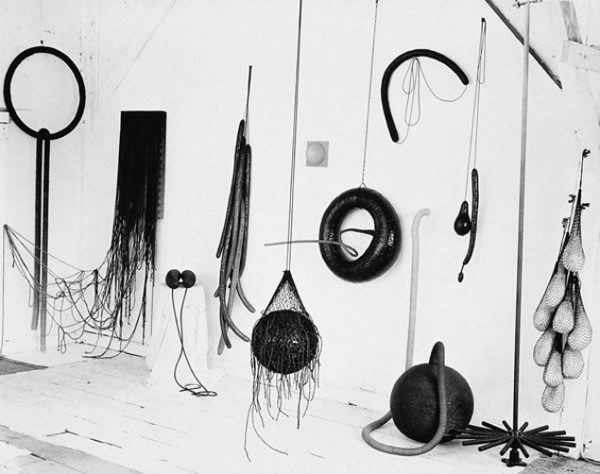
Eva Hesse's Studio, 1965-66

Eva Hesse's Studio, 1965-66

There are many ways to mask yourself, some more effective than others, and artists—the good ones—venture further into the business of masking than most. They’re also deep into unmasking, balancing the urge to reveal with the need to conceal. This is a more pragmatic than emotional project; even if artists tend to be an idiosyncratic and sensitive breed, art-making has to do with communicating, and effective communication involves strategy. Letting it all hang out rarely gets the job done right.

By the time of her premature death in 1970, Eva Hesse had a well-developed strategy: she’d learned to expose enough heart, flesh and gut while still maintaining the austere restraint of a minimalist. This hadn’t come easily. She’d hacked through years of personal baggage, purged herself of abstract-expressionist tendencies, fought the urge to mimic the work of her older artist-husband, Tom Doyle, sought pep talks from friend Sol LeWitt (who told her to “do more”), and worked incessantly—all to get to that tender severity that made her both a darling and a force within the rapidly expanding world of conceptual art.

Because I am a fan of the oeuvre Hesse built in the years preceding her death and protective of the process she went through to hone it, I’m resentful of anything that downplays her savvy in favor of some tragic artist myth. For this reason, I was suspicious of Eva Hesse: Spectres 1960 before it even opened. Now on view at The Hammer Museum, the exhibition features expressionistic paintings Hesse made soon after graduating from Yale, and promises to foretell her “desire to embody emotion in abstract form.” It seemed destined to play into the mythology that has so disserviced Hesse’s legacy: that of the tortured soul, gone too soon (as if Hesse, like Sylvia Plath, a figure to whom she’s often been illogically linked, died with her head in an oven and not in a hospital bed, of terminal illness). And it does, but in a weirder, more convoluted way than I expected.

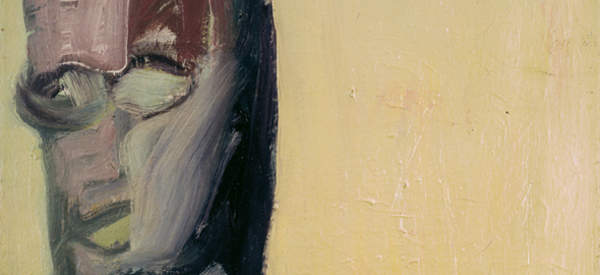
Eva Hesse, No title, Oil on canvas, 1960. Ursula Hauser Collection, Switzerland.

The wall text next to one of the first self-portraits in the exhibition, a vague image that conjures a cross between Willem de Kooning and Edvard Munch, reads, “this forceful and haunting group [of portraits] shows how the artist masked her real beauty behind ghastly visages.” A recent blog post from Yale Press, the publisher of the Spectres catalogue, echoes this idea of beauty obscured, describing a 1959 photo of Hesse that illustrates Helen Molesworth’s catalogue essay:

Only twenty years old, with soft brown hair, pale skin and a warm smile, Hesse is the figure of youth and beauty; a muse of subtle but erotic flirtation. Looking at her paintings from four years later, the viewer is wrenched from this superficial complacency, and thrust instead into a world fraught with pain, fear, insecurity, and alienation.

Certainly, Hesse was warmly attractive and, certainly, the figures in these early paintings are harrowing (and also funny, like the cross-eyed figure with a perfectly circular head and upside-down boat for a hat). Some cathartic need probably even propelled her to paint them, though it likely had less to do with a desire to hide beauty than to get at the knottiness of personhood. But the paintings mainly look like a young artist’s young work, attempts to wade out of the influence of Gorky or de Kooning to arrive somewhere more lucid.

Eva Hesse, No title Oil on canvas, 1960. Ursula Hauser Collection, Switzerland. And Eva Hesse, No Title, Oil on canvas, 1960. The Museum of Modern Art, New York, gift of Mr. and Mrs. Murray Charash.

The Spectres paintings are nicely composed–in one, a gorgeous blue-red stroke interrupts muddy brownishness that pervades the rest of the image; in another, the face is sectioned off in what could easily be a brutal homage to Matisse’s Green Stripe. They also tend to be perfectly balanced, and, if off-kilter, only slightly. “I have confidence in my understanding of the formal,” said Hesse, in the final, 1970 interview she gave to Cindy Nemser. “Those problems are solvable. I can solve them…beautifully.” But she had bigger, more compelling problems to tackle.

In Hang Up, a sculpture Hesse completed in 1966 (she later said she would’ve titled it differently if she’d been in the U.S., not Europe, and understood how the words “hang up” were being used), an empty frame wrapped in painted clothe has a steel rod extending out from it in a gangling loop. Hesse said it reminded her of rigidly bandaged broken arm: “It’s the most ridiculous structure I have ever made and that’s why it is really good.” The strategic mask Hesse chose–one of rigid, formal obsessiveness interrupted by heartfelt absurdity–emerged around the time of Hang Up and got bolder and more refined over the next four years, as she made work like the borderline sadistic Accession and dumbly repetitive Schema.

Before she died, Hesse asked a studio assistant to destroy a few select sculptures; he did so. However, unlike a number of her contemporaries and almost-contemporaries–Agnes Martin, Jasper Johns, John Baldessari, among others–she never obliterated what she’d made before she came into her own. If that’s a gift, it’s a dangerous one. What bothers me most about the way Spectres is framed is that it purports to give a glimpse into an early Eva, a Hesse who masks “real beauty” and grapples with “ghastly visages.” Really, what we’re glimpsing is a mask a young artist tried on and rejected before making herself one that fit much better.

Share

Best of 2010
Interview with Wangechi Mutu

Whew. For DailyServing, 2010 was a full year — 365 days of arts coverage from our 25 writers around the world, three new week-long series, our new weekly column, L.A. Expanded, and great new interviews with some of the world’s most high profile artists. For this last week of the year, our writers have selected their favorites for you to revisit.

But, we want to hear from you! Send us your favorite articles to info@dailyserving.com this week, and tell us why you love it. If chosen, your selected post and your comment will also publish as part of our Best of 2010.

This selection is from Aimée Reed.

Wangechi Mutu, "Royal Blue Arachnid Curse", (view of piece installed with damaged wall), 2005, ink, collage, contact paper on Mylar, 77 1/2 x 51 1/2 inches, Courtesy of the artist and Susanne Vielmetter Los Angeles Projects; Photo credit: Joshua White. Collection of Henry Kravis, New York

In February 2010, Kenyan-born, New York-based artist Wangechi Mutu was named the Deutsche Bank’s “Artist of the Year.” Her accompanying exhibition, My Dirty Little Heaven will open later this month at the Deutsche Guggenheim Museum in Berlin. Recently, DailyServing’s Aimée Reed had a chance to catch up with Mutu at her studio in Brooklyn to discuss her upcoming show, as well as the con-current exhibition This You Call Civilization?, at the Art Gallery of Ontario (AGO).

Aimée Reed: Tell me about the two exhibitions. Will both shows at AGO (open until May 23rd, 2010) and Deutsche Guggenheim (April 30th – June 13th, 2010) feature works from the same series simultaneously?

Wangechi Mutu: No. They both come from quite a wide range of different works. AGO happened to have contacted me to work with them earlier than the Berlin folks. For example they have installation works such as The Ark Collection (a work that consists of four large vitrines displaying postcard-sized imagery of women from African Art) and Sleeping Heads (drawings of severed heads that are installed on a “damaged wall”, or a wall containing perforated holes that evoke wounds), which are both memorable and significant pieces. They also have a lot of my larger collages, the catalog Shady Promise (published by Damiani) and video works.

Read More »

Share

Best of DS 2010
Danielle Nelson Mourning: Homecoming

Whew. For DailyServing, 2010 was a full year — 365 days of arts coverage from our 25 writers around the world, three new week-long series, our new weekly column, L.A. Expanded, and great new interviews with some of the world’s most high profile artists. For this last week of the year, our writers have selected their favorites for you to revisit.

But, we want to hear from you! Send us your favorite articles to info@dailyserving.com this week, and tell us why you love it. If chosen, your selected post and your comment will also publish as part of our Best of 2010.

This  selection is from Allison Gibson.

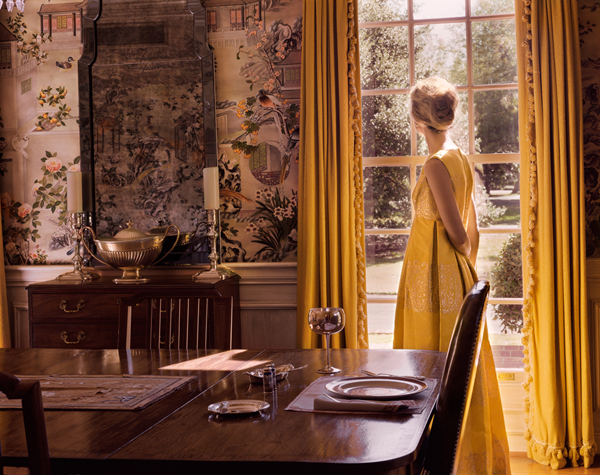
Annelle's Cornbread (Marks, Mississippi), 2006. Courtesy the artist and Taylor De Cordoba, Los Angeles.

I’m a sucker for a storyline involving a protagonist’s search for identity across generations and distant lands. More often than not this fascination is satisfied by reading a novel or watching a film, maybe listening to a three-verse country song. It’s not often that such a sprawling narrative emerges from within a work of art, but such is the case with the series of photographs by San Francisco-based artist Danielle Nelson Mourning in her debut solo exhibition at Taylor De Cordoba Gallery in Culver City.

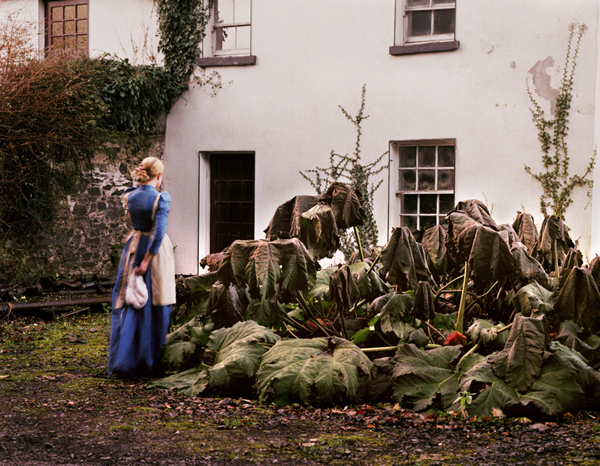
Homecoming presents large-scale ink jet prints of the artist’s pilgrimage across the country and the Atlantic to understand herself and her ancestry. This is no documentary, though; Mourning has visited old family homes in Marks, Mississippi and Niagara Falls, New York to make self-portraits in which the self is more fictional than real. She assumes the dress and style of domestic women from decades past, recalling in part Cindy Sherman’s Complete Untitled Film Stills, though in a decidedly less aggressive way. Mourning goes to Ireland as well to recreate haunting scenes of life during the potato famine of 1845. The work is endearing in its earnest investigation of family history and self, and in its multidimensional presentation of women of certain eras and of domestic life. It seems to be an intensely personal practice, as if the project would mean as much to the artist regardless of whether it had an audience. Sometimes work comes across as so prepared for an audience that there is a paucity of the artist’s own identity, but there’s none of that here.

Rhubarb (Cavan County, Ireland), 2006. Courtesy the artist and Taylor De Cordoba, Los Angeles.

The most affecting work in the show is the 8mm film, Memories from a Pleasant Visit, which mimics vintage 8mm home movies authentically with its camera shake, jumpy scene cuts and film noise. In it, the characters from Mourning’s Mississippi and Niagara Falls photo narratives are brought to life, though there is still a sense of disconnect between the intent of the characters as they move about, and any narrative that the viewer should draw from the quick scenes. Perhaps the film is the least narrative piece in the show because its presentation of ideas is so hectic, like scraps from the reel of life lying in disjointed piles on the cutting room floor of one’s mind. I actually wonder if I’ve ever been more taken with a work of video art, however. Maybe I relate to each of these divergent female characters, respond to grandma’s chatter as she flips through old photo albums, and possibly—most of all—enjoy the private thrill of being frightened by the subtle Hitchcockian tones of the film. The dull tapping of ivory keys, the lone voice of a choir girl singing, the black-and-white footage capturing the manic twirling of a woman in a gown—it’s chilling. But more so, it’s entrancing.

Paten Circle II (Marks, Mississippi), 2006. Courtesy the artist and Taylor De Cordoba, Los Angeles.

Danielle Nelson Mourning lives in San Francisco, CA. She earned her MFA at Royal College of Art, London. Her work has been included in several group exhibitions, including at Headlands Center for the Arts, Sausalito; Hoopers Gallery, London; and the Karlovy Vary International Film Festival, Prague. Homecoming closes today, June 26. The film Memories from a Pleasant Visit can also be viewed at this link.

Share

Best of 2010
Perfect Game: Raymond Pettibon, Hard in the Paint at David Zwirner

Whew. For DailyServing, 2010 was a full year — 365 days of arts coverage from our 25 writers around the world, three new week-long series, our new weekly column, L.A. Expanded, and great new interviews with some of the world’s most high profile artists. For this last week of the year, our writers have selected their favorites for you to revisit.

But, we want to hear from you! Send us your favorite articles to info@dailyserving.com this week, and tell us why you love it. If chosen, your selected post and your comment will also publish as part of our Best of 2010.

Andrew Tosiello selected this article by Michael Tomeo, saying “I love this one because I can’t get the last line out of my head. Mike Tomeo writes like a guy riffing over beers at a bar called “The Bus Stop,” listening to Led Zeppelin and giving a damn about art, all while telling you that it’s not that big a deal.”

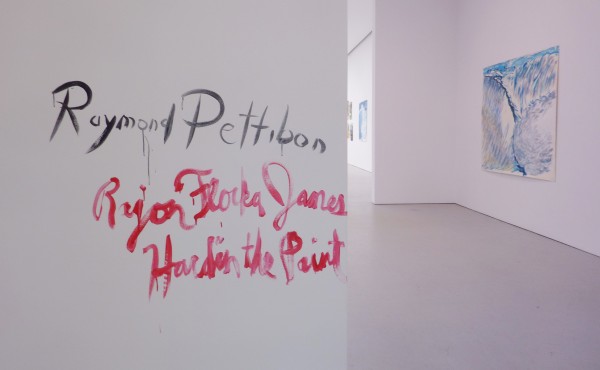
Rajon Flocka James in the house!

The title of Raymond Pettibon’s current show at David Zwirner, Hard in the Paint, riffs on basketball, art making, the Southern hip-hopper Waka Flocka Flame and maybe even the YouTube parody Baraka Flocka Flame. By signing the gallery wall “Rajon Flocka James,” Pettibon, whose given name is Raymond Ginn and is no stranger to cultivating an artistic persona, is partaking in a little fun. He seems to have relaxed—a tiny bit—from his mad-as-hell 2007 show, Here’s Your Irony Back (The Big Picture), which was the penultimate Fuck Bush show of the ‘00s.

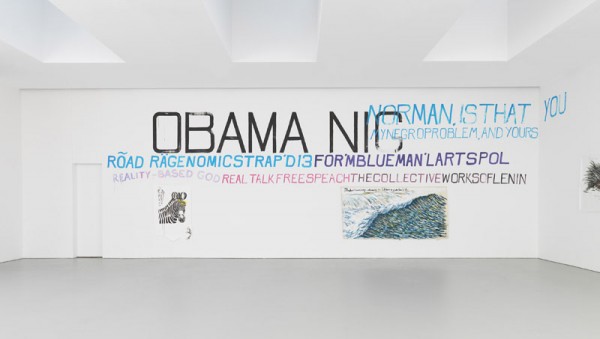
Hard in the Paint mines the American subconscious by mixing political content with Pettibon’s trademark surfing, baseball, and locomotive imagery. The result is a more nuanced critique of nationalism than straight-ahead rage. For instance, a large wall text combines the words “Obama nig,” a phrase based on the famous right-winger Norman Podhoretz, and a personalized take on Regeanomics that reads “rõad ragenomicstrap.” Rather than flirting with a Dr. Laura moment, Pettibon captures all of the undercurrents in the current American scene: the Tea Party’s screams of socialism, the role of religion, free speech and race.

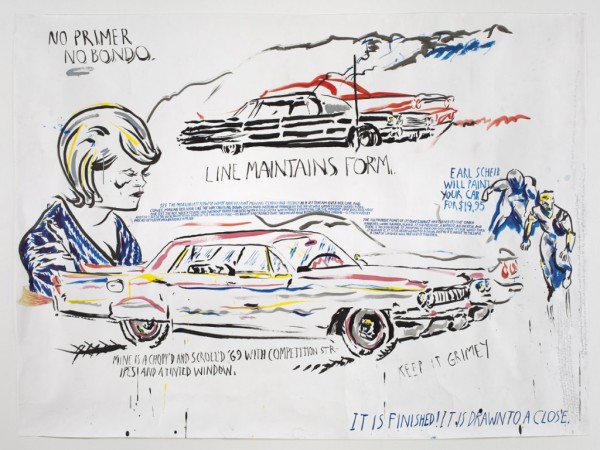
Raymond Pettibon, No Title (No Primer No Bondo...) 2010. 56 x 76 inches

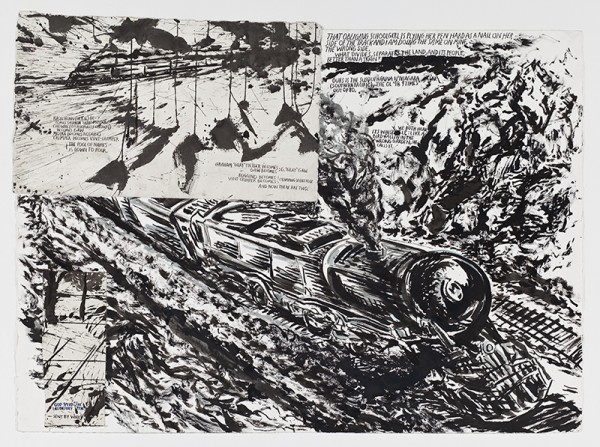
Pettibon is no leftist cheerleader however—he distrusts the whole system. The disastrous greed of Imperialism is reflected in works that combine post-WWII iconography with the grim reality of failure. Pettibon’s ball players, trains and Cadillacs call to mind the obsolescence of America’s golden era—his baseball pitchers always seem to screw up a perfect game in the 9th, trains aren’t nearly as prominent as they once were, and cars just don’t look very forceful anymore. In the same way that the television show M*A*S*H was set in the Korean War but was really meant to portray Vietnam, Pettibon’s fixation on mid-20th century America translates just as easily to now.

Raymond Pettibon, No Title (Where's the green...) 2010. 30 x 22 1/8 inches

Global annihilation by threat of the atomic bomb also seems to have a special place in Pettibon’s heart. Mushroom cloud scenes like No Title (Where’s the Green…) depict a coming-of-age and sexual awakening in the shadow of the bomb. Many of his explosions are seen from cinematic angles—he understands how deeply ingrained the Hollywood version of America, the one where we’re all extras and stunt men in some sort of spectacularly exploding drama, really is. Although he deals in the guilt-ridden imagery of those schlocky booklets that crazy religious people hand to you on the street, Pettibon’s scenes are so convincing that you just can’t turn away. No one combines war, surrealism, and the sublime better.

Raymond Pettibon, No Title (That obliging schoolgirl...) 2010. 30 3/4 x 41 7/8 inches

All nostalgia aside, Pettibon’s greatest asset might be his wide-ranging intellectual curiosity. Works about the fast food industry, advertising, philosophy, history, fashion and pop culture offer up just a few of the things that are on his mind in this ambitious show. Where hardcore punks are supposed to be screw-ups, and comic books were originally thought to be for dummies, Pettibon emerges as the hardest working smart guy in the room. Unlike rappers like Waka Flocka, Pettibon never brags about money, even though he’s got plenty. Unlike classic rock bands when they hit the ‘80s, Pettibon never went synth. Even though his biography gets overplayed, the secret to his success might be that success seemingly never went to his head. Sure, his work often relies on conspiracy theories and an easy sense of pathos, but he always gives his subjects a gravity that makes them seem alive. He doesn’t care about lame art school issues of composition or whatever—he just wants the train to feel like it’s crushing off the paper through bullets of dripping rain.

Share

Peace on Earth

L.A. Expanded: Notes from the West Coast
A weekly column by Catherine Wagley

David Bowie and Bing Crosby, Bing Crosby's "Merrie Olde Christmas" TV special, 1977

Bing Crosby died a month before Merrie Olde Christmas aired on national television. The holiday special included one of the most unexpected and fortuitous duets of the crooner’s career: a pairing with David Bowie, then fresh off of Station to Station. Bowie and Bing, over forty years apart in age, performed a combination of The Little Drummer Boy and Peace on Earth, the latter of which didn’t really even exist prior to September 1977. Apparently, the two songs were mixed together in a last ditch effort to keep Bowie on the show. According to the Washington Post’s Paul Farhi, the elfin glam star had agreed to appear with Crosby but refused to sing The Little Drummer Boy as planned, claiming he hated the song (not a huge surprise—it’s hard to imagine the man behind “They were just crass. . . with God-given ass” embracing “Come, they told me”). Writers tried to salvage what producers hoped would be a cross-generational show-stealer, overlaying that dogged “pa-rum-pum-pum-pum” with lines reminiscent of Longfellow’s melancholic I Heard the Bells… The result was spot-on.

On the final recording, Bowie sounds as clear-voiced and virtuosic as Nat King Cole; Bing is charismatic as ever. But what Bowie’s actually saying is borderline subversive. Over the grade-school beat of Drummer Boy, a song about unquestioning faithfulness, Bowie asks: “Peace on earth, can it be?” Will we ever “see the day when men of good will live in peace, live in peace again?” The duet turns redemption from a given into a question.

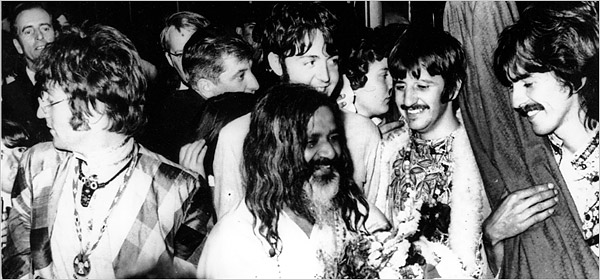
Another fairly dated remix that undercuts itself was among the best pieces of artwork I saw this year. Sexy Sad I (1987), Pipolitti Rist’s lanky, spinning riff on John Lennon’s Maharishi-inspired Sexy Sadie, appeared at Michael Benevento gallery this summer.

The Beatles with the Maharishi, 1968

As the story goes, Lennon wrote Sexy Sadie after The Beatles’ ill-fated trip to India (though Charles Manson notoriously claimed one of his followers inspired the song). The Indian guru the band had gone to visit proved himself less than saintly, hitting on girls and just being an all-around cad, and Lennon left more vehement than disillusioned.

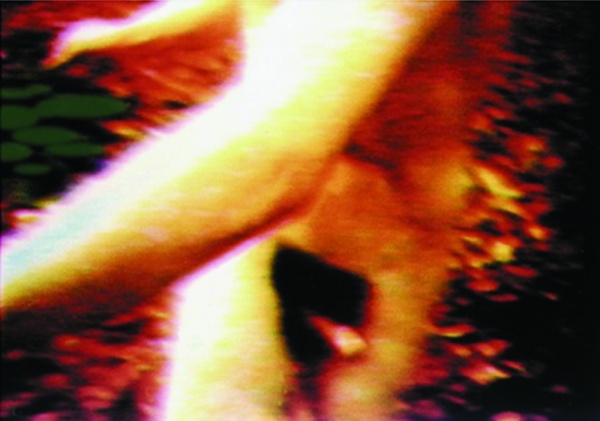
The Beatles’ song is pretty lucid and lyrical, despite its passive aggression. Rist’s interpretation, however,  is rough, blurred and broken up, though it still starts with that tongue-in-cheek bounce.  Lennon’s voice sings “Sexy Sadie, what have you done” first, then a gravely, goofy voice repeats the phrase. All through the vid, a gangling man with long, nude limbs follows the camera around, threatening it falteringly, never catching it. When the song reaches, “Sexy Sadie, you’ll get yours yet, however big you think you are,” the image of the naked man has just flipped upside down, then right side up again, and is retreating from view after throwing a few missed punches.

Pipilotti Rist, "Sexy Sad I," 1987

They’re both on my Christmas playlist–Bowie’s and Bing’s The Little Drummer Boy/Peace on Earth and an mp3 of Rist’s piece. They’re both about playing it safe, about defiance, and about a measured kind of hopefulness. For Bowie and Bing, “can it be?” becomes a way of saying “we’re smart enough to know what we don’t know, but human enough to hope” and, for Rist, the saucy aggression of Sexy Sadie becomes something more muddled, but also more sincere and less guarded than the original  Beatles song. Paired with that swinging and lunging body, the words “The world was waiting just for you” and “You made a fool of everyone,” suggest the sort of dejection that only someone who really wants to believe in enlightenment could feel. I can imagine the protagonist of Sexy Sad I, like Bowie and Bing, saying he wants to “give all the love that he can,” and “live in peace, live in peace again”–but first, he’s got to get all that undirected anger out of his system.

Share