Best of 2010
Interview: Brion Nuda Rosch

Whew. For DailyServing, 2010 was a full year — 365 days of arts coverage from our 25 writers around the world, three new week-long series, our new weekly column, L.A. Expanded, and great new interviews with some of the world’s most high profile artists. For this last week of the year, our writers have selected their favorites for you to revisit.

But, we want to hear from you! Send us your favorite articles to info@dailyserving.com this week, and tell us why you love it. If chosen, your selected post and your comment will also publish as part of our Best of 2010.

This interview between Seth Curcio and Brion Nuda Rosch was selected by L.A. Expanded columnist, Catherine Wagley.
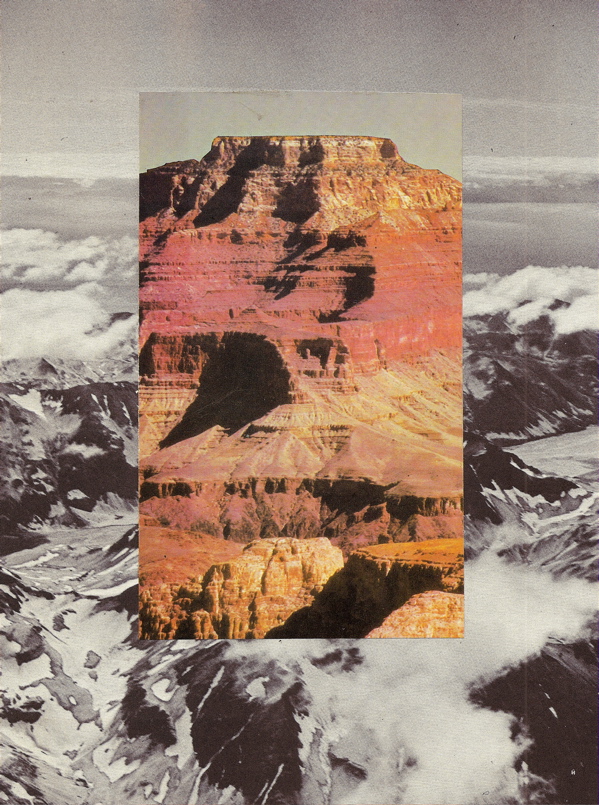
San Francisco-based artist and curator Brion Nuda Rosch creates subtle, yet powerful collages, paintings, sculptures and conceptual projects, which often pair disparate but poetic associations. This ability to provide insightful connections shines through Rosch’s playful but pensive collaborative and curatorial projects as well. Rosch often partners with other artists on creative exchanges through a one-day residency program in his own home called Hallway Projects, while curating more extensive exhibitions in other venues. Earlier this month, Rosch closed a solo show at Baer Ridgway Exhibitions, simply titled New Work by Brion Nuda Rosch, featuring work which investigates the value of materials and the idea of the non-monumental. The artist recently sat down with DailyServing.com founder Seth Curcio to discuss his recent Artadia Award, the next installment of his curated exhibition series, Paper! Awesome!, and his recent solo exhibition in San Francisco.

Seth Curcio: So Brion, you were notified a few weeks ago that you are one of the recipients of the Artadia award for San Francisco this year. Congratulations on your award. Tell me a little about the works that were included in your application and about the process that led to the selection.

Brion Nuda Rosch: I included a selection of collages and documentation of several assemblages. At the time I was also in the process of selecting work for my first solo exhibition and for an upcoming book project. Ultimately, the works included in my application were the starting points for the work shown at Baer Ridgway Exhibitions in San Francisco, CA from November 18 – January 2, 2010. I was short-listed as a finalist while preparing for this exhibition. The process was rather swift. First, a social with the jurors and other finalists, then a studio visit, then an announcement.

SC: Your creative practice is very diverse and includes curatorial projects as well as impromptu galleries and online projects, such as your blog Something home Something. Do you feel that your decentralized practice made your work more attractive to the panel at Artadia as they reviewed hundreds of artist applications? How do you feel that each of these different modes of working help to inform your greater practice?
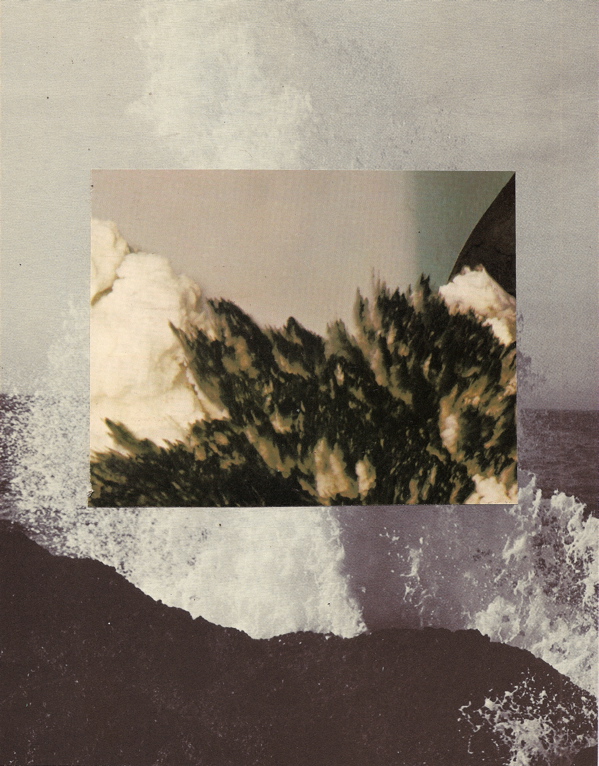

BNR: The focus for my application was primarily centered on my art making. My curatorial efforts were only represented in my Curriculum Vitae and were discussed only briefly during my studio visit. In any discussion about my work, conversation will not remain on one topic, such as painting, or collage. I feel I could easily assert different categories for various works, however doing so would prove to be a shortcoming. I balance the roles of both art making and curating — both practices relate to one another, each sharing similar starting points. Somewhere the boundaries fade and a project initiated from a curatorial standpoint becomes a work of art, and vice versa. It is not a priority to identify each action with defined labels. Most of my work simply involves a selection of material and then a relationship to that material within a new situation.

SC: Thinking about your recent show with Baer Ridgway Exhibitions and the statement that ‘most of your work simply involves a selection of material and then a relationship to that material’, I am curious about both your humbly-constructed images and sculptures. Talk a little about the concepts that play out in that exhibition, both through your image and object construction.

BNR: The images and the collages are both humble and monumental. Minimal adjustments have been made, a waterfall placed over a waterfall, a new ridge placed over a mountain range, a vague monument placed over a field. These ideas are monumental in scale, almost impossible, while also positioning room for our own reflection into the world around us. The monuments I create are non-monuments; they lack distinct meaning. The materials lack value, found book pages, recycled dump stock paint, wood and drywall. The assemblage works are a direct reaction to accumulated materials within my studio. The assemblage titled, Contents of Studio, Gathered, Painted Brown is just that, the contents of my studio gathered, painted brown and placed in a pile. I accumulated a collection of unsuccessful and unfinished works, and painting them all the same neutral color resolved the conflict I was having with them, placing them in a pile offered a solution for their arrangement and physicality.

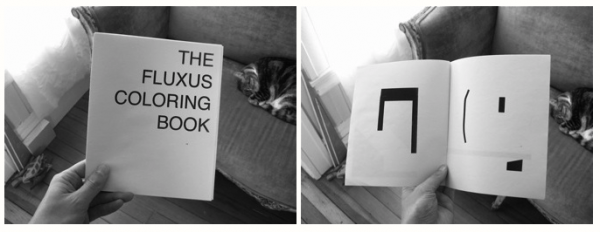
SC: In addition to your studio practice, I am also interested in your other more social and collaborative projects. I know that you have produced the ‘Fluxus Coloring Book’, you are now conducting day-long artist residencies out of your home, and you are in the process of curating the third installment of Paper! Awesome!, a show that features an impressive line-up of artists that work with or on paper.

BNR: The Fluxus Coloring Book was produced while in residence at Southern Exposure. During my residency, I worked with a group of artists to build The Portable Ice Cream Stand, part art object, part functioning ice cream stand, part social happening. Visiting artists and guests initiated the direction of the project. A worktable was built to make handmade fliers, later the table functioned as a place for conversation and art making. A few artists made coloring book pages, and guests colored in them. All of the work created at the table was left behind. As a reaction I wanted to develop something that could be taken away from the project. I have an interest in Fluxus art, and felt there was a relationship between the childlike tendencies of a coloring book and the humor of Fluxus art. The coloring book consisted of blank pages and non-representation lines. There was nothing to color in or around; the coloring book was failure, a document for it’s own joke.
One-Day Artist Residencies will take place within the context of Hallway Projects, which exists in my home. During these residencies, an interaction will take place in private, and then later be shared with the public via on-line documentation and distribution of printed materials. During each residency the contributor is offered both a physical venue and a reasonable timeline to execute direct actions in art making. Within the modest time frame and hospitable environment, I hope to interview each contributor and produce either collaborative works or investigate shared sensibilities in our interests as makers. For example, in a conversation many years ago, Amy Rathbone and I discovered we both dislike the colors yellow and blue. For her residency, we plan to explore the colors, and our reaction to them now. We plan to evaluate various tones of each color and rank our tolerance. In addition, we plan to directly tackle our fears by submersing ourselves in the colors and sharing our experience with the public in efforts to gain a better understanding of why we dislike the color yellow and the color blue.

And, Paper! Awesome! was first produced out of necessity for an exhibit within a short timeline. It took place at the now closed Mimi Barr Gallery in 2003. I put out a call to artists to submit work on a letter size piece of paper. I figured with the upcoming deadline, a letter size piece of paper was the most approachable form for both the artists, and my vision for installing the work in a cohesive manner. The works were hung on two walls in a quilt-like fashion. The second installment took place two years later, and involved an open call and a jury process. The range of artists selected added an important element to the exhibit. Artist who were established within the art world and artists who have not shown their work before were hung alongside one another and the proximity of the works offered a slightly anonymous experience for the viewer. For the third installment at Baer Ridgway this spring, I have invited an interesting range of artists who have shown extensively in the international art world, and I am in the process of working with members of other organizations to provide another element to the exhibit. Again, the timeline here is important, I invited the artists to participate nearly six weeks prior to the deadline of submissions. Like the One-Day Artist Residencies, I am interested in what can be produced within a limited time frame and limited space.

SC: So what can we look forward to from you in 2010? Do you have any exciting new projects that you have been wanting to tackle?

BNR: 2010 is shaping up to be very productive. I will be a curator in residence for a short period of time with Baer Ridgway Exhibitions. Little Paper Planes is publishing a book of my collages and assemblages. The book will be released in February. The Andy Warhol Foundation has funded the catalog for Artadia Awardees. I’m looking forward to returning to the studio, and having a lot of conversations about the potential to do larger projects. A very ambitious year to come!

Share

Best of 2010
New Work: R.H. Quaytman at SFMOMA

Whew. For DailyServing, 2010 was a full year — 365 days of arts coverage from our 25 writers around the world, three new week-long series, our new weekly column, L.A. Expanded, and great new interviews with some of the world’s most high profile artists. For this last week of the year, our writers have selected their favorites for you to revisit.

But, we want to hear from you! Send us your favorite articles to info@dailyserving.com this week, and tell us why you love it. If chosen, your selected post and your comment will also publish as part of our Best of 2010.

2010 year has brought on many new partnerships with publications around the country. We now regularly partner with the Huffington Post, Flavorwire, Art Practical, DaWire and KQED Arts in San Francisco. Marilyn Goh selected this article is from our friends at KQED Arts, where Danielle Sommer discusses R. H. Quaytman’s work at the San Francisco Museum of Modern Art.

In the 1950s, San Francisco poet Jack Spicer wrote that he considered a collection of poems to be a community meant to “echo and re-echo against each other.” A quick look at R.H. Quaytman’s new installation, I Love — The Eyelid Clicks / I See / Cold Poetry, Chapter 18, created just for SFMOMA, assures us that the analogy holds for a collection of paintings, too. Perhaps this is the reason that Quaytman and curator Apsara diQuinzio settled on Spicer as a guidepost for the exhibition.

Quaytman works primarily as a painter, but her installations are site-based and could in many ways be considered sculpture. Images are meant to “echo” — to complement and conflict with each other, and with the architecture of the room. The paintings in Quaytman’s one room show-within-a-show at the Whitney Biennial last spring stunningly incorporated one of the Whitney’s trapezoidal windows as a visual motif, making the actual window look like a trompe l’oeil painting.

With the SFMOMA show, Quaytman is again confined to a single room, a constraint that works well for her. The colors are subdued: a pastel pink just beyond cream and plenty of shades of gray. Using SFMOMA’s photo archive, Quaytman silk-screens images onto beveled, wooden panels of various sizes. The images are somehow relevant to Spicer’s work, although I’m fuzzy on the details: a snake, a creased photograph of a young man, a tripod, and a set of moons. Despite this specificity, the show is not drastically different from other Quaytman shows; while she works in “chapters” and uses specific people — like Spicer — as a way to dive into her work, her formal and conceptual concerns remain constant — and exquisite.

Techniques you’re more-or-less guaranteed to see from Quaytman include parallel lines so closely placed that they shimmer and pain the eyes, paint mixed with crushed glass, and every once and a while a flash of bright, bold color like florescent yellow or magenta. Perspective shifts and jarring juxtapositions between flat, geometric designs and representational images with deep space are par for the course, and most horizon lines lead you to a vanishing point that is off the canvas or in between two works. Shapes repeat, including a realistic representation of the edge of the wooden panels, an effect that serves to remind us that the paintings are objects, not just images.

Stare at any one painting for too long and the danger is retinal burn. The silhouette of a snake surrounded by a sea of sparkling turquoise remains as I blink my way around the room. The clutter in my retinal field builds, disperses, and builds again. Across the room is another painting with the same snake, larger and not in silhouette. Its pebbly skin is visible, and it becomes tangled with the afterimage of its cousin. There are two paintings that contain actual poems by Spicer. Each poem is placed central to its canvas, and yet each is downright painful to look at. Quaytman’s closely-placed lines prevent the text from dominating the image, although when you do manage to lock onto a poem and read it, everything in the periphery melts away.

“The poem begins to mirror itself,” writes Spicer. Poems mirror poems. Paintings mirror paintings. Images appear, accumulate and disperse, only to reappear. Jack Spicer passed away in 1965, but the rhythm and resonance of Quaytman’s installation is a reminder of more than the man. It’s a reminder of the cycling complexity of time in all its invisible and visible moments.

New Work: R.H. Quaytman is on view at through January 16, 2011 at SFMOMA.

Share

Best of 2010
Interview with Marc Horowitz

Whew. For DailyServing, 2010 was a full year — 365 days of arts coverage from our 25 writers around the world, three new week-long series, our new weekly column, L.A. Expanded, and great new interviews with some of the world’s most high profile artists. For this last week of the year, our writers have selected their favorites for you to revisit.

But, we want to hear from you! Send us your favorite articles to info@dailyserving.com this week, and tell us why you love it. If chosen, your selected post and your comment will also publish as part of our Best of 2010.

Noah Simblist selected Rebekah Drysdale‘s interview with Marc Horowitz, saying “I’ve been following The Advice of Strangers through Creative Time and this DS post – an interview with Marc in which he talks about his career – puts this brilliantly bizarre project into context. BTW – a favorite post from The Advice of Strangers in which he writes a play with a 6 year old.”

Marc Horowitz, a self-described “maximalist,” has permeated American culture with his socially-oriented projects and playful enterprises. His work includes video, drawing, cultural experiments, and the dynamic use of networks like twitter and youtube. In 2004, while working as a photo assistant for Crate & Barrel, Horowitz wrote “Dinner w/ Marc 510-872-7326″ on a dry erase board that was included in their fall catalog. He received over 30,000 requests for dinner dates, and began driving around the country to dine with people. The National Dinner Tour garnered attention from numerous press outlets; Horowitz appeared on The Today Show and was named one of People Magazine‘s 50 Hottest Bachelors in June 2005.

In 2009, Horowitz embarked on The Marc Horowitz Signature Series, for which he signed his name on a map of the United States and drove that route, stopping at 19 towns along the way. He documented these adventures in short webisodes. In Nampa, Idaho, Horowitz established the first Anonymous Semi-Nudist Colony (complete with complimentary jean shorts and ski masks). In Battle Mountain, Nevada, he pitched an idea to local politicians that involved changing the name of the town to something less pugnacious, suggesting the gentler alternative “Tender Pie Hill.” Other notable projects include Google Maps Road Trip and Talkshow 247.

In December 2009, Horowitz participated in a panel discussion as part of Art Basel Miami Beach‘s Video Art Program, “Video Art and Mainstream Distribution,” curated by New York’s Creative Time. Short films from The Marc Horowitz Signature Series were shown prior to the discussion. DailyServing’s Rebekah Drysdale was able to ask him a few questions about his past projects and future pursuits during an interview conducted over Skype in December.

Rebekah Drysdale: At your discussion in Miami, you mentioned you studied painting at the San Francisco Art Institute after leaving the business world. Do you think the tools you are using now, such as YouTube and Google maps, are the new media for this generation of artists?

Marc Horowitz: I think so. Painting and drawing will never die, obviously, but with the advent of the internet and the accessibility of video and broadcasting, I think that there is going to be such an insurgence of artists using these media.

RD: Your work engages the public, but seems very personal as well. What is the most influential encounter you have had in the making of your films?

MH: Omigod, there are so many of them!

RD: Can you pick one or two?

MH: The most memorable project is probably one you have never seen before. It was one I did while at the Art Institute, called Free Ideas. I went down to the corner of Market and Powell streets in San Francisco, where they turn the cable car. There are all kinds of tourists and homeless people there, the Seven Galaxies guy, preaching about the end of the world, religious people, preaching about God, and then there was me. I had two blank white sandwich boards that I made. I was handing out blank sheets of paper saying “free ideas.” People were confused. Most of the business people didn’t want to deal with me. One guy came up to me and said I was doing God’s work, for whatever reason. Several tourists thought that I was always there and wanted to have their pictures taken with me. Homeless people wanted me to write letters to their family members, so we would, and when we were done, they wouldn’t have their address. Kids wanted to have paper airplane throwing contests. I honestly think that project was what got me started in most everything I’m doing now.

RD: How did Free Ideas influence your later works?

MH: It was just taking such a simple idea as a blank sheet of paper and putting yourself out there in the world with that one element and then seeing what happens. I think that notion informed a lot of my projects after that. The Dinner Tour is the simple idea of dinner, at its least common denominator. Driving your signature across the United States is just a signature, something we use everyday. The Google Maps Road Trip was me and my friend wanting to take a simple road trip together, but not having the time or money, so we had to do it virtually.

RD: Tell me more about the experience and execution of the Google Maps Road Trip.

MH: The Google Maps Road Trip was a fascinating way of seeing America. It was also a really great way to get to know Peter (Baldes). In 2003, he e-mailed me saying I should have a blog. I had no idea who he was and why he was contacting me. Nevertheless, I immediately called him up because he put his phone number in the e-mail. We talked for a bit and he seemed nice enough, so we loosely kept in touch. I didn’t actually meet Peter in person until last year at a friend’s wedding. So all in all, we had only spent about twelve hours together in-real-life before we executed GMRT, and then we shared 40+ hours together “driving” across the country virtually. For me, it was like the Dinner Tour, except I got to know a single person, Peter, much more in depth.

The technical aspects of the project get a little complicated, but basically we left my house in LA and began driving together to Pete’s place in Richmond exclusively on Google Maps. For nine straight days, we “virtually drove” across the country by zooming in all the way on Google Maps and continuously pressing the Google Maps arrow keys eastward. We broadcast the entire experience live on googlemapsroadtrip.com. This meant that folks were able to not only see and hear us as we traveled, but also join us in a real-time chat room. Just think of it as an invitation for someone to hop in the backseat and ride along with us for part of the adventure.

RD: It sounds like your interaction with Peter during the Google Maps Road Trip was similar to what travel buddies may experience on a real cross country road trip. Do you think virtual travel will become more popular?

MH: Google Maps Road Trip is very lo-fi and basic. I would love to see it be implemented in schools. You could have an American fourth grade class travel around Europe, and (time zones permitting) they could travel with European students. They could go back and forth and talk about the things that are local to them. With the accessibility of Flickr photos, YouTube, and Panoramio (Google’s photo program), you can see all kinds of stuff you wouldn’t otherwise see. You can even bring up peoples’ live broadcasts while you are traveling. So, yeah I definitely think it is the start of something.

RD: In terms of your creative process, it seems that projects like The National Dinner Tour or the Marc Horowitz Signature Series would require much more planning than something live like the virtual road trip. Do you prefer to work with a plan or broadcast live?

MH: The Dinner Tour involved a serious amount of logistical planning more than anything else. Getting places on time, setting up dinner dates, etc. And I had no help. It was just a one man army. But that was a not-for-broadcast type of project. It was more experiential. Then I did the Signature Series, which was highly planned. A lot of it was written. We had to have all of the props, the locations secured, etc. It was a different way of working for me, but I really enjoyed it. Through all of the planning, there was still a lot of room for chance because we were doing the project in public, and in that way it felt very improvisational, like my previous works.

After that, I did Talkshow 247, where I broadcast myself live for three months, twenty-four hours a day, seven days a week on talkshow247.com. This project about destroyed me. There was always a live audience chatting away, commenting on my every action. It made me feel like I constantly had to be entertaining an audience that wasn’t even physically there. I really just wanted to live my life, but it became addictive to look at the chat and see what the audience was saying, and then do things to make my life more exciting. I didn’t really like that. So, to answer the question, I would much rather do some more planned out projects in the future, like the Signature Series. That is the direction I want to head with these projects.

RD: What type of work do you show in galleries?

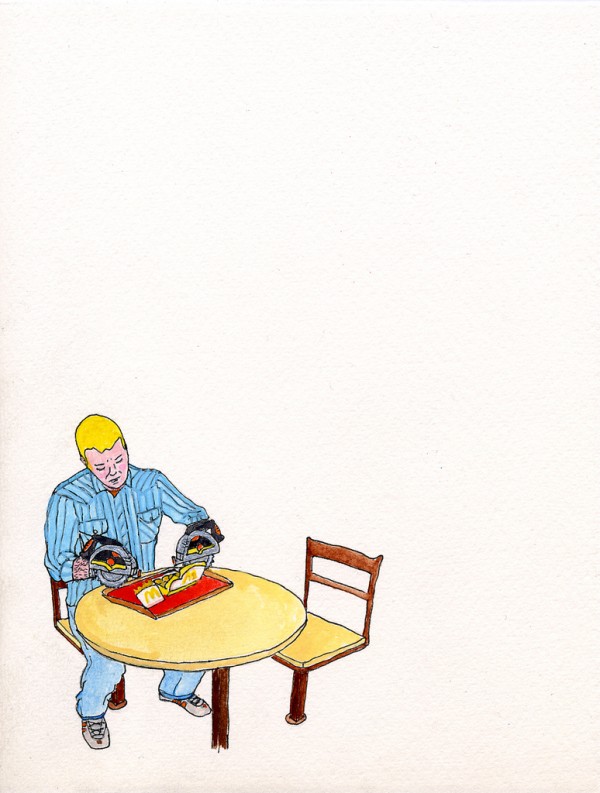
MH: I had some shows in Europe that were mostly drawings and sculptures because it is really hard to sell video art. It’s almost impossible. At some point, you have to make a product if you want to make a living as an artist, which is weird, you know? I did a show in Italy, called More Better. In it, I had made a drawing on how to make a helicopter out of a disassembled brick house and GMC truck. Really futile stuff, like a remote control bearskin rug. I made a suit of armor out of kids’ shin guards that is designed for people with a fear of sharp objects who are on a budget. Also included was The Tragedy Car Series, drawings of cars dedicated to terrible moments in history. For example, The Titanic Car. The drawings are interesting to me because I can really go way far out there, without actually having to execute these proposals. For a show I had at Nuke Gallery in Paris, I did a series called At Least You Don’t Have it This Bad. One of the drawings is a guy with circular saws for hands, and he’s trying to eat chicken McNuggets. That stuff is more fantasy-based. It’s really one big joke, they’re one liners. I like that.

RD: What are you working on now?

MH: I’m about to launch a new project called The Advice of Strangers. I’ve been working on it for about a year, but haven’t told anyone about it yet. Basically folks will be able to vote online on all my life decisions, small to large. Should I comfort the girl across from me who is crying? Do I tell my mom she should work out? Should I eat the noodle that fell on the floor that my roommate jokingly offered me? Should I start looking for a new place to live cause my landlord is an asshole? Do I move in with my girlfriend? Each decision will have a time constraint depending on the magnitude of the choice. And when the poll closes, I’ll post photo and/or video documentation of what happened as a result of the poll so people can see how their vote has effected my life.

The website for the project is www.theadviceofstrangers.com. If you are interested in participating, please check the site for the launch date.

RD: Your work certainly has a refreshingly witty appeal. Is there one last thing you would like DailyServing readers to know about you or your practice?

MH: A big component of my work is my blog, www.ineedtostopsoon.com. I am always posting fresh stuff there. Another thing that I am really into is Twitter. I’m so addicted to it. I’m using it as sort of a diary! You can follow me at www.twitter.com/marchorowitz.

Share

Best of 2010
Jobs Suck and Art Rules: Today I Made Nothing at Elizabeth Dee

Whew. For DailyServing, 2010 was a full year — 365 days of arts coverage from our 25 writers around the world, three new week-long series, our new weekly column, L.A. Expanded, and great new interviews with some of the world’s most high profile artists. For this last week of the year, our writers have selected their favorites for you to revisit.

But, we want to hear from you! Send us your favorite articles to info@dailyserving.com this week, and tell us why you love it. If chosen, your selected post and your comment will also publish as part of our Best of 2010.

Catlin Moore selected one of Michael Tomeo‘s articles, saying “I totally love everything Michael Tomeo has written this year – he’s so hilarious! I think his writing is really poignant and engaging while also remaining (god forbid, in the art world) entertaining.”

Today I Made Nothing, Organized by Tim Saltarelli, Elizabeth Dee, New York, NY, July 27 – September 18, 2010, Installation view Courtesy Elizabeth Dee, New York

On the heels of our week-long themed series 7 Days of Myth and Summer of Utopia, DailyServing is proud to bring you a collection of writings that explore the use of rebellion in contemporary art in this week’s series Rise of Rebellion. In this latest week-long series, our writers will explore the ways in which contemporary artists are using rebellion as a central concept in their artwork through exclusive interviews, articles, essays and daily features. Check in each day to examine the rebel that lives in all of us.

Today we begin our investigation into rebellion with Jobs Suck and Art Rules: Today I Made Nothing at Elizabeth Dee by Michael Tomeo.

I’m so over jobs right now. Sure, we need them, we’re thankful for the paycheck and it’s fun to hang out with coworkers (sometimes), but let’s face it, jobs blow. While the total freedom associated with making art seems antithetical to the 9 to 5 slog, there are definite correlations between art and work and they are given form in the impeccably timed Today I Made Nothing at Elizabeth Dee Gallery.

Virginia Overton, Untitled (chairs with lights), 2009, chairs, light fixture, ratchet strap, Dimensions variable, Courtesy the artist and Elizabeth Dee, New York

There are two types of workplace rebellion on view here. In one, the artist is an outsider, fighting for equal rights and clashing against the system. Works like Alejandro Cesarco’s Why Work?, Duncan Campbell’s Factories Act 1961, and Jonathan Monk’s The Sound of Music (A Record With the Sound Of Its Own Making), each use techniques and ideas from the 1960s and ‘70s such as appropriation and institutional critique. Vaguely recalling the efforts of the late-60s collectives such as the Art Workers Coalition, these works feel a bit dated, but they lend the show a historic scope.

Joseph Strau, title forthcoming, 2010, mixed media installation with floor lamp and two paintings, dimensions variable, Courtesy the artist and Elizabeth Dee, New York

Another group of artists is more successfully subversive. Mika Tajima, Renée Green, Joseph Strau and Virginia Overton each use the visual vocabulary of today’s corporate world as if they are involved in a diabolical inside job. Overton’s Untitled (chairs with lights) reconfigures mordant institutional design to create what is ostensibly a badass floor lamp/sculpture. Joseph Strau’s title forthcoming, presents two dainty abstractions with a lamp in front of them, as if Franz West were the display manager at IKEA. Mika Tajima’s A Facility Based on Change, an impenetrable work cubicle, updates the underlying claustrophobia in minimal sculpture for the middle management set. Renée Green’s banners take on the look of corporate brainstorming lists in what she calls Space Poems. They’re funny, off-putting and deceptively smart. In a room full of works attempting to challenge the boundaries of what art is, these might take the cake.

Renée Green, United Space of Conditioned Becoming: Space Poem #1, From My Institution Corporation Factory Blackberry Cellphone Mouth To Yours, 2007, double-sided color banner 42 x 32 inches (106.7 x 81.3 cm), Courtesy the artist and Elizabeth Dee, New York

It’s a sign of progress that, in a show about working, women have the strongest presence. However, other forms of advancement prove more difficult to measure. In the ‘60s, artists protested museums at a level unheard of today. As rebellious as this show portends to be, many of the artists on view are up and coming museum stars in their own right. Museums have begun to absorb rebellion as part of their aesthetic and they increasingly embrace and reward all forms of institutional critique and artist manipulation. By welcoming more acts of critique into their halls, they glean the benefit of appearing like nurturing patrons, but they also anesthetize any sense of real rebellion. We still have a long way to go, but Today I Made Nothing is an excellent place to start the conversation.

Share

Best of 2010
Interview with Babak Golkar

Whew. For DailyServing, 2010 was a full year — 365 days of arts coverage from our 25 writers around the world, three new week-long series, our new weekly column, L.A. Expanded, and great new interviews with some of the world’s most high profile artists. For this last week of the year, our writers have selected their favorites for you to revisit.

But, we want to hear from you! Send us your favorite articles to info@dailyserving.com this week, and tell us why you love it. If chosen, your selected post and your comment will also publish as part of our Best of 2010.

Sha Najak selected the interview between Babak Golkar and Sasha Lee, saying “the works are unique and I’ve never seen contemporary Islamic art portrayed in the way he did it. Golkar said in his interview that the ability he’s noticed about himself is the part where he can see things and compare and contrast them, to examine their relationship. I liked the simplicity of his purpose.”

Babak Golkar is a multi-disciplinary artist whose practice, at its fundamental roots, takes aim to deconstruct, recontextualize and rearrange our perceptions of the world around us. Like Zen koans, Golkar’s work seems to arrive at new understandings by setting up impossible questions. At it’s core is a spirit of unbridled philosophical investigation; one that exhibits a Duchampian twist on the visual pun mixed with a Gestalt sense of multistability and reification. Golkar’s work understands both the destructive and regenerative aspects of perspective and shifting visions; and fundamentally contests the fixity of subject and object and space. And, like his work, Golkar’s visual language maneuvers between seemingly oppositional realms–East and West, politics and revolution, Modernity and antiquity, Minimalism and ornament—ultimately exposing not the dialectical relationship between polarities, but rather the poeticism in the world around us.

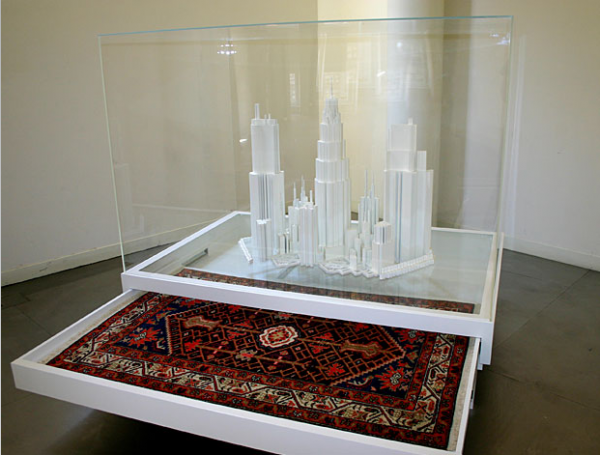
Sasha M. Lee: I wanted to begin with your series “Negotiating Space,” in which you use Nomadic Persian Carpets as a kind of architectural support, transforming its geometric twists and turns into rough blueprints for gleaming, white, three-dimensional models, rising from the woven geometric patterns. I thought the title and the conceptual framework of the work, for me, was actually a poetic way to summarize many of the themes that run through your work. Can you talk about how these forms interact, and why you chose to juxtapose these particular forms in this manner?

Babak Golkar: I’m interested in the alchemy of the art practice…arriving at gold, metaphorically of course, some sort of proposal for new understandings, the creation of new meaning. I like the idea of a particular piece transforming from two dimensions to three dimensions; something non-existent becoming a possible structure, and the subsequent interaction between the two. I like to talk about my work in terms of “becoming,” of interdependency between these two forms. In the case of the series “Negotiating Space” I don’t like to look at the nomadic Persian carpet as the origin of the whole thing per say…but rather one visual form constantly becoming the other and vise versa.

Hence the title—I like to use titles as materials in and of themselves– it is carefully chosen to hint at a state of uncertainty, a fluid or malleable state of existence. Really, I call the works “proposals,” rather than installations or sculptures.

Even though the carpet is technically the blueprint for the architectural scale-models, the structure adds a vertical dimension, which, as you move above the piece it collapses back to carpet once again. I like to talk about this idea of 2D to 3D, and its reversal; in particular the Duchampian aspect of playing with space. I’m inspired by Duchamp’s alchemical approaches to art making. In some ways I make a reference to Duchamp, in particular his piece, 3 Standard Stoppages. Do you know that piece?

Read More »

Share

Best of 2010
Brian Jungen: Strange Comfort

Whew. For DailyServing, 2010 was a full year — 365 days of arts coverage from our 25 writers around the world, three new week-long series, our new weekly column, L.A. Expanded, and great new interviews with some of the world’s most high profile artists. For this last week of the year, our writers have selected their favorites for you to revisit.

But, we want to hear from you! Send us your favorite articles to info@dailyserving.com this week, and tell us why you love it. If chosen, your selected post and your comment will also publish as part of our Best of 2010.

Michelle Schultz selected an article by Lindsay Pichaske, saying “while it is exhilarating to find a new artist, there is a wonderful nostalgia in rediscovering a familiar favourite – Brian Jungen, for me, is one of the poignant, significant, challenging artists coming out of North America, whose work poetically tackles issues of colonial identity, commodification and consumer culture – all while bringing a smile to my face.”

Strange Comfort, Brian Jungen‘s exhibition at the National Museum of the American Indian (NMAI), is as delightful as it is disquieting. Jungen, who is part Northwest American Indian, transforms objects of American consumption into relics of tribal culture. The result is transcendent hybrids that raise questions about the relationship between art, culture and commodity.

Six pieces from the Prototype for New Understanding series greet viewers entering the exhibit. While these pieces appear to be authentic tribal headdresses displayed under glass vitrines, it is soon revealed that they are in fact made of Nike Air Jordans. Because of this material transformation, the sculptures are in a state of constant becoming—at once creatures, masks, animals, shoes, and fantastical hybrids. There is a confusion of body parts as plushy shoe openings become eyes, rubber-tipped toes become mouths, and thick fabric tongues become beaks. The reassigning of parts designed for the anatomy of a foot to fit the anatomy of a face is as grotesque as it is wonderful.

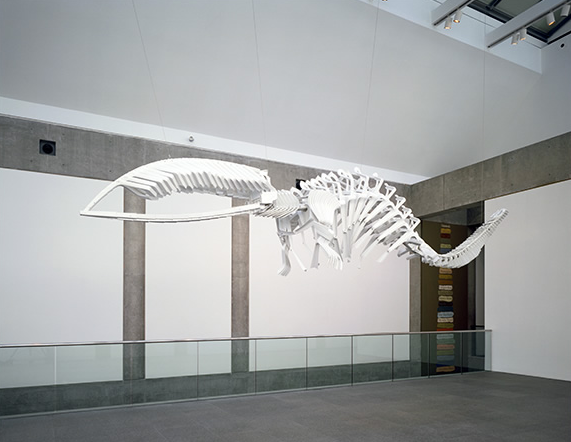
Jungen ironically critiques the way marginalized cultures have been pillaged for their goods by Western colonialists. He attacks commodity by making a triple-commodity—tribal relic, Nike shoes, and marketable art object. Jungen brings us further into his natural history museum of commodities with Shapeshifter, a huge whale skeleton made of white plastic chairs.

Side by side, the chairs become the sleek vertebrae and ribs of this immense animal. Suspended several feet above its platform, the whale’s shadows are haunting and give it the believability of an extinct, magnificent sea creature. Its empty body and ghostly shadows play foil to the recognizable lawn chairs that are its bones, for as much as we believe that this creature was once living in a faraway time, we know that it is part of our vernacular existence.

Questioning our own knowledge, we wonder if this whale could have really existed, or is it a made up version of Western history?

The context of the NMAI lends another layer to Jungen’s work. We are invited to view his sculptures as more than art. In this context, they become American Indian artifacts. By marrying seeming opposites, consumer and tribal cultures, Jungen proves that the treasures that fill the NMAI are not merely relics of a faraway past—they are the thoughtful products of a people that are part of contemporary society. This assimilation into mainstream commodity culture, for better or worse, perhaps provides a “strange comfort,” for both seekers of these treasures, and also the people to whom they belong.

Brian Jungen’s Strange Comfort is on view October 16, 2009–August 8, 2010 at the NMAI on the National Mall, Washington, DC.

Share

Best of 2010
Rebellion Four Ways

Whew. For DailyServing, 2010 was a full year — 365 days of arts coverage from our 25 writers around the world, three new week-long series, our new weekly column, L.A. Expanded, and great new interviews with some of the world’s most high profile artists. For this last week of the year, our writers have selected their favorites for you to revisit.

But, we want to hear from you! Send us your favorite articles to info@dailyserving.com this week, and tell us why you love it. If chosen, your selected post and your comment will also publish as part of our Best of 2010.

This article written by Bean Gilsdorf was selected by Michael Tomeo.

Paul Chan, The laws are my whores (2009). Suite of nine drawings, charcoal on paper, 39.5 x 27.5 inches each.

Today, Bean Gilsdorf looks at some of the artists that have broken the art world’s mold in her latest article Rebellion, Four Ways, as a continuation of our week-long series Rise of Rebellion.

Not long ago I had a conversation with a fellow artist. “I’m thirty years old,” she said, “and I’ve never really rebelled.” We talked about what rebellion means; it turns out that while I was imagining the traditional route of sex/drugs/rock-n-roll, she had something tamer in mind: “I was thinking about not bathing for a while.” I admit that I laughed out loud.

She and I were both thinking about social nonconformity in general, yet there are forms of revolt more specific to art and its milieu. True rebellion is a personal action, a stance to take against the machination of a system whether overt or hidden. When people talk about “the art world” they refer specifically to the capitalist market-driven system of exchange that takes place in the slim area of overlap between makers, dealers, and buyers. It’s a system of production and consumption like many others that relies on indoctrination, social pressure, and buy-in to a set of assumptions. In order to succeed in this world artists must play the game and follow the rules—all very insidious in a field that is purported to be about freedom and expression. Winners learn to play well and are rewarded for running within the confines of the maze and pressing the lever at the end. But the “art world” is not art, and never should the two be confused. Below are some of the tacit rules of the art world and the iconoclasts who break them. Consider this food for thought.

Paul Chan, Oh why so serious? (2008). Plastic and electronics, computer keyboard, 3.25 x 18.5 x 8 inches.

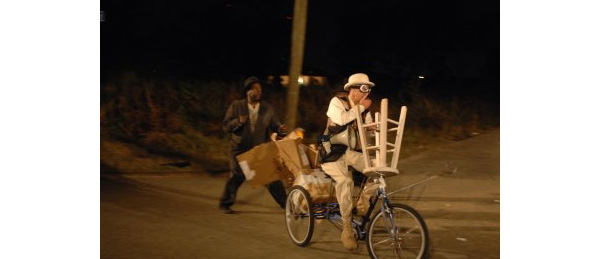
Paul Chan, Waiting for Godot (2007). Performance view, South Ward, New Orleans.

1.) Make all your work recognizable. A body of work is consistent and easily identified.

You’re a brand, and if you want to sell you need to make your brand instantly recognizable—just like a Louis Vuitton handbag or an Apple computer. Tell that to Paul Chan, the 37 year-old auteur of videos, sculpture, drawings, paintings, light projections, computer fonts, and the co-stager of five site-specific performances of “Waiting for Godot” in post-Katrina New Orleans. There is no “recognizable” here, no direct sense of continuity from show to show or even piece to piece; if you didn’t read the wall label you might not know who made the work. There is only a joy of making; freedom of expression, indeed.

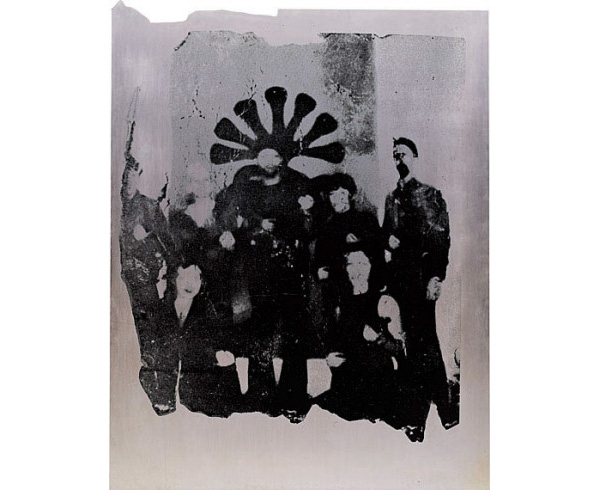
Cady Noland, SLA #4 (1990). Silkscreen on aluminum, edition 4/4, 78 3/8 x 60 5/8 x 3/8 inches.

2.) Promote your brand incessantly: lectures, residencies, studio visits, and visiting-professor gigs will help you advance.

It’s true that for most artists there is a social context to the work: after all, if no one knows what you make, how will they know if they like it or not? But is it true that one must exploit every connection, every opportunity, every possible avenue for social growth to create a career in the arts? Ask Cady Noland…oh, but you can’t. The reclusive artist won’t answer your email and won’t work with you if you she doesn’t trust you. Despite her many successes, Noland dropped out of the art world; self-promotion is not a game that she plays. In a 1994 review of Noland’s work, critic David Bussel wrote with keen prescience, “Anyone can be made into a hero or villain because minor celebrity is just another disposable object of mass consumption.” Despite Noland’s reticence to engage with the public, her work continues to be in demand.

Dana Schutz, Blind Foot Massage (2009). Oil and acrylic on canvas, 36.25 x 34 inches.

3.) Hit the big time: get rich, develop a waiting list, and hire a cadre of laborers to keep up with the demand.

(Bonus points if your laborers live in “developing” countries and you make this part of your schtick.) This is the model proposed by Andy Warhol and adopted by Jeff Koons. Some, like Kehinde Wiley and Takeshi Murakami, even make it an overt part of their practice to manage a hive of workers. In the overheated atmosphere of the art world, it’s easy to think that the artist who doesn’t meet the production quota dictated by collectors is a species of failure. It is said that Dana Schutz makes all her own paintings (unconfirmed by her gallery at the time of this publication), waiting list be damned. For an artist of her stature to do so is a very passionate and hopeful gesture, proof that rebellion isn’t always some kind of adolescent sneer: sometimes it’s just sticking to one’s principles.

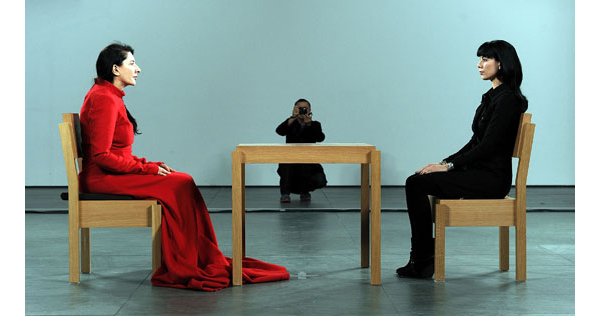
Marina Abramović, The Artist is Present, (2010). Performance at MOMA, New York.

4.) Be famous, get old, drop out.

You’ve got enough money, and maybe university tenure. This is the time to take it easy: make work that just repeats your best years ad nauseum, or even stop working altogether. Disproving this are John Baldessari and Marina Abramović, who continue to work hard and push beyond previous limits. Baldessari is 79 years old; in the last five years he designed the exhibition Magritte and Contemporary Art, had strong new work at his show at Sprüth Magers (Berlin) earlier this year, and currently has a long-overdue retrospective, Pure Beauty, at LACMA. Abramović, now 64, describes herself as “the grandmother of performance art.” Performing The Artist is Present this past spring at MOMA, she asserted the right and privilege of the artist to continue to explore her own work, to mine it and delve ever-deeper into unknown territory. This is the benefit of utilizing a lifetime of knowledge, growth, and experience to make innovative art. May we all be so blessed.

Share