George Condo’s Beautiful Dark Twisted Fantasy

Today’s post comes from our friends over at Flavorwire.com, a site dedicated to breaking exciting news in everything contemporary, including visual art. In the spirit of our ongoing content sharing partnership, we bring you an article about the collaboration between George Condo and Kanye West for Kanye’s latest album cover.

Some interesting, albeit not really surprising, news: According to Calvin Tomkins’ profile of George Condo in this week’s New Yorker, Kanye West wanted the cover art for My Beautiful Dark Twisted Fantasy to get his album banned — because he wanted more publicity. From the feature:

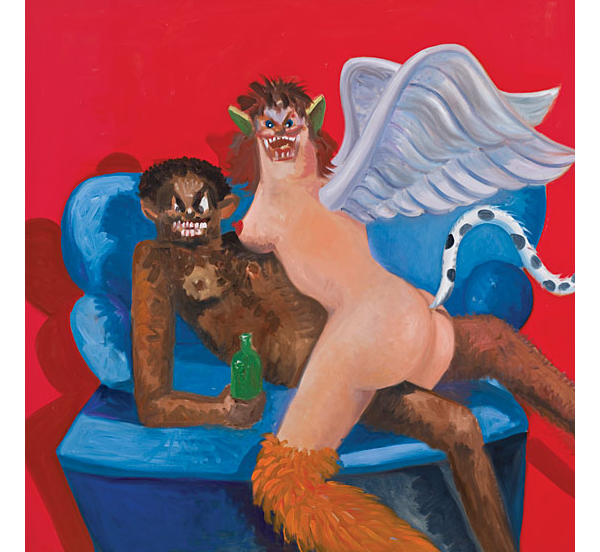
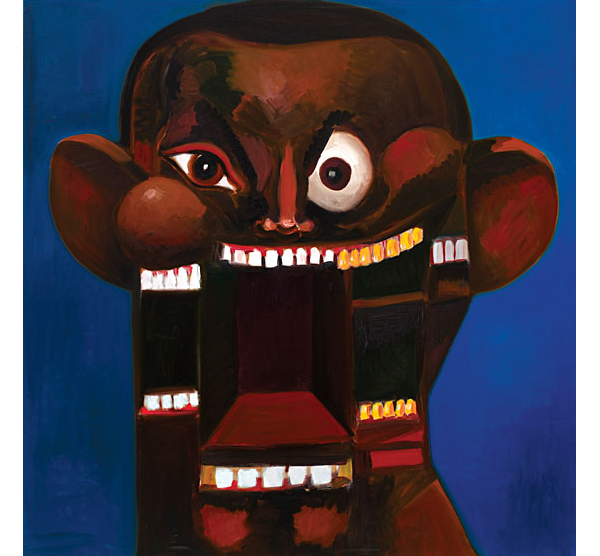
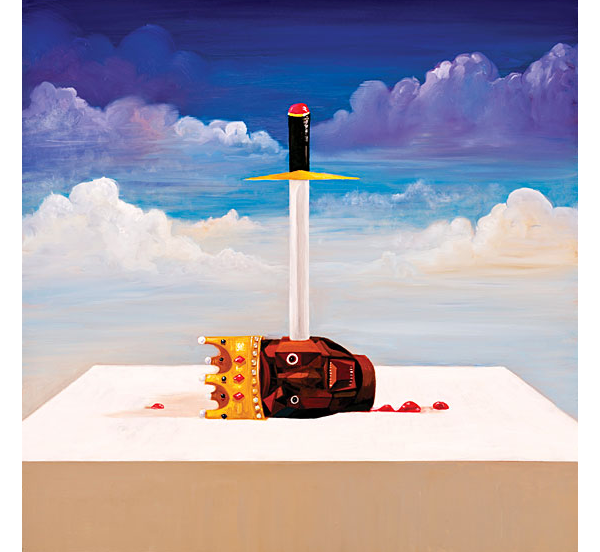
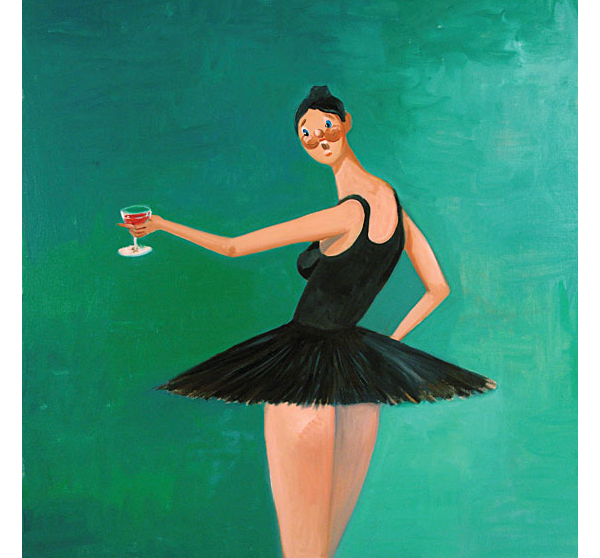
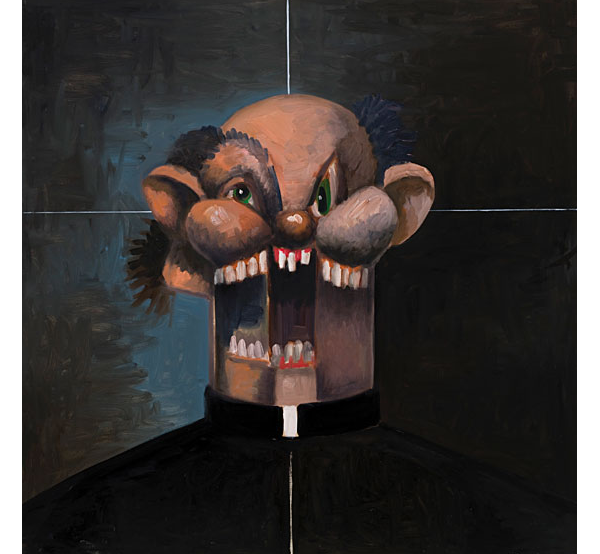
“West came to Condo’s studio, where for several hours they listened to tapes of his music, and over the next few days Condo made eight or nine paintings. Two of them were portraits of West, one in extreme closeup, with mismatched eyes and four sets of teeth. Another showed his head, crowned and decapitated, placed sideways on a white slab, impaled by a sword. There was also a painting of a dyspeptic ballerina in a black tutu, a painting of the crown and the sword by themselves in a grassy landscape, and a lurid scene of a naked black man on a bed, straddled by a naked white female creature with fearsome features, wings, no arms, and a long, spotted tail. West chose that one.”

Condo’s mid-career survey exhibition, which will feature more than eighty paintings and sculptures, opens at the New Museum on January 26th. Let us know if you think any of his Kanye-commissioned covers (which are pictured after the jump, with commentary from Condo) should make the cut.

“That’s a good painting. She’s a kind of fragment, between a sphinx, a phoenix, a haunting ghost, a harpy. And then Kanye is also in some sort of strange 1970s burned-out back room of a Chicago blues club having a beer — so far away from the real Kanye West that it’s just a scream.”

“It’s sort of cubist, you know, this portrait with all these different dimensions to it. Like an African mask with almost a modern face. I wanted to get that feeling that he’s almost a Miles Davis-like guy.”

“His tragedy was a kind of exile that Kanye imposed upon himself. He was free from exile by having the cathartic moment in the image. He’s alive in the painting, you know what I mean? In a strange way it’s like, he opened his eyes.”

“We were hanging around one night, and we were listening to that tune ‘Runaway,’ and somehow Kanye grabbed onto that idea of the ballerina. He just said, ‘Hey man, I’d like to have a great ballerina painting.’ I thought of a ballerina toasting. You know, ‘let’s toast to the scumbags.’”

“[Kanye and I] talked about paintings in the early baroque era depicting religious figures, and wanted to push that out into the open in today’s world. It mirrors the ‘paranoid’ riff on one of the tracks.”

All images and quotes via Vulture.

Share

Linnea Glatt: With In

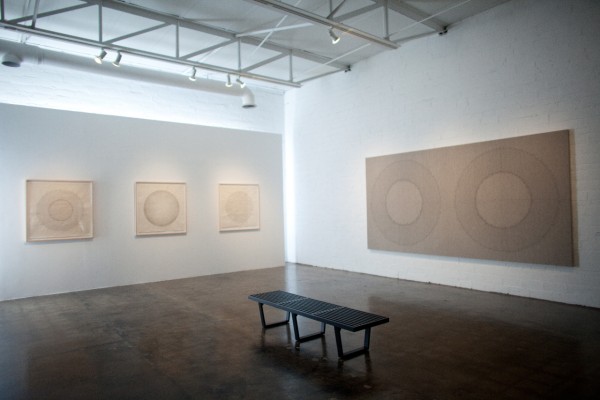
The work in this exhibition at Barry Whistler Gallery by Linnea Glatt is methodical, precise and quietly moving. While the works are often visually minimal, using only black and white, circles, lines and dots, they have a presence based on the accretion of their labor.

Linnea Glatt installation view, courtesy of Barry Whistler Gallery

Labor used to be a word that could be tied to abstraction. It was in the early twentieth century when abstraction was invented that the very notion of the artist/worker also rose to prominence. This came to a head with Abstract Expressionist artists who treated the studio as a workshop, wearing coveralls and diligently embracing the status of the proletariat. In the 1970s feminist artists expanded the notion of labor to encompass domestic work. Today, with Takashi Murakami, Demian Hirst or Jeff Koons as examples of artists functioning more like venture capitalists, those days seem long gone. But even the reference to a piece of art as a “work” harkens back to the days when labor was part of a belief system.

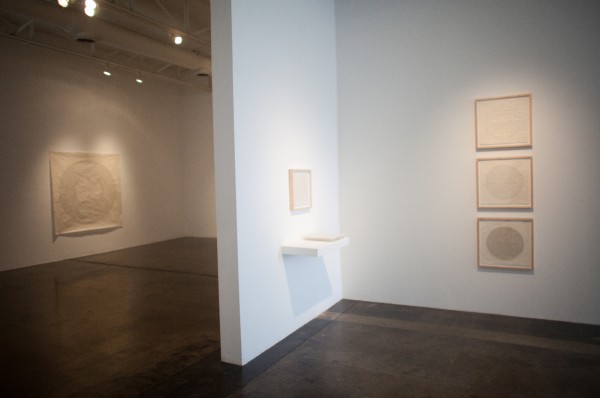
Linnea Glatt Installation view 2, Courtesy of Barry Whistler Gallery

Made with a sewing machine and thread on mulberry paper, many of these “works” use the grid as a starting point. But like Agnes Martin or Eva Hesse, the grid allows a structure for indeterminacy to chart its meandering path around a clear trajectory. As a result, analog machinery and the hand collaborate to make something that is deeply felt.

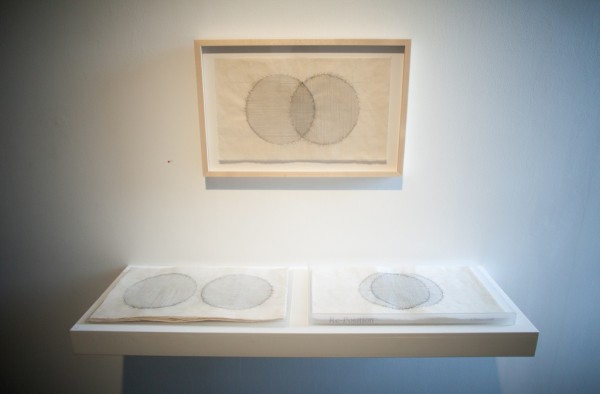
Linnea Glatt Installation View 3, Courtesy of Barry Whistler Gallery

Glatt uses seriality in a way that suggests time with progressive iterations of a visual trope. For instance, one series of drawings involves two circles. In each one the circles come closer and closer until they overlap, pass through one another and switch places, suggesting anything from a lunar eclipse to a Venn diagram. This was a common strategy for Minimalist artists and like Sol Lewitt’s cubes, the circle becomes a site for endless exploration.

Share

From the DS Archives: John Mann

This Sunday from the DS Archives, reacquaint yourself with Florida based artist, John Mann.  Two of Mann’s exhibitions, both up through January are:  Mapping: Memory and Motion in Contemporary Art at the Katonah Museum of Art and Constructed Territory at Wright State University in Ohio.

This article was originally written by Allison Gibson on January 12, 2010.

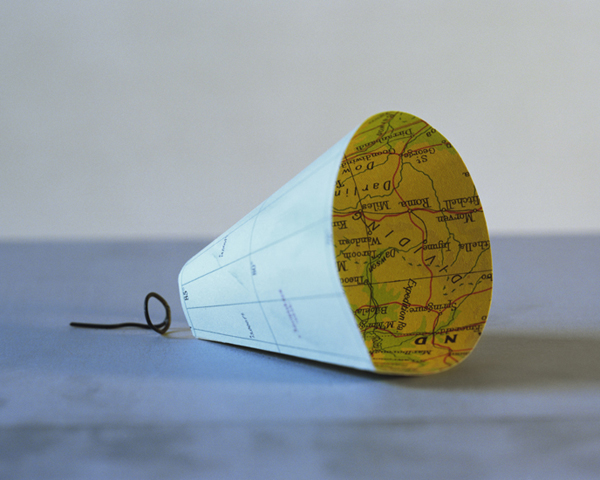
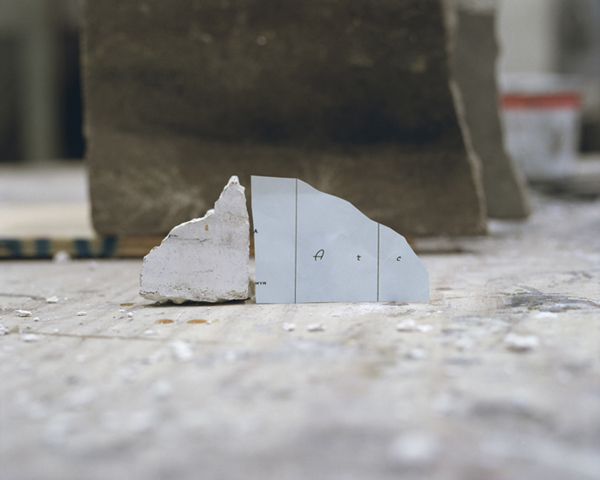
Currently on view at PDX Contemporary Art in Portland, OR is a solo presentation of new work by John Mann. The exhibition, entitled Folded in Place, represents Mann’s recent eponymous series of photographs. The shallow depth of field images present curious constructions of maps made by the artist—maps which now take on different roles than those once dictated by their previous lives as simple geographical guides. These new constructions seem to trade function for form as they morph into miniature architectures. Mann’s work is also currently in the group show Geography at Rayko Gallery in San Francisco.

John Mann lives and works in Tallahassee, FL, where he teaches at Florida State University. He received his MFA in Photography from University of New Mexico. His work has recently been exhibited in Crossroads at Museum of Contemporary Art, Atlanta, GA; Group Photography Exhibit at JK Gallery, Los Angeles, CA; NOW: Art of the 21st Century at Phillips de Pury, London, UK; Haunts at Privateer Gallery, Brooklyn, NY; and Hey Hot Shot at Jen Bekman Gallery, New York, NY.

Share

Super Symmetry: Painting the Particle Accelerator

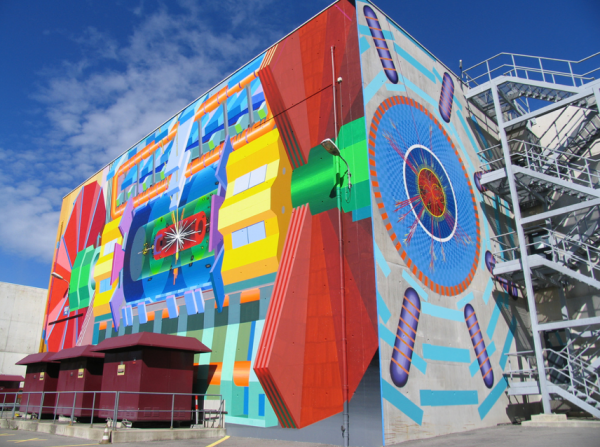
The twentieth century has provided a plethora of methods to communicate quickly to the masses, and it is becoming increasingly rare to find anyone taking the time to write a handwritten letter, much less create a large-scale public mural to share ideas with the public. However, for almost all of human history, wall paintings have served as one of the most effective ways to chronicle the events and progress of our time. Artist Josef Kristofoletti has tapped back into this method of communication and it has led him to some amazing places. From the gymnasium of his former high-school to a year long road trip around North America with the Transit Antenna artist collective, Josef’s desire to paint in public spaces has kept him moving. Perhaps the most impressive of these large-scale murals took place at CERN, the world’s largest particle physics laboratory, situated in the Northwest suburbs of Geneva on the Franco–Swiss border. There, Kristofoletti created a four story mural of the ATLAS particle accelerator, directly on the walls that contain the actual structure. Since the completion of the project just a few months ago, I’ve been dying to talk with the artist about his experience of seeing the world’s most ambitious laboratory, as well as the completion of his most impressive mural to date.
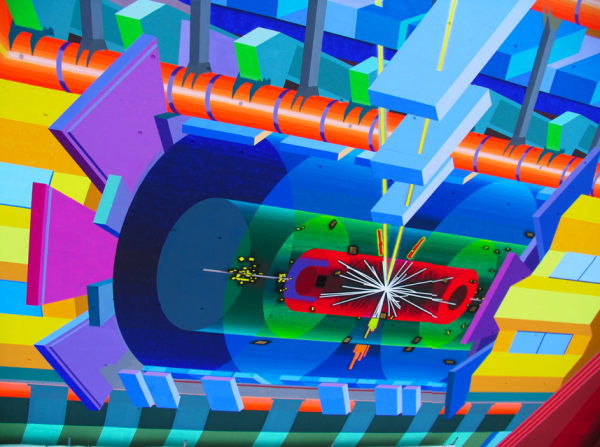
Seth Curcio: So Joe, you recently had the unique opportunity to do an artist residency of sorts at the famous CERN, the European Organization of Nuclear Research on the boarder of Switzerland and France. You had the honor of being the first artist invited to produce an original work of art for the organization. Tell me what projects led up to this invitation and how did the world’s largest and most advanced scientific laboratory learn about your work ?

Josef Kristofoletti: In 2008, I made a painting for a two person show with my friend Matt Phillips at Redux Contemporary Art Center. Matt and I had some conversations before the exhibit about what we wanted to show. We talked about the origin of the universe and dark matter, then I decided that I would do something related to CERN. I painted a mural of ATLAS, the largest of the CERN particle detectors. I tried to make the mural scientifically accurate, based on the schematics available on the CERN website. After the show opened it got a little bit of press and a month or so later I got a call from Claudia Marcelloni, the photographer and outreach coordinator for the ATLAS experiment. She told me that they had seen photos of my mural and asked if I might be interested in doing something on location. I couldn’t believe it at first, it just sounded really strange over the phone. We set up a time for a meeting with some of the physicists and I booked a flight to Geneva that same day.
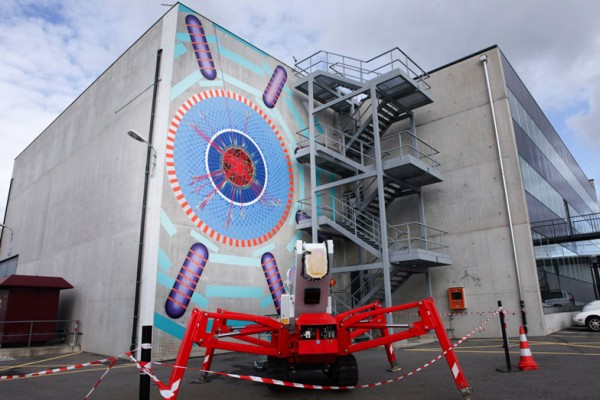
SC: Once you arrived at CERN, the officials gave you a tour of the facility, allowing you, an artist, unprecedented access to such highly restricted laboratories. Tell me a little about what you saw and how it turned into inspiration for the gigantic painting that eventually came to be?

JK: From the airport the CERN shuttle picked me up and took me right inside the lab’s main building. I met with two incredible scientists who work there, senior physicist Michael Barnett who is the head of the Particle Data Group, from Lawrence Berkley National Labs, and Neal Hartman, who engineered the innermost part of ATLAS, the pixel detector. It was a great meeting because they were as excited to talk to me about art as I was in finding out more about super symmetry. We talked about Egyptian sculpture and cinema. Neil has since left his position at CERN to attend film school in London. Anyway, they gave me a tour of the ATLAS facilities and we looked at some of the walls that I could potentially work on. By that time the detector, which is over 90 meters underground, was completely closed off to visitors and gearing up for the cool down process. Before collisions can start the entire 27 km tunnel is chilled with liquid helium to a temperature than is cooler than outer space. As we were talking about the possibilities of the project, my guides realized that I had to see the actual detector in person. After they made a few phone calls, and I started going through the most high secure checkpoint I have ever seen. The workers go through a complex biometric security system that includes a retinal scan. They all wear a dosimeter that measures radiation levels and there are plenty of safety warning labels on everything. We took the elevator down, then stepped out to look at the beast. There were a few men inside the detector doing some last minute work, but they were reduced to ants by huge size of its metal parts . It was sublime.
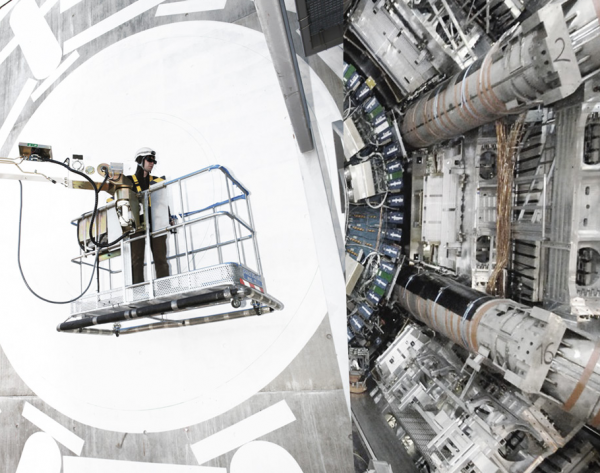
SC: This sounds amazing! I bet you never imaged in a million years that your research and project about ATLAS would eventually bring you into the exact laboratory that you studied for the mural at Redux Contemporary Art Center. I’d love to hear about some of the technical obstacles that you faced when creating the work, such as the time line needed for creating such an ambitious work, how you selected your subject matter, and dealing with extreme weather on the Franco-Swiss border. I even heard that you became a dad over this whole process. It just seems larger than life, both literally and metaphorically.

JK: I couldn’t get everyone to agree on the location that I wanted for the mural. I really wanted it place directly over the detector itself, and that alone took months. By the time that process was accomplished I had to start right away even though there was no funding for the project yet. I had charged the ticket to a credit card and flew back to Geneva from the United States. My third day there I met a side show performer named Stephan who lived by the train station and offered to let me sleep in his squat. He has this act where he can eat and swallow lit cigarettes. Stephan helped me stay sane for much of the project. There were so many security and safety issues at CERN that every day new problems came up. I had to go through safety courses to get clearance to work on the site and to use the Nacelle lift, which is the machine that was used to assemble the detector itself. I could not afford any assistants because it would have taken many more months of paperwork and training. I worked through French and German interpreters on many of the logistical issues and some of the safety classes. By the time I was able to touch paint to the wall it was October and getting colder every day. One day I couldn’t feel my hand any more and I realized that I had to face reality and come back the following year. I was able to finish the smaller of the two walls by mid November and had to return in June to continue. Halfway through the painting the whole operation was stopped by one of the electrical engineers in charge of safety. I was working right over the transformers and he said that in case of an accident the power supply would be jeopardized to the whole experiment. That stopped me until further security measures were dreamed up.

Every once in a while one of the physicists would confront me, very seriously, about how some part of the detector was not drawn properly. But, I respect that because for many of them this is a life’s work. Some have been there for twenty years going over the smallest details thousands of times. The whole detector is exactly precise to within one millimeter. I tried to explain to them that I was just making a painting. From up it the air I could see Mont Blanc just to my right, and the Jura mountains to my left. When I started on the proposals I found out that my wife was pregnant. My son Daniel was seven months old when I finished the mural. A lot of what has happened I can’t put into words, its been both shocking and beautiful. While I was at CERN I saw a lecture by Stephen Hawking. He was one of my childhood heroes. The first slide he showed said: ‘Why are we here? Where did we come from?’
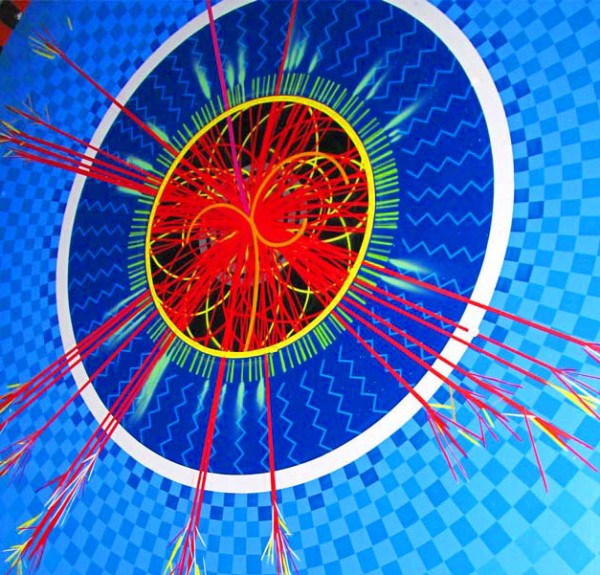
SC: That all seems like such a feat in itself, not to mention the fact that in the end you created an amazingly ambitious mural that lives up to all the magic that is happening inside the facility. So now that you are back in the US, what kind of projects are you working on, and what do you have coming up?

JK: Just before I came back to the US I went to Fame Festival in Italy and it was one of the most amazing art exhibitions that I have ever seen. It was so cool to see huge paintings by BLU and the other artists, I found that very inspiring. I’m really obsessed with large-scale paintings on walls and I love that the street art phenomenon keeps exploding all over the world.  My next big project, which I’m super excited about working on, will be doing something for the Olympics. Details on that project to come…


Share

God’s Eye View

L.A. Expanded: Notes from the West Coast
A weekly column by Catherine Wagley

Peter Van Agtmael, "2008, Above Afghanistan" on the cover of "2nd Tour, Hope I Don't Die." Via Magnum Photos.

Clicking through TIME Magazine’s “Most Unforgettable Images” of 2010 feels a bit like watching a missionary slideshow at an Evangelical tent meeting. There are helpless bodies,  flames, sweeping gestures and unsettling blue skies, all tied together in concentric compositions. What’s more, each image seems certain its viewers will  intuitively understand why and how it matters; they will first feel bowled over by stark reality, then invigorated by that implicit hope for redemption that any good missionary hopes to pass on. The fact that these 48 images have made TIME’s cut means they’ve evangelized effectively.

A weird religious fervor has characterized photojournalism almost since its beginning, certainly since the Second World War. The “god’s-eye-view” (a term used by scholar Erika Doss, among others) so many photographs take suggests sweeping access to the world’s events and terrains—it’s like writing in the third person omniscient.

One omniscient image in TIME’s “Best of” list is by Peter Van Agtmael, a Yale graduate who worked as a photojournalist in China and Johannesburg before embedding in Iraq and later Afghanistan (“I knew these specific wars were intertwined with me, or at least I wanted them to be,” he told the New York Times in 2009). The images he’s made are quietly searing and rarely of action as it takes place; more often, they described moments before, after or in-between. The photograph featured in TIME depicts long rows of cement barriers flanking a street at Camp Liberty in Baghdad. It feels cool and utilitarian, but its dogged repetition lends to a sort of romantically melancholic, admirably well-composed vastness.

Another image by Van Agtmael, one I find even more compelling, has similar vastness. Called 2008, Above Afghanistan, it features on the cover of the book 2nd tour, Hope I don’t die, and depicts a magnificent spread of desert terrain over which one lone white cloud casts a soft shadow. Even though it’s relatively small, the cloud recalls something atomic—like the billowing mushrooms of smoke that, post-Hiroshima, have come to stand-in for everything nuclear. The image also has a washed-out, blue-over-orange coloring that recalls the nostalgic aesthetic of William Eggleston.

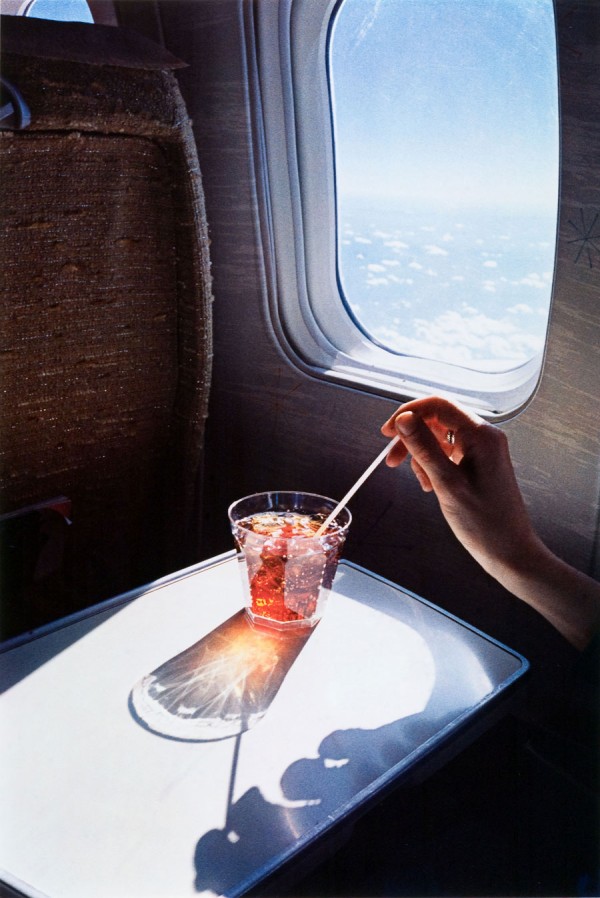
William Eggleston, from Los Alamos, 1966-1974. Courtesy the Eggleston Trust.

I can’t look at Van Agtmael’s Above Afghanistan without thinking of Eggleston’s Los Alamos series, much of which is on view at the Los Angeles County Museum of Art through January 16th. Completed in 1974, Los Alamos features a whole host of clouds and was loosely informed by the photographer’s visit to the atomic bomb’s birthplace (very loosely informed, actually, as Eggleston had almost finished the series when he first laid eyes on Los Alamos). Then-Corcoran curator Walter Hopps explained, “This title cloaks with some irony Eggleston’s ostensible subjects, found in a vast American terrain, yet acknowledges his belief in the aesthetic consequences of his private quest.”

Each time I visit the Eggleston retrospective, I leave in awe of one particular image from the series: a photograph of a cocktail on a plane. My awe makes me slightly self-conscious, as the image’s shimmery reflections have a sexiness reminiscent of a vintage cigarette ad. Or maybe, more aptly, they have both the brazen glamor of a James Bond flick and a veranda-worthy Southern gentility. Such lushness can’t exist anymore; it’s specific to a time when airplanes had leg room and air travel felt like freedom. Yet, despite the scene’s datedness, I can imagine the person stirring that cocktail leaning over and looking down onto a desert landscape like the one Van Agtmael portrays.

William Eggleston, from "Los Alamos," 1966-1974. Courtesy the Eggleston Trust and LACMA.

Van Agtmael’s images, like those of many photojournalists, adapt large public issues and render them for stirring private effect. While this public-made-private approach does not leave much room for moments like those Eggleston depicts, Eggleston’s images are gripping precisely because they leave room for a bigger world beyond their borders. They just doesn’t presume to take a god’s eye view of it.


Share

Disturbing Currents

Electricity is a strange and powerful thing. An invisible force that poses a deadly threat, we are taught to fear it at an early age. However, we have come to rely unconditionally upon it as well – in failure, as in a blackout, absolute panic and chaos ensues. And let us not forget that electric potential is the fundamental basis of all cellular life – perhaps this is why we are drawn to it in an inexplicable way.

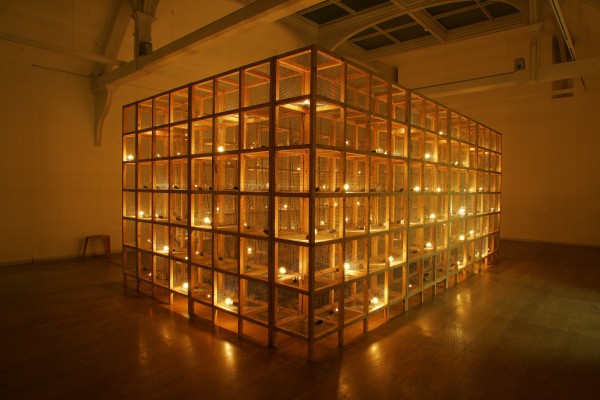
It is this dichotomy of attraction and fear, comfort and chaos, that drives Mona Hatoum’s work Current Disturbance, installed at the Whitechapel Gallery, as the third of a four part series – ‘an exhibition in 4 acts,’ displaying works from Greek collector Dimitris Daskalopoulos’s private holdings.

Mona Hatoum, Current Disturbance, 1996. Photo: Geoff Craddick/PA/Whitechapel Gallery

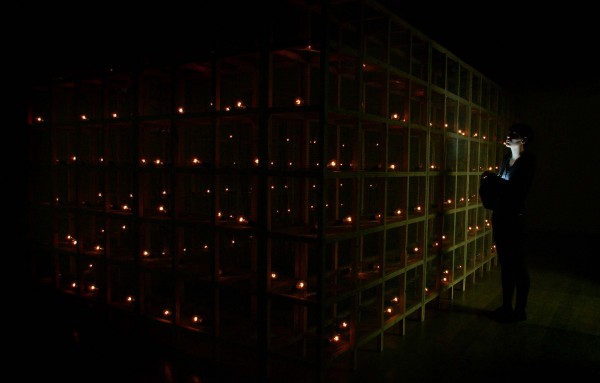
Created during Hatoum’s 1996 residency at Capp Street Project in San Francisco, Current Disturbance consists of 240 wire cages, each containing a single light bulb, stacked in a manner that recalls images of chicken farm housing practices. The thick black wires that lead from each lightbulb coil in the centre in an endless and menacing pit contained within the architectural structure of the cages. The entire system has been likened to a Panopticon – however we can only view it from the outside and are not implicated within it’s structures of surveillance and control.

Within the cages, the lights are enticingly warm, emitting a soft yellow glow that draws us in like moths to a flame. Or simply to an electric lightbulb for that matter. The lights pulsate and surge – slowly rising and fading, building to a great intensity then abruptly cutting out to blackness. Taking a moment, they regain their strength and begin to build once again.

Mona Hatoum, Current Disturbance, 1996. Photo: Geoff Craddick/PA/Whitechapel Gallery

There is no real pattern to their undulating, or at least not one we are able to decipher. At times they peak quickly  – others they manage to hold on for quite some time before faltering.

Intensifying their struggle, the fluctuating light is translated into electronic sound – an amplification of the current flowing through the wires that creates a low humming, a rising buzzing, and at the peak, an severe screeching that gets inside your head and leaves your ears ringing when it cuts out and the room turns to black.

Each bulb is contained within an isolated cell, but they function as a coherent, yet chaotic, system. It seems as though there is some sort of purpose for their action, but it is as if they are not able to quite get there. As they rise in intensity they collapse in upon themselves, just short of their goal, and after regaining their strength, try, try again.

They reach for something impossible for them to simultaneously achieve. Their persistence short-circuits the system and they all fail as a result – victims of their collective drive.

In modest materials – wood, wire and lightbulbs – Hatoum has constructed a system of power, pandemonium, aspiration and failure. While initially transfixed by the light, the subsequent experience is painful – we cannot create order out of the turmoil however hard we try.

A system of controlled chaos that will literally leaves your head buzzing for days.

Share

A Thousand Several

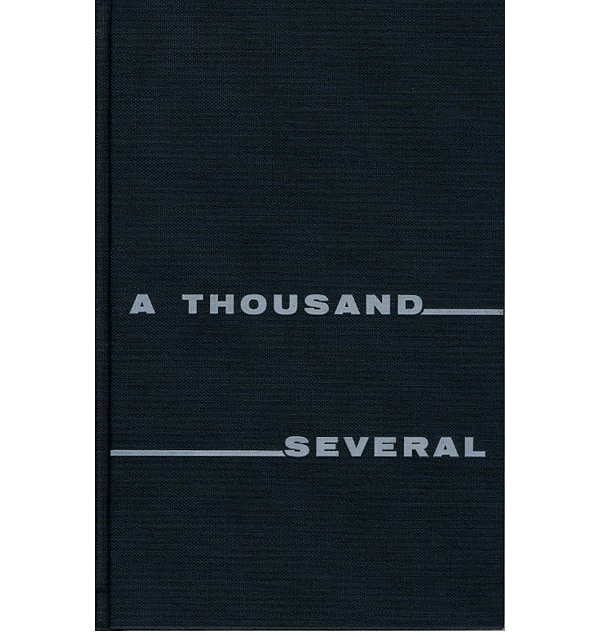
Today’s article is from our friends at Art Practical, where Christine Kesler discusses the new work from the arts book A Thousand Several by Emily McVarish recently on view at 871 Fine Arts Gallery and Book Store in San Francisco.

I recently had drinks with a friend who’d just relocated from the Bay Area to New York City. We discussed the phenomena of connection and connectivity, anonymity and intimacy, as they relate to living in a massive city like New York, and the comparatively small-town San Francisco. Years ago, when I lived in New York, my daily struggles with this spectrum of fleeting intimacy often struck me with the feeling that we are all alone together. Today, in San Francisco, Emily McVarish’s new body of work at 871 Fine Arts Gallery and Book Store, a subterranean space directly downstairs from Crown Point Press, brings these thoughts rushing back to me. A Thousand Several examines a contradiction in terms, investigating themes of disconnected, anxious, and individualized communities in the format of a book and its eponymous exhibition.

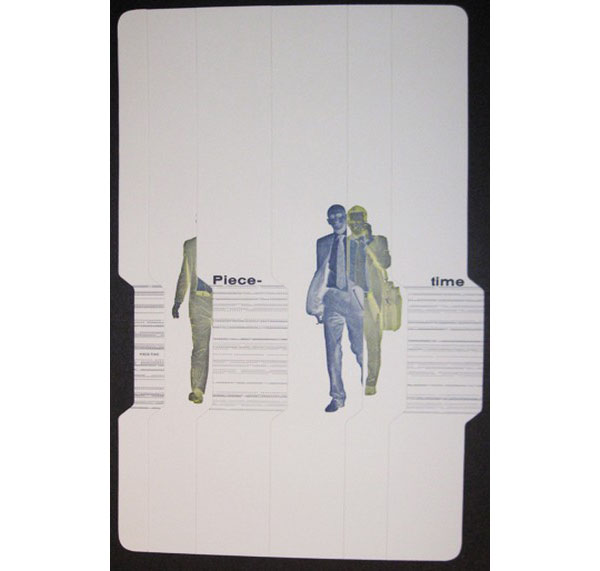
For the last two decades, McVarish has focused on making finely written, designed, die-cut, handset, printed, and bound books. While this was the first exhibition of hers that I’ve seen, A Thousand Several convinced me that her books are her most successful work. Through her medium, McVarish asserts the importance of the book format, and strikingly so in the face of such modern subject matter: information containment, conversation avoidance, and distraction to the highest degree. The exhibition consists of McVarish’s book and prints that hang on the gallery walls. A glass case holds books, and I was permitted to look more closely at A Thousand Several, which is in itself the book form of the exhibition: a compilation of the works on the wall. The contents of the book—unbound and disconnected—create a new code of severance that doesn’t quite translate. This book, much more than the exhibition and works on the wall, captures a real failure of the will to experience the world around us—and McVarish depicts it with great poetics.

To continue reading this article on the ArtPractical website, click here.

Share