Collectors’ Stage: Asian contemporary art from private collections

Subodh Gupta, Everything Is Inside, 2004, Taxi and bronze, 276 x 162 x 104 cm, Arario Collection. Image courtesy of the artist and Arario Gallery, Cheonan, Seoul.

Not too long ago, I spoke with Howard Rutkowski, formerly of Sotheby’s and now director of Fortune Cookie Projects, intending to satiate my curiosity about art auctions and art dealing. While he probably scoffed at my naivety, he candidly said to me, “Plunging into the murky business of the art world is akin to swimming with the sharks. There’s a delicate dance that takes place between buyers and sellers.” There seems to be very little disagreement in those sentiments in Rutkowski’s diplomatically crafted comments; they are in fact, echoed with gusto ad naseum in many recently published books about art dealing and collecting, where vitriol, fake kisses and nefarious sleights of hand are as commonplace as a trip to the supermarket in a world resolutely disconnected from reality.

“The nature of the art business is that it’s filled with pettiness and jealousy. There’s little mutual respect…everyone is insecure about their accomplishments, which often leads to a great deal of bad behavior to disguise the truth,” writes Richards Polsky with remarkable honesty in I sold Andy Warhol (too soon). “It used to be all about the art world: visiting artists in their studios, socializing with collectors, and hanging out at art fairs with your fellow dealers. Now it was all about the art market.”

It is a commonplace but also a shrewd observation. A more accurate description of the “art world” these days must extend beyond appreciation and connoisseurship to the capitalist maze system of production and consumption in whose perilous waters artists, dealers, collectors, museums and galleries navigate. With the dissolution of cultural and commercial barriers, art criticism and appreciation face possible relegation to serve as mere adjuncts to the main business.

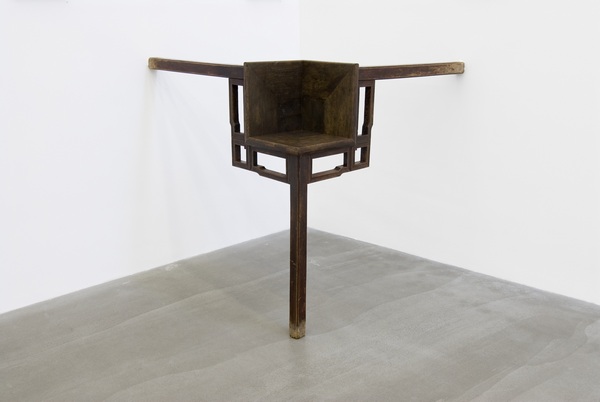
Ai Weiwei, Table With Three Legs, 2007, Table, Qing Dynasty (1644-1911), 117 x 115.5 x 115.5 cm, Collection of Mr Qiao Zhibing.

Running parallel with Art Stage Singapore – an international art fair that ended 16 January 2011 –, Collectors’ Stage: Asian contemporary art from private collections suggests that public exhibition spaces can get caught in these lively but fraught relationships. As a show created by a public institution, Collectors’ Stage engages in the meeker, mellower side of art-for-education purposes, positioning itself alongside Art Stage insofar as it could remain a neutral, fringe program while pinching some of the excess stardust from the highbrow glitz and glamor of its dominant partner. The show is intriguing in its bypass of a typical educational program that is de rigueur in many public art institutions’ exhibitions, lacking a certain insistence of pedagogical material and the usual contingent mix of critical thinking and art historical discourse. Drawing from the rich and varied coffers from private collections in order to parade the sheer diversity of Asian art lying in private hands, the exhibition triumphs the astute discernment and emerging intelligence of the collectors, while implicitly acknowledging the opaque (and potentially difficult) web of money, prestige and aesthetic (and monetary) value that exists between artists-as-producers and consumers.
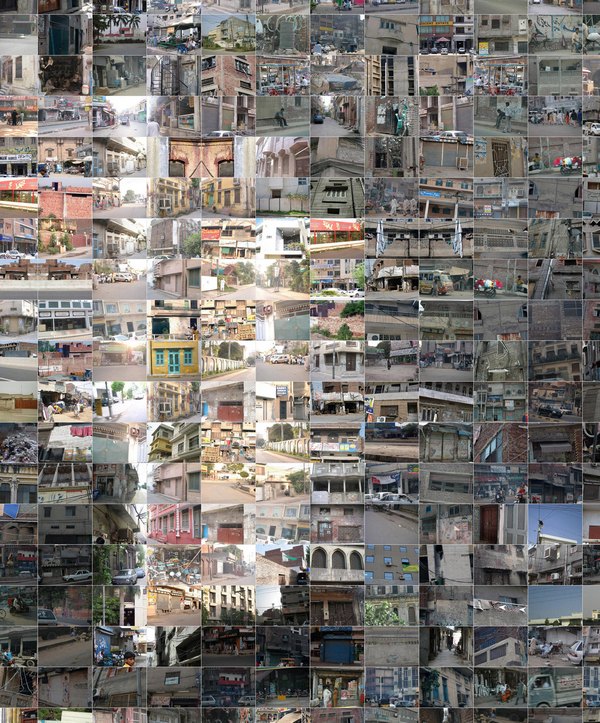
Rashid Rana, Desperately Seeking Paradise, 2007 – 08, C-Print + DIASEC, stainless steel, 300 x 300 x 300cm, Collection of Amna and Ali Naqvi. Image courtesy of the artist.

The result in this instance, is a close-knit, reciprocal and mutually beneficial relationship that emerges when private collections surface in public spaces. Collections that rest in a museum for any period of time cannot help but gain public exposure (or notoriety); both collectors and artists benefit from the increased media scrutiny – despite the sort of press it might receive. An institutional display thrusts upon an artist much valued affirmation and recognition while potentially providing them a step-up in the elaborate system of critical reception and endorsement, and collectors themselves are validated by their purchasing inclinations and intellectual taste. Depending on the choice of works, the museum in turn, receives accolades for its program and its audacious bid to entertain.

The repercussion of this agenda however, is the compromise of the works’ engagement with the space in which they are presented and it is seldom that their content or meanings are found in dialogue with its surroundings or its viewing public. Despite the standing argument that the gallery’s white spaces are contested territories that actively influence the reception and meaning of art, space in Collectors’ Stage is utilized as vacant zones housing the sheer size of some installations, and the works are assembled and administered rather than didactically curated.

It is still entirely possible (and perhaps even necessary) to enjoy the works as individual entities. Many of the artworks are jaw-dropping and materially accessible, open to non-specialist viewers unfamiliar with art theoretical concepts. Thematically grounded in issues innate to contemporary Asian art and familiar to Asian viewers themselves – the dichotomy of embracing progress and observing tradition, political farce, the burden of modern life, urban sprawl –, this brave new world of the Asian aesthetic is constantly lamented and paradoxically praised.
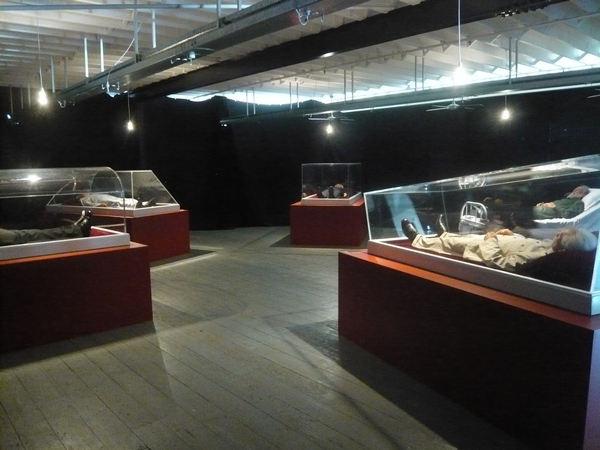
Shen Shaomin, Summit 2009 - 2010, Installation, Dimensions variable, Osage Art Foundation Collection.

Chinese artist Shen Shaomin’s Summit (2010) challenges the annual G8 Summit where world leaders meet to discuss global political and economic events, offering instead, a hypothetical meeting of the most influential communist leaders in history (Fidel Castro, Vladimir Lenin, Mao Zedong, Kim Il Sung, Ho Chi Minh) in the light of the recent global financial meltdown and the apparent failure of capitalism. Shen’s Summit brings together – if never in history, then only in museum (or mausoleum) space – resin-silica-gel constructed cadavers laid out in a pentagon formation in crystal coffins reflecting their nationalities, with the exception of Fidel Castro who lies on the brink of death. With hushed and repellent awe, we are asked to venture into ideological black holes; has capitalism juggernaut’s also finally come to a halt as spectacularly as socialist ideology waxed and waned in the twentieth century?

Subodh Gupta’s Everything is Inside (2004) is India’s iconic yellow Ambassador taxi sinking under the weight of its load, reinforcing the eternal themes of travel narratives: dislocation and relocation within the rural and urban spheres as consequences of aspirations and the relentless quest for prosperity. Prizing the abstract and the multi-dimensional is Rashid Rana’s Desperately Seeking Paradise (2007-8), a sculptural work that questions the act of representation and perception through the distortion of visual sequences of Lahore. Hu Jieming’s 100 years in 1 minute (2010) deconstructs the “grand narrative” of history by piecing together fragments of the past century’s momentous events in various combinations within 1 minute, consequently presenting infinite possibilities of historical trajectories that could have been.
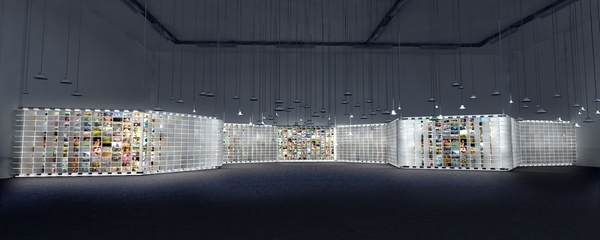
Hu Jieming, 100 Years In 1 Minute, 2004

Such works provide a dynamic summary of contemporary Asia: anxieties of geopolitical and socio-cultural changes that quite nicely form the thematic bedrock of Asian artists. They are deemed worthy of visual consumption and are called “great” because of the existence of a complex thread of validation from multiple sources. Collectively, it is not an automatic cause for celebration. With virtually unchallenged reviews and effusive praise, where then, is the place for dissenting voices and criticism amid these potentially intellectually stifling accolades? Where is the counterbalance of censure and soul-searching that has made these works what they are? Like Shilpa Gupta, I itch to start the blame game.
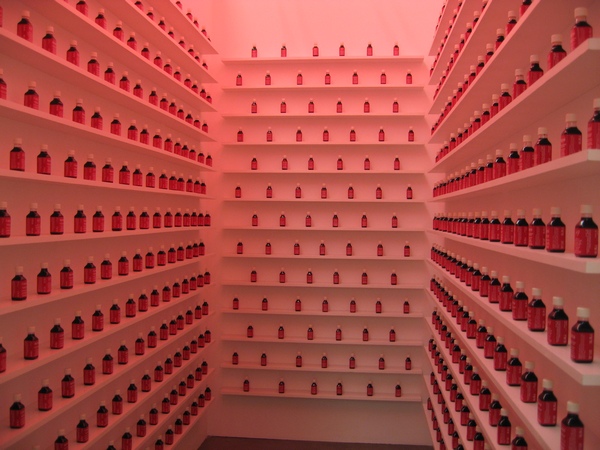
Shilpa Gupta, Blame, 1999, Installation with plastic bottles, Dimensions variable, The Lekha and Anupam Poddar Collection

Collectors’ Stage: Asian contemporary art from private collections is organised in cooperation with the first edition of Art Stage Singapore 2011, the newest international art fair in the Asia Pacific. The exhibition is presented at the Singapore Art Museum, and two off-site venues, ARTSPACE @ Helutrans and Tanjong Pagar Distripark. It will be on view until 17 February 2011.

Share

Four Works at the Museum of Fine Arts, Boston

Dominating the discussion of what’s new at the MFA Boston is the Americas wing. Reviews generally see it as a state treasure, an intangible cultural property that will bring the gospel of Copley and Sargent to the general public and a great reason to visit the museum again soon. During the success of the wing’s opening, there has been a quiet revolution going on at the far end of the museum. In preparation for the projected September opening of the seven galleries in the Linde Family Wing for Contemporary Art, there is a small temporary installation of 4 contemporary artists.

There is a bit of mischief in combing Allan McCollum, Rachel Whiteread, Darren Foote, and Donald Moffett. Their formal proximity make you feel like they belong together and have some deep intellectual meaning set in a grand narrative, but I’m not sure that their power is conceptual in nature. Dog, door, chair, and hand: they are objects that trigger relatable haptic memories. Each has a physical and emotional weight centered on loss and the body. Many of us touch these things daily (feel free to change the dog to a cat if you want). We have unending poetic descriptions of these objects: furry companions, endless friend, locked/slamming doors, doors of perception/consciousness, chairs of departments, pull the chair out, on the edge of your seat, and the hand and its touch are one of poetry’s standards.

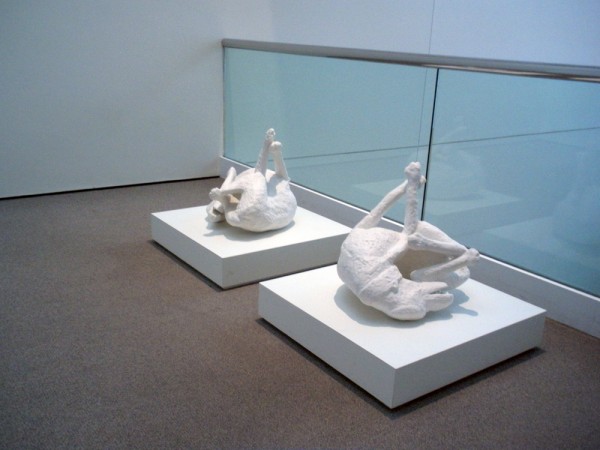
Allan McCollum, The Dog from Pompei, 1991 All photos courtesy John Pyper

Starting from the corner, unceremoniously installed above the escalator on two small plinths, are The Dog from Pompeii (editions 92.2 & 92.3). These were originally displayed in a large field of similarity, part of McColum’s non-original, original cast works, as each object is a cast of a cast of a dog that died in the Pompeii volcano explosion. These objects play with the idea of multiple and original. The actual dog was not found, but an empty shell in the settled ash was, and the original casting was cast from that shell. McCollum was able to get a casting of the casting and made a sculptural field of memories from a catastrophe two-millennia ago.

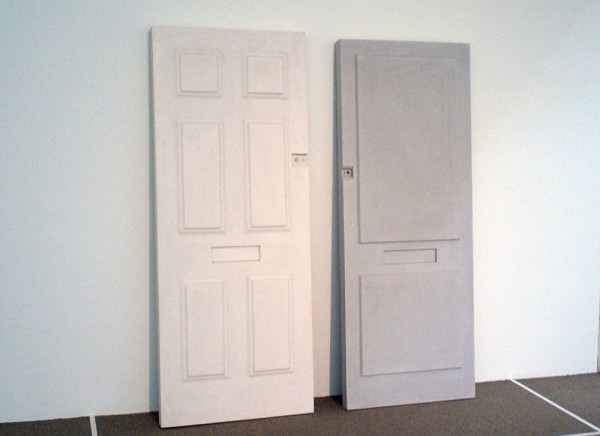
Rachel Whiteread, Double-Doors II (A+B), 2006-7

Rachel Whiteread’s Double-Doors II (A + B) also are cast multiples that play with originality and repeatability. These mirrored replacements, are the door, but reject the function and reality of the door. While the dog is historically located in the past, these doors are our now. The reflections of light on their shapes, the proportions of their design, their visual rhythm is so easily recognizable that some have dismissed them as not being art. Their materials, the neutral grey tones of the plasticized plaster, makes them seem unfinished and somehow less than something they could be. They deny their own handmade and unique features by simply being what they are, unique and handmade. I think that is what makes me most interested in them. Their repulsively exciting dullness.

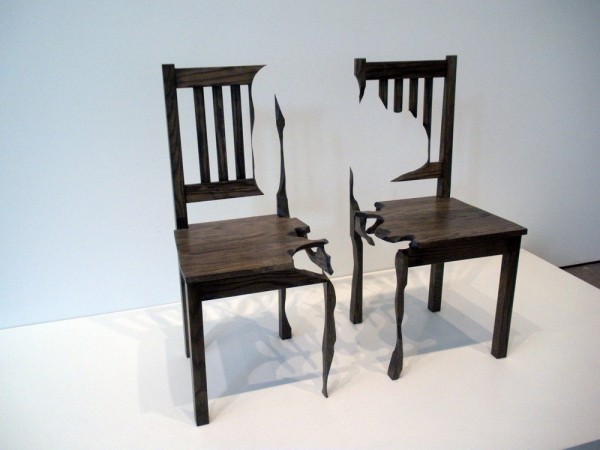
Darren Foote, Two Chairs, 2009

Darren Foote’s Two Chairs is a life apart from the first two works. His chairs are a mirrored pair that have dissolved, leaving no question of their handmade qualities. Their shape, a melting dissipation made in oak, doesn’t reveal any secrets or hold any graphic pattern that we need to unlock. Instead, their usefulness is squandered and we are left with a scarcity of possibilities. Either these chairs are being eaten by something in their interior or reflect shoddy workmanship by the producer. Erase a bit here, casually destroy a section of wood till it’s barely there– having a physical manifestation of what you can easily do in photoshop is unnerving. Are they a pendant pair, a portrait of disconnection? Their emotion, a punch you in the stomach feeling of decay, outweighs any concept that may be driving their creation.

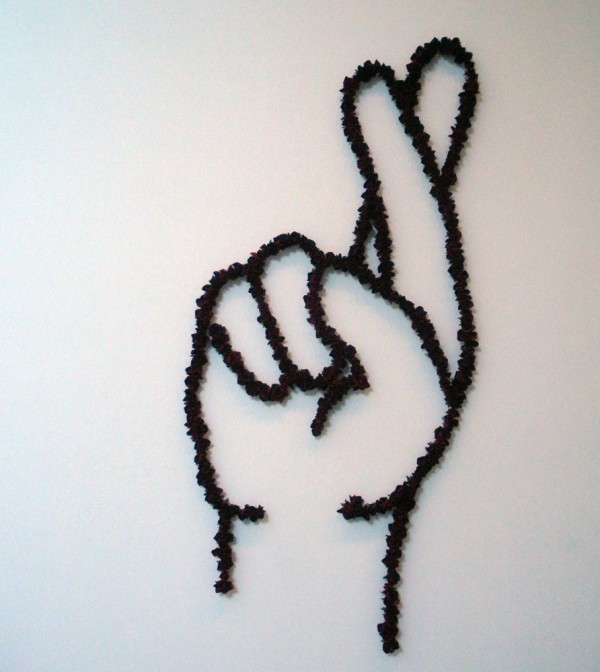
Donald Moffatt, Facts, Which If True (Joe McCarthy), 1992

Lastly, Donald Moffett’s Facts, Which If True (Joe McCarthy) is an unusual work from the artist. Instead of being direct and didactic, it is sly and witty. It is effectively a line drawing on the wall of two crossed fingers, made out of fake flowers. It seems to be based off the V for victory or a hippie peace sign, but instead is an ambiguous sign of either hope or a lie. McCarthy hoped that his lies were true, but that did not make them so. This work speaks about how the post war era, the G.I. bill, the anti-communist 50’s, and the peace & love generation are all part of the same process. Without the financial, baby boom, and GI bill there couldn’t be a growth in college education or a 60’s counter-culture on college campuses. This symbol goes right to the heart of post-war America’s propaganda.

Share

From the DS Archives: Interview with Richard Patterson

Today’s feature From the DS Archives revisits our 2010 interview between Noah Simblist and Richard Patterson.

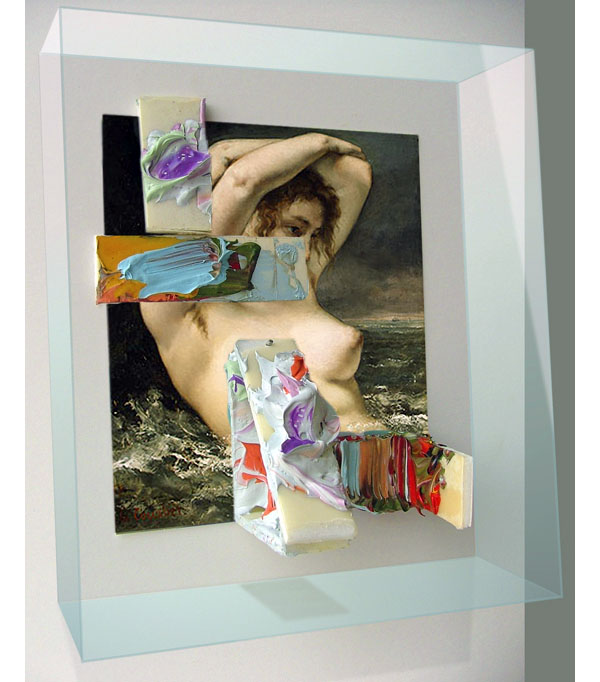
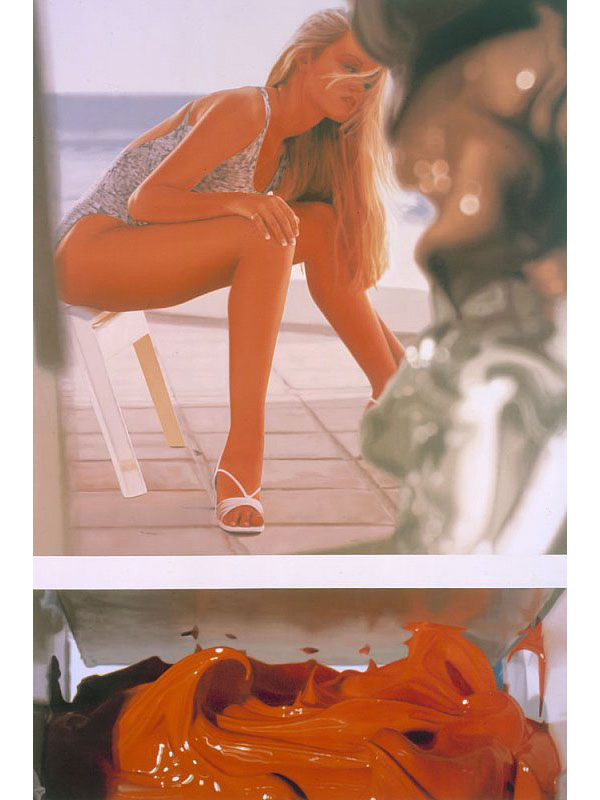
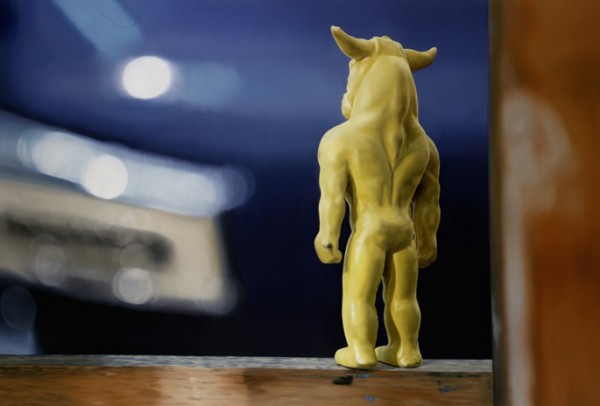
Richard Patterson emerged in London at Damien Hirst’s Freeze exhibition in 1988 as one of the YBA group. After moving to New York he eventually settled in Dallas. He is represented by Timothy Taylor Gallery in London and James Cohan Gallery in New York. He is known for paintings that combine imagery culled from popular culture and art history with painstaking detail. Combining car culture, soft porn, modernist design and the viscous seductions of paint, Patterson’s work often evokes both melancholy and desire. Here, Noah Simblist talks to him in his studio about his current paintings. They began by discussing the problems with working with appropriated imagery.

Richard Patterson: There’s so much shit to worry about. That’s what has sort of driven me to generate my own imagery rather than referencing other material because unlike in Germany where everything is seen as fair use, everywhere else it’s not. So it’s a very prohibitive time, you can’t visually comment on the world now in a satirical or ironic way without getting permission first. So, I got good enough in Photoshop where I started realizing that if you already know how to paint and draw you can actually generate stuff from scratch without sampling it.

Noah Simblist: The breasts in the Doge painting are from scratch?

RP: They are absolutely from scratch.

NS: Really?

RP: I decided to adorn these dancers with these slightly crazy, slightly cartoon breasts. And then Bellini’s Doge of Venice appears in the middle. There was a lot of power invested in this one person who is basically elected. I think of him as this benevolent type of prince. That’s not why I did it, but you know, he seems a little like the local collector Howard Rachofsky.

NS: The Doge of Dallas.

RP: The Doge of Dallas and all the breasts you know. These are my fake breasts.

NS: The Dallas fake breasts.

RP: These are the people that inhabit galleries. It’s also like Picasso. It’s the fear of impotence and death and the younger fertile woman you know. Also I think its ridiculous, it’s got a cartoony kind of dumbness to it. NS: You have said that these paintings are not meant to be purely ironic like the way that Jeff Koons uses appropriated imagery for a sly commentary on contemporary life.
RP: Koons is all about irony. But, there is a melancholy and genuineness, a specific mood in some of my paintings that isn’t there in Koons. Koons is all about the tedious stuff about consumerism.

I think that the American understanding of irony is where you say, “I really like your new sweater…not” My understanding of irony is from English culture, which is entrenched with irony. If you had your country blown to bits in living memory or you parents memory and you’ve seen your country change…We used to have this massive empire and I was brought up to believe that there was still this kind of Great Brittania type shit and then it is so clearly dwindling. How can you not be ironic about the fact that Hitler bombed the shit out of your country. That gives you a kind of cultural irony that is so, English. English culture is shot through with being invaded and assimilating new cultures through its history and then developing a sense of humor about it.

Read More »

Share

Sundance Film Festival: Blast Theory

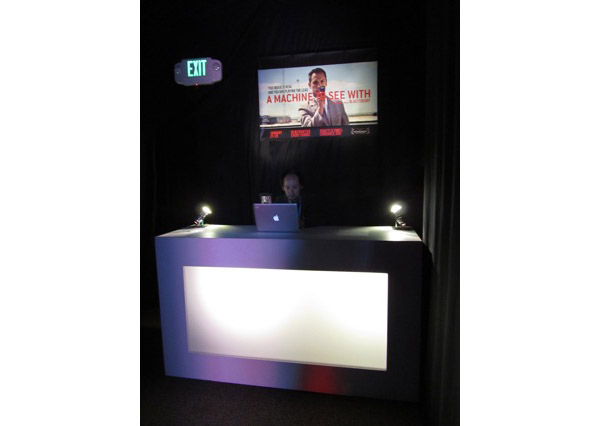
New Frontier is a multimedia art installation segment of Sundance Film Festival. 5th year running, New Frontier converges technology, art, light and space while pushing the boundaries of the moving image. Within New Frontier, Blast Theory’s A Machine to See With is an interactive film experience in which you are invited to take on the lead role in an imaginary heist movie. Led through the streets of Park City with a series of automated voice messages, participants are given choices during their journey that determine the fate of their experience.  Technology used? Basic cellphones.  Length of film? Approximately one hour.  Film equipment? Your own mind.

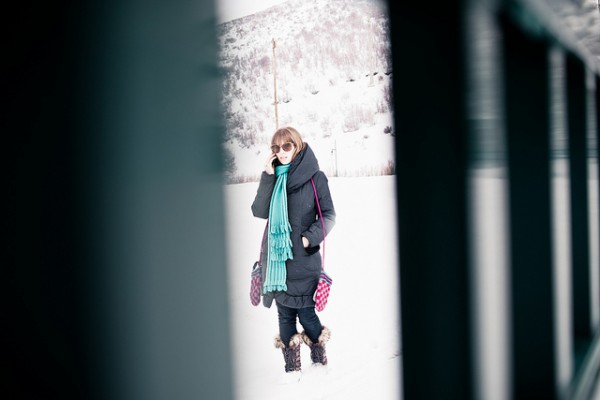
I arrived to Park City for the first time, lost in the reflective mounds of snow. Straight off the plane to New Frontier, where I was to participate in a test run of A Machine to See With, before it opened to the public the next day.  Knowing nothing more than the description above, I gave Nick Tandavanitj and John Hunter, the Blast Theorists, my cell phone number and anxiously waited for my first call.

Sound Bite: “This is A Machine to See With…”

The mysterious deep toned Brit instructed me to ignore any other incoming calls or messages.  What if I get a call from my— FORGET IT. As I began to walk around following the instructions, The Voice knew what I was looking at. It knew what I was passing. It sensed the fear in my eyes as the camera zoomed in closer. It was talking so overwhelmingly fast, I was afraid I would miss something. My paranoia excelled along with my pace. Everyone was in on it. It was The Truman Show with an evil twist.

Could I actually get away with a bank robbery in Park City? Did I really have the guts to do it? If the words “scavenger hunt” come to mind, erase them. No, this was not a “scavenger hunt”, for there were too many emotions attached to the experience.  It was not a search for objects but a search for courage within. The first major task forced me to lock myself in a bathroom stall, take out all my money from my wallet, and examine it.

Sound Bite: “Now hide the money… somewhere they’re not going to find it…”

I could have easily pretended to hide the money, but what if something happened? What if someone was watching? I decided not to use the bathroom even though I really needed to go.

The car in the empty lot was the next obstacle.  As the voice instructed, I opened the door and sat inside, as if it was my own.  And now was the time to Choose My Own Adventure. “A person will approach the car and knock three times. If you trust them, open the door,” instructed The Voice. A collaborator. A partner in crime. I didn’t trust her at all, but was too afraid to do this on my own. We devised our plan… I’m stashing the money. She’s distracting the teller.  Then, The Voice separately asked a series of questions about what we thought of each other. No, I did not think she would remember to smash the bank’s video footage and steer off plan before running away with the money. She seemed by the book. Were my answers the reason we were asked to split up again? We were instructed to go off in different directions and avoid each other as we approached the bank. The countdown began.  “Your hand should reach the door of the bank in 5… 4… 3… 2…”

This project is an example of Locative Cinema, taking the traditional cinematic viewing experience outside of the black box. A Machine to See With was selected for the Locative Cinema Commission, a joint project of ZERO1: The Art and Technology Network, The Banff New Media Institute at The Banff Centre, and the New Frontier program at the Sundance Institute. For me, the interweaving of reality and fantasy was the most interesting part. The spontaneity and uncertainty of this project was fresh and exciting and kept me on my feet, with an over awareness that a film from my sofa could never evoke.

Over 400 people participated over a nine day run. Out of those 400+, only one outraged participant cursed out the Blast Theorists for not being able to locate the bank. Only one person misunderstood the directions and hid their money with the toilet seat covers, giving a New Frontier staff member a bonus while in the loo.  At least 4 reported participants returned to the film’s locations after their initial run, to heighten the experience for other participants… Three of them entered the back seat of the car yelling “We’ve REALLY  gotta go through with this!” Another called out “Get in the van” as their unmarked vehicle crept alongside.  One gal even returned to the Blast Theorists unable to find the money she had hidden in her shoe. At that moment, she realized that an anonymous man had approached her friend moments earlier when they were asked to split up and said “ I think you dropped something.” $100 to be exact. “Is it part of the film?” she asked. Only in Park City… I thought.

Stay tuned for Blast Theory’s A Machine to See With in your hometown.  Next stop: Walker Art Center in Minneapolis.

Other Blast Theory Projects shown at New Frontier 2011

Kidnap lottery / 1998:
http://www.blasttheory.co.uk/bt/work_kidnap.html

Online virtual game with gps on live players / 2003:
http://www.blasttheory.co.uk/bt/work_uncleroy.html

Historical reinactment / 2009:
http://www.blasttheory.co.uk/bt/work_ulrikeandeamoncompliant.html

Share

Suprasensorial

L.A. Expanded: Notes from the West Coast
A weekly column by Catherine Wagley

Julio Le Parc, Lumiére en mouvement-installation, 1962/re-fabricated 2010, painted drywall, mirrors, stainless steel, nylon thread, and two spotlights, 42 ft. 5 in. x 16 ft. 10 in. x 16 ft., collection of the artist, photo by Iwan Baan.

When Light and Space sculptor James Turrell installed one of his light tunnels at the Whitney Museum in 1982, a woman leaned against a wall she thought she saw, fell and broke her wrist. She happened to be the wife of the Oregon State Supreme Court Chief Justice, and subsequently sued the museum. Her testimony: “It was a receding wall, I leaned against it, and it wasn’t there.” Turrell retells this story often, and, when he does, he sounds insightful while the woman sounds silly—entitled, and perhaps a bit of a fine art philistine (reported the BBC, “Whilst concerned for her safety, Turrell has recalled her testimony with a smirk”). And even if suing a museum over an art work that did what it was supposed to—toyed with perception—does seem like irrational vengeance-seeking, there is something genuinely ominous about art that can trick you so effectively. It plays God, and makes you feel like a passive participant. “I don’t function in the same situation as the general public,” Turrell has said. “I am the maker not the observer.”

Even before  Turrell and a handful of other young American artists started experimenting with light, a number of artists from Latin America had already begun to do so, some working out of the US or Europe. Their work has been far less prominently exhibited in the states, and some has not been shown at all. Now, five installations by Latin American Light and Space artist are featured in a surprisingly low-key, charming exhibition at MOCA.

Carlos Cruz-Diez, Cromosaturación, 1965/re-fabricated 2010, painted drywall, fluorescent lights, and colored plastic, 155 15/16 x 603 15/16 x 291 5/16 in., collection of Carlos Cruz-Diez, photo by Iwan Baan.

Suprasensorial: Experiments in Light, Color, and Space includes only six artists, two of whom worked as a team (and it may be the first MOCA show in years that hasn’t been annoyingly overhung): Carlos Cruz Diez, Lucio Fontana, Julio Le Parc, Hélio Oiticica and Neville D’Almeida, and Jesús Rafael Soto.

Walking through Suprasensorial, you feel not that you are being awed, but that you are participating in a certain science-fair-style awe about the way light works. If you enter through the second door,  the first piece you’ll encounter is Rafael Soto’s Penétrable BBL bleu, a sea of hanging rubber cords that resist your body weight as you push through them. Then there’s Carlos Cruz-Diez’s Cromosaturación, a series of fluorescent colored rooms you can see into but not out of–when I was in the green room, a child’s winter coat had been abandoned on the floor; it shouldn’t have been there, of course, but it made the space feel lived-in, communal rather than austere.

Hélio Oiticica and Neville D’Almeida, Cosmococa-Programa in Progress, CC4 Nocagions, 1973/re-fabricated 2010, water, pool, electric lights, projected images, sound, and paint, 24 ft. 7 1/4 in. x 45 ft. 1 5/16 in., Projeto Hélio Oiticica, Rio de Janeiro. photo by Iwan Baan.

It’s Hélio Oiticica’s and Neville D’Almeida’s Cosmococa-Programa in Progress, CC4 Nocagions that has received the most press since the exhibition opened, and understandably. They’ve made a swimming pool for a museum, and those who choose to climb in (you can buy swim wear in the gift shop and there’s a line of changing rooms and lockers outside the installation) listen to John Cage and, as they float, watch a looping slideshow of Cage’s music notations covered in drawings made with lines of cocaine. ” The water removes uncertainty,” D’Almeida told MOCA curator Alma Ruiz.

But my favorite work in the exhibition remains Julio Le Parc Lumiére en mouvement-installation. It reminds me of a West Hollywood hotel lobby, pretty, certainly, but glitzy in an almost commercial way. I imagine an exuberantly costumed, intermittently morose and enthusiastic Ariel Pink performing Round and Round inside Parc’s reflective. It’d be swank, melancholic, ephemeral and kitschy all at once. In other words, perfect.

Share

Cindy, Cindy on the Wall… Who’s the Strangest of Them All?

What would you do if you were one of the most iconic artists in the world, having forged a name for yourself with unmistakably recognizable work? What do you do to move forward? You can reject all that has made you famous, continue to churn out the tried and true, take a page from Duchamp’s book and take up chess or try and build upon your former practice to create something relevant and new…

In her latest solo exhibition at Sprüth Magers in London, Cindy Sherman seems to be attempting the latter.

Cindy Sherman, Untitled, 2010. Installation view, Sprüth Magers London, January 2011. Photograph: Stephen White. Image courtesy of Sprüth Magers Berlin London.

While Sherman is still photographing herself in a range of various guises, she has decidedly broken free of the frames that constrict her former work and has blown up photographs of an eclectic cast of characters to create a larger than life sized tableaux that extends throughout the two spaces of the gallery.

Cindy Sherman, Untitled, 2010. Installation view, Sprüth Magers London, January 2011. Photograph: Stephen White. Image courtesy of Sprüth Magers Berlin London.

The murals plaster the rooms like wallpaper, an effect furthered by the illustrative black and white backdrop, reminiscent of a Victorian woodlands as interpreted through home decor. And inhabiting the space is a strange and unnerving troupe that are very difficult to define…

Cindy Sherman, Untitled, 2010. Pigment print on Phototex adhesive fabric. Dimensions variable. Courtesy of the Artist and Sprüth Magers Berlin London.

Sherman’s work often depicts recognizable stereotypes: the stars of her famous ‘Untitled Film Stills,’ the Renaissance figures and clowns that followed and most recently in her 2008 series, the aging American socialite. However, we have also witnessed disconcerting and gruesome images, particularly in the Fairy Tales and Disasters series of the 1980s.

The figures we see at Sprüth Magers are neither familiar nor horrific; they are simply bizarre. Banished to a colorless forest, these poorly-dressed characters from folklore, fairytales and literature, appear as a cast of rejects. Too strange to be of use. Or perhaps, not strange enough.

Cindy Sherman, Untitled, 2010. Pigment print on Phototex adhesive fabric. Dimensions variable. Courtesy of the Artist and Sprüth Magers Berlin London.

On one wall there is the woman in a peasant-like floral dress, covered in a sheer boudoir wrap with a visible broken foot. An amalgamation of styles that makes you unable to place her in any particular time and place. Next to her stands a figure in an slumpy naked suit, feet in wool socks and brandishing a plastic sword. In the next room a knight in a tunic too big, paired with metallic zebra print trousers and a circus juggler in a dated costume and decidedly twenty-first century sneakers.

Cindy Sherman, Untitled, 2010. Pigment print on Phototex adhesive fabric. Dimensions variable. Courtesy of the Artist and Sprüth Magers Berlin London.

The figures do not sit in their setting, but are rather float on top of it, as if cut and pasted into this strange place. Perhaps it is this quality, this sense of flatness and dislocation, that recalls a favorite Sherman work, the 1975 animation Doll Clothes. However instead of a miniature Cindy we have giant figures, far too big for the space, that stare directly out over us, expressionless.

The heavy makeup that characterizes Sherman’s transformation of herself is gone – replaced instead with subtle digital manipulations used to contort her face. Topical alterations are replaced with structural ones – in the way that plastic surgery has become the preferred method over cosmetics to achieving the desired ‘natural‘ look.

Sherman’s work is undeniably iconic. As one of the most successful artists of the past decades there is an immense amount of pressure to continually produce something new. As these figures break out of their frames inhabiting the entire space and spilling out into the street through the Sprüth Magers window, Sherman attempts to break down her own formula – or at least bend it ever so slightly. For not abiding by the tried and true, Cindy – I applaud you, even if it is not my favorite work – I think I prefer vomit and vacuousness over vagueness.

Share

Mike Kelley at Gagosian Gallery

Mike Kelley claims he doesn’t particularly like Superman. The jury is out on whether or not this qualifies him as a communist, but his claim does provide a source of perplexity when evaluating the inspiration for his ongoing Kandor sculpture and installation series – the newest of which being currently displayed at Gagosian Gallery (Beverly Hills) alongside the latest chapters of his filmic project, Extracurricular Activity Projective Reconstruction (EAPR).

Kandor 10 / Extracurricular Activity Projective Reconstruction #34 and Kandor 12 / Extracurricular Activity Projective Reconstruction #35, installation view. Photo by Fredrik Nilsen. Courtesy of Gagosian Gallery.

In its original graphic incarnation, Kandor is noted as the fictional capital city of Superman’s native planet, Krypton. By the swift and conniving hands of the villainous Brainiac, the city was taken hostage and miniaturized for purposes not entirely sensible or mildly coherent – but not without valorous retrieval by our hero. Despite Superman’s Samaritan ways, the omnipresent plague of a haunting past hinders him from true emotional and psychological liberation – not to mention, visible underpants. For Kelley, the conceptual appeal lies in Kandor’s embodiment of an alienating victim culture for our protagonist: the notion of a burdensome present dictated by a labyrinthine past. Kelley’s unorthodox fusion of fragmented narrative, medium and sensory immersion seem nonsensical and queer at first encounter, yet the further we delve into his sensational rabbit hole, the closer we come to the truly bizarre fidelity of the human condition. Kelley confronts our latent attitudes and popular convictions relating to sexuality, socioeconomics, education and history with jocular finesse and – well – candor.

Kandor 10 / Extracurricular Activity Projective Reconstruction #34 and Kandor 12 / Extracurricular Activity Projective Reconstruction #35, installation view. Photo by Fredrik Nilsen. Courtesy of Gagosian Gallery.

Like glowing orbs, a handful of Kandor sculptures pepper the multiple galleries within the darkened Gagosian megaplex. The dwarfed cities encased beneath colorful bell jars appear relic-like, yet also profane at times – their jutting skyscrapers evoking a curiosity born of both estrangement and familiarity. The two primary microcosms – Kandor 10 and Kandor 12 – bear oversized tubes that snake into tanks of (presumably) atmosphere, per the accuracy of the comic book reference. Each is situated within environmental installations that embellish upon two distinct anecdotes central to the exhibition: the carnal Moroccan harem featured in EAPR #34, and the bleak sooty chamber that appears in EAPR #35. In merging his previously autonomous Kandor and EAPR projects, Kelley suggests an innate relationship between our own respective microcosmic realities and subsequent conditional behavior.

Mike Kelley, video production still from Extracurricular Projective Reconstruction #34, 2010. Courtesy Gagosian Gallery and Kelley Studio.

By way of illustration, Kelley’s EAPR #34 videos largely examine the lascivious conduct of society’s upper echelon when handed unrestricted power and entitlement. Directed in the style of a maladroit stage play, EAPR #34 shifts between a piggish male King belittling his covetous female harem and a group of scornful Queens admonishing a male servant. In both scenarios, the authoritarian’s disposition to abuse of influence and insatiable gluttony bespeaks a cyclical global history of flawed paradigm and deep-rooted desire for accumulation. Beside the video installation, Kandor 10 is nestled within a life-size stony grotto reminiscent of EAPR #34’s exotic Moroccan setting, as if displaying the incubator in which these voracious human mannerisms were nurtured. When the Kandor’s luminous mini-cityscape appears more familiar than it does foreign, one can only muse on how fictitiously reconstructive Kelley’s staged milieu really is.

Kandor 12 A (green screen), 2010. Tinted Urethane resin, steel, blown glass with water-based resin coating wood, enamel paint, silicone rubber, acrylic paint, lighting fixture and Lenticular 12. 126 x 202 x 276 inches overall (320 x 513.1 x 701 cm). Photo by Fredrik Nilsen. Courtesy of Gagosian Gallery.

Conversely, EAPR #35 jettisons us into a place of somber isolation and denial. Grimy clownish gnomes aimlessly shuffle around a murky cell, their void gazes searching for an ambiguous cue. Homogeneous in tired costume and ashen faces, the destitute prisoners amble in silent futility – resigned to the dim prospects of their ordained condition.

Video production still from Extracurricular Projective Reconstruction #35, 2010. Courtesy Gagosian Gallery and Kelley Studio.


The analogous Kandor 12 shares an equally inauspicious aesthetic; the cloudy brown bottle houses a municipality more reminiscent of chess pieces than modern skyscrapers – as if underlining the inmates’ loss of an unassailable game. The sparse backdrop of the gnomes’ cellar intimates a societal tradition of abhorrent secrecy and muted abuse of the weak, a ritualistic convention of marginalizing the vulnerable in order to preserve the greater hierarchy. As if acting as the underbelly to the rapacious actuality in EAPR #34, the vignette captured in EAPR #35 exposes the ensuing trauma that occurs in the wings as we strive to fulfill our socially performative roles – most of which remain immutably out of reach.

Kandor 12 A (green screen), 2010. Tinted Urethane resin, steel, blown glass with water-based resin coating wood, enamel paint, silicone rubber, acrylic paint, lighting fixture and Lenticular 12. 126 x 202 x 276 inches overall (320 x 513.1 x 701 cm). Photo by Fredrik Nilsen. Courtesy of Gagosian Gallery.

In fact, Kelley’s inclusion of the sets from the EAPR #34 and EAPR #35 videos in this exhibition make us feel but a mere player in one hell of a bewildering production. In tandem with his Kandors, the sets feel like an abstract extension of a transient ecology, a faux mise en scène demonstration of how we enact our own mortality. Do we unconsciously fall victim to institutional constructs in our quest for repute and satisfaction, acting a character merely to clinch our chances of eminence? Or do we find ourselves waiting in the wings for a cue – a protagonist – that may never come?

Kandor 10 / Extracurricular Activity Projective Reconstruction #34 and Kandor 12 / Extracurricular Activity Projective Reconstruction #35, installation view. Photo by Fredrik Nilsen. Courtesy of Gagosian Gallery.

Share