Lisa Tan: Two Birds, Eighty Mountains, and a Portrait of the Artist

Les Samouraïs , 2010 Single-channel video lightstands, painted wood, projector 3 min 36 sec, sound Courtesy of the artist & Galerie Vidal Cuglietta

One might be tempted to call Lisa Tan’s exhibition at Arthouse in Austin poetic. But what would this mean? It is spare, filled with layered and complex allusions, much like a poem. The imagistic lyricism of two finches in a cage; a lone man smoking as he stares out a window; flashes of barren mountain peaks; and a doctor’s stark appraisal of an aging body might suggest something more than prose as an apt metaphor. But regardless of the correct literary comparison, this exhibition is an aggregate of images – a series of artworks that collect around a few themes. One of the most evocative is the notion of the double.

Letters From Dr. Bamberger, 2001 - ongoing Annual post-physical letters 9 5/8” x 6 5/8 inches each Courtesy of the artist w/ special thanks to the University of Gothenburg, Valand School of Fine Arts

Much of the work is about relationships, both real and imagined, between two bodies. Letters From Dr.Bamberger is a project that Tan begun in 2001 when her boyfriend at the time went to the doctor. He received a letter from the doctor after his physical that summarized his health. Tan followed suit and also went to this doctor, shortly receiving her own letter. Year after year Tan and her romantic partner would go to the doctor and receive a letter that detailed their physical health. These letters, standing in for each of these years stand side by side, wrapping around the exhibition. They speak to the luxury of health insurance and the shifting of a body’s physicality over time. They also speak to the relationship between doctor and patient, which Tan originally compared to the teacher-student dynamic in graduate school when she began the piece ten years ago.

National Geographic, 2009 Double slide projection and printed text Dimensions variable Courtesy of the artist

Another work is National Geographic (2009), which is composed of two slide projectors and a screen. Tan took her late father’s magazine collection and cut out all of the images of mountains and photographed them. She then photographed the image that was on the backside of the page. In the dual projections this back-to-back relationship is splayed out in such a way that we see side-by-side comparisons governed by chance.

Les Samouraïs , 2010 - Single-channel video lightstands, painted wood, projector 3 min 36 sec, sound Courtesy of the artist & Galerie Vidal Cuglietta, Brussels

Les Samouraïs (2010) is based on Jean-Piere Melville’s 1967 film Le Samourai. This film, which was remade by Jim Jarmusch in 1999 as Ghost Dog, tells the story of an assassin who lives in relative solitude with only a small caged bird for company. The finch in the original film died in a studio fire shortly before the film’s completion and Tan memorializes it by digitally adding a second bird into the film, complicating the film’s tragic sense of isolation.

In Search of the Forgotten, Letters from Mme de Forget to Eugenè Delacroix, 2010 Archival inkjet prints with chine-collé in artist’s frame 6.3 x 19.7 inches Edition of 2 Courtesy of the artist & Arthouse at the Jones Center

Finally, there are a series of prints that record the correspondence between the nineteenth century French artist Eugene Delecroix and his friend and lover Madame Forget. Tan was fascinated by the wonderful associations that the English pronunciation of this woman’s name evoked. Was she indeed forgotten? What was her true relationship with this great titan of Romanticism? Tan’s process involved research in France and New York but rather than looking for concrete truths as an historian might, the artist is content with the richly ambiguous and open suggestions of correspondence and parallel gestures of expression.

Share

Stan VanDerBeek: The Culture Intercom at MIT List Visual Art Center

I’m reluctant to quote from Emerson’s Quotation and Originality, but it really does add to a conversation about the Stan VanDerBeek exhibition at MIT. While Emerson is obsessed with verbal communication and upholding the cannon as a garden that we can “honestly” borrowed from, The Culture Intercom actively fights the idea that “all minds quote” and “the originals are not original.”

VanDerBeek’s career was filled with experimental projects in film, early computer art, and the cybernetic-tinged utopian non-verbal communication that moved art into uncharted waters. If Al Gore invented the internet, than VanDerBeek envisioned it first. The working model of visual and cultural lateral leaps found in Mankinda (1957) carries through his later works like Newsreal of Dreams (1976). Each relies on associative leaps made out of a psychedelic arrangement of random things– frenetic, non-stable images morphing and fluctuating their meanings in the blink of an eye. The central work, a recreation of Movie-Drome, contains popular movies, art history slides, and contemporary music entangled in an overwhelming collage that is impossible to completely experience.

The show’s title comes from one futuristic option that came out of his Buckminster Fuller-esque dome for the original Movie-Drome, at Gate Hill Co-op in Stony Point NY. The idea was, that “non-verbal international picture language” could be beamed out via satellite to other domes. These were not motion pictures, but emotion pictures, filed with deep utopian notions of what we are capable of becoming in the future. Today we just make do with UbuWeb, YouTube, and tabbed browsing, but an alternative art broadcast system would be an excellent invention.

VanDerBeek’s cybernetic cold-warrior surroundings pop up in Breathdeath (1963) a few times. This and other works were a huge influence on Terry Gilliam, both during the Do Not Adjust your Set and Monty Python eras. Both Gilliam and VanDerBeek grew up in the post world war era and wore their politics on their sleeves. A central concern was if these new technologies would end in mutually assured self-destruction or if they would free us. There was a fear that technology was out to get us.

His Violence Sonata is probably the most utopian of the work shown. It’s a two hour video that was broadcast on channels 2 and 44 in Boston on January 12, 1970. He hoped that neighbors would get together and watch two televisions simultaneously. This experiment was designed to spark discussions about race relations and violence. There was even a live call-in portion and a studio audience who were asked  “Can man communicate?”

Part of VanDerBeek’s originality stems from his quoting. The use of altered, but popular and accessible images and their loaded messages allowed for cybernetic feedback loops and open systems that MIT was known for during VanDerBeek’s tenure as a Fellow at CAVS. I think in 2011 it is easy to see this type of artwork unconsciously quoted by freshman video classes, but this exhibition creates a coherent vision of VanDerBeek trying to harness these technologies for art’s sake, even if he wasn’t sure that it was possible.

Stan VanDerBeek: The Culture Intercom Will be on view at MIT List Visual Art Center from February 4- April 3, 2011. There will be a gallery talk by Fred Barzyk and David Atwood of WGBH on Thursday March 10 about Violence Sonata. March 31 there will be a screening of 16mm films not included in the exhibition. It will also be on view at Contemporary Arts Museum Houston from May 14- July 10, 2011.

Share

From the DS Archives: Jay Kelly

This Sunday From the DS Archives brings you California artist, Jay Kelly. You can see Kelly’s current exhibition through April of this year at the Katonah Museum of Art in Katonah New York.

This article was originally written by Seth Curcio on November 30th, 2008.

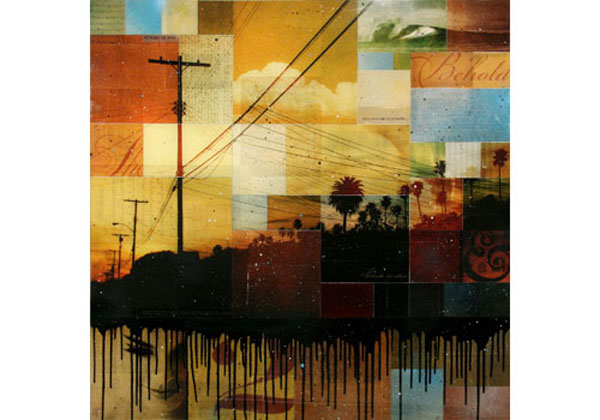
Artist Jay Kelly currently has a new series of works on view in the exhibition titled Rawness & Polish with Commissary Arts in Venice Beach, California. The works on view will include several medium and small-format collages. Some of the works are illuminated by light boxes, constructed of photographs, stencils, spray paint, and found imagery. The artist successfully fuses his personal interests of natural and urban-based elements, found in the land and cityscape of Southern California, with a highly decorative method of visual arrangement. The result reflects a slice of contemporary life synthesized into a graphically compartmentalized surface.

Kelly is a graduate of the UCLA, and has recently exhibited with Go Go Gallery in Miami, Florida andMuseum Works Gallery in New York City and Los Angeles. The artist was also commissioned this year to create a new work of art for The Abbot Kinney District Association, for this year’s Abbot Kinney Festival in Southern California.

Share

Fan Mail: Interview with Dara Gill

Each month, DailyServing selects two artists to be featured in our Fan Mail series.  If you would like to be considered, please submit to info@dailyserving.com a link to your website with ‘Fan Mail’ in the subject line.  Keep checking the site – you could be the next artist featured!

For this edition of Fan Mail, Sydney-based emerging artist Dara Gill has been chosen from a group of worthy submissions.  Just back from a project in the New South Wales bush, Gill took the time to discuss his passion for ideas, his creative process and to share his thoughts on anxiety – that omnipresent 21st century condition.

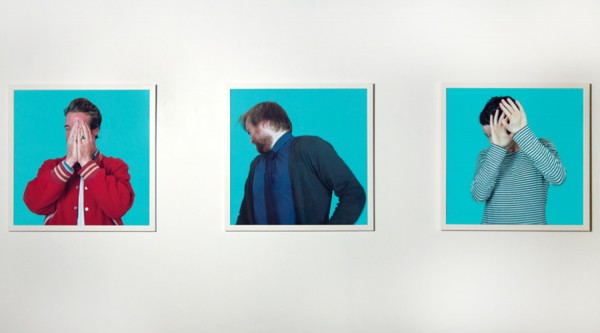
Untitled (Rubber Band Portraits), 2010. Courtesy the artist.

Kelly Nosari:  Your practice is so diverse.  You work in video, performance, sculpture, painting, sound and installation.  Where does your creative process begin?

Dara Gill:  My creative process starts first and foremost with research.  In this stage a formalisation of the research made is complied into a fluid ‘definition’ of the topic as I see it.  This normally includes the ideas of others coupled with my own ideas and this definition then informs the artworks themselves.

KN:  Anxiety is an overarching theme in your art practice.  How do you creatively engage an experience that is both personal and collective?   What is it that interests you most about this universal human condition?

DG:  Anxiety tends to sit at the top of the human emotional hierarchy, thus most emotions stem from anxiety.  It is the ubiquitous nature of the emotion that drew me towards it and its ramifications for daily life.  My yearning to understand the emotion stems from both wanting to know myself and my fellow man a little better, objectifying what is in essence subjective.  Initially my interest tended to sit with the neurotic forms of the condition, that is phobia driven anxiety, but as I discovered more about the emotion its daily ramifications became much more powerful and interesting.

Creatively engaging with anxiety, or any emotion in fact is often the hardest part, because for each it is truly personal.  Therefore the challenge of creating works that do not involve personal motifs or stories, but rather commonly shared experiences, is the trust of this creative engagement.  I always aim to communicate without relying on the texts created from my research or any over explanation of the meaning behind a work, but rather letting the work communicate through is imagery and processes.

Sisyphus Triptych #2 from Dara Gill on Vimeo.

KN:  The influence of the Greek myth of Sisyphus is evident in video works like Untitled (Sisyphus Triptych #2) or To Roll, in which you attempt a tedious or impossible task.  Please talk more about this myth and its influence on your work.

DG:  For me Sisyphus is a parable for anxiety.  Very briefly, anxiety stems partly from a foreboding sense that something is ‘not quite right’ – a negative reflection on ones current place in the world.  Anxiety is a general ambiguous feeling that something is missing or looming (Lack), and a wish (Desire) to rid one of this feeling.  The desire to change transforms into a desire to work or maintain a sense of busy-ness in order to quell anxiety.  This characteristic produces mundane work, work towards a perpetually unfulfilled and ill-defined end result.

My first point of interest within the myth Sisyphus is the mental state of Sisyphus as he completes each cycle of his task; his naive and instinctual habitual compulsion to push the rock up the hill, thinking that his toil will end once the rock reaches the summit, the horror as he watches it roll back down, and the amnesia he suffers each time the cycle continues.  Sisyphus is to constantly work towards a goal that has no foreseeable end to it, born out of a compulsion from nothing.

KN:  In much of your work, you aim not to reconcile or to perform anxiety, but to rather mischievously induce it in others.  Whether aiming rubber bands at peoples’ faces as in Untitled (Rubber Band Portraits) or surprising them with bright lights as in Untitled (Blinding Light Box) you create a very physical stress experience for the participant.  Talk more about this process.

DG:  Often the work that involves the use of people is born out of the research into the topic.  I often think that the best way to explain anxiety is to induce it in others.  For instance, in Untitled (Rubber Band Portraits) and Untitled (Blinding Light Box) I utilised one my observations of anxiety as being both a simultaneous Fight and Flight response, the effect of this causing a paralysing stillness or as Kierkegaard describes a ‘shuddering before nothingness’.  I drew a parallel with this ‘Deer in the headlights’ type moment, where the Deer is both mesmerised by the cars headlights but also fearful of its demise, both culminating again in a paralysing internal dizziness.  This motif was then manipulated into the bright lights in Blinding Light Box and the rubber bands in Rubber Band Portraits.

Untitled (To Roll) from Dara Gill on Vimeo.

KN:  You have described your work as ‘situational based research’.  I see that some pieces mimic psychological experimentation by facilitating discomfort and documenting it.  In Horror Vaccui Experiment (2009), for example, you record an unwitting subject as they wait alone in an empty room.  How do you go about this process?  What is the Knowledge Barter Experiment?

DG:  A key methodology within in my developing practice is the survey, that is, an attempt to engage with the public in situational based research where a subject responds to stimulus or a constructed environment, often with a visual outcome.  These works are performative in nature and documented through video, text, photography, and sound.  Through this process documentation becomes art object.  The tenor of these works is that of objective scientific research, but the parameters of the interaction are poetically manipulated in order for the outcome to become expressive of visual art.  The use of the survey has played a pivotal role in my investigation of anxiety, and is the tool that is used by the sciences to gain useful information on anxiety.  I wish to employ the survey in an almost playful sense, as pseudo-scientific investigation.  This methodology was used during the initial stage of my research and its findings inform more formal aspects of my artistic practise.

The Knowledge Barter Experiment was a fun side project that I always wanted to do but its connection to anxiety is very direct.  It forces a participant to actively reflect and comprehend ones own abilities and weaknesses, what they know and what they want to know.  Here they must define with some confidence their ability on a chosen topic.  This is not easy, as one attaches a value to what they know and thought they knew, and compares this to already existing teachings.  Secondary to this process is the defining of what one wants to learn.  This involves again identifying what one perceives they have little knowledge of and what they feel is valuable to know.

KN:  What are you working on now?

DG:  Right now I’m working on my next few solos that branch out into the topic of Hope and its connection to anxiety.  Hope for the most part sits in direct opposition to anxiety.  For Ernest Bloch, anxiety stems from a feeling of “something lacking and [the] want to stop it… [the] dreams of a better life”.  This hunger never ceases, “we never tire of wanting things to improve.  We are never free of wishes…”.  Friedrich Nietzsche opines that hope is ‘the worst of evils for it prolongs the torment of man’.  It is the space between such varied opinions that interests me, and the space in which I would like the work to exist.

KN:  Can you offer one piece of advice for emerging artists?

DG:  Document everything.

Share

Pure Exploitation

L.A. Expanded: Notes from the West Coast
A weekly column by Catherine Wagley

Merlin Carpenter, installation view, 2011, courtesy Overduin & Kite.

That cybernetics are no longer wholly imaginary doesn’t make them any more believable. In fact, it may just add to the surreality. Lukas Zpira, whose goes by a Surrealist-inspired anagram of his given name, is a self-described body hactivist; he has implants in his torso and cobalt teeth. “My modifications began in my mind,” Zpira said, speaking to Parisian writer Camille de Toledo in a hotel near the Bastille. “I went through a really self-destructive period. .  .  And if I was going to survive I needed something to live for.”  Self-revision became that something. He started with tattoos, then moved on to the  implants. He wanted “to apply technologies to [his] body in order to no longer be a slave to the machine.” In other words: to become a machine in order to subvert  machines, or become more of a body by removing all that is bodily. “Pure delusion!” exclaims de Toledo, recounting his encounter. Delusional, yes, but maybe not in the extreme.

In an information-as-power era, wanting to tie yourself to something intimately, grittily physical while still embracing that net-specific fluidity of authorship and data seems natural (though “natural” has undergone its own series of mutations). Zpira’s body hactivism makes those have-your-cake-and-eat-it urges possible—or at least makes a valiant attempt:

“Body hacktivists can only refute the validity of any patent, license or copyright relative to the body and its transformation.”

“Body hacktivism doesn’t include the need to be modified.”

“All modified persons are not necessarily considered as body hacktivists.”

“Body hacktivism is not a group and should foremost be perceived as a state of mind. . .”

Zpira’s state of mind has led to modifications, of course, and lots. But funnily, he doesn’t look radical. In fact, he looks sort of dated, like a grown up punk who didn’t change his appearance as what appeared around him changed considerably.

Merlin Carpenter, installation view, 2011, courtesy Overduin & Kite.

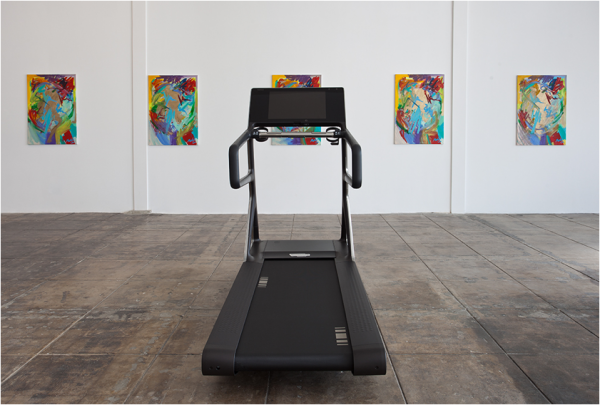
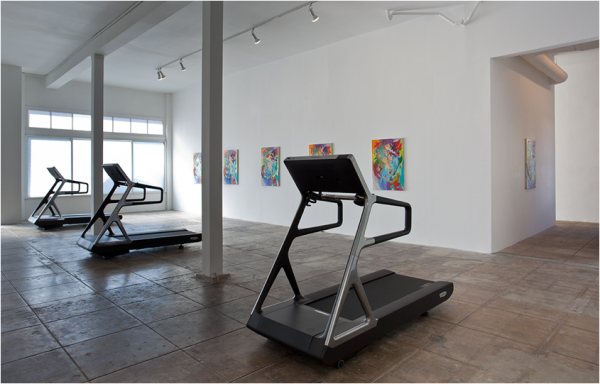
A similarly old, punkish and yet still weirdly “of its time” energy characterizes an exhibition I saw this week: Merlin Carpenter’s self-titled show at Overduin & Kite in Hollywood. It includes twenty iterations of the same rainbow colored, banally-sized neo-expressionist abstraction and four precisely placed, mint-condition treadmills—commodified expressionism paired with high-tech equipment in a way that at first seems cheap but, if you spend enough time, begins to feel inspired.

Carpenter, a London-based artist who has exhibited widely over the past two decades, made a bright gestural painting in 1990 (“it was meant to be a generic abstraction”). According to the press release—an essential and, thankfully, far from annoying resource for this particular show—Ed Lehan, a DJ and, I assume, friend, asked for the painting and Merlin agreed to give it, but only if Lehan made him 20 identical copies. “OK this happened and here they are,” reads the press release, “ they are about not being an assistant and not having one, ethical pure exploitation.”

The hand-made copies are all slightly different, but not remarkably so, and each has Merlin’s name and the date painted in bright blue at bottom right, with Peter Max enthusiasm. The first gallery has one treadmill in it, while the second has three (it was impossible not to think of that dazzlingly competent OK Go video—treadmills as quintessential props for 21st century self-making).

Merlin Carpenter, installation view, 2011, courtesy Overduin & Kite.

There’s no denying that the paintings are bad, and the treadmills non-sequiturs that don’t directly speak to what’s on the walls. But somehow the interaction between repetitive, painterly cluelessness and home-gym conceit speaks to revisionism and the push and pull between wanting to be tangibly grounded and yet longing to be endlessly replicable, and un-owned.

Lukas Zpira’s name may be surrealist-inspired; but Merlin shares his with an Arthurian legend. This (purely fantastical trait) makes them the perfect duo to bridge information, techiness and bodiliness and try to demystify the desire to self-revise , framing it as part of personhood.

Share

Seeing is Believing: An Interview with Trevor Paglen

Recent advancements in technology such as Google Earth and street-view, has given anyone with a computer and an internet connection the ability to collapse time and space. It is easy to sit in the comfort of your home and within just a few seconds, virtually place yourself anywhere in the world, that Google has imaged. This uniquely 21st century way of seeing may be relatively new to the masses, but there is no doubt that similar advancements were made years ago for military purposes. From the birth of photograhy, man has learned to “see with machines.” This concept is a crucial part of Trevor Paglen‘s research in art and experimental geography. Paglen recently presented a new series of images, and video, in an exhibition titled Unhuman on view now at Altman Siegal Gallery in San Francisco. I recently spoke with Paglen about photography and art history, aesthetics and the politics of watching that which watches us.

Trevor Paglen They Watch the Moon, 2010 / Courtesy of Altman Siegel Gallery

Seth Curcio: Trevor, your practice is centered in both experimental geography and art-making. Often the two collapse into one. Did your interest in geography develop concurrent with your interest in art-making? Or, did one come before the other?

Trevor Paglen: I’ve been an artist my whole life – much longer than I’ve been a geographer. In the mid 1990s, I started doing projects that had a strong relationship to landscape and the politics of visibility. While earning a MFA in Chicago, I became frustrated by the limits of traditional art theory, which mostly comes out of literary criticism, and wanted to find a more expansive theoretical language that could account for things like economics, politics, materiality, and so forth, in addition to questions of representation. Geography theory, I found, was incredibly powerful and flexible: it provided me with a way to think about cultural production in a much more powerful way than what I’d found in art and representational theory. So, I ended up moving to Berkeley and doing a PhD in geography.

Trevor Paglen: Unhuman Installation View/ Courtesy of Altman Siegel Gallery

SC: It’s interesting to know that you began making art long before your interest in science. In much of your work, there are strong references to art history as well as the history of photography. Those histories are intermingled with political and scientific concerns, allowing much of the work to function on multiple levels simultaneously. There are obvious references to Abstract Expressionism in works such as The Fence (Lake Kickapoo, Texas) and Untitled (Reaper Drone), as well as specific references to the history of photography in the works Time study (Predator; Indian Springs, NV) and Artifacts (Anasazi Cliff Dwellings, Canyon de Chelly). How do you feel these art historical references operate in the work, and what insight do they provide the viewer?

TP: Absolutely. There are all sorts of reference and nods to various art-historical moments and works, and references to specific historical photographs and gestures. I constantly use those references in a number of ways. With those references I want to ask “150 years ago, for example, a photographer looked at a particular place and that act of looking and photographing, at that particular historical moment, said a number of things about that historical moment. What happens when we try to see the same place now, and what might that act of seeing or photographing tell us about our particular historical moment?” The same is true for the references to various representational modes: “What,” for example, “does abstraction mean now? What, if anything, from that particular way of representing a historical and cultural moment, is relevant to our own contemporary moment? Why? And how?” For me, these sorts of historical references act as guide-points that we can use to understand how to see the world now, which is ultimately what I’m interested in.
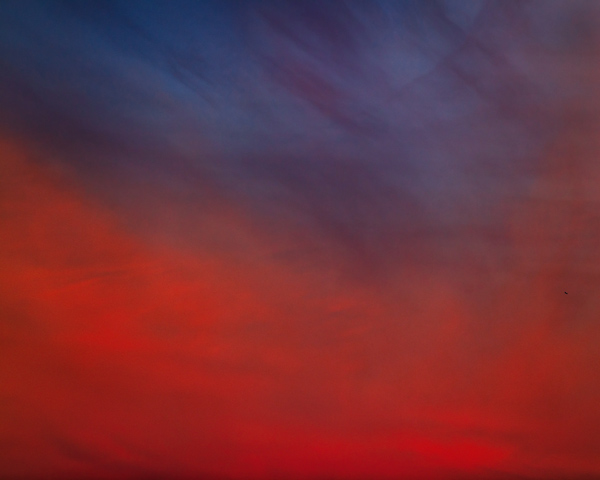
Trevor Paglen Untitled (Reaper Drone), 2010 / Courtesy of Altman Siegel Gallery

SC: The notion of seeing remains consistent in your work. As you mentioned before, this idea can be explored through the use of photography or by referencing specific moments of art history, when considering how other artists have seen the world and then represented that view in their work. Beyond these methods, much of your work is also investigating technology that is designed to see us, but not be seen. I find it interesting that the main way you shed light on these objects is to track and photograph them yourself, further reinforcing the idea of seeing. It seems that you are actively engaged in watching that which watches us. How do you feel about this cyclical processes?

TP: I think that there is a little bit of any irony in the act of “watching the people who are watching you” here for sure, and it’s certainly something that I’ve developed into a sub-theme quite explicitly in some works. But overall, I don’t think that particular dynamic is something I’m categorically interested in. That reading seems to emphasize the “surveillance” aspect of the work too much, and I’m actually not particularly interested in surveillance, per se. But it does point towards something that I am interested in, something I call “entangled photography” or “relational photography” – what I mean by this is thinking about photography beyond photographs. What happens if we start thinking about the practice of photography as embodying the critical moment in the work? In other words, what if the “fact” of photographing something is the essential critical point of a work? I started thinking about this a while ago when I was photographing secret military bases and CIA prisons – for me, a crucial part of those projects is not always what the images look like so much as the politics of producing them.

Trevor Paglen Time study (Predator; Indian Springs, NV), 2010 - Detail / Courtesy of Altman Siegel Gallery

I think I’m going to revise what I said about these relationships of seeing not being interesting to me. They are. But I think they’re part of what we might call the spatio-ethical dimension of the images’ conditions of production, rather than the aesthetic part of them. Sometimes the “entangledness” of the photograph can arise from these complex relations of seeing and counter-seeing in my work (i.e. photographing spy satellites or Predator drones photographing me), but not always. Sometimes the relational dimension can arise from the very fact of taking a photograph of something that, for political purposes, “isn’t there.”  Or any number of things. But, yes, the “relational” aspects of my work are absolutely crucial, even though they’re often not self-evident in the prints themselves.
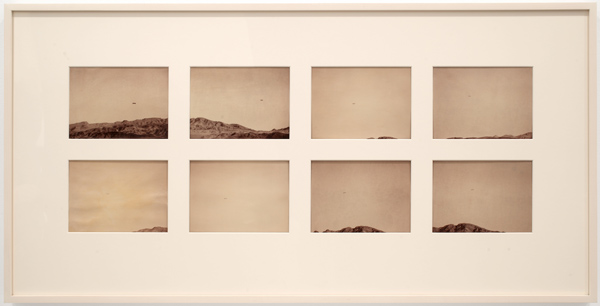
Trevor Paglen Time study (Predator; Indian Springs, NV), 2010 / Courtesy of Altman Siegel Gallery

SC: It’s intriguing to consider the fact of photographing being the critical crux of the work. However, I think I am still unclear exactly what you mean by entangled or relational photography in this context.  Can you provide me with a little more insight? Are you saying that the fact that you are able to produce the photograph supersedes the photograph itself? If so, why show the photograph at all — does it then become about exhibiting proof of the action?

TP:
With regard to your question about whether “that the fact that you are able to produce the photograph supersedes the photograph itself,” what I mean is a little more subtle. The “fact” of being able to produce the photograph is just one aspect of this. Let’s think about what photography is in two ways: we have one aspect of “photography” that happens prior to the photograph itself, and we have another aspect which is the photograph or image itself. In the former sense, I’m talking about all sorts of things – on one hand, you have a technological and social history of “seeing with machines” (my definition of photography). You also have specific sets of relations that  “set the stage,” as it were, before you open the shutter. In every instance, those relations are going to be different, but what I mean by “entangled” photography has to do with making those relations somehow part of the work – whether visible in the final photograph or not. And yes, the photograph in a sense does become “proof” of the action, or, more precisely, the photograph may point towards the action. But that doesn’t mean that the “relational” or “entangled” aspects of the photograph supersede the photograph itself. On the contrary, we also have the photograph itself. The image or photograph is an opportunity, related yet distinct from the “relational” aspects of the photography process, to convey other sorts of meaning, metaphor, allegory, or, if you’re so inclined (I tend not to be), documentation. So I’m not really talking about either part of the photography process superseding the other, I’m talking about the fact that there are all sorts of opportunities to develop the “relational” side of the work that can contribute to what the overall artwork is.

Trevor Paglen Untitled (Predators; Indian Springs, NV), 2010 - Detail / Courtesy of Altman Siegel Gallery

SC: As you often turn to the sky to track objects such as satellites, planes and drones, you seem to present these objects engulfed in a sea of space. Formally this presents a vastness that seems to echo the sublime. I feel like this gesture is also referential of moments in art history, but I also suspect that the idea of vastness itself operates as a metaphor for the unknown, or at least that which is present but rarely detected.  What are your thoughts on the concept of vastness and the sublime as it relates to some of the images on view now at Altman Siegel Gallery?

TP: This notion of the “sublime” is a really important part of what I do. I think about the sublime in relation to Jean Luc Nancy’s definition of it, which has to do with the sublime being the “sensibility of the fading of the sensible.” In other words, the sublime arises from those moments where we can sense that we cannot sense let alone understand something. This brings us to the “aesthetic” dimension of the work. In terms of contemporary critical theory, an investigation or discussion of the aesthetic is often thought of as a philosophical dead-end, a discussion that ended quite some time ago (except in reactionary ‘neo-art-for-art’s-sake’ conversations which usually function as little more than apologies for vapid art). But I’m not willing to cede aesthetics to the more reactionary corners of the art world. Historically, aesthetics has often been linked to notions of freedom: ambiguity and the sublime can be quite powerful and is something visual art can be quite good at dealing with. So it’s important to me that it’s a part of my work, but the underlying “relational” and ethical aspects of the work are crucially important. Without them, it’s just pretty pictures. And there’s no reason to care about pretty pictures.

Trevor Paglen PAN (Unknown; USA-207), 2010 / Courtesy of Altman Siegel Gallery

SC: Well, I appreciate that you are able to balance both political and aesthetic concerns without either seeming arbitrary. Taking a different turn, I’m also interested in the intersection of vision, geography and time in this new work as it applies to the 21st century. As an artist and scientist that produces artwork and research in this area, I am curious what you feel is happening right now? What are the implications of new technology and how do you feel it is changing the way we, as a collective society, view ourselves and the world around us?

TP: Ha! That question is too big for this interview, I think. This is really something I’m trying to think through. I’m not someone who thinks there’s something historically new about the fact that human perception is being radically reconfigured at the moment (I think that those in the 19th Century were probably greater, and this is a big hint to looking at some of my newer works), but at the same time, I’m interested in the ways that what “seeing” is, is historically specific. I’m extremely interested in what seeing is, and what seeing means in the contemporary moment. Of course, this has everything to do with machines, which in turn has everything to do with time (in several senses: 1) the ways in which machines rationalize time; 2) the ever-increasing “speed” of vision – think Predator drones in Pakistan flown by pilots in Nevada), which of course has everything to do with space (what Marx called the “annihilation of space with time” – again, think Predator drones flown from Nevada creating a relationally contiguous geography even though they’re obviously on opposite sides of the world). You can see the question gets really big really quickly.

Trevor Paglen: Unhuman Installation View / Courtesy of Altman Siegel Gallery

SC: Thanks for entertaining a question of that magnitude. I know that you currently have an exhibition on view, but I’d love to hear more about the research that you are currently engaged in. What are you working on now, and what projects or exhibitions do you have on the horizon?

TP: In the immediate future, I’m continuing my work on drones and continuing my work on “invisible” infrastructures that the piece The Fence (Lake Kickapoo, Texas) points to. I’ve also begun work on a longer-term project dealing with time and universality. I know that’s pretty vague, but it’s going to be a while before I begin to understand that project.

Unhuman will be on view at Altman Siegal Gallery in San Francisco through April 2, 2011.

Share

Boyle Family

“Take the actual surface coating of earth, dust, sand, mud, stone, pebbles, snow, grass or whatever. Hold it in the shape it was in on the site. Fix it. Make it permanent.”  (Mark Boyle, Journey to the Surface of the Earth – Mark Boyle’s Atlas and Manual, 1970)

Boyle Family, World Series, Barra, Elemental Study (rippled sand with worm casts), Mixed media, resin, fiberglass, 1992 – 2010, courtesy of Sebastian Boyle

In 1968, Mark Boyle (b.1934 Glasgow, d.2005 London) and Joan Hills (b.1931 Edinburgh) invited friends to a party at their flat in London. A map of the world – the largest which could be found – was hung in the upper room. Their children, Sebastian (b.1962 London) and Georgia (b.1963 London) Boyle led blindfolded guests to this upper room where they threw darts. The points where the darts landed, all over the map on dry land and sea, become the sites for the Boyle Family’s World Series, a significant undertaking where elements from randomly selected sites across the world, from a forest at Skarberget in Norway, to a pavement in New York City, and the Negev Desert in Israel, were recorded, represented and made permanent. The Barra Project forms one of the World Series, developed on the island of Barra in the Outer Hebrides of Scotland. Recently on view at the exhibition What You See Is Where You’re At: Part 3 at the Scottish National Gallery of Modern Art, Edinburgh, The Barra Project is the outcome of 18 years’ of work, and is the first British island the Boyle Family completed.

Boyle Family, World Series, Barra, Human / Physical Response Study (hairs from Boyle Family), Electron microphotographs, 1992 – 2010, courtesy of Sebastian Boyle

The works of the Boyle Family arise from a desire to study and present the world as truthfully as possible, eliminating the employment of personal preferences, judgments, hierarchy, or styles, and using, in essence, reality as a medium. In addition to objects from their environment, they have also enlarged microscopic views of their hairs, exhibited as towering prints. While visually presenting parallels in textures and forms with other plant and earth materials, the choice in drawing from an extension of themselves acknowledge their impact and interaction with the site.

Boyle Family, World Series, Barra, Surface Study, HD video on blu-ray, 1992-2010, installed at Scottish National Gallery of Modern Art, 2010/11, courtesy of Sebastian Boyle

This philosophy of drawing material from life was shaped from the initial forays of Mark Boyle and Joan Hills into making art. From their constructions of junk assembled from pieces of bicycles and twisted metal on wooden boards to their staging of live art events which dismantled barriers between the art, performer and audience, core to their practice was an interest in pursuing objectivity through a documentary approach. The commitment to include anything to represent has resulted in subjects spanning the elements of earth, air, fire and water, to human beings and societies. Behind the extreme visual accuracy of their works lie the complexities of traveling to, surveying the site, data collection, and a labor-intensive process in creating the works.

While initially marketed under Mark Boyle’s name until 1985 when works were presented under the Boyle Family, the concept, research and making of their works have been underpinned by a collaborative endeavor beginning with Mark Boyle and Joan Hills after they met in 1957, and later when Sebastian and Georgia Boyle arrived. Boyle Family works are currently presented in London at the Modern British Sculpture (22 January to 11 April, 2011) at the Royal Academy of Arts and at the Boyle Family’s project space, construction.

Share