Knots Landing: Lynda Benglis at the New Museum

More Failure More!!! -This week’s series on Failure falls in line with our previous rounds on Myth, Utopia and Rebellion. Stay tuned as we attempt to succeed this week with 6 more articles on Failure…

FORCE OF FAILURE: DailyServing’s latest week-long series
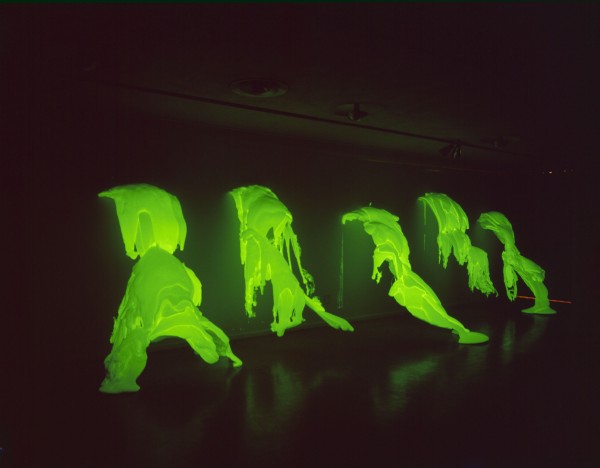
Lynda Benglis, Phantom, 1971.

Lynda Benglis is a fearless artist. She added a much-needed sense of humor to first-generation feminism and imbued late 1960s/early ‘70s Post-Minimal sculpture with an even more needed sense of color. But a lot of her work is kind of awful. Her legendary status as an artist who went toe-to-toe with the biggest male egos in the New York art world is well deserved, and I’ll take her slumping blobs of polyurethane as examples of entropy in sculpture over Robert Smithson’s lame mirrors stuck in dirt any day. The nearly uniform praise for her current retrospective at the New Museum, however, feels like it’s based more on her historical status than on the work itself.
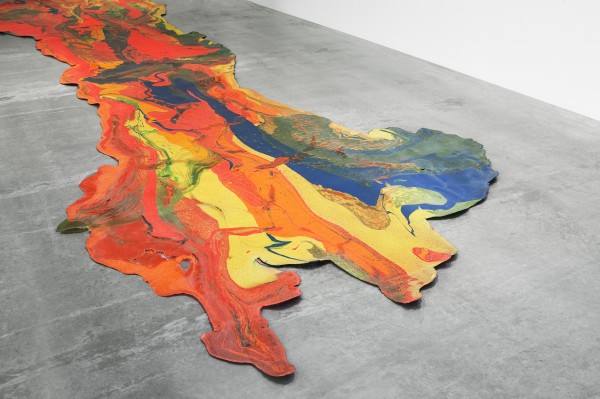
Lynda Benglis, Installation View, New Museum, 2011. Photo by Benoit Pailley.

The Fallen Paintings (Benglis’ signature poured latex floor pieces) are by far the best in show. Slabs of poured paint yield to gravity as they diffuse Minimalism’s rigid structure with Colorfield’s floating orbs and Jackson Pollock’s subconscious process. These works call to mind a sophisticated sense of order, like Merce Cunningham’s low center of gravity choreography.  However, the chicken wire, glitter, paint and plaster construction of the wall pieces, which was probably shocking in the ‘70s, just seems amateurish now. They don’t extend the properties of the material to anywhere near the same degree that the floor works do. They look good in reproduction, but in person they disappoint.
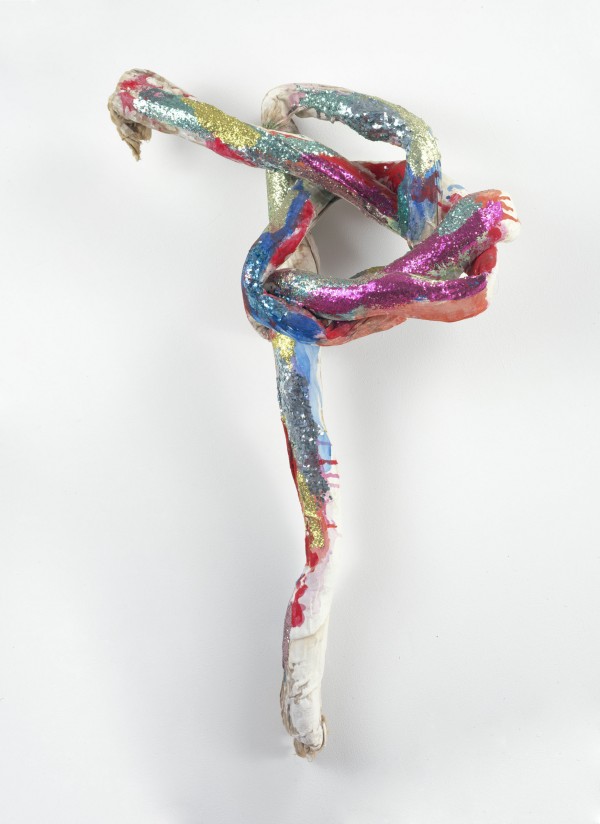
Lynda Benglis, Sparkle Knot V, 1972

As you move forward chronologically, Benglis’ work begins to reference the body in increasingly flat-footed ways and her forms get more cheesily symbolic. The Peacock Series from the late ‘70s/early ‘80s consists of vaguely vaginal decorated fans hung on the wall. Chiron, from 2009, is a big glowing pink egg. Even Phantom, five dramatic glow-in-the-dark dripping mountains (shown here for the first time since 1971) give off a distinct Led Zeppelin “Houses of the Holy” vibe. They’re cool in a geeky sort of way, but by the time I got to Primary Structures, (Paula’s Props), a room-sized installation of blue velvet drapes, some fake trees and Greek columns, I began to question Benglis’ taste for real.

Lynda Benglis, Installation View of Primary Structures, (Paula’s Props), New Museum, 2011. Photo by Benoit Pailley.

Where she completely kicks ass, however, is in her randy sense of iconic self-promotion. The photos of her at work on her floor pieces are classics, and the notorious advertisement from the November 1974 issue of Artforum, where she appears nude with slicked back hair holding a dildo between her legs, is still shockingly strong. Even though it’s been written about ad nauseum and reproduced a zillion times, it still packs a punch in person. Shot from below, Benglis appears as monumental as Michelangelo’s David and her image turns about 2,000 years of male-dominated Western Art History on its head. Set against a stark black rectangle, it’s as if Benglis is literally turning the page on Minimalism’s colorless form and gender hierarchy in the most in-your-face way possible. So what if feminists at the time hated it—Benglis was likely the first female artist to consciously construct a heroic artistic persona, and that took bigger balls than just throwing a vaginal reference or two into her work.
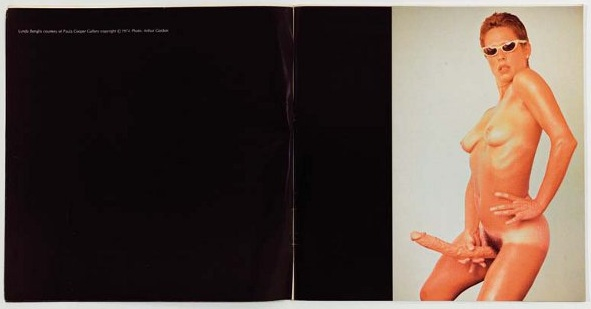
Centerfold by Lynda Benglis published in Artforum magazine, 1974.

If many of her wall sculptures don’t quite live up to her outsized rep, there are videos and Polaroids on display that certainly do. The Amazing Bow-Wow, 1976, is an uncannily watchable short film about a hermaphroditic human-sized dog that enters into a fateful love triangle full of jealousy and lust. It’s as unflinchingly gutsy as any Paul McCarthy, but with way more heart. Displayed next to the video is a series of Polaroids called Secrets that combine pornish images of Benglis and Robert Morris with close-ups of flowers. Here, the collusion between nature, sex and overlapping bodies is as palpable as it is in the floor sculptures. Rarely exhibited, the photos’ old wooden frames have the vibe of pre-boutique-era SoHo. Nostalgic art relic nerds, get ready.
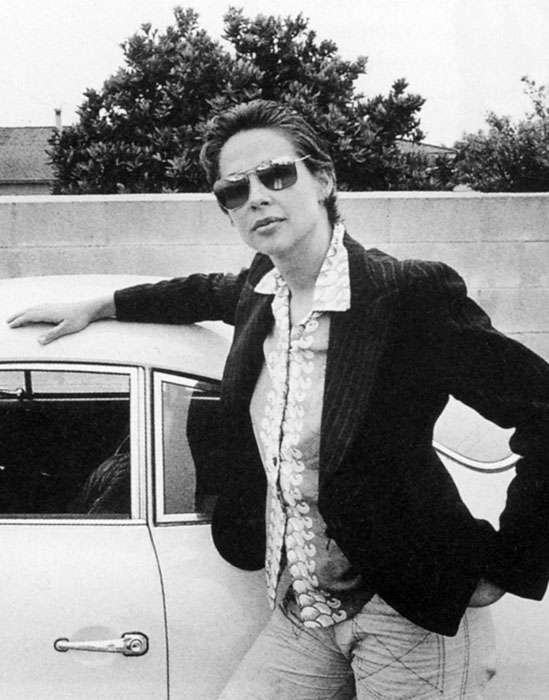
Lynda Benglis, Advertisement from Artforum magazine, April 1974.

All of Benglis’ work might not stand the test of time. She’s like a classic rock band that put out three or four great albums with timeless cover art. Like a lot of those bands, Benglis synthed out in the ‘80s and never quite recovered, but it doesn’t matter. The lesson here is that she full-on embraced failure in her work, through both an entropic use of materials and by taking risks that few artists today would even consider. For all of her posturing and dildo-ing around, she still feels human and extremely relatable, and she’s more than paid her dues. Every New Yorker knows that she’s one of ours, so if she makes criminally bad art, it’s cool. We just look the other way.

Share

Cory Arcangel: The Art of Hacking and Success of Failure

Over the past year, DailyServing.com has developed several week-long series to better investigate topics such as Myth, Utopia and Rebellion. This week, we are proud to present 7 new articles that explore the concept of failure, and take a close look at how this idea operates within contemporary art. But don’t worry, we didn’t try all that hard, as we all know what the ultimate result will be…

FORCE OF FAILURE: DailyServing’s latest week-long series

Filled with electronic blips, beeps and bloops there is one sound conspicuously missing from the Barbican Art Gallery – the sound of a pin-dropping.

Cory Arcangel, Various Self Playing Bowling Games (detail), 2011. Courtesy of the artist, Lisson Gallery, Team Gallery and Galerie Thaddaeus Ropac. Photo credit: © Eliot Wyman. Courtesy of Barbican Art Gallery.

Cory Arcangel’s installation in The Curve gallery of the Barbican is comprised of a series of bowling video games in constant auto play, projected along the long corridor that itself very much resembles a bowling hall. But not a single pin falls, the satisfying sound of the crash is absent, the balls hit the gutter, again and again and again…

With the installation’s title, Beat the Champ, multimedia artist Arcangel tauntingly dangles the idea of winning, impossible to achieve – like the fixed carnival games with the ball slightly too big for the basket, doomed to lose, time and time again.

The virtual characters on the big screen are programmed to be transfixed in purposeless repetition – Sisyphean meaningless work – condemned to re-perform their own failings for us in this crescent shaped theater of the absurd.

Cory Arcangel, Various Self Playing Bowling Games (detail), 2011. Courtesy of the artist, Lisson Gallery, Team Gallery and Galerie Thaddaeus Ropac. Photo credit: © Eliot Wyman. Courtesy of Barbican Art Gallery.

Not simply a looped video of a single miscalculated moment of a game, the video game consoles themselves are active and functioning – but in a forced state of hijacked programming. Their games are played out in a perpetual state of failure, hacked by tiny green chips that bear Arcangel’s name, forcing the game to loop in a continual state of defeat. The virtual characters are driven by a code devised by the artist, rather than human interaction.

Witnessing the progression in graphics and design – from the old Atari system that greets you in the beginning, through the original Nintendo, Sega Genesis and Sony Playstation, to more recent PS2 and Game Cube versions – is itself a testament to defeat. With technology becoming obsolescent at ever-increasing speeds, these systems are doomed to fail – already antiquated as they reach the consumer floor. They are systems designed to self-destruct, and give way to their successors at breakneck rates.

Cory Arcangel, Various Self Playing Bowling Games (detail), 2011. Courtesy of the artist, Lisson Gallery, Team Gallery and Galerie Thaddaeus Ropac. Photo credit: © Eliot Wyman. Courtesy of Barbican Art Gallery.

And as the systems here progress, defeat becomes increasingly pronounced. In the old Atari, the bowling ball instantaneously bounces back and attempts again, however as the avatars become more realistic, their resilience begins to wane. Emphasis is placed on their defeat. Disappointment, annoyance and anger grow, as they throw their virtual hands up in the air, shake their computer-programmed head and have full on temper tantrums. Read as a decreasing optimism and increasing frustration in technological advances, there is an underlying current,  a realisation that technology might not save us after all.

Cory Arcangel, Various Self Playing Bowling Games (detail), 2011. Courtesy of the artist, Lisson Gallery, Team Gallery and Galerie Thaddaeus Ropac. Photo credit: © Eliot Wyman. Courtesy of Barbican Art Gallery.

Hacking into the system, Arcangel satirises the failures and frustrations of contemporary society. The lighthearted game of bowling becomes a metaphor for the complex and dangerous relationship between man and machine. Arcangel sees it as the ‘short circuits in human nature caused by everyone staring at their phones or being on Facebook all the time’. While they may short-circuit they are controlled by the artist, the virtual characters are puppets of a pre-programmed code. The act of hacking is just as much a failure of the system – an affirmation of man over machine. We may not be able to beat the game or tear ourselves away from Facebook, but as Arcangel has shown, it is possible to alter the outcome and bend it to our will – In this perpetual failure there is hope.

Various Self-Playing Bowling Games, was co-commissioned by the Whitney Museum of American Art and will be shown there as part of the artist’s forthcoming exhibition in May 2011.

Share

From the DS Archives: Julian Hoeber

This Sunday From the DS Archives invites you to revisit the work of California artist, Julian Hoeber. You can see Hoeber’s current self-titled exhibition through March 12th at Blum and Poe in Los Angeles. Today’s DS Archive pick is from the artist’s third solo exhibition with the gallery.

This article was originally written by Catherine Wagley on October 9th, 2008.

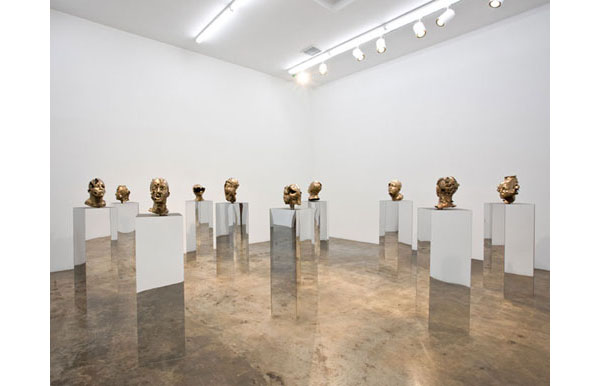
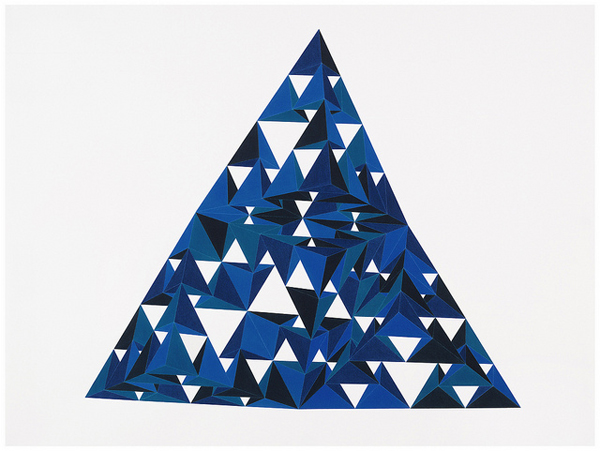
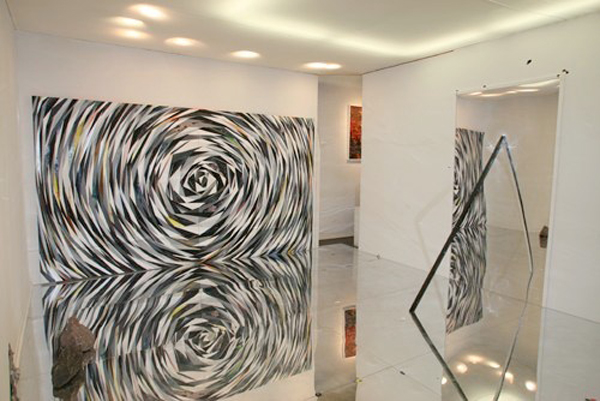
Julian Hoeber’s third solo show at Blum and Poe Gallery, titled All That is Solid Melts into Air, explores aged forms, bronze busts and op-art in particular, and emphasizes the way old recycled ideas shape “new” people and objects. In an insightfully written artist’s statement, Hoeber describes himself as a tube, listing the span of influences that have cycled through his system. What comes out is a digested, sometimes decaying conglomeration of forms.

Hoeber’s show includes two bodies of work – one a set of fifteen works on paper that toy with viewers’ perception; the other a series of bronze heads that have been shot, bit, and beaten up. The heads sit on reflective pedestals just high enough to emphasize their human scale.

Hoeber earned his MFA from Art Center. He also studied at Karel deGrote Hogeschool in Belgium and at the School of the Museum of Fine Arts, Boston. He recently participated in the group exhibition Against the Grain at LACE. All That is Solid Melts into thin Air will be on view through October 2008.

Share

In Perpetuity: Abstract Now/Abstract Then at the Berkeley Art Museum

All abstract art has one thing at its core:  the human body.  The existence of abstract art is as old as humankind, as are its attempts to either translate or transcend bodily experience without that pesky figuration getting in the way.  This conflict is even present etymologically:  the word ‘abstract’ boils down to meaning something along the lines of ‘drawn away’ – or ‘separated from material objects or practical matters,’ indicating that there is something immaterial able to be separated in the first place.  Something for us to be – or experience – beyond our body mass.

Dean Smith, Thought Form #11 (2005), image courtesy of the Berkeley Museum of Art

I’ve been watching the conversation surrounding abstraction here in San Francisco out of the corner of my eye for a while now.  In particular, over the last year I’ve seen three great shows that have challenged my understanding of what abstraction can achieve when you insist that it turn against itself and become a full-body experience: Alexander Cheves’s paintings and sculptures of floating geometric house forms at Rowan Morrison, Josh Podoll’s odd (and awe-ing) transcendental, painted meditations between the extremely close and extremely far at Romer Young, and (the icing on the cake) Chris Duncan’s mind-bending Eye Against I at Baer Ridgway.  This is what I wanted out of the Berkeley Art Museum’s bookended pair of shows, Abstract Then and Abstract Now.

Robert Irwin, Untitled (1969), image courtesy of San Francisco Museum of Modern Art

Instead, I got breadth, which I feel silly complaining about, but I’ll get to that in a second.  Despite its claim of featuring work from 1940 – 1985, Abstract Then sneakily kicks off with the Futurists:  the first work in the gallery space is one of Duchamp’s Boites (Series F) (1966), which contains – amongst other things – a small replica of Nude Descending a Staircase (1912).  Jean Tinguely’s disturbingly sexual Black Knight (1964) is worth interacting with; push a button and the mechanized sculpture kicks into gear, pushing and pulling a rod through an eyelet for as long as you feel comfortable allowing it.  Abstract Then is loosely grouped; progenitors of abstract expressionism like Jackson Pollock share one wall, while post-painterly descendants like Helen Frankenthaler occupy another.  Eva Hesse’s series of heavy, flesh-like rectangles, Aught (1968), separates these groups from minimalists and post-minimalists like Dennis Oppenheim and Robert Irwin, whose untitled disk-cum-orb is one of the most outstanding pieces in the show.  Not only does it play with your perceptions, but there’s a strong complement with Chris Duncan’s Untitled (The Painting) (2010), a 7.5’ x 14’ series of painted and collaged concentric ellipses.

Chris Duncan, Untitled (The Painting) (2010), installation view courtesy of Baer Ridgway

And herein lies the beginning of my complaint:  why not Abstract In Perpetuity, instead of Abstract Now and Abstract Then?  There are so many connections to be drawn between works, to keep them separate feels like dismemberment.  Most of the works in Abstract Now – which appears to be the weaker sibling – could have been complicated by juxtaposing them with the works of their predecessors.  Ron Nagle’s beautiful ceramic structures, though much smaller, display an attention to material topography and color that would be interesting paired against Jay DeFeo, or even Ad Reinhardt, while Jim Drain’s anthropomorphic fabric sculpture, Scribble (2007), would make an fun asterisk against Duchamp.  Not only that, but works that fail to hold up in such a setting could have been eliminated.

Jay DeFeo, Origin (1956), image courtesy of the Berkeley Art Museum

I’m left thinking of Yves Klein (who was not represented).  In its own unique and counter-intuitive way, Yves Klein’s Le saut dans le vide (1960) might be one of the most abstract works of the 20th-century, providing a powerful visual for the relationship between inescapable materiality and transcendental hope.  In Le saut, Klein captured his attempt to separate himself from the earth (and gravity); his body has just begun its leap, his eyes face upwards.  Klein realized that the body itself was an untapped medium for experiencing the opposing tendencies of abstraction — the transcendent and the material — and I see abstract artists like Cheves, Podoll, and Duncan playing in this tradition.  By allowing its works to co-mingle, instead of keeping them at arm’s length from each other, Abstract Now/Then might have been able to achieve what I think is a truly “now” experience of abstraction, one that insists on full-body immersion.

Share

Little Darlings

L.A. Expanded: Notes from the West Coast
A weekly column by Catherine Wagley

Richard Hawkins, "Crepuscule #2", 1994, Collage on Chinese lantern. Collection of Laurence A. Rickels, Los Angeles.

On The Rolling Stone’s website, you can see a behind-the-scenes video of  Terry Richardson shooting the new Justin Bieber cover. In it, between shots, Bieber answers fan mail. He’ll read a letter aloud then, not usually thinking for more then a second or two, spin off his answer. Someone name Marty T. asks the following: “When you take pictures during photoshoots,” (here, Bieber looks up with a we’re-doing-that-right-now grin, and there’s a photoshopped twinkle on his top tooth—it’s like a self-referential toothpaste commercial), “what are you thinking about when you make those intense faraway looks in your eyes?” Bieber, grinning again sans twinkle, replies, “Well, I usually think how bored I am just standing there. Like, photoshoots are long and that’s the face that comes out of me,” and then we see him asleep, head on the piano keyboard, wearing his baseball cap backward. If Marty, who asked that question and could be a girl but sounds like a boy, had hoped those faraway looks meant something special (or that Bieber would be able to put a finger on that something special), he just got hope-dashed by teenage boy cheek.

The day I visited Richard Hawkins’ Third Mind at the Hammer, a show full of some of the most slapdash refinement I’ve ever seen, I was browsing just behind an older couple, a man and woman. The man, standing over Hawkins’ Matt Dillon homage from the early 90s—an obsessive, perpetually nostalgic fanboy collage—half-asked, half-announced, “That’s Justin Bieber?”

Richard Hawkins, "Untitled (Slash/Twombly)," 1992, Altered book; twofold leaves of plates. Collection of Joel Wachs.

Mistaking Dillon for Bieber means misreading the 80s for the 00s and a dirty blond kid-cut for a dark brown shag of curls, but the man had something right: Dillon, like Bieber, was heartthrob worthy and immediately recognizable (well, to some, at least). Dillon, Keanu Reeves, Axl Rose, George Clements, the guys Hawkins adopted into his “indulgent obsession aesthetic” seem to me more beautiful than cute, more striking, less comfortable with childishness than Bieber. But Dillon was in his youthfully seductive, troubled teen stage over ten years before Hawkins the younger version of him on as a muse–one of Hawkins’ earlier works is an altered book by Nietzsche; pasted on the cover is an 80s photo of smiling Dillon and brother Kevin with arms around each other, and text on the left reads, “Through it all, Matt HAS remained close to his family, like his brother Kevin… success hasn’t spoiled this boy at all!”

By the time Hawkins was making works like lg.purple.matt.graveyard (1995) proving Dillon was a good kid no longer behooved mainstream media and Little Darlings, Dillon’s breakthrough and a source for Hawkins, was a decade and a half past. Distance matters in Hawkins’ work. It’s essential.

Richard Hawkins, "Shinjuku Labyrinth," 2007, Wood, collage, and table. Collection of Sam and Shanit Schwartz.

In a catalogue essay he wrote in 1989, Hawkins dealt with nostalgia and idealism–he wasn’t talking about his work, commenting instead on French Decadence and its contemporary counterparts. Still, what he said always seems to resonate with his own oeuvre: “the ideal may be a natural body, but it has to be distanced in some way.” Hawkins goes on, “It can be distanced by becoming artificial. The melancholic is infatuated with the ideal.”  In his show at the Hammer, chock full of cultural references, the images feel compelling because  they’ve been distanced from themselves just enough to become, not fetish-objects, but pitch-perfect stand-ins for melancholia. It might be a few decades, if ever, before Justin Bieber’s image can play a role like that.


Share

Consenting Adults: Taking Risks with Laurel Nakadate

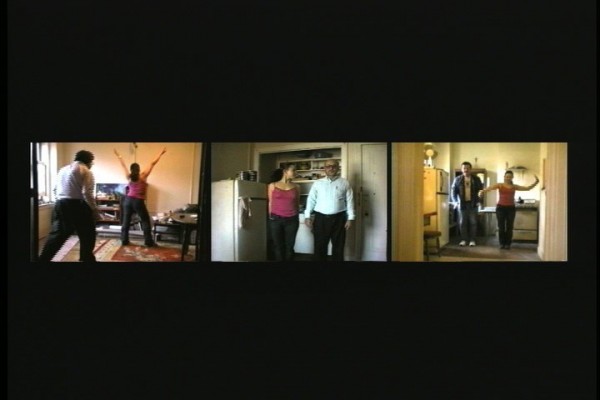
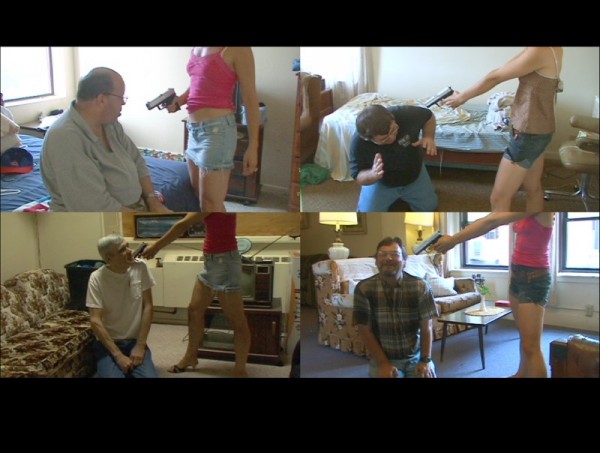
Laurel Nakadate’s work uses unassuming means to memorable effect. Oops! (2000) is a video of a young woman in a tank top and tight jeans dancing a choreographed routine while a man in late middle age dances (or stands) awkwardly beside her. It is mesmerizing in its ambiguity: is she making fun of the man? Which one is being exploited? Beg for Your Life (2006) shows Nakadate holding a gun to the head of various men while they perform the title action. Over and over, her work explores the power and beauty of events that teeter on the edge between anxiety and exhilaration. With her ten-year retrospective at PS1 in New York and various screenings and openings, Nakadate’s time is in short supply. I managed to wring this interview from her in record time before she jetted off to her next engagement.

Laurel Nakadate, Oops! (2000). Still from video.

Bean Gilsdorf: Your work explores the power dynamic between men and women. Is this a personal thing?

Laurel Nakadate: What it’s about, for me, is two people in a room and the discomfort and beauty in the space between them. There’s this idea that anything can happen in a room with two people: there are problems and concerns, implications…sometimes this person is at fault and sometimes that person’s at fault, but most of the time something beautiful can come out of the power struggle.

BG: You’re often physically present. Is the work biographical?

LN: No, it’s a construction.

BG: So you’re a stand-in?

LN: I’m an actor. I’m a performance artist or an actor in that scene. It’s not me, it’s some sort of hybrid with me in my body going into the space as a character. I definitely see it as a performance. It’s not Laurel.

Laurel Nakadate, Beg for Your Life (2006). Still from video.

BG: There’s so much risk involved. Do you ever feel frightened? And how do you move past that?

LN: I think there’s something thrilling about the unknown. I certainly feel like it’s work that challenges people to worry or not worry about the protagonists. But I’ve never done anything where I thought I was risking my life. I’ve made work that in retrospect seems that it was risky, or took chances, but when I made the work it was never about setting out to kill myself or get killed. It was always about this investigation. Now I look back at some of the work and I think, God, I was really lucky! But mostly I look back and I think I was really brave.

BG: The work seems very experimental and open-ended. How do you conceptualize what you’re doing when you’re about to go into it?

LN: It’s about telling stories that are difficult to tell, stories that are wily and winding, and what I love about them is that anything can happen, anything is possible and there can be any ending. It’s as complicated as any unknown, which we unravel through chance and creation and sorting through stories. I have a hard time categorizing things, I feel that it’s dismissive and not fair to the work. It’s performance-based work, and so by its very nature, experimental. And what I love about performance is that it can only happen that one time and that one way. You can try to recreate it, but it will never be the same and there’s something beautiful about that. But I find trying to label a piece of art as a specific thing problematic and reductive. Every painter has the right to say they are actually making sculpture, and every sculptor has the right to say they’re doing performance art. And every audience member has the right to read it as something else. Open and generous is where you have to be.

Laurel Nakadate, Exorcism in January (2009). Still from video.

BG: A lot of your work seems dark, but you’ve also talked about how the act of being in a space with someone else is an act of love.

LN: I certainly see darkness in the work, absolutely, but I don’t think darkness is bad. I think darkness is lovely.

BG: And you’ve also talked about the work as an exorcism. Once you’ve done a performance, are you done with it?

LN: It’s always different. Sometimes you’ll do something and you’ll feel like it’s resolved, and sometimes you’ll keep pounding on that door. You can’t win, because if you don’t keep pounding on the door people say that you’re a one-hit wonder; if you do keep pounding, people say you’re narcissistic or obsessed.

BG: What are you working on now?

LN: I’m writing a screenplay and working on a book project. I’m also kind of babysitting the MOMA/PS1 show in the sense that I’m still talking about it a lot. It just opened, so it’s still really new and exciting for me. I’ve got a show of new work opening at the end of April. I’m just going to take the summer to work on the screenplay.

BG: Can you tell me what it’s about?

LN: It’s about adults, that’s what I’ll say now. Consenting adults.

Share

Damaged Goods: The 10 Best Abused Artworks Ever

Today’s article is brought to us from our friends at Flavorwire, where Paul Laster discusses the 10 most damaged goods in visual art.

Art is both a precious commodity and a significant cultural symbol of our time. The museums and art centers that display the works are public domains, in which anything is likely to happen. Throw a bunch of publicity loving crackpots, wannabe performance artists, youthful vandals, social protesters, and accident-prone eccentrics into the mix and you enter the damage zone, where art gets hurt — or at the very least, publicly humiliated. After recently reading about a portrait of Mao Zedong getting shot because its hallucinating owner thought it was the actual Chinese despot in his house, we decided to investigate other tales of artful accidents involving works by celebrated artists — ranging from Monet and Picasso to Warhol and Serrano — and bullet holes, crowbars, felt-tip pens, and flying elbows and fists.

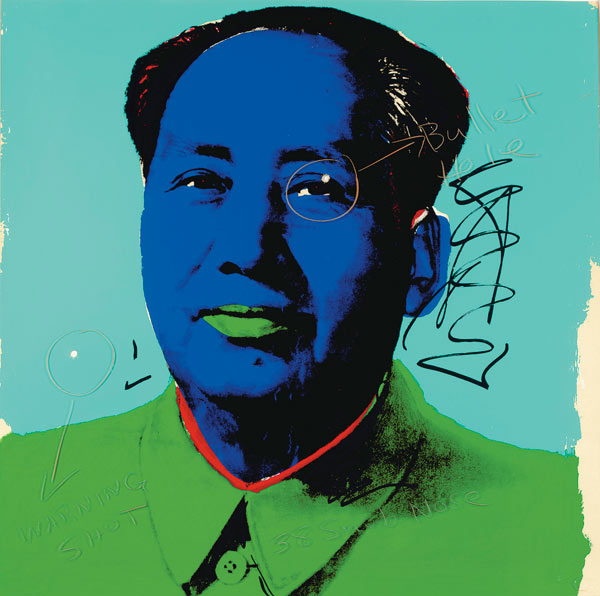
Two bullet holes in Andy Warhol’s 1972 screenprint of Mao didn’t deter a collector from buying it for $302,500 — 10 times the high presale estimate of $30,000 — at Christie’s in New York last month. The reason the piece was coveted has to do with the shooter as much as it has to do with the artist and subject matter. During a wild night in the 1970s, Dennis Hopper got spooked by the picture and shot it twice. Warhol loved the results and annotated the holes with circles and the words “warning shot” and “bullet hole,” which made the work an unplanned collaboration.

Click here to continue reading this story.

Share