101 Collection: Route 2 Undisclosed Destination

Today’s article is from our friends at Art Practical, where Dena Beard discusses the group exhibition Route 2: Undisclosed Location at CCA‘s Wattis Institute for Contemporary Art.

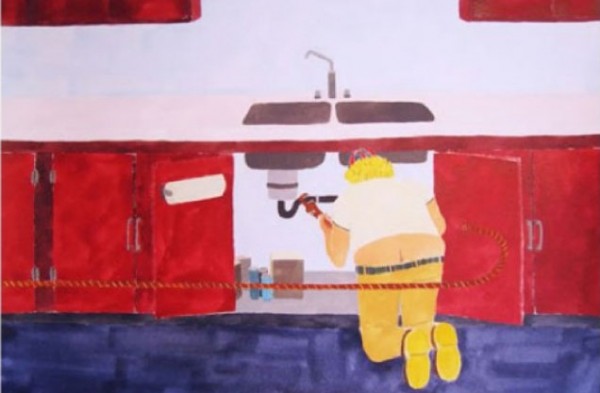
Elisheva Biernoff, They were here, 2009.

Route 2: Undisclosed Destination investigates the idea of a West Coast aesthetic as both a decoy and an impresario. In a truly complex approach by a new curator, location is a curatorial device that situates, and sometimes subsumes, the work within its site-specific grasp. Though a collector’s taste may sometimes limit exhibition options, curator Sharon Lerner employs ArtNow International Foundation’s 101 Collection of West Coast art with a nimble sleight of hand to delimit the very conceit of American Westernness.

Visitors have two options for navigating the exhibition: a left route, which I’ll call Manifest Destiny, and a right route, which I’ll haphazardly dub Re-Cut Contexts. Along the journey to the left, ideas of American expansion are quickly derailed by Gareth Moore’s Map (from Uncertain Pilgrimage) (2006–2009). Unfolded and completely blank, it evokes the anticipation or dread of an uncharted journey. The road leads to the central piece: Elisheva Biernoff’s They Were Here (2009), a generically painted sixteen-foot-long mural of an island paradise with white sand beaches and waterfalls; among the hidden details are exploding volcanoes, extinct plant life, dead birds, and shipwrecks. Upon peering through the scenic vista binoculars provided at a slight distance from the mural, the entire island disappears into a stereoscopic view of the surrounding ocean. Biernoff has labeled the binoculars a “time machine,” perhaps to suggest, like Moore’s Map, the double bind of imagining both an unrealized utopia and dystopia in two future potentialities.

Click here to continue reading this article.

Share

The Armory Show/Volta NY

The Armory Show shares its name with its historically significant predecessor following a brief stint at the same 69th Regiment Armory.  While today’s Armory Show is now in its twelfth year and situated on expansive piers along the Hudson River, it no doubt benefits from association with the formative 1913 International Exhibition of Modern Art.  However, positioned within a global art context that is increasingly homogeneous and accessible, today’s art fair could never shock audiences or transform the landscape as its 20th century predecessor once did.  Instead, The Armory Show offers its visitors a temporary microcosm of the global contemporary art market geographically reduced to the confines of its venue.
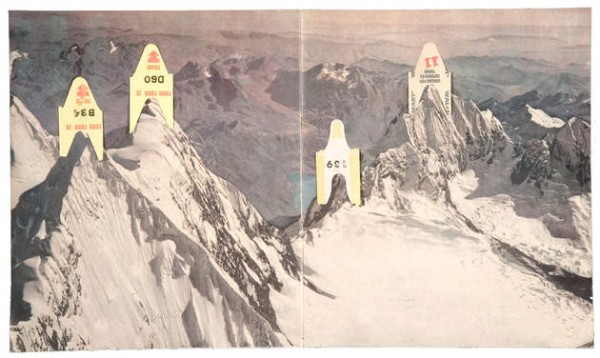
Untitled (Montanas), Gabriel Kuri (2011).

Armory Arts Week has become an annual event held March 3rd through 6th, centered on The Armory Show.  Competing venues have multiplied throughout the city of New York, including The Art Show, Pulse, Scope, Independent, Verge (Art Brooklyn), Moving Image, Red Dot and Fountain.  Headlining these fairs, The Armory Show 2011 continued its dual focus on both modern and contemporary art with Pier 92 focusing on the 20th century and Pier 94 accommodating nearly two hundred contemporary art exhibitors.  The fair’s limited program included Armory Focus:  Latin America, comprised of eighteen galleries highlighting Latin America’s contribution to contemporary visual art.  The Armory’s annual commission to create a visual identity for the fair went to Mexican-born conceptual artist Gabriel Kuri.  Also associated with the fair were Art Projx Cinema and Volta NY, a fair which presents solo artist booths in a smaller format.

DailyServing brings its readers highlights from The Armory Show and Volta NY.

Subway (2010), © Leandro Erlich, Courtesy Sean Kelly Gallery, NY

The Armory Show: Sean Kelly Gallery

Sean Kelly Gallery in New York presented Leandro Erlich‘s Subway (2010), which placed a sterilized version of New York’s urban transit reality within The Armory Show.  It struck an apt contextual note – much like his piece, The Boat, did during Art Basel Miami Beach 2010.  Both works form part of Erlich’s video window series and consist of an architectural element combined with video.

For Subway, Erlich sets a life-sized stainless steel door within a wall and positions video as window into a subway car.  The video becomes a realistic extension of the architecture and evokes great depth to create the illusion of looking ‘through’ it extending into the distance.  Three passengers sit in the immediate car, avoiding eye contact and lost in their own thoughts.  The figures are quiet and self-contained much like the video throughout its brief (1 min. 30 sec.) loop.  The light changes as the subway bumps and shakes along its track. Renaissance paintings offered a window into another world; in a similar way, Erlich uses the moving image to depict an imagined, realistic 21st century environment.

Last Meal on Death Row 'William Joseph Kitchens' (2010), Courtesy the artist and Blaine|Southern Gallery, London.

The Armory Show: Blain|Southern Gallery

Blain|Southern Gallery in London filled their booth with a selection of work, including Mat Collishaw‘s series of C-prints, Last Meal on Deathrow.  In this haunting fact-based series, Collishaw depicts the last meals requested by recently executed American death row inmates.  Drawing largely from the state of Texas and Jacquelyn Black’s documentation in Last Meal, Collishaw examines the ritual of eating before execution in a quiet, somber way.

Content is secondary upon first viewing one of these prints.  One is initially drawn in by an aesthetically pleasing arrangement of food, silver and glass – all of which was cooked and prepared by the artist.  The viewer is lulled by an apparently reticent image before reading the caption and learning of the context.  Collishaw’s series is visually inspired by Flemish Baroque still lifes.  Such a visual influence is evident in the dark backgrounds and supporting surfaces, which provide contrast for illuminated objects.  Just as layered meaning exists within the Baroque still life, the seemingly innocuous prepared food serves to reveal deeper meaning about the societies and individuals they reference.

Trees of 40 Fruit (2009-2011), Sam Van Aken, Photo: Bill Orcutt, Courtesy Ronald Feldman Fine Arts, NY.

The Armory Show: Ronald Feldman Fine Arts

Ronald Feldman Fine Arts, NY exhibited a solo installation by artist Sam Van Aken featuring his ongoing New Eden project, which filled the booth with vegetation. New Eden features a genetically altered orchard of trees or natural ‘sculptures’ that have been manipulated by the artist and painstakingly grafted to bear peach, plum, nectarine and apricot fruits.  Branches of blossoms on each tree indicate the presence of these disparate elements.  Part of the installation were synthetic mutations of grafted fruits and a display stand with hybrid vegetable seed starters.  Along the walls, prints of mixed seed packets and seed packet collages completed the booth.

While the installation initially seems to emphasize the unexpected aesthetic pleasure of genetic modification, its presence within the gallery space is intended to raise the profile of increasing scientific infringement on the natural world.  Van Aken starts a critical dialogue about genetic modification, which he views as futile.  As the artist told Art Newspaper ‘any change that you make is temporary’.  Mother nature proves stronger in the end and ultimately rejects human interference.
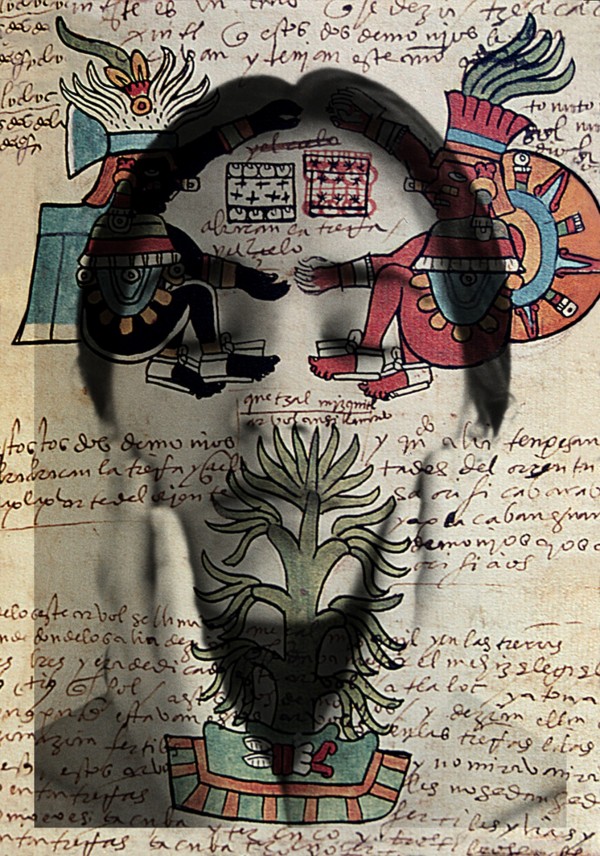
Cartografia Interior # 35, Courtesy the artist and Espaivisor-Visor Gallery.

Volta NY: Espaivisor-Visor Gallery
Espaivisor-Visor Gallery in Valencia, Spain exhibited new and recent work from the series Cartografia Interior by artist Tatiana Parcero.  In this series, Parcero redirects the contemporary trend of imagined geographic mapping onto the body in order to position it ‘in relation to time and place, science and thought’ further indicating that the body is ‘the container that holds everything’ including history, culture, and geography.

The ancient images appear like tattoos at first glance, which underscores Parcero’s view that the historical thoughts contained in the images are indelibly linked to the body.  The tattoo-like writings and drawings are taken from extensive research.  The artist has collected and photographed documents including pre-Columbian codices, ancient maps, cosmological charts, and anatomical engravings.  Parcero then printed her findings onto transparent acetate and layered them over intimate, corresponding photographic images of her body.  The ancient world and the artist’s own flesh visually bind and are re-imagined as one.
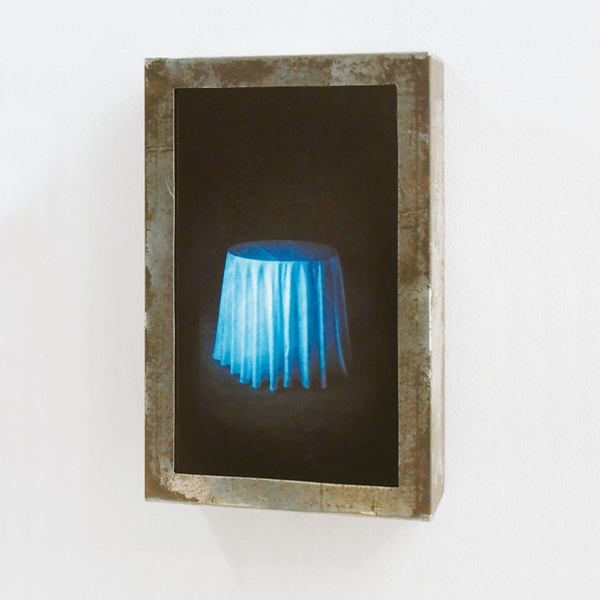
Winter Dreams - Table, courtesy the artist and MA2 Gallery.

Volta NY:  MA2 Gallery

MA2 Gallery displayed new and recent work by Ken Matsubara, which was recently part of Winter Dreams, a February solo show at the Tokyo gallery.  Matsubara’s Winter Dreams series is defined by his continued exploration of memory as both a collective and personal phenomenon.

MA2 Gallery’s booth was filled with small-scale mixed media works that invited intimate viewing.  At first glance, many of the objects could be readily encountered in the everyday world.  Purposefully weathered, framed shadow boxes and mirror boxes mysteriously presented moving images of simple motifs.  In Winter Dreams – Table, a ghostly, empty table covered by a white table cloth stands alone and spins.  Likewise, Winter Dreams – Cloud reveals an emanating cloud of smoke beneath a faded, silvered surface.  The artist’s emphasis on mirrors, in the form of aged, reflective surfaces points to the essence of memory as it is formed by the often hazy impression of experiences and dreams on our consciousness.  The open-ended nature of the images allowed them to be experienced by many viewers.  Finally, in Bottom of Buddha’s Hands, two shiny hands holding a crystal ball connect the concept of memory to humanity’s beginnings.


Share

From the DS Archives: Carefully Orchestrated Failures

As we wrap up our week-long series, Force of Failure, we revisit an article that features the work of Los Angeles-based artist Joe Sola. When discussing a recent performance by Sola, Daily Serving’s Catherine Wagley stated “This was as rewarding a game as any Super Bowl I’ve ever watched, because it showed how much the failure to perform could hurt, but it also showed failure to be an inevitable part of performing gender or anything else.”

L.A. Expanded: Notes from the West Coast

A weekly column by Catherine Wagley

Originally published on February 12, 2010

In a Bridgestone Tires ad that aired during last Sunday’s Super Bowl, a car resembling the Batmobile speeds along a dark, rainy highway. It turns a corner and slams on its breaks to avoid hitting a brightly lit roadblock set up by eccentric-looking villains. The villain in charge says, over a loud speaker, “All right here’s the deal. Your Bridgestone Tires or your life.” A shivering blond in a leather bodysuit is shoved out of the imitation Batmobile, which then spins around and speeds away. The punch line? The slighted villain whimpers, “I said ‘life,’ not ‘wife.’”

In a Dodge spot that also ran Sunday, a series of men with glazed over, submissive eyes, say things like “I will take your call,” “I will listen to your opinion of your friends,” “I will put the seat down.” But being put upon by their women can’t keep the men from making their “last stand” and driving cars they wants to drive. The ads end with a shot of a speeding car on a lonely highway. Apparently, there is only one kind of legitimate masculinity—the kind for which fast cars are metonymic—and women are its natural foils. That Super Bowl Sunday would arrive hand-in-hand with advertisement misogyny shouldn’t have surprised me, but, still, I expect more gender nuance even from my commercials.

In 2001, artist Joe Sola put himself at the mercy of a high school football team when he made the film Saint Henry Composition (2001). Included in LACMA’s 2008 exhibition Hard Targets, the film showed Sola, wearing no gear, being tackled by well equipped award winning football players. It was a weirdly contradictory performance—on the one hand, Sola had taken on an impossible task (success would have been supernaturally heroic, an alpha male triumph); on the other hand, his failure made him looked foolish, like he lacked a certain intuitive knowledge of sport that real guys should have.

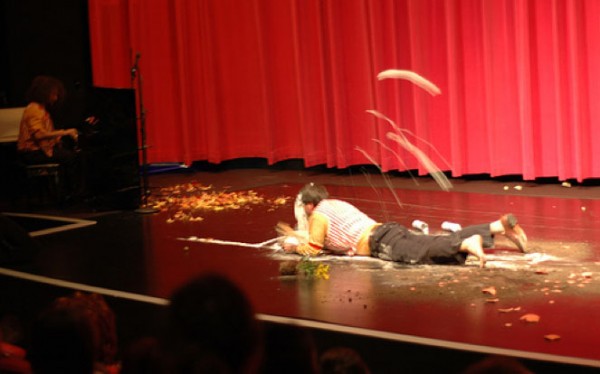
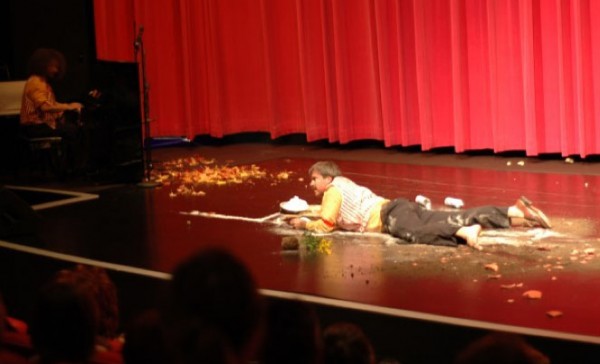
Sola’s soon-to-close exhibition at Happy Lion Gallery in L.A.’s Chinatown, called I found some Bic pens by the railroad tracks, takes gender into a more whimsical but still confrontational arena. It includes a lighthearted collection of self-referential watercolors, a brutally funny video pitting a [male] artists against a [male] collector, and, on January 30th, it also included a performance by Sola and collaborator Michael Webster. The performers—though it was mainly Sola that we watched, while Webster sat behind the piano and provided a perfectly timed soundtrack—wore red and yellow striped vests and black pants that made them look like circus performers. Their slapstick personae were reminiscent of a Charlie Chaplin-Marx Brothers’ hybrid, totally masculine but mocking of masculinity at the same time. Sola had typical junk food, glitter, feathers, and some explosives hidden inside a top hat that had been affixed to a table top (there was no attempt to maintain an illusion as Sola reached through the hat to pull out his props). He also had a blow torch, and the night consisted of dancing;  the placing of containers, filled with milk, cheerios, glitter, and the like, on precarious platforms around the gallery; and periodic explosions.

Toward the end of the performance, Sola set us up to expect something big. He’d built a contraption out of carboard, feathers, and glue that looked like a miniature horse. And he’d pulled out the blow torch, wordlessly warning people in the front row to don the protective glasses he’d passed out. In preparing for the big explosion, Sola accidentally slipped onto the floor, and he stayed down, waiting for an eruption that never happened. Then, like an injured and disgraced warrior, he pulled himself along the floor with his arms, stopping under each platform, letting bowls of milk and cheerios that had been placed on precarious platforms around the gallery fall on his head. By the end of the evening, his pants were collages of feathers, glitter and food, glued together with milk. This was as rewarding a game as any Super Bowl I’ve ever watched, because it showed how much the failure to perform could hurt, but it also showed failure to be an inevitable part of performing gender or anything else.

Note: Images from Webster’s and Sola’s Happy Lion Gallery performance are not yet available. The above images depict a 2008 performance at the Hammer Museum, called Bananas at the Hammer.

Share

On Display Nowhere (In Defense of Transcendental Quests and Lost Causes)

Today we continue our week-long series Force of Failure with Danielle Sommer’s article on Hans Waander’s project with the humble kingfisher.

FORCE OF FAILURE: DailyServing’s latest week-long series

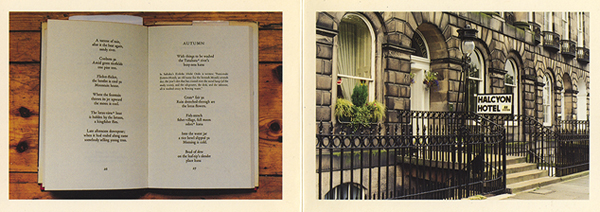
Flashback:  1982.  Somewhere in the Netherlands, a man alone on the river Maas – a Dutch artist by the name of Hans Waanders – encounters a kingfisher.  The encounter is so striking that Waanders spends the next nineteen years of his life creating project after project based on the kingfisher, projects which take the form of photographs, books, and prints.

Excerpt from Edinburgh Kingfishers (1999), Hans Waanders

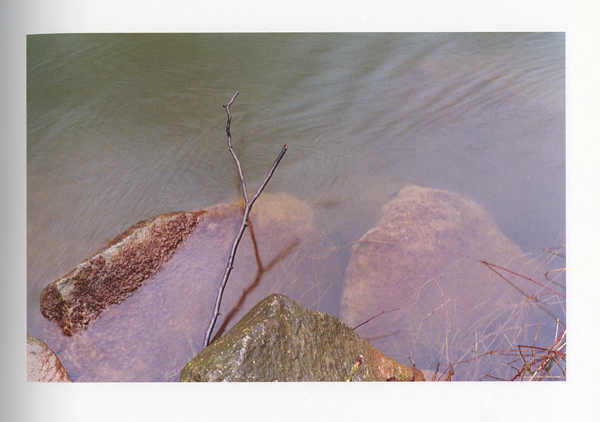
The most poignant of these is a series called Perches (2001): a collection of hand-placed perches on rivers all over Europe by which Waanders hoped to woo the kingfisher (or any kingfisher) back. As legend has it, however, the artist passed away in 2001 without ever witnessing (much less documenting) a kingfisher using one of his perches, although there are romantic reports from his friends about posthumous sightings.

Excerpt from Perches (2001), Location: Ourthe, Sy, Belgium, Hans Waanders

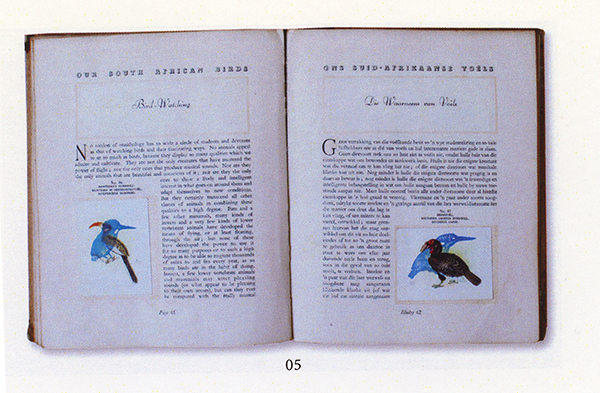
As failures go, Waanders’s is striking: Perches can be read as a record of the kingfisher’s persistent absence.  To this day, Waanders himself remains an unknown and perhaps even unpopular figure.  His art, in its apparently un-ironic embrace of the totalizing and the transcendental, exacerbates all of our contemporary suspicions about archival projects.  Not only does he give us an origin story for his practice, but included in his body of work are pieces that actually disturb, such as Our South African Birds (2001), in which he uses a handmade rubber stamp of a kingfisher to stamp out the images of other birds.

Excerpt from Our South African Birds (2001), Hans Waanders

Perhaps, though, the failure is not just Waanders’s, but our own. As viewers, or consumers of Waanders’s project, or any project, we persist in believing only what we can see, tag, taste, or witness.  Even as we theoretically reject the totalizing nature of the archive, we refuse to allow space for the undocumented.  To interpret Perches as failure is to forget that Waanders’s perches live in real time, not the frozen moment of the photograph.  At any given moment, a kingfisher might be hovering.

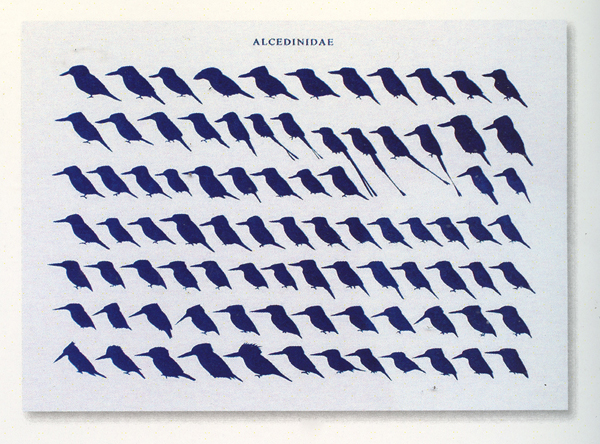
Alcedinidae (Date Unkown), Hans Waanders

I can identify with Waanders’s project:  eight years ago, I stood in a scrappy grove of aspen trees in Wayne County, Utah, about 100 feet from a cow pond that had gotten just enough monsoon rain to become a real watering hole.  Surrounded by tall, waving grasses, I watched as the black bear I’d startled away from the hole turned tail and ran in the opposite direction.  The wind seemed to affect the bear’s fur the same way it affected the grass; I remember thinking that the bear looked more like an otter swimming gracefully away through ocean waves than anything as clumsy as a land animal.

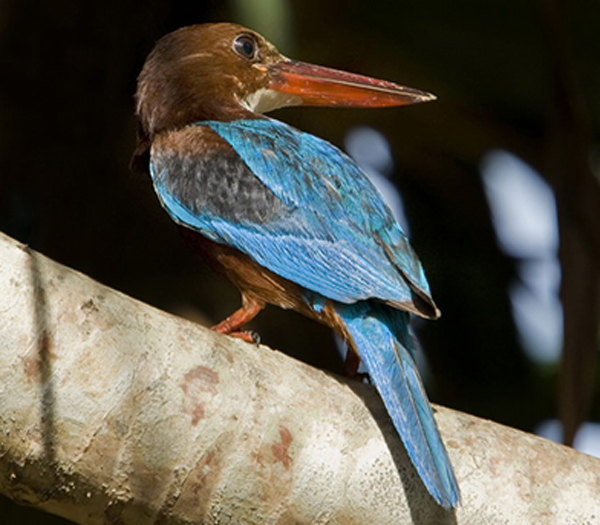
White-Throated Kingfisher, Image by Ziga Camernik

Waanders may have failed to woo a kingfisher to one of his perches; he may have failed to capture the kingfisher’s essence or totality (as all archivists are so doomed); he may even have failed to either a) embrace the beauty of other birds beyond the kingfisher or b) be obvious with the more tongue-in-cheek aspects of his project; but there is one arena where he did not fail, and that is in his stubborn attempt to sustain that searing and confusing moment in which so much art gets born: the accidental encounter with something bigger than yourself.

Share

This Space is Mine

Today we continue our week-long series Force of Failure with John Galliano, Natalie Portman and Vito Acconci in this week’s L.A. Expanded Column.

FORCE OF FAILURE: DailyServing’s latest week-long series

L.A. Expanded: Notes from the West Coast
A weekly column by Catherine Wagley

John Galliano, 2009.

John Galliano has a lavish-sounding last name (he shares it with an Italian liqueur), and lavish taste (“He knows, and we know, that no one would ever wear a 12-foot-wide crinoline over a baggy pair of printed drawers with, perhaps, a pair of plastic carrier bags on the feet,” wrote Sarah Mower for Style.com). That he would also take a lavish approach to outbursts, uttering a line of anti-Semitic epitaphs instead of just one or two, isn’t that surprising. So when, days before Paris Fashion week began, Galliano, the first Brit to head a French couture house, let his God-complex spin out and became, at least according to certain headlines, a dissolute failure, his fall seemed more irksome than surprising.

What’s happened since has been predictable; it’s exactly what happens when someone who’s found a certain niche of notoriety takes an egregious misstep and everyone sees. Dior let Galliano go; Naomi Campbell and Kate Moss  urged him into rehab; then pregnant, pixie star, Natalie Portman, the antithesis of the punk designer in deportment and pedigree, became unwitting spokesperson against anti-Semitism in general and drunken fashion gurus in particular, refusing to stay on as face of Dior fragrance if Galliano stayed on, too.  (In an effort to defend Portman’s spokeswoman clout, articles keep noting that her great-grandparents died at Auschwitz, a serious fact that this fiasco almost trivializes.)

Rodarte, "The Black Collection," 2010. Courtesy MOCA.

It had been rumored, probably baselessly, that Portman would wear Galliano to the Oscars two weeks ago. Instead she wore simple plum Rodarte. Which is more or less where this string of who-did-whats has been heading: the work of the Rodarte sisters, whose somber idiosyncrasy recalls the Brontës, is the subject of a current exhibition at MOCA’s Pacific Design Center. Presented by Swarovski (yes, of the crystals) and curated by Rebecca Morse, Rodarte: States of Matter features a selection of dresses from the designers’ recent Fall and Spring collections and a few costumes designed for the Darren Aronofsky film Black Swan.

MOCA PDC fares much better when it remembers that it is the satellite of an experimental contemporary arts institution and not a history of design museum. It rarely does, however, and it’s installations too often stray toward the pedantic. But Rodarte: States of Matter tries too hard to push the other way, going to great lengths to present the gowns as sculptural experiences and thus making it a battle to appreciate them as design at all.

Vito Acconci, "Claim Excerpts," still. Courtesy Whitney Museum.

Vito Acconci, still from "Claim Excerpts," 1971.

Downstairs, Rodarte’s Black Collection is darkly lit and hung in the center of a black painted room. You have to get close to see the the raw alpaca wool that climbs up a mannequin’s chest toward the shoulder and the tulle that twists in on itself like nautical netting after a storm. Upstairs, the lighting is at first severe and all-exposing, but then it flashes black and the dresses from the White Collection glow like they would in a bowling alley.  This theatricality doesn’t give the clothes the credit they deserve–after all, they’re gorgeously crafted objects, with a pre-Raphaelite gentility that butts up against a DIY scavengery—or doesn’t credit viewers with the ability to understand Rodarte’s drama without the help of special effects.

But as with Galliano, the MOCA exhibition fails only in stark contrast to success–it fails because it could have succeeded. That’s the most common, prominent kind of failure. It’s also the dullest, the kind that can be explained away and potentially remedied.

The last time I was in a room as dark as the one that now holds Rodarte’s Black Collection, I was at Emma Gray Headquarters, a tiny, narrow, bird’s nest of a space perched above the corner of La Cienega and Venice. Performance artist and photographer Dawn Kasper was re-inhabiting Vito Acconci’s 1971 work Claim, wearing a black hoodie, wielding a pipe and sitting blindfolded in a candle-encircled corner.

During the original Claim, Acconci, also blindfolded, sat at the bottom of a stairwell in the basement of a New York gallery with a crowbar, two pipes and and relentless tongue at his disposal, “claiming the space.” Any time steps approached, he’d swing his pipe, and threaten to kill. “I’ll stop anybody from coming down here in the basement with me,” he’d say, his outburst far less viscous but more ominous than any iteration of Galliano’s. “This space is mine.”

Kasper sat at the same level as her audience, not below. And her piece, more about wondering what could have compelled or propelled a performer like Acconci, lasted an hour to Acconci’s three. Carol Cheh of Another Righteous Transfer recorded pieces of Kasper’s intermittent monologue:

I want to be aggressive, I want to be convincing, I want to claim this space . . .  I am alone in this space . . . but I don’t really want this space . . . I don’t want to be him, I am a woman, I am claiming my own space, my own honesty.

“My work was about getting to a place that you couldn’t get to,” Acconci said recently, looking back on earlier performances. In that sense, Kasper’s Claim succeeded by failing–failing to get somewhere she never could have gotten anyway.

Share

An exhibition of an exhibition: Kwan Sheung Chi

Today we continue our week-long series Force of Failure with Magdalen Chau’s article on artistic struggle through the lens of Kwan Sheung Chi’s work.

FORCE OF FAILURE: DailyServing’s latest week-long series

Cash coupons to purchase works from “A Retrospective of Kwan Sheung Chi", Inkjet print on paper, 2002, Courtesy of artist

In 2002, Kwan Sheung Chi presented A Retrospective of Kwan Sheung Chi, an exhibition of an exhibition, where strategies of organization and self-promotion were translated into works of art. From the cash coupons towards the purchase of Kwan’s works, to paraphernalia featuring Kwan, the grandiose titling of the exhibition coupled with the unconcealed packaging and branding, created a deliberate projection of the bravado of a final year student, perhaps as reflection of the failure and anxieties not just of an artist but also of the structures embedded within a consumer-driven society.

“I am Artist” Exercise Book, Ball pen ink on exercise book, 20.5 x 16.5 cm each page, 2003 - 2007, Courtesy of artist

This questioning of the place and points of failure and success through the persona of a struggling artist continues in I am Artist, where the words “I am Artist” were written in exercise books and accompanied a series of statements revised annually. In 2005, his statement testified that he would price the work based on the hourly-rate agreed upon between him and the potential buyer. This statement was revised in subsequent years and in 2007, stated that he would produce the work only upon commission or for exhibiting. Through the use of language and writing, the contrast between the painstaking process of the “I am artist” exercise books with the reworded statements accounting for opportunities of financial gain point towards the conflict and choices between the laborious and often invisible practice of art-making and techniques of success which one could acquire to advance in the art market.

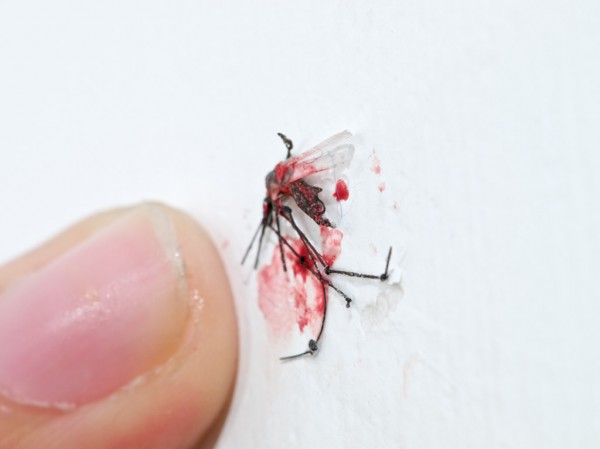
A Dead Mosquito, Artist’s hair & blood, Life size, 2008, Courtesy of artist

The course of the artistic struggle is captured within A Dead Mosquito, a work formed by the hair and blood of Kwan, installed to be almost invisible save for wall labels which call attention to its presence. The bodily material and almost insignificant size of the work evokes a deeply poetic and personal gesture of an artist, and art work, dwarfed and swatted.

It’s difficult to stand up as a person. I finally understand why he has been lying there for years, Black & white photography, 50 x 50 cm, 2009, Courtesy of artist

It appears that Kwan has completed one circuit where the bravado of a flailing artist has evolved towards a reflective questioning of failure in life and persistence in faith, with No matter, Try again, Fail again, his first solo exhibition in 2009 after A Retrospective of Kwan Sheung Chi in 2002. With the passage of time and a practice filled with experimentation across media, this opportunity for a retrospective is instead used for a new series of works including It’s difficult to stand up as a person. I finally understand why he has been lying there for years, that underlie a dominant sense of introspection. The exhibition culminated in an ironic auction of a statement the artist had written in 2008 which testified that he would refrain from selling any works for 3 years, and collectively, the works examine failure beyond the art context, as a thread which weaves across the fragility of intentions.

Kwan (b. 1980) graduated in Fine Art from The Chinese University of Hong Kong in 2003 and in recent years, has been involved in practices to integrate art with the community, co-founding the Hong Kong Arts Discovery Channel, hkPARTg (Political Art Group) and Woofer Ten. He will be exhibiting video works in Art Fair Tokyo which runs from 1 to 3 April 2011.

Share

Quit Marginalizing Yourself

Today we continue our week-long series Force of Failure. Stay tuned we have 4 more articles to present…

FORCE OF FAILURE: DailyServing’s latest week-long series

There are two main artist archetypes popular in our cultural ether. There is the pretentious, avant-garde artist whose genius can’t be explained but who commands a hefty fee for his work, and the stoner artist who lacks ambition and digs things that are ‘trippy’. I, however, have trouble placing myself or any other artist I’ve met into either role. Perhaps the only way to generalize us would be to describe artists as creators with perspectives that we want to share with others, yet the popular notions of the profession rarely stray from those mentioned stereotypes. We have lost control of not only how we are represented as people, but also the presentation of our larger artistic goals.

Jeanloup Sieff. Yves Saint Laurent, 1971. © The Estate of Jeanloup Sieff, Courtesy of NRW-Forum Dusseldorf

We seem to be struggling with the notion that our culture doesn’t care for, or value us; ingrained in us from the first time an elder exclaimed “But what are you going to do for money?” to follow up their initial ‘What do you want to be?’ type question. In fact, I initially hesitated as I typed the word “profession” to describe an ‘artist’ precisely because of the profound impact these nay-sayers and, admittedly, my current art income level have had on my understanding of the term.

Perhaps because of these misconceptions, we seem to have resigned to this fate of being the forgotten souls of society. Struggling to earn a living, many must relegate art making to the realm of hobby. Grants do come up, although not often enough to keep up with the demand, and showing opportunities are usually quite competitive and compensation is a rarity. There are ways to earn a living, to be sure, but permanently aligning income with art making can seem like an unrealistic goal that hardly merits any serious amount of focus.

The fundamental issue here is that we assume that people don’t care and won’t care. We continue to go out to openings and other events to support our colleagues at alternative art spaces and non-profit artist run galleries, but these seem to draw out the same crowd every month; an entire collection of people accepting the normalized version of an artist’s life.

These hot spots of artists are effectively social clubs where everyone at least recognizes everyone else, and no one buys any work. These gallery spaces may in fact cause us to marginalize ourselves and insulate our communities. Locating exhibition sites and events is simple if you know about them already, but can be difficult to seek out as an outsider, resulting in a homogeneous, choir-preaching, artist crowd. Certainly, if a little effort were made by the would-be patrons they could locate events themselves, but leaving the onus on them has been proving itself ineffective as a strategy of integration. If art is not presented as a worthwhile pastime in their minds, they will find other ways to spend their time and money.

One can play all their cards right, get discovered by a Charles Saatchi type and be set for life, but this is an unlikely future for most of us. Instead, we need to think about who we want to align with to disseminate our message in a broader sense, and target them. This opportunity, however, hasn’t be seized, and I would liken many art centers to churches in terms of patronage: aging or dwindling members and artists without the means to buy art coupled with unsuccessful outreach/no development strategies in effect. Perhaps the past can offer us a model for changing this downward spiral we seem to be caught up in.

Ron Galella. Lester Persky, Andy Warhol and Truman Capote, New York, December 1978. © Ron Galella, Ltd., Courtesy of NRW-Forum Dusseldorf

Currently, NRW-Forum Duesseldorf is showing Zeitgeist and Glamour, a private collection of photographs encapsulating Celebrity of the 1960’s. Along with movie stars and rock stars stand designers and artists in a myriad of private and public settings. Andy Warhol, Truman Capote, Robert Mapplethorpe and others are represented in front of the camera as often as they are behind the scenes of the images. This status and visibility made artists and their commodities relevant to mass culture, and made art cool and a worthy pursuit for some. Today, for whatever reason, there has been a significant shift the media’s presentation of and influence over art and critical thinking. Gone are the days of the Ayn Rand in-depth television interview with Mike Wallace.

In much the same way that the alignment of artists and entertainers made the public take note, we now need to appeal to a new audience in order to shape future cultural values. Big cities, where artists seem to gravitate, breed young urban professionals, essentially our peers, who are educated and intellectual, well-respected in their fields, and the ‘future leaders’. If we’re really concerned with promoting the discipline as a whole, we need to foster connections with these people who have some money and potential for increasing affluence, who value education, expertise, culture and politics. They are us (plus a job for which they were specifically trained). They are a sought out demographic and have the ability to produce and shape cultural values, and to not be interested in joining forces with them is ignorant and unjustifiably elitist.

Perhaps in the quest to validate ourselves as intellectuals, we’ve insulated and marginalized our community. Be it elitism, lack of pride, ignorance to the issue, lack of means for publicity, or something else, art cannot move beyond it’s role as something vital to few but the butt of many a pot jokes without a broader audience. We need to extend our reach outward to find people who will find our material relevant and come with the additional benefit of being valuable outside resources of critical and enriching discourse.

There are two main artist archetypes popular in our cultural ether. There is the pretentious, avant-garde artist whose genius can’t be explained but who commands a hefty fee for his work, and the stoner artist who lacks ambition and digs things that are ‘trippy’. Neither of these seems to capture the essence of me, or any artist I’ve ever met, yet the stereotype continues to influence popular opinion on the profession.
Share