Shotgun Reviews

Devorah Jacoby at Seager Gray Gallery

Shotgun Reviews are an open forum where we invite the international art community to contribute timely, short-format responses to an exhibition or event. If you are interested in submitting a Shotgun Review, please click this link for more information. In this Shotgun Review, Mary Ellen Hannibal reviews Devorah Jacoby: Unearthed at Seager Gray Gallery in Mill Valley.

Devorah Jacoby Painter, oil on canvas, 72 x 60. Courtesy of Seager/ Gray Gallery

Devorah Jacoby. Painter, 2016; oil on canvas; 72 x 60 in. Courtesy of Seager Gray Gallery.

Devorah Jacoby’s new exhibit, Unearthed, expresses the artist’s painterly and conceptual depths mostly in works of oil on canvas. Jacoby’s deep-time backgrounds and her in-the-moment figures create an intersection of temporal and spatial scales. Many of her paintings deploy curiously arrested narratives, which also stop the viewer and provoke reflection.

In Painter, a large portrait of a young woman, palette in hand and a single wing hovering behind her, Jacoby revises Winged Victory (Nike of Samothrace). In contrast to the developed feminine power of the Hellenic sculpture now in the Louvre, Painter has a childlike body and stands firm, but not ready for battle. The figure may lack certainty and direction, but the abstracted background of depth-defying color grounds the viewer. Unattached to the figure’s body, the wing evinces more aspiration than power, yet its complexity (re)assures us that she will fly. A stop-motion quality to the figure suggests time unfolding around her.

Read More »

Share

Printed Matters

Printed Matters – Mass Effect: Art and the Internet in the Twenty-First Century

Published in 2015, Mass Effect: Art and the Internet in the Twenty-First Century, edited by Lauren Cornell and Ed Halter, is a hefty tome for an art genre that still seems young and new. A compilation of essays from artists, art writers, and curators, the anthology takes on the subject of internet art in depth. It should come as no surprise that the topic is complicated, though I confess I began with naïve questions: What is considered internet art? And since the genre is so new, what would a history of it be like? Mass Effect became my thorough, though occasionally tedious, education—more like a graduate seminar than a primer.

Cover image of "Mass Effect," featuring Cory Arcangel, "Drei Klavierstücke op. 11," 2009 (still); single-channel video, sound, color; 15:58 min. Courtesy of the Artist and Team Gallery, New York.

Cover image of Mass Effect, featuring Cory Arcangel, Drei Klavierstücke op. 11, 2009 (still); single-channel video, sound, color; 15:58. Courtesy of the Artist and Team Gallery, New York.

Although I’m familiar with contemporary art history and theory, before reading this I could not have easily named artists who seemed to clearly fall within the genre (for example: Cory Arcangel, Petra Cortright, Seth Price, Cao Fei, Trevor Paglen, Hito Steyerl, Ryan Trecartin, and Angela Washko). Internet art has an expansive definition: art that is either made with, for, and/or in response to the internet. So, like the art historian Claire Bishop in her controversial 2012 essay, “Digital Divide: Contemporary Art and New Media” (originally published in Artforum and reproduced in the anthology), I found myself wondering why the art world doesn’t seem to have a flourishing relationship with new media. Her essay received substantial and hostile criticism of what was perceived as her ignorance of existing new-media and internet-art communities, enough to prompt the editors of Mass Effect to invite Bishop to pen a follow-up response for the anthology, which is worth reading for its additional context and contemplation about the topic.

Read More »

Share

Buenos Aires

Más Allá del Sonido [Beyond the Sound] at MUNTREF

Built in Buenos Aires during the first decade of the 20th century and active until 1952, the Hotel de Inmigrantes (Immigrants’ Hotel) was an immigrant checkpoint and a temporary shelter for exiles and expatriates from overseas. Today, the historic building fosters the National Direction of Migration and the Universidad Nacional de Tres de Febrero Museum, Centro de Arte Contemporáneo (MUNTREF). Within the building’s aseptic white tiled walls, ample hallways, and long corridors reverberate the sounds from the current exhibition, Más Allá del Sonido [Beyond the Sound]. Including five installations by six artists of different nationalities—Edgardo Rudnitzky (Argentina–Germany), María Negroni and Pablo Marín (Argentina), Eddie Ladoire (France), Steve Roden (USA), and Tintin Wulia (Indonesia)—guest curator Anne-Laure Chamboissier’s vision defies the exhibition space’s prototypical use as a container, and instead turns the building into an essential component of the pieces’ making. With each step taken through the exhibition, the symbolic weight of the venue’s history builds a dialogue with the works and visitors as a way to reinterpret paths and wanderings. From images to texts, to sounds and movements, migration becomes a strong leitmotif, not only in its historical dimension, but also as a perceptive experience.

Edgardo Rudnitzky. Border Music, 2016; steel, iron, barbed wire (custom made), 4 melodikons, wooden resonators, bronze, motor; 78.7x5.9 in. Courtesy of MUNTREF. Photo: Tania Puente.

Edgardo Rudnitzky. Border Music, 2016; steel, iron, barbed wire (custom made), 4 melodikons, wooden resonators, bronze, motor; 78.7 x 5.9 in. Courtesy of MUNTREF. Photo: Tania Puente.

Participating artist Edgardo Rudnitzky has said that “sound is never a private thing; in natural terms, sound is always a public matter. We cannot avoid it. One can actively suspend the understanding, but not the faculty of listening to something.”[1] In this sense, his installation Border Music speaks powerfully to the politics of migration and the experience of crossing the border. Border Music is made of a 20-meter rotary machine powered by an engine. Five lines of barbed wire are sent from one side of the machine to the other. The barbs emulate music notes on a staff, and the wires traverse various sound checkpoints where contact with four melodikons and wooden resonators create fragile bell sounds. Within the piece’s intimidating steel frame, the subtle, submerged melody lulls listeners into an ambient contemplation that demands attention to the many tragedies caused by fences and walls that separate nations and communities. The physical divide of space that Border Music creates may be real, but the sounds it emits have no parameters, and will not remain silent.

Read More »

Share

Birmingham

Luis Cruz Azaceta: War and Other Disasters at Abroms-Engel Institute for the Visual Arts

Over the past four decades, Luis Cruz Azaceta has continued to mine the vast possibilities of expressionism—a style that often lends itself to forms of humanism, idealism, originality, and angst that feel more fitting for the 20th century than our current moment. Yet the artist is vigilant in his desire to respond to the world around him, and refuses to retreat into a formal world of mark, splatter, and structure (as so many painters of his generation did) in order to address the ever-present weight of the political. In a selection of eighteen canvases created between 2002 and 2016, Luis Cruz Azaceta: War and Other Disasters at the University of Alabama–Birmingham’s Abroms-Engel Institute for the Visual Arts mobilizes expressionism to explore the range of disasters that define contemporary human experience. From the civil war in Syria to the aftermath of Hurricane Katrina, Cruz Azaceta points to the multifarious nature of “crisis” from a transnational perspective.

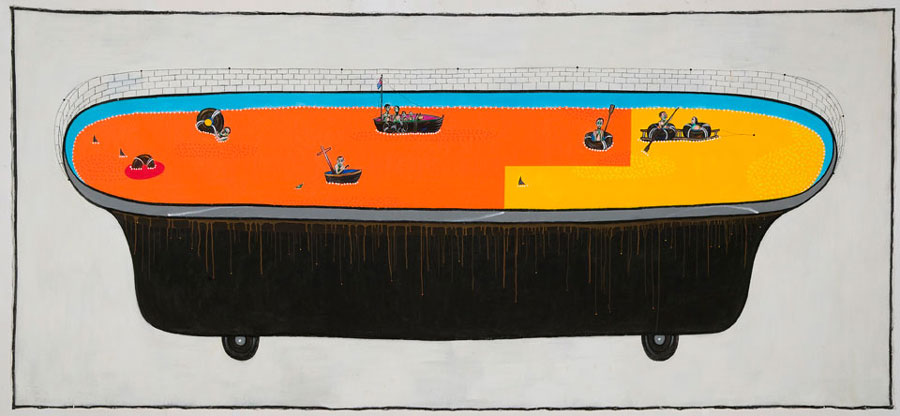
Luis Cruz Azaceta. Hell Act, 2009; acrylic, charcoal, pencil, and shellac on canvas; 72 x 160 in. Courtesy of the artist and the Abroms-Engel Institute for the Visual Arts.

Luis Cruz Azaceta. Hell Act, 2009; acrylic, charcoal, pencil, and shellac on canvas; 72 x 160 in. Courtesy of the Artist and Abroms-Engel Institute for the Visual Arts.

Born in Havana, Cuba, in 1942, Cruz Azaceta arrived in New York City in 1960 as an artist in exile—a political and psychological condition that has marked his work since the beginning of his career. Over the course of three decades he established himself with grotesque, existential canvases that spoke of the misery of new freedoms, urban malaise, and the diasporic experience. The central work of the exhibition, Hell Act (2009), seizes upon this subjective condition by representing the treacherous ninety-mile journey between Cuba and the United States as an enormous bathtub of refugees bobbing like toys in a pool of shark-infested neon-orange liquid. A direct attack on the inhumane choices and absurdities that define the balasero experience, which forces Cubans to leave and often never return, the painting speaks to the artist’s own struggle to define himself and his work through the liminal condition of in-between states, spaces, and memories.

Read More »

Share

New York

Pedro Reyes: Doomocracy at the Brooklyn Army Terminal

The word “doom” is frequently preceded by “impending” or “certain.” It implies finality—condemnation to a state of catastrophic ruin that overpowers any attempt to forge order and peace. In the case of Doomocracy, an immersive installation and performance in the form of a house of political horrors conceived by Mexico City–based artist Pedro Reyes, doom is employed as part parable and part prophesy—a way to evoke certain political, social, and economic realities as well as to project a potential future to come.

Pedro Reyes. Lady Liberty, 2016; installation view, Pedro Reyes: Doomocracy, 2016. Courtesy of Creative Time, New York. Photo: Will Star Shooting Stars Pro

Pedro Reyes. Lady Liberty, 2016; installation view, Pedro Reyes: Doomocracy, 2016. Courtesy of Creative Time, New York. Photo: Will Star Shooting Stars Pro.

Organized in collaboration with Creative Time, Reyes’s Doomocracy opened to the public on October 7, 2016, and will be performed on Friday, Saturday, and Sunday nights through November 6th. Curated by Nato Thompson, directed by Meghan Finn, and written by Paul Hufker, Doomocracy occupies a vital moment in our collective history. According to Creative Time, the project emerged with some urgency from the confluence of Halloween and the American presidential election—two events looming large, haunting our cultural imagination.

Gun violence, climate change, abortion, voter fraud, and surveillance are just a few of the issues addressed in Reyes’s series of fourteen Doomocracy scenarios. Performed by more than thirty actors, the vignettes take place within a labyrinthine set of stages constructed in the Brooklyn Army Terminal—itself a dystopian institutional backdrop akin to those in Fritz Lang’s Metropolis (1927). At once chilling and absurd, each act is performed with a self-conscious theatricality that never gives itself over to an entirely convincing tableau. A number of scenes, such as Matthew Korahais’s performance as a junk food coffin salesman, venture toward slapstick, while others, like Carolina Do’s infomercial for artisanal air, are sci-fi parodies that dissolve wonder into giggles. What becomes truly terrifying are not the performances themselves, but rather the larger questions the entire project provokes.

Read More »

Share

Interviews

The Importance of Being Hassan

Today, from our friends at REORIENT, we bring you an interview with Hassan Hajjaj (also known as the “Andy Warhol of Marrakech”). REORIENT editor Joobin Bekhrad talks with Hassan about his recent decoration by the King of Morocco, his participation in Made You Look: Dandyism and Black Masculinity at the Photographers’ Gallery, London, and pop art in the Middle East and North Africa. This article was originally published on October 17, 2016.

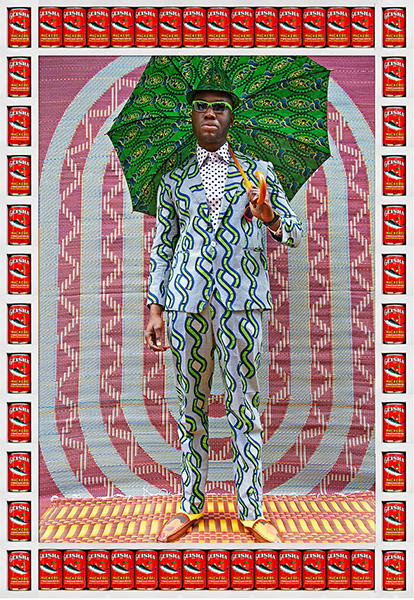
Hassan Hajjaj. Afrikan Boy, 2012.

Hassan Hajjaj. Afrikan Boy, 2012.

If you ever happen to be sauntering about Mister Hajjaj’s neighbourhood looking for a good time, do pay the man a visit—if he’s in, of course. (And if it isn’t pissing down like there’s no tomorrow. Don’t ask me why, but whenever I get out of the tube in Shoreditch, there’s hell to pay.) At Larache, the little shop of wonders named after his hometown in Morocco, there will be sights and sounds to delight your eyes and ears. You will sip on freshly brewed mint tea, recline on technicolour poufs, chat with someone you feel you’ve known for twenty-odd years, and tap your feet to hip-hop straight outta the ’Kesh, while passersby pop in and out shouting, “Ey, ’Assan!” Well, maybe I’m exaggerating, but that’s what comes to mind at the moment.

It’s been over a year since we caught up at Larache, and things have seemed to be getting better and better for the Moroccan boy wonder. Since then, he’s been decorated by the King of Morocco, released his first documentary film (written about for the first time by yours truly), and participated in a fabulous exhibition in London about black dandyism (Made You Look: Dandyism and Black Masculinity). Not bad, Hassan. Not bad at all.

Read the full article here.

Share

From the Archives

From the Archives — Pipilotti Rist: Worry Will Vanish and Stay Stamina Stay at Hauser & Wirth

This week, the New Museum opened a major exhibition of works by path-breaking multimedia and video artist Pipilotti Rist. As author Elspeth Walker observed in her 2015 review, Rist’s work confounds the divide between the human body, the natural world, and video technologies. Fielding otherworldly experiences made from footage of this world, Rist’s installation likely felt hypnotic to many viewers for a reason—she drew inspiration from early-20th-century psychiatric relaxation techniques. This article was originally published on January 8, 2015.

Pipilotti Rist. Worry Will Vanish Horizon, 2014 (video still); audio-video installation (video projection on two walls, carpet, blankets, with music by Heinz Rohrer); dimensions variable. Courtesy of the Artist and Hauser & Wirth London.

Pipilotti Rist. Worry Will Vanish Horizon, 2014 (video still); audio-video installation (video projection on two walls, carpet, blankets, with music by Heinz Rohrer); dimensions variable. Courtesy of the Artist and Hauser & Wirth London.

Worry Will Vanish and Stay Stamina Stay, parallel exhibitions by Pipilotti Rist at Hauser & Wirth in London and Somerset, respectively, feature footage generated during Rist’s recent residency at the gallery’s newest location in Somerset between summer 2012 and summer 2013. For material, Rist milks images from the plant life surrounding Durslade Farm, the historic Somerset compound that Hauser & Wirth has converted into gallery spaces, garden, farm, and café. Rist’s videos suggest the confluence of the micro- upon the macroscopic, like overlaid sheets of tracing paper revealing the similarities of the body, the natural world of plants, and the cosmos.

Both the works Worry Will Vanish Horizon (in London) and Mercy Garden (in Somerset) transform adjacent gallery walls into massive video theaters. In London, visitors remove their shoes before entering and are invited to lie down on soft white floor pillows while they take in the projections. In Somerset, the invitation for a seated vista is presented in the form of locally produced sheepskin rugs.

In London, Worry Will Vanish Horizon is focused on the somatic experience. The video traces a path through what appears to be the interior of a human body lined with blood veins that morph into the veins on the backs of leaves and mapped constellations in a black sky. The vantage point of lying down lulls the viewer into a hypnotic relationship with the body in the work. Rist is informed here by autogenic training, a psychiatric technique developed by Johannes Heinrich Schultz in 1932 in which the participant views a series of images from a particular physical position in order to induce relaxation. Though this manipulation of the viewer’s body in order to produce emotional response to video is novel, the orchestration of viewing a video about the body’s arrangement in space (referencing both outer space and one’s surroundings) results in an intersection of body, flora, and nebula that comes across as didactic as it is psychedelic. It feels like a throwback to a kind of New Age awareness of one’s place in the universe: an aesthetic that is beautiful but overused, enough to seem devoid—and, indeed, it is not of the void of which it hopes to speak. The work, in its seeming eagerness to relax the viewer, oversimplifies its own ideas.

Read More »

Share