Karin Sander at n.b.k.

My natural tendency, when looking at trash in an art gallery, is to play detective and treat the waste as anthropological evidence. For her solo show at Neuer Berliner Kunstverein, Karin Sander has cut six holes in the floor of the gallery’s administrative office where trash cans used to sit. Located directly above the gallery, the administration’s waste now falls down from the office space as it’s created and collects into piles on the gallery floor.

Karin Sander, Exhibition view Neuer Berliner Kunstverein, 2011 © Neuer Berliner Kunstverein/Jens Ziehe

While I could discern where the accountant sat, and maybe the person who opens mail, there was a distinct lack of personality to the trash.  I don’t know exactly what I was expecting, but there wasn’t even a single paper coffee cup, let alone food waste, or used Kleenex. One week in, and the most individualizing piece of trash I saw was an empty bag of hard candy. I got the sense that the content was being consciously controlled. So too felt the state of the trashed articles.

Crumpled up paper constitutes the majority of each pile. The act of crumpling, far from an efficient business practice, is the act of the frustrated writer we see in films, passionately struggling at their typewriter. It typically denotes angst towards the text being discarded. It is not simply that the paper has lost its functional use at one’s desk, but that it’s worthless, a failed attempt. Assuming all of the employees don’t loath their jobs, all of this crumpling activity could be the result of trash aestheticization (which I wouldn’t totally discount), or it could simply be the novelty of tossing one’s trash into a seemingly underground pit.

Karin Sander, Exhibition view (Director’s Office, first floor) Neuer Berliner Kunstverein, 2011 © Neuer Berliner Kunstverein/Jens Ziehe

A sizable piece of cardboard was ripped up by hand and sent down in smaller chunks, rather than simply putting the piece in a more appropriately sized receptacle. Some paper with non-sensitive information was torn into one inch squares that must have floated down like confetti. While the shift in roles of administrators and artists, and the ecological aspects around Sander’s work could certainly be discussed, what piqued my interest was the effort I felt on the part of the waste-makers to affect their piles, if not with an interest in aesthetics, with a conscious labouring over the materials.

Administrative duties in any field, I can attest, have a tendency to be fraught with tedious tasks and bureaucratic detail and sometimes it’s necessary to find ways to make those tasks more bearable. Being aware that their garbage is on display may elevate anxiety over what a worker throws out, but if nothing more, the activity provides a new way to break up the day by making a game out of waste disposal. While the individual piles may not provide insight into the anthropology of the administrative gallery worker, Sander’s intervention does highlight the ease at which a psychological shift can occur in a white collar worker with minimal spatial changes.

Share

Fan Mail: Interview with Amy Revier

Each month, DailyServing selects two artists to be featured in our Fan Mail series.  If you would like to be considered, please submit to info@dailyserving.com a link to your website with ‘Fan Mail’ in the subject line.  Keep checking the site – you could be the next artist featured!

For this edition of Fan Mail, Austin, TX based artist Amy Revier has been chosen from a group of worthy submissions to discuss the process and ideas that fuel her art practice.  With an imminent move to London on the horizon, Revier also fills us in on what’s next.

Woolly Headed, image courtesy the artist.


Kelly Nosari:
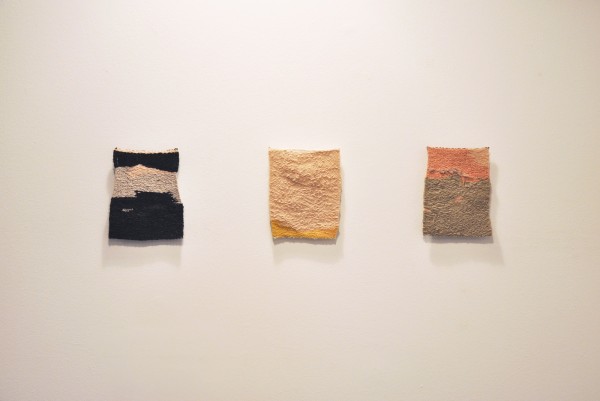
Textiles, significantly wools, and the process of weaving are important elements of your practice and have potential feminist implications.  In performance work such as Woolly Headed and Yolk Yoke, you wrap and confine your body in woven textile.  Your Woven Drawing series relieves woven textiles of their utilitarian nature, giving them new creative life as drawing comprised of texture and color.  Please talk about your work in this medium and the ideas that inform it.

Amy Revier:
I became interested in textiles through weaving.  The practice of weaving has such a dense relationship with ritual and placing oneself into a kind of solitary, psychological space.  Wool is a reference to that density – and it became a tool for hibernation in my performance work. I was also using wool to reference something wild and very animal. The head-wrapping performances would often become stiflingly hot and disorienting. I wanted them to waiver at that point just before something loses control, blows apart, and becomes lost. Performance was a way to become more intimate with the material – to dig into its structure and, while doing so, work in a very concentrated, obsessive manner, as weaving often demands.

The most recent work in textiles step away from performance and sit closer to drawing and painting. While living in Iceland, one of the projects I started was making portable woven drawings on handmade looms. It was during the dark winter months and making those drawings were like little daily rituals. They accumulated time, and also acted as parallels to text I was reading on otherworldly places – Anne Carson’s The Autobiography of Red, Jules Verne’s Journey to the Center of the Earth, Italo Calvino’s Cosmicomics.

Woven Drawings, image courtesy the artist.

Textiles used in the recent sculptural, body-board work are rolled to resemble rescue blankets or camping equipment.  I was interested in taking what is usually a very durable, non-descript blanket and making it handwoven in the most meticulous way (hand spinning the yarn, using paper and thin steel as warp and weft). I’m also beginning to explore the idea of a body-board unit (such as Riding on the Back of Another) as an object for ceremony more than rescue – for navigating unknown or mythical territories.

KN: Looking at a work like Riding on the Back of Another or Blackfog one can’t help but recall The Pack (1969) by Joseph Beuys.  Is Beuys a source of inspiration?

AR: Beuys’ work has definitely been a reference for me – specifically in the way he weaves myth, ritual, performance, and repetitive action or objects together.  I would also say I had a strong reaction to how he places architecture and textile together.  When I first saw Beuys’ work I thought of tribal cradleboards, which was my direct reference for [my earliest board work] Blackfog.

Riding on the Back of Another, image courtesy the artist.

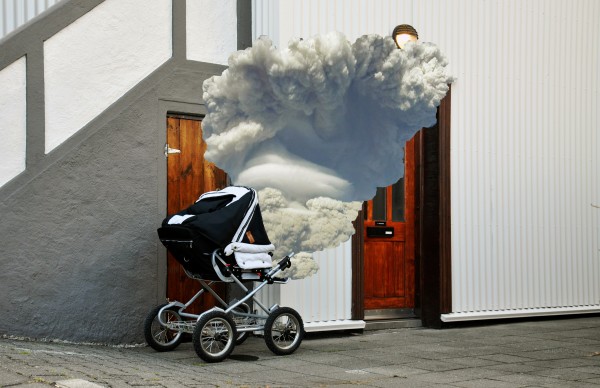
KN: Your series A Quiet Root May Know How to Holler depicts explosive clouds of smoke emanating from prams in otherwise quiet and empty urban settings.  Please tell us about this recent series.

AR: This series is a project that came together while in Iceland.  While on walks I quickly began to notice that prams are left outside with infants in them, while the parents go for coffee, groceries, shop, or socialize.  I found it linked to my research on the tribal cradleboards. Both cultures use an apparatus to keep the infant safe and secure while they gather food, or in the modernized Icelandic version, go for coffee and drinks. I made a daily habit of photographing these prams with infants in them, seemingly abandoned. The collaged image of the volcanic ash plumes came much later, after I had time to experience and understand the political, geological, and economic upheavals.  The ash cloud images are from Google, and are mostly of the Icelandic volcanoes that occurred in March-April 2010. But it was the apparatus that interested me most, and the fact that it became a metaphor for Iceland’s situation as a whole.  It contained something very alive and active, wild but slumbering – similar characteristics of volcanoes, and also of the unforeseen economic corruptions that caused Iceland’s devastating 2008 financial collapse.

KN: What are you working on at the moment?

AR: Currently I’m building a garment collection in collaboration with artist Natalie Northrup. Everything is built from the ground up – we’re weaving and quilting sculptural drawings, then slowly arranging the pieces together to form garments.  It’s a project that forms intersections between sculpture, drawing and painting, performance, and fashion. This first collection will be comprised of roughly fifteen pieces, installed in a space that allows them to waiver ambiguously between garment and sculpture.

I am also making woven drawings and new sculpture for an upcoming group show at Champion Contemporary in Austin, TX.

A Quiet Root May Know How to Holler, image courtesy the artist.

KN: Can you offer one piece of advice for emerging artists?

AR: I think about this when making work… a line from Eileen Myles in The Importance of Being Iceland:

One thing I was thinking about imperfection is that it’s exactly enough. It’s the beginning of something.


Share

From the DS Archives: Nick Cave and Phyllis Galembo

This Sunday, From the DS Archives invites you to reconsider the work of American artist, Nick Cave. Featuring Cave’s signature “Soundsuits,” the traveling exhibition Nick Cave: Meet Me at the Center of the Earth is currently up at the Seattle Art Museum through June 5th. Today’s DS Archive pick is from Cave’s exhibition with Phyllis Galembo last summer at the Halsey Institute of Contemporary Art.

This article was originally written by Rebekah Drysdale on June 5, 2010.

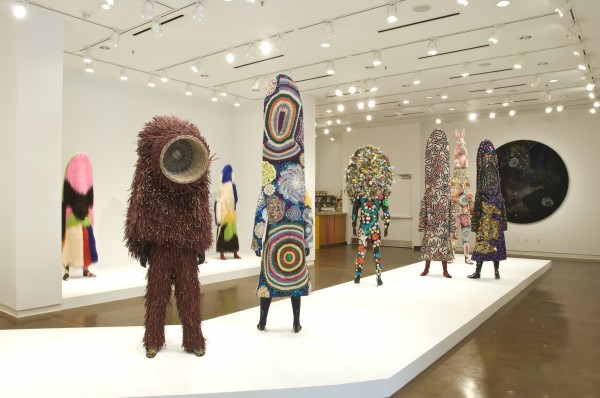
Installation View, Halsey Institute, photographs by Rick Rhodes

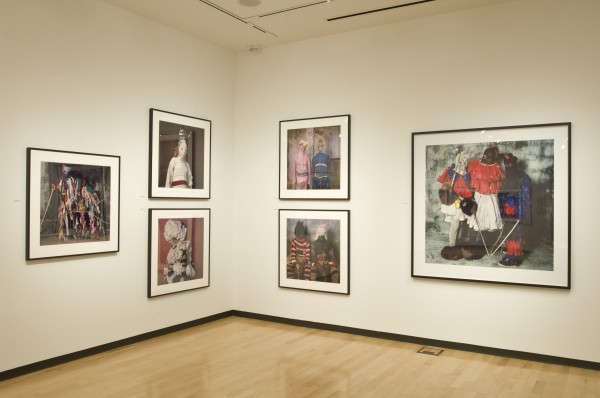
Call and Response: Africa to America / The Art of Nick Cave and Phyllis Galembo recently opened at theHalsey Institute of Contemporary Art in Charleston, South Carolina. The exhibition brings together the work of two American artists intrigued by the formation of cultural identity and individual experience within a society. Drawing inspiration from the rich ceremonial traditions and elaborate guises of African nations, Nick Cave and Phyllis Galembo create objects that are visually captivating and conceptually charged. Cave’s imaginative Soundsuits and Galembo’s photographic portraits of West African masqueraders prompt the viewer to regard the world in terms of connection and community.

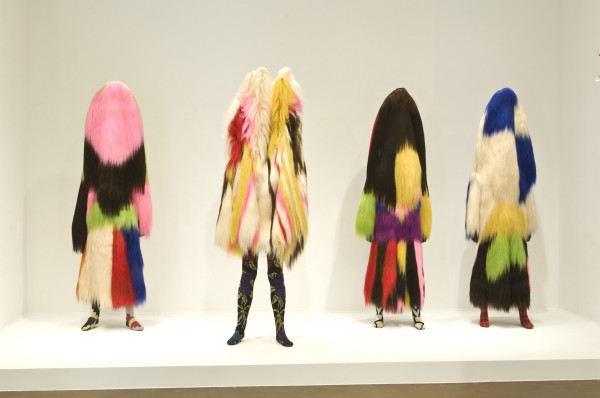
Installation View, Halsey Institute, photographs by Rick Rhodes

Upon entering the Halsey, one is struck by the mystical presence of Cave’s Soundsuits. Cave, a former dancer and current Chair of the Fashion Design Department at the School of the Art institute of Chicago, combines his experience in modern dance with his expertise in fiber textiles to create his Soundsuits. The first soundsuit was constructed entirely of gathered twigs, resulting in a subtle rustling sound when worn; thus, the name. The kaleidoscopic costumes reference the ritualistic garments worn by Galembo’s subjects, the people of Africa whom she has spent decades photographing. Cave’s sculptures, anthropomorphic assemblages of materials such as dyed human hair, plastic buttons, beads, sisal, sequins, fabrics, feathers, and other natural ephemera, are layered with personal and cultural associations. The disparate materials are masterfully woven together by the artist, ornamental embellishments create undeniable tactile and visual appeal for the viewer; the soundsuits incite a collective sense of awe.

In the adjacent gallery, Phyllis Galembo’s photographic portraits chronicle masqueraders from various West African countries, including Benin, Nigeria, and Burkina Faso. The masquerade is a meaningful mode of cultural expression for several African groups, and Galembo presents a straightforward observation of individuals within particular cultures. Galembo’s work is a field study on these regions, a modern documentation of their ancient ceremonial traditions. Disguised as animals, spirits, or ancestors, her subjects enact ancient legends and stories, but the artist captures them in stasis. Galembo, described as a “photographic hunter-gatherer” by writer Emma Reeves, incorporates her subjects’ natural surroundings in detailed compositions that highlight the garments, the accoutrements (i.e. a staff to connote authority), and the occasional glimpse of a bare, or sneakered, foot of a masquerader. Galembo elegantly achieves a personal encounter with a masked individual, and successfully conveys this engagement to the remote viewer.

Courtesy of Phyllis Galembo and Steven Kasher Gallery, New York

Call and Response: Africa to America will remain on view at the Halsey Institute of Contemporary Art until June 26th. The exhibition is taking place during Spoleto Festival USA, an annual performing arts event held in Charleston, SC every spring. The Halsey’s sincere presentation of Cave’s soundsuits and Galembo’s photographs offer an exciting visual arts alternative to the citywide performing arts festival.

Share

Pulling Data: Interview with David Bowen

David Bowen‘s solo exhibition, drift, recently opened at Redux Contemporary Art Center in Charleston, SC. Bowen investigates the intersection of mechanical and organic systems; his practice is driven by an interest in the collection and visualization of data. His materials include simple robotics and electronic components, integrated with natural elements and information systems.
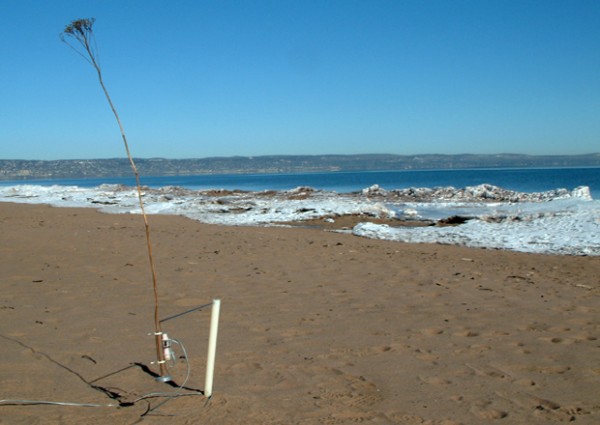
Two of Bowen’s kinetic sculptures, Fly Lights and Tele-Present Wind, are currently on view at Redux. Fly Lights, an orb containing house flies, is suspended from the ceiling in Redux’s first gallery. Encircling the sphere are spotlights aimed at the eye level of the viewer. The movement of the flies triggers the ring of spotlights to flash. Tele-Present Wind, located in Redux’s main gallery, consists of forty two dried plant stalks, each affixed to an electronic base. Part of the work is installed in the artist’s home state of Minnesota.

During the installation of drift, I stopped by Redux to ask Bowen a few questions about the works he was exhibiting in Charleston.

Rebekah Drysdale: The main components of Tele-Present Wind are installed in the gallery at Redux. Describe the off-site component to this piece.

David Bowen: This plant is called tansy, it’s an invasive species in Minnesota, and there is a single stalk, just like this one, in Duluth, Minnesota. It is blowing around in the wind as we speak. At the base of this tansy stalk, there is a device called an accelerometer, which measures x/y tilt. There’s actually one in the iPhone. [My recording device.] The plant stalk is blown around by the wind, which causes the accelerometer to tilt, and the tilt data is collected by a computer on the Minnesota side, and then sent to these devices in the gallery in South Carolina, in real time. The gallery installation is a recreation of the physical effects of the wind in Minnesota.

RD:  Tell me more about Fly Lights. Where do you derive your fly population?

DB: You can get anything on the internet. At Spider Pharm, Inc., you can get five grams of house fly pupae for five dollars. These flies were born in Arizona, came to Minnesota, and then I shipped them down here to South Carolina. These are some well-travelled flies. The idea here is that the subtle movements of the flies are being projected onto our scale. It is rather confrontational, the lights project into our space. These flies will live for about forty days. It takes a certain quantity of them to create the activity of the lights. If there weren’t as many of them, the lights wouldn’t be going off as frequently as they are. But they will die, and that’s part of the piece. As they die, the piece will start to atrophy.

A lot of this work is about contrast. I use natural and mechanical systems. As I work with both of these systems, what I continue to find more interesting is the unpredictable things that happen. Flies can behave in fairly predictable ways, whereas machines and robots, which you would associate with behaving in systematic, predictable ways, can have an unpredictable nature.

RD: Art has long been oriented towards the object, with an increasing awareness of process. In your work, object and process are thoroughly integrated. How do you begin a piece?
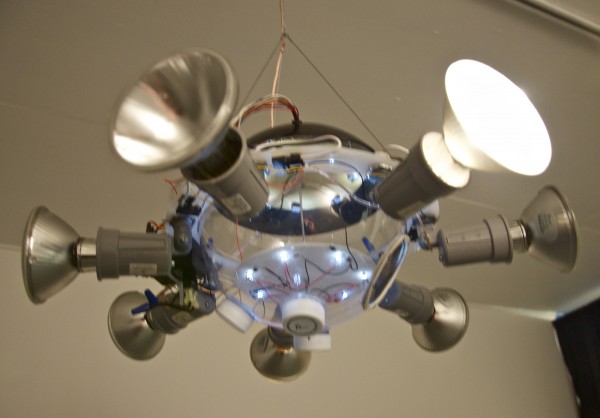
Bowen's Fly Lights installed at Redux

DB: Technology is becoming very accessible, and a lot of this stuff is DIY. I’m not really inventing anything new here, I’m just appropriating things like accelerometers, or ink jet printers, or light sensors, etc., to accomplish an end result. When I first started working with art and technology, I would get really excited about a particular sensor or a particular circuit board that I could plug into my micro controller and make it spit out ink. I would think, “that’s a cool thing, there has got to be a piece I can make around that.”

With these more recent works, I’m thinking more about the idea. I think, “I would like to create something that recreates the physical movements of the wind in the gallery space.” Then I just pull from a tool box or tool set.

RD: What are you working on now?

My most recent project is Tele-Present Water. It’s a wave form, and I have one going right now at Esther Klein Gallery in Philadelphia. It’s a very small undulating wave that pulls data from a NOAA data buoy in the Pacific Ocean. These data buoys are all over the world.

RD: How did you access the buoy’s data?

DB: Anybody can access it. You just get onto NOAA and pull data off of these buoys. You can get wind speed, wind direction, water temperature, outside temperature, surface depth, but you can also get wave height and wave frequency. I’m using that data in real time to articulate a sculpture that is, as we speak, undulating up and down in the gallery space in Philadelphia. It’s based on what’s accessible. It’s really amazing that artists, and I think there are a lot of us now, such as Aaron Koblin and Chris Jordan, are finding ways to use available data collections in their pieces. Due to the accessibility of the web, there is an ease in transmitting and finding data. Things like this weren’t possible ten or fifteen years ago.

RD: You have been selected for The Arctic Circle 2011 Residency. Tell me more about what that opportunity entails.

DB: It’s an ice class vessel that starts off from an island north of Norway. It’s actually ten degrees from the Arctic Circle. I will be spending two weeks aboard this vessel, sailing around the Arctic Circle with other artists and researchers. I will take an accelerometer with me, and mount it to the boat. The boat will obviously be physically affected by the waves, and I will collect data from that accelerometer and use that to articulate a sculpture. Basically, I will be collecting the physical effects on me. I have a good friend who has a sail boat, and when you’re on a boat for an extended period of time, you get acclimated to the movement. That effect is where Tele-Present Water came from, so that is what I will be doing for the Arctic Circle Residency. I’m hoping that the large-scale wave sculpture will debut in December 2011 at the Israel Museum in Jerusalem.

Bowen’s work has been featured in numerous exhibitions including: Brainwave at Exit Art, New York, NY, Artbots at Eyebeam, New York, NY and Data + Art at the NASA Jet Propulsion Laboratory, Pasadena, CA. He received his M.F.A. from the University of Minnesota, Minneapolis and is currently an Associate Professor of Sculpture and Physical Computing at the University of Minnesota, Duluth.

Bowen was selected for a solo exhibition at Redux Contemporary Art Center as the Featured Artist of ReceiverFest, which took place March 10th-13th in Charleston, SC. drift will remain on view at Redux until April 16th.


Share

Too Serious for a Series

L.A. Expanded: Notes from the West Coast
A weekly column by Catherine Wagley

Wolfgang Tillmans, Installation view, March 12 - April 9, 2011. Photography by Brian Forrest. Courtesy Regen Projects, Los Angeles.

There’s a video—one of many—that’s been circulating the web since last Friday. It’s called “Tsunami Hitting City of Kamaishi” and it lasts for a grueling four minutes and thirty-eight seconds. The first thirty seconds show a view of the Pacific coast that’s relatively calm, though overcast. Ships float by distantly and you can hear the inquisitive voice of a child in the background. No one sounds too disturbed. Then, by second thirty-nine, you see sudsy water foam up and pull boats from where they’ve been docked into the city. The becomes violent but slowly—it takes a few more drawn out seconds to register that something really, really bad is happening. By minute number two, the water’s roof high. By minute four, the city’s barely there, and that kid who sounded inquisitive and chipper a few minutes ago has started whimpering. Devastation, literally. Yet the weirdest part is that the video feels rhythmic, as if what’s happening makes intuitive sense.

The same friend who sent me the Kamaishi video also told me about how Japan had moved 13 feet closer to the U.S. since last Friday. He brought this up just after we left the March 12th opening of Wolfgang Tillmans’ new exhibition at Regen Projects in West Hollywood, which is why I now see Tillmans’ Iguazu whenever I think “Tsunami.”

It feels too obvious—an image of gushing brownish water, falling downward in a gorgeous triangle, standing in for a disaster that manifested in a tidal wave. I’d rather have one of Tillmans’ t-shirt or jean photos, with wearable, human swells and rifts lodged in my mind. But I wouldn’t want it to be the work of any other artist  (what if one of Tomory Dodge’s post-apocalyptic eruptions, or Doug Aitken’s smooth-as-molasses, foreboding-as-hell videos had become synonymous with Tsunami?).

Wolfgang Tillmans, Iguazu, 2010, Ink jet print on paper, 54 1/2 x 81 5/8 inches, Edition 1/1, 1 AP. Courtesy Regen Projects, Los Angeles.

When you push aside the fixations on “slacker” images, the fashion-art collide, and rave culture that has trailed Tillmans through his career (a career that, somehow, has gotten quite long), what you’re left with is an artist who understands time and speed far better than most—probably because he refuses to conform to the constructs of either, while at the same time refusing (or just showing little interest in) non-conformity.

Tillmans’ current exhibition at Regen Projects, his sixth with the gallery and the only one since 1995 to feature camera-based work exclusively, at first glance appears atypically linear. The images, all large, with the itinerant feel of travel photographs, hang on a single level. They’re not  staggered and stacked like previous Tillmans installations have been. Yet, seen as a body, they’re just as intermittent and tangential as anything in the artist’s oeuvre. You walk from to Times Square to a hotel room to an airport terminal to a fountain to a photocopier, then past egg cartons to an Argentinian vista. These scenes look like they’ve been caught and honed by someone, a globetrotter, with a sophisticated sense of space who happens to stop for a minute while moving through the other life he leads. (Lecturing at LACMA two weeks ago, Tillmans said that, in the 90s, he’d been hailed as photographing his generation, while really, he was just  photographing his life, but not his life–not exactly.)

Wolfgang Tillmans, Installation view, March 12 - April 9, 2011. Photography by Brian Forrest. Courtesy Regen Projects, Los Angeles.

Tillmans began making work with the help of a company photocopier just before the Berlin Wall fell. He started publishing images in magazines like i.D. soon after and then exhibiting in galleries. He continued through a decade of relative warlessness, at least in Western Europe and the U.S. (one of his books, Soldiers: The Nineties, chronicled the amorphous roles of men in uniform during this time), but endless technological revolutions (when he started, Tillmans used to promise collectors reprints of his digitally processed images should they fade, and they inevitably did; now, they rarely do), and through a subsequent decade of drawn-out international tensions (soldiers have definite jobs again). Through it all, he’s been remarkably good at staying themeless, never working serially. Working in “series is serious,” Tillmans joked during his recent “feature length” (his wording) lecture at LACMA.

Japanese novelist Kazumi Saeki, who experienced the March 11th earthquake from near Sakunami, likes series and published an op-ed in the New York Times this week in which he tries to make sense of disaster. Near the end, he remembers the ten years he spent as an electrician.  “My main job was to travel around Tokyo, repairing lights, including street lamps and the hallway and stairway lights in apartment buildings,” he writes. “For this reason, the sight of the well-ordered, unbroken expanse of the city’s lights always brought me a great sense of relief. Will I ever again experience such peace?”

If series is serious it’s also safe—and calming, like a line of city lights. Tillmans’ work has never been like that. At Regen Projects, each photograph is, on it’s own, a well-ordered thing. Iguazu, for instance, is stunningly composed, but, in a room of images, it has no real partner. The pictures don’t give the satisfaction of continuity or cohesion. They’re not safe in that way. And, unlike the Tokyo lights, they can’t be repaired because they’ve already been perfected.

Share

I Know Something About Love

In Parasol unit’s latest exhibition, Yinka Shonibare, Yang Fudong, Shirin Neshat and Christodoulos Panayiotou prove that they do know something about love as their visually seductive works tell tales of l’amour ripe with romance and nostalgia. I Know Something About Love reads as a gushing four-verse love poem to love itself – an extended visual sonnet that unfolds in time and space, instilling optimism, hope and desire in the love-stricken audience that ventures to dive on in.

What has always been striking about the space at Parasol unit is its impressive shapeshifting nature – the rooms constructed for one exhibition are completely dissolved in the next. Here, for I Know Something About Love, two floors have been transformed to create a one-way procession that takes you through tales of love and lust – a trail one can easily lose themselves in.

Literally.

The ground floor of the exhibition space has been overtaken by an ivy covered labyrinth –  a wrong turn finds you in a dead end, forced to turn back around and try again. However if you choose the right path, you may turn the corner and happen upon an intimate scene of love that looks strangely familiar.

Yinka Shonibare, MBE, The Confession, 2007. Two mannequins, Dutch wax printed cotton textile, shoes, coir matting, artificial silk flowers. 158 x 178 x 170 cm. Image © Yinka Shonibare, MBE, courtesy the artist and Stephen Friedman Gallery, London. Photograph: Patrick Gries for Musée du quai Branly, Paris

Jardin d’amour, originally created in 2007 for the Musée du quai Branly, Paris, is an elaborate maze by British-Nigerian artist Yinka Shonibare MBE, that contains three hidden sculptural tableaux. A sense of uncanniness is played out in our recognition of the scenes, taken from the eighteenth century Fragonard series, ‘Progress of Love,’ and here given the Shonibare treatment – headless figures with skin colour of indeterminate origin are clad in the colonial Dutch wax fabrics. In this Garden of Love identity is uncertain and authenticity questioned…

Love is never what it seems.


Yang Fudong, Flutter, Flutter... Jasmine, Jasmine, 2002. Video still, Three-channel video installation. Music by Miya Dudu. © Yang Fudong, courtesy Marian Goodman Gallery, New York/Paris and ShanghART Gallery, Shanghai.

Emerging from the maze and heading up the stairs, a sense of self is still hazy as Yang Fudong’s three channel video piece Flutter, Flutter… Jasmine, Jasmine explores the challenges of identity facing a generation of Chinese youth, filtered through perceptions of love. Here, a young couple, unsure of who they are, turn to each other to find themselves, struggling between what they think they should feel for each other and what they actually feel. When describing the first time they made love, the woman tells us, laughingly, that her partner seemed like a monster…

Love is complicated.

Shirin Neshat, Fervor, 2000. Video still, Two-channel black and white video/audio installation. © Shirin Neshat. Courtesy Gladstone Gallery, New York.

Further complicated by the traditions and values of Islamic society Shirin Neshat’s Fervor, finds love in a place where it is forbidden to be. A poetic, mirrored, two-screen video depicts a man and a woman who in a brief moment passing on the street have an instantaneous connection. As the film footage splits apart and comes back together, so do the characters. Their emotions culminate when they are shown to be physically divided by a thick curtain that separates the men and women, yet they are still intensely aware of the presence of one another; their connection electrifying…

Love is everywhere, where it is forbidden be.

Christodoulos Panayiotou, Slow dance marathon, 2005. Video still, Video (documentation of a performance). © Christodoulos Panayiotou, courtesy the artist and Rodeo, Istanbul.

Cypriot artist Christodoulos Panayiotou work, Slow dance marathon, continues to find love in unexpected places. Instead of having a barrier erected these individuals are asked to break down all sense of personal space. A document of a performative social experiment, Panayiotou asked volunteers, unknown to one another, to slow dance in a 24 hour public marathon. The warm embraces and tender caresses of strangers who perform gestures of love construct a tableau influenced by the expectations of the audience and the popular culture songs to which they dance.

Love can be what we force it to be.

Moving through the verses of love poem constructed here we find longing, lust and desire. Yes, we are told something about love, but even someone as daft as myself in the ways of love know this is not everything about love. The high from sugary sweet optimism cannot last for long.

Share

What’s Your Spirit Animal? Karen Kilimnik at 303

Karen Kilimnik, Installation view at 303 Gallery, New York 2011.

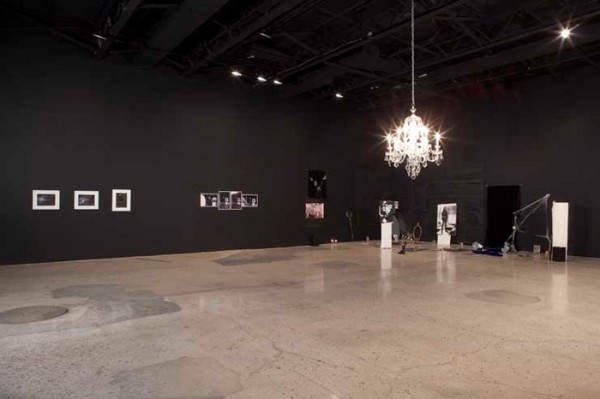
Karen Kilimnik’s current show at 303 Gallery in Chelsea is refreshingly spare and conceptually tight. Centered on a multimedia installation from 1989 titled The Hellfire Club Episode of the Avengers, the show also includes a few drawings from the late ‘80s and a handful of paintings and photographs from 2011. The disparate elements on view gel to create a sort of mini-opera, complete with a crystal chandelier hanging from the ceiling. Right before you can scream “kitsch!” the show stakes the claim that performing arts-style drama is relevant in contemporary fine art, and it’s utterly convincing (unless you hate Sofia Coppola and Black Swan, then don’t bother, and p.s. you’re boring).

Karen Kilimnik, Master Hare, 3rd Lord Grantham 2011.

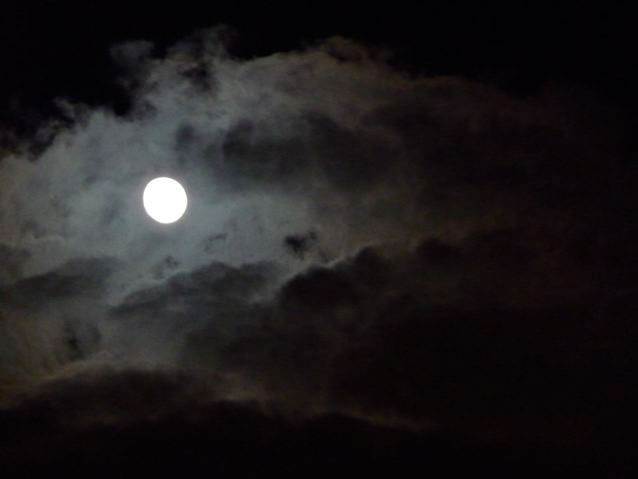
Carrying much of the dramatic weight here is the audio track in the Avengers installation. Re-mastered to be louder and clearer than the original, the track includes snippets of Madonna, Haydn, and the Rolling Stones, among others. It weaves its way into your experience, tying it in with a mood that could be described as “retro-sinister.” Apparently, the installation is based on a particularly saucy and controversial episode of the British cult classic spy TV series by the same name — but you don’t really need to know that to be drawn into the work. Unlike many installations that still feature the stultifying Bill Viola “art hum,” (a.k.a. pretentiously creepy mouth breathing sounds), Kilimnik understands the power of a good soundtrack. The audio, which is at turns catchy, ambient and suspenseful, lends a bit of drama to a trio of fairly pedestrian full moon photos, and overall imbues the show with a dynamic narrative that would otherwise be absent.

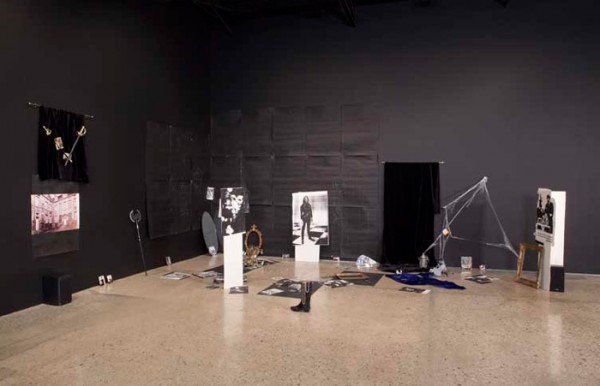
Karen Kilimnik, The Hellfire Club episode of the Avengers, 1989, mixed media Installation view at 303 Gallery, New York, 2011

The simplistic term “Scatter Art”, for which Kilimnik became known at the outset of her career, fails to describe how varied and formally acute The Hellfire Club Episode of the Avengers really is. Despite the staging and use of prop-like materials, Kilimnik knows how to throw stuff around in a way that feels way more considered than clusterfucked.  For instance, a faint white chalk drawing of an Edwardian manor on black paper ever-so-gently peels away from the black wall. A black velvet curtain on the same wall leads to nowhere, casually adding an unseen dimension.  Plastic axes and Halloween-grade cobwebs are manipulated in a way that transcends a haunted house aesthetic without stripping them of their store-bought oomph.  Although it might sound corny, a group of photos, Xeroxes, empty picture frames and shards of glass flesh out what is an immersive theatrical experience.

Karen Kilimnik, The Family in Scotland, 2011.

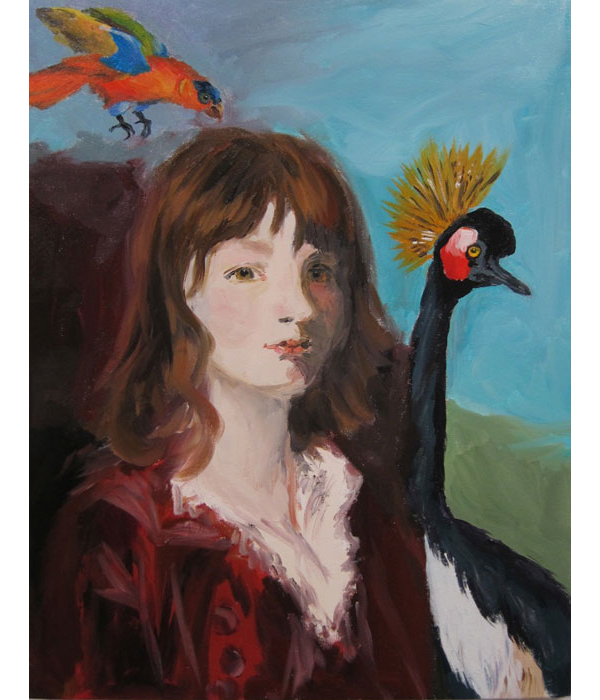
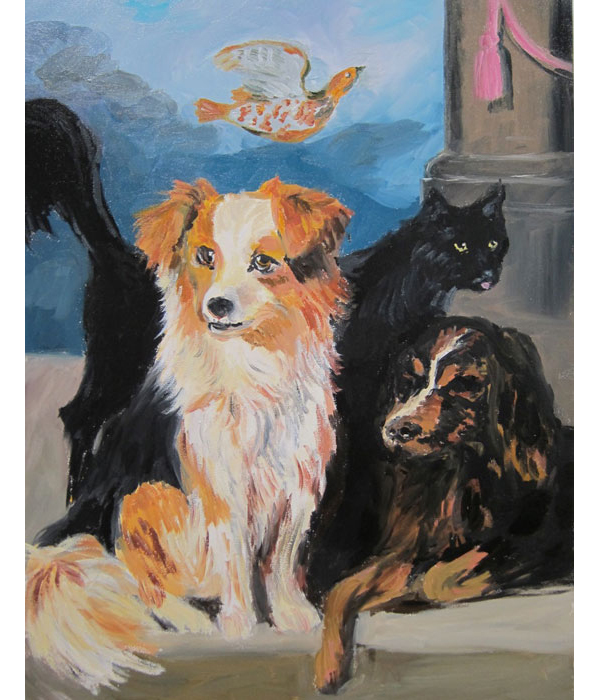
Few artists assimilate such disparate personal fetishes into their art as seamlessly as Kilimnik does.  In any given piece, she implicates widespread historical eras, painterly techniques, and psychological states.  The Ragamuffin of Kiddington Hall is as fey and dashing as any Fragonard, but with a touch of Brit rock attitude. Her drawings, which take their cues from advertising and employ a speedy illustrative touch, are impossible to date. They have a ‘60s vibe that looks simultaneously current, yet they were actually made in 1989.  Kilimnik’s signature knack for turning animal portraits into fetching character studies is also present in dog and cat paintings that are both fragile and endearing.

Karen Kilimnik, entre acte photo, 2011.

In essence, this show seems to be about the fleeting nature of… well, nature. It’s almost like if you were to stare at some of the works too long, they might dash off the wall or fade away like a passing trend. Kilimnik can be equally hard to pin down. According to the current issue of Interview magazine, she recently relocated to Montana from her longtime home in the Philadelphia suburbs. Who knows, maybe this accounts for the spaciousness of the installation. A full moon photo called My Walk in the Woods at Night underscores the noir vibe that prevails in this show, in lieu of her usual regally saccharine interior worlds. This time we’re outside, sort of… under the chandelier-lit night sky.

Share