Gabriel Kuri at the ICA Boston

Hidden within the hard facts are things too complicated and involved to be considered with too much precision. Economists and scientists choose what to measure when running their reports with good reason: if they eliminate the extraneous data than the utility of their predictive models increase.

This process hides what Gabriel Kuri calls “soft information in hard facts.” His sculptures are attempts to reclaim that soft information. Kuri’s pulls from singular sets of materials: advertising spreads, deli tickets, building materials and soap samples. Receipts form the core lexical basis for the exhibition playing roles as temporal markers, financial indicators, relics, and mimetic repositories. The entire show is spasmodic, an irregular and patchy incorporation of numerous bodies of work, but within that chaos are moments of real elegance.

Gabriel Kuri, Recurrence of the sublime, 2003. Bowl, avocados, and newspaper. Dimensions variable. Edition 2 of 3. Courtesy of the artist and kurimanzutto, Mexico City, Photo: John Kennard

One body of work seems to draw equally from the “luxury” condo market and hotel bathrooms. Slabs of countertop materials lean against the walls, attractively conjuring up 70’s minimalism. What distinguishes these from the ghost of minimalism-past are the soap samples placed on top of them. These odd inclusions into the white cube are an example of him releasing his authority to something other than his handiwork. In the past, he has gone so far as to allow for visitors to hang their coats on his sculptures in order to explore the limits of what artists should control.

Gabriel Kuri, Complementary cornice and intervals, 2009. Marble slabs, courtesy cosmetics, 149.5 x 182 x 8 cm. Courtesy of the artist and Franco Noero Gallery, Turin. Photo: John Kennard

His plastic bag amoebas, 2004’s Thank you Clouds, blow around on the ceiling holding nothing. Their bodies are herky-jerky billowing sacs that do not deny their everydayness. Locked down to the ceiling, unable to blow away, their tormented movement is more forced than 2008’s Model for a Victory Parade, a rolling energy drink on a conveyor belt that greets people to the exhibition. While formally simple, these works demand that the viewer engage intensely with the work. This may be Kuri’s central strength and problem. He forces a level of engagement that isn’t always possible outside of a tightly programmed solo show or a catalog with lots of supporting materials. I think that some of the work rewards intense reading, but some do not.

The standouts are his untitled receipts made into handwoven Gobelin tapestry. Following a logical process of buying and ringing up the same objects from the same store three years in a row creates a distinct and conceptually tight readymade. Beyond the work’s rational, these are objects that are awesome. They ooze poise. Same with Trinity. The simplicity permits these works to just be. No wrestling matches with meta-historical, data-constructs, and oblique-historicisms. Just compelling artworks.

Gabriel Kuri, Trinity (Voucher in triplicate), 2006. Three hand-woven wool tapestries. Each 334 x 118 cm. Collection of Gordon Watson, London. Photo: John Kennard

Gabriel Kuri: Nobody needs to know the price of your Saab is at the ICA Boston from Feb through July 4, 2011. It was organized by the Blaffer Art Museum.

Share

Need Not Be Made

In the beginning was the Word, and the Word was with God, and the Word was God. John 1:1

I don’t recall when I realized just how weirdly powerful the first sentence of the Gospel according to John is, but I remember that it was a thrilling experience. That short phrase contained a startling revelation: God was language.  It seems unnecessary to unpack this phrase any further—this isn’t an essay on God, after all—but it shows how meaningful language is to me.  At the age of seventeen, I could accept it as God.

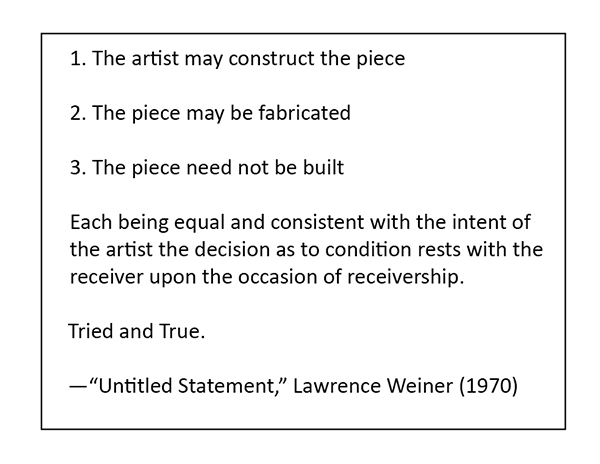
It should come as no surprise, then, that I became interested in what is now termed historical Conceptual Art, which is to say work by artists who defined themselves as conceptual artists in the late ‘60s and early ‘70s. Three statements from this time—“Sentences on Conceptual Art” by Sol Lewitt (1969); “Untitled Statement” by Lawrence Weiner (1970); and “Untitled Statements” by Douglas Huebler (1968)—concern me here.

I have chosen these three statements to highlight the two points that fascinate me most about Conceptual Art. The first is that the idea (I use the term in a loose sense, rather than in the rigid sense given to it by Lewitt) is as important as whatever object might be produced from it. For Lewitt, Weiner and Huebler, neither the object nor the concept takes primacy; they are equal and can be seen as different only in that one is (usually) a material substance and the other is not.

Secondly, there is the idea that stating contains the act— rather, it is the act of creating. This differs from other notions of production, which emphasize affecting change upon materials.  Coming back to where I started (the realm of religion and philosophy), I find this act of creation similar to that described in Genesis: “God said let there be light and there was.” (Gen 1:3)

I can’t help but wonder – is this what Lewitt meant when he described conceptual artists as mystics?

Share

From the DS Archives: Paired, Gold: Felix Gonzalez-Torres and Roni Horn

This Sunday, From the DS Archives examines the oeuvre and influence of Cuban-born, American artist Felix Gonzalez-Torres. Gonzalez-Torres is presently the subject of a traveling retrospective, Felix Gonzalez-Torres: Specific Objects without Specific Form, which is at its final destination, MMK Museum für Moderne Kunst Frankfurt, until April 25th. In the spirit of Gonzalez-Torres’ practice, the exhibition has a particularly experimental structure. While the show is installed initially by the exhibition’s curator, half-way through its duration, it is completely re-installed by a selected artist whose own practice is influenced by Gonzalez-Torres; Tino Seghal was chosen to curate the second half of the exhibition at MMK.

This article was originally written by Seth Curcio on October 29, 2009.

paired Gold

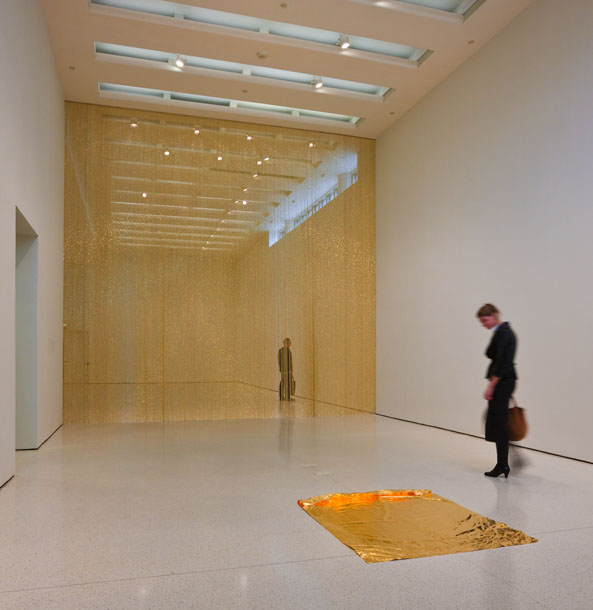
The Solomon R. Guggenheim Museum in New York City has brought together two works from their permanent collection for display together for the first time. Paired, Gold presents works by Felix Gonzalez-Torres and Roni Horn in a poetic dialogue between these two artist. The exhibition featuresForms from the Gold Field, a sculpture created by Roni Horn (1980-82) that is composed of two pounds of pure gold compressed into a rectangular mat and exhibited directly on the museum floor, and Untitled (Golden) (1995), a beaded curtain by Gonzalez-Torres which hangs in a doorway that the viewer must pass. According to the Guggenheim, Gonzalez-Torres first became acquainted with Horn’s Forms from the Gold Field during her 1990 solo exhibition at the Museum of Contemporary Art in Los Angeles. Gonzalez-Torres was thoroughly impressed by the simplicity and beautify of the work and shared the impact that the work made on him when the two artists met in 1993. As a gesture to their newfound friendship and shared sensibility, Horn sent him a square of gold foil just a few days after they first met. Being struck by the gesture, he created Untitled (Placebo – Landscape – for Roni) (1993), an endlessly replaceable candy spill of gold cellophane–wrapped sweets.

Together, Untitled (Golden) and Forms from the Gold Field express the beauty of minimal form and color while also representing a sense of fragility embodied by both artists. Paired, Gold: Felix Gonzalez-Torres and Roni Horn will be on view through January 6th 2010.

Share

Rosemarie Trockel

Rosemarie Trockel: Drawings, Collages and Book Drafts presents almost 200 works at the Talbot Rice Gallery, University of Edinburgh. Trockel’s explorations of artistic and social relations began in the 1980s, and her practice includes photography, film, sculpture and installation. Since 2004, she has embraced collage, opening the space for a recombination of ideas, motifs and materials.

Rosemarie Trockel, Hals, Nase, Ohr, und Bein (Throat, Nose, Ear, and Leg), 2009 Copyright: Rosemarie Trockel, VG Bild-Kunst, Bonn 2011. Image courtesy of Sprüth Magers Berlin London and Sammlung Goetz

Hals, Nase, Ohr, und Bein (Throat, Nose, Ear, and Leg) features a knitted piece, a familiar material that Trockel has drawn on in previous works, where patterns created with the aid of a computer and machines pull apart the associations traditionally made between women’s work and domesticity. Trockel fits the knitted piece within a printed illustration of a book cover, titled “Anonymous was a woman” with a drawing of a back-facing woman, perhaps alluding to the historical gaps surrounding authorship and gender. While the collage elements are connected through figurative sketches, the fully-suited androgynous figure appears as a contrast. The connotation of the leg as gestural and grounded, stands apart from the vocal and auditory qualities of the throat, nose and ear. Though resisting a clear narrative, the combination of these textual and visual elements  provokes thoughts pertaining to the nature of the presence, and absence, of female representations and voices.

Rosemarie Trockel, Vorstudie (Preliminary Study), 1989 Copyright: Rosemarie Trockel, VG Bild-Kunst, Bonn 2011. Image courtesy of Sprüth Magers Berlin London and Centre Pompidou Paris

Acts to expose and question depictions of gender and sexuality cut across a large section of Trockel’s work. The Academy where Trockel encountered opposition in a male-dominated environment in the 1970s is also a source for her investigations of alternative techniques to challenge established ideals regarding art making.

In Vorstudie (Preliminary Study), a painting of what appears to be a police figure is splashed with white. Patches and indeterminate shapes, where formlessness, as a product of chance, counters the rigor instilled by the Academy to remove signs of uncertainty in paintings.

Rosemarie Trockel, Klienkind mit Skelettierten Händen (Little Child with Skeletal Hand), 1991 Copyright: Rosemarie Trockel, VG Bild-Kunst, Bonn 2011. Image courtesy of Kunstmuseum Basel and Dieter Koepplin

The rejection of definite boundaries in favor of ambiguity has led to Trockel’s anthropomorphic figures. The wiry, matted hair and tiny skeletal hands against the body of the child Klienkind mit Skelettierten Händen (Little Child with Skeletal Hand) bring together life and death, innocence and sterility, in a visual image which appears eerie yet compelling for the manner in which it reflects the contradictory manifestations of human nature.

Rosemarie Trockel (b. 1952) lives and works in Cologne, and is a professor at the Staatliche Kunstakademie Düsseldorf. She represented Germany at the Venice Biennale in 1999 and 2003, and has another ongoing solo show, at the Royal Hibernian Academy in Dublin on view through April 25, 2011.

Share

Ariadne’s Thread

L.A. Expanded: Notes from the West Coast
A weekly column by Catherine Wagley

Elaine Reichek, "Paint Me a Cavernous Waste Shore," 2009-2010, Tapestry, 118" x 107". Courtesy of the artist and Shoshana Wayne Gallery.

When Richard Strauss’ indulgent opera Ariadne Auf Naxos had its U.S. premiere at the Met in 1962, critic Everett Helm was more than underwhelmed; he was exasperated. The whole show, he wrote, “makes dupes of the audience, being all form but having no real content.” It was “theatrically flabby,” “silly and contrived.” He criticized most of the cast, too (their English diction “ranged from about vague to intelligible”). But weirdly enough, he praised the lead, Leonie Rysanek, an inexhaustible diva who sang the part of the mythological mortal-turned-goddess whose love and loyalty leave her jilted. Rysanek “turned in a fine performance,” “her warm, appealing voice . . . remarkable for its flexibility” and “effortless dynamic range.”

Perhaps the reason Ariadne could be well played and appealing in an opera otherwise deemed egregious has to with the fact that she has always been beside the point. Both in the original tale and in the swaths of art and literature it has generated in the centuries since Greek mythology’s heyday, Ariadne, the woman who makes her lover a hero only to be abandoned and then forced to wed for all eternity, acts as a symbolic proxy, never quite allowed to be her own person.  De Chirico’s Ariadne is a prop, Chekhov’s incapable of really loving, and Sondheim’s an idealized memory.

Elaine Reichek, "Ariadne in Crete," 2009-10, Hand embroidery on linen 38 1/2" x 28 3/4". Courtesy of the artist and Shoshana Wayne Gallery.

Elaine Reichek’s current exhibition at Shoshana Wayne Gallery in Santa Monica gives Ariadne her due. Reichek, an artist whose tapestries and stitchings are historical mash-ups that have much more to do with the legacy of virtuosic craftsmanship—and of virtuosic borrowing—than of woman’s work, has culled together an army of literary and visual references to Ariadne. T.S. Eliot, Picasso, Nietzsche, Ovid, John Currin, Borges, Titian: almost any creative force you can think of is present and most are male. She’s unraveled their Ariadne-inspired work, and then stitched it back together so that, rather than a put-upon figure, whose thread has been pulled willy-nilly through history, Ariadne seems to take control of her historical trajectory with savvy, sinewy resolve.

In the best known version of the myth, Ariadne is daughter of the king of Crete. The king, who has it out for Athens, sacrifices seven young Athenian men and women to a Minotaur every nine years. When studly Theseus, an Athenian sick of all the death, decides to go into the Minotaur’s labyrinthine cave and put an end to the creature, lovestruck Ariadne helps him out, giving him a thread to unwind as he goes, so that he’ll be able to find his way out. In return, Theseus marries her but quickly loses interest, famously deserting her while she sleeps on a rock.

Elaine Reichek, "The Pigeons Sang," 2010, Inkjet printer on paper with digital applique and digital embroidery on linen, 51 3/4" x 46 1/2", Edition of 3. Courtesy the artist and Shoshana Wayne Gallery.

“No daughter of minds has ever got off lightly in love,” wrote Seneca, and Reichek has stitched this line into an eye-popping portrait of Ariadne as John Currin interpreted her: whimsically inquisitive, with big yearning eyes. In another portrait, appropriated from Edward Burne-Jones, Ariadne stands looking forlornly down at a loose ball of reddish string. But the laborious, precise pairing of imagery and text—the artist has hand stitched some of the embroideries, used a digitally programmed sewing machine for others and commissioned one tapestry—in Reichek’s work, makes Ariadne’s perceived vulnerability seem all wrong. She may not have got off easy, or ever been fully recognized for her smarts, but she was able to insinuate herself into the psyches of centuries’ worth of creatives, and thus become immortal.

Share

Contest, Context, Content

The Curators Battle is a pretty direct title for an experimental concept event. The Grimmuseum hosted two curators, Carson Chan and Aaron Moulton, who each organized separate shows in adjacent galleries, pulling work from the same artists. For added drama, there was a vote to choose the better show. At it’s best, forcing the audience to consider the behind the scenes development of an art show illuminates the relationship between the curator’s established context and the art’s content, instead of potentially taking the creative duties of the curator for granted.

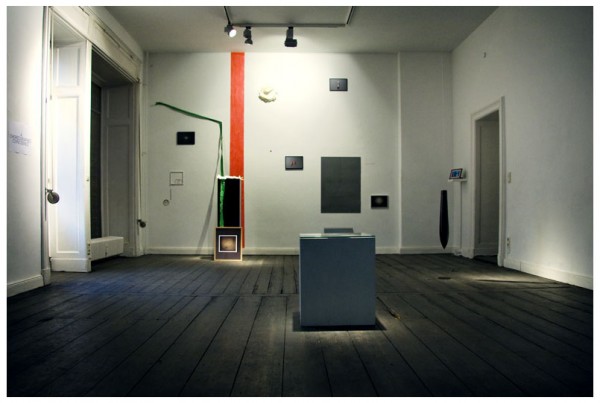
The Curators Battle, A Choreographed Coincidence. Installation Image. © Laura Gianetti

In both shows, however, I felt that the curators’ hands were so significantly foregrounded that the artists and artworks became ancillary figures. In both Stronger Magic and A Choreographed Coincidence (the two shows presented), the art was overshadowed by how the spaces were organized. The first actually overlapped wall space for works; one drawing was partially lit by a piece involving an intermittent, direct light. The second seems to  purposefully break most gallery conventions (eg. hanging artworks too high or too low, displaying framed drawings leaning against a pedestal, occasionally using non-traditional lighting). The tactics felt arbitrary, as if any piece could stand in the place of any other in a multitude of combinations.

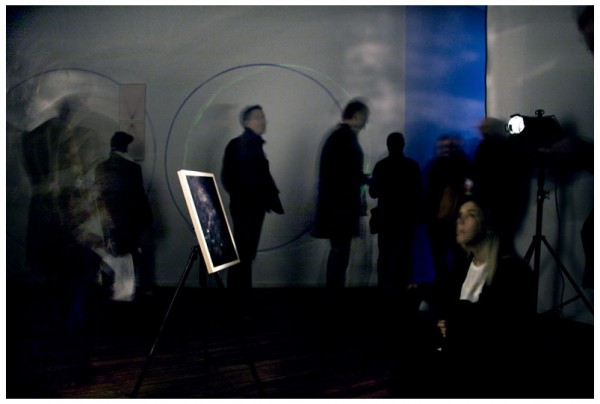
The Curators Battle, Stronger Magic Installation Image. © Laura Gianetti

The non-hierarchical structure of the internet and other systems of organization are cited directly and indirectly in curatorial statements and the work itself, throwing the notion of context into question. The curators treated themselves as assemblage artists, and the art as found objects. Particularly in Stronger Magic, a show that was mainly lit by just one art piece that turned on and off, each individual work became one genericized element in a large installation. The content of the individual works was presented as being barely important, as detailed pieces were only given seconds of decent lighting with which to view them.

The Curators Battle, Stronger Magic. Installation Image. © Laura Gianetti

My concern as an artist, is that the intentions of the artist and the context for understanding their work may have been overlooked in lieu of treating the work as innocuous content for the curators to control and manipulate as justification for their central theses. Something about this felt like misquoting in the way a sound bite from a politician may be extracted without necessary context to influence the speech’s meaning. Viewing images of the event’s photostream, where works were photographed individually, offers each piece it’s own space to establish context within it’s own content. That necessary space was missing live in this ‘Curate-Off’.

As a final note I’ll mention Constant Dullaart, one of the stand-outs in both shows. Check out Poser, a video-based sculpture currently in A Choreographed Coincidence.

Share

Fan Mail: Peter Granser

For this edition of Fan Mail, German artist Peter Granser has been selected from a group of worthy submissions.  If you would like to be considered, please submit to info@dailyserving.com a link to your website with ‘Fan Mail’ in the subject line.  Two artists are featured each month – the next one could be you!

Group on a Bench, 2009. Courtesy the Artist.

Peter Granser is a self-taught artist that began his career in photojournalism – allowing for a natural transition to his current practice.  Yet the depth of Granser’s on-site, immersive research is better equated to the work of an anthropologist than that of a journalist.  Using photography, Granser documents select phenomena such as the American theme park as in Coney Island (2000-2005) or an expansive retirement community as in Sun City (2000-2001).  The artist capitalizes on the specificity of his projects by aiming to reveal layers of meaning with archetypal resonance.

Portrait 18 and Portrait 19, 2009. Courtesy the artist

With recent project, J’ai perdu ma tête (2009), Granser’s intrepid curiosity led him to a psychiatric institution in France where he took part in the everyday lives of inhabitants.  As with past projects such as Alzheimer (2001-2004), Granser walked a tightrope between spectacle and measured representation of a complex condition.  His approach is to inhabit the world he documents.  For a time, Granser lived nearby and each day followed the schedule of eating, working and sleeping.  He slowly earned trust and was able to photograph special outdoors excursions, clay figures from art therapy sessions, and private rooms.  By the end of his stay, Granser was invited to photograph individuals.

Flickering, 2009, video still. Courtesy the artist.

J’ai perdu ma tête marked Granser’s first foray into video and sound, which has given the artist a new way to present his subject matter.  In Flickering, the artist examines the marriage of function and malfunction – presenting his piece in a blackened dead end tunnel accompanied by the sound of fluorescent lighting cutting in and out.  In Forest, the pleasant sound of chirping birds is juxtaposed with an increasingly smoky wooded image.  Presented rear-projected onto wall-sized plexi barrier, the video confronts the viewer with contradiction.  Granser states that he uses video to explore the passage of time ‘by using a single camera angle (like in a photograph) without any cut’.  His video work thus becomes an extension of his photographic practice.

Forest, 2009, installation view. Courtesy the artist.

J’ai perdu ma tête, will be on view from May 12th through July 2nd at the Atelier de Visu in Marseille, France.   It will also be on view at the Guislain Museum in Gent, Belgium from June through August 2012.  Kodoji will publish the project in book form in March of 2012.

Granser has been working on a new project in China since 2008, which he hopes to have completed by the end of this year.  To keep up with the artist, visit his newly launched website.

Share