First-Person Reality: I Am Not Free Because I Can be Exploded Anytime

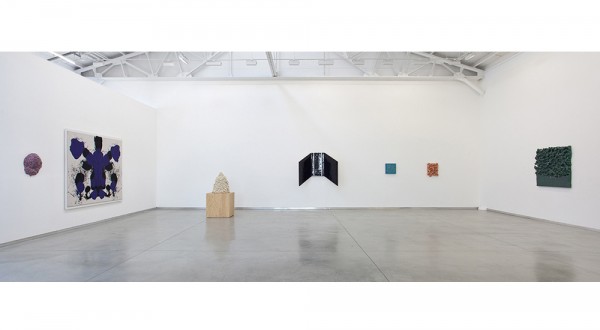
Installation view, 'Sterling Ruby. I AM NOT FREE BECAUSE I CAN BE EXPLODED ANYTIME', Sprueth Magers Berlin, 2011, © Sterling Ruby Courtesy Sprueth Magers Berlin London

The year is 1999. Television has adapted to the more violent nature of man.

Sterling Ruby‘s solo show at Sprueth Magers drops you into a space reminiscent of the real world, but reflected through an alternate lens. The main room feels overwhelming in scale, full of over-sized and crudely modeled ceramic sculptures, towering red dripping sculptures that look like some sort of giant animal’s tendons freshly ripped from its body,  and spray-painted canvases hanging on the walls. As well, there are hanging fabric pieces in the shape of drops that both mock and confirm violence with their suggestion as blood drips in such a comically literal fashion.

Sterling Ruby SP151, 2010 Spray paint on canvas 125 x 185 x 2 inches 317.5 x 469.9 x 5.1 cm, © Sterling Ruby Courtesy Sprueth Magers Berlin London

The most popular form of television remains the game show.

The video game Wolfenstein 3-D (1992) introduced gamers to a three-dimensional environment where the camera is your eyes, a now popular point of view with the proliferation of first-person shooter games. Ruby’s spray painted blocks and wall hangings seem to reference the aesthetic of these 90’s video game graphics that place the viewer in this familiar world where you’re still a normal human, but, due to technological limitations, non-essential information, such as concrete walls, aren’t highly rendered. This room is quiet, and the suspended animation of the fabric sculptures puts the situation on pause. It’s calm, but horrific, as if your character has just faced an incredibly dangerous situation and through violent acts, defeated the level. Instead of moving to the next environment however, you’re suspended in this room to examine all of the carnage that has been created. While Wolfenstein and its ilk were often criticized for their violence, there was at least a noble purpose for the bloodshed. The player, the narrative’s clear protagonist, was forced to deal with the situation placed upon him. That sense of urgency is not apparent here, as if the violence has no purpose.

One show in particular has dominated the ratings. That show is Smash T.V. The most violent game show of all time.

Two lucky contestants compete for cash and prizes. Each contestant is armed with an assortment of powerful weapons and sent into a closed arena.

In a first-person game, instead of pressing buttons to make an avatar respond from a distance, the line between reality and the game’s universe is blurred as the player is sharing a pair of eyes with the avatar. When a trigger is pulled, the bullet blasts out from in front of you, and in some cases, due to technological advancements made to heighten the game experience, you can feel a rumble or a recoil as the shot is fired. Your character didn’t shoot as you watched from the god perspective, you made the kill. Ruby argues that we don’t need these alternate worlds to tell us to be violent. By presenting this aesthetic in our real space, the over-the-topness of video games is used to highlight far worse atrocities of man that we regular people may ever have to encounter. In a world where wars are sold with technologies that are meant to separate us from the violence we cause, the hyper-violence suggested in Ruby’s shows drags back the more personal connection linking the offenders and the victims.

Installation view, 'Sterling Ruby. I AM NOT FREE BECAUSE I CAN BE EXPLODED ANYTIME', Sprueth Magers Berlin, 2011, © Sterling Ruby Courtesy Sprueth Magers Berlin London

Nowadays, simulated experiences are, if not completely believable, able to pique and maintain our interest while allowing us to play out fantasy scenarios that we may not want to carry out in reality. The problem comes when these simulations are based on reality and these traumatic and horrific scenarios do exist in our world. In Ruby’s show, it is as if our fused eyes have been pulled from this structure where our sole mission is to defeat the bad guys, into the complex ‘real world’ full of grey areas and complicated matters. This environment within the confines of the gallery, has all of the gore, but none of the background information or context. The entertainment value of gameplay has been stripped away, forcing us to acknowledge the reality we exist in.

The action takes place in front of a studio audience and is broadcast live via satellite around the world.

Video games are violent and make the players of them violent. While the validity of this statement is highly contested, that’s a common argument anytime a kid decides to bring a gun to school and take out his aggressions on the student body. The assertion is that once we find out how fun it is to see something die at our hands in a simulated situation, we are going to get a taste for blood that we need to quench in the real world.

Be prepared.

The future is now.

Sterling Ruby Monument Stalagmite/Survival Horror, 2011 PVC pipe, foam, urethane, wood, spray paint and formica 216 x 63 x 36 inches 548.6 x 160 x 91.4 cm, © Sterling Ruby Courtesy Sprueth Magers Berlin London

Ruby’s show seems to be the antithesis of the much discussed videogamafication of military operations in the media since the first gulf war. He takes the look of the hyper-violence that is all but commonplace in our media and makes one ‘level’ out of the gallery space. When your reality is like the virtual world, and you a video game character,  a sudden shift in what is deemed an acceptable violence level tends to occur.

You are the next lucky contestant.

Italicized and bolded headings are quotes from the opening cutscene of the videogame Smash T.V. (1990)

Share

Maybe Techno Doesn’t Suck? Cosima von Bonin and Moritz von Oswald, The Juxtaposition of Nothings at Friedrich Petzel

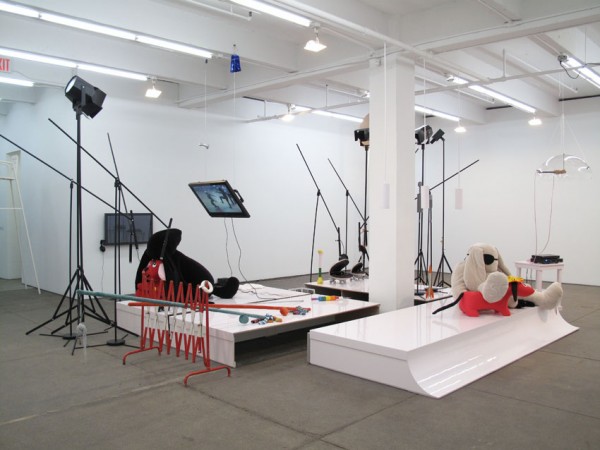
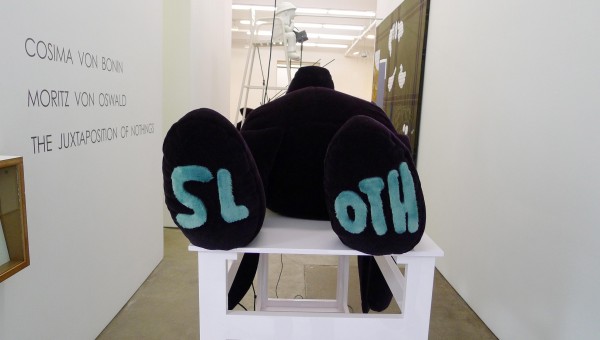
Cosima von Bonin and Moritz von Oswald, The Juxtaposition of Nothings, Installation View.

This show reminds me of the time I danced for hours at a club in Cologne, caught part of an arthouse film next door, and then somehow ended up at a bar where a bunch of people I didn’t know were drinking like it was the end of the earth. Ok, so that never happened. But I feel like Cosima von Bonin’s current show, The Juxtaposition of Nothings at Friedrich Petzel is a close approximation of that experience.

Cosima von Bonin and Moritz von Oswald, The Juxtaposition of Nothings, Installation View.

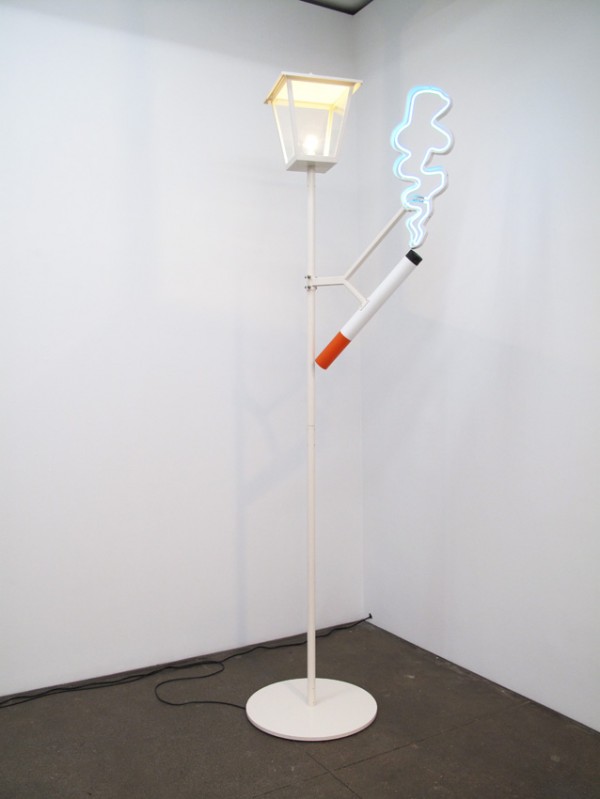
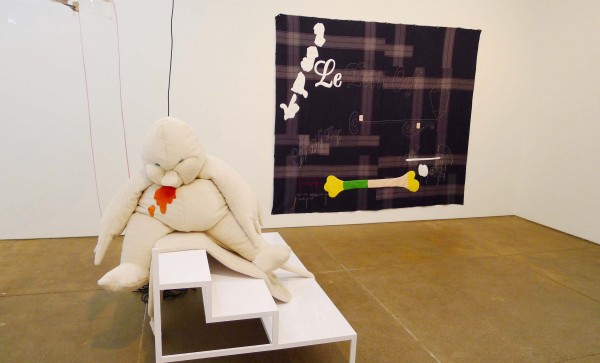
Von Bonin has always balanced her killer soft sculptures and fabric wall pieces with a deep investment in context and place-making. At Petzel, in collaboration with musician Moritz von Oswald, the focus is less on individual works and more on a sort of behind the stage/back alley voyeuristic adventure where the spectators are exhausted and drunk with cultural consumption. A puppy lies limp, arms laid out flat, staring at a video on loop. A floppy eared pimp-like bunny character with an eye patch appears to have found a friend in a bright red dog.  Even the light post is out for a smoke, as this show is at once chuckle-worthy and noir.

Cosima von Bonin and Moritz von Oswald, The Juxtaposition of Nothings, Installation View.

Viewers accustomed to the almost clinical reimagining of minimalist form in Von Bonin’s previous work might be put off by the glut of audio and video equipment on display here. But the sound is sharp and deployed with precision.  Each tightly contained audio zone adds a different layer to the show as pulsating dance beats blend into more spaced out jams. Moving around the gallery, you become part of the orchestration, as most of the animal sculptures are either on a sound stage, absorbing a video, or emitting a sound track of their own.

Cosima von Bonin and Moritz von Oswald, The Juxtaposition of Nothings, Installation View.

The back room seems to unwind from the activity of the main gallery like a club that lets out into the street at the end of the night. Sophisticated cardboard sculptures of a mailbox, café signage and a street lamp hang on the wall. A slumped over bloodied bird sits alone on a bleacher—here, the alienation of today’s technological self-absorption sets in.  While this theme isn’t terribly new (think Kraftwerk, Radiohead, or Kanye), von Bonin and von Oswald play the space between the handmade and the machined perfectly. While a lot of technological collaborations seem to blast off with an über-corny futuristic vision, the artists here spare us the space travel allusions.  The characters in this little drama are too busy livin’ to know that they don’t have a future anyway.

Share

The Hat, That Never Existed: Christoph Roßner at Romer Young

The paintings of Dresden-based Christoph Roßner have the power of a waking dream.  As opposed to our regular, logically- and visually-tangled dreams, the visions we have right before we fall asleep – or even in the middle of the day – tend to focus on single objects:  things recognizable but out of reach, comforting but not quite tangible.  Slow and atmospheric, they demand time and attention – almost like a good wine in need of lots of time and oxygen to breathe.  Like any good vintner, Roßner lets his work sit for long periods, sampling it until he feels its done.  And like the best vintners, he only releases a limited number of works at a time, which – thankfully – we’re able to see this month at the Romer Young Gallery, in a large part due to support from San Francisco’s Goethe Institute and the Southern Exposure Alternative Exposure Grant.

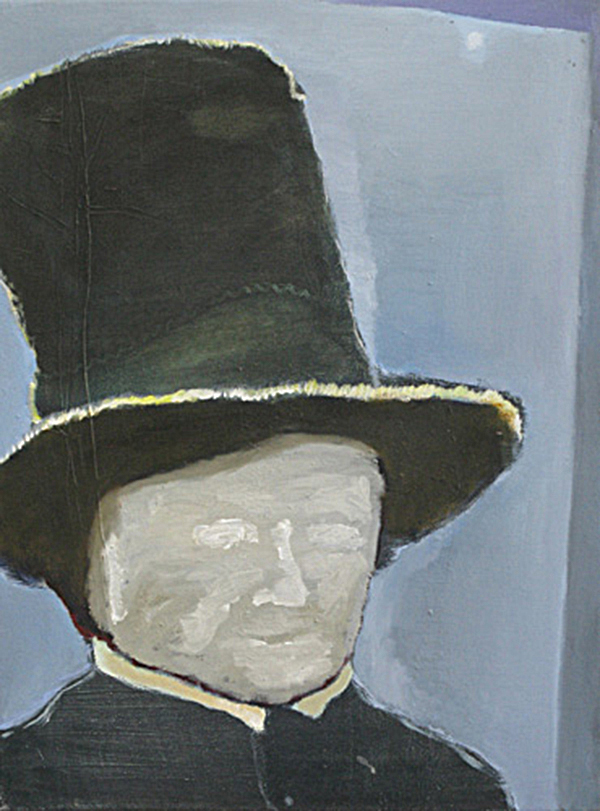
Man With Hat (2009), Christoph Roßner, oil on canvas, 23.5" x 17.75", image courtesy of Romer Young

Full of everyday objects – like people, a flag, a chunk of wood, a small prism or stone – the paintings seem familiar, but obscured.  Sometimes this obfuscation results from composition and scale:  the painting Small Wooden Piece (2010), for example, zooms in so tightly that it shows virtually nothing but end grain.  At other times, it’s due to technique:  faces, like that belonging to Man With Hat (2009), are blurred or smeared and then given the barest of human attributes (eyes, nose, mouth).  All background information has disappeared, replaced by thick sheets of color.

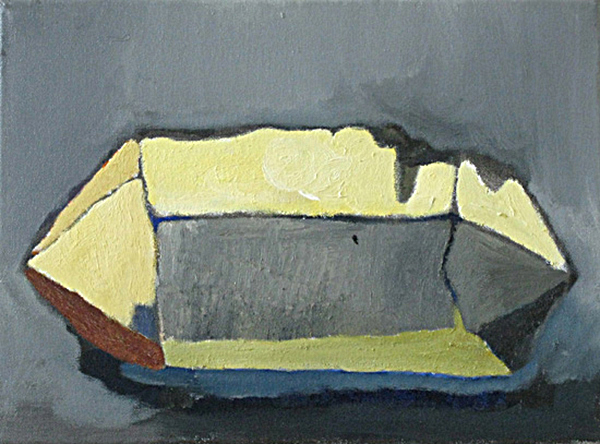
Stone (2009), Christoph Roßner, oil on canvas, 10.25" x 13.75", image courtesy of Romer Young

Roßner mainly paints in oil, placing layers on top of layers.  In Stone (2009), for example, a creamy yellow, prism-like object seems to glow in the center of a thick, gray background.  The different sides of the prism have been thickly coated with paint, as has the background itself  – so much so that what could be seen as empty space appears to have real mass.

Ghost (2008), Christoph Roßner, oil and acrylic on canvas, 19.5" x 25.5", image courtesy of Romer Young

More than adding density, however, Roßner’s overpainting suits his subject matter in a different way: each layer elides the one before, disguising details and preventing us from accessing specific narratives for any of the objects.   Looking again at the work on display, the pieces seem hauntingly personal.  The subject matter for works like Ghost (2008) and Flag (2010) – a doll or toy with a smeared face and a sheet of cloth or paper attached to a piece of wood – are decipherable and yet ultimately confusing.  We see their form, and through the weight of Roßner’s brush, the fact that they are significant, and yet we fail to see what the significance is.

Share

Do-Ho Suh: New Works

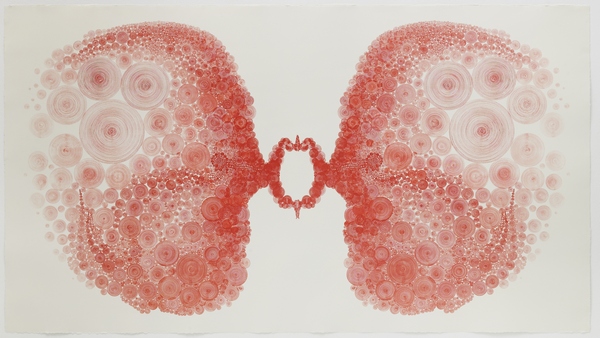
Do-Ho Suh, Karma Juggler, Edition of 3, 2010. Image courtesy of Singapore Tyler Print Institute

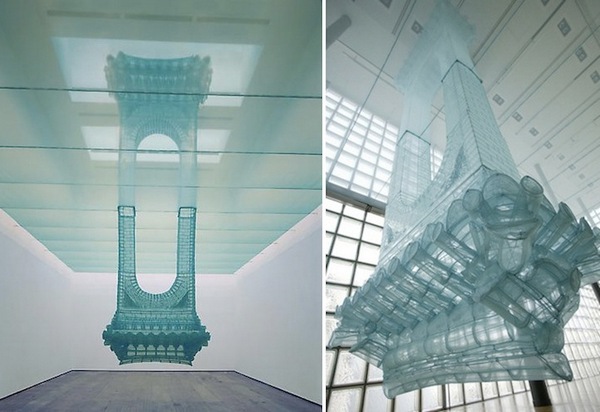
A cursory look suggests that variations on the themes of individuality (as opposed to the collective social unit) and transcultural displacement dominate Do-Ho Suh’s oeuvre. Fabricated in nylon, Staircase (2003) is a gauzy blanket of red that hangs suspended from a ceiling spanning 2 floors, an ethereal, translucent replica of his living space in Chelsea, New York in which viewers can peer – rather obliquely – into the open spaces of both storeys. Portable and set adrift in space, it is in such specific architectural structures of transition and liminality – staircases, arches, and gates – that Suh’s physically flimsy entities do not touch the ground but stretch seemingly into the sky, recalling the equally volatile and hazy ideas of home, while simultaneously sustaining a discourse of the limitations of public and personal space.

Do-Ho Suh, Reflection, 2004. Image courtesy of Lehmann Maupin Gallery, New York.

Do-Ho Suh, Staircase-V, 2008. Collection Thyssen-Bornemisza Art Contemporary. Image courtesy of the Artist and Lehmann Maupin Gallery, New York.

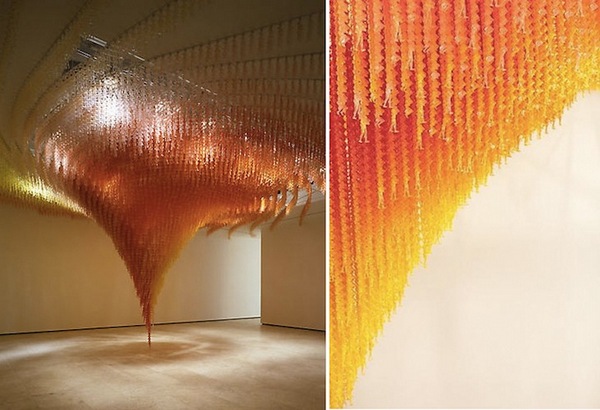
In Cause & Effect (2007), a circular, tornado-like funnel takes shape out of tiny acrylic figures stacked on one another’s shoulders, a precarious installation that results in the entire piece resting (quite literally) on the sole central figure’s feet. Its particular pathos draws from the fact that though the sheer force of collective effort is realised through the mobilisation of the individual, the individual is profoundly powerless on his own.

Do-Ho Suh, Cause & Effect, 2007. Image courtesy of Lehmann Maupin Gallery, New York.

After an 8-week residency at the Singapore Tyler Print Institute, Do-Ho Suh has produced a number of 2-dimensional works and thread-drawings, revisiting these issues that first emerged in his 3-dimensional sculptural creations. Using the technique of sewing lines over thin washi paper, the now-anchorless cotton threads float in water and are later fused onto heavy cotton paper in a hypnotising mesh of squiggles and lines.

Do-Ho-Suh, Karma Juggler, 2010. Image courtesy of Singapore Tyler Print Institute.

Through the repetitive use and spatial representation of basic forms and shapes, there is however, the broader sense that Suh’s contemplative, dimensionally-flat pieces now teeter on the edge of metaphysicality, particularly since they are now unencumbered by the larger-than-life theatrical presence of his previously monumental installations. Thematically similar to Cause & Effect’s depiction of the uneasy co-existence of the individual within a community, Karma Juggler (2010-11) is a series of drawings consisting of hundreds of concentric rings – all of which form a coherent entity – yet alluding to the existence of a supporting, primordial reality built on moral causation. Staircase’s (2010) 2-dimensional blue thread construction, now stripped of size and the vibrant hue of red still references its predecessor, relying on the viewer’s perception to envisage the levels to which it ascends.

Share

Migraines over Blue Shag Rugs

L.A. Expanded: Notes from the West Coast
A weekly column by Catherine Wagley

Mai-Thu Perret, "Migraine," Installation View, 2011. Courtesy David Kordansky Gallery.

A river of blood runs through the history of womankind,” wrote cultural critic Caitlin Flanagan, with so much dramatic sway that the truthfulness almost got lost in the motion. “That river stops, more or less, with the installation of [a] shag carpet.” The carpet in question—lush, blue and all the rage in the 70s—was installed by Byllye Avery, a “grassroots realist” and the first to open an abortion clinic in Gainesville, Florida. It covered up easy-to-sterilize, drab tiling, the kind medical facilities swear by, and, while it may have been unabashedly decorative, it sent a pragmatic message. “You wouldn’t put that kind of rug on the floor if it was going to be ruined,” said Avery.

Tiles have the unfortunate ability to make messiness, in some contexts even bloodiness, seem immanent. But a voluptuous blue shag carpet? That can soak up bodily vulnerability better than Donna Summer can smooth out anxiety.

The carpets in Swiss artist Mai-Thu Perret’s work may more moderate than the one Avery described, but they serve similar functions. They manage to soften austerity and absorb bodiliness at the same time, containing the visceral within a calculated cerebral frame.

Mai-Thu Perret, "Migraine II," 2010, acrylic on carpet, mounted on board, 72 x 96 inches (182.9 x 243.8 cm). Courtesy David Kordansky Gallery.

Mai-Thu Perret, "Migraine II," (detail) acrylic on carpet, mounted on board, 72 x 96 inches (182.9 x 243.8 cm). Courtesy David Kordansky Gallery, Los Angeles.

Perret’s current show at David Kordansky Gallery, fittingly titled Migraine, includes an impressive array of mostly abstract work but, somehow, doesn’t feel overhung. Perhaps this is because the pieces are all self-enclosed, each imperfect but almost perfectly so. When I noticed that the board bearing one of the large Migraine paintings, acrylic Rorschach marks spread out on off-white carpet, had bowed out from the wall, I half expected all the others to bow out too.

Geneva based, Perret has responded to—and crafted her own—literary sources since she began exhibiting nearly ten years ago. Her references manage to include utopian optimism and French decadence, and she has written a layered story, called The Land Crystal,  that serves, in some ways, as the backbone for much of work she’s made. The story tells of young women coexisting in a man-free commune (writer John Miller described the place as “post-pubescent and pre-menopausal: young, sexualized, yet abstinent,”  “outside the concerns of any real-politik”), not so much for militant as for confidence-building reasons. They’re trying to learn how to exist by themselves. It’s not necessary to understand this narrative, or even know about it, in seeing Perret’s work. It seems, rather, as an impetus for working. As novelist Zadie Smith put it, “Whenever you set up these structures, you realize after . . . that you could remove them, but it’s not good knowing after the fact. It’s what you need to give the [work] form.”

Mai-Thu Perret, "I could speak, I could speak," 2011, glazed ceramic, 24.8 x 34.25 x 7.87 inches (63 x 87 x 20 cm). Courtesy David Kordansky Gallery.

With the exception of the Rorschach paintings, most of the works in the show are glazed ceramics. Eggs, arranged in calculatedly ornamental ways that mute their organic qualities, recur as a theme. In one piece, As for resembling, it certainly resembles; but as for being, it certainly is not—Perret’s titles can be more exhausting and longwinded than Milan Kundera’snine eggs are impeccably arranged on a mid-size rectangle that, two-thirds of the way down, dissolves into butchered trails of doughy beige clay. In another, called I Could Speak, I Could Speak, what looks like a fragment of a fossilized skull protrudes from the surface while a mysterious, primordial looking imprint sinks down beside it. These shapes are flanked by eight eggs, so exactly placed they look like particularly round rivets.

When I think of craft, communes, and a “river of blood through womankind,” Womanhouse, the 1971 feminist experiment in radical homemaking, comes to mind. The house, where each room served as an installation space, had fried eggs sculpted to look like breasts on the kitchen wall, and a menstruation bathroom.  If in possession of the blue shag rug, Womanhouse’s residents might have opened up a space down the middle so the river of blood could flow right through its fibers. Perret’s work, in contrast, controls fluidity, emphasizing the design and structure of feminine decoration over the hands-on craftiness. And while it may still cause migraines, the desire to know fluids aren’t going to overrun you doesn’t seem to be going anywhere.

Share

Looking at Music 3.0 at the Museum of Modern Art, New York

"TELLUSTools", 2001, Double-LP, Composition: 12 1/4 x 24 5/8 in. The Museum of Modern Art Library, New York. Gift of Harvestworks. Cover Art by Christian Marclay. Produced by Carol Parkinson, Harvestworks. Image courtesy Kanji Ishii

"TELLUSTools", 2001, Double-LP, The Museum of Modern Art Library, New York. Gift of Harvestworks. Cover Art by Christian Marclay. Produced by Carol Parkinson, Harvestworks. Image courtesy Kanji Ishii

Where were you when the Music Television Channel was first introduced in 1981? I was seven years old and had a babysitter who, in her early twenties, was the coolest person I had ever met. I would follow her around just in the hopes that this perceived “coolness” would somehow rub off on me. It was through her that I was exposed, for the first time, to the brand-new phenomenon of the music video. Her family had just gotten cable and we would sit around and watch this small American network running loops of film shorts that visually illustrated the concepts and narratives of song by popular musical bands at the time. What we didn’t realize at the time, was that visual and popular culture as we knew it was changed forever.

Looking at Music 3.0., now at the Museum of Modern Art, New York through June 6, 2011, is an in-depth look at this moment in time and its effect on our cultural history. The third in a series of exhibitions exploring the influence of music on contemporary art practices, Looking at Music 3.0, focuses on New York in the 1980s and 1990s and the birth of the “remix culture.” The exhibition features 70 works from a wide range of artists and musicians: Beastie Boys, Kathleen Hanna and Le Tigre, Keith Haring, David Byrne, Miranda July, Christian Marclay, Sonic Youth and Run DMC.

Spike Jonze, Sabotage, 1994, Music by Beastie Boys. The Museum of Modern Art. Gift of the artist. © Capitol Records, Inc.

The exhibition begins with the German band Kraftwerk, positing that with tracks such as Trans-Europe Express, 1977, they had a large influence on the decades of music to come with their pioneering usage synthesizers and computer-speech software. It then expands into a wide array of issues and movements that were occurring during this time:  the birth of hip-hop and its growing strength in voicing the ongoing discrimination against the black community; activist movements seeking to counteract the AIDS epidemic and the increasing drug usage that was threatening New York; the introduction of art theory to new music as well as the rise of the digital domain; and the growing voice of artists commenting on the complicated relationship between commercial entities and its control of mass communication and the shaping of modern culture.

Le Tigre, "From the Desk of Mr. Lady," 2000, CD. Cover Art by Kathleen Hanna and Johanna Fateman. Image courtesy Le Tigre Records

A highlight of Looking at Music 3.0 is the in-depth look into the wave of Feminism that was grounded in the riot grrrl capital, Portland Oregon, in the 1990s. On display are photocopied zines and posters by artists Miranda July and Johanna Fateman, as well as audio tracks from the band Le Tigre. These recordings serve as examples of the impromptu punk bands that were forming all over and the band’s usage of humorous lyrics and electronic dance music to confront a myriad of social ills that existed in New York.

Anyone interested in the history of music and visual culture will enjoy this exhibition. But for those of us who remember where we were when the music video was first introduced, you will walk out asking yourself, “What happened to the revolution?”

Share

Cyprien Gaillard at KW Institute for Contemporary Art in Berlin

Today’s video is from our friends at ArtStars*, a traveling show about the contemporary art world, out to uncover the 7 Unsolved Mysteries of the Art World — one art scene, one country at a time. In this video, host, Nadja Sayej, talks with Parisian artist Cyprien Gaillard about his installation at KW Institute for Contemporary Art in Berlin. The installation involves hundreds of cases of beer and lots of eager Berliners. Let the fun begin.

Image courtesy of KW Institute for Contemporary Art, Berlin

Image courtesy of KW Institute for Contemporary Art, Berlin

Image courtesy of KW Institute for Contemporary Art, Berlin

Share