Postcards from America: a New American Road trip

Last Friday, May 13th, at the Harry Ransom Center in Austin, Texas, five Magnum photographers and one writer gathered to kick off their road trip christened, Postcards from America. Paolo Pellegrin, Jim Goldberg, Susan Meiselas, Alec Soth, Mikhael Subotzky & Ginger Strand will spend the next two weeks living together on a bus named “Uncle Jackson,” traveling from San Antonio, Texas to Oakland, California.
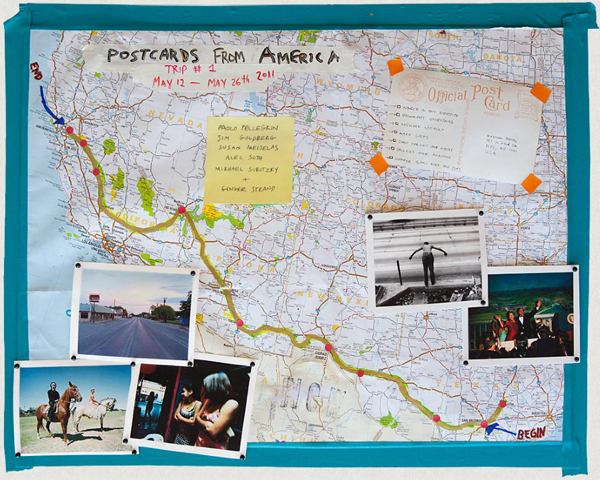
Postcards from America is certainly reminiscent of the 1935, Farm Security Administration (FSA), a project part of the New Deal for which photographers like Walker Evans, Dorothea Lange and others, were sent out to document the condition of rural families and areas during the depression. The difference in this contemporary iteration is that it is completely conceived and motivated by the photographers themselves, instead of any government or institution. This crucial characteristic gives the road trip the qualities of a trip with friends, one driven by adventure, curiosity, and the desire to show a side of the US that is often swept under the proverbial rug.

The project originated as an idea by Jim Goldberg and Susan Meiselas at one of Magnum’s annual meetings. In efforts to try to re-establish the way photographers and viewers experience the US, they brainstormed how to “see what America really is instead of just reading about it,” they “wanted to see and feel America.” (Meiselas)

From left to right: Carlos Loret de Mola, Lara Shipley, Ginger Strand, Paolo Pellegrin, Jim Goldberg, Susan Meiselas, Alec Soth, Mikhael Subotzky.

Like most road trips, this one started with a handful unforeseeable set backs (maybe Friday the 13th should have been a day spent in hiding); San Antonio experienced massive flash floods; Jim Goldberg caught the flu; the projectionist at the Ransom Center had technical difficulties during almost the entire panel discussion – but they approached the entire situation with the sense of humor shared between friends, which helped the audience, myself included, laugh along with them and appreciate the spontaneity and organic development of the project. As Alec Soth said on Friday, “the spirit of the road trip is you let it take you.”

Paolo Pellegrin, San Antonio, TX

While the projector was being fixed, each photographer and the writer, Ginger Strand, introduced him or herself by talking about their approach to the trip and what they had already experienced the day before in San Antonio. Each individual set off in search of something, and the amount of incredible material, images and stories they encountered in just one day was astounding. Once we saw images from the day before, it was clear that the project will reveal a truly diverse view of the US.

Alec Soth, Mu Man from Burma, San Antonio, TX

The Postcards from America project will conclude with a pop-up show at the Starline Social Club in Oakland, Ca on May 26th. For more information, check out the Postcards from America site to track the group on their journey, through their blog, twitter and facebook updates.

Share

Anthony McCall at Luciana Brito, São Paulo

How does meanwhile effect an artwork?

British artist Anthony McCall’s exhibition at Luciana Brito in São Paulo suggests a retrospective of an artist who returned to art-making in the last decade after an over-20 year hiatus. McCall’s reemergence is marked by revisiting and further developing what began as his “solid light” films made in the early 1970s: installations of hazy, darkened rooms with slow-moving beams of light from 16mm projectors.

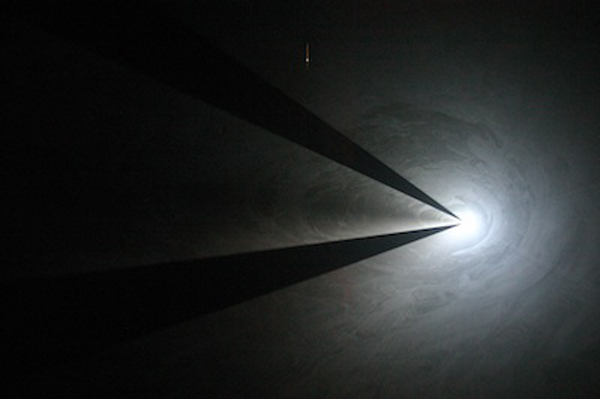
Meeting You Halfway II, 2009, courtesy of Luciana Brito Galeria, São Paulo

But time is a funny thing. The layers of cinema’s material evolution, and certain artworks produced since, have a temporal gravity that presses down on these works, effecting what their form implies. Today they appear as a precursor to works by artists like James Turrell and Olafur Eliasson that harness, expose and manipulate natural phenomena as a way to create phenomenological experiences. The exhibition has smartly included drawings and studies that reveal a motivation of cinematic deconstruction in addition to their phenomenological leanings, allowing the viewer to ponder the meanwhile.

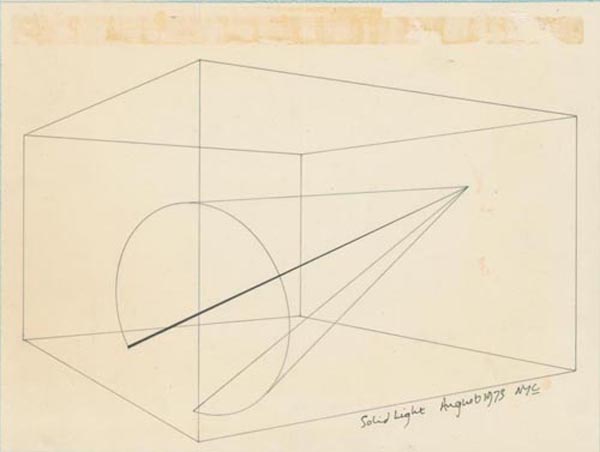
Line Describing a Cone sketch, 1973, courtesy of Luciana Brito Galeria, São Paulo

McCall’s seminal 1973 piece, Line Describing a Cone is a deconstructive act examining the conditions of film. Distilling the very material of film – projected light and duration – the reductive piece begins with a beam of light, a point, that over the course of half an hour draws a circle on the surface of a wall. An ephemeral, mesmerizing play of optics occurs as flowing particles of haze are drawn out of the shadows, illuminated by the light beam headed towards the screen, thus creating a 3-dimensional sculpture. There is a 4th dimension at work here too, time. We are at the intersection of cinema and sculpture. Experiencing this piece under new conditions, notably, without viewing the work as originally conceived as a filmic audience – from a specific set time, beginning to end – contributes to the shift in emphasis of the work as a cinematic deconstruction to a phenomenological experience.

Meeting You Halfway (II), 2009, (installation view Sean Kelly Gallery, New York), courtesy of Luciana Brito Galeria, São Paulo

Meeting You Halfway (II), 2009, (installation view, Sean Kelly Gallery, New York), courtesy of Luciana Brito Galeria, São Paulo

The 2009 Meeting You Halfway (II) typifies this evolution. As the title suggests, the viewer, the body that meditates the experience of the work, and social interaction come into focus. Our understanding through sensation, which was certainly present in Line Describing a Cone now becomes the subject. Here, experiencing this work in Brazil, the legacy of Lygia Pape and Lygia Clark seep up as a more visceral logic arises. For both light installations in the exhibition, we are beckoned to appease our curiosities, to place our bodies within the body of the work, being and experiencing a multitude – cinema, sculpture, drawing and performance.

You and I, Horizontal, 2007 (installation view, Serpentine Gallery, London), courtesy of Luciana Brito Galeria, São Paulo

McCall’s exhibition Installations and Works on Paper will run through June 18th at Luciana Brito Galeria.

Share

Dead Star Light

While the most beautiful world in the world may be that which is in your own mind, what happens when your mind fails you? Not just a matter of truth vs fiction, but a fundamental physiological failure that causes your mind to lose the ability to register, and remember, that which is around you – That reality is far from beautiful.

Kerry Tribe, H.M., 2009. Single 16mm film with sound, played through two adjacent projectors with a 20 second delay. Photo: Jamie Woodley © the artist. Courtesy the artist and Camden Arts Centre.

I recall studying the case of anterograde amnesiac H.M. in my psychology and neurology classes  – he was a test subject, not given any more attention than the rats whose grey matter we poked and prodded. An object of scientific inquiry whose unfortunate situation was hardly given a second thought and its contribution to the understanding of memory celebrated. Kerry Tribe’s video installation H.M. re-constructs the tale of the infamous case of the man who lost the ability to form new memories after a radical surgery to treat his severe epilepsy in 1953 removed parts of his brain. Re-instilling subjectivity, we meet H.M. (or an actor playing the role) who tells the story in his own recollections, rather than through scientific channels and empirical language.

Kerry Tribe, H.M., 2009. Single 16mm film with sound, played through two adjacent projectors with a 20 second delay. Photo: Jamie Woodley © the artist. Courtesy the artist and Camden Arts Centre.

In this bilateral video, on show as part of Tribe’s solo exhibition entitled Dead Star Light at the Camden Arts Centre, we become test subjects as our own short-term memory is prodded. Two screens, side by side, play the same film one 20 seconds after the other – the time equal to the period of H.M.’s working memory. Everything on the right has already been shown to us on the left, but often we can’t recall seeing it before, and inevitably begin to question our own capacity for memory.

Tribe’s exploration of the phenomenology of memory continues in the new works she has created for the exhibition – the most engaging of which is the installation Milton Torres Sees a Ghost. The backstory of this work involves American fighter pilot, a UFO and a classified mission. The result is government manipulation, the redaction of documents and one man’s attempt to reconcile his memories with the official story.

Kerry Tribe, Milton Torres Sees a Ghost, 2010. Installation with audio tape, reel-to-reel players, oscilloscopes and framed documents. Photo: Jamie Woodley © the artist. Courtesy the artist and Camden Arts Centre.

In the corner of the gallery sits a reel-to-reel player through which we hear Torres recount his memories of the night in which he encountered an unidentified flying object over British airspace, and an oscilloscope visualising the aural waves, mimicking the appearance of the radar screens of an aircraft. As the tape leaves the player it is impressively (seemingly denying all laws of physics) strung along the walls of the gallery entering another player in the room adjacent. In this player, the voice of Torres has been erased and the oscilloscope is inactive – flatlined and silenced with only background static noise audible. Story, memory, voice expunged by the controlling governmental and institutional powers above, as Torres questions his own recollections of the event.

Kerry Tribe, Milton Torres Sees a Ghost, 2010. Installation with audio tape, reel-to-reel players, oscilloscopes and framed documents. Photo: Jamie Woodley © the artist. Courtesy the artist and Camden Arts Centre.

Throughout her work, Kerry Tribe explores personal and historical tales, translating the nebulous structures of memory into experiential installations that reflect the tenuous qualities of the phenomenology of memory. Similar to H.M and Milton Torres, Tribe makes us aware that we cannot trust our own memories and that often, the physiological and psychological structures governing our own ‘truths’ are able to, quite easily, fail us.

Share

From the DS Archives: Louise Bourgeois: Mother and Child, at Gallery Paule Anglim

This Sunday, From the DS Archives remembers the beloved artist Louise Bourgeois who passed away a year ago this month. On view now through June 25th at Cheim & Read in New York is Louise Bourgeois: The Fabric Works, a selection of fabric “drawings” created from discarded clothes, sheets, towels and similar material from the artist’s personal collection.

This article was originally written by Aimée Reed on June 3, 2010.

Louise Bourgeois, "Echo I", 2007, Bronze painted white, and steel 76” x 17” x 14", Courtesy of the artist, Gallery Paule Anglim, San Francisco and Cheim & Read, New York; Photo courtesy of Cheim & Read, New York

This past weekend, the art world took a collective breath as it was informed of the death of a titan, French-American artist Louise Bourgeois. At the age of 98, Bourgeois had accomplished an impressive sixty-year career which, at the time of her death, was continuing to gain momentum.

Bourgeois was born December 25, 1911 in Paris, France where her artistic career started as a young child participating in her family business of tapestry restoration. She attended the Sorbonne in the 1930s, at the height of the Surrealist movement and studied in the workshop of Fernand Léger. In 1938, Bourgeois moved to New York with her husband, American Robert Goldwater (an art historian who specialized in tribal art), and again found herself in the epicenter of the artistic avant-garde, interacting with not only the European artists who were in exile from WWII, but also with the Abstract Expressionists who were claiming the spotlight. From there, Bourgeois was front and center for the subsequent artistic movements that were to follow: Pop Art, Pluralism, Identity Politics, Body Art, Feminist Art and Post-Modernism. Yet, Bourgeois’ work could never be defined as belonging to one. Rather, her work was able to incorporate aspects of all and, working in a variety of mediums, able to elevate into an entirely new category all on its own.

Bourgeois culled her childhood history and personal life as subject matter, and her works were riffed with what we can now categorize as Freudian and Lacanian theory. Growing up in Choisy-le-Roi, France, Bourgeois often references her imperious and philandering father and her mercurial mother, charging her work with sexuality, psychology and mortality.

It wasn’t until the late 60’s/early 70s that Bourgeois begin to gain recognition of her work, and once the ball started rolling, there was no slowing it down. Between 1978 and 1981, she had five-one woman shows in New York. She has participated in four separate Whitney Museum Biennales. She has represented the U.S. in the Venice Biennale and had her work included in Documenta. In the last twenty years of her career, the list of institutions which housed her solo exhibitions reads like a “Who’s Who” of international museums.

A wonderful display of her work is now on exhibit at Gallery Paule Anglim in San Francisco. The show, Mother and Child (open through June 12th), is a collection of recent sculptures, gouache drawings and mixed media print works.  With this particular grouping of drawings, Bourgeois applied blood-red gouache onto wet paper and the affect of the absorption, in some inexplicable way, perfectly illuminates the complicated relationship of the female form with childbirth. I use the word “complicated” because Bourgeois work is such: beautiful, graphic, raw, and visceral. Additionally, Bourgeois often depicts the female form as an abstracted fertility form often encountered in ancient civilizations, reminding us that even with all our modern day technology, childbirth is just as primordial as it ever was.

Louise Bourgeois, "The Birth", 2007, Gouache on paper 23 1/2” x 18”, Courtesy of the artist, Gallery Paule Anglim, San Francisco and Cheim & Read, New York; Photo courtesy of Cheim & Read, New York

The central piece of the exhibition, for me, was the work THE FRAGILE, 2007, a large piece of 36, 10 x 8 inches, archival dyes on fabric. Of all the work in the front room of a female form giving birth, this piece, installed in a smaller gallery room, seems the most intimate to me. This work comprises imagery of a variety of female fertility forms and spiders, juxtaposed together into a large grid. Often, Bourgeois would discuss the association of the spider form to her mother, and it is with this knowledge that the artwork reveals itself the most to the viewer. With THE FRAGILE, Bourgeois is allowing herself to be vulnerable with her audience, trusting enough to confide in us her complicated feelings about her mother, and possibly, her own role she has played in motherhood.

Louise Bourgeois, "THE FRAGILE", 2007, Archival dyes on fabric, in 36 parts 10” x 8” inches (each), Courtesy of the artist, Gallery Paule Anglim, San Francisco and Cheim & Read, New York; Photo courtesy of Cheim & Read, New York

With her passing, there have been a slew of articles written about Louise Bourgeois and her contributions and positioning within art history. Many of these articles allude to the majority of her influence being felt by a largely younger, female contingency. This may be true, but one does not need to be female to appreciate and feel the power of Bourgeois’ work. One must be willing to allow him or herself to let down their walls and engage in the intimacy that Bourgeois invites the viewer to experience. In this day and age of many artists attempting to assert their identity of who and what they are in this world via their chosen medium, I defy you to find one who can strip down their psyche to such a vulnerable state as Bourgeois, while metaphorically returning your gaze.

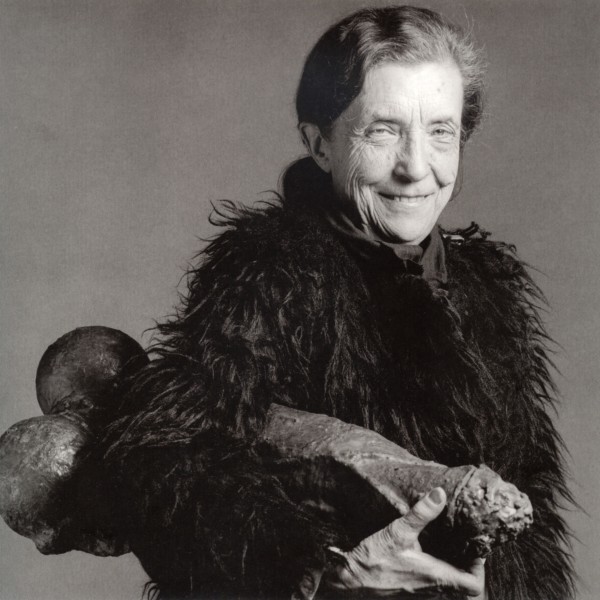
Robert Mapplethorpe, "Louise Bourgeois in 1982 with FILLETTE, 1968", Copyright the Estate of Robert Mapplethorpe

Share

Rashaad Newsome’s Hip Hop Heraldry

Today’s article is brought to us from our friends at Flavorwire, where Rozalia Jovanovic discusses Rashaad Newsome’s world of hip hop culture and heraldry.

As the Festival of Ideas for the New City continues in New York with its program of symposia, performances, exhibitions and a street festival, Rashaad Newsome’s performance Herald during Nuit Blanche New York’s Flash:Light stands out as the event of the weekend. Not only is it within the Midnight Organ Program at St. Patrick’s Basilica, part of an all-night string of events in SoHo, but it also features Newsome conducting the second ceremony in a series of rituals he is undertaking to attain the status of King of Arms. Newsome takes to the altar to conduct a haunting musical performance, with hoodie monks, juxtaposing hip-hop culture with religious space and featuring the church’s choir and organ, while a video collage is projected overhead. Here, we caught up with Newsome and take a look at some of his work that explores the connection between the system of heraldry, hip hop culture, and his work at large, to give you a primer for Herald.

Rashaad Newsome, Grand Duke of Harlem. Courtesy of the artist.

Newsome became interested in heraldry while visiting the castles and monuments of Europe. “I was really drawn to Armorial achievements,” he says, referring to the name for a coat of arms. “And how they’re integrated into the architecture of Europe… I was fascinated in the visual hierarchy that they impose on the viewer. Like when you see a coat of arms you know it’s associated with pedigree.” While in the 12th century heralds used to be the messengers of monarchs, the primary role of a herald in today’s culture is to be an expert in coats of arms. In the UK, heralds are still called on to read public proclamations publicly.

Newsome recreates European coats of arms from the 16th and 18th centuries using contemporary material. “I figured out that heraldry is how the coats of arms are created. It’s a system of symbols that represents social status, economic status, status as a warrior, pedigree, a way of assembling these images that represent all these different things to create a meta status symbol.”

Rashaad Newsome, Bend. Courtesy of the artist.

In discussing the links between heraldry and pop culture, Newsome says, “I felt like there was a lot of links between that and modern times. The way people do that with their bodies. I feel like people ornament their bodies in the same way. So there’s a lot of connections between popular culture specifically black youth culture, i.e. hip hop, which is a major reference point for me… You have to have the right kind of shoes, the right kind of jeans, the shirt, the jacket, the bling, the certain car. The certain girl, and then she comes with a whole set of accouterments that she has to have to be that status symbol. There was somewhat of a dialogue happening there.”

Rashaad Newsome, still from Pursuivant. Courtesy of the artist.

Because he was referencing the history of heraldry in his work, but imbuing it with his own experience and personal history, he decided to go to the school. “I contacted the Royal College of Arms in London and they invited me to come down.” Newsome shot a film of himself going through the first step of becoming a herald, that of Pursuivant — the most junior rank. The middle rank is Herald, and the senior rank is King of Arms. Newsome will be filming his performance and assumption of the status of Herald at St. Patrick’s Basilica. Read More »

Share

Peace of Mind

L.A. Expanded: Notes from the West Coast
A weekly column by Catherine Wagley

Camilo Ontiveros, "The Burial of Anastacio Hernandez," 2011, Installation view. Courtesy Steve Turner Gallery.

Most good artists moonlight as social historians at least some of the time. Often, they’re as bad at it as real-deal historians  are (just think what sort of voluptuously erroneous textbook Gauguin would’ve written on the Polynesians, or what might have happened if Damien Hirst gem-encrusted skull had launched a scholarly inquest into diamonds in the Congo). Bad history doesn’t preclude good art, of course;  sometimes it even propels it (depending on who you ask, Guaguin and Hirst are cases in point).

Being a both good historian and a good artist only seems to work  for rare individuals like Jeffrey Vallance—his faux Nixon Museum and serious study of “Painter of Light” Thomas Kinkade wreaked of well-researched sincerity—whose sense of what matters happens to be soaked in idiosyncrasy to begin with. But, of late, some more doctrinaire, less idiosyncratic artmakers have adopted a connect-the-dots approach to history and cultural commentary that seems to work quite nicely: pull together a careful collection of socially charged moments, set them out in the world, and let them do their work.

Camilo Ontiveros connects dots in his current exhibition, Some Boxes and Two Photographs About America, on view at Steve Turner Contemporary. Even his title evokes the un-boundedness of his narrative slant. From the street (this gallery often hangs work in its front window, a shtick that, on occasion, makes serious ideas feel like teasers), you can see a poster-sized photograph of a Navy billboard targeted at Latino youth. The young soldier it features squints in the sun, which casts a dramatic, flattering shadow down the middle of his face. He looks a little too small and awkward in his white uniform, however, and it’s hard to imagine him uttering the words “Este Es Mu Pais” (or “This is my Country”), spelled out beside him, with much gusto.

Camilo Ontiveros, "Este Es Mi País," 2011, Inkjet print, 30 1/2 x 71 1/2 inches. Courtesy Steve Turner Contemporary.

Inside, Ontiveros has installed an extensive collection of motley security system boxes, all variations on red, white and blue—granted, some “white” boxes are practically brown and some “blues” are closer to gray; still it’s got a patriotism to it that’s quaintness like a faded Norman Rockwell. In fact, the installation, called It’s Not Just Security, It’s Peace of Mind, feels like a museum collection of nostalgic relics from the 50s or 60s, just after our wartime prime. The boxes are neither obsolete nor expressly old, however. Ontiveros assembled them recently, while working as an alarm system installer here in SoCal.

The Burial of Anastacio Hernandez, 2011. Inkjet print, 25 x 36 3/4 inches. Courtesy Steve Turner Contemporary.

Invasion is a repeat theme in Ontiveros’ work. Security boxes exist to keep invaders out and the Navy has served that exact same purpose from time to time. Step into the back gallery at Steve Turner, and you’ll find a shrine to one particular invader stopped at the San Ysidro border a year ago. Called The Burial of Anastacio Hernandez, the shrine consists of a photograph of a funeral and two candles on a pedestal. The Anastacio in question had been deported after living in San Diego for 18 years and died in May 2010, beaten by police and shot with a stun gun as he tried to cross into the U.S. The case was publicized but never quite notorious, and Ontiveros’ installation won’t add any notoriety. It’s familiar enough to seem like any other present-day shrine, but minimal enough to avoid triteness.

The Burial is the only piece in the show not for sale. This feels indicative of the kind of artist Ontiveros is—not unreasonable (the boxes can all be bought), but tactful and concerned. Mexico-born,California-based, he’s regional first and foremost, a designation far more muscular than derogatory in this globally-obsessed world. He cares about what goes down in the swath of land between where he comes from and where he lives now in a possessive, sometimes indignant way. In Some Boxes and Two Photographs About America, he’s tying together moments with a quiet intensity, asking us to follow the thread and piece together a story–this time, about how invasion and our obsession with it has gone too far.


Share

Allison Smith at MCA Denver

The contemporary art world – accepting as it may be of the most oblique artistic practices – still responds tentatively to artists engaging with notions of craft. Yet, at a time when the handmade – a once integral part of everyday life – has become a luxury, craft can serve as a potent commentary on our history and national identity. In Piece Work, an exhibition on display now at the MCA Denver, Oakland-based artist Allison Smith draws on American decorative arts and craft traditions to address just this. Smith’s works offer a contemporary investigation of pre-modern and early American craft, but viewed from perhaps an unexpected perspective: the convergence of art and war.

Three display cases contain objects from Needle Work, a series in which Smith recreates European and American cloth gas masks from World War I and World War II. Aestheticized in museum vitrines, it is hard to imagine that such tenderly handmade items were once used to protect when our soldiers are now clad in Kevlar.

Needle Work (Wartime Textiles), 2010. Fabricated display cases containing sewn reproductions of wartime textiles, with identification tags and research images.

A central work in the exhibition, Fancy Work (Braided Rug), is a large rug begun by the artist, but carried on by visitors who are encouraged to continue its braiding in the museum gallery. While its sheer beauty and intricacy is enough to stop anyone in his or her tracks, Smith forces visitors to linger with the piece and its conceptual content by implicating them in the work’s very fabrication. Together with books addressing the tactics and varying histories of war scattered across the rug’s surface, the work creates a space in which participation and discussion foreground an engagement with history and personal experience of war. The slow, arduous completion of this handmade rug is a fitting metaphor for the protracted duration of contemporary war.

Fancy Work (Braided Rug), 2010-2011. Screen-printed linen.

In keeping with this spirit of collaboration, Smith organized several events during the exhibition that engaged both the local arts community and the general public by inviting them to create works in the museum. For example, Smith hosted “Sheep-to-Shawl,” a daylong event in which visitors collaborated to shear a sheep, spin the resulting fleece into wool and ultimately weave a shawl; the day was punctuated by speakers addressing the history of craft and fiber arts. By hosting a program rooted in collaborative craft-based work within the museum environment, Smith encourages the arts community and public to widen the scope of creative practices and interactions deemed relevant to the growing discourse on contemporary art.

Allison Smith: Piece Work runs through May 29th at the MCA Denver.

Share