Nomadic and Luminous: Ranu Mukherjee at Frey Norris

Ranu Mukherjee, Auspicious Picture, Multiple Sources of Power (2011). Hybrid film, 2 minutes 51 seconds. Edition of 5. Image courtesy of the artist and Frey Norris Contemporary & Modern.

What happens at the moment when energy becomes material, and how can we even dream of documenting it? The question has wide-ranging implications, from the memories stored in everyday objects to the effects of prayer. Ranu Mukherjee’s solo exhibition at Frey Norris Contemporary and Modern, Absorption Into the Nomadic and Luminous, takes up these issues. A former painter who now works mostly with photography and animation, the question has particular potency for Mukherjee, as it references the creation cycle of a painting (from pigment to paint to image), the balance between the intangible and tangible found in digital video, and perhaps the link between.

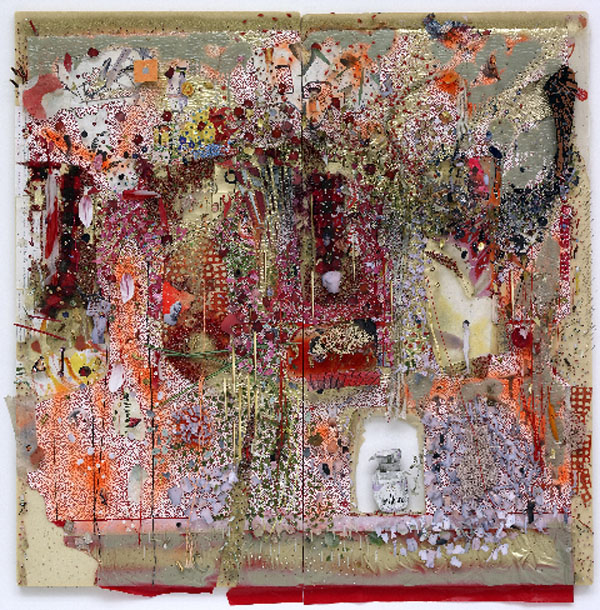
Ranu Mukherjee, Rajasthani Gypsy Shoes, Dr. Gabrielle Francis (2011). Ink on colored paper. 19 5/8 x 19 5/8 in. Image courtesy of the artist and Frey Norris Contemporary & Modern.

Nomadic and Luminous consists of a series of square paintings and a suite of hybrid films (so-called due to their combination of animation, photography, and video). In the first film, Auspicious Picture, Multiple Sources of Power (2011), an animated emanation, or halo, glows above a live action shot of ocean waves at night.  As the emanation fades and disappears, different articles of clothing and tapestry appear and disappear in the foreground, almost dancing, and we are left to contemplate each object—ocean, emanation, and clothing—as a source of power in its own right.

Ranu Mukherjee, Between the no longer and the not yet (2011). Ink on colored paper. 19 5/8 x 19 5/8 in. Image courtesy of the artist and Frey Norris Contemporary & Modern.

The second film, Abundance Picture, As Told By the Element Itself (2011), opens with the image of a checkered-cloth bundle making its way across a crocodile-filled river, with children’s silhouettes in the background. After a while the silhouettes fade, and the next image features bright clothing hung from tree roots, juxtaposed against a hand-painted landscape as yet another shadowy silhouette moves in and out of the frame, eventually revealing itself to be pile of gold.  The final film, Ecstatic Picture, Spilled Milk (2011), shows the infiltration and spread of a pitcher of spilled milk amongst a constant rain of flowers, Indian clothing and jewelry, and other objects. The empty silhouette of what could be a deity, or perhaps a mother and child, occupies the center of the screen. Eventually, a mass of cell phones appear and pour forth the rainbow equivalent of spilled milk, which mingles with rest of the animations and references the boon that cell phone technology has brought to India.

Ranu Mukherjee, Ecstatic Picture, Spilled Milk (2011). Hybrid Film, 5 minutes 4 seconds. Edition of 5. Image courtesy of the artist and Frey Norris Contemporary & Modern.

Taken together, the films provide a meditation on tangibility and intangibility; landscape, negative space, and sacred space; void, object, memory, and isolation.  And while Mukherjee describes the accompanying paintings as merely “note taking,” they should not be undervalued—particularly because they provide us with Mukherjee’s lexicon. The same pair of gold Rajasthani gypsy shoes, with their curled toes and red interiors, for instance, appears in both Rajasthani Gypsy Shoes, Dr. Gabrielle Francis (2011), and Auspicious Picture (2011). Similarly, landscape fragments based on lithographs of Indian deities, with the deities cut out, show up in multiple paintings, as well as both Auspicious and Ecstatic Pictures.

Ranu Mukherjee, Abundance picture, as told by the element itself (2011). Hybrid Film. 3 minutes 32 seconds. Edition of 5. Image courtesy of the artist and Frey Norris Contemporary & Modern.

To Mukherjee’s credit, the work never becomes ponderous, but remains uniquely well-thought out and mesmerizing. On a more personal note, the objects in the paintings also reference Mukherjee’s Indian heritage—just one more way long-stored energy materializes or becomes current.

Absorption Into the Nomadic and Luminous is on view at Frey Norris in San Francisco through July 30, 2011.

Share

Oh No You Ditten! Los Angeles invades SoHo

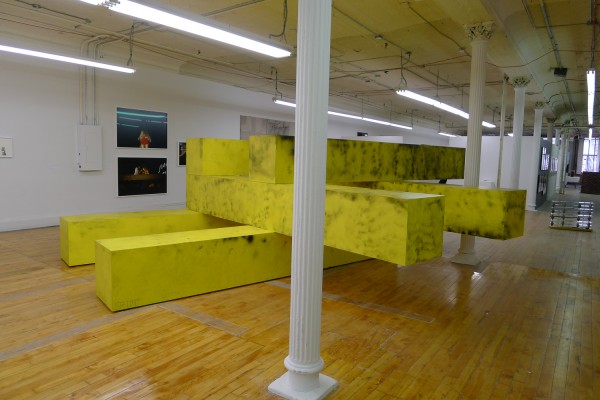
Installation View, Greater LA.

Is this a throwdown? It’s tempting to think so, since the title, Greater LA, is obviously a riff on the seminal P.S.1 survey Greater New York, and is installed in the same type of beat-up SoHo loft where major New York art history went down in the 1960s and ‘70s. But don’t get too excited. Any sense of bi-coastal competition erodes  quickly when you realize that many of the artists on view are already well-represented and accepted commodities here in New York.  Also, unlike Greater New York, which was a wild, not-for-profit showcase of up-and-comers, Greater LA is a commercial show and there really isn’t too much here that can’t be seen during a typical afternoon in Chelsea or the Lower East Side. So stop frontin’, y’all.

Alex Israel, Property, 2011.

If it were a throwdown, however, Sterling Ruby would be in the heavyweight class. With a group of stacked rectilinear forms, he adds color, a sense of the handmade, and illusion to minimalism’s airtight vocabulary.  Lofts like these have always been the perfect setting for minimal forms, and Ruby’s piece dominates a show that suffers from too many freestanding walls and too large a roster of artists. Token appearances by highly saleable artists (Mark Grotjahn works on paper, anyone?) give the show an art fair vibe that renders the whole “snapshot of exciting new LA art right now” thing nearly laughable.  A handful of great pieces amidst acres of empty loft space would have been way more effective.

Installation View, Greater LA.

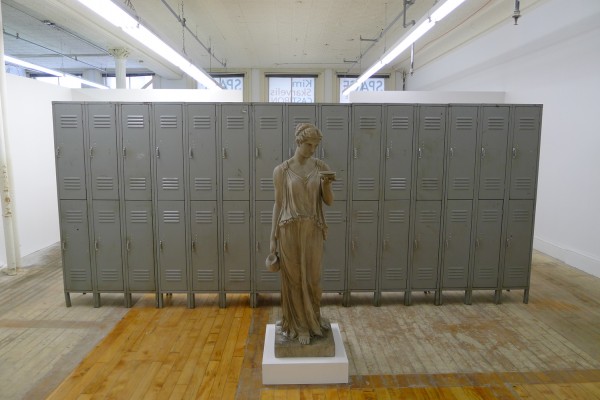
Alex Israel’s Property, however, provides a sophisticated moment. A Grecian figure stands in front of a group of lockers, as if you had accidently stumbled into the employee lounge at the Getty. This pairs well with Jonas Wood’s chunky paintings of Grecian urns.  Wood, who lives in Los Angeles but grew up in Boston, went to school in St. Louis, and already has a strong presence in New York, also seems out of place here. He represents the sort of omni-local artist who pervades today’s scene, the type that makes it hard to discern any real conceptual or aesthetic differences between Los Angeles and New York.

Personally, I would have loved to see more space devoted to artists who are not represented by New York galleries, to get at what, if anything, really distinguishes the two cities’ art ideologies. But I suppose you can’t blame the curators for playing it a little safe and including their bankable stars. Their kitchen sink approach and all-over-the-place-career-wise roster seems to say that no matter where you set up your studio, every artist stills wants and needs to show in New York. We throw down harder, and Los Angeles knows it. Otherwise, they would have just had the show there.

Share

Blueprint for a Bogey

The bogey, the term for a go-cart in Glasgow, has been made across generations by children to drive and play in. Given the DIY character of the bogey and use of scrap materials from old wheels and abandoned pushchairs, the premise of the exhibition, Blueprint for a Bogey, takes the absence of regulations concerning a bogey’s construction or play, to explore concepts surrounding play – the right to play, how we play, and the boundaries of play.

Attention, Corin Sworn with Nicolas Party and Ciara Phillips, copyright & courtesy the artists

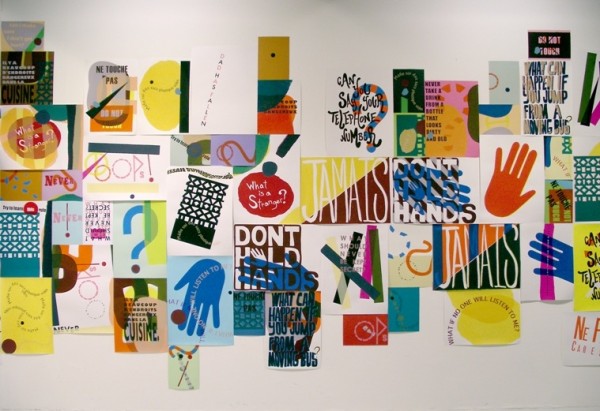
Attention is a collection of 130 silkscreen posters by Corin Sworn, Ciara Phillips and Nicolas Party, of which about 80 are on display. The choice of printing posters was inspired by Palle Nielsen, in particular his installation of printing equipment at a festival in 1969 in Denmark, which handed over the control of communication techniques to the public, and whose printed materials became the festival’s flyers and leaflets.  With a visual imagery and language derived from safety literature during the artists’ childhoods in the 1980s, the appropriation provokes thought on the relationship between visual culture, regulations, and aesthetics, and the way that the playfulness is now harnessed back from a domain that has imposed boundaries and norms on the interactions within play.

Hazel stick throw, LYC, Cumbria, 10 July 1980 © Andy Goldsworthy

Hazel stick throw comprises a series of photographs that documents one of Andy Goldsworthy’s ephemeral works, using the act of throwing, randomness, and the interaction of the sticks with gravity to create sculptures formed by the lines and directions of the sticks suspended in the air. Working with materials found in natural environments, Goldsworthy’s work conceives of play as a means of entering into, and experiencing the processes of chance, transience, growth and decay as inherent within nature.

Coloured Hair Performance (Basel 2009), David Sherry, copyright the artist

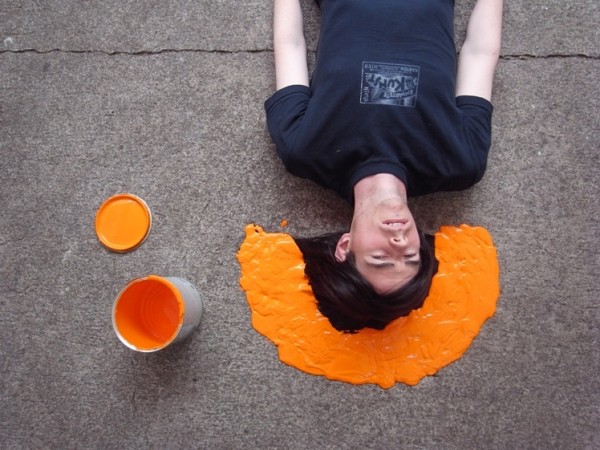
David Sherry intervenes into conventional ways of acting and perceiving, on occasion subjecting himself to stipulated routines or instructions, as gestures which underscore the humor and vulnerability of human action. Coloured Hair Performance is a photograph of Sherry’s performance at the Basel Art Fair in 2009 where he lay on the ground with orange paint poured around the edges of his hair. His hair was then cut away from the paint two hours later, leaving an artwork on the ground.

Electrical Appliance, David Sherry, 2011 © the artist, image courtesy of Glasgow Museums © Alan Dimmick

For Blueprint for a Bogey, Sherry created Electrical Appliance, which he performed at various locations in the gallery. Sherry, connected to an enlarged electrical socket, lies inert almost as if waiting to be charged, challenging our notions of common phrases and objects through playful reinvention of their uses.

Blueprint for a Bogey is currently on show at the Gallery of Modern Art, GoMA till 5 June. Other artists featured in the exhibition include Paula Rego, Peter Blake and Eduardo Paolozzi.

Share

From the DS Archives: Elliot Hundley

From the DS Archives reintroduces Los Angeles based artist Elliot Hundley this Sunday. Up now through July 1st at Regen Projects in Los Angeles is Elliot Hundley: Semele, an exhibition featuring large-scale wall bound collages, sculptures, and paintings inspired by Euripides’ Greek tragedy, The Bacchae.

This article was originally written by Chantel Tattoli on October 1, 2009.

Artist Elliott-Hundley1.jpg

Elliott Hundley‘s work mashes up the diligence of entomology displays with the audacity of pop-up books. He accumulates bits and pieces of lo-fi media like string, paper, and beading, and collages photographs – glues, pins and inlays for an atomistic, yet overall integrated scene. Color, texture and clipped images are made to beautifully butt heads in numerous intimate, epic conflicts. The effect is discursive, overlooking chronology and didacticism in favor of studying the nature of the conflict between the medias he pits against each other.

Hundley’s work is showing in a group exhibition, The World is Yours, ongoing until January 10 at Louisiana Museum of Modern Art, just outside of Copenhagen, Denmark. The exhibition’s title promises the world, but also means to insinuate “the real world”: as diehard, breakneck times; as an empty/broken promise; and as a manque dream – usually could’a, should’a, would’a been, but isn’t.

Artist Elliott-Hundley2.jpg

Elliott Hundley received his BFA in printmaking from Rhode Island School of Design in 1997, and his MFA in Painting and Drawing from the University of California at Los Angeles (UCLA) in 2005. His most recent solo show, Hekabe, occured this past spring at Regen Projects, Los Angeles, CA, and he will be in the forthcoming group exhibition,Contemplating the Void: Interventions in the Guggenheim Museum Rotunda, at the Guggenheim in New York City this February 19 – May 16.

View Elliot Hundley’s previous feature on DailyServing.com

Share

Fan Mail: Jason Gringler

For this edition of Fan Mail, Jason Gringler has been selected from a group of worthy submissions. If you would like to be considered, please submit to info@dailyserving.com a link to your website with ‘Fan Mail’ in the subject line. Two artists are featured each month—the next one could be you!

Upon first glance, the large-scale works of Canadian-born, New York-based artist Jason Gringler may appear to be straightforward abstract paintings. But a closer look at the distinctive materiality and details of these works reveals that this is not the case. Painting in the traditional sense has never really appealed to the artist, who prefers to challenge the medium’s limitations, in part through the use of unconventional materials. Rather than working on stretched canvas, he begins each work by mounting Plexiglas to the front of a wooden stretcher. To this surface, he applies not only acrylic paints, spray paints and collage, but also hand-cut pieces of Plexi- and broken mirrored glass, creating a variable surface through the application of many layers. The resulting works balance areas of transparency, translucence, opacity and reflectiveness.

Jason Gringler. "Killing Sisyphus," (2009). Acrylic, Collage, Spray Enamel, Cut Inlaid Plexiglas, Broken Mirrors. 72 x 84 inches. Courtesy of the artist.

Drawing inspiration from the urban environment in which he lives and works, Gringler’s practice is very much about construction, deconstruction and reconstruction. For me, his use of industrial materials and a muted color palette with pops of bright color evokes the stark contrast of concrete and steel against graffiti or posters, a hallmark of virtually all city streets.  His carefully constructed abstractions adeptly combine with fragmented images of his studio, juxtaposing real and constructed space.

These works do not sit stagnant on the wall. Through their sheer scale—six feet by seven feet to be exact—they engage the viewer’s body and encourage a consideration of how the work is produced.  Furthermore, the reflective quality of Gringler’s materials cultivates a dynamic experience that involves not only the audience, but also the display space’s architecture and lighting conditions.

Jason Gringler. "Collage 16," (2011). Acrylic, Cut Paper, Collage, Spray Enamel, Inkjet Prints. 8.5 x 11 inches. Courtesy of the artist.

Though complete works in their own right, Gringler’s collages also serve as studies for his larger works with an interesting twist, incorporating printouts of other works. His collages are composed from printouts of the Plexiglass works, in addition to photographs of his studio and the neighborhoods surrounding his workspace. This cyclical process allows for the in-depth examination, and perhaps exhaustion, of particular forms or compositions.

Gringler is the subject of a solo exhibition this September at Galerie Stefan Röpke in Cologne in conjunction with a new monograph.

Share

Defying Gravity

L.A. Expanded: Notes from the West Coast
A weekly column by Catherine Wagley

Marco Brambilla, "Civilization,"

Marco Brambilla, "Civilization (Megaplex)," 2010, 3-D High Definition disc. Private collection, London.

“I believe we were born dead,” said motorcyclist-daredevil Evel Knievel, rambling to Sports Illustrated in 1968. He’d just cleared 16 cars in Gardena, CA, before crashing over the fountains at Cesare’s Palace, and was romanticizing about future stunts. “I have accepted the fact that dying is a part of living,” he continued. “If I make it across the Grand Canyon, I’ll be a millionaire. But I’m not all jacked up to make a big killing. I want to do this thing because I want to do this thing. I don’t know if it’s going to make a worthwhile contribution to society or transportation, but I’m going to do it.” He never jumped the canyon; no one with sway—the U.S. government in particular—would let him. But if he had, he’d have had an audience big enough to fill a stadium.  He knew it too: “if I have to get off halfway across[,] [o]ne hundred thousand people aren’t going to say ‘boo.’’’

Madness meets mechanics, brazenness meets skill—it’s the combination of real dexterity and superhuman (crazy) ambition that can turn a man with a motorcycle into a crowd pleasing phenom.

Stuntman Evel Knievel jumping 140 feet at 90 mph over 13 buses at Wembley Stadium, May 27th, 1975. He crashed upon landing. Photo by David Ashdown.

There’s something of this outlandish, expert ambition coursing through Marco Brambilla’s current exhibition at the Santa Monica Museum of Art. Hailed as the world’s first exhibition of 3-D video art–a claim to fame that’s admittedly tinny (3-D film exists; how much back-patting does art deserve for catching up?)–the real pull of Brambilla’s show lies in the mad scope of its technique.

Angelino by way of Italy and New York, Brambilla has been filmmaking since the ’70s, experimenting, pushing buttons, keeping abreast of innovation. He’s known for appropriating blockbuster film clips and other iconic imagery, though the virtuosic density with which he pieces his appropriations back together is what makes him so singular. Most recently, he turned Kanye West’s egotism into magic, with his surreal, seductive video for the celestial single, “Power.” He also reportedly stole the show at the Loop video art fair in Barcelona, where Christopher Grimes Gallery featured his Evolution (Megaplex) in 3-D.

Marco Brambilla, "Wall of Death," 2001. Courtesy of the artist.

Marco Brambilla, "Wall of Death," 2001, Single-channel video. Collection New Line Cinema, Los Angeles.

The Santa Monica Museum show includes ten years’ worth of work, highlighting Brambilla’s savvy as  borrower as well as visionary.  When you enter the gallery—you’ll pick up your 3-D glasses on the way in, and save them until the very end—you first encounter Sea of Tranquility (2006), a grainy loop based on images of the 1969 Apollo 11 moon landing; then the pulsating, multi-layered Cathedral (2008), a kaleidoscopic fantasia of shots of mall shoppers; followed by HalfLife (2002), which, grainy again, invasively pairs surveillance footage of gamers with footage of the games they play. But it’s when you get to the fourth gallery space and see Wall of Death that the exhibition really begins to show its grit.

Long before Evel Knievel, motorcyclists performed the gravity-defying Wall of Death trick, often as a carnival sideshow. The “Wall” is the 20-30 foot vertical wooden side of a cylindrical drum that cyclists ride around after building up enough speed to coast horizontal to the floor. In Brambilla’s Wall, reimagined using black and white 1930s footage, the rider circles the drum endlessly, throwing up his hands in a magnetic gesture of showmanship. Brambilla used the Kinetoscope films popular in the early 1900s as the inspiration for his editing, and the loop has a quaint, vintage feel.

If Wall of Death depicts daredevilry, the show’s final two works, Evolution (Megaplex) (2010) and Civilization (Megaplex) (2008/2011), are themselves feats of daredevilry. They combine hundreds of looped videos from iconic films into scrolling inferno-like, 3-D opuses. They give gaping pictures of civilization as dark and complicated as Peter Jackson’s Mordor or Heironymus Bosch’s The Last Judgment. Crawling naked bodies from Pasolini’s Salo, Clint Eastwood striding forward, and the romantic soundtrack of Prokofiev’s Romeo and Juliet—the panorama of references scrolls on and on. You feel as if you could fall in to the imagery headfirst and be lost for eons.

Yet, despite the undeniable impressiveness of Evolution and Civilization, it’s Wall of Death that remains for me the most exquisite and compelling of Brambilla’s works. To depict the totality of humanity in a manner worthy of both Spielberg and Dante is a feat, but to get at one man’s insatiable, tireless desire to perform the impossible? That’s precious because it’s particular.

Share

Constructing the Victim

Santiago Sierra, Audience Lit by a Petrol Operated Generator, 2008; Veteran Standing in the Corner, 2011, Courtesy of KOW Berlin

Like a newspaper in its matter of fact presentation of content, Cady Noland / Santiago Sierra at KOW Berlin, curated by Alexander Koch and Nikolaus Oberhuber, appears purposefully removed of emotion. We never make eye contact with other humans, backs are often turned, or we find ourselves averting our eyes for our own protection.  We stand on the outside looking in. No one makes a human gesture towards us as viewers; our presence is not acknowledged or regarded with any sort of value. Just as we may be blind to other’s suffering, we are made invisible and unimportant.

Sierra’s video, Burned Buildings (Found Scene) (2008), starts with a hectic, first-person shot approaching a fire. We hear sirens, and see the unsteadiness of the handheld camcorder. We arrive behind a wall—shielding our view of the actual building—the camera is set down, and the video transforms into a contemplative, moving grisaille of smoke in the wind.  Any standard journalistic questions linger and remain unanswered.

Santiago Sierra, Burned Builings (Found Scene), Via Argine, Ponticelli, Naples, Italy, June 2008. Video 5'35", Courtesy of Santiago Sierra and KOW BERLIN, Photo by Alexander Koch.

Monochromatic in its curation, the visual aesthetic of the show easily captivates. This is a purposeful distraction. If we just look at the pictures without bothering to read the story, we don’t need to concern ourselves with the reality of the situations presented. Considering how many images and texts present themselves to us each day, disregarding most of them may be the best coping mechanism for fulfilling our day-to-day tasks and pursuing our own lives.

Santiago Sierra, Teeth of the Last Gipsies of Ponticelli, 2008. Courtesy of Santiago Sierra and KOW BERLIN, Photo by Alexander Koch

It is difficult, however, not to be struck by two of Sierra’s photographs, Teeth of the Last Gipsies of Ponticelli (2008). Two open mouths of teeth, ground down and deformed, give evidence of the psychological stress and physical condition of the sitters. They are both captivating and devastating in their spectacle. The time-intensive process of wearing teeth down so severely brings more questions than emotional concern. Awareness of this state implicates the viewer as partial perpetrator, despite the victim being foreign and obtuse.

Violence is an ever-present undercurrent of the show, and is most overt in Noland’s piece, Enquirer with Eyes Cut Out (1990). The removal of the image’s eyes points to a sort of Hollywood version of psychopathy. The type of story presented, involving the private lives of celebrities, exists in our culture not for its importance or affect on society at large, but rather to knock down people above us in the social hierarchy. Celebrity ‘rag mags’ seem to exist solely for this eventual purpose. Removing the eyes dehumanizes, and by taking away a celebrity’s humanity, we are able to freely violate and judge them, therefore purposefully making ourselves the offenders to their victimhood.

Cady Noland, Enquirer Page with Eyes Cut Out, 1990 , Courtesy of Sammlung Gaby and Wilhelm Shuermann, Photo by Alexander Koch.

We’ve all heard stories of exploitation, just as we’ve all at times chosen not to act or to rebel against various human atrocities. Seeing documentation of this, be it in a paper, or on a gallery’s walls, allows us distance and freedom from any sense of responsibility. The content of the show, however, remains commonplace. It’s delivered to us daily in our mailboxes, or is readily available at the corner newsstand. In 89 Huichols, Sierra highlights particular examples from our world that act as stand-ins for the marginalized figures that give regular society its “other” of the moment. Coupled with Noland’s work, the curators have moved us from the Sierra conversation “Why would he do that?” to “Why do we allow this?” The stories Sierra covers here don’t get a lot of news time when contrasted against Jaclyn Smith’s divorce, due to a lack of interest from the general public. This sentiment is subtle, but apparent throughout the exhibition.

There is a detached quality between both Noland and Sierra and their work.  They’re no Sarah McLaughlin, who appeals to our emotions to garner donations for abused animals. Instead, Coland and Sierra offer fodder for intellectual study.  They have selected specific victims for examination, but instead of inciting activism, the non-sensationalism of the exhibition is at times apathetic, and thus calls us out for our own apathy toward the details of the content. The power of this show relies on having a calm and ordered appearance, as well as projecting a tone of rationalism.

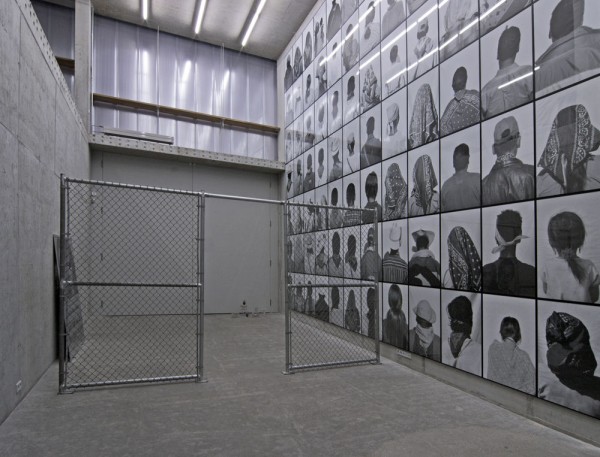
Exhibition view, Metal Fence, Cady Noland, 1990, 89 Huichols, Santiago Sierra, 2006, Courtesy of Santiago Sierra and KOW BERLIN, Sammlung Gaby and Wilhelm Shuermann, Photo by Alexander Koch

While a sort of historicizing happens with the pieces that involve particular groups of people, the object-based pieces in the show exist with a sort of timelessness. These pieces treat the viewer as both victim and perpetrator. We cause our own unease by walking through an imposing gate, and yet we subject ourselves to the onslaught of bright buzzing lights with the visceral awareness that even though we’re in control, we’re contributing to our own discomfort.

We know the wince and moment of anticipation all too well, but we continue to rubberneck at the sight of a car crash. For all the controversy that Noland and Sierra are known for, the show’s sense of violence or exploitation is severely reserved when pitted against any real story of human suffering. Noland and Sierra’s approaches to victimization in our society complicate our individual roles and responsibilities in playing on either side. While no one wants to be a victim, we seem to find ourselves in a position where victimization is natural or necessary, so we prefer the alternative, perhaps despite the moral implications of it, in order to survive.

Cady Noland / Santiago Sierra is on view at KOW Berlin through July 29, 2011.

Share