Jean-Pierre Gauthier

Courtesy of the artist and Jack Shainman Gallery, NY.

A room filled with a new series of distinct wall works, Hypoxia 1-6 (all 2011) can seem overwhelming at first. Each piece is a mess of metal tubing, cables, motors, microphones, amplifiers and compressors that activate expandable balloons covered in brightly colored braided sleeving. But as you walk around the room, moving between one work and the next, the distinctive intricacies of each individual piece draw you in, each one a separate atmosphere responding to your physical presence with subtle noises and gestures. The contrast between the industrial materials and the sounds, like birdcalls and rustling wilderness, evoke an untamed landscape, and blur the line between the opposing forces of the natural and the mechanical.

Montreal artist Jean-Pierre Gauthier is known for his captivating, often charming kinetic sculptures, for which he won Canada’s prestigious Sobey Art Award in 2004. For this solo exhibition at Jack Shainman Gallery, Gauthier has created a synesthetic experience. His laid-bare approach – a part of the experience of these pieces is being able to watch each sound as it is formed – turns the often hidden technology of sound art into an integrated experience, in which the action of the visual plane disperses seamlessly into the soundscape it generates.

There is something decidedly primal and heaving about these sculptures, especially in the movements and forms of the inflatable pieces, which lend the room a faintly sexual charge. Despite the obviously methodical and painstaking construction of each work, they retain a sense of the unrehearsed and spontaneous – with the freedoms and the perils of that state.

Courtesy of the artist and Jack Shainman Gallery, NY.

In the adjacent gallery, Thorax, 2010, integrates a number of similar works into a single installation, each element connected and controlled by a central computer dangling precariously like the mothership in the centre of the room. The effect of this piece is more menacing, with sound building slowly to a cacophonous climax. It is a portentous, almost threatening installation, but it’s also seductive, like watching a storm come in. Thorax might benefit from a more isolated situation – as sound bleeds between these two rooms and becomes at times impossible to untangle.

Gauthier’s new work is decidedly more ominous and less whimsical than some of the artist’s earlier pieces, like the drawing machine, Le Son de Choses, 2004, that is on view downstairs.

The exception is Sweeping Spirals, 2008-2011, which acts as a Fantasia-like gateway between the street and the central gallery spaces. Here, two broom heads dance on extended, multi-sectioned, dislocated red handles. As the brooms dance around the space, they ineffectually shift and poke at the debris on the floor beneath them – apparently left over from the actual installation – snipped ends of industrial plastic ties; colored thread; drywall dust.

The choreographed movements are beautiful, even mesmerizing; the rhythms of contemporary dancers reenacted as puppetry. Like all of the new work here, though, they have moods that keep you guessing – changing registers fluidly from acute frenzy to crouching anticipation.

Share

A Living Man Declared Dead and Other Chapters…

As a child I remember my father covering the walls of our home office with genealogy documents that mapped out centuries of our family history. There was something about knowing exactly where we came from that was significant for him and he dedicated much time and energy tracing our family origins. From this, I came to believe at a very young age that your relatives are a important part of who you are and that the blood that runs through your veins defines you.

American photographer Taryn Simon’s latest project, A Living Man Declared Dead and Other Chapters, uses bloodlines to weave poignant and powerful narratives of family and suffering. Wielding photography to record people, documents and relics, Simon is part of a persuasive school of artists the forcefully fuse documentary photography and art.

On opening night of Simon’s solo exhibition at Tate Modern, the foyer was filled with celebrations and libations, however the sheer power of Simon’s work was evident in the drastic shift in ambience as one crossed the threshold into the gallery space – the bubbling atmosphere dissipated as the captive audience introverted, shuffling around silently in the heavy air.

Taryn Simon, Chapter IV, A Living Man Declared Dead and Other Chapters, 2011. Installation View. Image Courtesy Gagosian Gallery.

Presented in a clinical manner, Simon’s systematic three-panel format provides a structure that counteracts the chaos and pathos of the stories told here. Eighteen chapters present genetics as inescapable and individuals defined by a single blood relative. Children exist in the shadows of their parents, grandparents or great-grandparents, or what they did. There is the descendants of the man forced to become the body double of Saddam Hussein’s son, Uday, a set of triplets affected by Thalidomide, Tanzanian albinos poached for their skin, and the bloodlines of Leila Khaled, the first woman to hijack and airplane and Hans Frank, Hitler’s legal advisor.

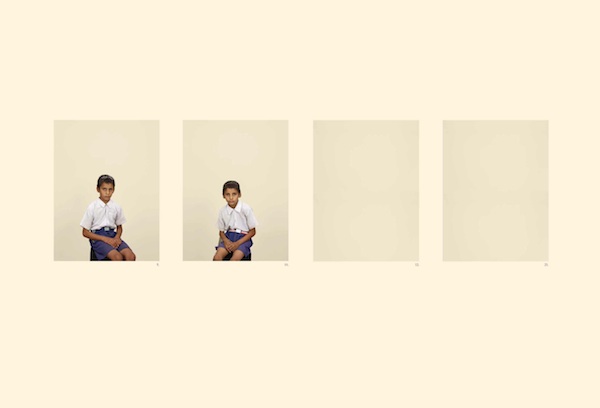
The portrait panel records their faces, the annotation panel details who they are, and the footnote panel contains the photographic evidence that supports the story. Blank spaces are left for those who could not be photographed for one reason or another, or chose not to participate, as detailed in the notes.

Taryn Simon, Excerpt from Chapter XVII, A Living Man Declared Dead and Other Chapters, 2011. Image Courtesy of the Artist and Gagosian Gallery.

Chapter XVII is the only one in the project that does not actually trace a bloodline, but instead documents the absence of a bloodline. At a Ukrainian orphanage, Simon photographed every child – individuals whose severance from a bloodline defines who they are, as they are absorbed into this alternative family. More often than not, this will largely determine who they become – as is noted, these children, when forced to leave at the age of sixteen, are highly susceptible to drug and sex trafficking, crime and suicide.

In A Living Man Declared Dead and Other Chapters, Simon’s deterministic assertion that where we come from defines who we are presents a particularly harrowing view of the world. But our bloodline does not have to be inescapable, as some of the absentee portraits who declined participation in the project have shown. The blank spaces here stand strongly for choice – the ability to remove yourself from a bloodline and not let it determine who you are – and it is these individuals, and their silence, that I find most intriguing. I can’t help but wonder who they are.

Taryn Simon, Excerpt from Chapter I, A Living Man Declared Dead and Other Chapters, 2011. Image Courtesy of the Artist and Gagosian Gallery.

Share

Berlin

Berliner Culture and The Kidney Bean Burrito

The natural tendency, when attending a show that promises to give you a sampling of a locale, is to define that culture through the exhibition’s cohesion. With everyone in Berlin identifying as an artist (a little hyperbolic), the saturation leads to a lot of “bad” art and “good” art, however you personally define it, making pinning down what is vital in the art world here an impossible task, and with over 80 participating artists, the multi-venue Based in Berlin seemed dead on projecting the art scene as undefinable, multicultural, and all-encompassing.

Oliver Laric, CEO (Installation shot), 2011, Courtesy of Based in Berlin

The international image of Berlin is nowhere more visible than in the city’s restaurant industry. Eat-in restaurants commonly seem to lack a speciality in-lieu of offering upwards of 200 items  from around the globe; Mexican, Chinese, Japanese, American and of course traditional German all in one spot. Supply constraints, because of kitchen economics and Berlin’s geographic location limit ingredient availability and often result in diluted and deluded versions of what should be. Because they try to replicate several foreign cultures all at once, these restaurants produce nothing authentically. It’s as if they have all the recipes, but substitute readily available ingredients for the harder to find items.

Is that what Berlin culture at-large has become: other cultures with Germany filling in the blanks when necessary? Surely one should be able to look to the community’s art to be at least representative of the culture, if not be the culture. Berlin’s reputation for art itself has led to this continual migration of artists searching for something in the city to aid in their process (whether it’s cheap rent, inspiration, connections, etc.). The result may mean learning from mentors that were new immigrants themselves no more than five years ago. Looking at the biographies of the artists presented here, most are foreign born, few are from Germany, and fewer still call Berlin their hometown. It’s as if there was a big empty space where all of the artists just decided to meet up, and in some utopian fantasy dreamed up the Berlin art scene… almost. Without responding to the city itself, artists are left trying to find their identity through something that can’t be defined. The focus here seems to be not on embedding oneself in a culture, but instead being one who helps define it.
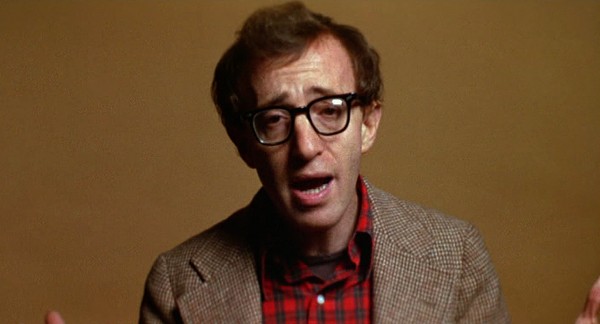
Erik Bünger, The Allens, 2004, Video installation, Courtesy the artist, Photo: Erik Bünger

Pieces like Erik Bünger’s The Allens, 2004, illustrate this image of Berlin. Putting on the headphones and listening to Woody Allen give a monologue, every next word translated into another language, is much like navigating the city. It’s impossible to follow all of the conversations, but hearing the variety of languages is inescapable. All of these cultures are being filtered through one figurehead, one of the most imitated and parodied celebrities in Western culture. Allen iconic voice and way of talking is stripped away as the words are spit out inorganically to reassemble the original text, leaving only glimmers of the original English speech.

Because, by and large, the artists are at least somewhat outsiders, is this show just a coincidental collection of work that could have just as easily been ‘The Studio Complex Group Show’ on 123 Fake St. in Anytown, Earth? The pitfall with defining one’s own culture in a white cube called Berlin, is that it makes culture, by negating Berlin’s entire history, irrelevant, and thus makes any attempts at cultural creation also irrelevant. When there is no real focus on preservation of local culture in the contemporary art of a place with hundreds of years of internationally impacting history, artists create their own problems instead of dealing with the problems already present in society. Moving to Berlin changes to moving to any foreign land and dealing with a new life situation. Understanding one’s existence in Berlin, with reference to the historical boundaries, navigational limits and cultural differences between adjacent neighbourhoods becomes understanding one’s existence in either a global sense, or a completely personal sense. It makes me wonder to what extent the art community in Berlin speaks to the multi-generational locals, or if there are two co-existent but mutually exclusive culture systems in Berlin.
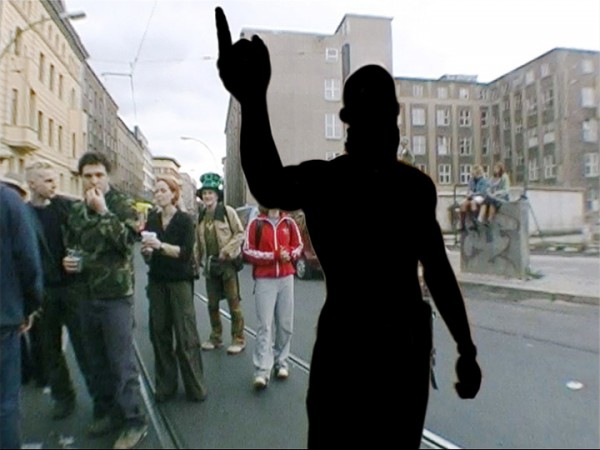
Matthias Fritsch, Replace:Technoviking, 2011, Video still, Copyleft by, Courtesy of the artist

Matthias Fritsch’s We, Technoviking, 2011, a video that is situated partly at Berlin’s Fuckparade, manages to drift between the local and the global. The original footage named Kneecam No.1, a popular internet meme, is both silly and startling; the technoviking is serious about fun, and protection. Social order is maintained by this super hero-type figure in what one would expect to be a festival that seems almost created to get out of hand. We, Technoviking compiles Youtube posted response videos inspired by the technoviking video and blurs the line between what is unique to Berlin and what is common around the world. The incredible international popularity of the footage has inspired an archive and exhibition that decentralizes the original event and relocates it in college dormitories, parks, and anywhere else. The nature of this video questions the authenticity of the event itself; no longer a unique experience in time and place. Everything is everywhere, there is no here.

Critiquing consumption may have been one of the bigger trends at Based in Berlin this year. Certainly, it’s something that most of us in industrialized society have conflicting feelings about. While I guess it’s nice to know that artists here are thinking about it, pieces like Rocco Berger’s Oil Painting, 2010, would have read the same in any Western star city and doesn’t benefit from being placed in a show that presumably wants to link the artists and city through the cultural production of art.

Rocco Berger, Wir müssen ins Detail gehen, 2009, Motoren, Holz ,Förderband (recycled), Galerie Alte Schule

It’s hard, as an outsider without local knowledge, to comment on Berlin’s body social with any sort of reference for local culture in Berlin. Instead it’s the popular culture that provides a skimming/surveying of what Berlin is with information that is at this point cliche (namely regarding Nazism and The Wall). Only the simplified, tourist-version to what are extremely complicated issues is accessible and therefore may get overlooked in-lieu of pursuing more self-centered subject matter. At its worst, it’s taking what the artist inherently has as the base of the meal, shaking in a few splashes of Wurze, and calling it Berliner art, and may be rightly feared by the immigrant artist. But this ignorance of the local is what is continually obfuscating the culture further and pushing it evermore so out of reach. As artists continue to produce with focus on the personal and the global, lack of identity becomes identity. Berlin may not be the only city faced with this issue, but it seems to be a brilliant example of the results of urban gentrification.

This discussion exists for me in Oliver Laric’s installation, CEO, 2011. One must climb up a temporary structure to view three SUVs sitting on a constructed roof with a vantage of some of the most iconic buildings of Berlin. At once it discusses global concerns of corporatism, consumption, waste and the environment, and contextualizes it amongst the history of the city. It addresses the disconnect between our daily lives and feeling any sort of connection to the locale beyond the personal. While the focus on multiculturalism and globalization may be positive directives at times, local culture and values still exist in large cities and continue to inform the cultural production of places like Berlin. By art culture diverging from Berlin’s local culture, two separate cities will form within one space, and art will further obscure itself from general society. Without local knowledge, opinion and input, any attempt at producing an authentic culture will come off tasting like a kidney bean burrito.


Share

Castaneda/Reiman at Baer Ridgway

In Still Life Landscape at Baer Ridgway, the artist team of Castaneda/Reiman works with two overlapping strategies: the appropriation and transformation of the customary depiction of terrain, and the invention of new landscapes by purely formal means. They apply these methods to the well-worn convention of the painted vista in search of the core or essence of landscape.  The result is a large group of works that read like a series of forensic reconstructions, wherein the artists propose a number of intriguing hypotheses about what it means to select, isolate, and depict the natural environment.

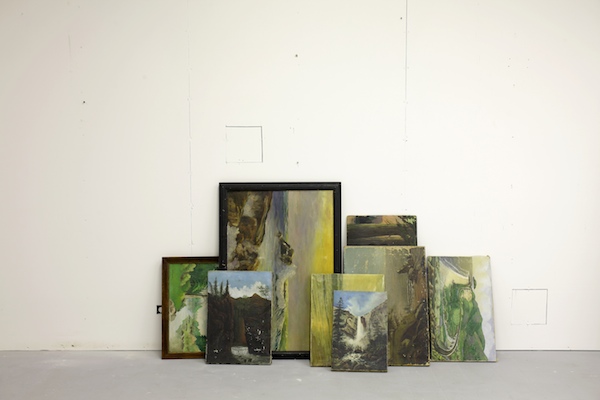
Still Life Landscape Document, 2011. Archival inkjet print, 27.75 x 41.75 inches. Edition of 3

The first piece in the show, a medium-sized inkjet print hung on the wall, gives a clue to the premise of the exhibition.  Still Life Landscape Document portrays a group of seven paintings leaning against a wall.  No matter the original position of each canvas, all are oriented portrait-wise, counter to the traditional horizontal format of the landscape.  Since a portrait is a study of character, the viewer understands immediately that the focus of this exhibition is to inspect or interrogate the archetypal form of landscape painting.

Two other works in the front room put forth different propositions.  The first is Landscape with Mantle (Collage), a wall-dominating composition constructed from a large print, a found wooden mantle, and paint.  The central part of the piece is a pigment print of digitally-collaged sections, appropriated from painted landscapes.  Horizontal stripes of paint pick up tones from the print and evoke Martha Stewart’s genteel-farmhouse palette.  The grandiosity of the work’s scale evokes the majesty of wild spaces, but as a whole the composition undercuts the fierce nature of open space by putting the print above the mantle—the well-behaved and traditional site for a painting.  Further, the muted tones of the paint stripes fence the print in and reinforce the convention of bringing depictions of nature’s expansive greatness into the contained and controlled space of the home.  In this work the tension between wild and domesticated resolves in favor of an airless interiority.

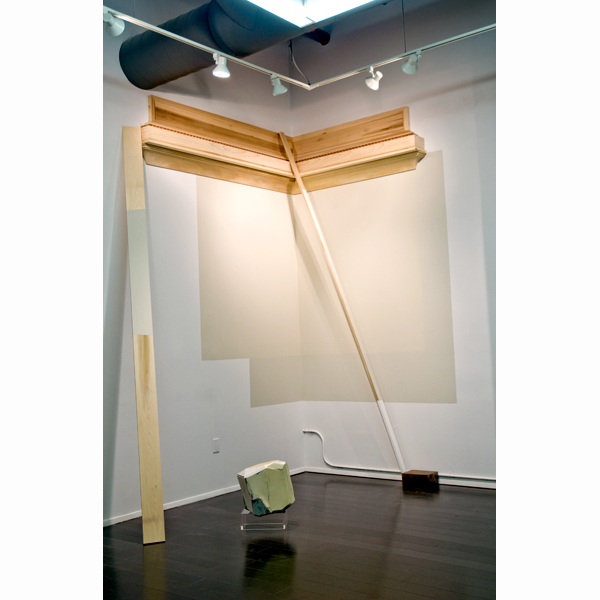
Landscape with Mantle (Still Life), 2011. Wood, paint, bronze. 132 x 95 x 7 inches

Across the room is Landscape with Mantle (Still Life), an installation of elements such as a gem-like angled sculpture set on a clear pedestal, a bronze block, and raw wood.  The corner walls and partial sections of the leaning planks are carefully painted in varying beiges.  Here the landscape is evocative rather than literal.  Mysterious and cool instead of commonplace or readily accessible, it is an urbanite’s proposal for a landscape, formal and abstracted.  Like the other works in the room, it is devoid of all real wildness.  In this, Castaneda/Reiman draws attention to the paradox of the traditional landscape artist: to celebrate and glorify nature in the customary rectangular canvas is also to restrict and sterilize.

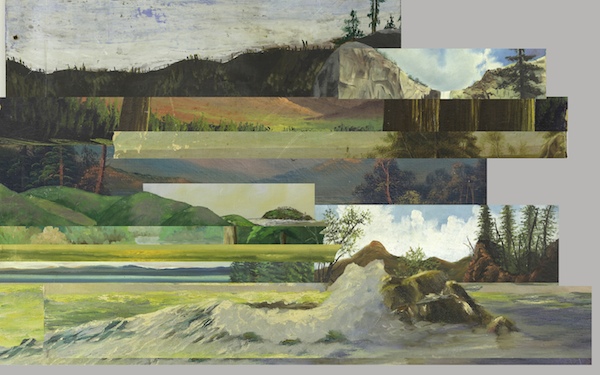
Composite Landscape (Horizon), 2011. Archival inkjet print. 22 x 35.5 inches. Edition of 3

Not all the compositions in the show are so visually distanced from their original subject.  Downstairs, the walls are hung with inkjet prints that each inspect a particular facet of the typical landscape.  Composite Landscape (Water) presents collaged views of water, and Composite Landscape (Horizon) shows the horizon lines from various paintings.  Each print is a collection of collaged rectangles taken from painted canvases, a digital trompe l’oeil in which the texture of the original is still alluringly visible.  These prints lead the viewer along the walls to the final piece in the show, Still Life Landscape (Sculpture), an installation that takes up almost the entire width of the room.  Printed to look like raw construction, a false wall manifests cuts and visible screw heads.  Eight landscapes sit on clear, one-inch slabs and appear to lean loosely against each other and the wall in various orientations (right side up, sideways, upside down), but the proximal viewer can see that they are actually a linked construction, with one canvas notched to hold the next like statements in an argument. Here the artists have faked a sense of the undone and the temporary, again enacting the division between raw wilderness and well-crafted refinement.  The resulting vacillation between poles asks the viewer to reflect on the contradiction inherent to representational landscapes: the enclosure and domestication of unfettered nature.

Still Life Landscape (Sculpture), 2011. Pigment printed drywall, wood, acrylic, paint. 40 x 119 x 15 inches

Art can renew and enliven a conventionalized practice by investigating the very properties that define its essence. In Still Life Landscape, Castaneda/Reiman have done just that; their explorations invigorate the landscape form by making it simultaneously recognizable and alien. The show takes the commonplace painted vista apart and puts it back together again in many thought-provoking ways.

Share

From the DS Archives: Dennis Oppenheim

This Sunday, From the DS Archives recalls American land and performance artist, Dennis Oppenheim, who passed away at the beginning of this year. Two sculptures  by Oppenheim – Engagement and Arriving Home - are included in the Vancouver Biennale, which closes June 30th. By positioning works within the context of various hubs of transportation – along bike routes, at the Vancouver International Airport, at new Canada Line stations and wrapped on buses and rapid transit trains – the exhibition emphasizes the physical movement of people in our mobile society, as well as our changing attitudes and sensibilities towards public art.

This article was originally written by Catherine Wagley on October 2, 2008.

Dennis_Oppenheim.jpg

Dennis Oppeheim, known for his experimentation in land art and body art, is now exhibiting new work at Ace Gallery in Los Angeles. Cactus Grove features colorful, exuberant, architectural sculptures of cacti – a lighthearted but characteristic venture for an artist who has spent the last forty years adventurously challenging the way people interact with space and nature. Oppenheim has used a span of materials, including fiber glass, side walk grating, galvanized steel, doors and windows, to evoke these organic cactus forms, engaging a conversation between architecture and natural bodies.

Oppenheim, who has lived and worked in New York since the 1960s, studied art at California College of Arts and Crafts in Oakland and Stanford University. At the 2007 Vancouver Sculpture Biennale, he was recognized for his life’s work in sculpture, photography and performance. Recently, Oppenheim was commissioned to display public sculptures during the 2008 Beijing Olympics. Two of his works, Engagement and Raining Halos, appeared during the games, one in Hong Kong, the other in Beijing. Oppenheim’s exhibition at Ace Gallery continues through December 2008.

Share

Fan Mail: Dominic Lippillo and Mark Schoon

For this edition of Fan Mail, Mississippi  based artist Dominic Lippillo and New York based artist Mark Schoon have been selected from a group of worthy submissions.  If you would like to be considered, please submit to info@dailyserving.com a link to your website with ‘Fan Mail’ in the subject line.  Two artists are featured each month – the next one could be you!

Dominic Lippillo and Mark Schoon. From the series "Anti-Local." 2010-2011. C-Prints. Two 4x4" images on 11x14" paper

Dominic Lippillo and Mark Schoon met in 2006 at the start of their MFA program in Photography at Ohio University. While Anti-Local is the duo’s first proper collaborative project, they recognized a shared sensibility in one another’s work at the time of their graduate thesis exhibitions in 2009. Lippillo recalls, “we were both working on domestic interiors, but in completely different ways and for completely different reasons. Having said that, we often made images that contained similar qualities.” Given this resonance, the two decided to share gallery space for their exhibitions. And thus was born the idea of a future collaboration.

Dominic Lippillo and Mark Schoon. From the series "Anti-Local." 2010-2011. C-Prints. Two 4x4" images on 11x14" paper

Upon completion of their degrees, Lippillo and Schoon went their separate ways, ending up in two very disparate locations: the small city of Starkville, Mississippi and Queens, New York – placing 1,114 miles between the two artists. Anti-Local has developed as an ongoing, photographic collaboration that investigates the significance of this distance as it pertains to the ideas of house versus home, space versus place. This series will end once the work becomes redundant; I’ve always admired the flexibility afforded by projects that artists allow to end naturally, if ever.

Logistically, Anti-Local is quite simple. The artists email one another three to fives photographs taken within their homes. The recipient responds to these visual “prompts” with a photograph of his own that utilizes aesthetic decisions regarding lighting, scale, texture and color – among other factors –to make them read as a pair.

Dominic Lippillo and Mark Schoon. From the series "Anti-Local." 2010-2011. C-Prints. Two 4x4" images on 11x14" paper

Alone, these images act as isolated vignettes of objects and domestic life. When placed in dialogue, and within the unique context of the artists’ separation and distinctive locales, they begin to engage in an interesting conversation regarding the similarities intrinsic to domesticity regardless of location.

The resulting diptyches are presented as 4 x 4 inch images on 11 x 14 paper. This format suits the project well as it invites the viewer to approach the work closely in order to discern the details that distinguish what are often quite similar photographs, both in subject and aesthetically. As the project moves forward, both artists have expressed an interest in continuing to challenge the reaches of this concept and format, creating images that are more personal and less generic in overall approach.

20 images from this project are currently on exhibition at the Renaissance Art Center in Dickson, Tennessee. In the fall, photographs from the project will be exhibited at the SRO Photo Gallery at Texas Tech University.

Share

Art is Pretty Interesting, Isn’t It?

L.A. Expanded: Notes from the West Coast
A weekly column by Catherine Wagley

WEIRD WALKS INTO A ROOM (COMMA), Exhibition poster, Sara Conaway and Lisa Williamson, June 4-July 9, 2011

“It’s best to turn people on. The hippies were always talking about being turned on,” said artist Dan Graham, speaking on a panel at the Museum of Contemporary Art two years ago. Thurston Moore and Kim Gordon, his co-panelists, had been his downstairs neighbors before they became Sonic Youth. They’d introduced him to fanzines and musicology while he immersed them in the sounds of The Feelies and the alt art scene. “It’s hard to define community because it doesn’t really have to do with location. It has to do with people turning people on to things,” added Gordon as the three embarked on a meandering conversation about Patti Smith, punk, tract homes, and ocean breeze.

Weird Walks into the Room (Comma), Lisa Williamson and Sarah Conaway’s current exhibition at The Box L.A. is a turn-on. It makes you want smart friends, the kind that clue you into things you didn’t know you couldn’t live without. The exhibition itself is lighthearted, but in an unencumbered rather than whimsical way. It’s a community of images and objects agreeably yet fastidiously conversant with each other.

Left: Lisa Williamson, "Club Foot and The Towel," 2011, Wood, canvas, acrylic and latex paint, 52 1/2 h x 16 w x 67 d; Right: Sarah Conaway, III, 2011, C-print, 17 x 22 inches.

Left: Lisa Williamson, "Club Foot and The Towel," 2011, Wood, canvas, acrylic and latex paint, 52 1/2 h x 16 w x 67 d; Right: Sarah Conaway, III, 2011, C-print, 17 x 22 inches.

The show’s press release, one of the least pretentious I’ve read, cites the artists’ shared “reverence for the amazing-ness of art.” This reverence manifests in a series of sleek, calculatedly quirky photographs by Sarah Conaway, which hang above, behind and around Lisa Williamson’s serendipitous sculptures. The photos are titled with Roman Numerals and spaced more or less in order, which means they sound the way they feel—“I,” “II,” “III”, “IV”, “V”—, like rhythmic flashes punctuating Williamson’s 3-D inventions, which include wooden polka dot pants, long yellow “stilts” and a pepto-pink “club footed” towel rack.

Though it’s hard to pinpoint what the sculptures and images are talking about, it’s not hard to tell they’re terribly engaged in talking. Sometimes, they converse with art’s history. There are prints that recall Eva Hesse’s stringy studies, and sculptures that have Ree Morton’s sauciness coupled with Sol Lewitt-worthy systematics. Other times, they fixate on the world’s weirdness. There are painted ladders and doorknobs, and photos of crumpled paper. Some moments feel nostalgic, others flippant. But it all somehow comes together tightly in a way that feels intuitively right.

With the exception, perhaps, of the show’s poster, a black and white photo of a vintage living room with an octopus-covered vase suspended supernaturally in the foreground, few of the individual works qualify as distinctly memorable. Conaway and Williams have created a vibe more than anything, one that manages to be compelling without being particularly momentous.

Sarah Conaway, VIII, 2011, C-print, 30 x 40 inches.

Sarah Conaway, "VIII," 2011, C-print, 30 x 40 inches.

About fifteen minutes in to the MoCA panel, Dan Graham, who’s exhibited at The Whitney, The Walker and four times at Documenta, described himself as a fan: “I have a passionate love for art now . . . and I just go around the world going to art museums and I buy architecture books and art books. Art is pretty interesting, isn’t it?”

That’s the question Williamson and Conaway volley around. And the answer is yes, art’s pretty interesting. It gives you leave to live in the space of turn-ons and combine all the little strings and moments and topics that shouldn’t make sense together but somehow do.

Share