Matrix 162- Shaun Gladwell

An athletic international globe-trotter, Shaun Gladwell‘s first solo show in the US is Matrix 162 at the Wadsworth Atheneum. The exhibition is of five videos (2005 through 2010) and one still image from a video. It ends up reading as a sort of mini-retrospective. It brings together work from his early preoccupation with extreme sports and urban motion through his reflection on the Mad Max movies (shown at the 2009 Venice Biennale). His post-Venice works are distinctive, including themes found throughout his career with a new-found subtlety.

Yokohama Linework from 2005 is a point-of-view video (here projected on the floor) of a skateboard traveling through Yokohama. The line he traces through the city is like an abstract drawing. It’s a linear composition with no narrative, an urban outline functioning as a self-portrait. He alludes to his own personal interests outside of art in this and other early videos, creating a caricature of the internationally wandering extreme athlete.
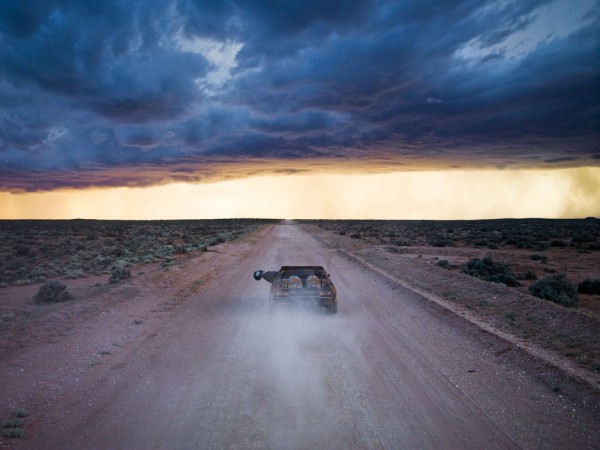
Shaun Gladwell, Interceptor Surf Sequence 2009. All images courtesy Wadsworth Atheneum

Anytime an artist brings in their own hobbies, it seems we then have to call it a form of pop art. Gladwell does directly engage popular movies in his MADDESTMAXIMVS series (2005-2009). After recreating Max’s Interceptor, he filmed two almost identical videos of an black-clad anonymous outlaw surfing on the top of the moving car. These two parts of Surf Sequence, one shot on a clear day and the other in front of a storm, were filmed in slow-motion, elongating the activity and emphasizing the surrounding landscape. This leads the audience to consider both the action and the surrounding Australian landscape.

There is a remarkably different feeling in his Apologies 1-6. Instead of being the outlaw engaged in risky behavior seemingly for fun, the outlaw now is following truckers in the outback of Australia, removing and caressing the resulting roadkill. The kangaroos that he picks up immediately echo Joseph Beuys’s How to Explain Pictures to a Dead Hare, but there is an additional layer here in that he is still portraying his Mad Max character. Is there a soft-side, an empathetic and socially liberal message in Mad Max that I don’t remember? The outlaw in Gladwell’s Apologies is an almost mushy, a gently affectionate human who spends time caring for these dead animals that have fallen at man’s mercenary hands.

Shaun Gladwell, Apologies 1-6, 2007-09

Gladwell is presumably carving out a space for the extreme sports enthusiast to have these feelings. Instead of just being a reactionary, everlasting man-child, Gladwell inserts an adult concern into this video game character stereotype. It would be impossible to simultaneously be a thinking person and a slave to the x-games formula of masculinity. Gladwell’s video still of a soldier balancing his gun on his hand allows another inquiry into masculinity. The pigeonholed roughneck is shown in a more casual playful note. Instead of considering the scars left behind by war, in the manner of Sophie Ristelhueber, Gladwell is offering up a quiet moment of humanity that looks foreign as a soldier.

The gun in this film still is similar to the prosthetic devices (skateboard, stilts, and crutches) in a trio of videos culled from his Pataphysical suite. These images of humans using tools to spin returns to his interest in extreme sports, but instead of placing the artist at center, he films hired performers to enact these physical actions.

Shaun Gladwell, Pacific Undertow Sequence (Bondi), 2010

His most most recent video on display, Pacific Undertow Sequence (Bondi) brings all these themes together. Gladwell sits on a surfboard, but something looks strange about this. What’s going on is that he is upside down, the sun is below him; the light is coming from the bottom to top, he has to lean down to get air, and the waves we see crashing are the undertow of each wave. Gladwell is engaged with an extreme sport again, but instead of being macho and powerful master of improbable motion, he is at the impulses of the tide. Underwater, unable to breath freely, his athleticism keeps him alive. There is another subtle symmetrical landscape with another single actor. Present again is his connection to the outdoors but it doesn’t function on a literal level, have a pedantic message to get across, or refer to a single device. It’s more physical and powerful than conceptual. Trying to sit still on a surf board might be his most vigorous work yet and his most understated.

Matrix 162, Shaun Gladwell is on display at the Wadsworth Atheneum Museum of Art, Hartford CT from June 2- September 18, 2011

Share

Art in Limbo

It’s true.  The state of Utah now owns Spiral Jetty.  For the last decade, the Dia Foundation has paid Utah’s Department of Natural Resources $250 a year to maintain the 20-year lease on the land surrounding the earthwork.  In February, the Dia received and paid its annual invoice, only to have the payment returned in June with a note that the lease had expired—a fact that had somehow escaped everyone’s attention, including the DNR’s.  According to an article by Jennifer Dobner of the Associated Press, the oversight may have occurred due to the fact that the DNR’s Sovereign Lands coordinator, Dave Grierson—the man who should have sent Dia a notice about the lease renewal—passed away last year.  Conspiracy theories about drilling aside, the Dia maintains that it has a “collegial” working relationship with the DNR and that they are in the process of re-negotiating the lease.  But for the moment, the Jetty belongs to Utah, a fact that has the art community unsettled.

Robert Smithson, Spiral Jetty (1970). Image copyright Danielle Sommer.

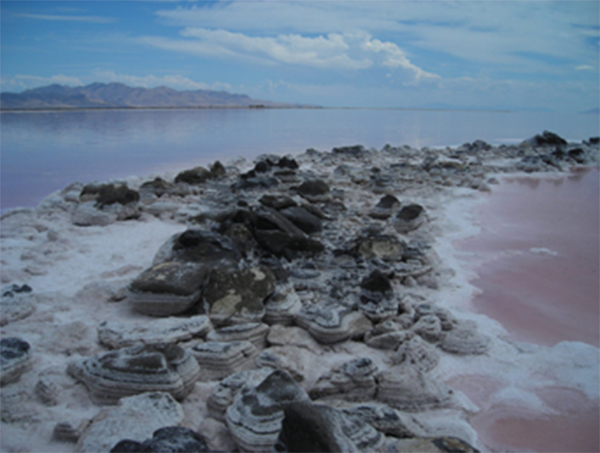
I first visited Spiral Jetty in August 2007, thirty-seven years after Robert Smithson installed it and thirty-four years after his death. I’d heard that the water level was low enough that the jetty was visible again, so I made a point to visit it on my way from Portland, Oregon, to Chicago, Illinois. I’d seen photographs, as well as the film of the construction that Smithson had made with his wife, Nancy Holt, but the physical experience caught me unprepared. Visiting Spiral Jetty in the flesh provides an experience of time unlike any other. Everything seems to halt, even as it remains in motion.

Robert Smithson, Spiral Jetty (1970). Image copyright Danielle Sommer.

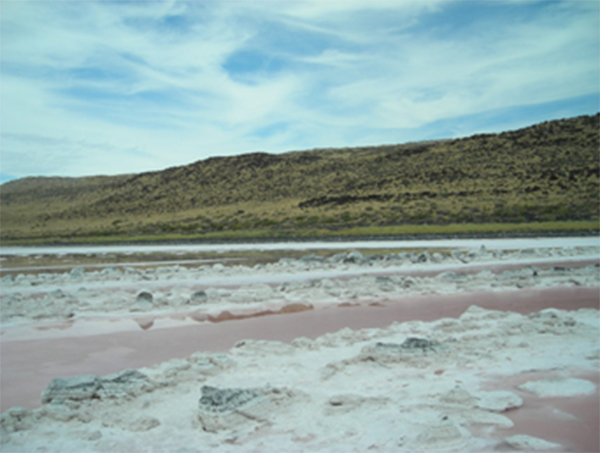
My approach via the long dirt road was almost exactly the same as what Smithson depicts in his film: the loud noise of a metal carriage on a washboard road, the horizon line of Wasatch Range, the dust pouring out from behind me. For a long while the lake maintains its distance, and then all of a sudden you are upon it. I expected to see Spiral Jetty immediately, but this is not actually the case; first you need to pass a half-submerged fence, and then a derelict oilrig.  After seeing so many pictures where the Jetty fills the frame, its smallness compared to its surroundings was a little startling, but not nearly as startling as the color palette: the sky was blue, the lake was pink, and the jetty, a bright, bright white. Whereas in Smithson’s photos and film, the Jetty is the brown and gray of newly excavated dirt and rock, the Jetty I saw that day was encrusted with salt. Gleamingly white. Sunglasses white.

Robert Smithson, Spiral Jetty (1970). Image copyright Danielle Sommer.

What was most striking, however, was the silence.  Obviously, the sounds of the city were missing.  But so were the sounds of things like birds and insects.  Finally, after five or so moments of standing, listening to the vast and deep nothing, I could hear a splish-splash, like a tiny, passive kid waving his hands around in the bathtub. I couldn’t figure out where it was coming from, mostly because my sense of how far sound could travel in this area was drastically off. That is, until I heard a swish-swoosh, swish-swoosh that turned out to be scores of pelican wings flapping in unison.  There are rookeries nearby, and if you’re visiting at the right time of year, you can see—and hear—the pelicans passing back and forth overhead as they search out food, or just paddling about in the water. I heard them coming for over a minute before I actually saw them.

Robert Smithson on the Spiral Jetty (1970). Photograph by Gianfranco Gorgoni.

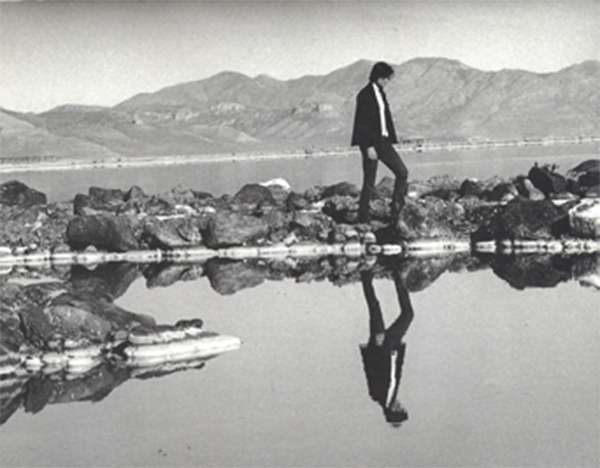
After the silence welled up again, I spent an hour or so walking Spiral Jetty, the sound of my feet crunching against salt crystals occupying the silence. From the jetty’s center, you see the earthwork from an entirely different perspective, losing any synthesized, overall view.  There are a few angles available in the story of Dia’s kerfuffle, including a level of bureaucracy that many of us find chafing.  Then again, most of us wouldn’t be able to manage the kinds of projects that Smithson and his ilk pulled off, which often involved negotiation with all varieties of publics. There’s also the awkwardness of having to put one’s faith in a gentleman’s handshake, which is where the fate of the Jetty currently sits.  I’d like to believe that Robert Smithson would find the whole situation at least a little humorous.  After all, his number-one articulated interest was the disintegration of systems. Then again, what a man articulates to be his main intellectual purpose and what he chooses to do when his livelihood is threatened rarely match up.

Share

Alec Soth’s Broken Manual

Many of us, at one point, have felt near our breaking point with the life we live and the sacrifices we have to make in order to even have that life. Escaping our day-to-day, or “the man” at large is at times the sweetest fantasy. Through a collection of portraits of the lives of men who have removed themselves from society,  Alec Soth’s Broken Manual asks of the viewer to reconsider the social standards that we take for granted and blindly accept in our lives.

Alec Soth, 2008_02zL0189 (leprechaun man), 2008, Edition of 7 + 3 AP, Archival pigment print, 40,6 cm x 50,8 cm / 16 x 20 inches, Courtesy Loock Galerie, Berlin

The images make these men and their more basic living situations heroic. One man, depicted with religious garb and standing among a thicket of trees, becomes a nobleman in search of a purer way of life to get closer to god. Another, of 2007_10zL0006 (I love my Dad), seen only through his impact on his ramshackle house, appears to have gone on a self-prescribed psychological retreat to assess his familiar relations without burdening others with his problems. A survivalist to be sure, one’s new accommodations consist of a blanket on the ground and jerry-rigged electricity overhead. Simple living at its best…?

Alec Soth, 2007_10zL0006 (I love my Dad), 2007, Edition of 7 + 3 AP, Archival pigment print, 101,6 cm x 127 cm / 50 x 40 inches, Courtesy Loock Galerie, Berlin

What reinforces the show’s conceptual ideas is how Soth has aligned his process accordingly. Traditionally, there are certain formal rules about how a photograph should be displayed. Standardizing decisions such as matting, framing, processing techniques, and scale across an entire show can formally tie images together quite easily, but limits the ability of each individual image to speak for itself, within and without the show. Soth, however, has subverted these common notions about Photography to some extent, by considering what presentation techniques best serve each photo within the show’s larger narrative.

Variety in colour, saturation and lighting elicit emotional connections with the subjects of each image. Some are sombre and reflective, or matter-of-factly objective while others have a hint of the fantastic. One can see, throughout the show, the deliberateness of Soth’s artistic choices in conveying the notion that it is important to ask why and take agency of our own situations rather than follow the path that some faceless majority has established as “the way”.

Alec Soth, 2007_05zL0059 (Edsel's stick), 2007, Edition of 7 + 3 AP, Archival pigment print, 76,2 cm x 61 cm / 24 x 30 inches, Courtesy Loock Galerie, Berlin

Where this is most apparent is with his black and white images of objects, such as 2007_05zL0059 (Edsel’s stick). The presentation of these objects transforms them into relics or historical documents, and angle Soth as some sort of anthropologist, respectfully investigating these subjects and their alternative lifestyles. At first glance, they may seem out of place in a room full of picturesque vistas and men with little facial expression. Without them, however, Soth’s position may appear somewhat exploitative or voyeuristic, and may prevent the viewer from experiencing reverence for the subjects. It is in this manner that Soth has sculpted the narrative of exhibition into complex reflections on life and managed to engage in and question the common practices of the medium he employs.

On view at Loock Galerie until July 23, 2011.

Share

Happy Independence Day

Happy Birthday America. This year at the 2011 Venice Biennale, Allora & Calzadilla are making sure we stay lookin’ good in our old age.

Alora & Calzadilla, Gloria, 2011.

Share

From the DS Archives-Bill Viola: Bodies of Light

This Sunday, From the DS Archives features internationally recognized video artist, Bill Viola. Viola’s 1996 work The Messenger - a video installation commissioned for Durham Cathedral  in North East England where it was initially installed – is currently included in the group exhibition Videosphere: A New Generation at the Albright-Knox Art Gallery in Buffalo, NY.

This article was originally written by Rebekah Drysdale on November 4, 20o9.

bill viola

Internationally acclaimed American artist Bill Viola has worked with video for over 35 years, creating immersive installations that surround the viewer with image and sound.  Driven by interests in sense perception, collective memory, subjective thought, and the universality of the human experience, Viola has produced videotapes, architectural video installations, and flat panel video pieces, as well as works for television broadcast.  His practice, stunning in its scope and technological sophistication, has greatly expanded the breadth of the medium and has helped to solidify video as a viable form of contemporary art.  His current exhibition at James Cohan Gallery in New York, Bodies of Light, which opened on October 23rd, includes a large video/sound installation as well as several flat screen pieces from the Transfigurations series, his most recent body of work.

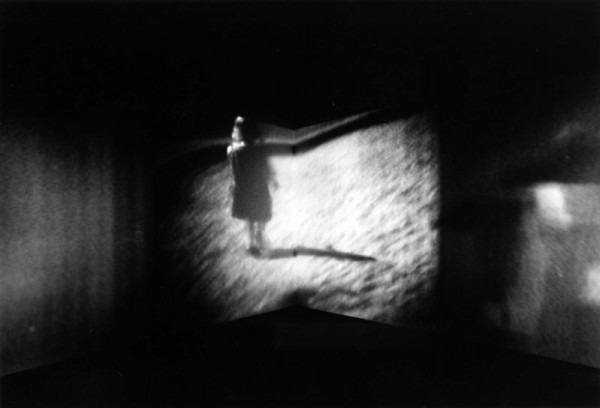
Pneuma, one of Viola’s signature full room installations, is situated in the main gallery space at James Cohan.  Bodies of Light marks the New York premiere of the piece, which was originally created in 1994 and updated in 2009. Pneuma consists of three channels of black and white High-Definition video projected into three corners of a square space, accompanied by three channels of amplified sound, resulting in a constantly shifting sound field.  In the darkened room, viewers encounter monochromatic images that alternately emerge and disappear from the projection space.  These images do not refer to any particular place or event, but function like memory and only allude to recognizable forms, triggering emotional response within the viewer.  The title of the work, pneuma, is an ancient Greek term that has no modern linguistic equivalent.  It refers to a vital force that animates the human and natural world.

bill viola
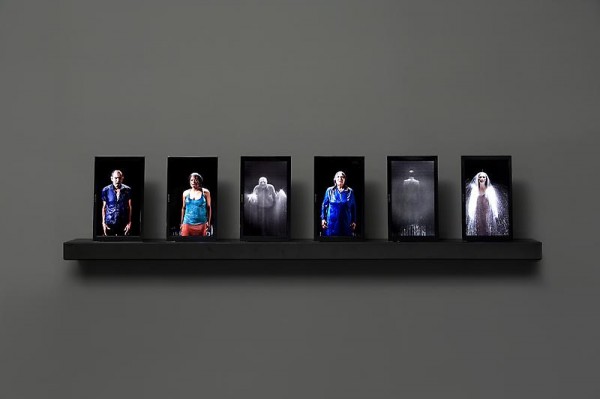
The Transfigurations series originated with Ocean Without a Shore, a piece created for the 2007 Venice Biennalewhere it was shown in the 15th century Church of San Gallo.  The works in the series depict mysterious black-and-white figures, recorded in grainy analog video, emerging from complete darkness to walk through a thin veil of water into a realm of clarity, color, and light.  Images recorded with an old surveillance camera slowly blend into those shot in High-Definition as the figures pass through the water screen.  The works being shown from this series areAcceptance (2008), Incarnation (2008), The Innocents (2008), and Small Saints (2008).

Viola’s works have been exhibited worldwide and are included in the collections of several international museums and important private collectors.  In 1997, the Whitney Museum of American Art organized Bill Viola: A 25-Year Survey that included over 35 installations and videotapes and traveled for two years in the United States and Europe.

Bodies of Light will remain at James Cohan in New York until December 19, 2009.

Share

The Greatest Disappearing Act

Today’s article is brought to us from our friends at Flavorwire, where Caroline Stanley discusses the greatest disappearing act, the art of Liu Bolin.

Liu Bolin, Hiding in the City No. 93 – Supermarket No. 2, 2010. Photo courtesy of Eli Klein Fine Art

Beijing-based artist Liu Bolin is the master of blending in with the world around him — no matter what the environment. Which is ironic, considering as he explained to The Daily Mail last year, “The inspiration behind my work was a sense of not fitting in to modern society and was a silent protest against the persecution of artists… My work is a kind of reminder, to remind people what the community we live in really looks like, and what kind of problems exist.”

In The Invisible Man, his third solo show at Eli Klein Fine Art, Liu’s self-camouflage skills are prominently displayed in a series of large-scale photographs — snapped both in his home country and during a recent trip to Italy — which take up to 10 hours each to complete. The artist has also spent the past month working on a new series, Hiding in New York, which will make its official debut later this year. Click through to preview a few images of Liu Bolin disappearing around NYC, as well as some of our favorite pieces from the show up at Eli Klein through August 28th.

Share

Cover Art

L.A. Expanded: Notes from the West Coast
A weekly column by Catherine Wagley

Pipilotti Rist, "Sip My Ocean," 1996

Within the past five years two all-male bands have covered the ire-raising, too-sweet-for-comfort single by The Crystals, “He Hit Me (And it Felt Like a Kiss).” Carole King and Gerry Goffin purportedly wrote the song after learning singer Little Eva had been beaten, multiple times, by her boyfriend, though Eva claimed the beatings were motivated by love. Phil Spector produced the song in 1962, letting not a note of irony seep through. “If he didn’t care for me/I could have never made him mad/He hit me and I was glad”: the song’s seeming sincerity and the near gleefulness of its sound got it banned on radio stations around the country. It justified victimhood, claimed powers-that-be.

The Blackeyed Susans’ 2009 rendition, called “She Hit Me,” nearly purges the song of it’s tooth—the “she” doing the hitting seems hot-tempered perhaps, but otherwise fairly tame. Grizzly Bear’s 2007 cover keeps “He” as the pronoun, and quiets the song. The man-on-man violence it evokes seems to play out on a leveler field, and the moodiness of the vocals come from a place of personal darkness rather than abused submission. Certainly, neither cover vindicates the female protagonist trapped in The Crystal’s original recording.


Rosha Yaghmai, "Love Forever," 2011, Fiberglass, gel coat, resin, enamel, steel 34 x 77 x 54 inches.

Covers are complicated projects. They let you be a fan, but also a collaborator, a history changer or, sometimes, a subverter. Musicians take them on far more freely than visual artists do; artists tend to prefer “appropriation” when feeling cynical and “homage” when feeling affectionate. But there have been a few memorable art covers, the most compelling of which may be Pipolotti Rist’s Sip My Ocean (1996), a two-channel video installation of a body in water. The soundtrack is Rist singing Chris Isaak’s stiflingly smug Wicked Game, and if you look for her cover on iTunes, you’ll find it under “I’m a victim of this Song.” Around minute three, you hear a screaming echo in the background that sounds like it’s trying to break free of the song’s over-sentimental structure: “No, I don’t want to fall in love,” it crows.

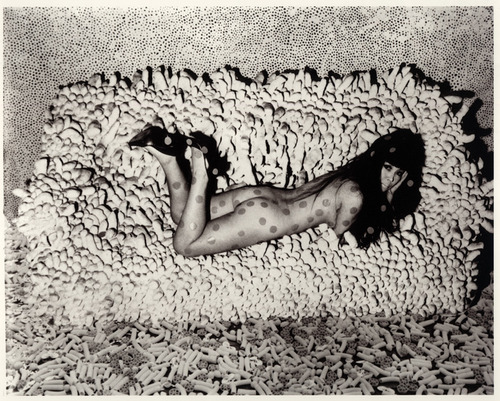
In her current solo exhibition at Thomas Solomon Gallery in Chinatown, Ever let the fancy roam, artist Rosha Yaghmai takes a less far less hostile approach to covers than Rist. She covers self-described Japanese “obsessional artist” Yayoi Kusama in a sculpture called Love Forever, which takes its title from Kusama’s 1998 MoMA retrospective and its form, in a pared down way, from  Accumulation No. 2, a couch covered in white protuberances.

Yayoi Kusama, Accumulation No.2,

Yayoi Kusama, "Accumulation No. 2," 1968.

In a 1999 interview with BOMB Magazine, Kusama explained, “As an obsessional artist I fear everything I see. At one time, I dreaded everything I was making. The [furniture] thickly covered in phalluses was my psychosomatic work done when I had a fear of sexual vision.” This nightmarish quality is all but gone in Yaghmai’s fiberglass form, a smooth white body that look more like the ghostly sheets thrown over furniture in old houses than a sofa itself. It’s gentle and protuberance-free, and mainly just reinforces its title: love for Kusama, and for the tactile appeal of lovingly crafted physical objects, will continue forever.

If it’s unnerving when a cover of a song as implicitly brutal as “He Hit Me” tames or even overlooks that  brutality,  it’s also unnerving when a re-imagining of work as aggressive and textured as Kusama’s is quiet and smooth. But Yaghmai’s  sculpture seems honest; smoothness is where Kusama’s influence belongs in her mind, and maybe the real question to ask is, how can aggression fade into smooth beauty over time and does this fading mean we’ve lost something or gained something along the way?

Share