All Artists are Punks…or Hippies

L.A. Expanded: Notes from the West Coast
A weekly column by Catherine Wagley
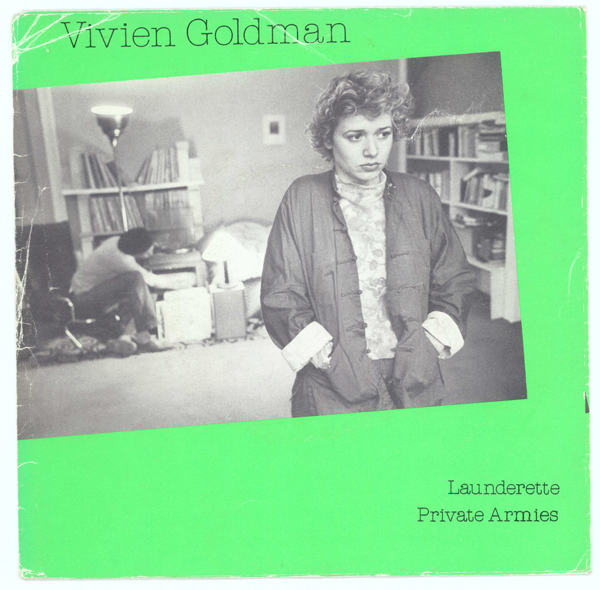
Album cover by Vivien Goldman, moderator of last weekend's Punk Panel at Honor Fraser Gallery.

On Saturday, July 16, Honor Fraser Gallery in Culver City hosted a panel on Punk. The panel preceded the openings of two shows, one an earnest exploration into punk’s visual precedents and antecedents, and the other an extravaganza of posters, bills, and graphics from the Punk movement of 1970s Britain. The Punk panel, chaired by Vivien Goldman, who has been a writer, performer, scholar and manager—she’s recently written a book on reggae—included a surprise guest who came in and put his motorcycle helmet on his chair about ten minutes after the panel’s scheduled start time.

Linder, "Pretty Girl I 1977/2006," Pigment print of original artwork, 7 x 9 2/5 inches, Edition 1 of 5. Courtesy Honor Fraser.

This surprise guest was Billy Idol, one of the more accessible of the punk rockers who started out in Britain’s scene. He had his signature leather, sunglasses and spikey hair, and, when the panel finally started, a lady in the front row went on to take a good few hundred photographs of him. A few others were making cell phone videos. But the woman next to me, chicly dressed and probably in her sixties, handed me a paper and asked if I could please write down the name of the man with the sunglasses so she could remember.

Billy Idol does not qualify as obscure, but many of the bands whose posters are plastered to the walls of Honor Fraser—the Slits, for instance—remain utterly unknown in certain circles. But their provocateur posture and moody DIY aesthetic will, I assume, strike most in the Western world as familiar.

A professor I had in grad school used to say all artists are either punks or hippies. My classmates and I spent a lot of time picking out who was who, and it’s harder than it sounds. Are you a hippie just because you use organic shapes and found materials? And are punks more defiant and streamlined? Can you be a concise hippie? Can you be an earthy punk?
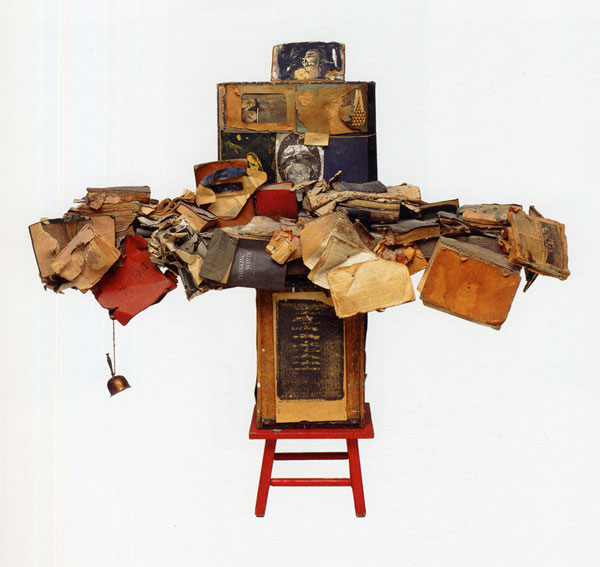
George Herms, "The Librarian," 1960.

A show that brings hippies and punks together in a concert of dissonant materials is the George Herms: Xenophilia (Love of the Unknown) exhibition that just opened at MOCA. Herms, a California artist who came up with no-holds-barred assemblage artist Ed Kienholz in the 1960s, has always had a slightly more elegant approach to gritty found object sculpture than his burly peer. The MOCA show puts some his early and later works into conversation with a number of 21st century artists, among them Amanda Ross Ho, Kaari Upson, Sterling Ruby and Elliott Hundley. Upson and Ruby are definitely punk; the blatant way they use ceramics and plastics feels insidious, unapologetic and almost dirty. Hundley is a hippie. His hanging sculpture is too organic and comfortable with itself. It has no bone to pick, but it’s painfully self-aware. Others, I can’t quite tell. What about the sprawling canvas made by Dan Colen, Agathe Snow and friends that looks like Sam Francis’ take on Warhol’s flowers? Even Ross Ho’s haphazard installation has a hippy-like mood, but a punk resistance to having meaning’s imposed on it. Whichever it is, the Herms show really does have a great, nonsensically collaborative mood to it, and I highly recommend a visit.

Share

Live your questions now

Live your questions now is a survey exhibition of artists over 60 years old at the Mackintosh Museum of The Glasgow School of Art. The title is taken from a quote by Rainer Maria Rilke, on responding to the uncertainties of life by living out one’s questions, opening the possibility of living one’s way into the answer. Within the exhibition, several artists  reflect on the intersections between art and life through the way the body, metaphorically and physically, is experienced and located in space.

Sam Ainsley, (Left) Untitled, 2011, dimensions variable; (Right top) The darkened splinterecho brainstream tide..., 2011, acrylic paint and print on canvas, 102 x 102 x 7cm; (Right bottom) Where there are hopes, there will always be fear, 2011, acrylic paint and print on canvas, 102 x 102 x 7cm; courtesy of Mackintosh Museum

Sam Ainsley’s (b. 1950, lives and works in Glasgow) works convey the relationship of the body to larger spatial contexts, in ways that express the psychological state. Against the corner of the gallery, Untitled comprises two outlines of Scotland with a successive sequence of word associations, such as “insecurity, knowing, disbelief, belief, love…” written around the perimeter. Viewed from a distance, the outlines appear as lungs of the body with the words as capillaries, making the emotions expressed by the words as the lifeline that courses through the country.

Lygia Pape, Tteia 1.A, 2011, gold thread, copper nails, 314cm x 321cm; courtesy of Mackintosh Museum

In the other corner of the gallery, the viewer’s body becomes the medium of experience between material and space in Tteia, or web, by Lygia Pape (Brazil, b.1927, d.2004). Assembled from a set of instructions, gold thread is strung to form a fluid and seamless structure that wraps, compresses yet also enlivens the spaces within and around. Pape was part of the Concrete movement and its reaction, Neo-Concretism, that sought to integrate a work within space as a reflection of how art functions in life, in way that opened the role for the viewer’s physical interaction and interpretation.

Helena Almeida, (Left) BAÑADA EN LÁGRIMAS #14, 2009, framed black and white photograph, 175 X 114.4 X 4.7 cm, (Centre) BAÑADA EN LÁGRIMAS #13, 2009, framed black and white photograph, 175 X 114.4 X 4.7 cm, (Right) Untitled, 2010, video, b&w, sound, 18', edition of 5; courtesy of Mackintosh Museum

This Neo-Concretist approach towards art-making influenced Helena Almeida (Portugal, b.1934), whose photography and video works have experimented with means to extend elements, from colour or the body, out of a confined space. Two photographs from the series BAÑADA EN LÁGRIMAS, or bathed in tears, are of Almeida encountering her reflection in a pool of water on the ground. The photographed action enlarges the space and view above Almeida, as a window to the world beyond the physical limits of the frame.

Against the backdrop of a rising number of survey shows of young contemporary artists, Live your questions now presents artists whose lives, as seen through their practice across decades, bear out philosophical challenges through persistent inquiry. The exhibition runs till 1 October 2011, and also includes works by Alasdair Gray, Joan Jonas, Ana Jotta, Michael Kidner and Běla Kolářová.

Share

Idols and Icons

Lale Tara, Innocent Surrogates, 2010. Medium : c-print Size : 90 x 120 cm, 127 x 190 cm. Photo: Yavuz Fine Art Gallery.

It is often that the photographic lens exemplifies the artistic genius behind the camera as much as the subject that it photographs. That’s not to say that this process is inapplicable to any other form of art production. But if it is only for the pictorial expression of eternal spiritual truths that justifies the existence of icons (and idols), the photography of belief systems – because of its capability to record time and place yet simulate the real – inches towards the profane. Treading this fine line is Idols and Icons: New photography from Asia & the Middle East, a photography exhibition that examines tropes of faith, ideology and theology by producing what is presumed to be too sacred for reproduction.

Manit Sriwanichpoom, Masters, 2009. Gelatin silver print. Installation View, Yavuz Fine Art Gallery.

With Masters (2009), Manit Sriwanichpoom of the Pink Man fame returns with a photo series of cross-legged monks in meditation, modelled after those who situate themselves in Thai temples receiving alms from the Buddhist faithful. However, Sriwanichpoom’s lens deceives; the blurred life-sized portraits are amulet-type mass-produced objects readily sold in shops, akin to mass-marketed paraphernalia typically associated with cult celebrity behaviour. Masters unapologetically continues Sriwanichpoom’s acerbic photographic critiques of Thai contemporary consumerism, and suggests that the fetishisation of these idols – a non-existent tenet of Buddhism – pushes commonly held religious beliefs into a new, corrupted reality.

Ampannee Satoh, Burqa, 2010. Medium : pigment print on paper Size : 120 x 120 cm, 150 x 200 cm, 120 x 180 cm, 150 x 300 cm. Photo: Yavuz Fine Art Gallery.

Issues of ethnicity and gender are equally prominent grounding anchors in the show. Ampannee Satoh’s Burqa series (2010) visually reduces the conflict to 2 symbols of opposing ideologies: burqa-clad women who stand against Parisian monuments endowed with an idealised republican rhetoric that finds itself reiterated these days (particularly because of the Islamic dress – a clichéd but key signifier of a clash of civilisations that separates public and private boundaries), in the French parliament. Shadi Ghadirian’s Miss Butterfly (2011) is a series of photographs in which a solitary woman weaves a web across several domestic settings, reclaiming the female agency’s dominance in the household while simultaneously suggesting its relentless and inescapable grip.

Shadi Ghadirian, Miss Butterfly, 2011. Medium : c-print Size : 70 x 105 cm, 100 x 150 cm. Photo: Yavuz Fine Art Gallery.

While commonly employed as a discursive indicator of power relations, the feminine figure’s iconic status is far from formulaic. Outside the virtuous woman’s conventional role as the domestic exempla, Lale Tara’s Innocent Surrogates’s (2010) human-sized female doll-subjects inhabit the main frame of the photograph, located – not unlike a medieval tapestry or a painting – within a border of votive reverence. Almost sacramental, suitably dramatic with some measure of artifice, Tara’s dolls occupy, in good unheimlich fashion, conflicted and malaised positions of transgression that cathartically play out our own repressed enjoyments.

Idols and Icons will be on view at the Yavuz Fine Art Gallery until 27 August 2011.

Share

Dreams and Disillusion in the Met’s After the Gold Rush

Well, I dreamed I saw the silver spaceships flying

In the yellow haze of the sun

There were children crying and colors flying

All around the chosen ones

All in a dream, all in a dream

– Neil Young, After the Gold Rush, 1970

Recent contemporary photography, particularly examples frequenting the walls of major museums, often seems drained of political poignancy, given over instead to aesthetic and commercial concerns: epic scale, vivid color, and the elastic potential of digital manipulations. But if the traditional—and vital—imperatives of documentary photography have been superseded by the tropes of high art, a compelling show at the Metropolitan Museum of Art rethinks the terms of this transformation.

Laurie Simmons (American, born 1949) Walking Gun, 1991 Gelatin silver print The Metropolitan Museum of Art, Purchase, Anonymous Gift, 1998 (1998.440) © Laurie Simmons

After the Gold Rush: Contemporary Photographs from the Collection is on view in the Met’s dedicated space for modern photography, a short walk from the snaking lines of viewers patiently waiting for a turn in the dramatically presented Alexander McQueen exhibition. As Associate Curator Douglas Eklund writes in the introductory text, the 25 pictures gathered together represent the first time this space has engaged directly with the state of the world, our ‘culture at large’. But this is a show as much about the state of the medium, and about the commitment of the museum to represent the diversity of photographic practices. All of the pictures here have been made in the last three decades, and many of them are recent acquisitions.

Hans Haacke (German, born 1936) Thank You, Paine Webber, 1979 Gelatin silver print and chromogenic print The Metropolitan Museum of Art, Purchase, Vital Projects Fund Inc. Gift, through Joyce and Robert Menschel, 2010 (2010.416a, b) © Hans Haacke

The show juxtaposes more obviously politically potent work from the era of the culture wars with more recent conceptual work. The appropriated and re-configured text and images from a corporate annual report in Hans Haacke’s Thank You, Paine Webber, 1979, points to the absurdly feeble attempts of corporate America to sooth its collective conscience, and the constructed, surreal violence of Laurie Simmon’s Walking Gun, 1991, calls up an active resistance to gender inequality that is strikingly powerful if somehow also nostalgic for a time when such imagery felt more like a loaded gun.

After the Gold Rush: Contemporary Photographs from the Collection The Metropolitan Museum of Art March 22, 2011 – January 2, 2012 Images © The Metropolitan Museum of Art

Moyra Davey’s Copperhead Grid, 1990, anchors the room, ten neat rows showing the decaying surfaces of American pennies, an elegy for the economy.

Adjacent to it, an early Jeff Wall, The Storyteller, 1986, sits casting its signature glow in the corner. Despite its contextual relevance here—it shows a group of Vancouver’s down and out gathered by a looming overpass—it is still a kind of elephant in the room, edging out some of the work around it by sheer girth, and foretelling the waning of the artist’s own political interest and the general shift in tone his brand of ‘museum’ photography has led.

After the Gold Rush: Contemporary Photographs from the Collection The Metropolitan Museum of Art March 22, 2011 – January 2, 2012 Images © The Metropolitan Museum of Art

But the show also offers the possibility of a sea change, or at least a subtly altered, more socially engaged institutional perspective on recent work.

The state of war and US military strategy is the subject of two very different pieces. Trevor Paglen’s work uses sophisticated technology to track covert American military activity, often resulting in abstractions of captured light—in this case, KEYHOLE IMPROVED CRYSTAL from Glacier Point (Optical Reconnaissance Satellite; USA 186), 2008, shows a streaking satellite purportedly on a reconnaissance mission somewhere above Yosemite. A recent work by An My Lê, in contrast, shows detailed images of its titled subject, Suez Canal Transit, U.S.S. Dwight Eisenhower, Egypt, 2009, that invite close examination. Sequence and perspective, however, are intentionally confused, destabilizing any feeling of a fixed point of view.

After the Gold Rush: Contemporary Photographs from the Collection The Metropolitan Museum of Art March 22, 2011 – January 2, 2012 Images © The Metropolitan Museum of Art

On the wall opposite, one of James Casebere’s meticulously photographed cardboard constructions has never seemed so fragile or so perfectly chosen a subject. In this model, Landscape with Houses (Duchess County, NY) #1, 2009, shows a complex of suburban dream-houses, the likes of which we have seen vanished in the recent housing market collapse.

James Casebere (American, born 1953) Landscape with Houses (Dutchess County, NY) #1, 2009 Chromogenic print The Metropolitan Museum of Art, Purchase, Alfred Stieglitz Society Gifts, 2011 © James Casebere

Like the repetition of Davey’s pennies and these rows and rows of houses, and despite the inevitable encroaching visual power of each piece on one another, the pictures in this room undeniably gather force together. The gallery space is occupied by their collective energy: violence, decay, suspicion, and the slow-burning failure of late capitalism.

A constellation of images by Wolfgang Tillmans (who was involved in their arrangement), including a sleeping baby and Shanghai’s TV tower, ends the show in a glittering attempt at restoring some meaningful connection to the alienated world pictured in the surrounding room.

Wolfgang Tillmans (German, born 1968) Oriental Pearl, 2009 Inkjet print The Metropolitan Museum of Art, Purchase, Vital Projects Fund Inc. Gift, through Joyce and Robert Menschel, 2010 Image courtesy the artist and Andrea Rosen Gallery, New York © Wolfgang Tillmans

As in the three-verse Neil Young song it invokes, the idyllic past and dystopian present conjures an irrevocable passage that leaves space only for a dream of a possible future.

After the Gold Rush: Contemporary Photographs from the Collection also includes work by Gretchen Bender, Philip-Lorca diCorica, Robert Gober, Katy Grannan, Curtis Mann, Adrian Piper, and Christopher Williams. It is on view at the Metropolitan Museum of Art until January 2, 2012.

Share

Best of the Bay? Bay Area Now 6.

Writing about “Bay Area Now 6” calls to mind the joke about the elephant described by six blind men. With 18 artists showing 98 objects, its identity depends on where you stand. This triennial survey of current art in the San Francisco Bay area is a leviathan, a potpourri of media, artists and diverse agendas. Making matters more difficult, Yerba Buena Center for the Arts—with its tunnels, balconies and hangar-like spaces—defies traditional notions of “exhibition.” Instead of “exposing” the works, these spaces bend artists to their will, and demand that the works exhibited respond to the various shapes and proportions of the environs, or suffer the consequences. Some works fare better than others.

In Stockpile (2011), Allison Smith treats the vast hall as a warehouse, creating an eerie stillness. Smith has stacked unpainted replicas of colonial American furniture—chairs, chests, muskets and tables—into a giant tower. Fresh ghosts, they come complete with packing crates, labels, and lengths of authentic period weaving. Despite her best efforts, the silent, monochromatic heap is dwarfed by the space. Crafted to human scale, the diminished pile references the inaccessible nature of human history, and perhaps also implies that “human scale” is increasingly irrelevant.

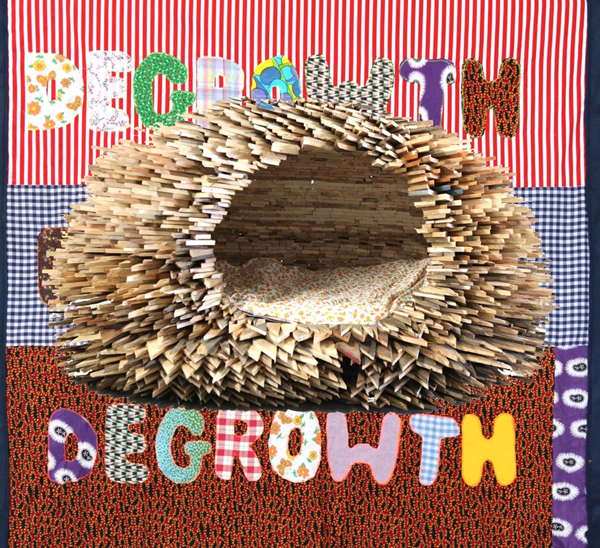
Suzanne Husky, "Sleeper Cell," 2011. BacKground, "Degrowth Quilt," 2011. Images by the artist.

Suzanne Husky and Brion Nuda Rosch each claim a mini-gallery space within YBCA’s main space. Like an anthropologist, Husky profiles practitioners of “Modernes Vies Sauvages”—rustic, off-grid lifestylers—and frames her investigations as her art practice.  In Sleeper Cell Hotel (2011), Husky installs several small huts, a reading area where one can research eco-activism, and a monitor with a looping eco-infomercial.  The huts, diminutive and pristine on the concrete floor, are bunkers-for-one, complete with woven quilts advertising “Degrowth.” Constructed of wood shakes and shingles with a hedgehog-like appearance, they are advertisements for a Thoreau-inspired lifestyle and a return to simplicity, and would be equally at home in the dirt and disorder at the Hayes Valley eco-activist farm and encampment that Husky researched.

Another of the mini-galleries houses a stunning collection of sculptures and collages by Brion Nuda Rosch. Carefully proportioned and constructed, the dozen totemic pieces covered with brown paint evoke both Joseph Beuys’s Braunkreuz sculptures and Brancusi’s studio installations. They are jammed together and positioned below eye level, so it is difficult to get a clear line of sight of any one sculpture, or of any of the elliptical photocollages on the walls. In the doorways of the tiny studio space, Rosch has also installed slender, L-shaped forms, like false lintels, so that a viewer must bow on entering, and bend to examine the works. If Rosch is recreating the claustrophobic crowding of his own studio against the background of the giant space, he has achieved a tour de force.

Upstairs from the main space, in a darkened gallery all his own, complete with motion detection sensors, Mauricio Ancalmo has installed Dualing Pianos: Agapé Agape in D Minor (2011). A giant rectangular loop of lace-like computer paper shapes the air, and passes through two Duo-Art player pianos, face å face, and a vintage word processer located midway between them. A cobbled-together affair with wooden rolling pins replacing its original rollers, the processor/typewriter is the heart of the triad. One piano is in tune, one out of tune.  The score moves through one piano and plays in reverse as it passes through the second. Occasionally, the pianos strike chords together, both dissonant and beautiful. The piece has a quiet, unpredictable meter and an aural spaciousness, which varies as viewers move around the space. Ancalmo collects and repurposes outmoded technological devices to create subversive and nostalgic narratives; this one feels like a conversation between old lovers—or a “dual,” not a “duel.” Lyrical and elegant, it is the star of the show.

Richard T. Walker, "the speed and eagerness of meaning," 2011, 3-channel video installation. Image courtesty Richard T. Walker and Christopher Grimes Gallery.

As a British artist currently working in the Bay Area, Richard T. Walker takes an enraptured look at the California landscape in his three-channel video, the speed and eagerness of meaning (2011).  Walker imports the great sweep of Joshua Tree National Park into his Yerba Buena space.  Uncannily evoking Glenn Gould’s video, “The Idea of North,” Walker’s is his “Idea of West.” A rambling philosophical voice-over seems off-kilter and pretentious as the artist stands in place with his back to the audience, facing the landscape à la Caspar David Friedrich. Unable, despite his rhetoric, to make sense of the beauty and vastness with himself in it, he builds a song instead, playing all instruments himself, overlaying one line of sound—drum, guitar, sticks, voice—over another, like the sedimentary layers of the stones in his landscape. It is his inchoate response to the grandeur and his own insignificance. A Brit, with fresh eyes, may see it all best.

Sean McFarland’s moody, dark photographs of foliage in Golden Gate Park, reminiscent of 19th-century paintings and photographs of the forest of Fontainebleau, suffer from reflective framing and poor location. No glass at all and a quiet room might have helped make them more visible. And Chris Fraser’s camera obscura, Developing a mutable horizon (2011), located at one end of the upstairs balcony, is so remote that this reviewer and a gallery guide interrupted a couple in flagrante delicto.

Chris Fraser, "One line drawing the view from my studio window, 2009-10," 2009, Light installation. Image courtesy Chris Fraser.

In the exhibition prior to BAN6, Song Dong spread the entire contents of his mother’s lifetime home on the floor of the great hall at Yerba Buena, arranged according to category. Both the vastness of the project and the scale of the minutiae served the space well, with the best viewing place being a little balcony that overlooked the whole. This aerial view would also serve work like Christian Boltanski’s great piles of clothing memorializing the Holocaust, or the historic airplanes from the National Air and Space Museum. But there is no easy bird’s eye view for the breadth of work being done around the Bay, nor any inner coherence. The hard-working viewer has to put it together. There are substantial rewards.

Share

From the DS Archives: Francis Alÿs, A Story of Deception

This Sunday, From the DS Archives features Belgium artist Francis Alÿs. On view through this month, Alÿs’ A Story of Deception will be on view in NYC at the MoMA. In 2010, the exhibition was featured at the Tate Modern in London and was covered by DailyServing’s Kelly Nosari.

This article was originally published on August 14th, 2010.

Francis Alÿs in collaboration with Olivier Debroise and Rafael Ortega. A Story of Deception, Patagonia, 2006 still from 16mm film (4:20). Courtesy of Francis Alÿs and Galerie Peter Kilchmann, Zurich © Francis Alÿs.

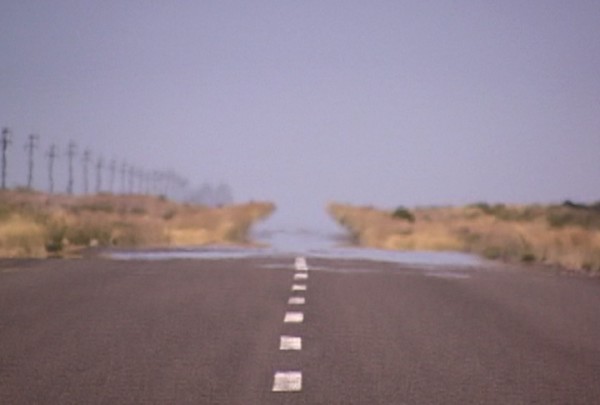
A Story of Deception is the title of Francis Alÿs‘ current retrospective on view at the Tate Modern. The title of the exhibition, which spans the artist’s two-decade long career is borrowed from a work of the same name, and appropriately provides the exhibition’s subtitle and introduces the gallery visitor to Alÿs’ work. The 16 mm film, A Story of Deception, captures a mesmerizing and unobtainable mirage on the horizon. The camera centers itself on a road, halved by a dotted white line and follows it across an arid Patagonian landscape. The film’s imagery and intent are oblique and deceptively simple – allowing a variety of creative, metaphorical interpretations. The road can be read as representative of a border and the unobtainable mirage as the often out-of-reach goal of border crossing.

Francis Alÿs, Ambulantes (Pushing and Pulling), Mexico City, 1992-present Slide projection. Courtesy of Francis Alÿs and David Zwirner, New York. Image by Francis Alÿs © Francis Alÿs.

While Alÿs is most readily associated with the film or video documentation of his actions, this retrospective takes care to illustrate the multi-media nature of the artist’s practice and is curated thematically. Film and video work is presented with related photographs, paintings, drawings or other ephemera. In one particularly successful example, Paradox of Praxis I or Sometimes Making Something Leads to Nothing (1997) is shown near photographs taken in Mexico City dating as early as 1992. These projected photographic images from the series Ambulantes (Pushing and Pulling) feature street vendors and workers bearing loads in the streets. The connection is evident between these photographs and Paradox of Praxis, in which Alÿs pushes a block of melting ice through the city’s streets. Both point to the often comical futility of contemporary labor.

The artist typically begins his work with an action, allowing other media to play a supporting or planning role, but that is not always the case. The artist works in a variety of media, including photography, sculpture, animation, drawing and painting. Paintings such as Le Temps du Sommeil (2003-present) and Silenco (2003-present) illustrate that Alÿs is influenced by urban advertising. They also reference the precedent – intentionally or not – of past artists like Magritte.

Film or video documentation of Alÿs’ carefully planned actions remain the most compelling and most capable of conveying both subtle and overt political messages. In Re-enactments (2000), Alÿs references the gun violence of his adopted Mexican homeland. When Faith Moves Mountains: A Project for Geological Displacement (2002) is one of Alÿs’ most well known works for its sheer monumentality. In it, the artist directs 500 volunteers to form a line and physically move a sand dune located outside of Lima, Peru. Armed solely with shovels and the spirit of collective effort, these volunteers complete a task whose apparent futility belies its profound metaphorical statement. This great effort of ‘geological displacement’ points to the immense shared burden of geo-political displacement.

The contemporary nation-state border, as a contradictory line that is both increasingly restricted and crossed, is an important theme in Alÿs’ art practice. The artist addresses the hypocrisy of the border in works such as The Green Line or Sometimes Doing Something Poetic Can Become Political and Sometimes Doing Something Political Can Become Poetic (2005) in which the artist walks the 1948 armistice border line between Israel and Palestine. Trailing a leaking can of green paint behind him as he walks a now defunct border, he quietly and profoundly points to the idiocy of human suffering caused by an arbitrary line of division. Loop (2007) chronicles the artist’s purposefully ludicrous route across the US – Mexico border as he travels from Tijuana to Australia, up the Pacific Rim to Alaska, and then finally to California. The epic route of travel taken in lieu of the actual distance between Tijuana and San Diego highlights the difficulty of this border crossing for illegal economic migrants. Also referring to the theme of border crossing, The Rehearsal (1999-2004) features a red Volkswagen Beetle that continually tries and fails to reach the top of a dirt road.

The exhibition makes a strong conclusion with the premiere of Tornado (2000-2010). This newly completed, 55 minute video documentation from hand-held camera footage was ten years in the making. It captures the artist as he places himself in the path of high-altitude tornadoes in Mexico – enduring severe winds and no visibility brown-outs in attempts penetrate the tornado’s central vortex where the air becomes eerily still. Alÿs places himself in peril – throwing himself blindly into chaos in hopes for resolution through the extraction of meaning. Or, as curator Mark Godfrey argues Tornado is again concerned with the border crossing and the immense difficulty of entering and leaving geo-political zones in our increasingly mobile world.

Francis Alÿs Tornado Milpa Alta, 2000-10 Video documentation of an action and related ephemera 55 minutes Courtesy of Francis Alÿs and David Zwirner, New York Image: Video Still © Francis Alÿs

Francis Alÿs: A Story of Deception remains at the Tate Modern until 5 September. The show’s next stop is Alÿs’ home country where it will be presented at Wiels in Brussels (9 October – 30 Janurary). The exhibition comes state-side next year to New York’s MoMA (8 May – 1 August 2011).

Francis Alÿs is represented by David Zwirner in New York and Galerie Peter Kilchmann in Zurich.

Share

The Life and Death of Marina Abramović

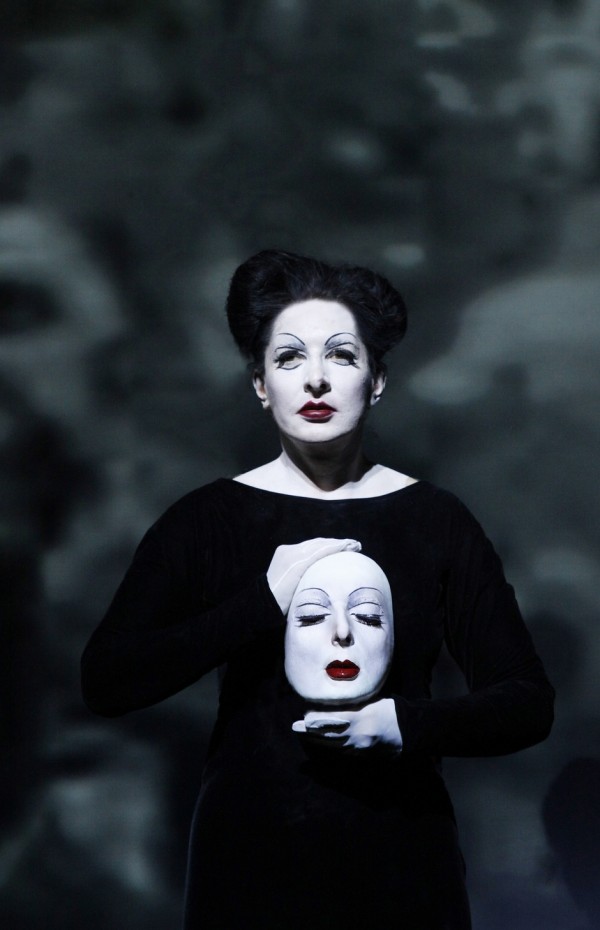
Robert Wilson, Marina Abramović, Antony, Willem Dafoe, The Life and Death of Marina Abramović, 2011. © Lucie Jansch

It is rare to see Marina Abramović without a mask. Not a physical barrier – as we know well, she often performs without a stitch of clothing or a smear of make-up. This covering is an emotional sheath – a rigid facade upheld throughout her work and her career even at the most vulnerable of moments. So it was beguiling to find here, under layers of theatrical makeup, staged dialogue, and highly elaborate scenes, a side of the artist unbeknownst to me. Astonished at how taken aback I was when Marina Abramović smiled did I then register the inconspicuous absence of such an expression.

Abramović’s work and life are inextricably linked and she has been creating biographical theatrical pieces since 1989 – remixed and reworked by a different director with each incarnation. For the Manchester International Festival, Abramović puts her life in the hands of director Robert Wilson who fragments her stories, and twists fact, fiction, dreams and nightmares into the fierce surrealistic theatrical production, The Life and Death of Marina Abramović.

Robert Wilson, Marina Abramović, Antony, Willem Dafoe, The Life and Death of Marina Abramović, 2011. © Lucie Jansch

Willem Dafoe is the Tim Burton-inspired narrator who punctuates Abramović’s life with abrupt revelations – ‘1948: Refusing to walk. 1964: Drinking vodka, sleeping in the snow, first kiss. 1969: She doesn’t remember.‘  The atmosphere is charged by the score written and performed by the infamous Antony who sings ‘Watch me. Hurt myself. It makes me. Feel so alive.’

Robert Wilson, Marina Abramović, Antony, Willem Dafoe, The Life and Death of Marina Abramović, 2011. © Lucie Jansch

In contrast to the uninflected and exhausting durational performances Abramović is known for, The Life and Death of Marina Abramović, is extravagant, sumptuous and highly dynamic, and reminds us of things we often forget – for example, that Marina Abramović is funny. The self-proclaimed ‘grandmother of performance art’ has a bone-dry sense of humour, exacerbated by her thick accent and peculiar sentence structure, and the ability to laugh at herself as we see in such elaborate scenes as those constructed around her childhood insecurities of her ‘big nose.’

Robert Wilson, Marina Abramović, Antony, Willem Dafoe, The Life and Death of Marina Abramović, 2011. © Lucie Jansch

However, this highly theatrical and absorbing production moves beyond the superficial to the nature of performance art, and the authenticities of those who perform. Here is an artist who has lived out her life in the public eye, and has given herself over completely to her art. As in the infamous The House with the Ocean View in 2002 and the 700 hour performance at The Artist is Present at MoMA last year, Abramović exists purely for the public. Her life is a series of replayed and remixed symbols and signs that construct the persona ‘Marina Abramović’ – played by an ecclectic cast of characters here.

Robert Wilson, Marina Abramović, Antony, Willem Dafoe, The Life and Death of Marina Abramović, 2011. © Lucie Jansch

In one of her Nightsea Crossing performances where she and Ulay sat across from one another motionless, excruciatingly trapped in their aching bodies, it was only in confronting death that Abramović was able to go on. Here, once again, in The Life and Death of Marina Abramović, she meets the inevitability of her eventual demise – a spectacle that, when the time comes, will likely rival the theatricality of this production. But in the meantime she will continue to embrace her life and move forward, in a charged way only one who has accepted death can do.

Share