Grounds for Annulment

L.A. Expanded: Notes from the West Coast
A weekly column by Catherine Wagley

Jeff Wall, "The Destroyed Room," 1978, Transparency in lightbox, National Gallery of Canada, Ottawa. © The artist. Discussed in Michael Fried's book.

When essayist Geoff Dyer, whose main goal always seems to be sating his own curiosity, debuted his New York Times book column last week, he did so with a perfectly paced takedown of art historian Michael Fried. Fried famously “exposed” the melodrama of minimalism in the late 1960s, and that’s what he remained known for until he discovered something new a few years ago: photography. The book that heralds this discovery, Why Photography Matters as Art as Never Before, argues the photograph has moved from the valleys to the precipice of contemporary art. It has become cutting edge, and artists like Jeff Wall and Thomas Struth are among its edgiest practitioners.

Why Photography Matters spends a lot of time reflecting on its author’s own critical legacy, announcing the relationship between Fried’s current and previous thinking and making sure readers know exactly which argument the book is about to make before said argument is made. It’s this preemptive announcement-making approach that Dyer dug into, caricaturing Fried’s tone, and ending by saying, bitingly, that someday Fried “will cross the border from criticism to the creation of a real work of art. . . called Kiss Marks on the Mirror: Why Michael Fried Matters as a Writer Even More Than He Did Before.”

I loved Dyer’s column the first, second and third time I read it. Then, a few days after it appeared, I came across this tweet by @bobbybaird (a.k.a. Robert Baird, a Chicago writer): “Dyer’s a great mimic, but I’ve never understood the urge to make reviewees seem less interesting than they are.” The tweet made me feel slightly embarrassed. Swept up by Dyer’s deft parody, I’d overlooked what the column downplayed: that, pompousness aside, Fried’s perpetual self-announcement has led to some pretty memorable criticism. And he made seemingly paradoxical ideas about the indulgences of pared-down art like Donal Judd’s or Carl Andre’s easier for me to articulate on my own. I keep a copy of his 1967 essay, “Art and Objecthood,” in my desk drawer.

"Piero Golia: Concrete Cakes and Constellation Paintings," 2011, installation view. Courtesy Gagosian Gallery, Beverly Hills. Photo: Douglas M. Parker Studio.

It’s hard to be incisively critical and fair at the same time. It’s definitely possible, though. Zadie Smith, a writer I often associate with Dyer perhaps because she’s his outspoken fan, became a book columnist for Harper’s nearly a year ago. Her inaugural column considered Harlem is Nowhere, a debut essay collection by the young Sharifa Rhodes-Pitts. The book’s dreaminess annoyed Smith, and a friend who read the first draft of her review called it contemptuous. The same friend made a suggestion: “come to Harlem and see what she means.” Smith went, and spent a day experiencing Harlem the way she imagined Rhodes-Pitts must have. Then she read the book again. The review that appeared in Harper’s had some reservations but no contempt. “This dreamy atmosphere [Rhodes-Pitts] was trying to conjure up is something real,” Smith said in an interview with Harper’s editor Gemma Sief. “My first reaction to it was in actual fact wrong.”

There’s a place in the world for fast-paced, acerbic criticism. But giving yourself the time to think and, when necessary, double back on your ideas? Far richer in the long term. That said, criticism can be cruelly difficult if you try to meet each work on its own terms, in the visual arts at least as much as in literature. Guys like John Ruskin, who celebrated the Pre-Raphaelites and hated on James McNeill Whistler in 1840s-70s England, or Clement Greenberg, who crusaded for abstraction in 1940s-70s New York, found a way to side-step some of that difficulty: they built up their own value system and moved through the world more or less championing what fit the system and rejecting what didn’t. The efficacy of such dogmatism seems to be waning a bit, however. The writers I trust most speak their minds but readily admit their minds can, or maybe even should, change.

Writer and curator Ed Schad has an L.A. blog, icallitoranges, that takes itself and its subjects seriously; there’s often some sweat and blood behind  its posts. Two weeks ago, Schad grappled with artist Piero Golia’s exhibition at Gagosian’s Beverly Hills space, posting a review of the artist’s concrete cakes and debris-covered paintings, and questioning whether the art lived up to the artist’s ideas. I read the post the morning it went live, and appreciated its self-awareness. However, by mid-day, the review had disappeared. Schad gave no explicit reason for this, but said that, in a week or so, after further consideration, he would repost.

This past Monday, the review indeed reappeared in its original form. This time, it was accompanied by an account of a three-hour conversation between the writer and artist, initiated, I assume, after Golia read what Schad originally wrote.  The two sat on the fire escape behind Gagosian’s Beverly Hills space and tried to understand each other. They didn’t succeed entirely. While Golia set out the terms behind the work in the current show, and Schad tried to wrap his head around them, the critic still ended up dubious. “It is possible that I just don’t get it (very possible),” writes Schad, “but it is also possible that there is something weak going on here, a game of shadows. . . that doesn’t need me, the viewer, to be played.”

R-L: Mark Rothko, "The Syrian Bull," 1943, Oil and graphite on canvas; Adolph Gottlieb,

"The Rape of Persephone," 1943, Oil on canvas. Both courtesy the Allen Memorial Art Museum, Oberlin College. The paintings appeared in the 1947 Federation show.

Years ago, in 1943, New York Times critic Edward Alden Jewell admitted to being “befuddled” and “non-plussed” by the abstraction he’d seen at a recent Federation of Modern Painters and Sculptors show. With some help from Barnett Newman, painters Mark Rothko and Adolph Gottlieb, all of whom appeared in the show, responded to Alden, sending a letter to the Times:

It is . . . an event when the worm turns and the critic of the TIMES quietly yet publicly confesses his “befuddlement”, that he is “non-plussed” before our pictures at the Federation Show. We salute this honest, we might say cordial reaction towards our “obscure” paintings, for in other critical quarters we seem to have created a bedlam of hysteria. And we appreciate the gracious opportunity that is being offered us to present our views.

The artists didn’t explain their paintings—that wasn’t their aim, they said—but they put some effort into describing their general beliefs about art. For critics and the public, art’s “explanation must come out of a consummated experience between picture and onlooker,” they wrote. “And in art, as in marriage, lack of consummation is ground for annulment.” Of course, genuine engagement rarely requires a three hour conversation with an artist and not all consummated marriages work out. But annulment seems like the cheap out. Divorce at least means you made a go at it. Then there are those rare married couples who keep at one another’s throats for decades and somehow still manage to make the battle seem worth it.

Share

HAIRY: An Interview with Chris Sollars

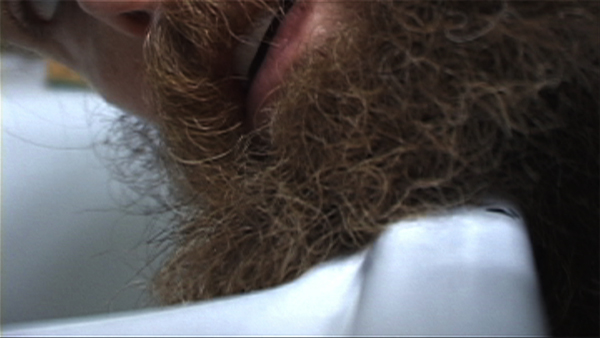
For the last year, Bay Area artist Chris Sollars has sported a biblical behemoth of a beard, although his cleanly shaven cheeks are once again on view in Sollars’s newest project, Hairy, shown as part of YBCA’s Bay Area Now.  It’s an interesting update on an identity-probing lineage that includes predecessors like Chris Burden, Gordon Matta Clark, James Luna, Ana Mendieta, and David Hammons.  DailyServing recently had the opportunity to chat with Chris about the work.

DS: So!  Since I haven’t seen you in a while, are you closest to Man, Woman, or Child?

CS: Closest to Child!  But since I’m doing these hair events, I’ve been growing the beard back.  It’s just not very long.  I have scruff, but it’s not a “beard” beard.

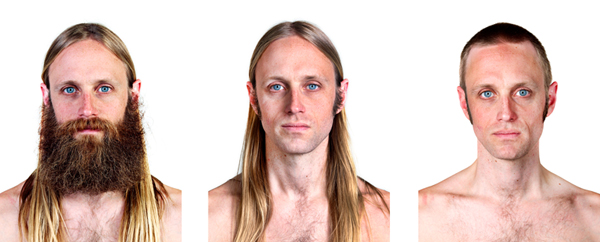
Chris Sollars, "Man Woman Child," 2011. 3 Framed C-prints, 20" x 26" each.

DS: I have to ask, which came first, the beard or the art?

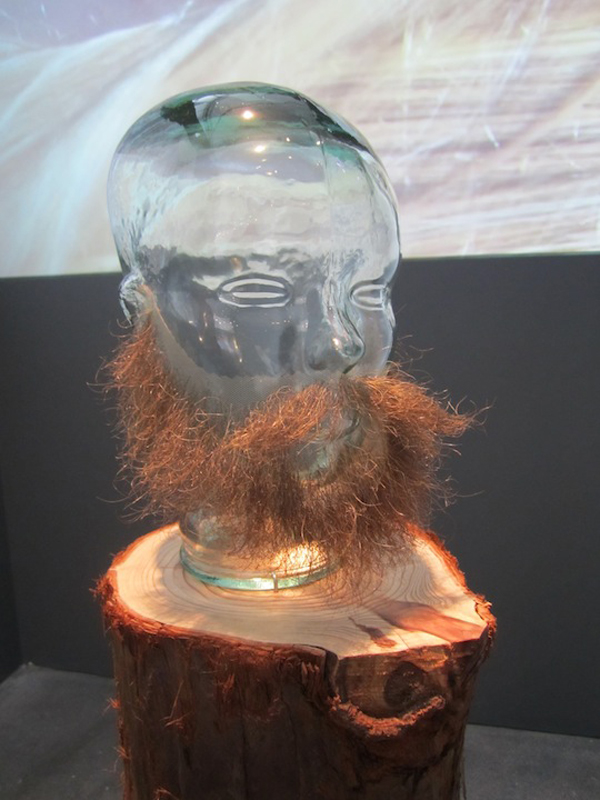
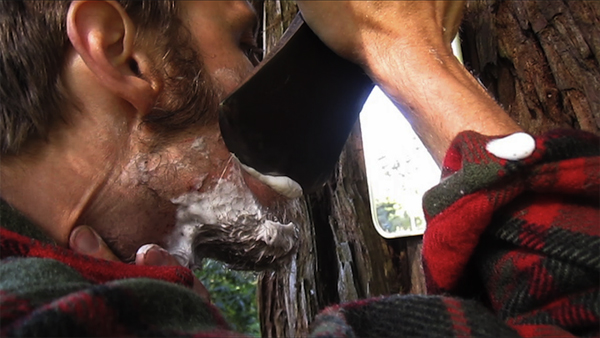
CS: Well, even before the beard, I’ve always known that I wanted to make a wig of my long hair, which I’ve had since high school, and wear it at a later date. That’s why the title is Hair and the subtitle is When I’m 64.  I like the collision of those two moments of time—wearing hair from when I was thirty-four when I’m sixty-four.  So I think that piece came first.  As for the beard, I started growing it, and it just turned into its own thing.  My girlfriend took a long trip and by the time she got back, I already had a bunch of things I wanted to do with it.  Before I cut it, I wanted to let it grow a little longer and let it live on its own, and it inspired a series of works.  I’d done a performance in 1998 at Skowhegan where I went to a tool shop in Maine with a lot of old tools and was drawn toward this long handled axe… I personally tried to sharpen it and make a video of me shaving with it.  Of course, I didn’t have much hair back then, because I was 22, and I didn’t have the capacity to grow hair like I do now.  Anyway, I decided that with this new beard I wanted to do it again, with an axe.  Working with my wigmaker, however, I had to grow the beard as long as possible, and if I was going to shave it off with an axe, it wouldn’t work as a wig.  It’s a really a rare thing, to make a wig out of someone’s own beard hair, because you’re hand-knotting, and working with different clumps of hair—looping it like a rug—and it’s a difficult thing, even if your beard is really long, because it’s still so short.

Chris Sollars, "Hair: When I'm 64," 2011-2040. Hand-knotted wig made of human hair. Image courtesy of the artist.

Chris Sollars, "Beard," 2011. Hand-knotted facial hair. Image courtesy of the artist.

DS: It’s probably pretty brittle, too.

CS: Yeah. So I decided to do the beard wig first, and then grow back a beard that was substantial enough to shave off with an axe.  So that was the process.  And in between, before I cut off all the hair, I wanted to do a series of related videos.

DS: Were you intentionally trying to touch on issues of gender and masculinity?

CS: Well, yeah.  I named the triptych (the photographs of myself) Man Woman Child (2011) on purpose, because… Well, a child would never have a beard like that and a woman would never have a beard to that extent.  I’ve always had fine hair, and I’ve always been in between being kind of “girlie” and, well, not.

Chris Sollars, "Shave," 2011. Video still. Image courtesy of the artist.

DS: Shaving your beard with an axe is such an over the top gesture!  And you’re wearing this plaid flannel.  But I noticed that as you started to talk about your work, you weren’t talking about gender as much as you were talking about intersecting moments in time, or an interest in working with certain tools.

CS: Well, [the interest in the axe] led to that.  It led to the absurdity of knowing that I could cut down trees, but that I could also cut my face with the thing!  There’s a moment in the videos where there’s a cut or change or rupture that happens.  I’m thinking of the video edit like I am cutting hair, so there’s a real switch that happens, a change of one’s look, or the change that can happen with a cut when you juxtapose one image with the next.  Leading up to the show, in fact, and even currently, I’ve been hiding out a little bit, just until people have seen that work [and realize that Sollars is now totally clean-shaven]. It’s kind of a strange performance that’s still going on.  I was even wearing costumes to change my identity around town. I didn’t want to reveal that I’d cut my hair until the show had opened.  I realized as soon as I cut my long hair that that pieces like mine and like Chris Burden’s I Became A Secret Hippy (1971) don’t exist as just performances, but as pieces of our identity from that point forward.

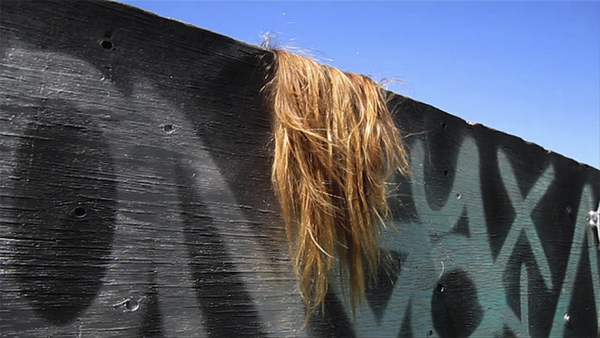
Chris Sollars, "Hair Lay," 2011. Video still. Image courtesy of the artist.

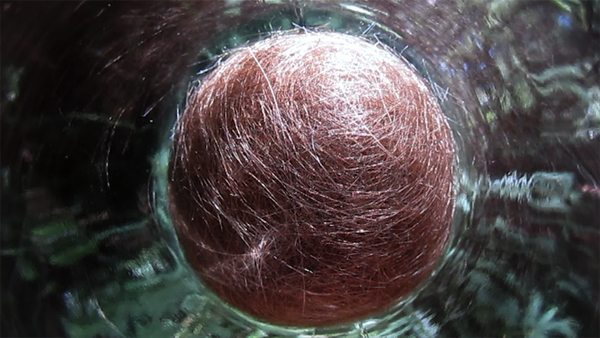
Chris Sollars, "Hair Ball," 2011. Video still. Image courtesy of the artist.

Chris Sollars, "Beard Rub," 2011. Video still. Image courtesy of the artist.

DS: What about race? Does that play in at all?  I might be reading more into the project than what you intend, but I read an article in the New York Times about Matta Clark’s Clock Shower (1973), and writer’s spin was about how it was this glorious time in New York when this guy could walk to the top of the Clocktower building and cover himself in shaving cream and then diddle with the clock.  And my thought was yeah, if he’s white, he can do this.  Going from that thought, and looking at your work, which includes this golden ball of hair surveying a forest and the golden blonde Hair Lays and the Beard Rubs, which seem to be about marking or claiming in certain ways, I’m just curious if there are any thoughts about…

CS: …about identity in relation to race?  Well, I think that perception of where I exist culturally, or politically or socially, changes with the haircut.  Going back to Burden’s Secret Hippy, you might be a countercultural person, but you’re wiped of that in terms of your identity.  I guess that’s why I also looked at Ana Mendieta’s piece with the transplanting of the man’s beard onto her face, taking on that masculinity.  Or Adrian Piper’s Mythic Being.  So I’m aware of these female performances and cross cultural performances with hair and identity, and I was thinking, okay, so if there’s this white man art with these things opposed to it or juxtaposed against it, what is white male identity art?  Or what is it specifically to me?  I guess that’s why I focus so much on the hair as a material, like with close-ups of the hair grain, which I think of as wood grain.  Kind of just investigating what is it that my being is made up of.  You know, the scraggly curly beard hair, the long fine hair… What happens when I change?  When I’m separated from it?  How does it exist on its own as an abstraction, like with the Hair Lays, or the beard itself rubbing on things?  I think the masculine action of shaving with an axe kind of completes the picture of that identity of that person.  And I’ve been so influenced by a lot of that ‘70s work that I was curious about performing that investigation on myself.

Share

Architecture of Narrative

As part of our ongoing partnership with Art Practical, Daily Serving is republishing Patricia Maloney‘s article Architecture of Narrative on David Claerbout‘s exhibition at SFMOMA in San Francisco.

Four video installations comprise Architecture of Narrative, the exhibition of work by Belgian artist David Claerbout, currently on view at the San Francisco Museum of Modern Art. The exhibition’s title underscores the presiding concerns in Claerbout’s study of cinema; he strips his videos of conventions such as plot, character development, and in some cases, action and instead places emphasis on light, sound, and setting. He juxtaposes chronological time against cinematic time, freezing and repeating a single moment so that a scene progresses through a series of vantage points but never forward. In three of the videos, individuals are arrested in position and held captive in a Sisyphean interlude, while space, sound, and time slip past them. More significant than the dissection of cinematic conventions, however, are the negotiations with power that Claerbout creates for viewers.

Please visit Art Practical to read the full article.

Share

Skip the Trip to the Library:
People Don’t Like to Read Art at Western Exhibitions, Chicago

Deb Sokolow, Chapter 5. They meant for it to fail., 2011, graphite and acrylic on paper mounted to panel, 30x22", courtesy of Western Exhibitions

“People don’t like to read art.” It’s the sort of self-deprecating, tongue in cheek, slightly hipster-ish title you’d expect from a show featuring just such a group of young artists. “We acknowledge not everyone will enjoy this text+art stuff. And we don’t care, because we say it’s important.” But taken a bit less literally, as I had initially interpreted the title, it gets at the idea that people don’t like to derive meaning, to decipher, art. So in this way, perhaps the language in these text-based pieces helps us derive meaning more concretely; the verbage helps us “read” the works more deeply.

Kirsten Stoltmann, You Will Never Be Punk, 2011, oil paint Sharpie on magazine pages, 10x8", courtesy of Western Exhibitions

The offering in Western Exhibition’s group show sweeps the spectrum in terms of media—collage, drawing, sculpture, video, artist books. And in terms of voice as well. The labored, meditative collages of Meg Hitchcock, each one fashioned from thousands of tiny cut-out squares of individual type are juxtaposed against Kirsten Stoltmann’s loud, sharply funny, colorful sharpie drawings on pages from fashion magazines. One of her models declares, “To fart or not to fart.,” as she looks oh so forlorn with her hand to her cheek. Cat Glennon’s “Fuck This” spelled out with cigarette butts and her “You Don’t Need to Read It” in which the words “you don’t need to read into it, you just need to read it” overlaid with a check from a greasy spoon, dead matches, and playing cards, speak of grungy coffee shop angst.

Meg Hitchcock, detail of In the Day of My Trouble (Psalm 86), 2009, letters cut from the Chandogya Upanishad, 12x8", courtesy of Western Exhibitions

Simon Evans’s pyramid-shaped sculpture, “Monument for Sun Related Events,” is one of the most startlingly intimate pieces in the exhibit. Lined, yellow legal paper covers the pyramid, affixed to which are snippets of hand-written text. An inner world emerges in sentence fragments. Somehow these thoughts, memories really, are a stream-of-consciousness confessional, and at the same time, they’re so familiar you can almost recall, from your own past, the moments he spins forth. It was such a guilty pleasure to read, as if peeking into someone’s diary.

Simon Evans, Monument for Sun Related Events, 2008, pyramidal sculpture covered in lined yellow legal paper with blue and red ball point pen, 28x20x20", courtesy of Western Exhibitions

Whatever an art lover’s appetite for “reading,” whether compelled by a quick glance that packs a punch aesthetically or by more of an in-depth verbal communion with the pieces, from bubble gum beach fiction to heavy tomes of autobiography, the work in this show provides for all preferences, except of course for those people who really don’t like to read art.

“People don’t like to read art” is on view at Western Exhibitions in Chicago through August 13.

Share

I found Paradise at ltd los angeles.

As an exhibition of contemporary Puerto Rican artists, one might be tempted to hypothesize that Paraíso, on view this month at ltd los angeles, is meant to express a quintessentially Puerto Rican attitude, or perhaps act as homage to the land itself.  What’s primarily on display, however, is a state of mind: one shared by quite a few 21st-century contemporary artists, regardless of nationality.  In fact, if the artists and curators involved in Paraíso are to be taken at their word, paradise is a land where promises are both made and broken; where familiar objects act in unfamiliar ways; and where the only guarantee is that there are no guarantees.

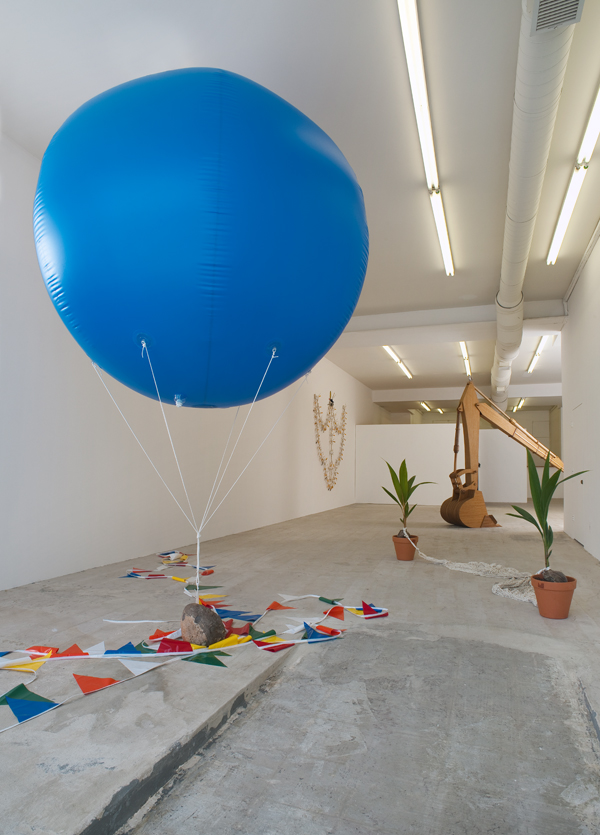
Paraiso at ltd los angeles. Installation view. Image courtesy of ltd los angeles.

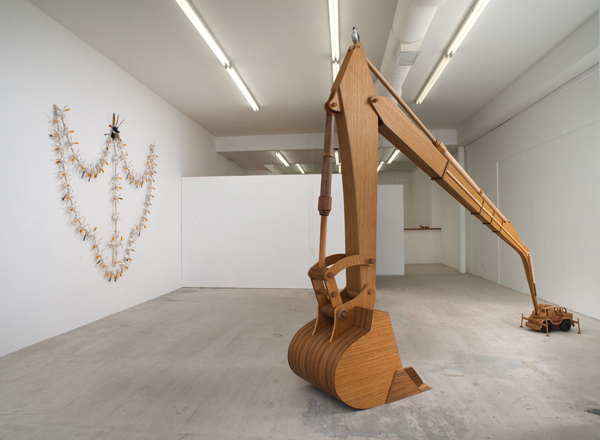
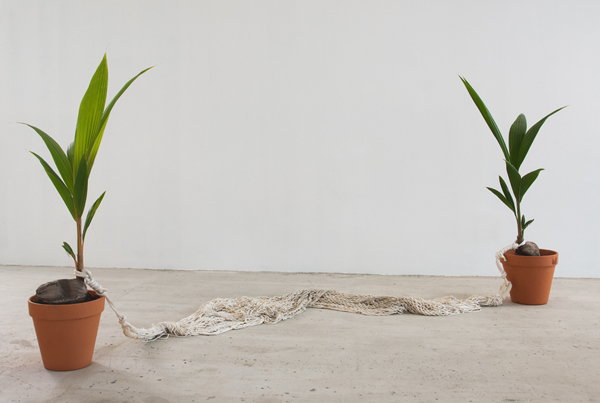
Take Paraíso’s three opening works: Michael Linares’s Untitled, 2011, a big, blue balloon hovering above several beached strands of triangular, car-lot flags, weighted down by a rock; Linares’s Wait ‘til it grows, 2011, two small coconut trees sprouting straight from the coconuts themselves, burdened by a hammock strung between them that has yet to make it off the ground; and Charles Juhaz-Alvarado’s Del brazo a la garganta: (mimus polyglottos), 2011, a large, handcrafted wooden bulldozer claw that looks like it should be attached to an equally huge wooden bulldozer, but which is actually attached to a vehicle the size of a toy.  All three works exist in indeterminate states, with the onus on the viewer to decide whether the balloon is ascending or descending, or whether the hammock will make it off the ground.

Paraiso at ltd los angeles. Installation view. Image courtesy of ltd los angeles.

Michael Linares, Wait 'til it grows, 2011-ongoing. 4 feet x 8 feet. Image courtesy ltd los angeles.

This “half-empty or half-full” scenario continues throughout the show, including Jesús “Bubu” Negrón’s video La Promesa, 2003, in which the artist lovingly and exasperatedly drags an empty wheelchair from the airport in Mexico City to Ex-Teresa, an exhibition venue, stopping at multiple bars.  Two equally entertaining works by Negrón sit at the registrar’s desk: Mini Colillón Masculino, 2011, and Mini Colillón Femenino, 2011, a set of two giant and crumpled cigarette butts made of hundreds of smaller cigarettes.  Here your options include being disgusted by the sculptures’ material or wowed by their whimsy (including lipstick stains to indicate which Colillón is Femenino).

Jesús “Bubu” Negrón, La Promesa, 2003. Digital video with photonovela. Image courtesy ltd los angeles.

Jesús “Bubu” Negrón, Mini Colillón Masculino, 2011, and Mini Colillón Femenino, 2011. Cigarette butts, lipstick and glue. 8 in x 4 in x 4 in, approximately. Image courtesy ltd los angeles.

While Paraíso’s visual punning is reminiscent of the Puerto Rican artists Allora and Calzadilla’s entry at this year’s Venice Biennale, its message is more nuanced.  The press release for the show makes much of the idea that paradise relates to action, referencing scholar Alan Millard’s description of paradise as a work of cultural memory, as well as Cuban author José Lezama Lima’s book Paradiso, a sprawling tale in which little happens but just about everything is discussed.  Whimsy, beauty and tragedy are all there for the taking, but Paraíso reminds us that more often than not, they come as one package, and it’s up to us to decide how we’d like to unwrap it.

Paraíso is on view through August 13, 2011, at ltd los angeles in Los Angeles.

Share

From the DS Archives: The Art of Hacking and Success of Failure

This Sunday, From the DS Archives features artist Cory Arcangel. The artist has several exhibitions on view this month, notably Here Comes Everybody on view at the Hamburger Banhofin Berlin and Pro Tools at the Whitney Museum in New York City. The archive pick was written on March 7, 2011 by Michelle Schultz during our previous week-long series Force of Failure, in which 7 artists wrote on the strategies of failure in contemporary art.

Cory Arcangel, Various Self Playing Bowling Games (detail), 2011. Courtesy of the artist, Lisson Gallery, Team Gallery and Galerie Thaddaeus Ropac. Photo credit: © Eliot Wyman. Courtesy of Barbican Art Gallery.

Filled with electronic blips, beeps and bloops there is one sound conspicuously missing from the Barbican Art Gallery – the sound of a pin-dropping.

Cory Arcangel’s installation in The Curve gallery of the Barbican is comprised of a series of bowling video games in constant auto play, projected along the long corridor that itself very much resembles a bowling hall. But not a single pin falls, the satisfying sound of the crash is absent, the balls hit the gutter, again and again and again…

With the installation’s title, Beat the Champ, multimedia artist Arcangel tauntingly dangles the idea of winning, impossible to achieve – like the fixed carnival games with the ball slightly too big for the basket, doomed to lose, time and time again.

The virtual characters on the big screen are programmed to be transfixed in purposeless repetition – Sisyphean meaningless work – condemned to re-perform their own failings for us in this crescent shaped theater of the absurd.

Cory Arcangel, Various Self Playing Bowling Games (detail), 2011. Courtesy of the artist, Lisson Gallery, Team Gallery and Galerie Thaddaeus Ropac. Photo credit: © Eliot Wyman. Courtesy of Barbican Art Gallery.

Not simply a looped video of a single miscalculated moment of a game, the video game consoles themselves are active and functioning – but in a forced state of hijacked programming. Their games are played out in a perpetual state of failure, hacked by tiny green chips that bear Arcangel’s name, forcing the game to loop in a continual state of defeat. The virtual characters are driven by a code devised by the artist, rather than human interaction.

Witnessing the progression in graphics and design – from the old Atari system that greets you in the beginning, through the original Nintendo, Sega Genesis and Sony Playstation, to more recent PS2 and Game Cube versions – is itself a testament to defeat. With technology becoming obsolescent at ever-increasing speeds, these systems are doomed to fail – already antiquated as they reach the consumer floor. They are systems designed to self-destruct, and give way to their successors at breakneck rates.

Cory Arcangel, Various Self Playing Bowling Games (detail), 2011. Courtesy of the artist, Lisson Gallery, Team Gallery and Galerie Thaddaeus Ropac. Photo credit: © Eliot Wyman. Courtesy of Barbican Art Gallery.

And as the systems here progress, defeat becomes increasingly pronounced. In the old Atari, the bowling ball instantaneously bounces back and attempts again, however as the avatars become more realistic, their resilience begins to wane. Emphasis is placed on their defeat. Disappointment, annoyance and anger grow, as they throw their virtual hands up in the air, shake their computer-programmed head and have full on temper tantrums. Read as a decreasing optimism and increasing frustration in technological advances, there is an underlying current, a realisation that technology might not save us after all.

Cory Arcangel, Various Self Playing Bowling Games (detail), 2011. Courtesy of the artist, Lisson Gallery, Team Gallery and Galerie Thaddaeus Ropac. Photo credit: © Eliot Wyman. Courtesy of Barbican Art Gallery.

Hacking into the system, Arcangel satirises the failures and frustrations of contemporary society. The lighthearted game of bowling becomes a metaphor for the complex and dangerous relationship between man and machine. Arcangel sees it as the ‘short circuits in human nature caused by everyone staring at their phones or being on Facebook all the time’. While they may short-circuit they are controlled by the artist, the virtual characters are puppets of a pre-programmed code. The act of hacking is just as much a failure of the system – an affirmation of man over machine. We may not be able to beat the game or tear ourselves away from Facebook, but as Arcangel has shown, it is possible to alter the outcome and bend it to our will – In this perpetual failure there is hope.

Various Self-Playing Bowling Games, was co-commissioned by the Whitney Museum of American Art and will be shown there as part of the artist’s forthcoming exhibition in May 2011.

Share

Art, Inside and Out

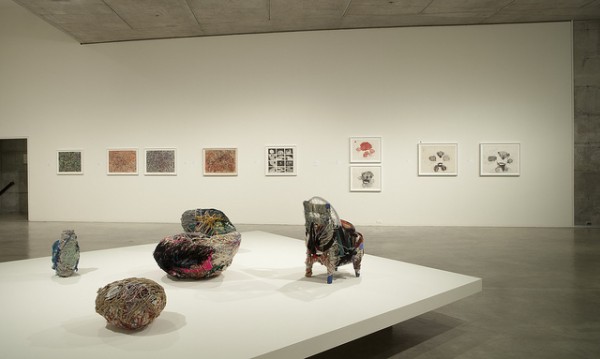
Installation view of Create, curated by Lawrence Rinder with Matthew Higgs. Photo: Sibila Savage.

The growing spotlight on artists with developmental disabilities simultaneously questions ethics, challenges definitions in Art and inspires viewers. The current exhibition at the Berkeley Art Museum/Pacific Film Archive, Create, features the works of 20 artists from three pioneering Bay Area centers for arts and disability – Creativity Explored, Creative Growth Art Center and the National Institute of Art and Disabilities.

Once in the museum, I found myself at an ethical crossroads. The only information provided was a brief introductory wall text at the beginning of the first gallery, and a slightly longer anecdote in the take-away, written by the co-curators Larry Rinder and Matthew Higgs, respectively. Both texts note that the artists included all have a developmental disability of some kind, but little else about their process, experience or intent. Except, of course, to clarify that the artists are not performing art therapy in a drab gray room with bars on the windows. The paradox for me remains in determining for whose benefit exactly, is the mention of the artists’ conditions made? In the introduction, Rinder mentions that the artists’ “status as outsiders is rapidly shifting to that of insiders.” This can be taken in a few ways: for my Mom, and others like her, who insist they were among the first to discover the phenomenon of outsider art, they may be greatly bereaved to hear that outsider art has hit the mainstream, and now even their t-shirts are $60 a pop. For others it can be seen as an advancement that has been a long time coming. The artists featured in Create all possess the level of talent, individual voice and depth to be expected of the those supported by the Berkeley Art Museum and other major institutions. This issue elicits a nagging feeling that questions the motivation of listing the artists as developmentally disabled. I cannot help but wonder how I would have viewed the art if I had not known this facet of the exhibition.

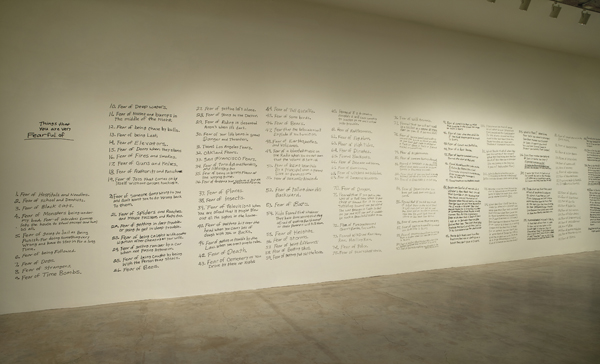
Michael Bernard Loggins, 'Fears of Your Life' Installation View. Photo: Sibila Savage

Trying to look at the artwork as untainted by the knowledge of the artists’ conditions, I saw three galleries filled with pieces so creative and uninhibited, my eyes hungrily devoured the unique detail in each piece. Four examples of Attilo Crescenti’s sprawling, surreal and abstract figure drawings demonstrate the potential of an unrestricted vision of the human form. Written in huge, black scratchy handwriting on the entire back wall of the first gallery, is Michael Bernard Loggins’ text piece “Fears of Your Life.” Loggins included all fears in his list, both the profound and the mundane:

13. Fear of being lost.

21. Fear of spiders and roaches.

And mouse raccoons and rats too.

52. Fear of rolling down a hill backwards.

82. Fear that if you are bad or naughty noone’s isn’t going to love you anymore.

Carl Hendrickson and Jeremy Burleson both created sculptures that blur the line between practical application and surreal artistic liberty. Hendrickson’s wood sculptures resemble recognizable structures at first glance, yet further inspection reveals that their construction negates their utilitarian function. Burleson’s sculptures of medical equipment made from tape, plastic and paper, maintain an amazing amount of detail and accuracy, yet cannot be forgotten as non-functional art objects.

Carl Hendrickson. Image courtesy of Creative Growth

Create brings up several important questions that remain unanswered, and perhaps will not be answered for some time. How are these artists different or the same as others featured in major institutions? How does an artist’s past or present condition affect the reception of their work? Is the image of ‘outsider’ art exploited by the mainstream in the same way as other minorities, subcultures or fringe societies? The success and importance of the exhibition is in its posing of these questions, and the opening of a dialog that may be continued by the art world, both inside and out.

Installation view of Create, curated by Lawrence Rinder with Matthew Higgs. Photo: Sibila Savage.

Create was curated by Larry Rinder, the director of BAM/PFA and Matthew Higgs, the director of White Columns. On view from May 11, 2011 – September 25, 2011.

Share