For this edition of Fan Mail, Curtis Amisich has been selected from a group of worthy submissions. If you would like to be considered, please submit to info@dailyserving.com a link to your website with ‘Fan Mail’ in the subject line. Two artists are featured each month—the next one could be you!
Curtis Amisich. "Call Me Queequeg," 2010 from the series "Scrambled." Acrylic on Panel. 24 x 24 inches. Courtesy of the Artist.
In 1964, Time magazine published an article entitled “Op Art: Pictures that Attack the Eye,” in which MoMA curator William Seitz explains that works from the budding movement designated “[Optical Art] exist less as objects than as generators of perceptual responses.” The paintings of Curtis Amisich quite evidently echo the work of Op-Artist Bridget Riley, but also more subtly reflect the influences of Minimalist art like Frank Stella’s “Protractor” paintings and Barnett Newman’s “Zip” paintings. Yet, while this work clearly represents an extension of this lineage, they also address more contemporary issues by virtue of their production in the 21st century.
Curtis Amisich. "Testing 1, 2, 3 ... Your Patience," 2009 from the series "Scrambled Porn." Acrylic and varnish on panel. 16 x 20 inches. Courtesy of the Artist.
In an era when such intricate works could quite easily be produced on a computer, Amisich meticulously executes his paintings in a process that lasts a number of weeks. He begins each painting with a single line, creating adjacent lines that mimic every characteristic of its neighbor – to the extent possible by a human hand. The opticality of this formal approach is enhanced in these paintings through layering and sharp contract. The resulting paintings – with Testing 1, 2, 3 … Your Patience an exemplary example in my mind – are full of movement. It is hard to believe that what appears to vibrate is simply a series of stationary lines.
Curtis Amisich. "I Think I See Something II," 2010 from the series "Scrambled Porn." Acrylic on panel. 60 x 60 inches. Courtesy of the Artist.
Over the past several years, Amisich has worked on two separate, but closely related, series: Scrambled Porn and Scrambled. Both bodies of work refer to the act of intense viewership, an ever-pertinent issue in our media-driven society. The most recent “Three Screen Report” by the Nielson Company – which measures TV viewing, online activity, and mobile phone usage – confirms what everyone already suspects: American media consumption continues to rise, with over 35 hours spent watching television and about 4 hours surfing the Internet each week. In Scrambled Porn, Amisich connects this consumption to the distinctive visuality of Op Art by evoking the feel of staring at an electronic screen. He furthers this conversation in Scrambled, where he focuses more intently on the impact of color and the ways they can be mixed, combined and woven together, to beautiful effect in a painting like I Think I See Something II.
L.A. Expanded: Notes from the West Coast
A weekly column by Catherine Wagley
Detail L: Robert Morris, poster for exhibition at Castelli-Sonnabend, April 1974; Detail R: Lynda Benglis, advertisement in Artforum, November 1974; a poster for "Lynda Benglis / Robert Morris: 1973 - 1974," an exhibition at Susan Inglett Gallery
When sculptor Lynda Benglis published her scandal-worthy Artforum ad in 1974, the one where she held a double dildo up to her naked, oiled, and fit-as-a-biker-chick body, the din of criticism that followed came mainly from art world insiders. It was the insiders Benglis made the ad for, reacting against potently macho ads by artists like Robert Morris, who had appeared in the magazine to promote one of his exhibitions topless, buff and wrapped in chains. A few women, most notably Rosalind Krauss, resigned from the publication in the wake of Benglis’ stunt. Others jumped to the artist’s defense: Peter Plagens wrote in a letter that, those offended should cover “the offensive anatomy with a small Don Judd inset.” Plagens wasn’t saying no one had a right to object to a double-wide dildo, just that Artforum editors in particular had better acknowledge their double standard before skulking away, put-off by a one-time provocateur who’d made a clever jab.
Plagens’ jab was pretty clever itself—what would fit over a dildo better than a Donald Judd?—and I quoted it recently when reviewing the traveling Lynda Benglis’ retrospective currently at MOCA Los Angeles. I actually tried covering the offending anatomy with one of Judd’s “specific object” sculptures, a blue one from 1967 as shiny as Benglis’ oiled up body. Of course, it fit perfectly.
My photoshopped Benglis-Judd image ended up on facebook, where it received praise from a few of today’s art insiders. Unfortunately, one of my mother’s friends saw the image too. She’s not an insider, and while she’s not a prude either, without context, the image struck her as bald-faced and, yes, offensive.
Lynda Benglis' 1974 advertisement, with the "offending anatomy covered by a small Donald Judd inset."
I felt badly. It hadn’t been meant for her. But I also wondered if offense would have been taken as easily at a different kind of blatancy.
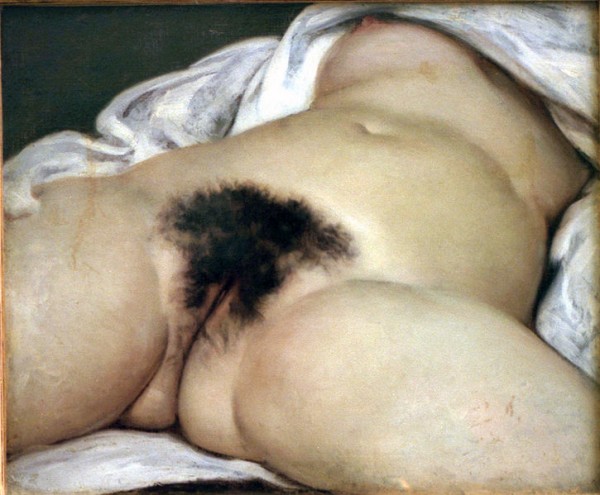
An art critic for public radio with whom I often work reviewed the Benglis show as well. When he went to post a version of his review on the web, as he always does, his editors objected to one of the images he’d chosen: the Benglis ad sans Judd insert. Liberal art aficionados might be able to handle this, the editors said, but it was too risque for their more general audience. Only a few weeks before, the same critic had posted a far more explicit image on the same site, Courbet’s famous The Origin of World, of a reclining woman. All you can see is her stomach, thighs and what’s between.
Gustave Courbet, "The Origin of the World," 1866.
I know we now have decades’ worth of arguments about women as objects in art (“Do women have to be naked to get in to the Met Museum?” the Guerrilla Girls asked in 1989) and the unease that’s caused when the male gaze is subverted (“[T]he woman as icon, displayed for the gaze and enjoyment of men, …always threatens to evoke the anxiety it originally signified,” wrote Laura Mulvey in 1975). However, I think it’s something more basic that makes the Benglis ad hard to take for those not in on the joke. Certainly, Courbet’s The Origin of the World would have caused uproar had it appeared to the public in 1866, when he first painted it. Instead, it stayed in private collections until a 1988 exhibition at the Met, and today it’s seen unarguably as a painting. Benglis’ ad is harder to classify. It’s part advert, part social critique, part photo project; with its “unnaturally” sculpted body, it riffs off the visual language of pornography; most overtly, it mismatches genitalia. It seems to me that that’s what we still can’t handle: provocation that collides categories.
Much is written about the biography of Ralph Eugene Meatyard. A Navy man, born in Illinois, he attended Williams College through the Navy’s V-12 program. He became a licensed optician and lived most of his life in Lexington, KY. In 1950, before his first child was born, he made a life changing decision: he bought a camera.
That’s when he found his new calling. He fell for the technical questions that plague all photographers. To this run of the mill mix of lighting, focal lengths, and shutter speed he added things things that were found in his personality and in the counterculture of the 60’s. It seems like such a cliche to be a beatnik cultural warrior, but he was, and the body of work he produced during the 60s is remarkable.
Starting in 1961, he gave himself a decade to master photography. He had been a member of the Lexington Camera Club for six years by that point and was comfortable with standard photographic issues. Instead of casting a wider net he dug in to a narrower focus: Rolleiflex mid-size monochrome negatives and small prints. After eliminating any question of what camera to use, he was free to care about what would be his subject.
Meatyard, Ambrose Bierce, 1964 Gelatin silver print, 7 x 7 1/4 in.
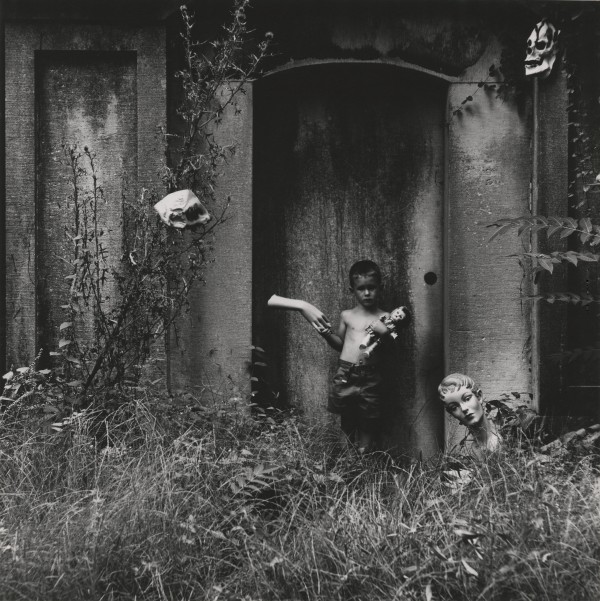
On weekends, Meatyard would drive around looking for the crumbling ruins in the rural poverty that surrounded Lexington, KY, but not so he could shoot “ruins porn” or look for the personification of rural life like Shelby Lee Adams did in Appalachia. His children, who had grown up with a shutterbug dad were often his models. The images he took of them were not casual shots of kids at play in the backyard but were arresting compositions guided by his counterculture beliefs and framed with serious technical skill.
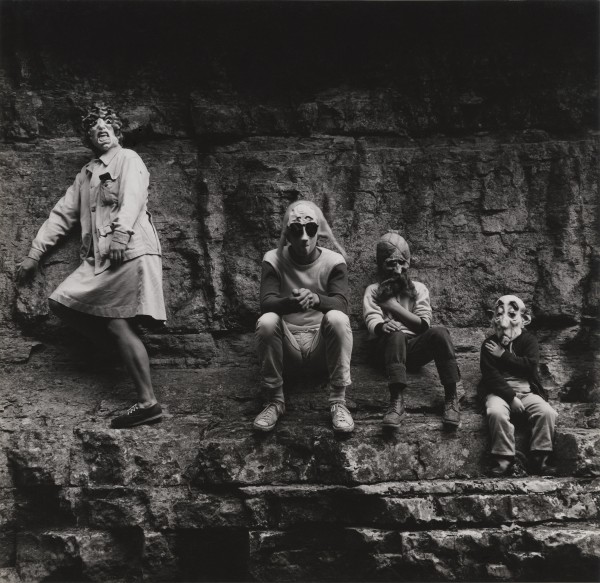
The Art Institute of Chicago currently has a first-rate exhibition of the images from his peak output. Ralph Eugene Meatyard: Dolls and Masks collects together Meatyard’s dense compositions, structures of silver and gray with doll faces hiding in the corners of crumbling architecture. He would allow his children to pose as they wanted to, there are a few repeats in their positions, but it adds to the mystery. His formal compositions and his subject matter seems impenetrable. His photographic explorations, motivated by zen philosophy and jazz improvisations, are a dense network of subconscious associations and uncanny resemblance. The natural, fleeting poses of his children fracture against the ponderous old man masks and oversized hands in which they are posing. Their bodies stand out against the stark and worn naturally lit backgrounds that often contain thick, unlit darkness.
Meatyard, Untitled, date unknown Gelatin silver print, 7 3/8 x 7 3/8 in.
Many of his images violate what we know to be true, but he never intended to photograph what was there. He was uninterested in mere optical facts or creating reassuring images. Instead, he wanted to create anew a universal subject that stood for something. He quotes Ambrose Bierce‘s Devils Dictionary in at least one title “Romance, n. Fiction that owes no allegiance to the God of Things as They Are.” His “sympathetic general subject” looks back to the type of images religions around the world used to teach the illiterate: Buddhist Thangkas, Eastern Icons, Catholic Altarpieces, etc. These images of people idealize rather than describe their subjects. Meatyard too does this, consciously forcing the subject into the uncanny valley between living creature and lifeless doll.
Like the religious icon, Meatyard’s figures are telling us something about how to live, who we are, and what we should expect in the future, it’s just impossible to definitively know what they are saying. A combination of “The Child is father of the Man” and “Show me your original face before your mother and father were born” these images challenge the viewer with “unfair arguments with existence.” Do the masks cover up the person, or does the person fill in the mask? Every subject in Meatyard’s photos are challenging the lens of the camera. Actively standing up to any amount of objectifying gaze, deformed but confident, these subjects go eyeball to eyeball with us. Even the youngest and presumably most innocent of these subjects stands facing us, boldly answering the questions his father was asking.
#Hashtags: Viral Thoughts on Politics, Arts, and Culture
In honor of last weekend’s events in Libya, DailyServing kicks off our newest series, #Hashtags, with an article by writer and editor Matthew Harrison Tedford on street art and politics. #Hashtags provides a platform for longer reconsiderations of artworks and art practices outside of the review format and in new contexts. Please send queries and/or ideas for future to hashtags@dailyserving.com.
Anti-Qaddafi graffiti in Benghazi, February 25, 2011; artists unknown. Courtesy of Al Jazeera English.
There is no shortage of negative consequences to censorship, and I trust my readers are well aware of many. But there is an odd silver lining to take away from all of this. It says something about the power art possesses when one of the most important lawmakers in the United States, a powerful Emirati Sheikh, and the governor of Maine all become involved in art criticism, as has happened over the last year. These acts of censorship only exist because powerful people and organizations recognize that art influences the world—something that is all too easy to forget.
The positive side of this power has been witnessed this year in turbulent North Africa. Alongside the protests and insurrections of this year’s Libyan civil war, there has been an equally vociferous artistic outpouring. Rather than mere epiphenomena, resulting from but not influencing the revolution, the explosion of street art and graffiti in Libya has been a pragmatic part and parcel of the uprising. My own biases and doubts sometimes lead me to question the role of artist-as-activist. But the artists of the Libyan civil war have faced challenges far more dire than those of most North American or European MFAs or career artists—I’ve never even seen a Kalashnikov on an art school campus. By examining a situation where artists risk their lives and the future of their country is at stake, one can cut through biases about the immediacy of art and see its relevance to political situations that appear less pressing or dire.
In a June 18 Al Jazeera English report on the post-uprising street art of liberated Benghazi, journalist Sue Turton stated that the anti-Qaddafi graffiti had grown increasingly sophisticated since the beginning of the revolution. The images shown in the report depict the colonel’s head in a trashcan, in a meat grinder, being punched, hanging from a noose, and scrawled on with a confusing mix of swastikas and Stars of David. Unlike barely-legible Sharpie tags, these murals exhibit technical skill and are often large scale. Some even appear to have been created with paint, palette, and patience. Not only have artists taken the city as their canvas, they have done so with more confidence and pride than was possible under the Qaddafi regime.
In the same report, cartoonist Akram Briki stated that prior to the uprising he would draw pictures of Qaddafi and his crimes, but he could not show them to anyone and had to tear them up, out of fear of repression. Briki’s actions suggest a fundamental need to express political convictions or concerns, so much so that he felt compelled to do so, if only for himself. If humans are truly political animals, then a lack of substantive political expression is a torturous form of dehumanization. Another street artist, Radwan Zwae, reported that before the uprising, he was arrested and beaten for attempted graffiti, and his friend was shot and killed for drawing a caricature of Qaddafi. Now, in an atmosphere that allows for political expression, he is allowed to actualize himself as Radwan Zwae, artist. It is worth noting, however, that my research found no evidence of pro-Qaddafi graffiti in rebel-held Libya, or an indication of what the reaction would have been from the rebel National Transitional Council.
Anti-Qaddafi graffiti in Benghazi, March 6, 2011; artist unknown. Courtesy of شبكة برق | B.R.Q.
Another interesting observation is that many murals and graffiti scrawls contained English text, suggesting they were intended to be viewed by foreigners just as much as by locals. The word “freedom” appears on countless walls, along with phrases such as, “We don’t give up; have victory or die,” “We are not your puppets anymore!,” “Game over,” and the Obamanian “Change we need,” among others. For these artists, graffiti is more than self-expression; it is also a means of communicating with the outside world. Sometimes a picture is worth a thousand tweets. The international support rebels have gained is indebted to their public relations campaign, of which images of these murals serve as an assertion of dissatisfaction with the ruling regime.
Anti-Qaddafi graffiti on a former government building in Benghazi; artists unknown; February 25, 2011.
In both the resolve of these artists and in the confidence of their murals, one can witness one of the essential elements of politics. Philosopher Jacques Rancière argues that politics arises when people make “pronouncements on the common which cannot be reduced to voices signaling pain.”[i] That is to say, when one is only a victim, he is not engaged in politics, but is the subject of oppression. The majority of the murals and graffiti of liberated Libya, however, are triumphant and optimistic. With these works, large segments of Libyan society have not just argued, but have shown that they are equals that can co-star on the political stage with the Qaddafi regime. Graffiti is an aesthetic assertion of freedom and power.
These works are the beginning of a post-Qaddafi culture and set the groundwork for the state that will follow, should the rebels succeed in dethroning the colonel. Freedom of expression is quite literally splashed on the walls of the country. Kleptocracy and oppression have been openly criticized for all to see and rally against. To be sure, revolutions rarely end swimmingly, as the messy French Revolution and America’s apartheid revolution quite plainly illustrate. There is no guarantee that democracy will prevail even if the National Transitional Council establishes total sovereignty between the Egyptian and Algerian borders. There is almost no doubt in my mind that graffiti will be viewed as criminal vandalism, as it is all over the world. But the more the messages of these murals are seen, openly discussed, and digested by the Libyan people, the harder it will be for a new regime to usurp these hard won freedoms.
As graves fill in Libya, one could accuse me of failing to understand that the end of the civil war will come through warfare or diplomatic negotiations or something else far more “practical” than adolescent taggings. My approach to understanding the political role of art, however, is holistic, appreciating that no gun, no diplomat, and no mural can change the course of a revolution alone. But politics and culture are not separate spheres, not even separate sides of the same coin. They are inextricably weaved together. To understand this is to acknowledge that cultural producers are politicians—revolutionary or counterrevolutionary politicians, depending on one’s own disposition. We must fight against censorship with vigor, but when Eric Cantor and John Boehner personally attack an exhibition, we can at least take solace in their fear of contemporary art. Libya’s aesthetic insurrection documents the immediacy of the political role of art, but it is not more immediate there, just more present.
For galleries of the graffiti and street art of the Libyan civil war, see:
sspspss…UM biddle BOP, 1997; enamel paint on trace Mylar; 7.5 x 6 m (24 x 20 ft); Private Collection, Topanga, California
At the entrance to the gallery’s first level of Ingrid Calame‘s solo exhibition at The Fruitmarket Gallery in Edinburgh, the pale green enamel of sspspss…UM biddle BOPappear like forceful strokes and splatters that drip down the wall, unfolding across the ground. Though emerging as paintings with energetic and abstract shapes, Calame’s works evolve from a painstaking process that originates from the representation of cracks and stains of the physical environment.
Calame first began tracing blobs in her studio in 1996, before venturing into the streets to trace the shapes, textures and stains on pavements, cultural and industrial sites. Driven by a desire to understand the world through acts of reconstruction, particularly from places that have been overlooked or disregarded, these tracings are then redrawn, layered to form a constellation of interlocking shapes, with enamel filled in within the lines.
Vu-eyp? Vu-eyp? Vueyp? Vu-eyp?, 2002; enamel paint on aluminium; 61 x 61 cm (24 x 24 in); Courtesy the artist
The array of colors across the drawings and paintings appear to compensate for the neglected histories of the sites that inform Calame’s works. From the pastel hues of tracing lines across drawings, to rich shades of green against deep red and purple in Vu-eyp? Vu-eyp? Vueyp? Vu-eyp?, the tenor of the exhibition is upbeat, and appears to convey a sense of discovery from the act of recreation. This quality emanates also from several onomatopoeic titles whose meanings are indecipherable yet express an aural experience of the shapes and paints.
#334 Drawing (Tracings from the L.A. River and ArcelorMittal Steel), 2011; coloured pencil on trace Mylar; 285 x 183 cm (112 x 72 in); Courtesy the artist and Susanne Vielmetter Los Angeles Projects
#334 and #346 are recent drawings that reveal part of Calame’s intensive working process. Backed by a team while working on sites, Calame obtained tracings from the dried-out concrete riverbed of the L.A. River, hand-stencilled numbers on the factory floors of the ArcelorMittal Steel factor floors and the cracks in an abandoned wading pool at the Perry Street Projects in Buffalo, New York. These tracings each bearing their unique marks, were assembled, retraced using coloured pencil, to form paths of new meanings derived from the residues of time. The second floor of the gallery also features a large wall drawing from the L.A. River, created in-situ.
#346 Drawing (Tracing from the Perry Street Projects Wading Pool, Buffalo, NY), 2011; coloured pencil on trace Mylar; 183 x 285 cm (72 x 112 in); Courtesy the artist and Susanne Vielmetter Los Angeles Projects
Calame (b. 1965, Bronx, New York) currently lives and works in Los Angeles, California. The exhibition featuring drawings and paintings from 1997 to 2011 runs till 9 October 2011, and forms a part of the Edinburgh Art Festival.
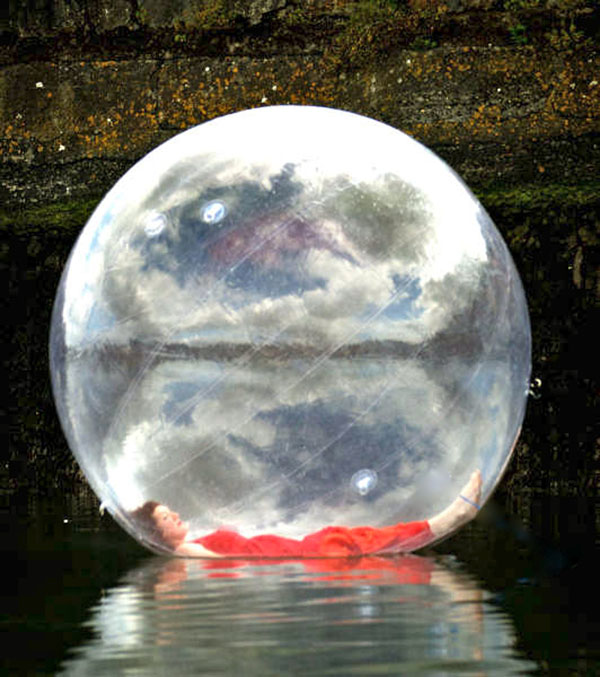
All of Aideen Barry’s work exists in a very fragile balance: a woman performs domestic tasks while levitating; a sculpture promises both the control of cleanliness and the chaos of an explosion; women in flowing red dresses dance on water in giant floating plastic balls, all the while falling comically—and using up the oxygen in the sealed sphere. At each viewing of her work I, too, hold my breath–with anticipation–because anything could happen. Barry was most recently an artist-in-residence at the Headlands Center for the Arts, just north of San Francisco, where we sat down to talk before she flew back to Ireland.
Aideen Barry, Spray Grenade SG08/3#02, 2008; aluminum, brass, steel; 8.25 in x 3.25 in, edition of 5
Bean Gilsdorf: You often use the home as a site for your work. What informs your sense of unstable domesticity?
Aideen Barry: I suppose there are two main parts that inform the work. In 2006 I was diagnosed with obsessive-compulsive disorder, which manifested out of living in “Celtic Tiger Suburbia,” these estates of cookie cutter homes that grew up out of the [Irish] boom of the ’90s. It’s a very un-Irish landscape—and unlike in the past when you knew your neighbors and cared for each other—suddenly you didn’t know who your neighbor was. The domesticity that I’m interested in came out of this space. I was living in one of these houses and all of the people in the estate were all obsessed with materiality and being perfect and clean. And this is where my anxiety manifested itself; I would spend all my time cleaning my house in order to fit in with my neighbors. I wasn’t sleeping, so then I was more anxious, and I would stay up late cleaning even more to alleviate the anxiety. And I would look out the window and that was what all my neighbors were doing! And I tried desperately to fit in. That’s definitely what drives a lot of the work, this veneer of perfection—but underneath there are cracks, something that’s not right. I’m really interested in Freud’s notion of the unheimliche, the uncanny, something that can be familiar and strange at the same time. For Levitating I spent seven days jumping while [filming] cleaning, so as to create the illusion of levitation. And the spray grenades were a way of merging advertising on “the new war” which is the war on germs. I took the familiar grenade and also the familiar cleaning spray and bastardized them together to create this seductive object.
Aideen Barry, "Heteratopic Glitch," detail view, 2008. Image courtesy of Anne Ffrench/Aideen Barry
BG: Talking about fear and landscape makes me think about Heteratopic Glitch. That work changed the landscape, and inside the plastic balls the women were in a potentially airless environment. At first it seems beautiful and playful, but then you are afraid for these women.
AB: It is potent with anxiety, that space. They can’t puncture the ball or they’ll sink. No one really knows what might happen. That’s something I’m really conscious of in the work, that there’s an expectation or anticipation, but the future is a bit ambiguous. In those works that involve a landscape I like to push beyond the realms of possibility; you don’t expect ten women to be able to walk on water…
Aideen Barry, "Heteratopic Glitch," panoramic view, 2008. Image courtesy of Anne Ffrench/Aideen Barry
BG:…it’s a fantasy…
AB: That aesthetic is important to me, the phantasmagorical, where something can behave in the most absurd and sublime way. In the 1980s we had only two [Irish] TV channels, both run by the state which was effectively bankrupt at the time. As a cost-cutting measure they would buy eastern European animations from Czechoslovakia, Poland, the Ukraine, Lithuania, etc…films by Jan Lenica, Jan Svankmajer, Walerian Borowczyk, and others. The Irish TV censor didn’t see them as anything but children’s cartoons, but in actuality they were extremely dark, politically-motivated visual protests. Some of the scenes are so violent, and yet they could be seen as only a chair and a table moving around in stop-motion. The aggression and anxiety in these films really informed my aesthetic and my motivation with material and technical application.
BG: That darkness is so customary in your work. I’m thinking of your video Possession where scissors attached to locks of a woman’s hair cut the lawn, and a pile of food travels down the table into her mouth…it’s partly normal, and partly macabre.
AB: Yes, I’m definitely looking at the domestic object and turning it into something fantastical, turning the garage door into a bread cutter and so on, and looking at other anxieties like eating disorders. That’s also informed by the gothic. Ireland has so many gothic writers: Bram Stoker, Joseph Sheridan Le Fanu, and they were informed by Irish mythology. That’s rooted in my practice, too, playing with the familiar. The housewife in Possession is familiar, but there is a slippage between what’s real and what’s perceived to be real, a kind of madness.
BG: The stop-motion also serves to reinforce the repetitive nature or drudgery of everyday existence, but elevates it into this level of fantasy.
AB: And the stop-motion makes the body jerk in an unnatural way. The familiar, the drudgery is there but it has a different pace. It’s faster, like a Buster Keaton film.
BG: You’ve talked about the work coming from a place of anxiety. When you finish a project, how does it feel to step away from it?
AB: I don’t think it’s cathartic. I don’t think it relieves the anxiety, I think that’s always going to be there. I had to acknowledge that a couple of years ago, I just recognize the signs and I know how to control it so that it doesn’t spiral completely out of control. I think the best part is to acknowledge that it exists. Mental illness is a taboo subject in Ireland. I’m sure it is here, too…I’m sure you’re not supposed to have a breakdown, there’s something wrong with you and therefore you’re damaged! But I acknowledge that I am damaged. Every now and again I go off my track, and the best way to put myself back on track is to make a comment on what set me off in the first place.
BG: And in all of this, do you think if yourself as a feminist?
AB: Feminist theory is as important now as it’s ever been. Remember that in Ireland, we didn’t have a sexual revolution the way you did here [in the US]. People forget, but birth control only became legal in Ireland in 1995, we only got divorce eleven years ago. But it’s beyond Ireland, it’s global. All the references that I had when making the animations, you can totally see them in Desperate Housewives, women who are married to their property and who play a role in a restrictive society. Not much has changed in that regard, so a comment has to be made. And as a woman working in the art world you can definitely say the glass ceiling remains, and you have to challenge all those conventions by making a comment about where we are now. The feminist critique is very much prevalent in the work.
This week’s pick from the DS archives features Italian-born artist, Maurizio Cattelan. Cattelan has an upcoming retrospective exhibit at the Guggenheim opening on November 4 2011, until January 22, 2012.
The following article was originally published on June 9, 2010 by Noah Simblist.
Courtesy: Marian Goodman Gallery, New York, Photo credit: Zeno Zotti
A myth is a foundational narrative that may be based in truth or fiction but either way it tells a story of who we are. Thus self-consciousness is constructed by a shared narrative and helps us to give shape and even name our identity. If we think of identity in the usual terms of religion or nationalism, some examples of these mythological narratives include the King James Bible or the story of George Washington cutting down a cherry tree. But in the art world, there are strains of mythology that are built on identity formations like artist, curator, or critic.
Photo: Zeno Zotti
Maurizio Cattelan is notorious for using unabashedly bad-boy black humor to resist easy classifications of identity. He does so through imagery and institutions that are deeply tied to religion, nationalism and the art world. In his exhibition at the Menil Collection in Houston, Is There Life Before Death, Cattelan has worked with the curator Franklin Sirmans to explode the distinctions between a number of categories. The exhibition includes art objects that are situated as “interventions” in the galleries of Byzantine, African and Surrealist art, culminating in a haunting set of works in dialogue with Arte Povera works from his native Italy. As a result the work is both art object and its context within the museum. In this sense Cattelan plays both artist and curator.
This blurring of boundaries is one of many attacks against authority that Cattelan perpetrates. But as Sirmans notes in the accompanying catalog, Cattelan has a long tradition of work in and out of normative roles. In addition to making sculpture and installations, Cattelan also worked on the publicationPermanent Food and acted as curator for the Wrong Gallery and the 2006 Berlin Biennial along with curators Massimiliano Gioni and Ali Subotnick. This kind of interdisciplinary activity cuts against the grain of traditional divisions of labor in the art world. The myth of these divisions is based on the notion that artists are dumb mute expressionists who use innate talent to make objects that are interpreted by critics, bought by collectors and arranged by curators. By resisting this mythology, Cattelan capitalizes on the expansion of artistic practice by many artists of the twentieth century such as Duchamp and Warhol found in the Menil Collection.
Courtesy Kunsthaus Bregenz, Photo: Markus Tretter
But Cattelan also challenges more traditional mythologies such as Christianity. His Untitled, 2009, a taxidermied horse on its side with a wooden sign reading INRI staked in its flank, was placed in a dark gallery of dreamy Magritte paintings. This obviously references the Latin acronym inscribed on Jesus’ cross declaring him to be king of the Jews. But placed on a dead horse, a symbol of foolishness, what does this mean? In the Menil’s comment book there were some Christian visitors that were very much offended by this work, assuming that is was heretical along with Untitled, 2007, a sculpture of a woman face down and crucified in a shipping crate.
Photo: Hester + Hardaway, Houston
These gestures cause controversy because they rupture the fragile fabric of our expectations. When these Christian visitors walked into the Byzantine section of the Menil Collection they were looking for something old and true. They were expecting artifacts that would deliver on the promises of their identity’s myths. Instead they were confronted by a Trojan horse, an object that trafficked in similar iconography but proposed something less clear and concrete. This was the true heresy, for mythology cannot tolerate ambiguity and skepticism. Myths are made to describe truths and their reproductions and meant to reaffirm them. But artists like Cattelan use mythology along with the strategies of artistic, critical and curatorial practice to reveal that a story is only as good as its teller.












 Courtesy: Marian Goodman Gallery, New York, Photo credit: Zeno Zotti
 Photo: Zeno Zotti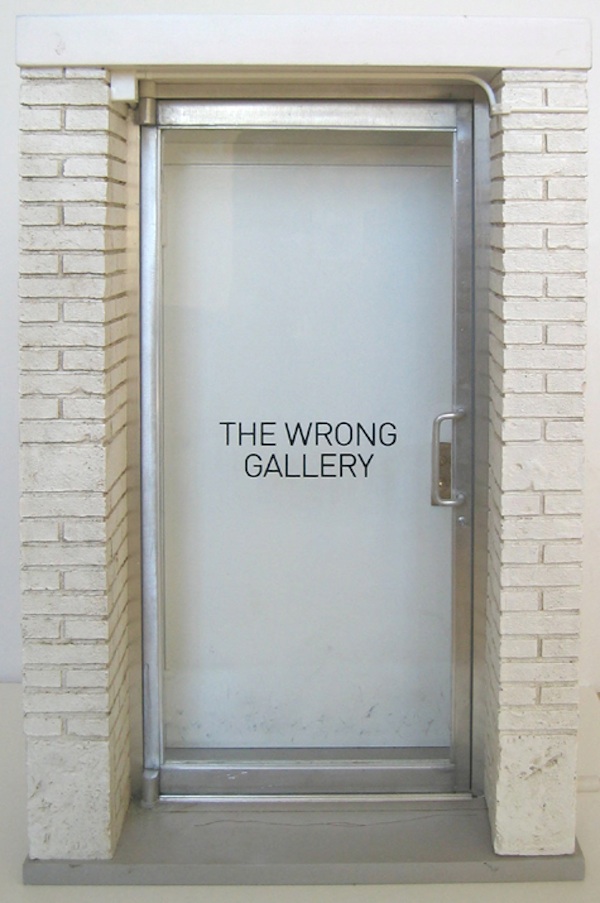
 Courtesy Kunsthaus Bregenz, Photo: Markus Tretter
 Photo: Hester + Hardaway, Houston



