From the DS Archives: Aleksandra Mir

This week, we take a trip down memory lane with Aleksandra Mir. Mir’s internationally “Venetian” postcard designs were featured in the 53rd Venice Biennale. Currently on view through October 9, 2011, Mir’s video piece First Woman on the Moon (1999-) is part of the group exhibition ONCE UPON A TIME: FANTASTIC NARRATIVES IN CONTEMPORARY VIDEO, at the Guggenheim, Berlin.

The following article was originally published by Kelly Nosari on June 9, 2009.

AleksandraMir2.jpg

Aleksandra Mir‘s work at the 53rd Venice Biennale, VENEZIA (all places contain all others), is highly appropriate given that Venice is often considered to be the ultimate tourist destination. Responding to the global souvenir postcard phenomenon, Mir has printed one million copies of her own postcard designs for the exhibition. These postcards are available free-of-charge to each Biennale visitor in both the Arsenale and the Giardini exhibition venues. The artist’s basic intention is to have the participant write on and mail the stamped post card using an onsite letter box, dispersing the work globally.

In each of her 100 postcard designs, Mir pairs the designation ‘Venezia,’ with appropriated images of tourist destinations from around the world. However, none of the postcard images actually depict Venice. The locations vary widely, featuring tropical and snow-covered climates, cityscapes and miscellaneous natural wonders. At times, well-known landmarks such as the Ponte Vecchio in Florence and the Chateau de Chambord in France are attributed to Venezia.

AleksandraMir3.jpg

All of Mir’s postcard images contain bodies of water, which is the defining feature of Venice. Historically, the city’s location on water was the key factor in its development as a powerful trading empire. Yet, bodies of water are certainly not an exclusively Venetian characteristic. Water is shared by different geographies, and enables transportation, connecting distant areas around the world.

Mir’s ultimate goal seems to be for these postcards to connect places around the globe in a similar fashion as the bodies of water featured on the postcards. The gallery visitor completes Mir’s work by sending it out into our globalized world, thus creating unexpected encounters.

Aleksandra Mir was born in Lubin, Poland in 1967. Mir has shown internationally since the mid 1990s and was a founding member of the collective M.I.M.E. She attended Gothenburg University, the School of the Visual Arts (NYC) and the New School (NYC). Today, she is a citizen of both Sweden and the United States, while living and working in Palermo, Italy.

VENEZIA (all places contain all others) will remain at the Biennale until the closing on 22 November 2009.

Share

Beguilingly Incomplete: Our Origins at the Museum of Contemporary Photography

Alison Ruttan, Mullet, ballpoint pen on inkjet print, 2006, courtesy of the artis

In the increasingly rigorous quest for knowledge acquisition and verification, photography and science are uneasy bedfellows. Allison Grant‘s curatorial statement for Our Origins, showing at the Museum of Contemporary Photography, puts it so: “Like science, photography offers arrangements of information, pulled out of the complexity of the world as a whole, presented with seemingly impartial clarity.” Sure, data in visual form can aid us in more fully analyzing and authenticating abstract concepts; it can contribute to a collectively shared, reproducible, foundational knowledge base.

But, after years of convenient digital manipulation built upon decades more of tediously produced and often lo-fi, though no less convincing, visual fictions–from spirit photography to Stalin’s ‘retouched’ propaganda–if there’s one thing we’ve learned about photography, if not yet science, it’s that seeming ‘evidence’ can be deceiving. That’s not even to mention the now relatively widespread practice of illustrating, and claiming new if sometimes unfounded comprehensibility in, sophisticated hypotheses by way of compelling pieces of information design. (GOOD Magazine, I’m talking to you.) In this, it’s clear that images, not only in their contents, but in their arrangements and relationships to one another, can tell a misleading story.

In its approach, Eric William Carroll’s G.U.T. Feeling series featured in the show, is reminiscent of Larry Sultan and Mike Mandel’s Evidence, one of the original masters of the beguilingly incomplete visual account. Carroll gathers found scientific documents and his original drawings and photos in a classification that seeks a coherent grand narrative, while also taking humorous comfort in its impossibility.

Penelope Umbrico, Suns (From Sunsets) from Flickr, inkjet prints, 2006-ongoing, courtesy of the artist

More often than deliberate misdirection, though, both science and photography engage in presenting a purportedly complete picture as a culturally or biologically shared phenomenon while removing it from its context. Though I haven’t seen Penelope Umbrico‘s 7,626,056 Suns From Flickr in it’s entirety—like most installations of the work, the partial in this show only exhibits a grid of a couple hundred of them—I already feel like it’s everywhere. Haven’t seen the suns yet? Sure you have. Each of these few million snapshots pulled from the popular photo-sharing website, feature our nearest star as the main character. You’ve already experienced multitudes of these sun shining/setting images, just like in Umbrico’s collection. What you haven’t experienced, and the absence of which her obsessive compilation emphasizes for us, is each of the unique circumstances in which those photos were captured.

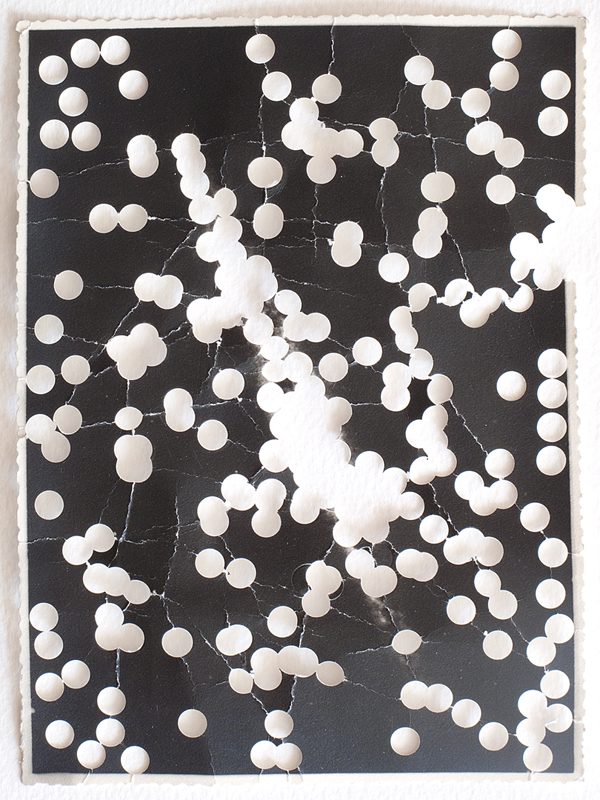
Aspen Mays, Punched Out Stars 2, 2011, courtesy of the artist and Golden Gallery

While Aspen Mays’s Punched Out Stars highlight their vacancies much more aggressively. Rather than depicting the suns of other galaxies in her images of night skies, Mays chooses to redact them, literally removing them with a hole punch, precisely asserting the lack of information present. And here the show highlights the use of photography in pursuits of scientific endeavor as both powerfully illuminating and uneasily incomplete, while also articulating the insufficiency of the scientific effort itself. There are just so many gaps in our knowledge and thus gaps in our ability to accurately represent that knowledge.

Our Origins is on view at Chicago’s Museum of Contemporary Photography through October 15.

Share

Light of the World

L.A. Expanded: Notes from the West Coast
A weekly column by Catherine Wagley

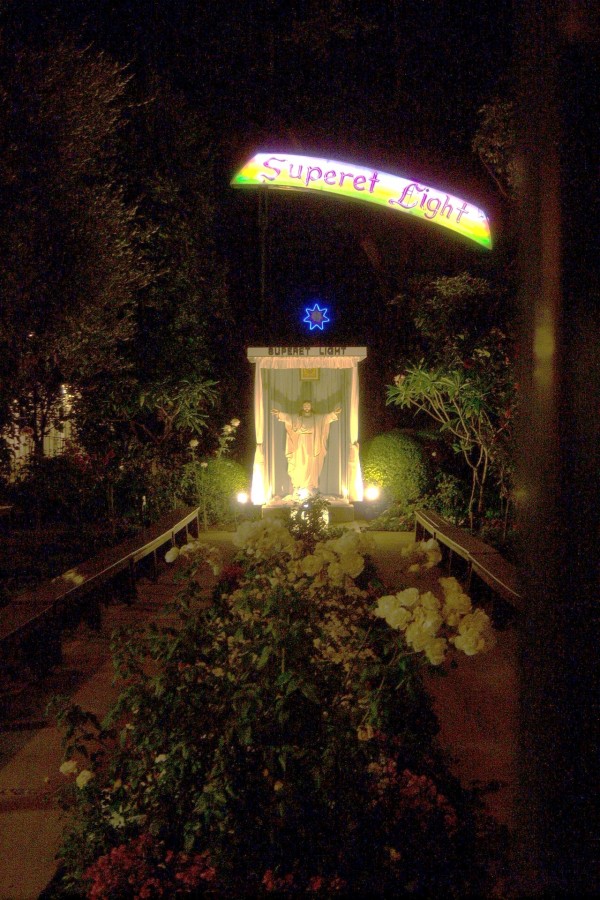
Mother Trust Superet Church's Prayer Garden

A mile and a half from where I live, close to downtown, there’s a strange treasure: a traditional white church with a tall steeple and prayer garden complete with a Jesus sculpture right next door. It looks like a place Anne of Green Gables might have gone to pray, except that the protestant Avonlea-worthy quaintness is turned upside down by a whole lot of neon. There’s a pink and purple neon sign above the church itself and a shooting neon rainbow above the Jesus in the garden. It would be gaudy it weren’t so grippingly uncanny, especially at night.

The Mother Trust Superet Church was founded in 1926 and purportedly combines a scientific study of light with Bible study. “Jesus’ Words were shining with and in a brilliancy of golden and purple Light,” reads the church’s website, which also alludes to the church’s belief in auras and reincarnation.

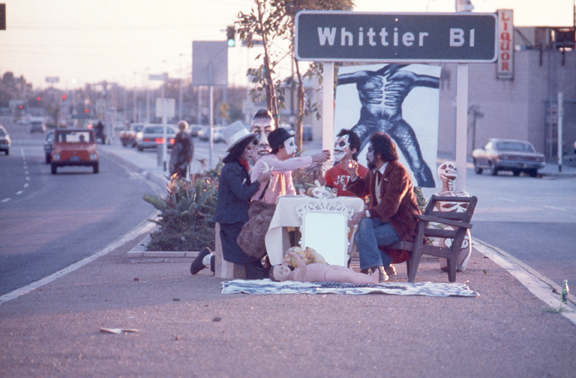
Asco, First Supper (After a Major Riot), 1974

I thought of Mother Trust and its weird spiritual whimsy Wednesday, when strolling through ASCO, the Los Angeles County Museum of Art’s soon-to-open exhibition of work by an under-exposed Chicano collective consisting of Gronk, Willie Herron, Harry Gamboa and Patssi Valdez. Active in L.A. in the 1970s and ‘80s and named after the Spanish word for nausea – as the story goes, one member of the group said “This gives me ASCO” after seeing a grating exhibition, and an idea for a new kind of art was born – the group had a lot to be nauseous about, including the war in Vietnam, which had killed a seemingly disproportionate number of young Chicano men.

The show largely includes video and photographic documentations of performances, one of which was the Stations of the Cross, performed in 1971 along Whittier Boulevard in L.A. A procession and a protest, the artists wore outlandish costumes (Gamboa was Pontius Pilate in a clown suit) and headed, with a large cross and skeleton in tow, toward the Marine Recruiting Station, where they would deliver the skeleton. Later, they interrupted a mass in Evergreen Cemetery and staged First Supper (After a Riot), dining on an island in the middle of a street  during rush hour. In these performances, they wore make-up and outlandish costumes—platform boots, or  home-made masks.

Asco, Asco Goes to the Universe, 1975

Always, ASCO looked reverently serious, no matter how riotous or disruptive they were being. Like the Superet church with its kitschy and over-the-top neon, their disruptions and eccentricities, even when motivated by disgust at the world around them, were full of conviction.

Share

See Yourself Sensing – or What it Feels Like to be a Cyborg

We are all cyborgs…

Didier Faustino, (G)host in the (S)hell, 2008. Video Still. Image courtesy of the Artist and Galerie Michel Rein.

as Donna Haraway proclaimed in her 1991 manifesto. The fusion of man and machine in popular culture, scientific exploration and artistic production in the late 20th century, was loaded with fear, alongside great aspirations, of genetic engineering, technological advances and mechanisms of control. However, the anxiety of the future that was expressed in 1990s art with the exploration of digital interfaces and the disintegration of the body, seems now to have dissipated – our reality of this is far less distressing than what was envisioned 20 years ago.

Black Dog Press’s recent publication and accompanying exhibition at WORK Gallery, See Yourself Sensing: Redefining Human Perception, takes up the post-humanist trajectory of art once again, but reframes it within one aspect that has largely been brushed over – the senses – and asks you to consider how trans-human prosthetics alter individual perception and the experience of reality – or what it might feel like to be a cyborg?

In Didier Faustino’s (G)host in the (S)hell, perception and appearance are altered by a relatively benign substance that through excess becomes deformative. Faustino’s video records a performance in which the artist painstakingly chews bubbly pink gum that when adequately softened, is applied to his face. With time, the sickly sweet substance turns the artist into a monster, his breathing becomes increasingly laboured, and we can only cringe at the sticky reality underneath it all – the host must truly be in hell.

Beta Tank, Eye Candy, Yellow, 2008. Image courtesy of the Artist.

Extending sweets into cerebrally triggered sensation, Beta Tank’s Eye Candy project creates a proposal for an object that is stimulating to both the tastebuds and the mind. Eye Candy aims to ‘transmit vivid emotive images into your mind’s eye’ in six distinct flavours through an electrode-laden lollipop – a fictional creation based on very real existing technology. A true synaesthetic world where image and colour are on the tip of your tongue.

Ann Hamilton, Face to Face • 28. Image courtesy of Ann Hamilton Studio.

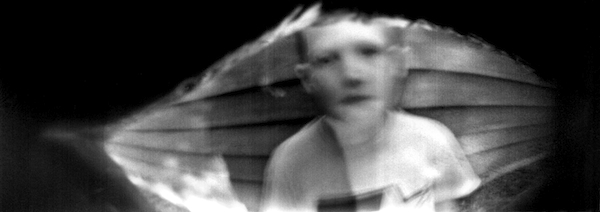
Ann Hamilton’s curious series of photographs, Face to Face, appear, at first glance, to present the world through the aperture of the eyelid as faces hazily emerge from a distinctive frame. However, Hamilton is working with the same portal as Eyecode – transforming her mouth into a tiny, functional camera. Her ‘mouth seeing’ extends the senses of the mouth beyond taste – here becoming the location of vision.

Golan Levin, Eyecode. Image courtesy of the Artist and Bitforms Gallery

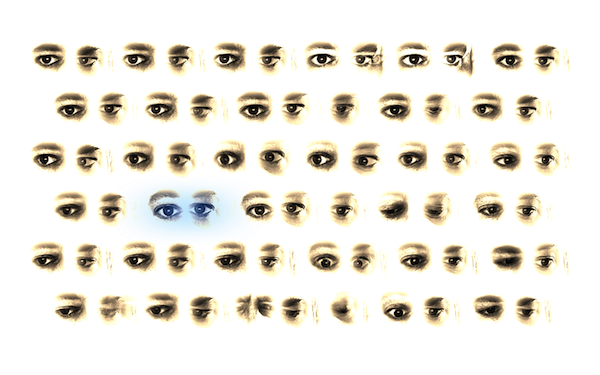
And turning vision back at you, Golan Levin’s Eyecode, allows you to see yourself seeing, and others seeing you as well. Levin’s high-tech programme unwarningly records your eye movement as you stand in front of the screen, and plays it back to you alongside hundreds of others who have stood there before you. An uncanny, and quite intriguing, experience indeed, founded in mechanisms of surveillance.

What sets these works apart from the previous generation of artists is a sense of humour and intimacy – an engagement with the body that is less founded in fear, and rather in intrigue and the exploration of potentials. The question has been reframed to curiously ask, ‘What does this feel like?’ – and the possibilities of reality presented are quite enticing indeed.

Share

Lonely Furrow

Shambhavi Singh, Griha Do Sanctum II, 2011. Pigmented Paper Pulp with STPI hand made cast paper pulp, 188 x 145 x 6 cm. Image: © Shambhavi/Singapore Tyler Print Institute 2011

Eschewing portrayals of the pastoral life, Shambhavi Singh’s canvasses are visceral, nebulous and profoundly spiritual, tending towards the cosmic and perhaps, even the anti-idyllic pastoral. Lonely Furrow, her solo exhibition at the Singapore Tyler Print Institute, re-centres our focus on the harsh existence of rural workers in her native Bihar but refrains quite remarkably, from any social commentary of the rural-urban divisions plaguing rapidly industrialising nations.

Shambhavi Singh, Hasiya, Sickle 1/8, 2011. Sulphur tint and Lithography on STPI hand made paper, 127 x 101 cm. Image: © Shambhavi/Singapore Tyler Print Institute 2011

Portraying instead a preoccupation with the macrocosmic, Singh’s vision is ungoverned by socio-political boundaries and is worked out through the most basic of forms; in this case, through the elemental shapes of the farmer’s tools: the curve of the sickle and the roundness of the seeds that he sows. Even the production processes of the works exhibited in Lonely Furrow parallel the tactile, labour-intensive processes of the agricultural industry. The Hasiya (2011) clusters and Beej Brahmaand Ek/Cosmic Seed (2011) – first engraved in copper plates and later chemically corroded – seem to pay tribute to a communal resilience that inevitably wears thin against the brutality of life. The Illumination series is created out of painted layers of pigmented paper pulp onto freshly made paper, the fibrous textures of the pulp presenting the known universe as it must have looked like to the inhabitants of pre-history.

Shambhavi Singh, Anjor Teen, Illuminate 3, 2011. Pigmented Paper Pulp applied on pigment stained STPI hand made paper pulp, 175 x 140 cm. Image: © Shambhavi/Singapore Tyler Print Institute 2011

Yet for a figure so central to the show’s melancholic tone, the farmer himself is missing from her canvasses perhaps, this is where elegiac quality of Singh’s work emerges most powerfully. Anjor Teen (2011) and Dhibri Ek (2011) – among those in the Illumination series – depict oil wick bottles and bowls used for sustenance and energy. The turmeric wall sculpture Griha Do Sanctum (2011) is a bare, circular indentation carved into an uneven and cracked surface, illustrating human life as it is lived at its barest and most minimal. We know of the farmer through his tools, his home and his living materials but not the individual. These physical structures embody his marginalised life – they paradoxically express the sense of the transitory – yet hold the collective and enduring memory of a toiling group whose karmic reality is a designed dependence on and perhaps, the eventual consumption by the cyclic forces of nature.

Shambhavi Singh, Dhibri Ek, Wicks 2, 2011. Pigmented Paper Pulp applied on pigment stained STPI hand made paper pulp, 137 x 175 cm. Image: © Shambhavi/Singapore Tyler Print Institute 2011

Lonely Furrow will be on view at the Singapore Tyler Print Institute until 10 September 2011.

Share

Me, Myself, and My Avatar

Desirée Holman, video still composite from Heterotopias, 2011, courtesy of the artist and Silverman Gallery, San Francisco.

Along with nine, hand-selected participants, artist Desirée Holman has spent the last two years developing a series of avatars. The resulting project, Heterotopias, 2011, a video and supporting drawings on view now at the Berkeley Art Museum, refers to corporeal reality’s relationship to virtual reality, the physical process by which the digitally rendered avatar is formed, and the ironic stasis of the body whilst the imagined self is set free.  Unfortunately, Holman only refers to these ideas.  While aesthetically engaging and fun to watch, Heterotopias fails to delve beyond the surface of her topic.

Shot as a sort of music video, the participants sit before laptops in similar, homey interiors.  They dance, are transformed into both live-action and digitally animated superhero-like characters, and engage in battle with long staffs. Considering the care taken in creating the colorful and fanciful costumes and scenery, as well as the richness of the concept, a viewer expects much more from these characters than what is delivered.

Desirée Holman, Mask of Agamemnon (Diffuse Map), 2011, courtesy of the artist and Silverman Gallery, San Francisco.

One cannot help but wonder: is sitting in front of a computer the extent of the lives of these individuals?  Even Superman’s Clark Kent has distinguishing characteristics, personal dramas and quirks.  If these avatars are an opportunity to exist in a space untethered by the bounds of the real, why do the avatars perform feats no more complex than hitting one another with sticks?

Not one of the actors or avatars has any true individuation, despite the potential offered by their appearances. The elaborately developed avatars are little more than costumes: digital exoskeletons worn by the subjects.  Holman and her participants supposedly spent a great deal of time and effort in the development of these fictions: why is the audience not granted access to this aspect of the project? We have all played video games, seen superhero fiction, or engaged in social networking sites as digitally warped versions of ourselves.  In each of these scenarios, the stories generated by fictional or semi-fantastic characters are engaging and multi-dimensional: both morally and socially complex.  We should be granted similar complexity from these characters.

Desirée Holman, Dancers Dancing in Their Own Digital Ectoplasmic Cocoons 1, 2010, courtesy of the artist and Silverman Gallery, San Francisco.

The show’s accompanying drawings are an interesting addition. Pieces such as Dancers Dancing in their Own Digital Ectoplasmic Cocoons are beautifully executed and freeze time in a manner that allows us to attempt a more in-depth connection with these individuals.  The “ectoplasmic cocoons,” incidentally, work better in the drawings than in the videos; in the latter, the pink lining on the characters as they jump between fantasy worlds seems to be a result of poor color-keying. Though not all of the works are as successful, one drawing of a costumed face alludes to information promised but never quite delivered: a man stares ahead, awkwardly, wearing a humorous headpiece.  His eyes indicate that he is unsure of the world in which he belongs, torn between his virtual self and actual self.  He is self-conscious, but nonetheless set free by his ridiculous garb.  Is this a drawing of the man, or of his digital armature?  Where in this spectrum does the drawing, and in fact, all art—itself a virtual rendition of reality—fall?

Share

From the DS Archives: Mike Kelley

On view from September 8 – October 22 at Gagosian Gallery (London), Mike Kelley continues his investigation on the inconsistencies in the story of Superman. Kelley began his quest in 1999 with the Kandors series, and the newest iteration, Exploded Fortress of Solitude, highlights the devastation and destruction of Superman’s home planet.

The following article was originally posted on February 2, 2011 by Caitlin Moore.

Mike Kelley claims he doesn’t particularly like Superman. The jury is out on whether or not this qualifies him as a communist, but his claim does provide a source of perplexity when evaluating the inspiration for his ongoing Kandor sculpture and installation series – the newest of which being currently displayed at Gagosian Gallery (Beverly Hills) alongside the latest chapters of his filmic project, Extracurricular Activity Projective Reconstruction (EAPR).

Kandor 10 / Extracurricular Activity Projective Reconstruction #34 and Kandor 12 / Extracurricular Activity Projective Reconstruction #35, installation view. Photo by Fredrik Nilsen. Courtesy of Gagosian Gallery.

In its original graphic incarnation, Kandor is noted as the fictional capital city of Superman’s native planet, Krypton. By the swift and conniving hands of the villainous Brainiac, the city was taken hostage and miniaturized for purposes not entirely sensible or mildly coherent – but not without valorous retrieval by our hero. Despite Superman’s Samaritan ways, the omnipresent plague of a haunting past hinders him from true emotional and psychological liberation – not to mention, visible underpants. For Kelley, the conceptual appeal lies in Kandor’s embodiment of an alienating victim culture for our protagonist: the notion of a burdensome present dictated by a labyrinthine past. Kelley’s unorthodox fusion of fragmented narrative, medium and sensory immersion seem nonsensical and queer at first encounter, yet the further we delve into his sensational rabbit hole, the closer we come to the truly bizarre fidelity of the human condition. Kelley confronts our latent attitudes and popular convictions relating to sexuality, socioeconomics, education and history with jocular finesse and – well – candor.

Kandor 10 / Extracurricular Activity Projective Reconstruction #34 and Kandor 12 / Extracurricular Activity Projective Reconstruction #35, installation view. Photo by Fredrik Nilsen. Courtesy of Gagosian Gallery.

Like glowing orbs, a handful of Kandor sculptures pepper the multiple galleries within the darkened Gagosian megaplex. The dwarfed cities encased beneath colorful bell jars appear relic-like, yet also profane at times – their jutting skyscrapers evoking a curiosity born of both estrangement and familiarity. The two primary microcosms – Kandor 10 and Kandor 12 – bear oversized tubes that snake into tanks of (presumably) atmosphere, per the accuracy of the comic book reference. Each is situated within environmental installations that embellish upon two distinct anecdotes central to the exhibition: the carnal Moroccan harem featured in EAPR #34, and the bleak sooty chamber that appears in EAPR #35. In merging his previously autonomous Kandor and EAPR projects, Kelley suggests an innate relationship between our own respective microcosmic realities and subsequent conditional behavior.

Mike Kelley, video production still from Extracurricular Projective Reconstruction #34, 2010. Courtesy Gagosian Gallery and Kelley Studio.

By way of illustration, Kelley’s EAPR #34 videos largely examine the lascivious conduct of society’s upper echelon when handed unrestricted power and entitlement. Directed in the style of a maladroit stage play, EAPR #34 shifts between a piggish male King belittling his covetous female harem and a group of scornful Queens admonishing a male servant. In both scenarios, the authoritarian’s disposition to abuse of influence and insatiable gluttony bespeaks a cyclical global history of flawed paradigm and deep-rooted desire for accumulation. Beside the video installation, Kandor 10 is nestled within a life-size stony grotto reminiscent of EAPR #34’s exotic Moroccan setting, as if displaying the incubator in which these voracious human mannerisms were nurtured. When the Kandor’s luminous mini-cityscape appears more familiar than it does foreign, one can only muse on how fictitiously reconstructive Kelley’s staged milieu really is.

Kandor 12 A (green screen), 2010. Tinted Urethane resin, steel, blown glass with water-based resin coating wood, enamel paint, silicone rubber, acrylic paint, lighting fixture and Lenticular 12. 126 x 202 x 276 inches overall (320 x 513.1 x 701 cm). Photo by Fredrik Nilsen. Courtesy of Gagosian Gallery.

Conversely, EAPR #35 jettisons us into a place of somber isolation and denial. Grimy clownish gnomes aimlessly shuffle around a murky cell, their void gazes searching for an ambiguous cue. Homogeneous in tired costume and ashen faces, the destitute prisoners amble in silent futility – resigned to the dim prospects of their ordained condition.

Video production still from Extracurricular Projective Reconstruction #35, 2010. Courtesy Gagosian Gallery and Kelley Studio.


The analogous Kandor 12 shares an equally inauspicious aesthetic; the cloudy brown bottle houses a municipality more reminiscent of chess pieces than modern skyscrapers – as if underlining the inmates’ loss of an unassailable game. The sparse backdrop of the gnomes’ cellar intimates a societal tradition of abhorrent secrecy and muted abuse of the weak, a ritualistic convention of marginalizing the vulnerable in order to preserve the greater hierarchy. As if acting as the underbelly to the rapacious actuality in EAPR #34, the vignette captured in EAPR #35 exposes the ensuing trauma that occurs in the wings as we strive to fulfill our socially performative roles – most of which remain immutably out of reach.

Kandor 12 A (green screen), 2010. Tinted Urethane resin, steel, blown glass with water-based resin coating wood, enamel paint, silicone rubber, acrylic paint, lighting fixture and Lenticular 12. 126 x 202 x 276 inches overall (320 x 513.1 x 701 cm). Photo by Fredrik Nilsen. Courtesy of Gagosian Gallery.

In fact, Kelley’s inclusion of the sets from the EAPR #34 and EAPR #35 videos in this exhibition make us feel but a mere player in one hell of a bewildering production. In tandem with his Kandors, the sets feel like an abstract extension of a transient ecology, a faux mise en scène demonstration of how we enact our own mortality. Do we unconsciously fall victim to institutional constructs in our quest for repute and satisfaction, acting a character merely to clinch our chances of eminence? Or do we find ourselves waiting in the wings for a cue – a protagonist – that may never come?

Kandor 10 / Extracurricular Activity Projective Reconstruction #34 and Kandor 12 / Extracurricular Activity Projective Reconstruction #35, installation view. Photo by Fredrik Nilsen. Courtesy of Gagosian Gallery.


Share