Best of PULSE LA

There is another art fair in Los Angeles.

Art fairs are synonymous with crowded, cavernous booths, prepackaged artwork, and most of all: money. But, this new art fair in Los Angeles does what very few art fairs have managed in the past; PULSE has combined a strong, experimental group of galleries and project spaces with actual money making. Combining gallery booths with project spaces for non-profit institutions and artists, PULSE delivers sculpture, installation, photography, and painting from some of the world’s most interesting contemporary artists. Having a strong presence in New York and Miami, PULSE opened its doors in Los Angeles to an all new crowd on Friday September 30th, and will continue through 5pm this evening. DailyServing sent three writers to  PULSE LA to bring you the most interesting and noteworthy projects.

Allyson Strafella, Von Lintel Gallery, Booth B-9

Allyson Strafella, “Crenelation,” 2006. Typed dashes on green transfer paper. 6” by 10”.

By its very nature, an art fair overstimulates.  This might be the reason my eye landed on Allyson Strafella’s work, a series of simple and colorful geometric forms, à la Ellsworth Kelly:  two deep red rectangles, one black, and one more I can’t quite recall—possibly something voluptuous and green floating in a field of white.  They looked out of place, overly simple and stubbornly modern.  Yet…they wobble.  They even seem a little furry.  Strafella works on a customized typewriter, with a special set of keys and a much wider bed than what any of the secretaries on Mad Men would use.  She chooses flimsy papers, including colored carbon papers, which she then inserts into her machine and completely distresses through repeated mechanical contact. In some places that Strafella hits over and over with the typewriter keys, the paper becomes lace-like, or begins to fall apart.  The results hover between sculpture and drawing, bringing new texture to an old form.

Allyson Strafella is represented by New York’s Von Lintel Gallery and can be seen for one more day in booth B-9.

Written by Danielle Sommer.

_______________________________________________________________________________________________________________________

Kenji Sugiyama, Standing Pine Gallery, Booth I-7

Image Caption: L: Kenji Sugiyama, detail from Institute of Intimate Museums: Mazes, 1998, mixed media installation; Right: Kenji Sugiyama, installation view of Institute of Intimate Museums, 2000, mixed media installation. Courtesy Standing Pine - cube.

Japanese gallery Standing Pine’s whole booth is devoted to obsessively detailed miniature “museums” by artist Kenji Sugiyama. They’re small cardboard boxes or round viewfinders the size wiffle balls that you can look through to see a whole exhibition installed to scale. At Pulse, a long line of flimsy pasta boxes sit on a white shelf, and when you crouch to look through one end, you’ll see a corridor assembled in a pristine, calculated manner, with faux wooden floors, framed images lining the walls, and benches spaced along the center. Sugiyama calls this series of work, which he began making in 1999, Institute of Intimate Museums and each museum exhibits tiny installations of his own work. This makes the project slightly solipsistic, but teeny-tiny solipsism, it turns out, can be delightfully idiosyncratic.

Written by Catherine Wagley.

_______________________________________________________________________________________________________________________

Hong Seon Jang, David B. Smith Gallery, Booth A-7

Hong Seon Jang, Green Forest, Tape on chalkboard, 24 x 36 in., 2011 (Detail)

I always love to see what galleries have tucked away in their closets at art fairs – interesting work is often times hidden behind closed doors, drawn curtains or around a corner. I was pleased to peak down the closet hallway of Booth A-7, Denver’s David B. Smith Gallery, where a small work by New York based artist Hong Seon Jang is hung. By meticulously applying layers of tape on a chalkboard, the artist creates an idyllic scene of a deer in a forest, capturing the subtlety of shading, pattern and depth using only this simple material. His use of tape – a material employed for its temporary nature – adds a sense of physical vulnerability to the work, challenging what may initially be seen as simply a beautiful image.

Written by Allie Haeusslein.

Share

From the DS Archives: MoMA PS1

From the DS archives brings you an interview with Laurel Nakadate, her ten-year retrospective was on view at MoMA PS1 earlier this year. Today is the last day of the New York Art Book Fair at PS1, don’t miss  it!

This interview was originally posted on March 3, 2011 by Bean Gilsdorf:

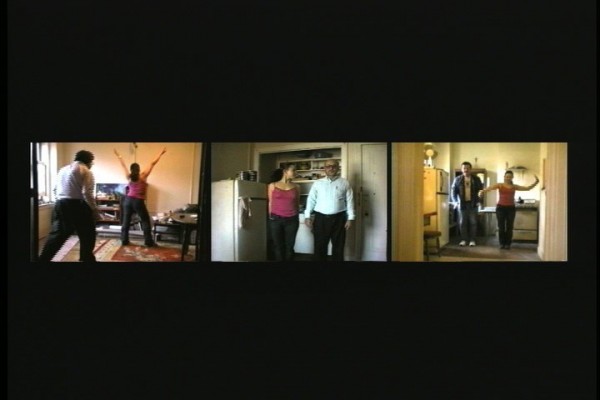
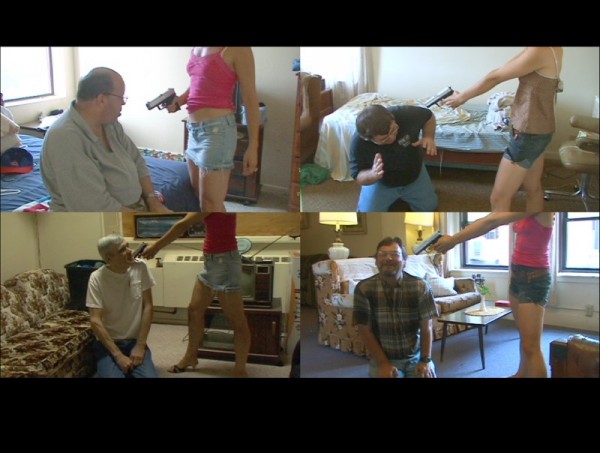
Laurel Nakadate’s work uses unassuming means to memorable effect. Oops! (2000) is a video of a young woman in a tank top and tight jeans dancing a choreographed routine while a man in late middle age dances (or stands) awkwardly beside her. It is mesmerizing in its ambiguity: is she making fun of the man? Which one is being exploited? Beg for Your Life (2006) shows Nakadate holding a gun to the head of various men while they perform the title action. Over and over, her work explores the power and beauty of events that teeter on the edge between anxiety and exhilaration. With her ten-year retrospective at PS1 in New York and various screenings and openings, Nakadate’s time is in short supply. I managed to wring this interview from her in record time before she jetted off to her next engagement.

Laurel Nakadate, Oops! (2000). Still from video.

Bean Gilsdorf: Your work explores the power dynamic between men and women. Is this a personal thing?

Laurel Nakadate: What it’s about, for me, is two people in a room and the discomfort and beauty in the space between them. There’s this idea that anything can happen in a room with two people: there are problems and concerns, implications…sometimes this person is at fault and sometimes that person’s at fault, but most of the time something beautiful can come out of the power struggle.

BG: You’re often physically present. Is the work biographical?

LN: No, it’s a construction.

BG: So you’re a stand-in?

LN: I’m an actor. I’m a performance artist or an actor in that scene. It’s not me, it’s some sort of hybrid with me in my body going into the space as a character. I definitely see it as a performance. It’s not Laurel.

Laurel Nakadate, Beg for Your Life (2006). Still from video.

BG: There’s so much risk involved. Do you ever feel frightened? And how do you move past that?

LN: I think there’s something thrilling about the unknown. I certainly feel like it’s work that challenges people to worry or not worry about the protagonists. But I’ve never done anything where I thought I was risking my life. I’ve made work that in retrospect seems that it was risky, or took chances, but when I made the work it was never about setting out to kill myself or get killed. It was always about this investigation. Now I look back at some of the work and I think, God, I was really lucky! But mostly I look back and I think I was really brave.

BG: The work seems very experimental and open-ended. How do you conceptualize what you’re doing when you’re about to go into it?

LN: It’s about telling stories that are difficult to tell, stories that are wily and winding, and what I love about them is that anything can happen, anything is possible and there can be any ending. It’s as complicated as any unknown, which we unravel through chance and creation and sorting through stories. I have a hard time categorizing things, I feel that it’s dismissive and not fair to the work. It’s performance-based work, and so by its very nature, experimental. And what I love about performance is that it can only happen that one time and that one way. You can try to recreate it, but it will never be the same and there’s something beautiful about that. But I find trying to label a piece of art as a specific thing problematic and reductive. Every painter has the right to say they are actually making sculpture, and every sculptor has the right to say they’re doing performance art. And every audience member has the right to read it as something else. Open and generous is where you have to be.

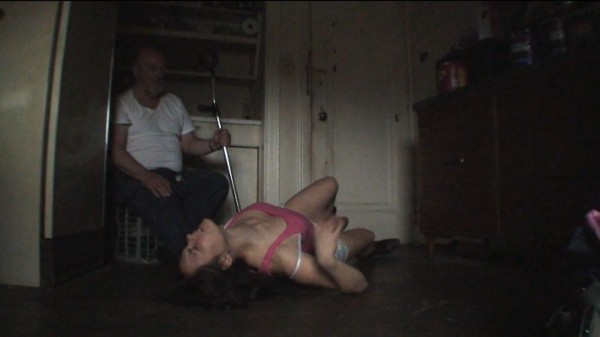
Laurel Nakadate, Exorcism in January (2009). Still from video.

BG: A lot of your work seems dark, but you’ve also talked about how the act of being in a space with someone else is an act of love.

LN: I certainly see darkness in the work, absolutely, but I don’t think darkness is bad. I think darkness is lovely.

BG: And you’ve also talked about the work as an exorcism. Once you’ve done a performance, are you done with it?

LN: It’s always different. Sometimes you’ll do something and you’ll feel like it’s resolved, and sometimes you’ll keep pounding on that door. You can’t win, because if you don’t keep pounding on the door people say that you’re a one-hit wonder; if you do keep pounding, people say you’re narcissistic or obsessed.

BG: What are you working on now?

LN: I’m writing a screenplay and working on a book project. I’m also kind of babysitting the MOMA/PS1 show in the sense that I’m still talking about it a lot. It just opened, so it’s still really new and exciting for me. I’ve got a show of new work opening at the end of April. I’m just going to take the summer to work on the screenplay.

BG: Can you tell me what it’s about?

LN: It’s about adults, that’s what I’ll say now. Consenting adults.

Share

Sean McFarland at YBCA’s BAN 6

Sean McFarland discusses his recent projects Pictures of the Earth and Dark Pictures as a part of Yerba Buena Center for the Arts‘ Bay Area Now 6. Read the DailyServing review of BAN6 here.

Share

Are you a Rauschenberg or a Johns?

L.A. Expanded: Notes from the West Coast
A weekly column by Catherine Wagley

Jasper Johns, "Map," 1961, Encaustic, oil, and collage, Museum of Modern Art, New York. Art (C) Jasper Johns/Licensed by VAGA, New York, NY

A block of Grand Avenue in downtown L.A. was  completely blocked off a few days ago, but hanging across the barricades was a big red arrow pointing down Bunker Hill with “jurors” written across it. No other signs told passers-by anything about the construction or about detours, but to let the jurors get lost would be un-American. A friend of mine, an artist, was recently “Juror one” in an L.A. case thrown out after only a day. In that day, however, she parked below Disney Concert Hall and got in for free at MOCA. Jurors, it turns out, get certain perks.

Robert Rauschenberg, "Canyon," 1959, oil, housepaint, pencil, paper, fabric, metal, buttons, nails, cardboard, printed paper, photographs, wood, paint tubes, mirror string, pillow & bald eagle on canvas, National Gallery of Art, Washington, D. C.

The jury happened to include another, younger self-declared artist, who at first struck my friend as savvy.  The two of them decided to visit MOCA together, and, walking through the room with the Johns and Rauschenberg work from the museum’s permanent collection, G. asked the question: “Rauschenberg or Johns? Who’s best?” “Well, I really liked those Rothko’s,” the kid she was with said, “but I guess Rauschenberg, if I had to choose, but Pollock’s my favorite.” Clearly, he didn’t get it. Rauschenberg vs. Johns is the litmus test. Your answer shines a mirror on what you want from the world, and on the art scene, it’s a way better personality gauge than, say, Meyers Briggs: The repressed, introverted and calculating Johns vs. the all-out exhibitionist Rauschenberg.

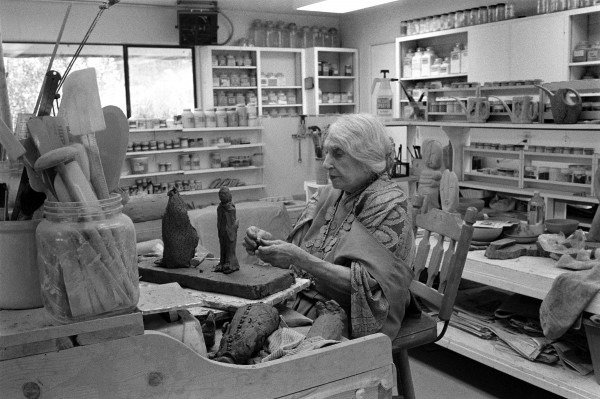
Jasper Johns owned the work of indomitable ceramicist and Dadaist Beatrice Wood, currently the Santa of a Monica Museum of Art retrospective. Wood attended the Arensberg salon (“an inconceivable orgy of sexuality, jazz and alcohol,” according to artist Francis Picabia’s wife), with Duchamp in the 1910s, and then continued art-making, mostly in California, for the rest of the century, until her death in the late 1990s. She made drawings, figurative ceramic sculptures and then whole armies of outlandish teapots, plates and cups, getting all the more daring as she got older. One teapot from 1983 is shaped like a fish. Johns never owned that one, however. The two of the works that were his in the current show include a small brown chalice and a gold plate, both relatively conservative objects but both still exorbitantly shiny, fair examples of the Wood’s oeuvre.  It’s hard to imagine Rauschenberg choosing those two though; I imagine him going for the bolder, weirder shapes—like the teapot with figures dancing on the lid.

Beatrice Wood in her studio

Wood wrote a book called I Shock Myself in 1985, beginning with the line, “While the substance of ceramics is clay and chemicals, the stuff of life is most certainly people.” Which, I guess, is why thinking about the fact that Johns owns Wood, and playing the Rauschenberg vs. Johns game remain endlessly interesting: they acknowledge that what art you want and like have some bearing on who you are as a person.

Share

History in Art at MOCAK

With the work of over forty artists, History in Art at the Museum of Contemporary Art in Krakow is a sizeable exhibition; but its scale is not only warranted, it is necessary.  If the internet age ushered in a global culture of multiplicity, then History in Art demonstrates the contemporary attitude toward the formation of a historical record: individual voices make up a flexible, imaginative whole.

Accordingly, there are many approaches to exploring the past in this exhibition.  Some artists take history itself as a subject, while others focus on particular events from the world-shaking to the minutely individualistic.  The overarching theme is solidly postmodernist; a conspicuous refutation of the existence of any single version of events.  In fact, History in Art reinforces the preference for subjectivity by presenting work by artists working in all media and at different stages of their careers.  In this way, the exhibition examines history from almost all angles and media, and the diversity is rewarding.

Shinji Ogawa, Then and Now, Krakow, 2010, acrylic on book

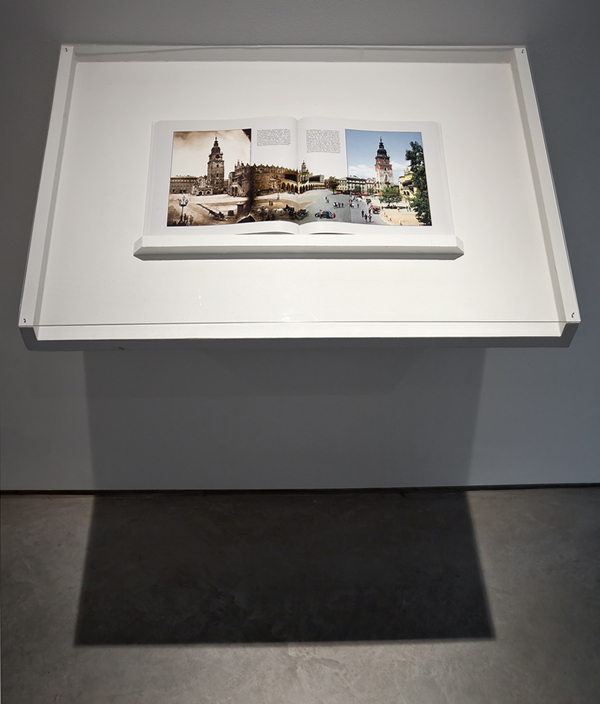
Shinji Ogawa’s practice involves a series of techniques that investigate the image by drawing, overdrawing, halving, doubling, and layering.  Along one wall are three vitrines that encase picture or travel books from various cities.  One example, Then and Now, Krakow (2010) shows two views—one antiquated, one more modern—of the city’s main square with its famous Cloth Hall.  Ogawa has drawn the architectural elements that are cropped out of the originals across the gutter of the book.  His work links the two individual pictures, extending the scene and bringing the past in touch with the present.

Krystyna Piotrowska, I Left Poland Because…, 2010, video, 31 min

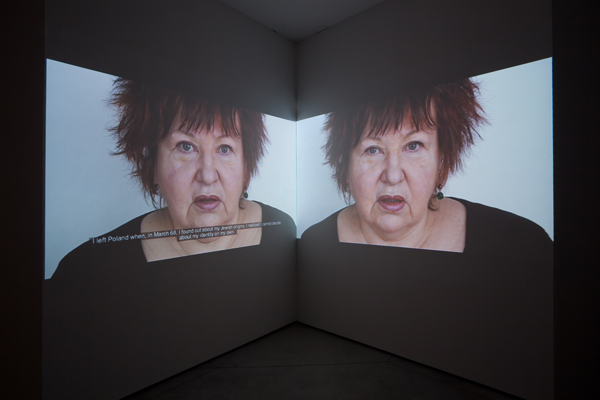
Loss haunts many of the works in the exhibition.  Krystyna Piotrowska‘s I Left Poland Because… (2010) is a two-channel video projected into the cleft of two angled walls.  Very simply, the two images show a close-up shot of a person uttering sentences beginning with “I left Poland because…” On the left, the person speaks in Polish; on the right, she speaks in English.  When one side is speaking, the other is frozen.  One quote: “I left Poland because it was the only country where I couldn’t be Polish.”  The components of this installation all contribute meaningfully to the whole: the angled walls create a setting where the speaker looks at the audience, but also nearly faces her estranged self.   Additionally, the switch between Polish and English very deftly facilitates an awareness of how language creates identity. The immobility of one side while the other talks points to the barriers of language and the slippage of translation.  In the gap between languages, how much is lost?

Robert Kuśmirowski, Processing, 2011, installation

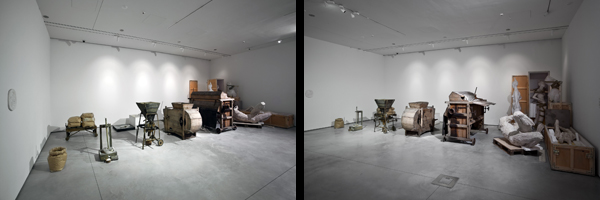
Robert Kusmirowski’s Processing (2011) is a room-sized installation wherein classical sculptures are ground to dust.  One side begins with the figures in packing cases, then on leftward to threshing and winnowing machines, to a flourmill, a drill, and a sawmill cart.  This allegorical factory reduces even the most durable members of art’s legacy to mere grist for the mill.

Boaz Arad, Marcel, Marcel, 2000, video

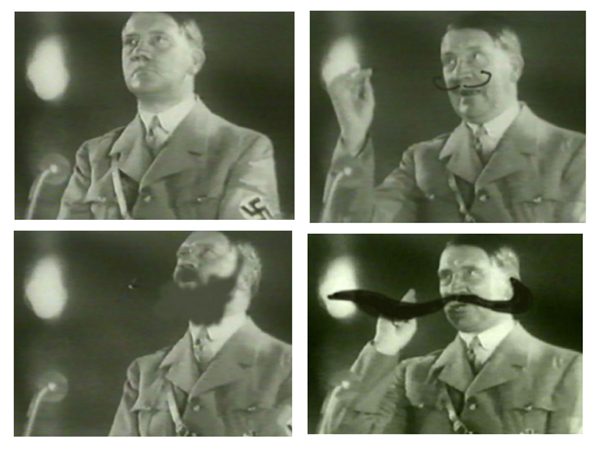
Videos presented on flat-screen monitors are scattered throughout the exhibition.  It seems fitting that digital video, that most plastic of media, should be used to examine and recreate history.  Boaz Arad‘s work, for example, uses the flexibility of video combined with humor to address the legacy of Hitler and the Nazis.  100 Beats (1999) lampoons Hitler as a pervert masturbating onstage by looping a short clip of der Führer moving his hand in his pocket.  Shalom Jerusalem takes short clips from various archives of Hitler’s speeches to create a public address that never happened: Hitler saying, “Shalom Jerusalem, I apologize.”   In Marcel, Marcel (2000) Hitler’s mustache is playfully re-imagined.  This strategy of using absurdity to counter fear and brutality brings welcome levity to the exhibition as a whole.  Hitler’s reign may seem both geographically far and historically distant to an American audience, but the effects of World War II are still keenly felt in modern-day Poland.  By heightening the buffoonery of a murderous little dictator, Arad swabs old wounds with new laughter.

Share

EVOL’s Underground City in Hamburg

Today’s feature is brought to you by our friends at Flavorwire, where briefly discusses Berlin-based street artist EVOL‘s newest project.

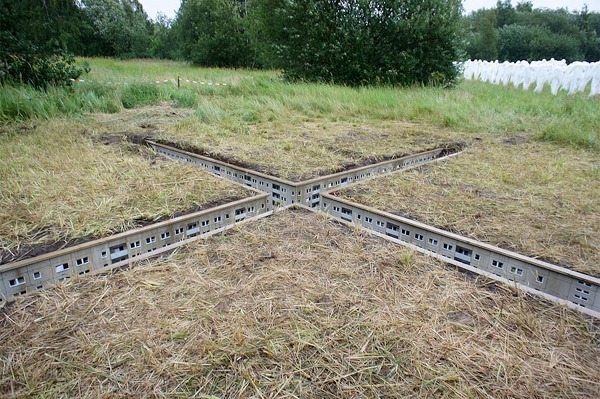
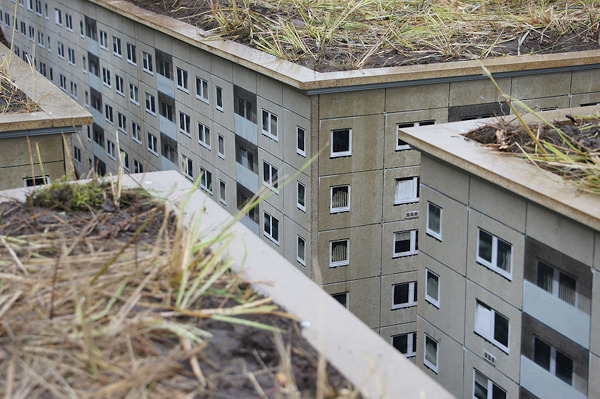
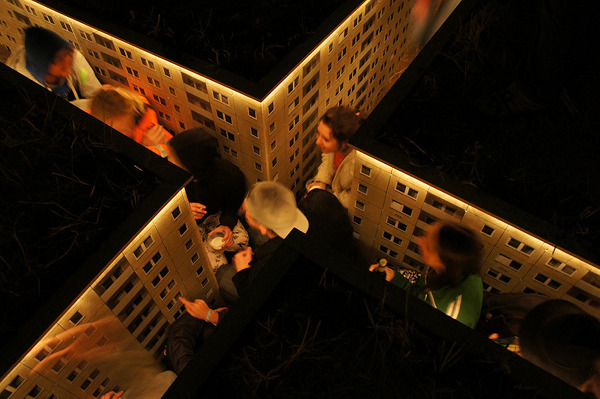
In Nordkreuz (“Northern Cross”), Berlin-based street artist EVOL has created a miniature, underground city in the fields of Hamburg, Germany. The installation — which took him eight days to complete — found the artist outside of his typical urban environment, digging into a picturesque meadow to create a grid that viewers could actually walk through. The buildings’ compound-like, grey facade provides a striking contrast to the scenic surroundings, complete with dirt “roads.”

Check out the making-of the installation and the artist’s other work here.

Share

Conclusion to the Big Ideas: An Interview with Alon Levin

Modernity—in all its West-centric incarnations—has been debated, deliberated and disputed since the last feudal lord packed it in.  Baudelaire lambasted the arbitrary parameters that dictate “advanced” civilization; Machiavelli’s antecedents celebrated them. The very notion of a “modern” world results in a perpetual discourse on the factors that prescribe it. Within the walls of Ambach & Rice‘s new Los Angeles gallery, the dialogue persists with Alon Levin‘s staggering solo exhibition, Conclusion to the Big Ideas, a collection of insightful works supplemented by the artist’s publication, Modernity in Very General Terms, 2011.  Through its meticulous scrutiny of power structures, capricious rules, and sociological myth, Levin’s work accentuates the irrational aspects of so-called rationality. And yes, he’s privy to a bit of satire.  DailyServing contributor Catlin Moore recently interviewed Alon Levin about his work.

Installation view, courtesy of Ambach & Rice.

Catlin Moore: Let’s start with the book, Modernity in Very General Terms. This piece spans the course of ten years’ worth of writing and research for you, and also serves as a tutorial for your  exhibition currently on view at Ambach & Rice in Los Angeles, Conclusion to the Big Ideas. For those unfamiliar with your work, how are the concepts in the book incarnated in the exhibition, or are they? Is this a relationship you have forged in previous bodies of work?

Alon Levin: I wouldn’t really call the book a tutorial, it is more of a collection of notes to myself. I made the book before I made the work for the show, and I included the book to serve similarly in the context of the exhibition: as a companion piece that is on the one hand a work in and of itself, but that at the same time provides a kind of background to the rest of the exhibition.

CM: Some sections of the book are more minimal than others. For example, “An Introduction to Europolis” consists of incredible detail, empirical evidence and formulas, while “The Object As Never Seen Before” is more allusive.  Why the variation in presentation, and how does that manifest in the tangible artwork?

AL: All the texts and works within the book were originally made with different intentions. Some segments were written to myself, some to friends, some for publication, and still others as works [of art] in and of themselves. “An Introduction to Europolis” was a work that was published in dot dot dot in 2004, while “The Object As Never Seen Before” was part of a reader that accompanied an installation in 2010. Since the book was not written at once or in any linear way, it is as fragmented and seemingly under construction as the rest of the work in the exhibition. Both the written and the physical work range from the severely abstract to the absolutely concrete, while dealing all the while with whatever issues are of interest to me. In that sense, they don’t seem so at odds with one another to me. They are two poles of a language that sometimes clash and sometimes merge.

Book view, courtesy of the artist.

Read More »

Share