The Take-Away: Run Off at MacArthur B Arthur
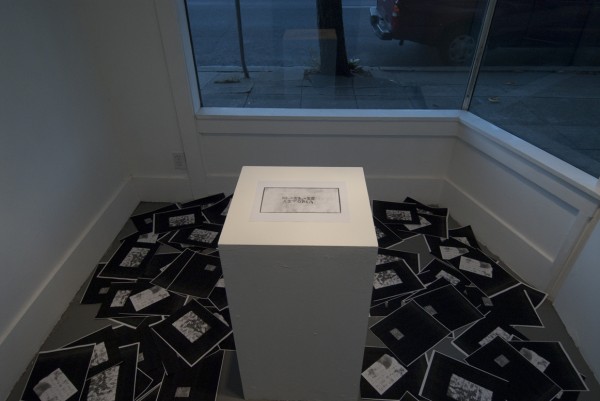
David Kasprzak, "10-22-38 Astoria," 2011. Mixed media. Image courtesy MacArthur B Arthur.

Anyone who’s ever temped in an office or published a zine knows the marvelous idiosyncrasies of the Xerox machine: the sliding, illuminated beam that scans the images; the warm stacks of copies identical enough to be called “exact” yet often full of bleeding letters; shiny black-hole shadows and flecks of who-knows-what from the machine itself.  In Run Off, now on view at MacArthur B Arthur in Oakland, curators Aaron Harbour, Jackie Im and Brandon Drew Holmes set out to investigate the nature of the “take away” art object, selecting artists to work with multiples and produce pieces for viewers to handle and take home.  These artists get us to step back from the ever-present glow of intangible images on our phone and computer screens and into something slower and stranger: the scanning light of the photocopier.

Jon Kuzmich’s work Ethos, 2011, exploits the individual fingerprint of one copy machine, re-Xeroxing a page of text until the successive generations of copies warp and twist into a black Milky Way. Kuzmich displays not only the reams of paper he went through, but an animation of each copy scanned.  The image melts frame by frame, from one sheet to the next, invoking the photocopier as a source of light and heat, or a tactile, irregular experience.
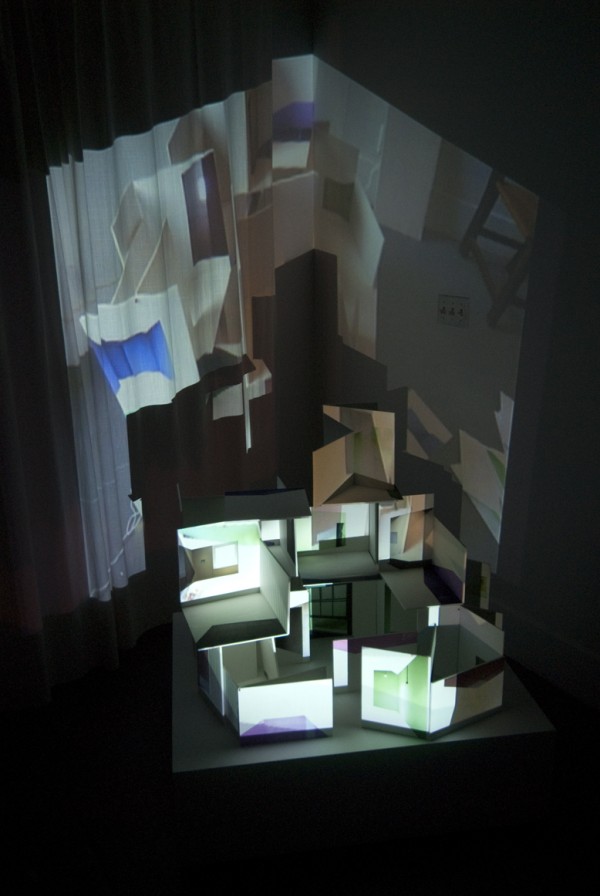
Cybele Lyle, "Untitled (De/Construction)," 2011. Mixed media. Image courtesy of MacArthur B Arthur.

Cybele Lyle’s Untitled (De/Construction), 2011, presents a series of small, photographed architectural quotes tenuously assembled as a chaotic card house.  Lyle lights the structure with a projected view of a white room. Visitors can take away panels, altering the sculpture and the play of light. At the opening exhibition, viewers took panels and also protectively reconstructed the teetering structure.  Hunter Longe, working with large-scale photocopies in Reproduction Destruction Connection, 2011, offers viewers two poster-sized copies of a fuzzy, bar-shaped shadow.  In the piece on view, two sheets are layered together, the top sheet rubbed translucent with olive oil to produce a ghostly, X-shape.  Clean and minimalistic Longe’s piece speaks quietly to the power of customizing and altering mass-produced items.

Read More »

Share

From the DS Archives: Cy Twombly

This week from the DS Archives we bring you the sculptural works of Cy Twombly. Don’t miss the current exhibition of his works at the MoMA NY, on view until January 2, 2012.

This article was originally posted by Seth Curcio on November 24, 2009:

Cy Twombly

Artist Cy Twombly has created a new series of sculptures, under the humble title Eight Sculptures. These new objects are currently being presented at Gagosian Gallery‘s 980 Madison Ave location in New York City. The exhibition is a companion to a new series of paintings, titled Leaving Paphos Ringed with Waves, on view at Gagoisian’s Athens gallery. In addition to the shows at Gagosian, the acclaimed artist also had two major museum exhibitions on view this fall, Cy Twombly: The Natural World, Selected Works 2000-2007‘ that inaugurated the new wing of The Art Institute of Chicago, and Cy Twombly: Sensations of the Moment at Museum Moderner Kunst, Vienna.

Eight Sculptures is a continuation of Twombly’s acclaimed formally driven, pedestal-based objects. While the earlier forms were created from accessible materials and objects, generally coated in gesso to create hauntingly white forms, the new sculptures are cast bronze with a white patina creating a very similar effect. Each sculpture references the unearthed fragility of an object of antiquity, while remaining distinctly modern in its formal presentation.

Share

The Clock, Cremaster Cycle, and the Otolith Trilogy

The world doesn’t need any more films. The world doesn’t need any more video art. So if you’re going to bring an image into the world, you have to think it through. –Kodwo Eshun

After 50 years of production, distinct periods are appearing in the history of video art. Not distinct ism’s or manifesto driven bubbles, but separate works that seem palpably similar. As the technology used to make movies evolves past the time limits of tape, emerging digital technologies have given artists the ability to create works that seem unlimited in size, length, or production schedule. In 1993, Douglas Gordon laid down the gauntlet by slowing Hitchcock’s Psycho to 2 frames a minute, stretching it into a 24 hour composition. Since then, there have been numerous videos that have tested the stamina of the creators through decade long production schedules or the audience by being unwatchable in one sitting. Boston and Cambridge recently hosted three examples of these monumental works: The Cremaster Cycle, the Otolith Trilogy, and The Clock. Together, these movies point to a new, epic sized production practice and away from traditional art school skills (do any art schools teach bull riding?).

The Cremaster Cycle (Brattle Theatre, October 1-4) is a five movie series filmed between 1994 and 2003. It forms a self-referential system that both functions as a movie and an “Aesthetic System” for Barney’s prints, sculptures, and other ephemera. The entire program hangs on a series of analogies to bodily functions (the title is named after the muscle that raises and lowers the testes) that consider the creative act through a biological motif.

Still from Otolith III. HD Video. © The Otolith Collective. Image courtesy of MIT LIst Visual Art Center

The Otolith Group Trilogy (MIT List Art Center, September 6- 22) was filmed between 2003 and 2009. It is the shortest series considered here, all three movies total under 2 hours, but the production involved a multinational filming schedule, help from more than 8 art groups across multiple continents, and do not include the numerous spin off productions. The Otolith Trilogy is a collage of found film segments and original images. Named for a portion of the inner ear, the otolith structure help us keep our balance and handle the effects of gravity. All three movies are obliquely about the effects of time and how we keep our stability in a changing world. Otolith I (2003), assembled in response to the invasion of Iraq, documents a new species of humans who can only live in low gravity. Otolith II (2007) is primarily a visual comparison between Mumbai’s Dharavi and Le Corbusier’s planned city, Chandigarh. Otolith III (2009) is a prequel to the unrealized film The Alien from Indian director Satyajit Ray.

Read More »

Share

Situation Rooms

L.A. Expanded: Notes from the West Coast
A weekly column by Catherine Wagley

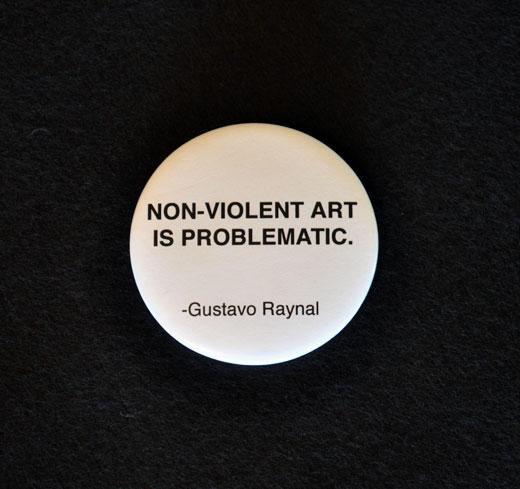
A button York Chang designed for Arco Madrid. It quotes a Latin American artist Chang invented.

York Chang always wanted to be a Latin American artist. The complication with this was that he wasn’t: wasn’t from Latin America, hadn’t grown up there, didn’t have family from there. As he described Wednesday, at Paper Chaser’s X-Ten Biennial, an evening over which arts professionals talked for ten minutes each about their influences, he solved the problem in a fairly labor intensive, metafictional way, creating a Latin American art movement, making the work of its artists and working to convince others it actually existed. But, still, it’s the weirdness of the situation that interests me more than the solution. What can you do when you want, impossibly, to be something you can’t be?

Director Jason Reitman, of Juno fame, will be doing something impossible next Thursday (Oct. 20). He’ll be restaging The Breakfast Club with a collection of unannounced, perhaps unconfirmed, performers. Reitman’s “cast” will gather at LACMA, and then just do it, launch into the 1985 teen classic with no rehearsals to help them along. It’s the situation that audiences will come to see, and the potential is immense. Despite it’s seeming feel-good message–stereotypes don’t go past the surface, all people are deeper than they appear–the movie is almost like a piece of endurance theater, with amazingly absurd vignettes.

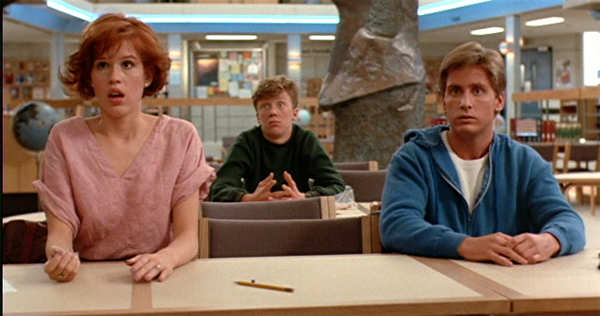
Still from "The Breakfast Club"

Molly Ringwald puts lipstick on with the tube between her breast. Emilio Estevez breaks glass like a mad man. And then they just sit in the library for hours on end.Who should play Allison, “the mute,” who puts chips in her sandwich and chews loudly? Aubrey Plaza? Maybe that’s too obvious. Winona Ryder, a troubled dark-haired beauty? And what if Estevez’s jock was played by someone not really cool or athletic at all? Fred Armisen? Somehow, I’ve got Mad Men’s John Hamm locked in my head as the criminal John Bender character. He doesn’t have the beady eyes, but I’d like to see him as the bully.

Read More »

Share

Of the Place: An Interview with Amy Franceschini

Artist and educator Amy Franceschini is the founder of Futurefarmers, a San Francisco-based artist collective and design studio that designs projects that address current social, environmental and political challenges through the use of diverse forms of audience engagement. The essence of Futurefarmers projects has been described as “a balance of critical and optimistic thought with the use of inventive and pragmatic design elements.” The collective is currently the subject of an exhibition at the Nevada Museum of Art and will contribute to a group exhibition at the San Francisco Museum of Modern Art in 2012, Six Lines of Flight. DailyServing contributor Allie Haeusslein recently met with Franceschini at her studio to discuss some of her recent projects with Futurefarmers.

"Shoemaker's Dialogues" at the Guggenheim, New York. 2011.

Allie Haeusslein: Perhaps the best way to contextualize the projects we will discuss is to talk a bit about the birth Futurefarmers. Can you identify some of the key issues or influences that sparked the creation of the collective?

Amy Franceschini: It wasn’t something that was created, which I think is important; it sort of became – and it is always becoming. But it really came out of a design studio in the 1990s, in which I was doing design work. At that time, I had to start collaborating with lots of different kinds of people – programmers, engineers, copywriters, photo editors, and researchers. So, the studio became filled with all of these different thinkers who were sharing the space. That ethos of collaboration was really exciting. And then, we started to get asked to do art projects by museums. I wanted to keep that multidisciplinary ethos going.

AH: The collaborative spirit you’ve described really seems evident in your project at the Guggenheim this past March. Can you describe the genesis of this project and how you feel it responds specifically to the New York City environment?

AF: The exhibition was part of a new series called Intervals, which is supposed to show artists who’ve never had a solo show in NYC. They ask artists to respond to the building in a way that it hasn’t been used before and for the exhibitions to be short.

When we went there, we were like “what do we do at the Frank Lloyd Wright museum in terms of speaking to the building? And what do we say in New York? What do we say on this stage that has such a spotlight on it?” What we felt in our several site visits was that Manhattan, specifically, has changed so much over the years. We felt like the soul of it had gone, like that thing of New York wasn’t as strong as it had been before. Maybe it’s out in the other boroughs, but Manhattan is starting to feel like a caricature of itself. How do we respond to that? That was part of the starting point.

Conceptual sketch for "Soil Kitchen." Drawing by Dan Allende.

Read More »

Share

The Grange Prize for Contemporary Photography

Canada’s Grange Prize officially launched last month in Toronto. The Prize, now in it’s fourth year,  nominates four contemporary photographers, two from Canada and two from a different partner country—this year India—but lets the world decide the winner.

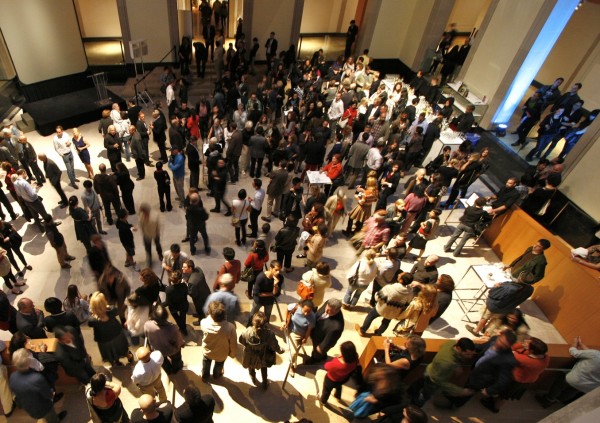
Grange Prize launch party, Art Gallery of Ontraio, 2011, courtesy of Art Gallery of Ontario

The prize is one of many corporate-institutional partnerships (the Deutsche Börse Photography Prize presented by The Photographer’s Gallery, for example, or Canada’s recently inaugurated Scotiabank Photography Award, founded by Ed Burtynsky, that support excellence in the arts, through both exposure and a substantial purse. In this case, the partnership is between Toronto’s Art Gallery of Ontario (AGO), where many gathered to celebrate the launch and exhibition opening last month, and Aeroplan, a Canadian corporate sponsor whose product, travel rewards, links nicely with the Prize’s shifting international connections.

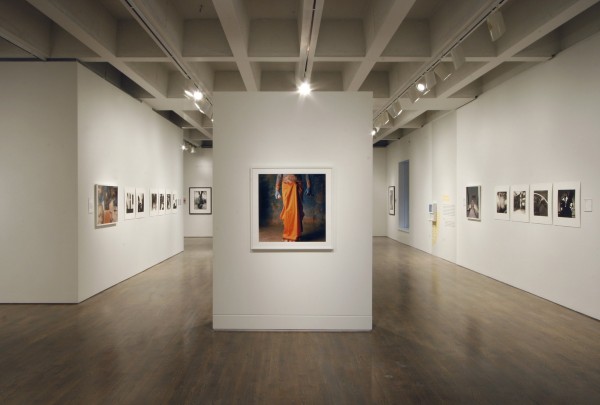
Grange Prize installation view, Art Gallery of Ontario, 2011, courtesy of Art Gallery of Ontario

But the twist is that the Grange Prize winner, who walks away with $50,000, is entirely determined by online voting.  Those who make it to the AGO can vote via dedicated computers after wandering through the exhibition—but anyone (or, more accurately, anyone with internet access and an email address) is invited to look at a gallery of selected work by each artist on the Prize website, as well as bios, statements and video interviews, and cast their vote from a computer anywhere on earth. The democratic and virtual qualities of the prize raise some interesting questions about changing institutional attitudes and the decline of the physical object—but that’s for another discussion.

This year’s jury (two Canadians and two Indians), have made it a tough choice. All four nominees are women, and all of them make work that arguably blurs the line between the documentary tradition and art photography. Though their practices and images are distinctive, they share an interest in connecting to overlooked communities, and in the social and political dimensions of making their often invisible subjects visible.

Read More »

Share

#Hashtags: Narco-Violence and Ritual Sacrifice

#Hashtags: Viral Thoughts on Politics, Arts, and Culture

This month, #Hashtags features an essay by the Mexican-American artist and writer Robert Gomez on the relationship between online images of drug cartel violence and Aztec rituals.  Please be aware that this article contains graphic representations of violence.  The author and the editors of the site would like to make clear that we are not interested in exploiting the sensational qualities of these images, but rather in their complex social roles. #Hashtags provides a platform for longer reconsiderations of artworks and art practices outside of the review format and in new contexts. Please send queries and/or ideas for future to hashtags@dailyserving.com.

"Two Flayed Men Appear in Tepic," a screen shot from Blog del Narco, 2011. Website and Digital Video. Image Slightly Blurred by Author.

As Mexican-American, I am awed by Mexico’s cartel warfare, and by the seeming American ambivalence towards it.  My first experience with Narco-violence started where you are now: at the computer, as I read through online articles about drug trafficking. Eventually, I came to El Blog del Narco. Hosted by an anonymous college student, El Blog del Narco claims to democratically post videos, pictures, and stories from anyone with information on the drug war. The moment remains vivid to me—it was a Tuesday afternoon, and the San Francisco fog was just beginning to roll across the sky. I clicked upon an article.  At first, I didn’t quite understand what I was seeing. It looked like two bodies piled on top of each other, except the skulls were the color of pus. I scrolled down, and saw what looked like a flattened mask of a face. I realized the image was of two flayed men, one with his heart removed. I felt sick. This was real. There were no movie crews creating this image—no costume designers, no makeup. It was achingly raw.  And yet in the same moment, I realized that I had seen this before, not in life, but in images of sixteenth-century Aztec ritual sacrifice.

Read More »

Share