Frieze Art Fair: Special Projects and Emdash Award

From time to time we at DailyServing like to feature content from sites we partner with, like the Huffington Post and Art Practical.  Today we bring you a look at several of the special projects commissioned by the Frieze Art Fair, which closed October 16, 2011.  This post comes courtesy of the Huffington Post, Constantin Bjerke, and Crane.tv.

The aim of the Frieze Art Fair is to create a unique destination with an atmosphere that is of cultural and commercial value. This year’s Frieze programme — curated by Sarah McCrory — included seven specially commissioned projects as well as the Emdash Award. The programme integrates a number of unique viewpoints throughout the fair that will demand a shift in viewers’ perception.

Crane.tv met with several of the artists, including Peles Empire, Laure Prouvost, Pierre Huyghe, Christian Jankowski and Emdash Award winner Anahita Razmi:

Laure Prouvost’s idiosyncratic signs had to be made up just a few days prior to the fair as a response to its architecture. Pierre Huyghe’s aquarium, a live ecosystem, hosted a specific narrative which had the effect of exchanging the chaotic bustle and bright lights of the fair for a dark contemplative space. Christian Jankowski’s project engages directly with the idea of sales and the value of luxury goods. The extravagant and functional boat which he created was available to buy not only as exactly that, but as a Christian Jankowski artwork. Peles Empire is a collaboration between Katharina Stoever and Barbara Wolff, founded in 2005. At the fair, they installed a bar that acts as a Gesamtkunstwerk, in which everything — from the reproduced room and its decorative furnishings, to the serving of the guests and taking part in the fair — was part of the work.

Anahita Razmi won this year’s Emdash Award. Her proposal was selected from amongst 579 applicants of the highest quality. Her commission highlights how Tehran’s skyline was recently used by protestors after the Iranian presidential election. Her art was deemed to embody the principles of the Emdash Foundation in an exemplary way: thought provoking, supporting new ideas, and allowing time for reflection with a focus on topicality. She uses Trisha Brown’s 1971 “Roof Piece”, which took place on 12 different rooftops over a ten-block area in downtown New York, as its point of departure.

Text by Natasha Seagrove for Crane.tv

Share

From the DS Archives: Ai Weiwei

This week from the DS archives we bring you an oldy but a goody: Ai Weiwei. You can see his Circle of animals/Zodiac Heads at the Los Angeles County Museum of Art until February 12, 2012.

The following article was originally published on May 21, 2008 by Annette Michalski:

Ai-Weiwei-5-22-08.jpg

A collection of works by acclaimed Chinese conceptual artist, Ai Weiwei is currently on show at Sherman galleries, Paddington. The display, entitled Under Construction focuses primarily on two artworks by the artist. The installation piece named Through fills the entire exhibition room and is comprised of fragments of tables and temple pillars that date back from the Qing Dynasty (1644-1911). Weiwei has reconstructed them so that the angular beams often impale the tables and lean against them.

His second major work featured within the exhibition is a three hour film entitled Fairytale, which documents his performance piece of the same name, completed for Documenta XII in Kassel, Germany last year. For this work Weiwei invited a diverse range of 1001 Chinese citizens, stemming from different ages and provinces to come to Germany and view Documenta XII as part of his performance. He arranged their passports and accommodation and even gave them spending money, allowing them to create their own plans. In correspondence with this, the artist also organized the importation of 1001 chairs from the Qing and also Ming Dynasty (1368-1644) to be situated around the city of Kassel throughout Documenta XII’s duration.

Weiwei studied at Beijing Film Academy and Parsons School of Design. After being born and raised in China he moved to the United States in his early 20s, where he lived for over a decade, before later returning to his homeland, where he currently lives and works. He helped design the National Olympic Stadium for the 2008 Beijing Olympics, and was the co-curator of Fuck Off, a notorious exhibition showcasing shocking Chinese art that coincided with the Third Shanghai Biennale in 2000.

Share

The Famous One from Lucas #1

Christine Ay Tjoe, The Famous One from Lucas, 2011, Installation view. Photo: Edward Hendricks.

A biblical parable tells of a wayward son who leaves home for a distant land after demanding his inheritance from his father. Squandering his riches quickly, he repentantly returns to his father’s house hoping to be hired as one of his father’s servants but find instead, his father’s unexpected kindness and forgiveness. Christine Ay Tjoe’s current site-specific show The Famous One from Lucas # I at the Hermès Art Space references this well-known narrative of prodigality, articulating the interdependency of loss/gain and despair/hope through soft-fabric sculptures constructed out of goose-feathers, tulle fabric, stockings and industrial felt.
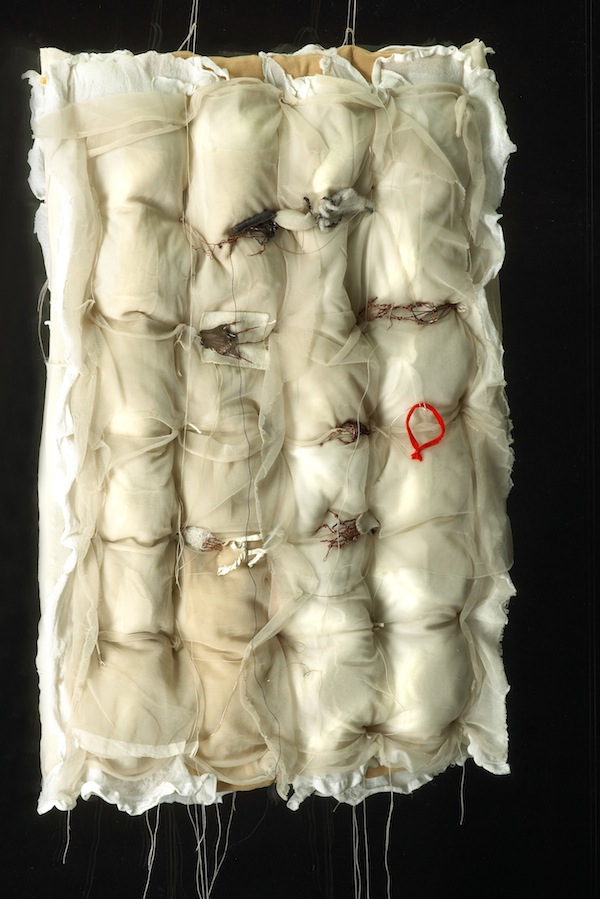
Christine Ay Tjoe, 24 of Us 65, 2006, Mixed Media and Glass Box, 65.5 x 50 x 6 cm.

Attempting to sublimate the profound personal workings of hope and despair into rituals of healing and rebirth has been a recurrent theme in Tjoe’s artistic practices. Unlike what we’ve come to expect from many contemporary Asian artists who respond to political or social change, Tjoe’s sensibility veered off this course early on. In 2003, her installation Santa/Satan at the CP Open Biennale was an acerbic critique of government authorities encumbered by bureaucracy and its trappings. But at some stage, her artistic gaze had turned inward, probing out suitable platforms on which questions of the transcendental could be raised. “I’m interested in the relationships between theology and humanity, which give rise to perceptions on the range of human emotions, motivations and experience,” she writes in an email interview, when asked if there were indeed, fundamental questions about art and religion that she had always sought to answer. “It relates to universal human experiences and emotions such as joy and grief and human expressions in extreme situations – this is something I’ve been curious about and continually investigate in my works.”
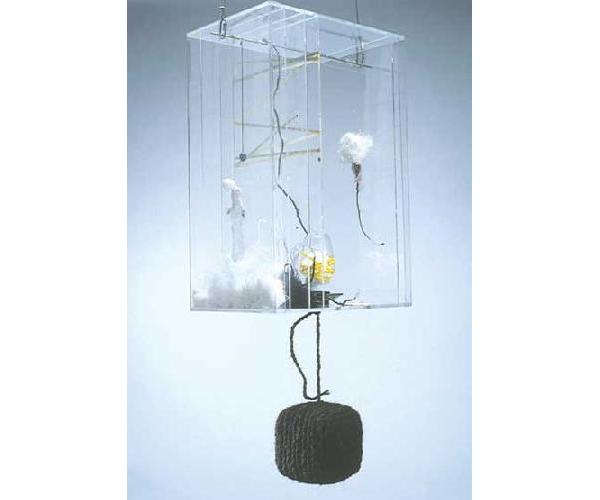
Christine Ay Tjoe, Santa/Satan, 2003, Installation, mixed media, 80 x 52 x 37 cm.

Steered by spiritualistic meditations and cosmological perspectives, her works are unsurprisingly attuned to the allegorical and the symbolic, utilising ephemeral spaces and fragmentary images that comment on the irreducible essence of flawed human nature. Lama Sabakhtani Club (2010) compares the tragic scale of loneliness and anguish to Christ’s ordeal on the cross in a series of installations assembled by strings, nails and fabrics. In Interiority of Hope (2008), Tjoe’s imagines the psychological state of the criminal Barabbas – the man Pilate released instead of Christ at the demand of the people – as one caught between the joy of his release and the unrelenting guilt of the crimes that he committed. In both shows, the forms of her work often appear as impressionistic renderings of complex lines or as misshapened entities whose purpose remain ambivalent. They share an allusive and elusive quality that often suggests that materials from without exist only to reveal the malleability and flux found within, elucidating an artistic vision that treads dangerously close to rehashing Renaissance humanist patterns of self-knowledge and its limitations.
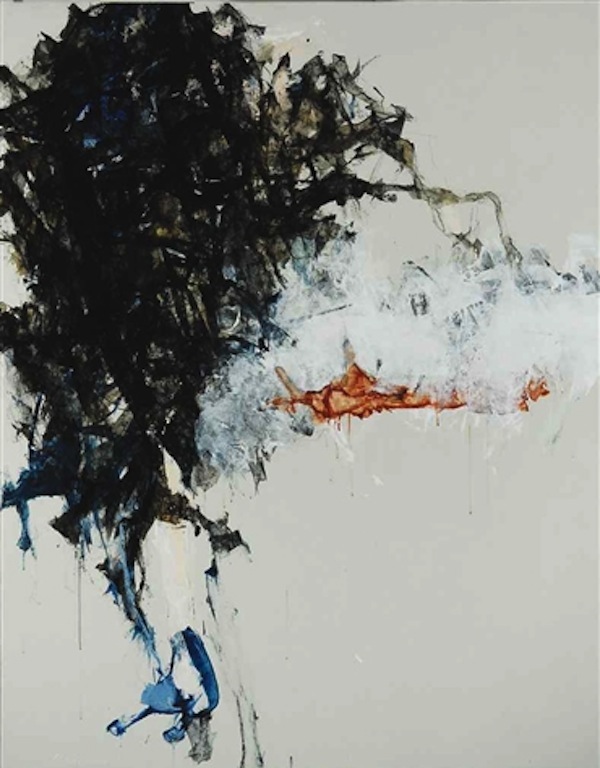
Christine Ay Tjoe, Barabas Lights no. 07, 2008, acrylic on canvas, 170 x 135 cm.

The Famous One from Lucas # I continues Tjoe’s exploration of materiality as metaphor for the esoteric nature of the human condition. Textiles are primarily transformed into both familiar and non-familiar objects – a worn-out sofa and a teddy bear being the more recognisable ones –, their surface textures and form adding, according to Tjoe, an interesting dimension of sensation especially for the object art she creates. But like wanderers in a labyrinthine environment, it is hard to tell where The Famous One from Lucas # I starts and ends, despite Tjoe’s assertion we are walking through memory markers (displayed as physically undefined objects along cocooned walls) that express the journey of one’s life. We know the show’s conceptual starting points: the sheer greyness of the human psyche dictates that hope and despair are faces of the same coin, defined by their relation to one another. Yet the lack of linearity in its atmospheric spaces, soft curved walls and winding pathways seems to scope out a more cosmic intersection of nature and nurture; it introduces into the visitor experience a hint of the tenuous boundaries separating the cerebral and the emotional, the past and the present, the spiritual and the carnal.
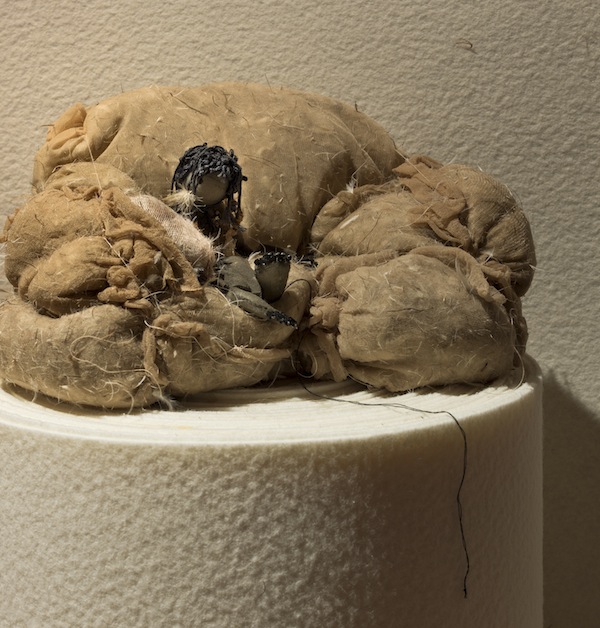
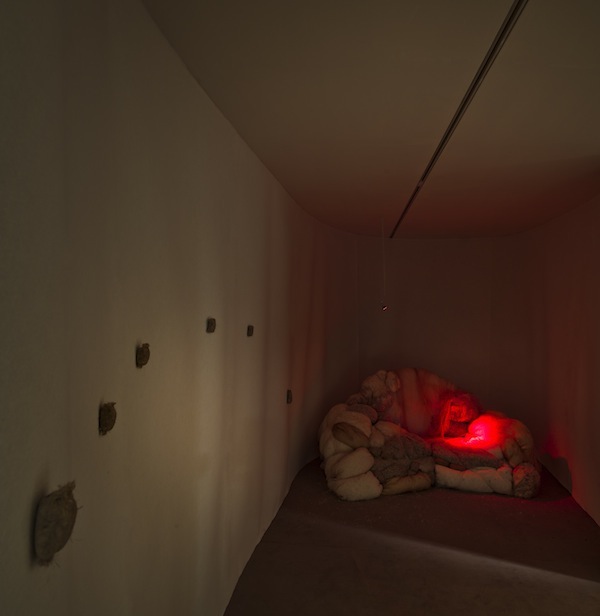
Christine Ay Tjoe, The Famous One from Lucas, 2011. Photo: Edward Hendricks.

The physicality of the work reflects its metaphorical framing; we inexplicably find ourselves wandering in its pathways numerous times, beginning where we end, ending so that we could start once more. In this visual text, we can participate in the shameful indulgence and repeated transgressions of prodigality while simultaneously walking the passage of redemption and liberation.

***

The Famous One from Lucas #I was on show at the Hermès Art Space until November 27; this article could not have been completed without the contribution of Christine Ay Tjoe herself in an email interview and the support of Hermès Art Space and the Singapore Tyler Print Institute.


Share

Things with Birds in Them

L.A. Expanded: Notes from the West Coast
A weekly column by Catherine Wagley

Richard Kraft, installation view from "Something with Birds in It" at Charlie James Gallery. Courtesy Charlie James and the artist.

I am in Wisconsin this week. My uncle picked me up at the airport Monday, and, within minutes, had reminded me that Madison was filled with nothing more than zombies and liberals—I’d come in to the Madison airport, but he and my grandmother live an hour’s drive out—and had asked me if I’d become a Valley Girl yet. “It’s just a matter of time,” he said.

He couldn’t remember what I did in California, so I told him. Had I ever seen a real Van Gogh, he wanted to know, or something Gaugin made before getting all wrapped up in that Tahitian business? And had I heard of Owen Gromme, who was one of those naturalist right up there with Remington? I hadn’t heard of Gromme, but I was in luck, my uncle told me: my grandmother’s independent living home is full of them.  Apparently, a local priest, the priest who said my grandfather’s funeral, had owned and donated a gaping number of Gromme prints to the Oak Park Senior Home, and now they hang across from the elevator, next to the stairs, on the walls of the TV room. “Before I even let you see your grandma, I’m giving you an education,” my uncle said. “The way he painted shadows, you can tell what time of day it was.”

Read More »

Share

Chroma: Interview with Katarzyna Przezwanska

Katarzyna Przezwanska‘s work is both playful and serious: riotous colors precisely define spaces for objects on a desk or in a room, or grace the facade of a dour old concrete building. She is equally adept at using pop brights and cool, pensive tones to create moods or to reference a particular history or locale. Her installation in the most recent Frieze Art Fair elicited the comment, “Przezwanska’s work demonstrates a belief in the redemptive power of colour.” I had a chance to talk with her in Tarnow, Poland about her process, her identity as an artist, and her next projects.

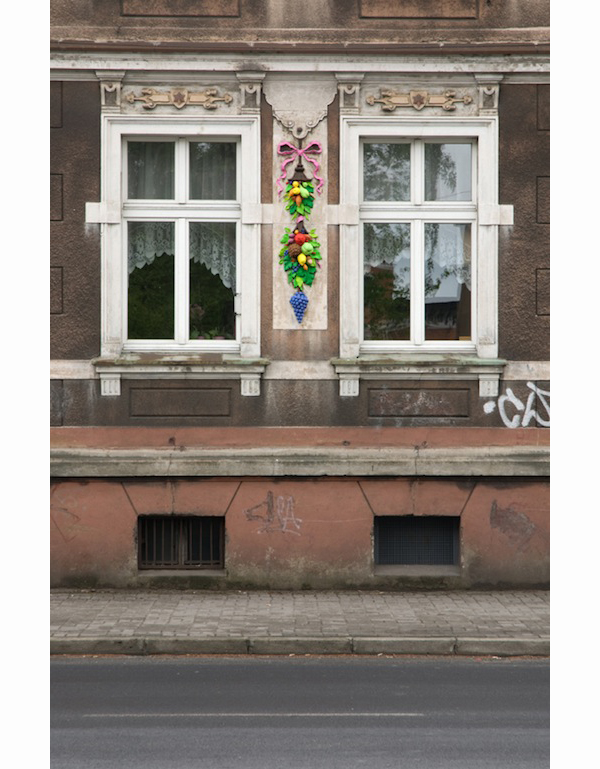
Katarzyna Przezwanska, Ornament, 2010. Building decorations, emulsion, conservator

Bean Gilsdorf: Some of your projects respond to Modernism. How did that part of your work begin?

Katarzyna Przezwanska: I think it was natural because in Poland there are a lot of Modernist buildings, it’s our natural environment. It’s also disappearing and underrated.

BG: And for one of your projects, you worked with your own space, your own apartment.

KP: Yes, I designed it to be a space that is functional, by using visual divisions done with color. It’s an artwork, but it’s alive. It’s not fixed or finished, so when I need to change something, I do it. It’s an open project. In my work, the colors usually come from the surroundings of the project. In every project each color has a meaning or a story. It’s not always necessary that the viewer has to know why, but when I know it, it works better.

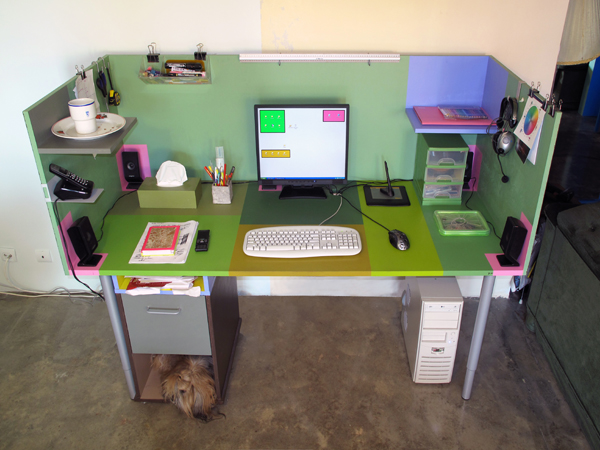
Katarzyna Przezwanska, Desk, 2010. Aluminum, blockboard, enamel, acrylic paint.

BG: You made a fountain for the exhibition Tarnow: 1000 years of modernity, now exhibited in the lobby of the Centrum Kultury in Moscice. Is that work site specific or could it go anywhere?

KP: No, I wouldn’t put it anywhere, I wanted it to be in a space that people use. Initially I wanted to put it outside, but it wouldn’t work because of the wind and other things. Before the [Centrum Kultury] building was renovated there were some nice pools outside, so I thought it would be good to bring water back to that space. The building has very big windows, so I used some of the ochre and green colors that you see in the surrounding area, a synthesis of the environment.

Read More »

Share

Perth

Wrong Angles

Alex Spremberg, Chroma Flow (Object E), enamel on cardboard works on table, 2011, Courtesy of the artist and Perth Institute of Contemporary Arts

Alex Spremberg’s current exhibition at Perth Institute of Contemporary Arts is an exploration of the limits of painting and a meditation upon the throwaway materials that pervade contemporary life, specifically the omnipresent cardboard box and the printed newspaper. Wrong Angles is, ostensibly, a painting exhibition, but despite the polychromatic riot of surfaces dripped and marbled with industrial paint, Spremberg reveals a preoccupation with the formal properties of objects and the overlooked aesthetic systems which construct our experience of consumer items: food, household goods and even information.

In the series Chroma Flow, Oblique Objects and Conference, the artist has reconfigured the cardboard box by disrupting its standard right-angled (or orthogonal) construction. Rejecting the restrictions of the 90-degree join, Spremberg has sliced and folded along the diagonal, with the increasingly complex polygonal variations offering an alternate angularity to the familiar box. The surface of each form has been meticulously, painstakingly, covered by layer upon layer of colored enamel paint, and they sit boldly upon plinths constructed from stacked cardboard boxes painted white. Through these devices, Spremberg debases the conventions of museum display while elevating the humble cardboard box to the status of art object; this celebration of the utilitarian could be read as a parody of modernist abstraction. However, Spremberg’s fascination with the physical and optical properties of paint transcends any ironic intent; these works address in equal measure the process of applying paint to a surface and the desire to invest a painting with the presence of an object.

Read More »

Share

The Builders: An Interview with It’s Our Playground

Installation of Heather and Ivan Morison's Dream Workshop; image courtesy of It's Our Playground

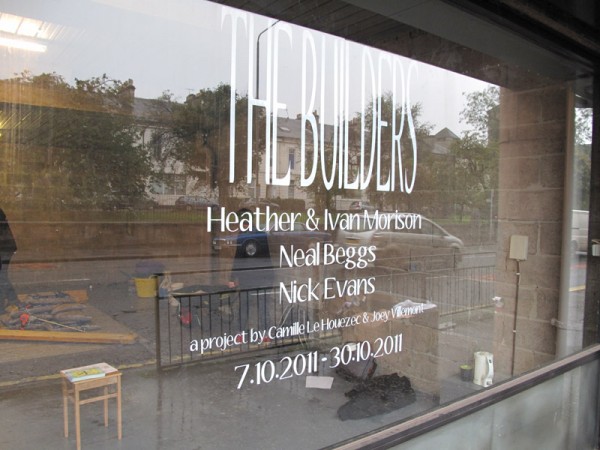
The Builders is a “living exhibition” that runs till 30 October 2011 at The Market Gallery, Glasgow, and unfolds from interventions by a group of artists working in sequence. Heather and Ivan Morison first list the materials and tools that form their dream workshop; Neal Beggs creates new works in the gallery for seven days using only what is found within the workshop, and Nick Evans displays these works in a final exhibition. The Builders is a project by Camille Le Houezec and Joey Villemont, also known collectively as It’s Our Playground (IOP).

Magdalen Chua: How did IOP come about, and do you have your individual artistic practices?

It’s Our Playground: We’ve never done curatorial courses and have been trained as artists, with our personal artistic practices. We see exhibitions as an artistic practice, not just reserved to a certain number of people trained to do exhibitions. In France, curatorial practice is not something often heard of, although some art schools are starting to have classes on curating.

We noticed that the exhibition, as a subject, was not part of our programme, and we turned our studio in the art school (Ecole Nationale Supérieure d’Art de Bourges) into an exhibition space.

For every project we’ve done, as seen in The Builders, a work is produced. We really like to be surprised, and not just select works. As we both come from an artistic and not an institutional background, we prefer working with an artist, not just with his work.

Maybe there is a relationship with our own practice. Camille only produces work when there is the chance for it to be exhibited. We know that artists have to produce and want to work with them on it.

We have never approached an artist for one specific piece. It is always for a project, and the collaboration is always central to our practice. We want to find our own place in this process and do not want to be just spectators.

Heather and Ivan Morison's Dream Workshop; image courtesy of It's Our Playground

Read More »

Share