The Part That Would Like to Burn Down Our Own House

Geof Oppenheimer, "Social Failure and Black Signs," 2010. Pigment print 34 x 24.8 inches; edition of 3. Image courtesy of Ratio 3.

Recently in the San Francisco Bay Area it has been impossible to walk down a street without running into (or trying to avoid) someone protesting something. The messages range from concise to ironic, sardonic to flat-out fed up. In the undulating sea of abridged manifestos, there is the rare message so poignant that it demands the sign-bearer’s cause receives deeper consideration. Geoff Oppenheimer’s current exhibit at Ratio 3 Gallery, Inside Us All There is a Part That Would Like to Burn Down Our Own House, presents a reductive, politically-driven narrative filled with violence, chaos, nationalism, pageantry, existentialism and self-reflection. The title may be a mouthful, but it creates an interesting opposite to Oppenheimer’s expertly edited works, and sets the tone for the show as a whole.

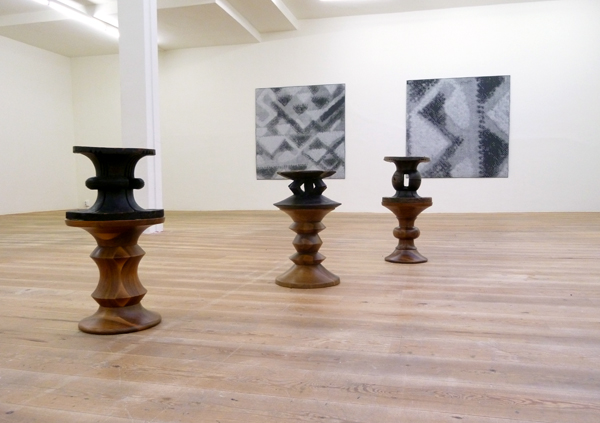
Installation View, Geoff Oppenheimer, "Inside us all there is a part that would like to burn down our own house," 2011. Courtesy of Ratio 3 gallery.

Depending on when you enter the gallery, your initial sensory experience will most likely be one of two things: visual or auditory. For some, a minimalist installation of sculptures and photographs will greet them. Others will not be able to ignore the deafening cacophony of marching-band instruments streaming from an invisible source. But we’ll get to that later.

Read More »

Share

From the DS Archives: New Photography of 2009 at MoMA

This week from the DS Archives we take a look at MoMA’s 2009 New Photography exhibition, and see where some of the photographers are now:

The works of Sarah VanDerBeek and Leslie Hewitt are now on view at the Austin Art House‘s current exhibition,  The Anxiety of Photography – On view until December 30, 2011

Walead Beshty recently exhibited Securities and Exchanges at Ullens Center for Contemporary Art in Beijing, China

Daniel Gordon’s Still Lifes, Portraits and Parts are on view at Wallspace Gallery in NYC until December 17, 2011

This article was originally published by Rebekah Drysdale on November 23, 2009:

Walead Beshty

Walead Beshty

The Museum of Modern Art in New York is currently presenting New Photography 2009, this year’s installment of a series that began in 1985 with the aim of exhibiting the most compelling recent work in the field of contemporary photography.  Organized by Eva Respini, Associate Curator in the Department of Photography at MoMA, the exhibition brings together six young artists, Walead Beshty, Daniel Gordon, Leslie Hewitt, Carter Mull, Sterling Ruby, and Sara VanDerBeek, in a visually diverse body of work.  Most of these artists actively produce work in other media, such as drawing, video, and installation, and each one has an innovative and distinct method of constructing a photograph.  Collectively, these artists investigate the making of a photographic image in the twenty-first century, often utilizing processes of collecting, assembling, or manipulating other images or items.

With the advent of contemporary aesthetics and technologies, photography, long characterized by its ability to capture and represent reality, is again the subject of critical debate. The historical definition of the medium is challenged by the rise of digital capabilities and software programs, which allow photographers to combine their own images with others that are digitally uploaded or scanned.  The abundance of imagery now available at the click of a mouse has led artists towards a deeper analysis of the role of an image within society.  The six artists included in the exhibition create their pictures in a studio or darkroom, investigating the expanded vocabulary of digital processes and its technical and theoretical implications for photography.   The exhibition highlights an epochal moment of transformation for the medium, showcasing the work of artists who critically confront our media saturated world, and open a new era of possibility for photography.  Some works reference traditional techniques of the medium while others are constructed from online images; the works included range from abstract to representational. Read More »

Share

Vernon Ah Kee

The Palm Island riot and its aftermath are the focus of Indigenous artist Vernon Ah Kee’s latest exhibition Tall Man, held in conjunction with the Melbourne International Arts Festival and Gertrude Contemporary. Comprising three segments – a video installation, a portrait and text – the series is an examination of the ongoing cruelty and official indifference toward the Aboriginal Community in Australia.

In 2004, indigenous Australian Cameron Doomadgee was brutally murdered at the hands of a white officer while in police custody, sparking riots on Palm Island in North Queensland. Doomadgee was first arrested for public drunkenness and reported dead an hour later, having suffered from four broken ribs which had ruptured his liver and spleen. His death was recorded as “an accidental fall” in the coroner’s report and all charges on the officer were later dropped in 2007.

“Tall Man”, Four-channel video installation, 2010. Image courtesy of the artist and Milani Gallery, Brisbane

In his four-channel video installation, Tall Man (a reference to Aboriginal Shire Councillor Lex Wotton’s commitment to the rights of Palm Islanders), Ah Kee appropriates footages from mobile phones and camcorders, edited together with archival news footages to reconstruct the unfolding of events – footages that were ironically used in court as evidence to convict Wotton of inciting the Palm Island riot. But in the hands of Ah Kee, they tell a different story of the injustices faced by the Aboriginal community in Australia. In contrast to the video installation where Wotton is seen enraged and devastated in public, Ah Kee depicts Wotton with subtle and gentle lines – a non-threatening, calm and warm-hearted figure.

Read More »

Share

Time Cycles

L.A. Expanded: Notes from the West Coast
A weekly column by Catherine Wagley

Sam Falls, Untitled (West Hollywood, CA. Green), 2011, Hand-dyed green cotton and metal grommets, 10 x 85 feet. Courtesy M+B

That week Pacific Standard Time, SoCal’s Getty-funded, 60-plus institution push to excavate its own post-WWII art history, officially opened, I popped into a gallery showing a great selection of new work by an older artist. Is this an official Pacific Standard Time show, I wanted to know. “I don’t really know what that means,” the director said. ”We never signed any paperwork or anything, but we’re showing an old school artist and putting the PST logo on all our press releases.”  At least his show made sense historically–the artist had been around and working during that 1945-1980 period PST focuses on. But the PST logo is so widespread right now that not all shows labeled “participants” are immediately understandable in relation to SoCal history. It’s become something of a game, trying to guess how and why certain shows might be PST-appropriate.

I wrote about young-ish artist Joel Kyack’s PST -participating show, a spoof on reverence for history, a while back, and another just opened exhibition of new work in West Hollywood uses the “PST” logo to justify an examination of time.

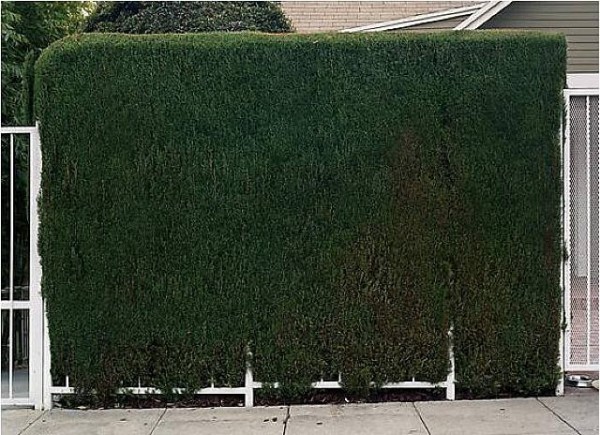
The first work you see in Time and Material at M+B gallery is a big green cotton cloak hanging down from the top left corner above the door. It feels like a mix between a discarded fashion week runway and a construction site. It also makes the door slightly intimidating to walk through, since you’ve got step on and then over the artwork to get into the gallery. This particular work reminds me of Miles Coolidge’s photograph, Hedge, an image of shrubbery that’s overgrown a fence in a neighborhood that otherwise looks flawlessly controlled–it’s ever so slightly uncomfortable.

Miles Coolidge, "Hedge," 2009, Pigment inkjet print, 45 x 60 inches

Past Falls drapery and into the gallery, there’s a collection of small enamel-topped, steel-legged tables by Kyle Thurman, sand bags by Jacob Kassay, and  a worn folded paper by N. Dash. All this seems a bit too intentionally underwhelming, too aware of its own ordinariness, but not so the video by Joe Zorilla in the back room.

Read More »

Share

Vincent Vulsma – A Sign of Autumn

Vincent Vulsma’s exhibition at the Stedelijk Museum Bureau Amsterdam explores the use of appropriation through the history of Dutch colonial expansion. He presents a contemporary artistic perspective on our relationship with colonialism beyond imperial history. Using and re-working a number of works originally seen in the ‘African Negro Art’ exhibition in New York’s MOMA in 1935, Vulsma displays the historic artifacts along with modern designs, in order to confront us with contemporary meanings behind colonized objects.

Socles (a b c), 2011, WE455(XI),2011, WE455(XII), 2011, Image courtesy of gallery

The exhibition’s title, which initially appears ambiguous, is in fact a reference to the writings of the French historian Fernand Braudel. The phrase ‘a sign of Autumn’ describes:

‘the time when the leader of the preceding expansion of world trade reaps the fruits of it’s leadership by virtue of it’s commanding position over world-scale processes of capital accumulation. But it is also the time when that commanding position is irremediably undermined’.

The accumulation of objects under the umbrella of this exhibition title it an attempt to prompt us to reflect on the postcolonial conditions of empires.

No. 124, 2011. Antelope mask, Baule, Ivory Coast, before 1933. On loan from the Tropenmuseum Amsterdam. Image courtesy of gallery.

The central object in the exhibition is a Baulé tribe mask from the Ivory Coast. The mask, shown with the inside on full view instead of the humanized facial features, was originally collected during the Dutch colonial expansion into Africa. Its fine, idealized features, with its symmetry, craftsmanship and quality of material, are hidden, promoting the viewer to carefully investigate the vitrine in which it is secured. The trade number and the stamp from where it originated are displayed with stature, emphasisng Vulsma’s views on postcolonial theory, where the colonial marks carry more historical and cultural importance than the figure depicted.

Read More »

Share

Perth

Horse Play

Anna Nazzari, Arc de Triomphe, carved western cedar and electronic components, 2010. Photograph: Bo Wong

Anna Nazzari’s exhibition Horse Play at Turner Galleries presents the losing game, and the dogged impulse to try again, as an inescapable aspect of the human condition. With a nod to the absurdist existentialism of Albert Camus, Nazzari’s games, which are impossible to win, allude to the futile quest for meaning in an inherently meaningless world. For Nazzari, this nightmarish scenario provides the ground to stage an acerbic investigation of gender revolt, in which the desire to transcend the restrictive gender roles set out within patriarchal culture is repeatedly thwarted by the fact that the game is rigged.

Nazzari’s objects are exquisitely and painstakingly rendered, with concealed mechanisms, delicate marquetry and handmade timber frames. Nazzari’s labor-intensive ‘amusements’ seduce the viewer with the polished aesthetics of the gentleman’s club, enticing us to play, to throw caution to the wind.

Read More »

Share

Vision and Communism

On the night of October 25th, police officers fired teargas and flash grenades into a crowd of “Occupy Wall Street” protesters in Oakland, CA. The event was a significant escalation of force following weeks of arrests and threats of mandatory dispersal issued by police and local officials in American cities. The morning after the Oakland confrontation, news outlets were awash with chaotic images of police in riot gear and protesters scattering from smoke-filled streets, their hands clutched to their mouths and eyes. It was later revealed that a young war veteran named Scott Olsen was left in critical condition after one of the teargas canisters ricocheted off his head.

The aftermath of the Oakland Police's continued assault on occupiers and demonstrators. #StandWithOakland #OccupyOaklandd

Much of the news coverage of the violence in Oakland stemmed from videos and twitter pictures posted online by the protestors themselves. The New York Times published demonstrator’s twitpics with their original hashtags (The aftermath of the Oakland Police’s continued assault on occupiers and demonstrators. #StandWithOakland #OccupyO http://twitpic.com/75xhe3) insisting on the savagery of the police. Cinéma vérité clips of young people rushing to Olsen’s aid in front of a wall of riot police quickly became available and were broadcast alongside film captured by news crews. Indeed the OWS protests, like the right-wing Tea Party protests before them, are ready-made events for the 24-hour news spectacle.

Read More »

Share