Francesca Woodman at SFMOMA

On view at SFMOMA and traveling to the Guggenheim in 2012, Francesca Woodman is a testament to the faithfulness of an artistic inquiry.  In photo after photo Woodman experimented with formal elements, tested endless configurations, and explored feminine identity. Woodman’s self-discipline is evident in the multiple galleries hung with her photographs. Considering her age—she was in her late teens and early twenties when the work was made—her tough-minded dedication is rather surprising: to produce the 174 photographs now on view, she had to have been in front of or behind the camera, or in the darkroom, to the exclusion of much else.

Woodman most often acted as her own model, and the small black-and-white compositions, usually nudes, are visually straightforward but conceptually complex.  What complicates the work is the knowledge that Woodman is not just the vulnerable nude, but also the architect of that condition.  In many photos Woodman’s gaze is directed at the viewer; and yet knowing she was also the photographer mediates that directness, because ultimately what her model-self was looking at was her photographer-self, backwards through the lens of the camera, posing for her own view.  In this way, she was able to explore her femininity as a construct of at least partially her own making, bringing a feminist awareness to her investigations.

Francesca Woodman, Polka Dots, Providence, Rhode Island, 1976. Gelatin silver print, 5 1/4 in. x 5 1/4 in. Courtesy George and Betty Woodman

Take, for example, Polka Dots (1976).  Wearing a spotted dress, Woodman crouches against a decaying, dilapidated wall.  Over her head there is a fist-sized hole punched through the plaster and lath.   Similarly, her dress is unzipped at the side, revealing part of her torso and the curve of her left breast.  Splayed fingers hide her mouth, heightening the vulnerability of her posture and semi-nakedness, and her messy hair corresponds to the ruined nature of the room.  Her awkward, submissive pose and undone dress belong to a madwoman—but her eyes are not crazy, they are guiltily sexual.  They dare the viewer to compare the hole in her garment to the hole in the wall and to see how they might be similar.  And yet the title is neutral, focusing coyly on the pattern of the dress and the concurrent black spots on the wall, redirecting the viewer to the composition as a whole and reflecting the conceptual slyness of the work.  Contradictions and ambiguity create depth as Woodman refuses to provide an easy summary of femininity or desire.

Read More »

Share

From the DS Archives: Paul Thek

This week from the DS Archives we implore you to remember the bodacious and brilliant Paul Thek. Thek is joined by an excellent line up of artists for the 2012 Glasgow International Festival of Visual Art. So grab a taxi/car/bike/plane/train/horse and head over to Glasgow to see the works of Aleksander Mir, Ruth Ewan, Richard WrightCorin Sworn and much more! (Those are just a few of the artists we’ve covered on DS)

This article was originally published by Catherine Wagley on June 10, 2011:

L.A. Expanded: Notes from the West Coast
A weekly column by Catherine Wagley

Peter Hujar. Thek at his work table in Oakleyville, Fire Island, 1967 (reproduced from the original color slide). ©1987 The Peter Hujar Archive LLC; courtesy Matthew Marks Gallery, New York.

Sometimes, an artist strikes a chord with his contemporaries, and affection for him ripples through culture more distinctly and effusively than anything he’s actually made.  Paul Thek was that kind of artist, perhaps better suited to being a muse than to having one. Homages began coming his way before he’d cleared thirty-five and,  lucky for us, this means countless, compelling bits of him course through the arts and ideas left over from recent decades.

Read More »

Share

HORIZON/S: An interview with Matt Lipps

Matt Lipps’ newest body of work HORIZON/S, flips the traditional mode of institutional curating on its head. In this series, Lipps appropriates content from a late 1950s arts and culture publication that promises to offer a curated selection of international culture that will add a sense of sophistication to anyone’s taste. From these images, Lipps’ playfully explores what happens to the meaning of certain objects and images when you remix them into new systems and catagories – altering both content and context. DailyServing’s founder Seth Curcio, recently spoke to the artist about the physical construction of his mysterious photographs, the ubiquity of images today, and how his own taste emerges from the appropriated pages of Horizon Magazine.

Matt Lipps, Untitled (Standing), 2010 | 40" x 53" | Courtesy of the Artist

Seth Curcio: So Matt, currently you have an exhibition on view at Jessica Silverman Gallery in San Francisco, titled HORIZON/S. The series pulls from cultural images that transcend time, location, and cultures. But, before we dive into these ideas, I’d like to learn some basics, like how these images are constructed. They seem so mysterious – can you walk me through the process of finding your source material and constructing the image?

Matt Lipps: Sure, this body of work, like the majority of my work since 2004, is an entirely analog process involving sculpture, collage, and theater staging on a small scale with a cast of paper dolls that I’ve cut out and propped up with supports so that they may stand on their own. For HORIZON/S I pulled from the first 10 years of Horizon Magazine, a bi-monthly hardback arts journal first published in September 1958. The magazine’s inaugural issue sets up a general invitation to the American people to join the editors of the magazine on a voyage towards an imagined “horizon” of high art and culture – examining art(ifacts), architecture, theater & film actors, and serving up what would be fine “taste” for those who weren’t in the know – a relatively antiquated way of thinking about art objects.

Read More »

Share

Three Ways to Look at Famous Legs

L.A. Expanded: Notes from the West Coast
A weekly column by Catherine Wagley

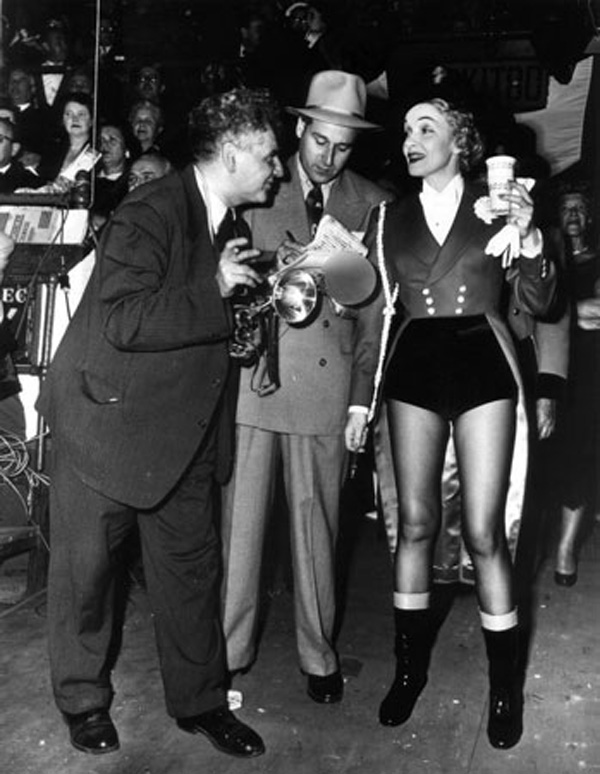
Weegee, "Self-Portrait with Marlene Dietrich," ca. 1940s

My favorite photograph in MOCA Los Angeles’ newly opened Weegee show is the one of the crime photographer turned expert ogler with Marlene Dietrich’s legs. It’s a riff off another Weegee image, “Self-portrait with Marlene Dietrich,” in which the photographer leans in, smiling in a pandering sort of way at the actress, who’s wearing a leotard and cape and clearly saying something. Weegee then took that image and distorted it, superimposing her legs over her torso, so that Marlene is only legs, and it’s those legs he’s leaning in on and smiling at.

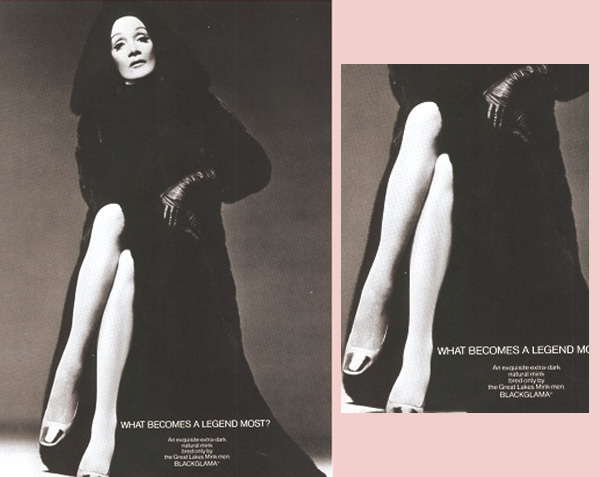
Marlene Dietrich, photographed by Richard Avedon for the Blackglama ad campaign, 1969

Other photographers of the era were much more delicate about their fixation with the Dietrich legs, famously insured by Paramount. Richard Avedon, for instance, had the actress in against a dark background with cloak pulled back to expose her long white limbs. Milton Greene showed her, again wearing black and against a black backdrop, sitting bent over so that her torso is barely visible–it’s just blond hair leading down to long white legs. Milton makes her all legs too; there’s just a sculptural elegance that allows the image to ingratiate itself as an aesthetic experience.

Read More »

Share

Ahmed Alsoudani: Psychological Warfare

It was almost impossible not to take notice of Iraqi-American artist Ahmed Alsoudani’s mass invasion at the Venice Biennale this year – if the vivid colours and immense canvases didn’t immediately attract your attention, the sheer repetition of his highly distinctive work assured that the images infiltrate your psyche. And hot on the heels of this inclusion in three major Venice exhibitions is Alsoudani’s first solo show in London – at the prestigious, albeit slightly contentious gallery, Haunch of Venison.

With a surrealistic quality that is more Švankmajer than Dali, Alsoudani’s work fragments inorganic structures and fleshy bodies, abstracting them at times to a point of non-recognition, in a dynamic compendium of the most intriguing grotesqueries.

Ahmed Alsoudani, Untitled, 2011, charcoal and acrylic on canvas, 152.4 x 130.8cm. © Ahmed Alsoudani. Courtesy Haunch of Venison.

One of the things I admire most about Alsoudani’s work is the lack of pedantics – all ‘Untitled’ (a registrar’s nightmare), they never force-feed the viewer, but rather allow you to delve into their chaos only at the depths which you can handle. Layering raw graphite drawing with polychromatic painting that at times approaches a cartoonish nature, the works have a slightly uneasy quality about them –  a tension inherent within the medium that continues through to the subject matter.

Ahmed Alsoudani, Untitled, 2011, charcoal and acrylic on canvas, 152.4 x 134.6 cm. © Ahmed Alsoudani. Courtesy Haunch of Venison.

The subject here is war – the pain and suffering we inflict on one another in conflict – which seems to be an inseparable constitution of human civilisation. Following in the footsteps of Goya and Picasso, Alsoudani conveys the atrocities of war through the price paid in the traumatisation of the individual – in particular the psychological repercussions of warfare.

Alsoundani attempts to capture the results of war on the people who live in those circumstance – not just in numbers and the corporal consequences of injury and death – but the unseen and internal effects on the psyche.

Read More »

Share

Thumb Cinema – Amy Sillman at Capitain Petzel, Berlin

Amy Sillman, Installation View "Thumb Cinema," courtesy Capitain Petzel, 2011

Amy Sillman’s new suite of paintings at Capitain Petzel are large and spatial, with an airiness well-suited to the glass paneled façade of her new Berlin gallery. Sillman’s latest canvasses still have the brute gestural force of a paint-conjured “id,” but also possess a kind of nimbleness and play alluded to in the exhibition’s title, Thumb Cinema.  Her palette is quiet, with lavender and forest greens evoking visions of British dales and naked Roccoco picnics.  A sense of solidity rarely appears in these works, replaced instead by misty shapes and raucous lines, which recall the rhythmic playfulness of Kandinsky or Mondrian.

The comic (in both senses of the word) aspects of Sillman’s paintings are belied by the massive size and scope of their Abstract Expressionist roots.  Sillman’s work is made more powerful because it diminishes the self-seriousness of AbEx, instead extolling the sensual, personal and indulgent mark.

Read More »

Share

Collected: Stories of Acquisition and Reclamation

Fore’ n’ Aft Souvenir Book, May 21, 1943. Mayme A. Clayton Library and Museum. Image courtesy of the Museum of the African Diaspora.

More a thoroughfare between the institutional offices and educational spaces than destinations, the second and third floor galleries at the Museum of the African Diaspora (MoAD) can be, at times, unforgiving display spaces. Nevertheless, as an institution, MoAD consistently presents exhibitions that expand one’s notions of race and identity. One need only to look at last year’s “African Continuum: Sacred Ceremonies and Rituals,” which contrasts with a more recent Richard Mayhew monograph: two exhibitions tenuously and productively held under the cultural umbrella of African Diaspora—or more pointedly, black visuality.

Langston Hughes, "The Weary Blues," 1926. Illustrations by Miguel Covarrubias. From the Collection of Alden and Mary Kimbrough. Image courtesy of the Museum of the African Diaspora.

In promotional material, MoAD is described as “presenting the rich cultural products of the people of Africa and of African descendant cultures across the globe.”  To be clear, this includes all Lucy’s progeny. To drive this point home, guests are asked both in a digital tour and in the writing on the walls, “When did you discover you are African?” “Collected: Stories of Acquisition and Reclamation,” MoAD’s current exhibition, includes selections from three collections: the Mayme A. Clayton Library and Museum, the Melvin Holmes Collection of African American Art and the Collection of Alden and Mary Kimbrough. Although each of these collections are distinct, much of what is displayed is Black Americana from the 19th and 20th centuries, including movie posters, paintings, signed first editions, an antebellum estate mortgage and ragtime sheet music. A really exceptional Charles White drawing, The Open Gate (1948), depicts a young black man standing before an open-metal gate; true to White’s practice, the figure and entrance allude to America’s postwar atmosphere—longed for opportunity at the cusp of change. In the second floor gallery are several film posters from both lesser-known independent cinema—1948’s Miracle in Harlem—and the classics, such as Carmen Jones (1954) and St. Louis Blues (1958). Here, Nat King Cole and Eartha Kitt hum, projected on a wall for a room of empty office chairs.

Read More »

Share