The Next Phase: An Interview with Dan Cameron

Commonly founders of organizations are so caught up in the building, growing, and running of the organization that questions of the sustainability after said founder leaves are left unanswered. This is far from the truth for Curator Dan Cameron, the founder of Prospect New Orleans, an international art biennial in its second iteration. He kindly sat down with me to discuss his imminent departure from Prospect to become Chief Curator at the Orange County Museum of Art.

Dawn DeDeaux, The Goddess Fortuna and Her Dunces in an Effort to Make Sense of it All, 2011. Photograph by Michael Smith.

Tori Bush: How does it feel to leave Prospect after over five years founding and cultivating the biennial? Have you accomplished what you wanted to in New Orleans?

Read More »

Share

Fighting those Winter Blues

The dark, dreary weather at this time of year casts a shadow over even the most upbeat of Londoners. The shortest day of the year is upon us, with Winter Solstice bringing less than 8 hours of daylight. And with the characteristic haze of grey clouds and drizzle for which England is notoriously known, it is quite difficult to resist the urge to lazily sleep the days away in the comfort of your home.

But artist James Yamada is fighting back against the winter blues. His installation, The summer shelter retreats darkly among the trees, is the first in the aptly titled Parasolstice – Winter Light, a series of outdoor projects in the back garden of London institution Parasol unit, which aim to address the phenomenon of light.

James Yamada: The summer shelter retreats darkly among the trees, 2011, Parasol unit installation view. Photograph by Stephen White.

Yamada’s constructed shelter invites you to sit under it, and bask in its full spectrum light – the same wavelengths used to clinically treat seasonal affective disorder (SAD). The work gives off an otherworldly blue glow reminiscent of the Turrell bubble that descended upon London last winter, but the work of this James has a completely different intention – to restore a sense of normality and functionality to the user, rather than immerse them into anarchic alternate universe. While also a case of science and art joining forces, this installation is far more innocuous than the Turrell, and admittedly, not quite as much fun.

Read More »

Share

Agitated Histories

Grasping the nebulous zone of art and politics can be arduous at best. The curatorial project of Agitated Histories attempts to do just that by compartmentalizing the political narrative. The Re-enactment, The Archive, The Persona, and The Intervention give some scaffolding from which the viewer can approach the work. The artists in this exhibition engage with the political, the social, and the personal through formal concerns and artistic research. We are looking at history (recent) here, through a distinctly political lens.

THE RE-ENACTMENT

One of the most compelling pieces in the exhibition is Mexican artist Yoshua Okón’s Octopus (2011). Created during a residency at the Hammer Museum, the 4-channel video piece grapples with what is both humanizing and alienating. Day laborers re-enact the civil war in Guatemala, wearing in black or white clothing, depending on which side they had fought for. On the set of a Home Depot parking lot, the laborers replay scenes from their country’s history, but now the opposing sides point invisible weapons at an invisible enemy, not at their historical foes. “Octopus” is Guatemalan slang for the United Fruit Company, alluding to the company’s ambiguous role in Guatemalan politics and complicating the narrative further.

THE ARCHIVE

Sam Durant and Zoe Leonard & Cheryl Dunye

The pliableness of the document becomes evident through Zoe Leonard & Cheryl Dunye’s The Fae Richards Photo Archive (1993-1996). A fictional African American performer is created through an archive of snap shots, film stills, and head-shots. Photography’s role in the construction of history becomes clear as we are left to conjecture about the possibilities of this figure.

Read More »

Share

Jack White: Neo-Totems and Other Works of Art

In a recent BBC documentary on J Dilla, the deceased beatmaker’s family and fellow industry folk recount the seminal producer’s style, marked most notably by a counter-quantizing of his drum machine: a drunken mechanization, a meeting point of analog practices (the mythic process of searching through crates of records) and digitization that concurrently sounded ill-programmed (off-beat), yet intentional and on-point. This is man-made modernism, in contrast to the conventional image of crisp lines and sharp edges. So what would J Dilla’s sound look like? Jack White’s Neo-Totems, on display at the African American Art and Culture Center, come to mind.

White is a native of rural North Carolina and has taught in art programs in the American South and Northeast. He describes his work as “Abstract Impressionism”; still, much like underground or “backpack” hip hop, White’s sculptures imagine a future as much as they point to a past. In Neo Totem #11 (2009), discarded and weathered lumber lies next to mass-produced combs, nails and objects: an over four-foot piece of found wood, dusty and handled pieces of metal peeping through stains, and a not immediately visible hair pick. The objects come together, but they are slightly off, or not perfectly symmetrical. Although it might be predictable to state as much about such work, White’s sculptures are soulful.

Read More »

Share

From the DS Archives: Postcards From America

The United States hold certain inalienable symbols: freedom, adventure, equality, the pursuit of happiness etc.. While the promises of the U.S. have been kept with varying levels of success, there have always been individuals searching for the real America. Photographers in the U.S. have a particularly strong history of transnational exploration and investigation, and wouldn’t you know it they’re at it again! 2011 has been a year to reconsider organizations like the FSA (Farm Security Administration) and how photographers can give a truly illuminating view of this country. Earlier this year Magnum Photo launched the Postcards from America Project featuring Paolo Pellegrin, Jim Goldberg, Susan Meiselas, Alec Soth, Mikhael Subotzky & Ginger Strand. Currently the Wattis Institute at California College of the Arts has brought together both vintage iconic images from the FSA in combination with the works contemporary photographers. With this week’s pick from the DS archives, we hope you will consider this year’s reference to photographic history, and new historic moments.

The following article was originally published by Amelia Sechman on May 18 2011:

Friday, May 13th, at the Harry Ransom Center in Austin, Texas, five Magnum photographers and one writer gathered to kick off their road trip christened, Postcards from America. Paolo Pellegrin, Jim Goldberg, Susan Meiselas, Alec Soth, Mikhael Subotzky & Ginger Strand will spend the next two weeks living together on a bus named “Uncle Jackson,” traveling from San Antonio, Texas to Oakland, California.
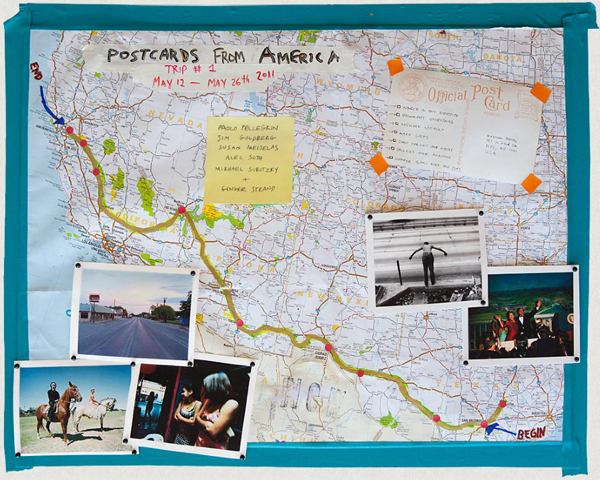
Postcards from America is certainly reminiscent of the 1935, Farm Security Administration (FSA), a project part of the New Deal for which photographers like Walker Evans, Dorothea Lange and others, were sent out to document the condition of rural families and areas during the depression. The difference in this contemporary iteration is that it is completely conceived and motivated by the photographers themselves, instead of any government or institution. This crucial characteristic gives the road trip the qualities of a trip with friends, one driven by adventure, curiosity, and the desire to show a side of the US that is often swept under the proverbial rug.

The project originated as an idea by Jim Goldberg and Susan Meiselas at one of Magnum’s annual meetings. In efforts to try to re-establish the way photographers and viewers experience the US, they brainstormed how to “see what America really is instead of just reading about it,” they “wanted to see and feel America.” (Meiselas)

From left to right: Carlos Loret de Mola, Lara Shipley, Ginger Strand, Paolo Pellegrin, Jim Goldberg, Susan Meiselas, Alec Soth, Mikhael Subotzky.

Like most road trips, this one started with a handful unforeseeable set backs (maybe Friday the 13th should have been a day spent in hiding); San Antonio experienced massive flash floods; Jim Goldberg caught the flu; the projectionist at the Ransom Center had technical difficulties during almost the entire panel discussion – but they approached the entire situation with the sense of humor shared between friends, which helped the audience, myself included, laugh along with them and appreciate the spontaneity and organic development of the project. As Alec Soth said on Friday, “the spirit of the road trip is you let it take you.”

Paolo Pellegrin, San Antonio, TX

While the projector was being fixed, each photographer and the writer, Ginger Strand, introduced him or herself by talking about their approach to the trip and what they had already experienced the day before in San Antonio. Each individual set off in search of something, and the amount of incredible material, images and stories they encountered in just one day was astounding. Once we saw images from the day before, it was clear that the project will reveal a truly diverse view of the US.

Alec Soth, Mu Man from Burma, San Antonio, TX

The Postcards from America project will conclude with a pop-up show at the Starline Social Club in Oakland, Ca on May 26th. For more information, check out the Postcards from America site to track the group on their journey, through their blog, twitter and facebook updates.


Share

Startle Reaction

Startle Reaction, an exhibition of works by Torsten Lauschmann is on view at Dundee Contemporary Arts till 8 January 2012.

Skipping Over Damaged Areas is a compilation of movie titles, sequenced to form a new narrative. It is screened in the first gallery with Misshapen Pearl, a film that assembles street scenes and television footage, with Lauschmann’s voiceover reflecting on the streetlamp as a manifestation of the physical and ideological shifts that accompany a consumer society. While the upbeat tone of Skipping Over Damaged Areas contributes a celebratory tone to technology’s ability to alter histories for new narratives, Misshapen Pearl reveals the uneasiness of living in an era of consumerism fuelled by technical advancement.

A phrase in Misshapen Pearl speaks of the street as a “space motivated by aesthetics rather than discourse; you are witnessing it by watching this film”, articulating the way contemporary society has demarcated activities within a sphere labeled as culture, comprising elements that excite and entertain for our consumption. This line of thought is set into motion in the the second gallery, where one is not just witness to, but a participant in an interactive space that values an aesthetic experience activated through light and sound.

Torsten Lauschmann; byt 2011; Projection, oak boards, various objects; Dimensions variable; 3 Mins (looped); Installation view, Torsten Lauschmann, ‘Startle Reaction,’ DCA, Dundee 2011

Historical elements are drawn upon in individual works, in particular, cinematic icons and features that once represented cultural and technical advancements. On entering the gallery, one sees byt, an installation of angled shelf boards with two mirrored projections of Charlie Chaplin’s The Great Dictator in which he satirizes Hitler and fascism.

Torsten Lauschmann; The Coy Lover 2011; Yamaha Disklavier, snow machine, controlling software; Dimensions variable; Installation view, Torsten Lauschmann, ‘Startle Reaction,’ DCA, Dundee 2011

In the center of the gallery, sits The Coy Lover, a piano that begins playing when the gallery is darkened, accompanied by falling snow. Similar to the emptied function of the shelf boards when angled, the insertion of a self-playing piano seems redundant and rather melodramatic, yet gives a strange pleasure and joy when experienced.

Torsten Lauschmann; Dear Scientist Please Paint Me 2011; Luminous paint, moving headlight, controlling software; Dimensions variable; Installation view, Torsten Lauschmann, ‘Startle Reaction,’ DCA, Dundee 2011

To this extent, Startle Reaction opens a conception of technology away from the parameters of function and mechanics, towards one as a manifestation of imagination that stems from, and fuels a desire for experience and delight. Neither is technology a device that merely obliterates tradition for the new. Dear Scientist Please Paint Me is a light projection that dances along and bounces off the luminous-painted wall, creating illuminated spirals that fade in time.

Torsten Lauschmann; Father’s Monocle 2011; Custom built game engine, meniscus lens, motor; Dimensions variable; Installation view, Torsten Lauschmann, ‘Startle Reaction,’ DCA, Dundee 2011

The temporal nature of the illuminations contrasts with the ideas of infinity evoked by Father’s Monocle, a whirlpool of numbers made to ceaselessly converge through a rotating meniscus lens.  Technology is deployed to present a dimension of time beyond rational categorizations of the past, present and future, and a channel for these to meld into one experience.

All images courtesy The Artist; Mary Mary, Glasgow and DCA, Dundee

Photography credit:  Ruth Clark

Share

Experimental Impulse

L.A. Expanded: Notes from the West Coast
A weekly column by Catherine Wagley

Unknown Artist, Performance at CalArts (date unknown). Courtesy of the CalArts Archive.

“I basically did two things with my class,” said artist and teacher Michael Asher. “We took the clock out of the room and forgot about time.” That quote is pinned to the wall at RedCat gallery, along with a host of other quotes from students and instructors working at California Institute of the Arts  and at other emerging institutions in the 1970s, in the heyday of California Conceptualism. Each expresses a similarly rigorous, risky but wholly idealistic idea of how to think about art: artists were “learning the techniques of thinking,” according to photographer and sculptor Barbara Bloom; there was a “sense of social change” without “aesthetic preferences,” according to architect Craig Hodgetts; “every piece we acquired made it possible for us to live another day,” according to collector Judy Spence.

At this point, it is common knowledge in art circles that CalArts of the 1970s, and the institutions many of its artists worked within, Los Angeles Institute of Contemporary Arts and Los Angeles Contemporary Exhibitions in particular,  emphasized ideas over objects. Certainly, things got made, but the thinking behind those things was always the point.

Read More »

Share








